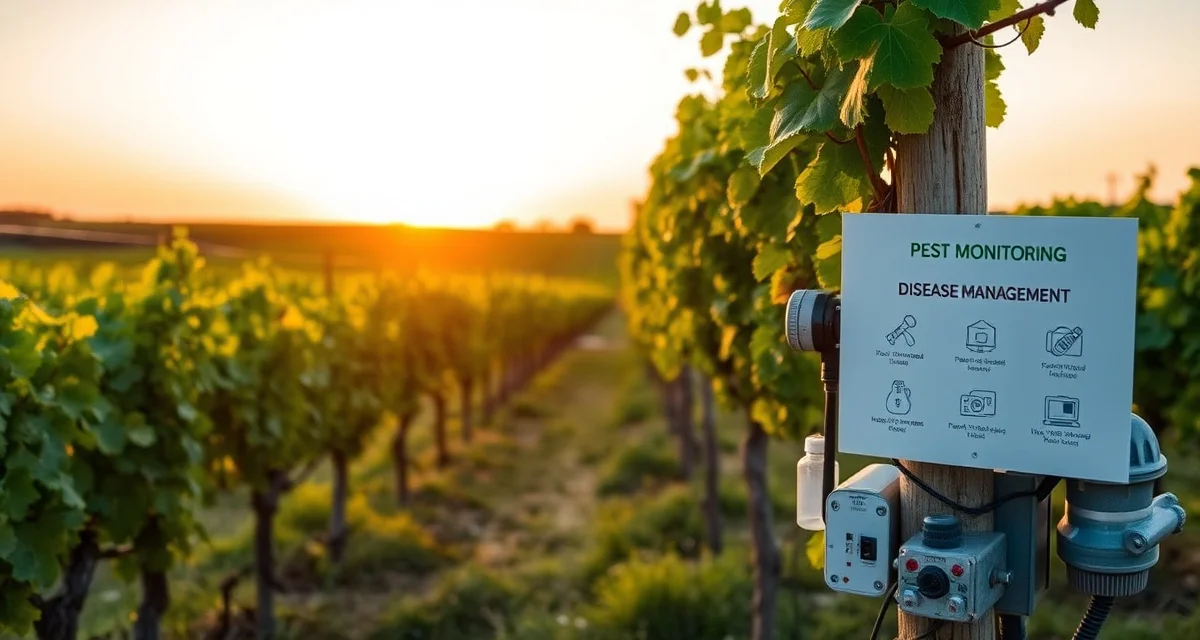
The Complete Texas Vineyard IPM Guide
Pierce's disease is the most notable threat to Texas vinifera production -- that biological reality shapes every decision about where to plant, what varieties to grow, and how to monitor your vineyard. Block-level pest pressure history for Texas Hill Country, Lubbock, and High Plains AVAs shows meaningfully different disease and pest calendars between the regions, with Pierce's disease pressure declining sharply at higher elevations and in regions with fewer glassy-winged sharpshooter populations.
This guide covers the complete IPM framework for Texas wine regions, connecting pest biology, regional differences, spray program design, and TDA compliance requirements.
TL;DR
- Pierce's disease (Xylella fastidiosa), transmitted by Blue-green and Glassy-winged Sharpshooter leafhoppers, kills infected vinifera vines within 3-5 years; monitoring requires weekly sharpshooter trap counts at vineyard perimeters near riparian habitat, with GWSS specifically -- a more efficient vector -- requiring immediate TDA reporting when population levels rise
- Texas requires certified pesticide applicators to maintain records for 2 years from application date; TDA license number is required on all records and weather conditions must be documented -- extreme summer heat (105°F+ in Hill Country) and high winds create both efficacy and drift compliance concerns that should be documented in every spray record
- Sulfur phytotoxicity is a practical constraint across Texas wine regions: do not apply sulfur when temperatures will exceed 90°F within 24 hours of application -- powdery mildew programs in Hill Country must account for this with early morning application windows or alternative materials during heat events
- Pierce's disease risk varies sharply by elevation and region: High Plains operations at 3,000-4,000 feet face substantially lower risk than Hill Country operations near riparian corridors; Davis Mountains at 5,000-6,000 feet face very low risk; site selection before planting is the most effective Pierce's disease management tool
- QoI resistance in powdery mildew is documented in Texas; rotate programs to Groups 3, 7, and 13 with no more than 2 consecutive applications from the same group; High Plains programs can use 10-14 day intervals during summer due to semi-arid conditions, but should tighten to 7 days around bloom and veraison
- VitiScribe's Pierce's disease monitoring module captures sharpshooter observations, vine symptom assessments, and management decisions at block level; weather station integration provides local temperature data for spray window assessment critical to sulfur phytotoxicity risk management in Texas summers
Texas Wine Regions and Their Distinct Challenges
Texas Hill Country (Fredericksburg-Kerrville-Johnson City area): The largest Texas wine region by winery count. Elevation 1,500-2,500 feet. Warm, semi-arid climate with hot summers and mild winters. Pierce's disease pressure is a concern in Hill Country due to Blue-green Sharpshooter and Glassy-winged Sharpshooter activity. Summer heat creates unique spray timing challenges -- applications during extreme heat can damage vines and reduce product efficacy.
Texas High Plains (Lubbock area): The largest Texas wine grape production region by acreage. Elevation 3,000-4,000 feet. Semi-arid continental climate with hot days, cool nights, and low humidity. Pierce's disease risk is substantially lower at High Plains elevation with lower sharpshooter vector populations. Lower humidity reduces some fungal disease pressure compared to Hill Country or eastern Texas.
Texas Davis Mountains (Jeff Davis County): Emerging wine region at 5,000-6,000 feet elevation. Highest elevation and coolest growing conditions in Texas. Very low Pierce's disease risk. Disease pressure profile more similar to high-elevation southwestern states than to eastern Texas.
Other Texas regions: Production exists in the Escondido Valley, Mesilla Valley portions of Texas, and in East Texas (higher Pierce's disease risk).
Pierce's Disease: Texas's Defining Pest Challenge
Xylella fastidiosa is the bacterial pathogen causing Pierce's disease. It's transmitted by sharpshooter leafhoppers that feed in the xylem (water-conducting tissue) of plants. In Texas:
Blue-green Sharpshooter (Graphocephala atropunctata): The primary vector in Hill Country and central Texas. Feeds on riparian vegetation and moves into vineyards from adjacent natural areas.
Glassy-winged Sharpshooter (Homalodisca vitripennis): A more efficient vector introduced from California to Texas. Present in central and southern Texas. GWSS is a serious threat wherever it's established because of its greater feeding efficiency in delivering the bacteria.
Disease progression: Infected vines show leaf scorch (brown margins with a yellow halo), abnormal fruit maturation (uneven ripening, fruit stays green when others ripen), and eventual vine decline. Vinifera varieties typically die within 3-5 years of infection.
Management strategy:
- Site selection: Plant vinifera in areas with lower sharpshooter activity -- higher elevation, away from riparian corridors, in regions with lower confirmed GWSS populations.
- Monitoring: Deploy yellow sticky traps and panel traps around vineyard perimeters, especially near riparian habitat. Count and identify sharpshooters weekly during the growing season. Report elevated GWSS populations to TDA.
- Vector management: Imidacloprid (systemic neonicotinoid) applied to soil or foliage reduces sharpshooter feeding time in the vineyard. Timing relative to vine phenology and bloom pollinator protection requirements is important.
- Removal of infected vines: Remove and destroy infected vines promptly to eliminate the vine as an inoculum source.
- Variety selection: Use resistant or tolerant rootstock and variety combinations where vinifera production is marginal for Pierce's disease risk. Some vinifera clones show less severe disease progression.
Pierce's disease vineyard guide covers the disease biology and management in detail.
Primary Disease Pressures in Texas Wine Regions
Powdery Mildew: The dominant fungal disease concern in Texas Hill Country and High Plains. Texas's hot summers with warming afternoon temperatures and morning dew create infection conditions despite low humidity. Programs need 7-10 day intervals through bloom and summer growing season. QoI resistance is a concern -- rotate to Groups 3, 7, and 13.
Botrytis: Lower priority than in Oregon or the Finger Lakes given Texas's dry summers, but relevant for Hill Country varieties with dense clusters during wet harvest periods. Programs vary -- Hill Country operations with Chardonnay or Muscat may manage botrytis routinely; High Plains programs with red varieties may consider it only in wet years.
Downy Mildew: Present in Texas but at much lower pressure than in the eastern US. The semi-arid climate of Hill Country and High Plains creates fewer infection events than humid eastern states. Copper programs may be appropriate in wet years, particularly in Hill Country.
Cotton Root Rot (Phymatotrichum omnivorum): A Texas-specific soilborne pathogen that kills vinifera vines and is difficult to manage. Not controllable with standard fungicide programs -- site assessment before planting and rootstock selection are the primary tools.
Most Important Insect Pests in Texas
Sharpshooter leafhoppers: The Pierce's disease vectors described above. Primary monitoring focus in all Texas wine regions.
Grape Leafhopper (Erythroneura species): Present throughout Texas and requiring threshold-based monitoring. Second-generation leafhopper counts at 20-25 nymphs/leaf warrant treatment using selective insecticides.
Spider Mites: Two-spotted spider mite and Pacific spider mite can build to damaging populations in Texas's hot summers. July-August monitoring with predator-to-pest ratio assessment drives intervention decisions.
Grape Berry Moth: Present in Texas but at lower pressure than northeastern US wine regions. GBM populations in Hill Country warrant monitoring and degree day-based management in blocks with prior history.
Vine Mealybug: Present in established Hill Country vineyards. Crawler timing monitoring and systemic insecticide (Movento, Group 23) applications at peak crawler activity.
Texas Regulatory Framework: TDA Requirements
The Texas Department of Agriculture, Pesticide Programs Division administers pesticide compliance in Texas.
Record retention: Texas requires that certified pesticide applicators maintain records for 2 years from the date of application. Records must be available for TDA inspection.
Required record fields:
- Certified applicator name and Texas Department of Agriculture license number
- Date of application
- Location of application (physical address or GPS coordinates)
- Crop or site treated
- Pest controlled
- Product name and EPA registration number
- Rate applied per acre
- Total amount of pesticide applied
- Application equipment
- Weather conditions at time of application
Texas Certified Pesticide Applicator: Commercial applications of restricted-use pesticides require a Texas Department of Agriculture Certified Pesticide Applicator in Category 1a (General Pest Control) or Category 1 (Agriculture). Licensing is administered by TDA with written examination and renewal requirements.
Weather documentation in Texas: Texas's extreme summer heat and wind events make weather condition documentation particularly important. Applications during temperatures above 95°F or in winds above 10 mph are both efficacy and compliance concerns that should be documented in spray records.
Building a Texas Vineyard Spray Program
Dormant Season (December-February)
Pruning timing: Texas Hill Country dormant pruning typically occurs January-February. Apply pruning wound protectants in blocks with Eutypa or Botryosphaeria history.
Pierce's disease assessment: Scout blocks for vine decline, leaf scorch symptoms. Mark vines for removal. Assess sharpshooter habitat around vineyard perimeters.
Program planning: Review prior season FRAC and IRAC rotation records. High Plains operations need to plan sulfur and DMI programs calibrated to semi-arid conditions.
Budbreak Through Shoot Elongation (February-April)
Regional timing: Texas Hill Country budbreak typically occurs late February to mid-March. High Plains budbreak is typically 2-4 weeks later.
Powdery mildew program start: First application at 2-4 inch shoot growth. Sulfur or DMI fungicide. Begin FRAC rotation from the first application.
Sharpshooter monitoring begins: Deploy yellow sticky traps and begin weekly monitoring at vineyard perimeters.
Grape berry moth: Deploy pheromone traps at tight cluster in blocks with prior GBM history.
Bloom (April-May in Hill Country, May-June in High Plains)
Powdery mildew: 7-day intervals during bloom. High-efficacy systemics: Quintec (Group 13), Luna Privilege (Group 7), SDHIs.
Bee protection: Texas has notable commercial beekeeping. Avoid neonicotinoid applications during bloom.
Sharpshooter management: If sharpshooter populations are elevated, assess insecticide options. Note neonicotinoid restrictions during bloom for bee protection -- timing of these applications requires careful coordination.
Berry Development Through Veraison (May-August)
Heat management: Texas's summer heat events (105°F+ days in Hill Country) affect spray timing and product selection. Sulfur should not be applied when temperatures will exceed 90°F within 24 hours. Applications at early morning minimize heat stress from application.
Powdery mildew: Continue at 10-14 day intervals during summer. Resume 7-day intervals around veraison.
Spider mites: July-August peak pressure period. Monitor leaf undersides at 10-25 vines per block. Apply selective miticide if pest mites substantially exceed predator populations.
Leafhopper: Second-generation monitoring in mid-July through August. Threshold-based management at 20+ nymphs per leaf.
GBM second generation (if applicable): 750-850 DD50 from biofix. Rotate IRAC group.
Harvest (August-October, varies substantially by variety and region)
High Plains: Earlier harvest than Hill Country due to variety mix and growing degree day accumulation.
PHI management: Every application decision must be evaluated against harvest date. Texas's often-earlier harvest dates than northeastern states may compress the pre-harvest spray window.
Powdery mildew: 0-day PHI materials as harvest approaches: sulfur, Vivando, Pristine.
Harvest clearance: Block-level PHI clearance documentation before harvest.
VitiScribe for Texas Vineyard Operations
VitiScribe's Pierce's disease monitoring module captures sharpshooter observations, vine symptom assessments, and management decisions at the block level. Weather station integration in Hill Country and High Plains provides local temperature data for spray window assessment -- critical for managing the sulfur phytotoxicity risk in Texas's summer heat.
TDA-formatted compliance records include all required fields for Texas inspection. For how block-level scouting records connect to spray decisions across multiple Texas regions, see vineyard IPM pest id records. Texas Hill Country vineyard management covers region-specific management context for Hill Country operations.
Frequently Asked Questions
What are the most important pests in Texas vineyards?
Pierce's disease via sharpshooter leafhopper vectors is the most notable threat to vinifera production in Texas and shapes the geographic distribution of vinifera production. Powdery mildew is the primary fungal disease across all Texas wine regions, requiring a managed program from budbreak through harvest. Grape leafhoppers and spider mites require threshold-based monitoring and treatment during the summer growing season. Grape berry moth is present in Hill Country at lower pressure than northeastern states but warrants monitoring in blocks with prior history. Pierce's disease risk varies sharply by region -- High Plains operations at 3,000+ feet face much lower risk than Hill Country operations near riparian corridors.
What TDA records are required for vineyard pesticide applications in Texas?
Texas requires certified pesticide applicators to maintain records for 2 years from application date, available for TDA inspection on request. Required fields include the certified applicator name and TDA license number, application date, application site location, crop, pest controlled, product name and EPA registration number, rate per acre, total product applied, application equipment, and weather conditions. Texas Certified Pesticide Applicator Category 1 (Agriculture) covers vineyard restricted-use pesticide applications. Weather condition documentation in Texas is particularly important given the extreme heat events that create product safety constraints and the wind conditions that affect drift risk.
How does VitiScribe support Texas vineyard IPM and TDA compliance?
VitiScribe's weather station integration connects to local Texas weather stations in Hill Country and High Plains for spray window assessment calibrated to Texas's heat and wind conditions. Powdery mildew infection risk alerts account for Texas's specific temperature and humidity patterns -- semi-arid conditions where morning dew drives infection risk even at low afternoon humidity. Pierce's disease monitoring records capture sharpshooter activity observations and vine symptom assessments in the scouting module. TDA-formatted compliance records include all required fields. Block-level records differentiate between Hill Country and High Plains operations within the same account if you manage across multiple Texas regions.
How should a Texas grower document a spray record when application conditions required deviation from the planned timing?
Texas's heat events sometimes require delaying a planned application or switching from sulfur to a heat-compatible material to avoid phytotoxicity. When that happens, the spray record should note the original planned timing, the reason for the adjustment (temperature forecast, wind conditions, or heat event), and the actual application conditions at the time of application. For sulfur substitutions during heat events, noting the temperature forecast that triggered the product switch documents the efficacy and safety rationale. TDA inspectors assessing spray records can identify gaps between planned and actual timing -- a documented explanation is more defensible than an unexplained timing deviation. VitiScribe's spray record entry allows field notes that create this explanatory context alongside the required compliance fields.
What monitoring documentation is required for Pierce's disease management in a vineyard?
Pierce's disease monitoring doesn't require a prescribed documentation format under TDA, but complete monitoring records support defensible management decisions and are essential for understanding block-level infection risk over time. Effective monitoring records include: trap deployment dates and locations, weekly sharpshooter count data by trap and species, dates of any vine removal due to confirmed PD symptoms, and vine symptom assessment data from field scouting. For vineyards near confirmed GWSS populations, GWSS-specific count data and TDA reporting documentation should be retained. When imidacloprid or other vector management insecticides are applied, the spray record should note the target pest (sharpshooter leafhopper vector), the monitoring data that justified the application, and the IRAC group of the product used for resistance management documentation.
What is The Complete Texas Vineyard IPM Guide?
[FAQ_ANSWER_PLACEHOLDER: This answer needs to be generated by AI with specific data, examples, and actionable advice relevant to The Complete Texas Vineyard IPM Guide. Target 50-150 words.]
How much does The Complete Texas Vineyard IPM Guide cost?
[FAQ_ANSWER_PLACEHOLDER: This answer needs to be generated by AI with specific data, examples, and actionable advice relevant to The Complete Texas Vineyard IPM Guide. Target 50-150 words.]
How does The Complete Texas Vineyard IPM Guide work?
[FAQ_ANSWER_PLACEHOLDER: This answer needs to be generated by AI with specific data, examples, and actionable advice relevant to The Complete Texas Vineyard IPM Guide. Target 50-150 words.]
What are the benefits of The Complete Texas Vineyard IPM Guide?
[FAQ_ANSWER_PLACEHOLDER: This answer needs to be generated by AI with specific data, examples, and actionable advice relevant to The Complete Texas Vineyard IPM Guide. Target 50-150 words.]
Who needs The Complete Texas Vineyard IPM Guide?
[FAQ_ANSWER_PLACEHOLDER: This answer needs to be generated by AI with specific data, examples, and actionable advice relevant to The Complete Texas Vineyard IPM Guide. Target 50-150 words.]
How long does The Complete Texas Vineyard IPM Guide take?
[FAQ_ANSWER_PLACEHOLDER: This answer needs to be generated by AI with specific data, examples, and actionable advice relevant to The Complete Texas Vineyard IPM Guide. Target 50-150 words.]
What should I look for when choosing The Complete Texas Vineyard IPM Guide?
[FAQ_ANSWER_PLACEHOLDER: This answer needs to be generated by AI with specific data, examples, and actionable advice relevant to The Complete Texas Vineyard IPM Guide. Target 50-150 words.]
Is The Complete Texas Vineyard IPM Guide worth it?
[FAQ_ANSWER_PLACEHOLDER: This answer needs to be generated by AI with specific data, examples, and actionable advice relevant to The Complete Texas Vineyard IPM Guide. Target 50-150 words.]
Related Articles
Sources
- Texas Department of Agriculture (TDA)
- Texas A&M AgriLife Extension
- UC IPM Program
- FRAC (Fungicide Resistance Action Committee)
- American Vineyard Foundation
Get Started with VitiScribe
Texas's sharpshooter monitoring requirements, summer heat constraints on sulfur application timing, and TDA compliance records that must document weather conditions for every spray event create documentation demands that manual logs don't reliably meet. VitiScribe's Pierce's disease monitoring module captures sharpshooter trap counts and vine symptom records, weather station integration provides real-time temperature data for spray window decisions, and TDA-formatted compliance records include all required fields. Try VitiScribe free and log your first Texas-compliant spray record today.