What is a viticultural area (AVA) and why does it matter?
TL;DR
- A viticultural area is a defined grape-growing region recognized by the U.S.
- Alcohol and Tobacco Tax and Trade Bureau (TTB) based on geographic and climatic features, not political borders.
- The U.S.
- calls these American Viticultural Areas (AVAs).
- As of 2025, there are more than 270 AVAs.
- Winning AVA status lets a winery print that region's name on its label if at least 85% of the wine's grapes come from that area.
What is a viticultural area, exactly?
A viticultural area is a delimited grape-growing region with geographic or climatic features that set it apart from surrounding land. The definition comes straight from federal regulation. Under 27 CFR Part 9, the TTB defines an American Viticultural Area as "a delimited grape-growing region having distinguishing features as described in part 9 of this chapter" [9]. That distinguishing feature requirement is what separates an AVA from a county or a ZIP code. You have to prove the place is meaningfully different.
The concept is borrowed from Europe. France's AOC system and Italy's DOC both carve up wine country by place-based rules. The U.S. version started with the first AVA designation in 1980 (Augusta, Missouri), and it's deliberately lighter on production rules. An AVA tells you where the grapes came from. It says nothing about which varieties you plant, how you farm, or how you make the wine. That gap matters enormously in practice.
For a vineyard manager or small winery owner, the AVA system is really two things at once. It's a marketing tool that puts a prestigious place name on your label. And it's a compliance boundary you have to track carefully, because the sourcing and labeling rules shift depending on which AVA (or AVAs) your blocks fall inside.
How does the AVA designation process work?
Anyone can petition for a new AVA. The TTB receives the petition, publishes it in the Federal Register for public comment, then issues a final rule if the evidence holds up. The petitioner does all the research. There's no filing fee, but a serious petition runs to hundreds of pages [2].
The TTB weighs petitions against five main criteria [2]:
- The proposed name shows up on maps.
- The area has been known by that name in evidence older than recent marketing.
- A boundary can be drawn using features on U.S. Geological Survey (USGS) topographic maps.
- The area has distinguishing features: climate, geology, soils, physical features, or elevation.
- Those features actually set it apart from surrounding regions.
Climate and soil data do the heaviest lifting. Petitioners pull decades of weather-station records, USDA soil surveys, and USGS geologic maps. A petition for a small mountain AVA might lean on fog patterns and diurnal temperature swings. A valley floor petition might center on one distinct alluvial soil type.
The comment period is usually 60 days, and opposition is common. Neighboring vineyards sometimes object because they want in, or want to keep competitors out. Wineries argue about where the boundary falls. The TTB reads all of it and can redraw lines before issuing the final rule. Start to finish, from petition submission to designation, usually takes two to five years. There's no guarantee of approval.
How many AVAs are there in the U.S., and where are they?
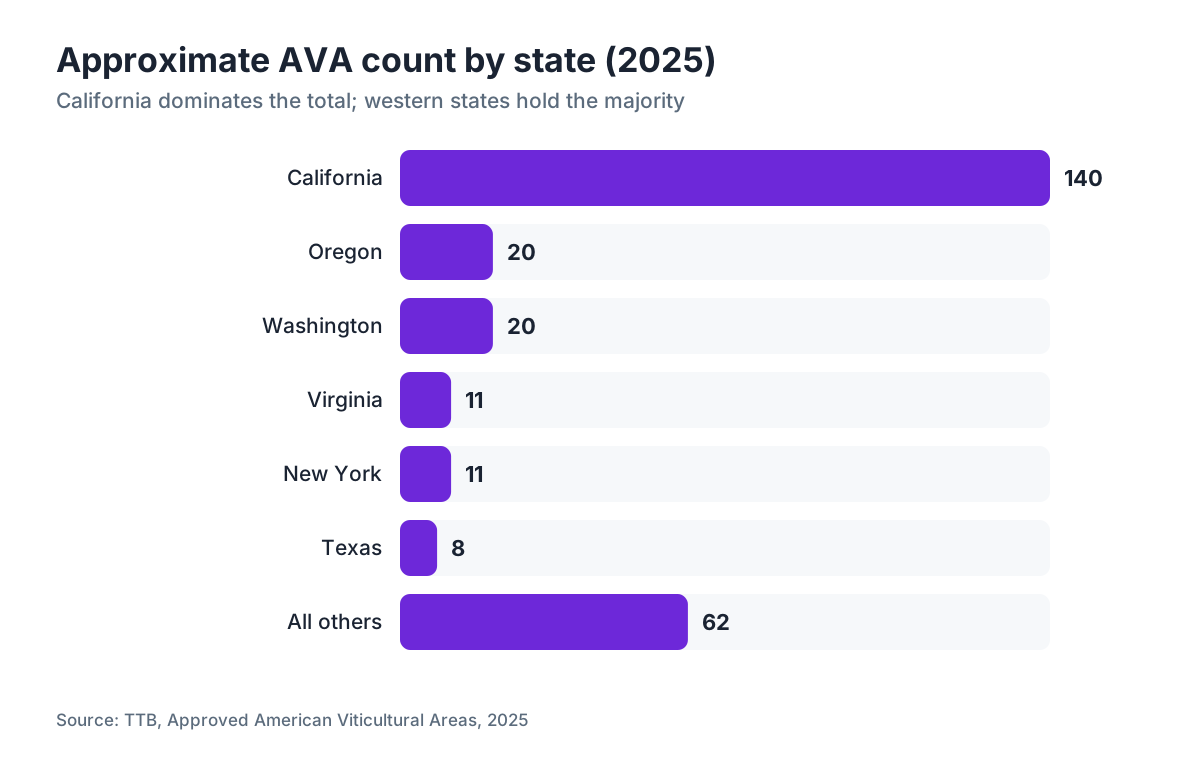
The TTB's official list shows 272 approved AVAs as of early 2025 [9]. California has the most by a wide margin, with roughly 140 of its own, from sprawling regions like the North Coast down to sub-appellations of just a few hundred acres.
The TTB publishes all current boundaries on its website, and you can view them overlaid on USGS topographic maps. That overlay is genuinely useful when you're trying to figure out whether a specific block falls inside or outside a given AVA.
| State | Approximate AVA count (2025) |
|---|---|
| California | ~140 |
| Oregon | ~20 |
| Washington | ~20 |
| Virginia | ~11 |
| New York | ~11 |
| Texas | ~8 |
| All others combined | ~60+ |
The numbers move as new petitions get approved. Oregon added several sub-AVAs within the Willamette Valley over the past decade as growers tried to separate specific ridge systems and soil types. Washington's Columbia Valley AVA holds more than a dozen nested sub-AVAs [3]. Nesting is common: a wine can legitimately claim the broader AVA, the nested sub-AVA, or both, depending on how the winery wants to position it.
To see how a single region uses its AVA identity, look at a specific growing area. Paso Robles wineries are a good example. The Paso Robles AVA is subdivided into 11 sub-AVAs, each pegged to different soil and climate conditions across the Salinas River divide.
What percentage of grapes must come from an AVA to use its name on a label?
The federal rule is 85%. If a label says "Napa Valley," at least 85% of the grapes in that wine have to come from the Napa Valley AVA [9]. The other 15% can come from anywhere.
California is stricter for Napa specifically. California law (Business and Professions Code Section 25241) requires 100% Napa Valley fruit to use the Napa Valley appellation on a label sold in California. That's a state rule that overrides the federal floor for wines marketed inside the state [4]. Napa is the one glaring exception. Everywhere else, the 85% federal floor holds.
A few related thresholds are worth knowing:
- Vintage year on the label: 95% of the wine must come from grapes harvested in that year when an AVA is also stated (85% if only a state or county appellation is used) [9].
- Varietal labeling: 75% of the wine must be made from the named grape variety under federal rules. Some states set a higher bar.
The compliance math gets complicated fast when you're blending fruit from multiple blocks, some inside an AVA and some outside. Clean block-by-block records from harvest through fermentation aren't optional. They're how you prove the percentages if the TTB ever asks.
What are the distinguishing features that define an AVA?
The TTB's regulations at 27 CFR 9.12 list the distinguishing features a petitioner can use [9]: climate, geology, soils, physical features (rivers, ridgelines, mountain ranges), and elevation. In practice, most successful petitions rely on climate and soils together.
Climate factors that show up again and again in approved petitions include average growing degree days (GDDs), fog incidence, marine influence, diurnal temperature variation, and frost dates. The University of California, Davis, has published extensive work on heat summation and GDD as tools for viticultural suitability, and that framework runs through petition filings constantly [5].
Soils are the other workhorse. A ridgeline with rocky, well-drained volcanic soils sitting above a valley floor of heavy clay loam is exactly the kind of contrast that supports a separate AVA claim. Petitioners pull data from the USDA Web Soil Survey and often hire geologists to write site-specific reports.
What the TTB is not asking is whether the wines taste different. Sensory differentiation is impossible to regulate fairly, and the TTB has never required it. The distinction is geographic and scientific, not organoleptic. That's a defensible position, even if wine writers routinely wish the rules went further.
How does an AVA differ from a wine region in Europe?
The short answer is production control. European appellations like France's AOC or Italy's DOCG layer grape variety restrictions, yield limits, minimum alcohol levels, and sometimes aging requirements on top of geography. An AVA does none of that.
You could plant Sangiovese in the Willamette Valley AVA, ferment it in a concrete egg, age it for two weeks, and put "Willamette Valley" on the label as long as 85% of the fruit came from inside the boundary. That would be an odd business decision, but the TTB wouldn't stop you. Variety and method are entirely the winery's call.
This is a feature, not a flaw, in U.S. wine law. The system is meant to communicate place of origin without becoming a production code. Consumers who want to know what those places taste like have to rely on producers' reputations, critics, and their own palates rather than a regulatory guarantee.
The tradeoff is real. An AVA name conveys geography reliably. It conveys style or quality only as well as the producers inside it choose to perform.
Why do AVAs matter for vineyard managers and winery compliance?
For the person running day-to-day operations, AVAs show up in at least three compliance contexts.
First, block-level sourcing records. To claim an AVA on a label, you need documentation that the fruit from each specific block actually came from inside the boundary. Your block maps have to align with the TTB's published boundary coordinates, and your harvest records have to be block-specific, more than variety-specific or tank-specific. Sloppy recordkeeping at harvest can make a label claim indefensible months later.
Second, custom crush and grower contracts. If you buy fruit from independent growers, your contracts should name which blocks the fruit comes from and, ideally, have the grower confirm each block's location relative to the AVA boundary. This matters most near boundary lines, where adjacent parcels may fall inside and outside the same AVA.
Third, blending decisions. Because the 85% threshold is figured on the finished wine, you have to track volumes carefully when you combine lots. Blend a tank of 100% AVA fruit with a tank of non-AVA fruit and the result may or may not meet the 85% floor, depending on the volumes.
This is exactly the recordkeeping workflow where vineyard management software helps. VitiScribe, for example, is built around block-level field records that connect harvest data to compliance documentation, so the numbers you need for a label claim are captured during normal operations rather than reconstructed after the fact.
The vineyard operations context matters here too. If your estate spans multiple AVA boundaries, which happens more than people expect in fragmented regions, you want block maps and GPS coordinates that are current and precise.
Can a wine label list more than one AVA?
No, not in the way you might think. A label can carry only one appellation of origin. You can't list two separate AVAs side by side as co-equal appellations.
What you can do is use a broader appellation that covers multiple sub-regions. If your fruit comes from both the Russian River Valley AVA and the Sonoma Coast AVA, you can use the broader "Sonoma County" or "North Coast" appellation, provided the sourcing thresholds are met for that broader area. You lose the specificity, but you gain the flexibility.
The nested AVA structure offers another path. If the Russian River Valley sits entirely within the Sonoma Coast AVA (which it does, with some nuance), you can use either name, choosing whichever positioning better serves the wine. The fruit just has to qualify under the percentage rules for whichever name you choose.
Some producers print extra geographic information in the body text of their labels or in marketing copy without it being the formal appellation of origin. That's legal as long as it isn't misleading, but it doesn't carry the regulatory force of the official appellation statement.
What is the history of American viticultural areas?
The modern AVA system traces back to 1978, when the Bureau of Alcohol, Tobacco and Firearms (BATF, the TTB's predecessor) proposed regulations for American appellations of origin. The first AVA petition formally approved was Augusta, Missouri, finalized in June 1980 [6]. Napa Valley followed that same year, which is part of why the Napa name got its early celebrity status.
Before 1978, U.S. wine labeling relied on either generic European place names ("Burgundy," "Chablis") or county and state appellations with no geographic precision. The industry, led by figures in California and partly stirred by the 1976 Paris Tasting that put California wines on the world map, pushed for a more credible system of place-based identity.
The BATF handed its alcohol regulatory functions to the newly created TTB in 2003, and the AVA program moved with it. The regulatory framework in 27 CFR Part 9 has been amended repeatedly as the program grew, most notably in 2020 when the TTB tightened its petition requirements to ask for more rigorous climate and soil data [2].
The count has grown from a handful of AVAs in the early 1980s to 272 today. New designations run at a fairly steady 5 to 15 per year, with occasional bursts when a region's growers organize a coordinated push for several sub-appellations at once.
How do you find and read the official AVA map?
The TTB publishes all current AVA boundaries on its website at ttb.gov, and the underlying boundary data is available in GIS format for anyone who wants to load it into mapping software [9]. The boundaries are defined by reference to USGS 7.5-minute topographic maps, and the legal description in each AVA's Code of Federal Regulations entry names specific map quadrangles, roads, ridgelines, and elevation contours.
For everyday use, the TTB's online tool lets you search by state or by name and see the boundary overlaid on a base map. It's not the most polished GIS interface you've ever touched, but the boundary data itself is accurate and current.
If you need precise block-level analysis, the best move is to download the TTB's GIS shapefiles and load them into QGIS (free) or ArcGIS alongside your own parcel and block data. That lets you answer definitively whether a given block falls inside or outside an AVA, which matters when you're writing contracts or planning label claims years before harvest.
Washington State University Extension and UC Davis both publish region-specific resources on AVA geography in their states, which fill in the raw TTB data with agronomic context [3][5].
What happens if a winery makes a false AVA claim on a label?
The TTB can act against labels that make false or misleading appellation claims. Enforcement mostly runs through the label approval process. Every wine label sold in the U.S. has to receive a Certificate of Label Approval (COLA) from the TTB before commercial distribution, and the TTB reviews appellation claims as part of that review [7].
If a false claim slips through, which happens when records are thin or applications are inaccurate, the TTB can revoke the COLA, require a label recall, and in serious cases pursue civil or criminal penalties. The more common real-world trigger is a state regulator or a competitor tipping off the TTB after the wine is on the market.
For a small producer, a label recall is a hard financial hit. For a mid-size winery, it's a reputational one too. The honest risk-management answer is to keep complete sourcing records from the start rather than hoping the paperwork never catches up to you.
The California Department of Alcoholic Beverage Control (ABC) has its own enforcement jurisdiction for wines sold in state, and California's stricter Napa Valley rule means the state has acted against labels that met the federal 85% threshold but not California's 100% requirement [4].
How do AVAs affect vineyard value and land pricing?
AVA designation demonstrably moves land prices, though pulling the AVA effect apart from other variables is hard because good land tends to cluster in desirable AVAs for the same underlying reasons. Nobody has a clean randomized study on this. The best available data comes from land transaction reports by appraisers and farm credit organizations rather than controlled academic work.
What the market shows consistently is that Napa Valley AVA land trades at multiples that dwarf comparable land just outside the boundary. In recent years, planted Napa Valley vineyard land has averaged well above $200,000 per acre in many transactions, while comparable Sonoma County land (still very expensive by national standards) has averaged closer to $60,000 to $100,000 per acre across many subregions. The boundary line isn't the only explanation, but it's a real part of the price gap [8].
At the sub-AVA level, the effect is sometimes surprising. The Sta. Rita Hills sub-AVA in Santa Barbara County commands a premium over the broader Santa Ynez Valley AVA because Pinot Noir and Chardonnay from that narrow coastal corridor have built a strong critical reputation. The premium is partly the name and partly what the name has come to mean through producer performance.
For a vineyard manager advising an ownership group on a land purchase, be specific: the AVA boundary line is a real legal and economic fact, more than marketing. A parcel two hundred feet outside a prestige AVA is a different asset than one two hundred feet inside.
Frequently asked questions
What does AVA stand for in wine?
AVA stands for American Viticultural Area. It's the official term for a federally designated grape-growing region in the United States, defined and administered by the Alcohol and Tobacco Tax and Trade Bureau (TTB) under 27 CFR Part 9. The designation identifies where grapes were grown but does not regulate which varieties must be planted or how the wine must be made.
How many American Viticultural Areas are there?
As of early 2025, the TTB has approved 272 American Viticultural Areas across the United States. California has the most, with roughly 140, followed by Oregon and Washington with around 20 each. The count grows by roughly 5 to 15 per year as new petitions are approved. The TTB publishes and maintains the official list on its website.
What percentage of grapes must come from an AVA to put it on the label?
The federal minimum is 85%: at least 85% of the grapes in the wine must come from the named AVA. California is stricter for Napa Valley specifically, requiring 100% Napa Valley fruit for wines labeled and sold in California under state Business and Professions Code Section 25241. Most other states follow the federal 85% floor.
Who approves American Viticultural Area petitions?
The Alcohol and Tobacco Tax and Trade Bureau (TTB), a bureau of the U.S. Department of the Treasury, approves AVA designations through a federal rulemaking process. A petitioner submits evidence of distinguishing geographic features, the TTB publishes the petition in the Federal Register for public comment, and then issues a final rule. The process typically takes two to five years.
Can I petition for a new AVA myself?
Yes. Any individual, winery, or grower group can submit a petition to the TTB. There is no filing fee, but the petition must include substantial evidence: historical name use, USGS-based boundary maps, and climate and soil data showing the area is geographically distinct from surrounding regions. Most successful petitions are backed by organized grower or industry groups with resources to compile the required documentation.
Is Napa Valley an AVA?
Yes. Napa Valley was designated an AVA in 1980, one of the earliest designations. It contains 16 nested sub-AVAs including Oakville, Rutherford, Stags Leap District, and Howell Mountain, among others. California law additionally requires 100% Napa Valley fruit (more than the federal 85%) for wines sold in California bearing the Napa Valley appellation.
How is an AVA different from a county or state appellation?
A county or state appellation uses political boundaries. An AVA uses geographic and climatic boundaries, drawn to capture a place with measurable distinguishing features. AVAs require only 85% sourcing from within their boundary; county appellations require 75%. An AVA designation goes through a formal federal rulemaking process with evidence requirements; county and state appellations exist automatically as political units.
Do AVA rules tell wineries which grapes to grow?
No. Unlike European appellations such as France's AOC, U.S. AVAs impose no varietal restrictions, yield limits, or winemaking requirements. A winery can plant any variety, use any winemaking method, and still use an AVA name on its label as long as the sourcing percentage is met. The AVA system is purely a geographic origin system, not a production standard.
Where can I find an official American viticultural area map?
The TTB publishes an interactive AVA map and downloadable GIS shapefiles on its website at ttb.gov. The boundaries are defined by reference to USGS 7.5-minute topographic map quadrangles, and the legal boundary descriptions appear in each AVA's Code of Federal Regulations entry under 27 CFR Part 9. GIS data can be loaded into QGIS or ArcGIS for block-level analysis.
Can a winery be in more than one AVA at the same time?
Yes, a physical winery or vineyard can fall within nested AVAs simultaneously. For example, a winery in Rutherford sits inside both the Rutherford sub-AVA and the broader Napa Valley AVA. Growers near boundary lines may also have different blocks in different AVAs. Each wine label, however, can only carry one appellation of origin in its formal appellation statement.
What records does a winery need to support an AVA label claim?
At minimum: block-level harvest records showing fruit origin by lot, documentation that each sourced block falls within the AVA boundary, and production records tracing those lots through fermentation and blending to the finished tank or barrel. If you source from independent growers, purchase contracts specifying block locations and AVA membership strengthen your documentation considerably. The TTB can request these records during a label review or audit.
How long does it take to get a new AVA approved?
Two to five years is the typical range from petition submission to final Federal Register rule, though outliers exist in both directions. Simple petitions with clear geographic evidence and minimal public opposition can move faster. Contested petitions, or those requiring boundary revisions after the comment period, stretch longer. There is no statutory deadline for the TTB to act.
Do other countries have systems equivalent to AVAs?
Yes, most major wine-producing countries have appellation systems. France's Appellation d'Origine Contrôlée (AOC), Italy's Denominazione di Origine Controllata (DOC and DOCG), and Spain's Denominación de Origen (DO) all define geographic production zones. Most European systems go further than AVAs by also regulating grape varieties, yields, and winemaking methods. Australia uses Geographic Indications (GIs) with a structure closer to the U.S. approach.
What is a nested AVA?
A nested AVA is a smaller, more specific viticultural area that sits entirely within a larger AVA. The Columbia Valley AVA in Washington, for example, contains more than a dozen nested sub-AVAs including Walla Walla Valley and Yakima Valley. A wine can use the sub-AVA name or the broader AVA name, depending on sourcing and the winery's marketing strategy, as long as the 85% threshold is met for whichever appellation is claimed.
Sources
- TTB (Alcohol and Tobacco Tax and Trade Bureau), main site (Wine section): 272 approved AVAs as of 2025; 85% sourcing requirement for AVA label claims; the TTB administers the AVA program
- Federal Register, Establishment of AVA and petition rulemaking notices (Treasury/TTB): Five criteria for AVA designation: named on maps, historical name use, USGS-based boundary, distinguishing features, differentiation from surrounding area; 2020 petition requirement updates; petitions run to hundreds of pages
- Washington State University Extension: Washington's Columbia Valley AVA contains more than a dozen nested sub-AVAs
- California Business and Professions Code Section 25241 (California Legislative Information): California law requires 100% Napa Valley fruit for wines bearing the Napa Valley appellation sold in California
- UC Davis Department of Viticulture and Enology: UC Davis heat summation and growing degree day framework used in viticultural suitability analysis and AVA petitions
- Federal Register, Augusta viticultural area final rule (1980): Augusta, Missouri was the first approved AVA, finalized June 1980
- TTB, Certificate of Label Approval (COLA) program: All wine labels sold in the U.S. must receive a COLA from the TTB before commercial distribution; TTB reviews appellation claims as part of this process
- American Society of Farm Managers and Rural Appraisers (ASFMRA): Napa Valley planted vineyard land has averaged well above $200,000 per acre in recent transactions, substantially higher than comparable Sonoma County land
- Code of Federal Regulations, Title 27, Part 9 (Electronic Code of Federal Regulations): Full regulatory text governing American Viticultural Areas, including the AVA definition, boundary definitions, the 85% and 95% thresholds, and distinguishing feature requirements under 27 CFR 9.12
- Cornell University, College of Agriculture and Life Sciences (Cornell AgriTech): New York has approximately 11 approved AVAs; Cornell extension publishes regional viticultural resources for northeastern U.S. growers
Last updated 2026-07-09