Coastal viticultural consultants: what they do and what they cost
TL;DR
- Coastal viticultural consultants advise vineyard owners on site selection, variety and clone selection, spray program design, canopy management, and regulatory compliance in cool-climate, fog-influenced regions.
- Fees run $75 to $250 per hour, or $8,000 to $30,000 per season for full-service contracts.
- The most reliable way to vet one is checking their pesticide adviser license and their track record in comparable coastal soils.
What does a coastal viticultural consultant actually do?
A coastal viticultural consultant is a hired specialist who gives a vineyard owner independent technical advice. They don't sell inputs. They don't own the equipment. Their only product is judgment. That distinction matters a lot on the coast, where growing conditions run on marine layer fog, low heat accumulation, big diurnal temperature swings, and steady disease pressure from Botrytis and downy mildew. Generic advice pulled from a warm-inland playbook fails here more often than it works.
The core services break into a few buckets: pre-plant site evaluation and soil mapping, variety and rootstock selection, annual spray program design (including mandatory pesticide records and Worker Protection Standard compliance), canopy and shoot management, irrigation scheduling, and harvest timing calls. Some consultants also help with vineyard development budgets, trellis system selection, and post-harvest performance reviews.
Beyond the agronomy, many coastal consultants have become the de facto compliance officers for small operations. The EPA's Worker Protection Standard requires that all agricultural employers provide pesticide safety training and access to labeling, and most small wineries don't have an in-house person who stays current on those rules [1]. A good consultant builds that into the annual contract instead of treating it as an extra.
One thing to flag: the title 'viticultural consultant' is not licensed or regulated at the federal level. In California, anyone advising on pesticide applications in a commercial context generally needs a Pest Control Adviser (PCA) license issued by the state Department of Pesticide Regulation [2]. Oregon and Washington have their own versions. If a consultant on the coast is writing spray recommendations without PCA credentials (or the state equivalent), that's a real legal risk, and it lands on you more than on them.
Why do coastal vineyards need different advice than inland sites?
Coastal regions share a climate fingerprint that creates problems you won't see in the Central Valley or the warmer blocks of the Columbia Valley. Think the Sonoma Coast, the Santa Cruz Mountains, Santa Barbara County's Sta. Rita Hills, Oregon's Willamette Valley, and Long Island's North Fork. Growing degree days (base 50 degrees F) can run 1,800 to 2,400 in cool coastal sites versus 3,200 or more in warm inland regions [3]. That compressed heat budget makes phenological timing tighter and amplifies vintage-to-vintage variation.
Fog is the other factor. Morning fog drives up leaf wetness hours, and leaf wetness drives disease. A consultant working coastal blocks has to think differently about fungicide timing windows, spray coverage on tight-clustered varieties like Pinot Noir, and canopy architecture that lets light and air move through. The standard 'spray on a 10 to 14 day calendar interval' habit that works in Napa falls apart fast during three straight weeks of coastal fog in June.
Rootstock choices get harder too. Coastal soils often carry high clay fractions and nematode pressure that differs from inland benchland sites. UC Cooperative Extension research shows rootstock selection on coastal sites should account for soil drainage class, phylloxera biotype risk, and how water stress interacts with fog-driven diurnal cooling [3]. A consultant who hasn't worked those specific soils gives you advice that might technically check out and still misses the local reality.
For a sense of how coastal and near-coastal operations position themselves within a single state, the south coast winery and paso robles wineries pages on this site are worth a look.
What do coastal viticultural consultants charge?
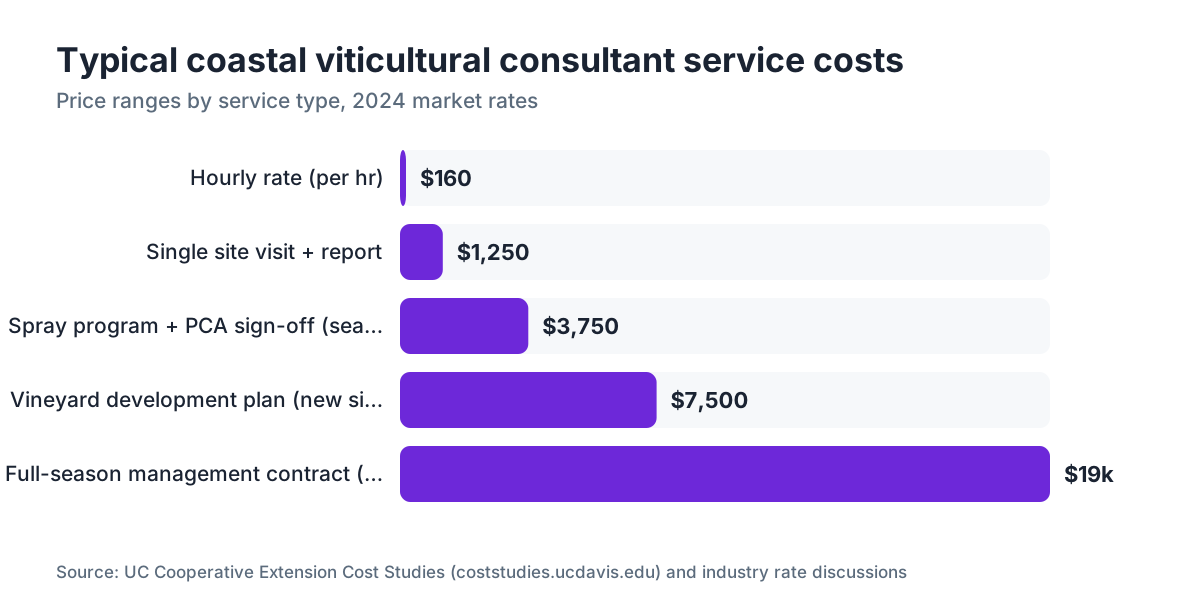
Hourly rates for independent viticultural consultants run $75 to $250 per hour as of 2024, with coastal specialists clustered at the top. The pool of people who actually understand marine-influenced viticulture is small, and small pools cost more. Season-long contracts for a small vineyard (5 to 20 acres) typically land between $8,000 and $30,000 a year, depending on visit frequency, scope, and whether the consultant is also writing and managing spray records.
Here's how the pricing usually breaks down:
| Service | Typical Price Range |
|---|---|
| Hourly consultation | $75 to $250/hr |
| Vineyard development plan (new site) | $3,000 to $12,000 |
| Full-season management contract (5 to 20 ac) | $8,000 to $30,000/year |
| Spray program design + PCA sign-off | $1,500 to $6,000/season |
| Single site visit + written report | $500 to $2,000 |
| Expert witness / legal review | $200 to $350/hr |
Those ranges come from published rate discussions in extension literature and industry surveys. Nobody has clean systematic data on consultant fees. The closest public reference is the UC Cooperative Extension sample cost studies, which log hired consultant costs as a line item in vineyard establishment and operations budgets [4]. Those figures tend to lag real market rates by two to three years, so treat them as a floor.
One honest note: the cheapest option is almost never the right call on the coast. A consultant who charges $85 an hour after a career in warm-climate Chardonnay blocks gives you warm-climate advice. A single wrong spray timing decision on a 15-acre Pinot Noir block in a high-pressure year can cost more than the whole annual consulting fee.
How do you verify a coastal consultant's credentials?
Start with the license. In California, PCA licenses are publicly searchable through the state Department of Pesticide Regulation [2]. The Oregon Department of Agriculture maintains a similar database for its Pesticide Consultant license [5]. The Washington State Department of Agriculture licenses Commercial Pesticide Consultants [6]. If a consultant can't point you to an active license in the state where your vineyard sits, that's a hard stop.
Past the license, look for documented experience in comparable coastal conditions. Ask for references from vineyards in similar GDD zones and similar soil types. Sonoma Coast Pinot experience is relevant if your block sits in the Santa Cruz Mountains. A resume that's all Paso Robles Cabernet is a real risk.
Formal education doesn't guarantee good field judgment, but it matters. UC Davis runs viticulture and enology programs that train most of California's credentialed consultants [7]. Cornell's viticulture program at its Geneva station is the main training ground for Northeast and Long Island practitioners [8]. Washington State University's viticulture extension work covers the Northwest [9]. A consultant who has completed advanced coursework or extension programs from one of those institutions, and keeps up continuing education credits, is at least working from a known baseline.
Professional associations add a layer. The American Society of Enology and Viticulture and the Society of Wine Educators run credentialing programs. The American Vineyard Foundation funds research that serious consultants follow. None of these are perfect proxies for field competence. But a consultant who shows up in the professional community is more likely to stay current on emerging pests and resistance management than one who doesn't.
What questions should you ask before hiring a coastal viticulture consultant?
The first question is the license check, covered above. After that, a handful of questions separate good candidates from adequate ones.
What's your experience with a specific disease or pest? On the coast, the ones that matter are Botrytis bunch rot, downy mildew (Plasmopara viticola), leafroll virus, and in many regions, spotted wing drosophila. A vague answer tells you plenty.
How do you handle spray record-keeping and WPS compliance? The EPA's Worker Protection Standard requires specific documentation, training records, and central posting of safety information [1]. A consultant who treats that as your problem is leaving you exposed. A good one either handles it directly or hands it off with a clear protocol.
How many clients do you carry, and how many site visits can you commit to per season? Some coastal consultants are stretched across 30 or 40 clients and can only manage quarterly visits. That might be fine for a mature, stable vineyard. It's a bad fit for a new planting or a block with an active problem.
Do you use any remote sensing or digital scouting tools? Not a requirement, but a useful signal. A consultant who folds weather station data, satellite NDVI imagery, or a structured scouting log into their practice tends to be more systematic than one running on memory and instinct. Those tools also keep your records cleaner if you ever get audited.
If you already keep digital field records, this is where a platform like VitiScribe makes the relationship smoother. Spray records, scouting logs, and compliance documents live in one place the consultant can reach between visits, instead of a binder pulled out at each appointment.
How does a coastal consultant handle pesticide records and EPA compliance?
This is one of the most underrated parts of a consultant's value. The EPA's Worker Protection Standard, revised most recently in 2015 and enforced through state lead agencies, covers any agricultural establishment that uses pesticides and has agricultural workers or pesticide handlers [1]. The WPS requires employer-provided training (within 30 days of first entry into a treated area), access to pesticide application and safety information, and specific decontamination supplies. Violations can carry penalties up to $18,000 per violation under FIFRA [1].
On spray records specifically, California law requires licensed PCAs to file a Notice of Intent with the county agricultural commissioner before restricted-material applications, and requires growers to submit monthly pesticide use reports through the county commissioner's office [2]. Most other coastal states have their own state-level versions of the same idea.
A competent coastal consultant with a PCA license will usually manage the Notice of Intent process, keep copies of application records, and stay on top of report deadlines. They should also track restricted-entry intervals (REIs) and pre-harvest intervals (PHIs) for every product applied. Those two numbers cause more compliance headaches at harvest and during state inspections than anything else.
One practical note: the record system you use matters. Handwritten paper records are legal in most states. They're also hard to search, easy to lose, and slow to pull together when an inspector asks for three years of records by variety block. Digital records aren't legally required anywhere as of this writing. They're just a lot easier to live with.
What's the difference between a viticultural consultant and a farm advisor?
People use the terms interchangeably, but there's a real distinction. A farm advisor (or farm adviser, depending on the state) historically meant an extension-affiliated advisor, especially the county-based, publicly funded advisors of UC Cooperative Extension. Those positions have been cut hard over the past two decades, and many counties no longer have a dedicated viticulture farm advisor at all.
A private viticultural consultant is a for-hire professional working independently or through an agronomy firm. They have no obligation to the public interest, only to their clients. That's not a knock. It means they can specialize deeper and aim entirely at commercial outcomes.
The practical difference that matters most: a UC Cooperative Extension farm advisor's recommendations are backed by publicly funded research and carry no conflict of interest tied to input sales. A private consultant's advice is also independent of input sales if they're fee-only, but ask directly. Some consultants have informal ties to specific distributors, or work for or with input companies. That isn't illegal. It's worth knowing.
In California, UC Cooperative Extension still publishes county-by-county farm advisor contacts and free technical resources through its viticulture programs [3][4]. Even after you hire a private consultant, those resources are worth using.
Do coastal vineyards need a consultant year-round or just during the season?
Honest answer: it depends on the operation's size, maturity, and how much expertise the vineyard manager already carries.
A mature 10-acre Pinot Noir block run by an experienced manager who holds their own PCA license probably needs a consultant for one annual planning session in late winter, a few check-in visits during the growing season, and a post-harvest review. Call it 15 to 25 hours a year.
A new planting, a block converting to organic certification, or a site with an active disease or nematode problem is a different story. Those situations can justify monthly or biweekly visits through the season, plus off-season soil sampling, cover crop planning, and equipment audits.
Winter isn't dead time for a good coastal consultant. Dormant pruning strategy, cover crop establishment, frost protection review, and vine training decisions all happen between November and February in most coastal regions. A consultant who goes dark from harvest to bud break is missing some of the year's most consequential calls.
The most efficient model for most small coastal operations is a tiered contract: a base number of site visits and on-call hours per month, plus an agreed hourly rate for anything beyond that. You're not paying for weekly visits during a quiet stretch, and you still have clear access when something goes sideways.
How do coastal consultants approach organic and sustainable certification?
Organic certification in a coastal vineyard is genuinely harder than on a warm, dry inland site. High pressure from Botrytis and downy mildew means the spray program works harder with materials that are often less effective than conventional fungicides. Sulfur and copper products are the workhorses of organic viticulture, and copper carries its own regulatory baggage: the EU has capped copper applications at 6 kg/ha/year as a three-year average, and regulators elsewhere are watching that precedent [10].
A consultant with certified clients on the coast knows the organic program has to be built around canopy management first and materials second. Tight canopy architecture that traps moisture is the real disease driver. No organic spray program makes up for poor canopy hygiene.
For operations chasing CCOF, Oregon Tilth, or USDA National Organic Program certification, a consultant's job includes checking materials for allowed or prohibited status under NOP rules [10], helping build the required organic system plan, and keeping records in a format certifiers accept. That's real added workload, and it should show up in the contract scope.
Sustainability programs like the California Sustainable Winegrowing Alliance's certification or LIVE (Low Input Viticulture and Enology) in Oregon run their own third-party audits. Some coastal consultants are trained assessors for those programs. Others aren't. If certification is part of your goal, confirm the consultant knows the specific program before you sign anything.
How do you structure and manage a consultant contract?
The contract should spell out scope, visit schedule, deliverables, and a clear line between decisions that need the consultant's sign-off and decisions the vineyard manager can make alone. Vague contracts are where expectations drift and relationships fall apart.
Minimum elements worth including:
Scope of services: list the specific activities covered (spray program, scouting, harvest timing, compliance records, organic certification support) and what's explicitly out of scope.
Visit schedule: number of on-site visits per season, minimum notice required, and what happens when a visit needs to move because of weather or a pest event.
Communication expectations: how fast will the consultant respond to an emergency call? Forty-eight hours is fine for planning questions. Six hours is more like it for an active disease outbreak or a suspected WPS violation.
Record ownership: all spray records, scouting logs, and compliance documents should be yours when the contract ends. Sounds obvious. It comes up every time a consultant relationship breaks up.
Termination terms: a 30 to 60 day notice period is standard. Make sure you can terminate for cause (a license lapse, repeated missed visits) on shorter notice.
If you track everything digitally, sharing record access through a platform like VitiScribe means both parties see the same current picture of the block. No arguments about what was applied, when, or at what rate.
For a wider view of how field operations and compliance fit together, the vineyard overview on this site covers the general operational framework.
Which university extension programs are best for coastal viticulture knowledge?
Three programs are genuinely worth knowing for coastal viticulture, and each one covers a different coastal region.
UC Davis and UC Cooperative Extension have the deepest bench for California coastal viticulture. Their Viticulture and Enology work publishes open-access research on cool-climate varieties, rootstock performance in coastal soils, and integrated pest management for Botrytis and downy mildew [3][7]. The cost-of-production studies from UC Cooperative Extension are the most useful public benchmarks for judging whether a consultant's recommendations line up with actual industry practice [4].
Cornell Cooperative Extension at Geneva, New York is the main resource for the Northeast, including Long Island's North Fork and the coastal-influenced Finger Lakes. Their pest management guidelines and Concord-to-vinifera transition research get used widely by consultants in those regions [8].
Washington State University Extension covers the Columbia Valley and the Puget Sound-influenced sites of western Washington. Their work on late-season disease management and irrigation scheduling in variable maritime climates carries straight over to western Oregon and coastal Washington operations [9].
All three publish free extension bulletins and cost studies that any consultant working in their region should be reading. If a consultant isn't familiar with recent publications from the relevant program, that's a sign they've stopped keeping up.
Frequently asked questions
How much does a coastal viticultural consultant cost per year?
Full-season contracts for a 5 to 20 acre coastal vineyard typically run $8,000 to $30,000 per year, depending on visit frequency, scope, and whether spray record management and WPS compliance work are included. Hourly rates for independent consultants range from $75 to $250. Coastal specialists tend to land at the high end because the relevant expertise pool is smaller than for inland regions.
Is a viticulture consultant the same as a pest control adviser?
Not exactly. A viticultural consultant is a broad term for a hired agronomic advisor. A Pest Control Adviser (PCA) is a licensed professional under California law (with equivalents in Oregon and Washington) who is legally authorized to write and sign pesticide use recommendations. In California, anyone recommending pesticide applications commercially must hold a PCA license from the Department of Pesticide Regulation. Many viticultural consultants hold PCA licenses, but the titles describe different things.
Do I need a consultant if my vineyard manager already has experience?
Maybe not for day-to-day operations, but some situations pay for outside eyes: a new planting, a disease outbreak you can't identify, an organic certification process, or a big change in variety mix. Even experienced managers benefit from a second read on spray resistance management and canopy decisions. Think of it as a specialist referral. You don't need one every week, but the right one at the right moment prevents expensive mistakes.
What coastal wine regions are most difficult from a disease management standpoint?
The Sonoma Coast, Santa Cruz Mountains, and Willamette Valley consistently carry the highest Botrytis and downy mildew pressure among California and Oregon's coastal regions, driven by fog frequency and low evapotranspiration rates. Long Island's North Fork faces similar pressure amplified by humidity from the Sound and the Atlantic. These regions need tighter spray timing windows and more canopy work than most warm inland appellations.
Can a viticultural consultant help with USDA organic certification?
Yes, and for coastal vineyards it's one of the more valuable uses of their expertise. The organic materials list under the National Organic Program is specific and full of subtle exceptions, copper applications face accumulating regulatory pressure, and the required organic system plan has to be documented and updated annually. A consultant who knows your certifier's requirements and coastal disease pressure is far more useful here than a generalist.
What does the EPA Worker Protection Standard require for vineyards?
The WPS requires all agricultural employers using pesticides to provide safety training within 30 days of a worker's first entry into a treated area, post pesticide safety information in a central location, provide decontamination supplies, and keep records of pesticide applications and handler activities. Violations can carry penalties up to $18,000 per violation under FIFRA. Many coastal vineyards use their consultant to manage this documentation and training schedule.
How many site visits per season should I expect from a consultant?
For a mature coastal vineyard with an experienced manager, six to twelve site visits per growing season is a reasonable baseline, roughly monthly with extra visits around bud break, flowering, and pre-harvest. New plantings, blocks under active pest or disease pressure, or operations pursuing certification may need biweekly visits from April through October. Confirm the minimum visit number in writing before signing any contract.
How do I find a viticultural consultant who specializes in cool-climate or coastal regions?
Start with UC Cooperative Extension county advisors in California, Cornell Extension in New York, or WSU Extension in Washington. The American Society of Enology and Viticulture member directory lists consultants by specialty. State farm bureau referral lists are another option. The most reliable route is asking neighboring vineyards in a similar GDD zone who they use and what the working relationship is actually like, beyond the marketing pitch.
What's a reasonable trial period or pilot engagement with a new consultant?
A single site visit plus a written report ($500 to $2,000 depending on the consultant) is a low-cost way to test judgment and communication before committing to a season contract. Ask for a block-by-block assessment with specific recommendations you can act on. If the written report is vague or generic, that's a preview of what you'll get year-round. Good consultants are specific from the first visit.
What records should a viticultural consultant help me maintain?
At minimum: pesticide application records (product, rate, REI, PHI, block, applicator), scouting logs with pest and disease observations by block and date, weather station data tied to spray decisions, and WPS training and posting records. In California, monthly pesticide use reports to the county agricultural commissioner are also required. Organic operations add soil amendment records and materials verification documentation. Digital systems make this far more manageable than paper.
Are there viticultural consultants who focus specifically on small or estate wineries?
Yes, and for coastal operations under 25 acres, a consultant who focuses on small estates is usually a better fit than one whose practice is built around large commercial accounts. Small-estate consultants are more likely to tailor their visit schedule to your actual decision calendar rather than showing up on a standardized interval that fits a different operation's rhythm. Ask directly what percentage of their client base sits under 30 acres.
How do consultants handle harvest timing recommendations on the coast?
Coastal harvest timing is one of the highest-stakes calls of the year, because the window between physiological maturity and the next rain event or Botrytis outbreak can be measured in days. Good consultants combine Brix, pH, TA, and berry sensory evaluation with weather forecast data and block-by-block disease scouting to give you a specific pick window rather than a single number. They should also walk you through the trade-off between hanging longer for flavor and picking early to manage disease risk.
Can a viticultural consultant help with a new vineyard site selection on the coast?
This is one of the highest-return uses of consultant time. Pre-plant site evaluation should include soil mapping (texture, drainage class, pH, organic matter), GDD estimation from nearby weather stations, frost risk assessment, prevailing wind analysis for disease pressure, and water availability review. Getting these wrong at planting is an expensive, slow mistake to fix. A few thousand dollars in consultant fees at this stage can prevent decades of poor performance.
Sources
- U.S. EPA, Agricultural Worker Protection Standard: The WPS requires pesticide safety training, central posting of information, and decontamination supplies; violations carry penalties up to $18,000 per violation under FIFRA.
- California Department of Pesticide Regulation: California requires a PCA license from CDPR for anyone writing commercial pesticide use recommendations; PCA license status is publicly searchable, and licensed PCAs must file a Notice of Intent before restricted-material applications.
- University of California Agriculture and Natural Resources (UC Cooperative Extension): Coastal growing degree days can run 1,800 to 2,400 (base 50 degrees F); rootstock selection on coastal sites should account for soil drainage, phylloxera biotype risk, and water stress under fog cooling.
- UC Cooperative Extension, Sample Costs to Establish and Produce Wine Grapes: UC Cooperative Extension cost studies document hired consultant costs as a line item in vineyard establishment and operations budgets, with data updated periodically by region.
- Oregon Department of Agriculture: Oregon requires a Pesticide Consultant license for professionals advising on commercial pesticide applications; the license database is publicly accessible through the Oregon Department of Agriculture.
- Washington State Department of Agriculture: Washington licenses Commercial Pesticide Consultants through the WSDA Pesticide Management Division.
- University of California, Davis: UC Davis offers viticulture and enology programs and publishes open-access research on cool-climate varieties, rootstock performance in coastal soils, and IPM for Botrytis and downy mildew.
- Cornell University, College of Agriculture and Life Sciences (Cornell AgriTech, Geneva): Cornell's viticulture program at Geneva is the primary training and extension resource for Northeast U.S. practitioners, including Long Island coastal vineyards.
- Washington State University Extension: WSU Extension covers Columbia Valley and Puget Sound-influenced sites; their work on late-season disease management is applicable to coastal Washington and Oregon operations.
- USDA Agricultural Marketing Service, National Organic Program: The National Organic Program specifies allowed and prohibited materials for organic certification; copper applications face accumulating regulatory pressure at state and international levels, with the EU capping copper at 6 kg/ha/year as a three-year average.
Last updated 2026-07-09