American viticultural areas: what they are, how they work, and why they matter
TL;DR
- An American viticultural area (AVA) is a grape-growing region with a defined boundary, recognized by the Alcohol and Tobacco Tax and Trade Bureau (TTB).
- As of 2025 the TTB has approved more than 270 AVAs.
- To put an AVA name on a label, at least 85 percent of the grapes must come from that area.
- AVAs set no quality standard.
- They define origin only.
What exactly is an American viticultural area?
An American viticultural area is a grape-growing region with a drawn boundary and geographic or climatic features that set it apart from the land around it. That's close to the TTB's own language. The agency defines an AVA as "a delimited grape-growing region having distinguishing features as described in part 9" of the Code of Federal Regulations [1]. The key word is "delimited." An AVA is a line on a map. It's not a certification, not a quality tier, not a protected designation of origin in the European sense.
The TTB sits inside the U.S. Department of the Treasury and runs the AVA program under 27 CFR Part 9 [1]. When it reviews a petition, it weighs soil type, climate, elevation, and physical features. What it never judges is whether the wine tastes good. Two vineyards a fence apart, one inside the boundary and one just outside, could grow identical fruit. The line is geographic, full stop.
That distinction matters to you because the AVA name on the label is really a marketing and traceability tool. It tells a buyer where the grapes grew. It also triggers a specific federal rule: 85 percent of the wine's volume has to come from grapes grown inside that AVA before the name can appear [1]. Every AVA sits within one or more states, so the 85 percent federal rule stacks on top of whatever appellation rules the state adds.
So what makes a viticultural area "American"? The federal framework, nothing more. France uses Appellations d'Origine Contrôlée, which pile on grape variety restrictions and production methods. AVAs skip all of that on purpose. Congress and the ATF (now TTB) chose origin-only when the program launched in 1980 [2].
How many AVAs exist, and where are they?
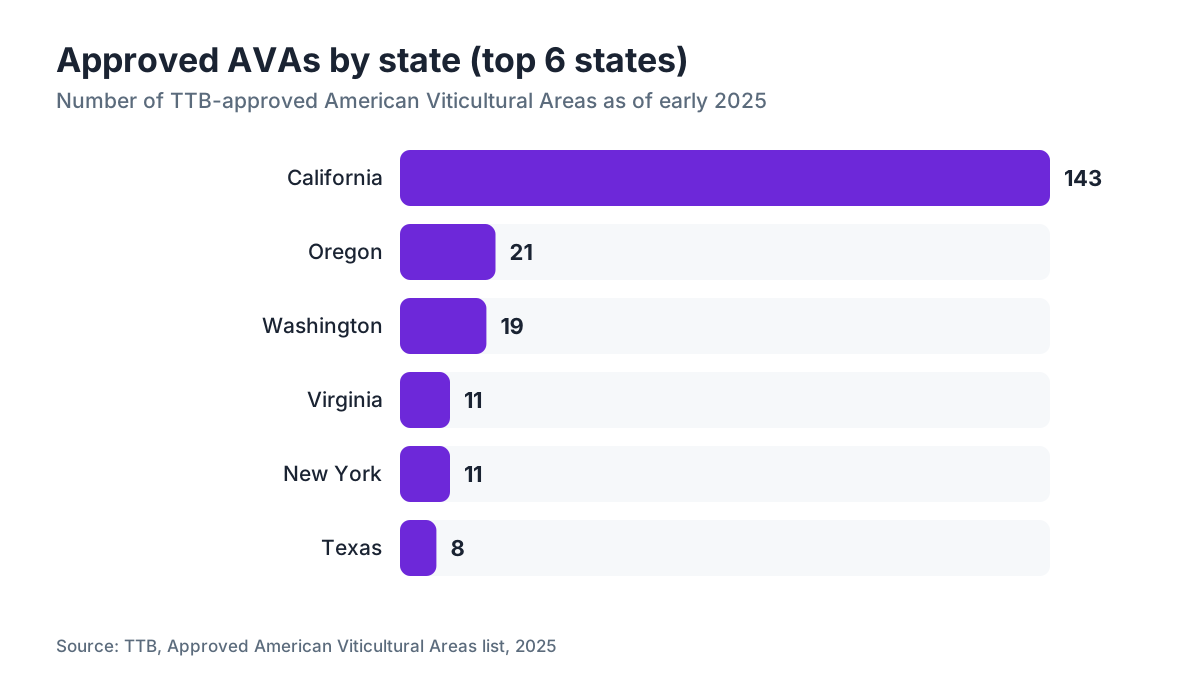
The TTB had approved 276 AVAs as of early 2025, with more petitions in the queue [1]. California runs away with the count, holding more than 140 of them. Washington, Oregon, and Virginia all have busy programs, and states like Texas and New York have been adding designations steadily for the past decade.
The map is lopsided. Some AVAs are huge. The Upper Mississippi River Valley AVA touches four states (Iowa, Illinois, Wisconsin, and Minnesota) and covers roughly 29,000 square miles. Others are pocket-sized. Cole Ranch in Mendocino County, California covers about 62 acres, one of the smallest in the country [3]. Size tells you nothing about prestige or how much wine comes out.
Nested AVAs are everywhere. A wine can carry more than one AVA name at once if the grapes clear the 85 percent bar for each region. Napa Valley is the textbook case: the broad Napa Valley AVA holds sub-AVAs like Oakville, Rutherford, and Howell Mountain. A wine from Oakville fruit can say "Oakville," "Napa Valley," or both, depending on what the producer wants to lead with and what the label rules allow.
The paso robles wineries region in San Luis Obispo County shows how tangled this gets. Paso Robles Wine Country, the parent AVA, now holds eleven sub-AVAs approved between 2013 and 2016, each split out mostly by soil type and distance from the coast [3]. Growers there pick the designation that tells their story best.
How is a new AVA petition approved?
Anyone can petition the TTB for a new AVA, and there's no filing fee. What there is instead is a stack of paperwork. The TTB's rules at 27 CFR 9.12 lay out what a petition needs: a name, proof the name is in current or historical use, a written account of the distinguishing features, a United States Geological Survey (USGS) map showing the proposed boundary, and a boundary description precise enough that someone can trace it on that map [1].
The distinguishing features section is where petitions live or die. The TTB wants climate data (temperature, rainfall, frost dates), soil series descriptions, elevation ranges, and sometimes a topographic barrier. Academic backing helps. Cooperative extension researchers at UC Davis and Cornell have supplied independent climate or soil analysis for several successful petitions [4][5]. It isn't required, but a petition carrying peer-reviewed data moves faster.
Once the TTB rules the petition complete, it publishes a notice of proposed rulemaking in the Federal Register and opens a public comment window, usually 60 to 90 days. Anyone can weigh in: neighboring wineries who think the boundary is wrong, landowners who want in or out. The TTB reads the comments, then issues a final rule. Start to finish, the process usually runs two to five years, and some petitions drag well past that.
One practical note. The TTB sets no minimum size. You could petition for a single vineyard if you could prove its distinguishing features, and a handful of tiny AVAs exist for exactly that reason: one producer with the money and the will to see it through. Whether that's sound policy gets argued about in the trade.
What are the AVA labeling rules winemakers must follow?
The core federal rule is 85 percent. If an AVA name is on the label, at least 85 percent of the wine's volume must be made from grapes grown in that AVA [1]. The other 15 percent can come from anywhere, even outside the state, and there's no federal duty to disclose where. Simple on paper, easy to trip over in a busy crush.
States can be stricter, and Oregon is the one everyone cites. Oregon law requires 95 percent sourcing for a wine to carry an Oregon appellation name, with tight rules on grape variety labeling on top [6]. California follows the 85 percent federal floor for most designations but runs its own labeling regulations through the California Department of Alcoholic Beverage Control.
Vintage adds another layer. Put a vintage year on the label next to an AVA name and federal rules require at least 95 percent of the wine to come from grapes harvested that calendar year [1]. That's a higher bar than the 85 percent appellation rule, and it catches producers off guard every harvest.
Walk through a real scenario. Say you make a wine from 87 percent Napa Valley Cabernet and 13 percent Lake County Cabernet, all one harvest. You can say "Napa Valley." You can show the vintage. You cannot say "Oakville" unless 85 percent came from inside Oakville specifically. And if you sell into Oregon or another state with stricter pass-through rules, check those regs before you print a single label.
The TTB's Alcohol Beverage Labeling program holds the guidance and runs the Certificate of Label Approval (COLA) system, which is where all this gets enforced [1]. If you're tracking compliance across several sourcing arrangements, VitiScribe can hold your lot-level sourcing percentages so you know where you stand before you commit to artwork.
What makes Los Carneros stand out as an AVA case study?
Los Carneros is one of the most instructive AVAs in California because it was built on climate logic, not political lines. The Los Carneros American Viticultural Area covers the southern ends of both Napa and Sonoma counties, right at the top of San Pablo Bay [3]. That bay position is the whole argument. Cold marine air and morning fog push in off the water most days, holding temperatures well below the areas ten miles north. Growers petitioned because Carneros Chardonnay and Pinot Noir behaved nothing like Napa Valley floor fruit, and they wanted a label that said so.
The TTB approved Los Carneros in 1983, one of the earlier California sub-region designations. What stands out is that the boundary runs straight through the county line. A grower in southern Sonoma and a grower in southern Napa can both print "Los Carneros," so long as they hit the 85 percent rule. That shared identity across two counties was unusual then and set the pattern for other climate-based cross-county AVAs.
Los Carneros is now one of the AVA names consumers actually recognize, which shows what a well-defined, well-promoted boundary is worth. That recognition took decades and leaned on producers using the name year after year. AVAs without a critical mass of producers behind the name tend to fade from buyer awareness even while the TTB boundary sits on paper.
For vineyard managers here, the two-county setup means you may answer to both the Napa County and the Sonoma County agricultural commissioner for pesticide use reporting and spray records, even though your fruit wears a single AVA name. The administrative map and the viticultural map don't line up, and that gap is real compliance overhead.
How do AVAs affect vineyard operations and record-keeping?
The AVA boundary reaches past the label into daily operations. In California, spray applications get reported to the county agricultural commissioner, and that reporting follows the county the vineyard sits in, not the AVA it belongs to [7]. A vineyard in Los Carneros that straddles the Napa-Sonoma line technically files with two separate commissioners. That's not a thought experiment. It happens.
Pesticide use reporting under the California Department of Pesticide Regulation demands field-level records identifying the legal county, section, township, and range of each application [7]. None of that maps to an AVA. The name means nothing to the commissioner. Your parcel's legal description is what counts. Growers running blocks across several AVAs, common for larger management companies, need systems that split records two ways: by AVA for label compliance, by county parcel for regulatory filing.
EPA's Worker Protection Standard (WPS), revised in 2015, covers every agricultural workplace including vineyards, AVA or not [8]. It requires central posting of application information, restricted-entry interval (REI) compliance, and annual training for workers who might be exposed. AVA status changes none of it. A vineyard inside a prestigious Napa sub-AVA carries the same WPS load as a table-grape block in the Central Valley.
The real record-keeping job is tracking the sourcing percentage at the lot level through crush and fermentation. Blend fruit from multiple AVAs and you need documentation that backs whatever the label claims. Handwritten logs work until they don't; they scale poorly. This is one of the core problems VitiScribe was built to solve: tying vineyard block records to winery lot records so the 85 percent math is traceable.
If your vineyard is just getting into the documentation side, start with one block map that links each block to its county parcel number and its AVA. That single sheet clears up most of the confusion when spray reporting season and label approval season collide.
What distinguishes an AVA from a wine region or appellation?
People swap these terms around, but they mean different things. A wine region is informal. It's a geographic area people associate with wine, and it carries no legal weight. Napa Valley as a region existed long before the Napa Valley AVA was approved in 1981 [2].
An appellation of origin is the broader federal category. Under TTB rules, a wine can name a country, a state, a county, or an AVA as its appellation. Each carries its own sourcing threshold. State appellations require 75 percent of grapes from that state, except Oregon, which requires 100 percent for wines labeled with just the state name [1]. County appellations require 75 percent from that county at the federal level, though states can set the bar higher.
European protected designations of origin (PDOs) go far past AVAs. They dictate permitted grape varieties, maximum yields, minimum alcohol, and sometimes aging. The Bordeaux AOC, for one, limits producers to a set list of varieties. No U.S. AVA does anything close. That's a policy choice, not an oversight. The U.S. industry fought production controls when the program was created, and that stance has held [2].
GI (Geographical Indication) is the WTO-level term that covers both American AVAs and European PDOs. Under the TRIPS Agreement, wine GIs get stronger protection than other agricultural GIs, which is why "Champagne," "Burgundy," and "Chablis" are legally restricted in trade deals even though American wineries used those names freely for decades [9]. The AVA system is how the U.S. meets its GI obligations at the international level.
Can a vineyard be in more than one AVA at the same time?
Yes, and it's more common than most people outside the trade guess. Nested AVA structures let a single vineyard block qualify at once for a sub-AVA name, a parent AVA name, and a county appellation. A Rutherford vineyard in Napa Valley qualifies for "Rutherford," "Napa Valley," and "Napa County" all at once, as long as the sourcing thresholds are met [1].
There are also overlapping AVAs that aren't strictly nested. The North Coast AVA takes in all of Napa, Sonoma, Mendocino, Lake, Marin, and Solano counties. A vineyard in Calistoga sits inside Calistoga AVA, Napa Valley AVA, and North Coast AVA at the same time. The producer can pick any of those names for the label, or none and just use "California," whatever serves the marketing.
The only real limit is the sourcing threshold. Every AVA name you use requires 85 percent of the grapes from inside that specific boundary. Reaching for a smaller, more specific name doesn't free you from meeting the percentage for a broader one if you list both. In practice, most producers pick one designation and hold to it.
For growers selling to several wineries, this matters because different buyers want documentation at different AVA levels. A buyer making a Rutherford-labeled wine needs block-level records. A buyer making an entry-level Napa Valley bottling just needs county-level confirmation. Your records have to feed both.
How do AVA boundaries affect land value and grape pricing?
Sitting inside a recognized AVA generally lifts both vineyard land value and grape contract prices, though pinning the number down is hard because AVA recognition rides alongside other quality signals. Napa Valley is the most-studied case. Land inside the Napa Valley AVA trades at a steep premium to comparable ground just outside it, roughly $150,000 to over $500,000 per acre depending on sub-AVA and block, against $20,000 to $80,000 per acre in less recognized California regions [10].
Nobody has clean controlled data separating the AVA premium from the underlying terroir, because the boundary usually got drawn where the quality difference already existed. The chicken-and-egg problem is real, and anyone selling you a precise AVA premium figure is guessing.
Grape pricing runs the same way. California's annual grape crush report, published by the CDFA, shows wide price spreads by district and variety, and the top-priced districts almost always line up with established AVAs [10]. Napa Valley Cabernet Sauvignon has averaged roughly $8,000 to $10,000 per ton in recent crush reports. Central Valley Cabernet averages under $500 per ton. The AVA isn't the only reason for that gap, but it's part of it.
Smaller, newer AVAs change the math. A brand-new AVA with no consumer recognition may deliver almost no price premium at first. It can take a decade or more for a new name to register with buyers, and during that stretch growers pay the compliance overhead (careful sourcing documentation, label approval costs) without banking a price benefit. Whether to petition for a new AVA or market under an existing broader name is a genuine strategic call, and the answer turns on how different your terroir really is and how much marketing money your region's producers will spend.
What are the main AVA petition mistakes and why do they fail?
The TTB has kicked back incomplete petitions for a few repeat reasons. The most common is a boundary description you can't trace on a USGS map. The regulation wants precise legal descriptions keyed to named roads, ridgelines, streams, or survey markers [1]. Vague lines like "the area generally known as" come straight back.
The second failure point is thin evidence of distinguishing features. The TTB wants data: climate station records, USDA soil survey maps (available through the Web Soil Survey at NRCS), documented geographic features [12]. A petition claiming a region is distinct because "locals have always known it makes different wine" goes nowhere without objective support.
Name conflict is another wall. If the proposed name already exists as a different geographic or political name, or could be confused with an existing AVA, the TTB flags it in review. That has snagged several petitions in states with limited naming options.
Extension resources at UC Davis and Washington State University have published guidance on building a defensible petition, mostly around climate data collection and soil documentation [4][5]. WSU's viticulture extension program has worked on several successful Pacific Northwest petitions and makes a useful starting point for growers in that region.
One thing that gets overlooked: the public comment period can sink a petition that looks airtight on paper. Neighboring producers who feel the boundary shuts them out unfairly, or who think the name grabs a shared regional identity, can file heavy objections. Talk to your region's producers before you file. It isn't legally required, but it's practically the difference between a smooth review and a fight.
How do AVAs interact with organic and sustainable certifications?
AVA status and organic or sustainable certification run on separate tracks. The TTB cares only about geography. The USDA's National Organic Program, run through the Agricultural Marketing Service, cares only about production practices [11]. A vineyard can hold both, either, or neither.
Still, AVA membership and sustainable certification often overlap on the ground because both pull in growers paying close attention to their sites. California Sustainable Winegrowing Alliance (CSWA) certification is common across Napa and Sonoma AVAs, and Oregon's LIVE certification has deep penetration in the Willamette Valley. These programs carry their own record-keeping demands around pesticide applications, soil health, and water use, layered on top of county reporting and WPS compliance.
The practical question for a vineyard manager is whether one record-keeping system can satisfy every auditor. The county ag commissioner wants pesticide use by parcel. The National Organic Program wants input records and prohibited-substance documentation. A sustainable certifier wants broader environmental metrics. No two use the same form. Build a single source-of-truth record set that exports to each format and you save days at audit season.
The gervasi vineyard model, where vineyard operations run tight alongside hospitality and on-site production, tends to carry extra documentation needs because visitors and educational programming create more public-facing exposure. Any AVA designation there just adds one more layer to an already busy operation.
Frequently asked questions
What percentage of grapes must come from an AVA to use that name on the label?
At least 85 percent of the wine's volume must come from grapes grown within the named AVA under federal TTB rules (27 CFR Part 9). Oregon is stricter, requiring 95 percent for any Oregon appellation. If you also show a vintage year on the label, 95 percent of the wine must be from that harvest year, regardless of the appellation threshold.
How long does it take to get a new AVA approved?
Two to five years is the typical range from petition filing to final TTB rule, though some run longer. The TTB publishes a notice of proposed rulemaking in the Federal Register after finding the petition complete, opens a public comment period (usually 60 to 90 days), then reviews comments before issuing a final rule. Incomplete petitions get returned and reset the clock.
Does an AVA guarantee wine quality?
No. AVAs define geographic origin only. The TTB does not judge wine quality when reviewing a petition, and AVA regulations impose no requirements for grape variety, yield limits, or winemaking methods. Two wines with the same AVA name can be dramatically different in quality. That's a deliberate feature of the American system, unlike European PDOs, which often include production rules.
What is the smallest AVA in the United States?
Cole Ranch in Mendocino County, California is among the smallest approved AVAs, covering roughly 62 acres. It was approved in 1983 and is widely cited as a single-vineyard AVA created by one producer. The TTB sets no minimum size for petitions, so very small designations are legally possible as long as distinguishing features can be documented.
What is the difference between an AVA and a county appellation on a wine label?
Both are appellations of origin under TTB rules, but they carry different sourcing thresholds. A county appellation requires 75 percent of grapes from that county at the federal level. An AVA requires 85 percent from within the specific AVA boundary. County appellations follow political lines; AVA boundaries wrap around distinguishing geographic or climatic features. A wine can use both at once.
What states have the most American viticultural areas?
California has by far the most, with over 140 approved AVAs as of 2025. Washington, Oregon, and Virginia are the next most active. Newer wine regions in Texas, New York, and the Midwest have been adding AVAs over the past decade. The TTB keeps a complete list of all approved AVAs on its website.
Can a winery in a different state use an AVA name on its label?
Yes, if the 85 percent sourcing threshold is met. A winery in Nevada could label a wine "Napa Valley" if 85 percent of the wine came from grapes grown within the Napa Valley AVA. The AVA points to where the grapes grew, not where the winery sits. State licensing and distribution laws are a separate matter.
How does the Los Carneros AVA span two counties?
The Los Carneros American Viticultural Area was approved in 1983 and covers the southern portions of both Napa and Sonoma counties along the northern edge of San Pablo Bay. The TTB drew the boundary around the cool marine climate rather than the county line. A grower on either side of the border can use the Carneros name if 85 percent sourcing is met.
Is there a fee to petition for a new AVA?
No. The TTB charges no filing fee for an AVA petition. The real costs are indirect: compiling climate and soil data, working up USGS map boundary descriptions, and sometimes hiring consultants or attorneys to assemble a defensible petition. Extension programs at UC Davis, Cornell, and Washington State University have published guidance to help petitioners structure submissions without outside counsel.
Do AVA boundaries affect pesticide reporting requirements?
Not directly. Pesticide use reports go to the county agricultural commissioner based on the legal parcel location, not AVA membership. In California, applications are reported by county, township, range, and section under the CDFA's pesticide use reporting system. A vineyard in an AVA that crosses county lines may need to file with two separate county commissioners.
What evidence does the TTB require to approve a new AVA?
The TTB requires evidence the proposed name is in current or historical use, a written account of distinguishing features (climate, soil, elevation, physical features), a USGS topographic map with the proposed boundary drawn on it, and a boundary description precise enough to trace on that map. Climate station data, USDA soil survey information, and academic support strengthen a petition but are not formally required.
Can an AVA name appear on the label if the wine contains grapes from multiple AVAs?
Yes, as long as 85 percent of the wine comes from the named AVA. The remaining 15 percent can come from other AVAs or regions. You cannot list multiple AVA names on one label unless the wine separately meets the 85 percent threshold for each. Most producers choose the single AVA that best represents the wine's origin.
How do nested AVAs work in places like Napa Valley?
The Napa Valley AVA contains sixteen approved sub-AVAs including Oakville, Rutherford, and Howell Mountain. A vineyard block in Oakville qualifies for both the Oakville sub-AVA and the broader Napa Valley AVA at once. Producers can use either name as long as the 85 percent sourcing requirement is met for whichever they choose. The sub-AVA name usually signals more specific terroir to buyers.
Does the AVA program comply with international wine trade rules?
Yes. The AVA system is the United States' implementation of geographical indications (GIs) for wine under the WTO TRIPS Agreement, which requires member countries to protect wine and spirits GIs. U.S. trade agreements with the European Union include mutual recognition provisions covering AVAs and European PDOs, which is why American wineries have been phasing out semi-generic European place names like "Burgundy" on domestic labels.
Sources
- UC Davis Viticulture and Enology department: UC Davis researchers have contributed climate and soil analysis to AVA petition proceedings
- Washington State University Extension, Viticulture and Enology program: WSU extension has been involved in Pacific Northwest AVA petitions and publishes guidance on petition preparation
- Oregon Liquor and Cannabis Commission, Oregon wine labeling regulations: Oregon requires 95 percent sourcing for wines labeled with an Oregon appellation name
- California Department of Pesticide Regulation, Pesticide Use Reporting program: California pesticide use reports filed by county parcel, not AVA boundary; requires county, section, township, and range
- WTO, TRIPS Agreement Article 23 on geographical indications for wines and spirits: Wine GIs receive stronger protection under TRIPS than other agricultural GIs; U.S. has phased out semi-generic European place names
- California Department of Food and Agriculture, California Grape Crush Report: Napa Valley Cabernet Sauvignon grape prices and comparison to Central Valley; land value ranges by region
- USDA Agricultural Marketing Service, National Organic Program: USDA NOP certification is independent of AVA status; governs production practices not geographic origin
- USDA NRCS, Web Soil Survey: USDA soil survey maps used as supporting documentation in AVA petitions
Last updated 2026-07-09