When to spray grapes for powdery mildew: timing that actually works

TL;DR
- Start sprays at budbreak when shoots reach 1 inch, before any visible mildew.
- Reapply every 7 to 14 days through veraison, tightening intervals when temperatures hold between 70 and 85°F with moderate humidity.
- Disease models like UC Davis's Gubler-Thomas index tell you when risk peaks.
- Missing the window between budbreak and bloom is the most expensive mistake you can make.
What is powdery mildew of grapes and why does timing matter so much?
Powdery mildew of grapes is caused by Erysiphe necator (formerly Uncinula necator), an obligate fungus that lives its whole life on living grapevine tissue. It overwinters as cleistothecia in the bark or as dormant mycelium inside infected buds, and it starts firing off ascospores at budbreak, right when sprays are the last thing on your mind. [1]
That early window is the whole game.
Unlike almost every other vineyard disease you manage, this fungus needs no leaf wetness to germinate. It just wants temperatures between 50 and 95°F and moderate humidity. The sweet spot is 70 to 85°F with relative humidity above 40%. [2]
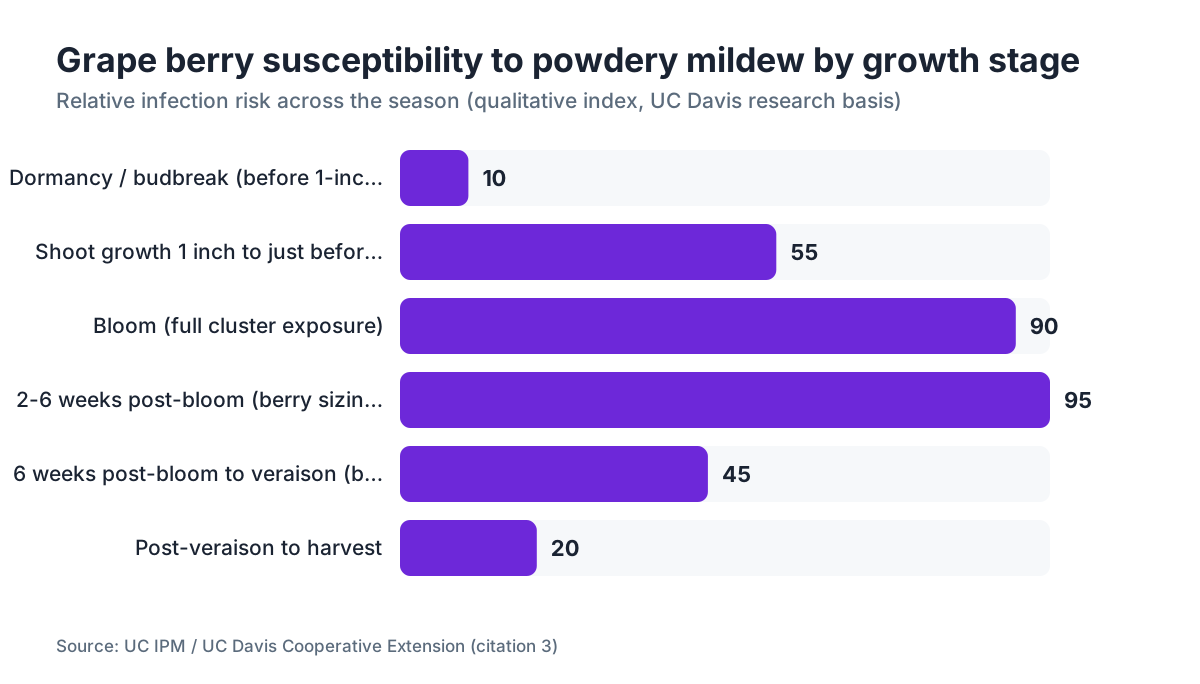
You can own the best fungicide on the market and still lose fruit if you start two weeks late. Research from UC Davis found that unprotected vines between budbreak and bloom can build infection levels no later spray program will fix. Berries stay susceptible from shortly after fruit set until roughly 3 to 4 weeks past bloom, and that window is tight. Skins are thin, surface area is expanding fast, and early infections show up at harvest as russeting, cracking, and a follow-on Botrytis problem. [3]
Timing matters more than product. Write that on the shop wall.
When exactly should you start your first powdery mildew spray?
Start at 1-inch shoot growth. That's the number almost every extension program in the country lands on, and it holds from the Willamette Valley to Virginia. Growers in high-pressure regions push the first application even earlier, at half-inch bud swell, if they had bad outbreaks in prior years or if their flagshoot count runs above 2 to 3% of shoots in spring. [2]
The reason for the early start is simple. The first ascospore release from bark cleistothecia happens at budbreak, once 10-day average temperatures clear roughly 50°F. Waiting for visible symptoms puts you behind. Powdery mildew has a latent period of 5 to 7 days at optimal temperatures, so you won't see the white sporulating colonies until the infection is already set and spreading. [1]
For most Vinifera varieties, the critical window runs from 1-inch shoot growth through about 4 to 6 weeks after bloom, roughly when berries hit 8 to 10 mm and start to harden. After that, resistance climbs as skin cells mature and the cuticle thickens. [3] Highly susceptible varieties like Chardonnay, Cabernet Franc, and Riesling often warrant protection all the way to veraison.
Nobody has perfect data on the exact start date for every microclimate. What you can do is track your 10-day average spring temperature and cross-reference it against your first-application dates from prior years. A logbook going back three seasons is worth more than any generic calendar date.
How often should you spray, and what affects the interval?
The standard interval is 7 to 14 days, and you push toward 7 when conditions favor the fungus. Three things compress the window: temperature, humidity, and rainfall (which washes off contact materials).
Here's the honest version of the interval decision:
| Condition | Recommended interval |
|---|---|
| Temperatures 70-85°F, RH above 50% | 7 days |
| Temperatures below 65°F or above 90°F, dry conditions | 14 days |
| Rain exceeding 1 inch (contact materials only) | Reapply within 48-72 hours |
| High flagshoot pressure from prior year | 7 days from budbreak through bloom |
| After veraison, moderate pressure | 14-21 days or suspend |
Systemic fungicides (DMIs, strobilurins, SDHIs) hold protectant activity for 10 to 14 days under normal conditions. Contact materials like sulfur need reapplying on the short end of the range. Wettable sulfur loses efficacy fast after rain and in very low humidity. [4]
Bloom is the most sensitive period and gets the shortest intervals no matter what the weather does. The rapid cell division in berries during and just after bloom makes tissue unusually easy to infect. UC IPM is explicit: protect bloom with a 7-day interval minimum in almost any climate where E. necator lives. [3]
What are disease prediction models and should you use one?
The Gubler-Thomas powdery mildew risk index, developed at UC Davis in the 1990s, is the most widely used disease model for grape powdery mildew in the United States. It builds a daily risk index from 0 to 100 off hourly temperature readings. When the index climbs past its threshold, you spray. When temperatures stay outside the fungus's happy range, you can safely stretch the interval. [2]
The model works because E. necator has a well-mapped temperature response. Sporulation and germination shut down below 50°F and above 95°F. A run of 90°F-plus days genuinely knocks risk down, and the index catches that. In UC Davis trials, growers running the model cut fungicide applications by 30 to 50% in some years with no rise in disease pressure, compared to calendar-based programs. [2]
Cornell's NEWA (Network for Environment and Weather Applications) runs a similar tool, free online, pulling weather station data across New York and neighboring states to build site-specific forecasts for powdery mildew and other diseases. [5] Washington State University Extension also puts out regional IPM tools that fold in local weather. [6]
Should you use one? If you have a weather station in or next to your vineyard, yes. If you're leaning on the airport station 15 miles away, accuracy drops hard, and you're better off with a conservative calendar program and tight bloom intervals. A $200 to $400 on-site weather station pays for itself in one season if it saves you even two unneeded applications.
Which fungicides work best at each timing window?
Product choice matters less than timing, but it still matters. Here are the main classes.
Sulfur (elemental and wettable). The oldest and cheapest option. It works as both protectant and eradicant at low disease levels, and it's organic-approved. Two limits: it can burn foliage above 90°F, and you can't apply it within 14 days of oil sprays. Sulfur is the backbone of most programs in California, the Pacific Northwest, and New York. [4]
DMI fungicides (demethylation inhibitors, FRAC group 3). Myclobutanil, tebuconazole, and others. True systemics with protectant and eradicant activity out to about 72 to 96 hours post-infection. Resistance has developed in some regions, especially California vineyards with long DMI history. Rotate them. Don't lean on one exclusively. [7]
Strobilurin fungicides (FRAC group 11). Azoxystrobin, trifloxystrobin. Strong protectant activity, but resistance builds fast if overused. Most advisors cap strobilurin use at 2 to 3 applications per season. [11]
SDHI fungicides (FRAC group 7). Newer chemistry, good efficacy, expensive. Usually held for bloom or for fast protectant coverage after a rain event.
Bicarbonate and other low-risk materials. Potassium bicarbonate (Kaligreen, Armicarb) works as an eradicant at low disease levels and is OMRI-listed. Cheap and safe, but weak on protectant activity, so timing is everything with these.
Rotate FRAC groups across the season. A typical California Vinifera program might read: sulfur at budbreak, DMI at bloom, strobilurin plus sulfur post-bloom, then sulfur through pre-veraison. The specific products inside each class matter less than the rotation itself.
What are the most susceptible growth stages for powdery mildew infection?
The berry has a narrow window of extreme susceptibility. UC Davis research found berries are most easily infected from about 2 to 6 weeks after bloom, when cell division is rapid and the cuticle is thin. Once the cuticle hardens, roughly around pea size, infection gets much harder to start. [3]
Leaves stay susceptible all season, but leaf infection, ugly as it looks, rarely causes economic damage on its own. The real loss is fruit. Infected berries crack, which opens the door to secondary Botrytis. Severe early fruit infection leaves russet scarring that drags down wine quality and marketability.
Clusters are more susceptible than leaves. The rachis (cluster stem) gets overlooked a lot: mildew there makes it brittle, and clusters can shatter at harvest.
Shoot tips are a big early-season infection site, and that's where you often spot the first white colonies. Flagshoots (shoots growing straight from infected buds) are a major source of primary inoculum inside your own vineyard.
The practical takeaway: don't ease off during early berry development even when the canopy looks clean. The disease can be running inside the cluster before you ever see white on the leaves.
How do you control powdery mildew on grapes without spray, or at least reduce spray dependence?
You can cut spray pressure, but on Vinifera in most climates you can't drop the program entirely. Several cultural practices genuinely reduce disease severity and buy you room to stretch intervals.
Canopy management. Powdery mildew loves humid, shaded canopies. Leaf removal in the fruit zone, usually at or just after bloom, opens up air movement, drops humidity around the cluster, and lets fungicide reach the fruit. UC Davis research showed fruit-zone leaf removal cut disease severity compared to unmanaged vines, even under the same spray program. [3] Shoot positioning, suckering, and hedging all help.
Variety selection. If you're still in the planning phase, resistant varieties are the strongest tool you have. Several interspecific hybrids (Marquette, Frontenac, La Crescent) and some Vitis labrusca crosses carry real resistance. Among Vinifera, Grenache and Gewurztraminer are less susceptible than Chardonnay or Cabernet Franc, though no Vinifera variety is truly resistant. [9]
Vine balance. Overly vigorous vines build dense canopies and stretch out the susceptible-tissue period. Managing nitrogen and water helps. Overfed vines are structurally more susceptible.
Irrigation timing. Evening irrigation raises overnight humidity around clusters during the exact temperature band where E. necator germinates best. Morning irrigation that dries off before evening is the better choice.
Cut overwintering inoculum where you can. Pulling heavily infected shoot material at dormancy pruning and getting it out of the vineyard (or flail-mowing and incorporating it) reduces the cleistothecia bank in your bark. Nobody has clean data on exactly how much this helps the following season, but it's standard advice from most extension programs.
None of these replace a spray program in high-pressure climates. They ride shotgun.
How does the EPA Worker Protection Standard affect spray timing decisions?
The EPA Worker Protection Standard (WPS) requires that workers and handlers be notified of applications and that restricted entry intervals (REIs) be observed before anyone re-enters treated areas. [8] For powdery mildew fungicides, REIs range from 4 hours (sulfur, under certain conditions) up to 12 to 48 hours for DMI and strobilurin products.
This matters for timing because bloom is also when your canopy work peaks. Tying, shoot positioning, and fruit thinning all land in the same 4 to 6 week window when you need maximum fungicide coverage. Spray a block and then send a crew in the next morning without observing the REI, and that's a compliance violation.
The fix is scheduling. Spray the day or evening after a crew finishes canopy work in a block, or time the application so the REI clears before the next hand operation. Keeping accurate records with application time, product, REI, and re-entry date is required under WPS and should be routine. [8]
Some winery compliance programs and appellations also demand spray records for their audits. A running log that captures block, growth stage, product, rate, interval, and re-entry is the floor, not the ceiling.
For operations juggling records across many blocks, field data platforms like VitiScribe can calculate the REI clearance date automatically, which cuts the odds of a slip when you're making back-to-back applications during bloom.
WPS training applies too: handlers who mix or apply pesticides must get annual pesticide safety training. The WPS was updated in 2015 and those changes are still in full effect. [8]
How do you know if your spray program is actually working?
Scout. It sounds obvious, but plenty of growers spray on a schedule and never check disease levels in any systematic way. Scouting for powdery mildew means walking every block at least weekly from budbreak through veraison, checking leaf undersides (first colonies often show there), shoot tips, and cluster stems.
Use a simple rating scale: 0 (no infection), 1 (1 to 5% leaf area affected), 2 (6 to 25%), 3 (over 25%). Track it by block and variety. If ratings climb despite a full program, you've likely got a resistance problem with your current active ingredient or your coverage is poor.
Coverage is an underrated failure point. Powdery mildew sprays have to reach the cluster zone. One upward nozzle on a simple sprayer won't cut it in a dense canopy. Cross-flow and tower sprayers that throw material into the fruit zone beat basic vineyard sprayers head-to-head, especially in leafy California Vinifera blocks.
If you spot flagshoots (shoots fully coated in white mildew, growing from infected buds) in spring, that's a signal your overwintering inoculum load is high and you should shorten the interval for the whole early season in that block.
If your ratings stay low despite a reduced-input program, that tells you the opposite: you may have more flexibility than you're using. The Gubler-Thomas model helps formalize the call, but your own scouting data is the ground truth.
What are the biggest timing mistakes growers make with powdery mildew sprays?
Missing the first application window is the most common and most costly error. Wait for visible disease before you start, and you're already two infection cycles behind.
Easing off too early at veraison is the second big one. Some growers stop everything at veraison because they've heard berries turn resistant after softening. Partly true: skin resistance does rise. But late-season mildew on leaves weakens the vine, and berry infections already set from earlier in the season keep expanding. Highly susceptible varieties often need protection right through veraison.
Running the same FRAC group all season is another trap. Resistance to DMI fungicides (myclobutanil especially) is documented in California and other regions. [7] Rotating groups isn't optional in a high-pressure environment. It's the only way to keep your chemistry working.
Applying sulfur in extreme heat burns fruit and leaves. Phytotoxicity shows up above 90°F in most sources, though the threshold shifts with formulation and vine stress. [4] Spraying wettable sulfur on a day that hits 92°F is a real risk, especially on water-stressed vines.
Last one: poor record-keeping that kills your ability to learn. If you don't know what you applied, at what interval, and what disease pressure followed, you can't improve the program. Three seasons of spray logs plus scouting ratings is a genuine edge over the block next door.
How does powdery mildew spray timing differ by region?
The biology is identical everywhere. The pressure window is not. California's Central Valley and coastal regions usually see early, sustained pressure from E. necator starting in March or April depending on location, and growers there often run 7-day intervals from budbreak through veraison on susceptible varieties. Cooler coastal spots in Sonoma and Santa Barbara catch natural temperature breaks that stretch safe intervals through summer. [2]
Pacific Northwest growers in Oregon and Washington fight a compressed but intense season. WSU Extension notes that the same rainy spring conditions driving high Botrytis pressure also strip sulfur coverage repeatedly, forcing more applications during bloom. [6]
New York and the East Coast get warm, humid conditions that favor powdery mildew from late May into August. Cornell's NEWA system is built for exactly this, folding in the temperature and humidity profiles typical of Lake Erie, Finger Lakes, and Hudson Valley sites. [5]
Hot, arid desert climates (southern Arizona, Texas High Plains) can watch the disease nearly shut down through midsummer heat. Disease models earn their keep there, because a calendar program will drive pointless applications during 100°F-plus stretches when the fungus isn't sporulating.
The general principle: cool and humid, err toward shorter intervals and don't use heat as an excuse to skip. Hot and dry, run a disease model and let temperature data set your intervals, especially midsummer.
How should spray records for powdery mildew fit into your overall vineyard compliance system?
Spray records are legally required in every U.S. state for restricted-use pesticides and strongly recommended (or required under winery compliance programs) for general-use materials too. California's DPR requires licensed applicators to keep pesticide use records for at least three years, and commercial agricultural operators must file monthly pesticide use reports with their county agricultural commissioner. [10]
A complete powdery mildew record entry should capture date and time of application, block or vineyard unit, growth stage, product name and EPA registration number, active ingredient and FRAC group, rate per acre or per 100 gallons, method and equipment, REI, weather at application (temperature, wind speed, relative humidity), and applicator name and license number where it applies.
That's a lot of fields to track by hand when you're spraying 12 blocks across a tight bloom window. This is where digital records earn their keep. VitiScribe is built for vineyard spray record compliance, with fields mapped to WPS and state reporting rules so nothing slips mid-season.
For vineyard operations of any size, good spray records also cover you in a neighbor complaint, a worker injury claim, or an appellation audit. The records are your proof that you followed label directions, observed REIs, and ran the block on a defensible program.
Frequently asked questions
What temperature is too hot to spray sulfur for powdery mildew?
Most extension programs put the cutoff at 90°F, though some formulations and vine stress situations pull it down to 85°F. UC IPM and Cornell both recommend skipping wettable sulfur when temperatures are forecast to top 90°F on the day of application or the following day. Heat drives sulfur to volatilize harder, and water-stressed vines are more prone to phytotoxicity.
Can you spray for powdery mildew during bloom without hurting pollinators?
Sulfur applied in late evening, when bees aren't foraging, is the standard bloom recommendation. DMI and strobilurin fungicides carry low bee toxicity but should also go on in early morning or evening to avoid direct contact. Check your product label for pollinator language, since some labels carry explicit bee advisories. Avoid tank-mixing insecticides with bloom-period fungicide sprays.
How do you know if powdery mildew has become resistant to your fungicide?
The clearest sign is disease that persists or worsens despite on-schedule applications at label rates. If DMI fungicides like myclobutanil are failing in a California vineyard, resistance is a documented issue in that state. Send a sample to a plant pathology lab for sensitivity testing, or assume resistance if you've run the same FRAC group more than three seasons straight without rotation. Switch groups and watch for improvement.
How many spray applications does a typical powdery mildew program require per season?
A full-season calendar program for a susceptible Vinifera variety in a high-pressure region typically runs 8 to 14 applications from budbreak through pre-harvest. A model-guided program can drop that to 5 to 8 in favorable years. Organic programs leaning on sulfur often need more applications than conventional ones, because sulfur has shorter residual activity and washes off easily.
Is powdery mildew worse in dry weather or wet weather?
Powdery mildew is unusual among fungal diseases: it doesn't need leaf wetness to infect. It thrives in dry conditions with moderate humidity, around 40 to 70% RH. Prolonged leaf wetness actually inhibits spore germination and can suppress the disease for a while. That's the opposite of most vineyard diseases, which is why powdery mildew can wreck a low-rainfall year.
What growth stage should you stop spraying for powdery mildew?
For most varieties, you can reduce or stop sprays 3 to 4 weeks after veraison, once berries have fully colored and sugar accumulation is well along. But the pre-harvest interval (PHI) on your product label governs the final application, not growth stage alone. Some labels carry PHIs of 7 to 14 days before harvest. Always check the label. Highly susceptible varieties may warrant a reduced-rate late-season application even close to harvest.
Can you use baking soda or other home remedies to control powdery mildew on grapes?
Potassium bicarbonate (not baking soda) is a legitimate OMRI-listed control used in organic programs. Baking soda (sodium bicarbonate) raises leaf-surface pH and inhibits the fungus, but it has limited residual activity and can leave salt deposits on foliage. Neither one gives the protectant coverage needed as a sole program in high-pressure situations. They work as eradicants at low disease levels, useful alongside other materials.
What does flagshoot percentage tell you about powdery mildew risk?
Flagshoots are shoots growing from buds infected with E. necator mycelium the previous season. Counting them in spring estimates your overwintering inoculum pressure. University of California guidelines suggest that if more than 2 to 3% of emerging shoots are flagshoots, you should treat the block as high-pressure and run 7-day intervals from budbreak. Low flagshoot counts allow some flexibility in early-season interval length.
How do I document powdery mildew sprays to meet WPS requirements?
Under the EPA Worker Protection Standard, the handler and employer must keep records including product name, EPA registration number, active ingredient, amount used, location, date and time of application, and the REI. Records must be retained for two years and made available to authorized representatives. Many state programs require more fields. Keep logs per block with re-entry dates recorded, and train your crew annually on pesticide safety as WPS requires.
Are there grape varieties that are resistant to powdery mildew?
No Vitis vinifera variety is fully resistant, but susceptibility varies a lot. Grenache, Syrah, and Mourvedre are generally less susceptible than Chardonnay, Cabernet Franc, or Riesling. Interspecific hybrids like Marquette, La Crescent, Frontenac, and Baco Noir carry real resistance from wild Vitis species and usually need far fewer fungicide applications. Cornell and other breeding programs are actively developing high-quality resistant varieties for eastern U.S. climates.
What is the Gubler-Thomas risk index and where can I access it?
The Gubler-Thomas index is a temperature-based model developed at UC Davis that accumulates hourly readings into a daily mildew risk score from 0 to 100. Scores above 60 signal high risk and call for a 7-day interval. The model is available through UC IPM (ipm.ucanr.edu) and several commercial weather and crop management platforms. You need an on-site or nearby weather station with hourly temperature data to run it accurately.
How much does a full powdery mildew spray program cost per acre?
Costs swing widely by product mix, equipment, and labor rates. A conventional calendar program using sulfur and DMI fungicides in California runs roughly $150 to $400 per acre per season in materials alone, before equipment and labor. Organic programs relying on higher-frequency sulfur applications can run comparable or higher. Rotating FRAC groups for resistance management often bumps material cost but protects long-term program efficacy.
Sources
- UC IPM, Grape Powdery Mildew (Erysiphe necator) pest management guidelines: Powdery mildew of grapes is caused by Erysiphe necator, which overwinters as cleistothecia and as mycelium in infected buds, releasing ascospores at budbreak
- UC Davis Cooperative Extension, Gubler-Thomas Powdery Mildew Risk Index description: The Gubler-Thomas model uses hourly temperature data to generate a mildew risk index; temperatures of 70-85°F are optimal for E. necator; model-guided programs reduced applications 30-50% vs calendar programs in UC Davis trials
- UC Davis Cooperative Extension, Grape Powdery Mildew management publication: Berries are most susceptible from 2-6 weeks after bloom; fruit-zone leaf removal reduces disease severity; unprotected vines between budbreak and bloom develop infection levels no subsequent program corrects
- UC IPM, Sulfur use in vineyards for powdery mildew: Wettable sulfur can cause phytotoxicity above 90°F and should not be applied within 14 days of oil sprays
- Cornell University NEWA (Network for Environment and Weather Applications), grape disease forecasting: Cornell's NEWA provides site-specific powdery mildew risk forecasts for New York and neighboring states using local weather station data
- Washington State University Extension, Grape Powdery Mildew management: WSU Extension notes that rainy spring conditions in the Pacific Northwest require more frequent reapplication of contact fungicides during bloom due to wash-off
- UC IPM, DMI fungicide resistance in grape powdery mildew in California: Resistance to DMI fungicides including myclobutanil is documented in California vineyards with long DMI use history; FRAC group rotation is recommended
- EPA, Worker Protection Standard for Agricultural Pesticides (40 CFR Part 170): EPA WPS requires observation of restricted entry intervals, worker notification, and annual pesticide safety training; records must be retained for two years
- Cornell University, grape variety disease susceptibility and cold-hardy hybrid breeding: No Vitis vinifera variety is fully resistant to powdery mildew; interspecific hybrids such as Marquette, La Crescent, and Frontenac carry significant resistance from wild Vitis species
- California Department of Pesticide Regulation, Pesticide Use Reporting requirements: California DPR requires licensed applicators to retain pesticide use records for at least three years; commercial agricultural operators must file monthly pesticide use reports with county agricultural commissioners
- UC IPM, Grape Powdery Mildew, Fungicide FRAC group rotation guidance: Strobilurin fungicides (FRAC group 11) should be limited to 2-3 applications per season to manage resistance development in E. necator
Last updated 2026-07-09