Powdery mildew control in grapes: the complete field guide
TL;DR
- Powdery mildew (Erysiphe necator) is the most economically damaging fungal disease in most grape-growing regions.
- Control depends on hitting the right timing window, 0.1 to 3 inches of shoot growth through fruit set, with effective chemistry rotated across FRAC groups.
- A 7-to-14-day spray interval, matched to weather and variety susceptibility, protects yield and wine quality far better than reactive treatments.
What is powdery mildew of grapes and why does it matter so much?
Powdery mildew of grapes is caused by Erysiphe necator (formerly Uncinula necator), an obligate biotroph that can only grow and reproduce on living plant tissue. That biology shapes everything about how you manage it. Unlike downy mildew, it doesn't need free water to infect. It thrives in moderate temperatures, 70 to 85°F (21 to 29°C), with relative humidity above 40 percent, and prolonged rainfall can actually suppress it because spores wash off.
The economic stakes are real. A 2019 review in the journal Plant Disease estimated powdery mildew causes 20 to 40 percent yield loss in susceptible varieties when left uncontrolled, and that's before the flavor and fermentation problems that come from infected fruit [1]. Sulfur dioxide off-gassing from heavily infected berries can crash a fermentation. Winemakers hate receiving infected fruit, and they're right to.
The disease overwinters as chasmothecia (sexual fruiting bodies) in bark crevices, or as mycelium inside dormant buds. Those infected buds produce flag shoots in spring, and spotting them early is one of the most reliable signals that your inoculum pressure is high this season. Once temperatures hit 50°F (10°C) consistently, the fungus begins releasing ascospores from chasmothecia. Those primary infections stay invisible for 7 to 14 days before you see the white powdery colonies. By the time you see symptoms, you're already behind [2].
When is the critical timing window for grape powdery mildew control?
The window that matters most runs from budbreak through three to four weeks after fruit set. UC Davis plant pathologists put grape clusters at their most susceptible from just before bloom through about 3 to 4 weeks after berry set, after which the berry skin begins to resist infection as it thickens and the epidermis matures [2].
In practical terms, that means a spray schedule running from 0.1-inch shoot growth through roughly 40 to 45 days after 50 percent bloom. Once berries reach about 4 percent sugar or roughly pea size (depending on variety), disease already on clusters can still grow, but new infections struggle to take. You're not off the hook. Late-season leaf infections cut photosynthesis and carryover inoculum builds up. But the urgency drops sharply.
The most useful tool for timing early-season sprays is a degree-day model. UC Davis and WSU both publish powdery mildew risk models built on cumulative degree-days above 50°F. Once you've accumulated about 50 degree-days (base 50°F) from January 1, the risk of primary ascospore infection rises meaningfully [3]. Many growers start their first sulfur or protectant application at 0.1-inch shoot growth regardless of the model, then tune later intervals with weather data. That's not wrong. It's just conservative.
| Growth stage | Susceptibility level | Recommended interval |
|---|---|---|
| Dormant / bud swell | Very low | No spray needed |
| 0.1-inch shoot growth | Low, rising | First protectant if inoculum present |
| 3 to 5 inches of shoot | Moderate | 10-14 day interval |
| Pre-bloom (cluster elongation) | High | 7-10 day interval |
| Bloom through fruit set | Very high | 7-day interval, curative if needed |
| 3-4 weeks post-set (pea size) | Moderate | 10-14 day interval |
| Veraison onward | Low | Extend or drop to foliar only |
What are the most effective chemical controls for grape powdery mildew?
Powdery mildew chemistry splits into two camps: protectants, which block infection before it happens, and single-site systemic fungicides, which have curative and eradicant activity but carry resistance risk. A good program sequences both.
Sulfur (inorganic, FRAC code M2) has been used on wine grapes since the 1800s and it's still the backbone of most programs. It's cheap, resistance has never been documented in Erysiphe necator, and it fits conventional and organic programs alike. Wettable or micronized sulfur at 3 to 8 lb per acre (depending on formulation) applied every 7 to 14 days covers the protectant role cleanly. The catch is phytotoxicity. Don't apply sulfur within two weeks of an oil spray, don't apply above 95°F (35°C), and skip it when the forecast shows a swing past 90°F within 24 hours of application. Certain varieties, Concord and other Labruscas most famously, are sulfur-sensitive [4].
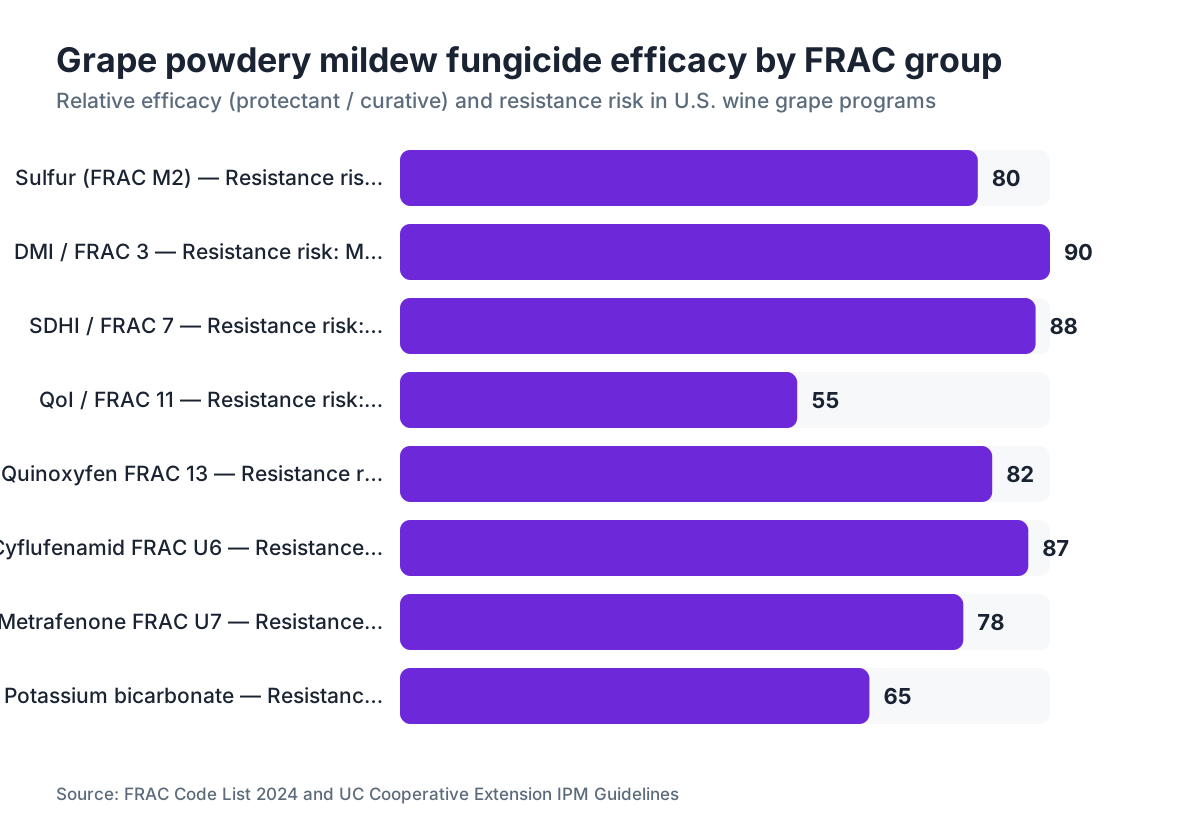
The systemic FRAC groups that UC Davis, Cornell, and WSU all recommend rotating include:
- FRAC 3 (DMI / sterol demethylation inhibitors): myclobutanil (Rally), tebuconazole, trifloxystrobin. Curative activity up to 72 hours post-infection. High resistance risk.
- FRAC 7 (SDHI / succinate dehydrogenase inhibitors): fluopyram, fluxapyroxad, benzovindiflupyr. Newer mode of action with strong efficacy, but resistance cases are already documented in California [5].
- FRAC 11 (QoI / strobilurins): azoxystrobin, trifloxystrobin, pyraclostrobin. Effective, but resistance in powdery mildew populations is widespread in some California regions. Use cautiously and never alone [5].
- FRAC 13 (quinoxyfen): limited to 2 applications per season, good premix partner.
- FRAC U6 (cyflufenamid): excellent efficacy, narrow mode of action, limit to 2 sprays per season.
- FRAC U7 (metrafenone): contact, disrupts haustoria formation, fits well as a rotation partner.
- Potassium bicarbonate: OMRI-listed, eradicant activity, fits organic programs.
Strobilurin resistance is now common enough in California that WSU researchers recommend treating FRAC 11 as support chemistry, not a primary fungicide, in high-pressure situations [5]. Cornell's guidelines for the Northeast suggest no more than one application per season in some regions [6].
Spend the money on a true FRAC 3 or FRAC 7 product timed at bloom. That's where it pays. Save the cheaper sulfur runs for early-season buildup and late-season maintenance.
How do you build a resistance management rotation for grape powdery mildew?
Fungicide resistance in Erysiphe necator is documented in commercial vineyards, not a theoretical worry. The FRAC (Fungicide Resistance Action Committee) recommends never making more than two consecutive applications of a single-site fungicide from the same FRAC group before switching to a different mode of action [7]. Most university guidelines add a sharper rule: no more than two to four applications of any single-site FRAC group per season, total.
A practical rotation for a conventional 10-spray season in a high-pressure region might look like this. Start with sulfur (FRAC M2) for the first two to three sprays. Insert a FRAC 3 DMI at bloom when curative activity matters most. Rotate to a FRAC 7 SDHI at fruit set. Go back to sulfur for two intervals, add a FRAC U6 or U7 product, and finish the season with potassium bicarbonate or sulfur. That's a rough sketch, not a prescription. Your local UC Cooperative Extension or Cornell Cooperative Extension advisor will know the resistance situation in your specific region.
The fastest way to wreck a rotation is to reach for the same high-efficacy systemic every time pressure spikes. Resist that. A fully susceptible population of Erysiphe necator can shift to practical resistance in as few as five to seven generations under continuous single-site selection pressure [7]. In warm climates running 10 to 12 generations per season, that happens faster than you think.
Accurate spray records (product names, FRAC codes, dates applied, rates) are the only way to know where you stand in a rotation. They're also compliance paperwork required under California DPR and most other state pesticide regulations. Tools like VitiScribe log FRAC codes alongside application records so you can see your rotation on a timeline instead of hunting through handwritten notebooks mid-season.
What organic or non-chemical options actually work for powdery mildew control in grapes?
Organic growers aren't at a big disadvantage here. Sulfur and potassium bicarbonate are OMRI-listed and genuinely effective. The gap between a well-timed sulfur program and a good synthetic program shrinks a lot when intervals are tight and coverage is good.
Other materials with documented (if sometimes modest) efficacy:
Neem oil and clarified hydrophobic extract of neem: OMRI-listed, some contact and systemic activity. The real limit is label restrictions on pre-harvest interval and mixing (don't mix with sulfur within two weeks). Coverage is everything with oils.
JMS Stylet Oil (petroleum-based spray oil): works mechanically by disrupting mycelium and blocking germination. Has eradicant properties up to 72 hours post-infection in some studies. Not OMRI-listed but compatible with some organic programs depending on the certifier [8].
Biological agents: Bacillus subtilis products (Serenade, Cease) and Bacillus amyloliquefaciens (Double Nickel) show real efficacy in university trials as a supplement to a full program, but not as standalone controls in high-pressure seasons [9]. Treat them as interval-stretchers or rotation slots, not as primary protection during bloom.
Canopy management gets dismissed as a soft option, but it isn't. Shoot positioning, leaf removal in the fruiting zone (one to two passes, typically pre-bloom and post-set), and avoiding excess nitrogen all cut the microclimate conditions that favor colonization. Cornell research found a single pre-bloom leaf pull in the fruit zone reduced powdery mildew severity by 30 to 50 percent in some trial years [6]. That's a real number. It also helps spray penetration in dense canopies.
Cover crops and vine spacing choices affect air circulation and how fast morning dew dries. These are slow levers, but they matter for chronic problem blocks.
How do application coverage and equipment affect powdery mildew control?
A great fungicide applied with poor coverage is a mediocre fungicide. Powdery mildew colonizes both upper and lower leaf surfaces, plus cluster stems, rachises, and berries. Getting material into the fruit zone of a dense Napa-style canopy in July is genuinely hard.
Air-blast sprayer calibration is the starting point. WSU's extension service recommends a minimum water volume of 50 to 100 gallons per acre in most grape canopies, climbing to 100 to 150 gallons per acre in denser canopies or at high leaf area index stages [10]. Many growers under-dilute systemic fungicides because they assume the chemistry compensates. It doesn't.
Droplet size matters too. Powdery mildew control benefits from finer droplets (100 to 200 micron VMD range) than some other applications, because you need canopy penetration and surface coverage. Coarser droplets cut drift but can miss interior surfaces. Adjusting nozzle selection seasonally, finer in dense post-bloom canopies, larger early season, is worth the 20-minute setup time.
Apply when wind is below 10 mph, temperature is below 90°F, and you have at least 4 to 6 hours before expected rain (for protectant products). Most systemic FRAC 3 and FRAC 7 materials are rainfast within 2 to 4 hours. Check the label, not a neighbor's estimate.
For small blocks or steep terrain where a tractor-mounted airblast is impractical, backpack or motorized mistblowers can work, but they need more passes and slower travel to match coverage. Don't skip blocks because access is hard. Those are usually the disease reservoirs that re-infect the rest of the vineyard.
How do you identify powdery mildew on grapes vs. other diseases?
The white powdery coating is recognizable, but early infections and cluster infections can be subtle enough to mistake for other problems.
Early-season: Watch for flag shoots, canes that emerge stunted and distorted and covered in white mycelium. These come from buds infected the prior season. Flag shoots are a high-inoculum warning sign [2].
Leaf symptoms: White powdery patches, usually starting on the upper leaf surface in drier regions. Downy mildew starts as yellow oily spots on upper surfaces with gray-purple sporulation below. Powdery mildew growth is always white and shows on both leaf surfaces. Leaves may curl or pucker.
Cluster symptoms: Early infection webs white mycelium over the rachis and young berries. Infected berries turn brown at the infection site, harden, and often crack as they try to expand against stiffened skin. Cracked berries then pick up secondary Botrytis. Late-season infections on larger berries may show as a faint white coating or brown netting (russeting), particularly on darker-skinned varieties.
With downy mildew (Plasmopara viticola), you'll see the classic "oil spot" yellow lesions on upper surfaces and white cottony sporulation on the lower surface. The two diseases can co-occur. If you're unsure, a hand lens at 10x lets you see the true powdery mycelium and conidiophores of Erysiphe necator clearly. Downy mildew sporangiophores look bushy and tree-like under magnification, very different.
Botrytis (gray mold) on clusters can look superficially like advanced powdery mildew, but Botrytis is gray-brown and fuzzy rather than white and powdery, and it develops under high humidity and after berry injury rather than in warm, dry conditions.
What are the pre-harvest intervals and re-entry intervals for common powdery mildew fungicides?
Pre-harvest intervals (PHI) and re-entry intervals (REI) are on every fungicide label and they're legally binding. The EPA Worker Protection Standard (40 CFR Part 170) requires that PHI and REI information be posted at the agricultural establishment and that workers stay out of treated areas during the REI without full PPE [11].
Here are PHI and REI values for commonly used grape powdery mildew fungicides. Always verify against the current label, since these can change with label revisions:
| Product (active ingredient) | FRAC | PHI (days) | REI (hours) |
|---|---|---|---|
| Wettable sulfur (various) | M2 | 0 (day of harvest) | 24 |
| Potassium bicarbonate (Kaligreen, MilStop) | NC | 0 | 4 |
| Myclobutanil (Rally 40WSP) | 3 | 7 | 24 |
| Tebuconazole (Elite) | 3 | 7 | 12 |
| Fluopyram + trifloxystrobin (Luna Sensation) | 7+11 | 7 | 12 |
| Penthiopyrad (Fontelis) | 7 | 7 | 12 |
| Azoxystrobin (Abound) | 11 | 14 | 4 |
| Quinoxyfen (Quintec) | 13 | 14 | 12 |
| Cyflufenamid (Torino) | U6 | 7 | 12 |
| Metrafenone (Vivando) | U7 | 7 | 12 |
| JMS Stylet Oil | NC | 0 | 4 |
If you're harvesting in phases or running a tight schedule, sulfur and potassium bicarbonate give you the most flexibility on PHI. The 14-day PHI on azoxystrobin catches growers off guard in early harvest blocks.
Under the EPA Worker Protection Standard, agricultural employers must provide pesticide safety training, access to labels and SDS sheets, and decontamination supplies [11]. California's DPR adds requirements including a certified pesticide applicator or qualified applicator licensee signature on restricted-use pesticide records [12].
Can you eat grapes with powdery mildew on them?
This one comes up a lot, and the honest answer has some caveats. Grapes with light powdery mildew on the skin are technically edible and not known to cause illness in healthy adults. The fungus is host-specific to Vitis species and related plants. It doesn't produce mycotoxins the way Aspergillus or some Fusarium species do.
That said, berries with visible powdery mildew infection often taste bad. The mycelium leaves a musty, unpleasant flavor. Heavily infected berries develop skin cracking, which leads to secondary Botrytis, and Botrytis-colonized grapes can carry ochratoxin A under certain conditions, a mycotoxin with regulatory limits in wine in the European Union [13]. So while eating a few lightly infected table grapes off the vine isn't a health emergency, heavily molded clusters with secondary fungal growth are a different story.
For wine grapes, infected fruit is a quality problem even at low infection levels. Erysiphe necator mycelium carries fatty acids and odor compounds that survive into wine, giving what winemakers describe as a "moldy" or "earthy" off-character. UC Davis research showed that even 3 percent bunch infection could produce detectable sensory defects in finished wine [2]. If you're selling fruit, buyers will reject clusters with visible infection, and rightly so.
For fresh market table grapes, USDA grade standards allow no more than a small tolerance for disease defects including mildew. Commercially, infected table grapes don't reach retail in any real quantity.
So: eating a few affected grapes won't hurt you, but you wouldn't want to, and for wine production, even light infection matters.
How do regional differences affect grape powdery mildew management?
Where you farm shapes almost every management decision. Erysiphe necator pressure varies dramatically by region, and so do the fungicide resistance patterns in local populations.
California's North Coast (Napa, Sonoma) has warm, dry summers with little rain during the growing season. Disease pressure comes from inoculum in overwintering chasmothecia and infected buds rather than repeated wet-weather spore events. The dry conditions mean sprays aren't washed off, but the warm temperatures also push the fungus through generations fast. Strobilurin (FRAC 11) resistance is well-documented in California, and some FRAC 7 resistance has been detected [5]. Programs here run sulfur-heavy with strategic FRAC 3 and FRAC 7 placements.
The Pacific Northwest (Oregon's Willamette Valley, Washington's Columbia Valley) has more variable humidity. In warmer eastern Washington AVAs, powdery mildew management resembles California's approach. In cooler, wetter Willamette conditions, the overlap with downy mildew management adds complexity, and some fungicides pull double duty.
The Northeast (Finger Lakes, Hudson Valley, Long Island) deals with higher rainfall and humidity, which means more fungicide washoff, shorter effective intervals, and often the added challenge of managing both powdery and downy mildew at once. Cornell's Viticulture and Enology program publishes one of the best regional spray guides, updated annually, specific to New York conditions [6].
The Southeast and mid-Atlantic contend with different Vitis species susceptibility profiles. Native American varieties like Concord and hybrids like Chambourcin have some natural resistance, but vinifera grown in these climates is highly susceptible. Summer heat and humidity create a different pressure curve.
For growers looking at wine country destinations like Paso Robles wineries or coastal California operations, local AVA climate data is the first thing any honest disease management plan should reference. What works in Dundee, Oregon won't necessarily translate to Temecula.
For a broader look at how different operations handle this, vineyard management practices vary widely by region, and knowing your local conditions is the foundation.
How should spray records for powdery mildew applications be kept for compliance?
Pesticide application records aren't optional. California requires licensed applicators to keep records of all pesticide applications for three years, covering both restricted-use and general-use pesticides applied to agricultural crops [12]. Federal law under FIFRA requires records for restricted-use pesticides for two years. Other states have similar rules with varying timelines.
A compliant spray record for a powdery mildew application needs at minimum: applicator name and license number (if restricted-use product), product name and EPA registration number, active ingredient, rate applied, total amount used, crop and site description, application date and time, application method, and the target pest. Some states add weather conditions at time of application.
For a 12-spray powdery mildew season with multiple products, that's a lot of paperwork. Missing an EPA Reg number or logging the wrong rate is exactly the kind of thing that shows up in a DPR audit. The practical answer is a spray log template that captures every required field before the application happens, not after.
Tracking FRAC codes next to your legal spray records isn't legally required, but it's one of the smarter operational habits you can build. When you can look at a season's records and see FRAC 11, FRAC 11, FRAC 11 three times in a row on a single block, you catch a resistance problem developing before the fungicide quits on you. Platforms like VitiScribe build FRAC code tracking into the spray log so it's captured automatically instead of as a separate exercise.
Keep physical or digital copies accessible to employees in case of a WPS inspection. Under the EPA Worker Protection Standard, workers are entitled to pesticide application information including product names and PHI/REI dates [11].
What does a full-season powdery mildew spray program actually cost?
Nobody talks about this honestly enough. The cost of a powdery mildew program swings hard on region, pressure level, acreage, and whether you run conventional or organic. But ballpark numbers help.
A sulfur-dominant program for a low-to-moderate pressure season might run 8 to 10 applications at roughly $10 to $20 per acre per application in product cost (wettable sulfur at current pricing), so $80 to $200 per acre in fungicide materials. Application cost depends on whether you're using your own equipment and labor, but contract spraying typically runs $30 to $80 per acre per pass in most wine regions as of 2024. A 10-pass season at $50 per pass is $500 per acre in application cost alone.
A conventional program that adds two or three strategic FRAC 3 or FRAC 7 sprays at bloom and fruit set tacks on $40 to $80 per acre in product cost for those passes. A FRAC U6 product like cyflufenamid (Torino) runs $25 to $40 per acre per application. Premium SDHI-strobilurin premixes can run $50 to $90 per acre.
For a 20-acre block in a high-pressure region running a full 12-application conventional program with materials and application, total costs in the $900 to $1,500 per acre range are not unusual. On $20,000-per-ton Napa Cabernet, that's an easy call. On $500-per-ton bulk Chardonnay, the math is tighter, and stretching interval length or cutting pass count becomes a real operational decision.
Organic programs cost more per material application (potassium bicarbonate, neem, and biologicals all run higher per acre than sulfur) but can be offset by premium pricing for certified organic fruit.
Nobody has great industry-wide data on average per-acre powdery mildew program costs across U.S. wine regions. The closest public figures come from UC Cooperative Extension sample cost studies, published for several California production regions and updated periodically [14].
Frequently asked questions
Can you eat grapes with powdery mildew on them?
Eating lightly infected grapes won't make you sick. Erysiphe necator doesn't produce mycotoxins. But heavily infected berries with cracking often carry secondary Botrytis, which can produce ochratoxin A under some conditions. More practically, infected grapes taste musty and bad. For wine, even 3 percent bunch infection causes detectable flavor defects in finished wine, according to UC Davis research.
What is the best fungicide for grape powdery mildew?
There's no single best product. Sulfur (FRAC M2) is the most reliable backbone because resistance has never developed to it. For curative activity around bloom, a FRAC 3 DMI like myclobutanil or a FRAC 7 SDHI product is most effective. The key is rotating FRAC groups to slow resistance. Never rely on strobilurins (FRAC 11) alone in California; documented resistance is widespread there.
How often should I spray for powdery mildew on grapes?
Spray every 7 days during the highest-risk period: pre-bloom through 3 to 4 weeks after fruit set. Before and after that window, 10 to 14-day intervals with a good protectant are usually enough. After veraison, you can often stretch to 14 days or focus on foliar applications only. Adjust interval based on temperature, rainfall, and local disease pressure model outputs.
What temperature kills powdery mildew on grapes?
Erysiphe necator is suppressed, not killed, above 95°F (35°C). Prolonged heat above 100°F can destroy surface mycelium. But the fungus survives inside tissue and in bark, so a heat spike doesn't clean up an established infection. Temperatures below 50°F (10°C) stop spore germination. The sweet spot for active disease development is 70 to 85°F with relative humidity above 40 percent.
What's the difference between powdery mildew and downy mildew on grapes?
Powdery mildew (Erysiphe necator) produces white powdery colonies on both leaf surfaces and clusters. It thrives in warm, dry conditions and needs no free water to infect. Downy mildew (Plasmopara viticola) causes yellow oil-spot lesions on upper leaf surfaces with gray-white cottony sporulation underneath, and requires free water for infection. The two diseases often need different fungicide programs, though timing overlaps can allow combination products.
Is powdery mildew worse in wet or dry weather?
Counterintuitively, powdery mildew is worse in warm, moderately dry conditions. Unlike downy mildew, it doesn't need rain or free water for spore germination. High humidity (40 to 80 percent RH) supports sporulation, but heavy rainfall actually washes spores off surfaces and suppresses the disease temporarily. Overcast, humid weather with moderate temperatures and no rain is close to ideal for powdery mildew. Dew can support infection.
How do I know if my fungicide program has resistance problems?
Signs include reduced control despite correct timing and coverage, with products that used to work well at the same rates. FRAC 11 resistance in California populations is now common enough that many advisors treat strobilurins as essentially ineffective alone. Formal resistance testing is available through some university plant pathology labs. The practical response is to drop FRAC 11 as a primary option and rotate hard among other groups.
What is a flag shoot and why does it matter for powdery mildew?
A flag shoot is a cane that emerges in spring from a bud infected with overwintering Erysiphe necator mycelium. It looks stunted, distorted, and covered in white powdery growth. Flag shoots are primary inoculum sources for the season. Finding multiple flag shoots in a block tells you your overwintering inoculum is high, meaning you need tight early-season spray intervals and shouldn't delay your first application.
Can I use the same powdery mildew fungicide all season on grapes?
No. Using a single-site fungicide (FRAC groups 3, 7, 11, 13, U6, U7) repeatedly through a season selects for resistance in the Erysiphe necator population. FRAC guidelines recommend no more than two consecutive applications of the same FRAC group before switching modes of action. Maximum seasonal applications for most single-site products range from two to four, depending on product label and group. Sulfur has no resistance risk and can be used throughout.
What are the worker re-entry intervals for grape powdery mildew sprays?
REI varies by product. Sulfur and potassium bicarbonate have a 4 to 24-hour REI depending on the specific label. Most systemic fungicides like myclobutanil (Rally) carry a 24-hour REI. Azoxystrobin (Abound) is 4 hours. Under the EPA Worker Protection Standard, REI information must be posted and workers may not enter treated areas without full PPE during the REI. Always check the current product label.
How does canopy management reduce powdery mildew in grapes?
A well-positioned, open canopy improves spray penetration into the fruit zone and increases air circulation, which speeds drying of dew and cuts the humidity that supports spore germination. Cornell research found pre-bloom leaf removal in the fruit zone reduced powdery mildew severity by 30 to 50 percent in some trial years. Excess nitrogen also raises susceptibility by producing soft, fast-growing tissue. Canopy management doesn't replace fungicides but meaningfully cuts pressure.
What records do I legally need to keep for powdery mildew fungicide applications?
California requires three-year record retention for all pesticide applications on agricultural crops, including applicator license, product name, EPA registration number, active ingredient, rate, amount used, crop, site, date, time, and application method. Federal law under FIFRA requires two-year records for restricted-use pesticides. Other states have similar requirements. Records must be accessible to workers under the EPA Worker Protection Standard and available for regulatory inspection.
Do organic vineyards have effective options for powdery mildew control?
Yes, several. Sulfur (OMRI-listed) is the primary tool and genuinely effective when applied on a 7 to 14-day interval with good coverage. Potassium bicarbonate (MilStop, Kaligreen) adds eradicant activity. JMS Stylet Oil has curative properties up to 72 hours post-infection. Bacillus subtilis products (Serenade) work as supplemental interval-extenders. A well-timed organic sulfur program competes well with conventional programs when intervals are maintained.
What varieties of grapes are most susceptible to powdery mildew?
Vitis vinifera varieties are the most susceptible. Among them, Chardonnay, Cabernet Sauvignon, Merlot, and Zinfandel are considered highly susceptible. Muscat varieties are extremely susceptible. American Vitis labrusca varieties like Concord have much greater natural resistance. Many hybrid varieties bred for disease resistance (Regent, Marquette, Frontenac) have significant resistance but are not immune. Sulfur-sensitive labrusca varieties require alternative chemistry even in conventional programs.
Sources
- Plant Disease, USDA / APS, 2019 review on Erysiphe necator economic impact: Powdery mildew causes 20 to 40 percent yield loss in susceptible varieties when left uncontrolled
- UC Davis Viticulture and Enology, Grape Powdery Mildew: Clusters are most susceptible from just before bloom through about 3 to 4 weeks after berry set; 3 percent bunch infection causes detectable sensory defects in wine
- Washington State University Extension, Powdery Mildew Management in Grapes: Degree-day model base 50°F; approximately 50 accumulated degree-days from January 1 signals rising primary ascospore infection risk
- UC Cooperative Extension, Pest Management Guidelines: Grape: Sulfur phytotoxicity risk above 95°F and within two weeks of oil application; Concord and labrusca varieties are sulfur-sensitive
- University of California Cooperative Extension, Fungicide Resistance in Grape Powdery Mildew: FRAC 11 resistance is well-documented in California Erysiphe necator populations; some FRAC 7 resistance has been detected
- Cornell Cooperative Extension, New York and Pennsylvania Pest Management Guidelines for Grapes: Pre-bloom leaf removal in the fruit zone reduced powdery mildew severity by 30 to 50 percent in some trial years; no more than one FRAC 11 application per season recommended in some regions
- FRAC (Fungicide Resistance Action Committee), FRAC Code List 2024: No more than two consecutive applications of a single-site FRAC group before switching; a susceptible population can shift to practical resistance in five to seven generations under continuous selection
- WSU Extension, Stylet-Oil for Powdery Mildew Control in Grapes: JMS Stylet Oil has eradicant properties up to 72 hours post-infection in trials
- UC Cooperative Extension, Biological Control Products for Grape Powdery Mildew: Bacillus subtilis products show efficacy as supplement to a full program but not as standalone controls in high-pressure seasons
- Washington State University Extension, Sprayer Calibration and Application Technology for Vineyards: Minimum 50 to 100 gallons per acre water volume recommended; 100 to 150 gallons per acre in dense canopies
- U.S. EPA, Worker Protection Standard (40 CFR Part 170): PHI and REI must be posted; workers may not enter treated areas without full PPE during REI; workers entitled to access pesticide application information
- California Department of Pesticide Regulation, Pesticide Use Reporting: California requires three-year retention of pesticide application records; restricted-use pesticides require licensed applicator or QAL signature
- European Food Safety Authority (EFSA), Ochratoxin A in Food and Grapes: Ochratoxin A has regulatory limits in wine in the European Union; Botrytis-colonized grapes can carry this mycotoxin under certain conditions
- UC Cooperative Extension, Sample Costs to Produce Wine Grapes: Per-acre production cost data for California wine grapes including pest management expenses
Last updated 2026-07-09