Fungicide for powdery mildew on grapes: what actually works
TL;DR
- Powdery mildew (Erysiphe necator) is the most economically damaging fungal disease in most U.S.
- grape-growing regions.
- Sulfur, DMI fungicides (FRAC 3), and QoI strobilurin fungicides (FRAC 11) form the backbone of most programs.
- Timing beats product choice: the window from budbreak to 6-inch shoots is where you win or lose the season.
- FRAC 11 resistance is widespread.
What is powdery mildew on grapes and why does it spread so fast?
Grape powdery mildew is caused by the obligate biotrophic fungus Erysiphe necator (formerly Uncinula necator). It's the single most economically damaging fungal disease in most U.S. wine and table grape regions, costing growers millions in lost fruit quality and yield every season [1]. The pathogen overwinters as chasmothecia (sexual fruiting bodies) in bark crevices, or, more commonly in warm regions, as mycelium in dormant buds. That's the part that catches people off guard. The disease is already inside the vine before you see a single white colony.
Spores release early, often when temperatures first climb above 50°F (10°C) and vines are pushing bud break. The conidia that spread the disease germinate best between 68°F and 77°F (20-25°C) and don't need free moisture on the leaf surface at all. That's a big difference from downy mildew. E. necator actually gets inhibited by prolonged rain and humidity above 90%, which is why hot, dry inland regions often see severe outbreaks while cooler coastal vineyards sometimes catch a break [1][2].
Infected clusters are the real economic loss. Berries infected before veraison can crack or develop a cork-like surface that ruins wine quality. Post-veraison infections still leave a sensory footprint in finished wine, with off-aromas linked to geraniol and 1-octen-3-ol production in infected tissue. Take the disease seriously early, or you're managing cleanup later.
Here's the blunt version. By the time the vine looks sick, you've already lost a generation of spores to the wind.
When should you start spraying fungicide for powdery mildew on grapevines?
Start at budbreak and don't wait for symptoms. That's the answer that has held up across 30 years of UC Davis, Cornell, and WSU research. By the time you see the white powdery coating, the infection is 7 to 14 days old and the fungus has already produced a new generation of conidia [2][3].
WSU's extension recommendations put the highest-risk window as budbreak through 4-6 weeks post-budbreak, specifically the period from 0 to roughly 300 degree-days (base 50°F) [3]. That's when young rachis tissue is most susceptible. Cornell's integrated pest management program uses the same logic, calling the period from 1-inch green through cluster separation the 'critical window' for powdery mildew management [4].
In most California coastal or Pacific Northwest regions that means your first spray goes on at 50% budbreak, full stop. If you're in a high-pressure region (Napa Valley floor, Columbia Valley, Paso Robles), weekly 7-day intervals with protectant sulfur through bloom are standard. Lower-pressure sites can stretch to 10-14 days between sprays, especially post-veraison. UC Davis IPM guidelines specify a 7-day interval during bloom and up to 14 days at other times, depending on weather and disease pressure [1].
One more thing. Morning temperatures below 50°F on the day of spray don't stop you. Sulfur applied protectively sits on the tissue and volatilizes slowly over days as temperatures warm. The protection is cumulative.
Which fungicide classes are most effective against grape powdery mildew?
Here's a quick map of the main chemistry groups, their FRAC codes, and how to think about them in a real program:
| FRAC Group | Class | Example Active Ingredients | Mode of Action | Resistance Risk |
|---|---|---|---|---|
| M2 | Inorganic sulfur | Sulfur (wettable, micronized, flowable) | Multi-site | Very low |
| 3 | DMI / triazole | Myclobutanil, tebuconazole, metconazole | Sterol biosynthesis inhibitor | Moderate |
| 11 | QoI / strobilurin | Azoxystrobin, trifloxystrobin, pyraclostrobin | Respiration inhibitor (Qo site) | High (widespread) |
| 7 | SDHI | Fluxapyroxad, boscalid | Succinate dehydrogenase inhibitor | Moderate-high |
| U8 | Quinoxyfen | Quinoxyfen | Unknown, pre-penetration | Moderate |
| BM01 | Mineral oil | Stylet-Oil, JMS Stylet-Oil | Physical / suffocant | None |
| NC | Potassium bicarbonate | Kaligreen, Armicarb | pH disruption | None |
Sulfur is still the workhorse of almost every program. Micronized wettable sulfur products (80% sulfur, particle size under 5 microns) give good redistribution on leaves and clusters. The downside is phytotoxicity risk above 90°F (32°C), especially on Chardonnay, Riesling, and Concord types. Many growers switch to JMS Stylet-Oil or potassium bicarbonate during heat waves and come back to sulfur when temperatures drop [1][5].
DMI fungicides (FRAC 3) are the most widely used single-site materials in commercial programs. Myclobutanil (Rally 40WSP) is probably the most common in the eastern U.S. Tebuconazole and metconazole dominate in parts of California. They work systemically and can stop an infection in progress if applied within 72-96 hours of an infection event. Rotate them with other FRAC groups. Using FRAC 3 more than 2-3 times per season in sequence selects for reduced-sensitivity populations [6].
QoI strobilurins (FRAC 11) have a resistance problem you cannot spray your way around. Resistance is widespread in E. necator populations across California and the Pacific Northwest. A 2011 study published in Plant Disease found 'complete resistance to QoI fungicides in powdery mildew populations sampled from commercial California vineyards' [6]. If you're still leading with azoxystrobin as your primary material, reconsider. QoI fungicides still have a place as tank-mix components with a multisite, but they're not reliable stand-alone materials in high-pressure regions.
SDHIs (FRAC 7) like fluxapyroxad and boscalid are newer and effective, but resistance is developing in some regions. Limit to 2 applications per season and always mix with a multisite [7].
Biologicals and organics are the honest weak link. The biofungicide market for powdery mildew includes Bacillus subtilis products (Serenade Optimum), Reynoutria sachalinensis extract (Regalia, which elicits plant resistance via FRAC P5), and neem oil. None of them give the protectant efficacy of sulfur under high pressure. They make the most sense in organic programs where sulfur is the primary material and biologicals add suppressive activity, not as replacements for conventional chemistry in a conventional program.
What's the best fungicide program for powdery mildew on grapes?
There's no single best product. The best program is a rotation that manages resistance while keeping the disease below economic threshold. Here's how most experienced advisors build it.
Start with a protectant like sulfur from budbreak through about 6-inch shoot growth. Add a DMI (FRAC 3) or SDHI (FRAC 7) at bloom, when cluster tissue is most vulnerable and weather is often unfavorable for tractor access. Use a 7-day interval during bloom regardless of conditions. After fruit set, stretch intervals to 10-14 days if pressure is moderate and rotate between your FRAC groups so you're never making more than two consecutive applications of any single-site chemistry.
WSU's powdery mildew management guidelines suggest 'no more than two sequential applications of any single mode of action' as a firm resistance-management rule [3]. UC Davis IPM reinforces this with product-specific application limits, typically 2-4 per season for most DMI and SDHI products [1].
Post-veraison, the berries are less susceptible but the rachis and skin infections from earlier in the season can still progress. Many growers drop to a 14-day sulfur program post-veraison through about 3-4 weeks before harvest. Watch your PHI (pre-harvest interval) carefully: sulfur has a 0-day PHI for most registrations, but tebuconazole has a 7-day PHI and some DMI products run 14 to 30 days [8].
For organic growers, the standard program is micronized sulfur on 7-day intervals through bloom, potassium bicarbonate as a rescue treatment if you get behind, and Bacillus subtilis-based materials to add suppressive pressure. The National Organic Program allows sulfur under 7 CFR Part 205 as long as it meets purity standards. Your certifier should confirm your specific product is on your approved materials list [9].
How do DMI fungicides compare to sulfur for grape powdery mildew?
They do different jobs, and that's the whole answer. Sulfur is a protectant. It prevents new infections by killing conidia on contact and has zero post-infection activity. DMI fungicides are systemic and have both protectant and curative activity, meaning they can stop an established infection if you apply them within roughly 72-96 hours of the infection period. They also have some eradicant activity, which is useful if you come back from a rain delay and find early colonies.
The practical implication: during bloom, when you might miss a spray window due to rain or tractor access issues, a DMI at the next opportunity is worth more than sulfur alone. Outside of bloom, especially on a tight 7-day sulfur schedule with no lapses, the added cost of a DMI may not pencil out for a low-pressure site.
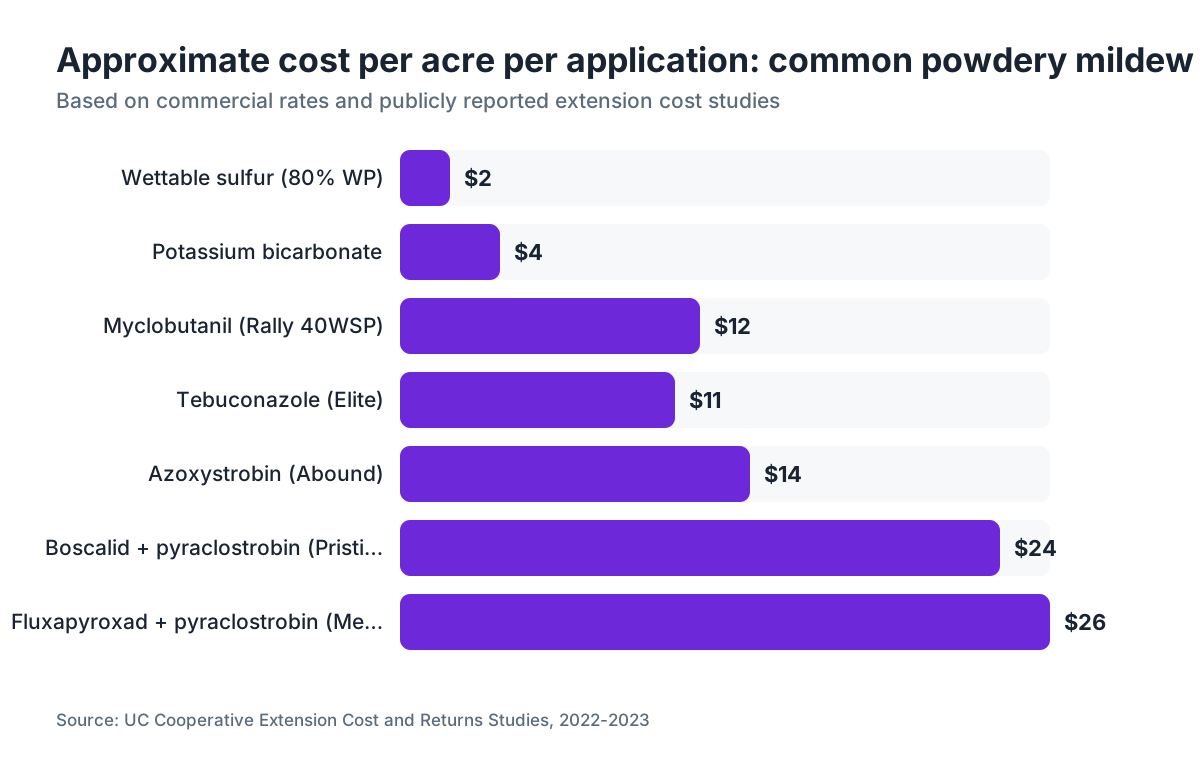
The cost gap is real. Micronized sulfur products run roughly $1.50-$3.00 per acre per application at label rates for commercial 80% WP formulations. DMI fungicides like Rally 40WSP run $8-$15 per acre depending on rate and supplier. SDHI premixes (Pristine, Luna Sensation) can run $18-$30 per acre. Nobody has perfect current pricing here because distributor contracts vary widely, but those ranges reflect what's been publicly reported in extension cost-of-production studies [5][10].
For a small vineyard manager, the practical program is short: sulfur as the backbone, one or two DMI applications at bloom, and no QoI strobilurin products as your lead material.
How do you get rid of powdery mildew on grape vines mid-season?
If you're already seeing active colonies on leaves or clusters, you're in rescue mode. The first thing to do is honestly assess how widespread it is. Scattered leaf colonies on lower canopy leaves in July are a different problem from cluster infections at bunch closure.
For active infections within 72-96 hours: apply a DMI fungicide (myclobutanil, tebuconazole) at the labeled curative rate, which is often the higher end of the label range. Don't use QoI strobilurins as your rescue material in California or Pacific Northwest vineyards given widespread resistance [6].
For older colony growth on leaves: potassium bicarbonate (Kaligreen, Armicarb) at 2.5-5 lbs per 100 gallons has genuine eradicant activity by creating a high-pH environment that disrupts fungal cell membranes. It's not as strong as a DMI but it's useful in organic programs or as a tank-mix addition. JMS Stylet-Oil can smother established colonies physically.
For cluster infections: if you're past veraison and seeing cluster infections, the damage to that fruit is largely done. Maintain your spray interval to stop spread to adjacent clusters. Sulfur with a 14-day interval and good canopy penetration is appropriate. More volume helps. Most powdery mildew sprays go on at 30-75 gallons per acre by air-blast, but clusters at fruit set respond better to 60-100 gallons per acre for penetration [1].
Document everything. A spray record that shows your application dates, weather at application, and rates gives you a real picture of where your program broke down and helps adjust next season. If you're tracking multiple blocks with different disease pressure, field-by-field records matter for compliance and agronomic learning alike. Tools like VitiScribe help vineyard managers log spray records by block with application timing and weather data in one place.
One thing I'd actually do: pull 10-20 shoot tips per variety per block at bloom and examine them under a hand lens. Early colony detection on shoot tips is a reliable leading indicator of cluster risk and buys you a couple of days before berries are exposed.
What about resistance to fungicides in grape powdery mildew?
Resistance is the biggest long-term threat to your spray program, and it's not theoretical. The 2011 Plant Disease study by Marks et al. screened California vineyard populations and found complete resistance to QoI (FRAC 11) fungicides in a majority of samples tested [6]. The G143A mutation responsible for QoI resistance has been confirmed across multiple California AVAs and in Pacific Northwest populations.
DMI resistance is more complicated. It's quantitative rather than binary, meaning populations develop reduced sensitivity over time with repeated selection pressure rather than flipping a single resistance gene. Monitoring programs at UC Davis have tracked shifts in DMI sensitivity across California vineyards for over a decade, and the trend is toward reduced efficacy in heavily sprayed districts [1].
The practical rules:
- Never apply more than 2 sequential sprays of any single-site FRAC group.
- Always tank-mix single-site products with a multisite (sulfur, copper, mineral oil) to reduce selection pressure.
- Rotate FRAC groups across the season: FRAC 3 at bloom, FRAC 7 at fruit set, back to multisite sulfur through the rest of summer.
- Don't increase rates to compensate for reduced efficacy. That accelerates resistance selection. If your product isn't working, switch modes of action.
The Fungicide Resistance Action Committee (FRAC) publishes resistance risk ratings and use recommendations for all registered chemistries. Their grape powdery mildew guidance is worth reading before you finalize your spray program each season [7].
Are there organic fungicides for powdery mildew on grapes that actually work?
Yes, with an honest caveat about efficacy ceilings. Organic programs can get good control in moderate-pressure years with a disciplined approach. They get harder to hold in high-pressure years or when weather causes spray delays.
The most effective materials in certified organic programs:
Sulfur is still the foundation. OMRI-listed micronized sulfur at 3-4 lbs per 100 gallons, 7-day intervals during bloom. Phytotoxicity risk above 90°F is the main constraint [1].
Potassium bicarbonate (Kaligreen, Armicarb, MilStop) is OMRI-listed, 2.5-5 lbs per 100 gallons. Genuine protectant and mild eradicant activity. Good choice for post-veraison when you want to avoid sulfur residue and heat is a factor.
Mineral/neem oils like JMS Stylet-Oil are widely used. Physical mode of action, low resistance risk. Efficacy is moderate. It works best as a supplement to sulfur rather than a replacement.
Bacillus-based biofungicides like Serenade Optimum (Bacillus subtilis QST 713) show consistent suppressive activity in trials but rarely match sulfur head-to-head under high disease pressure. UC Davis trials have shown 40-60% disease reduction versus 70-90% for sulfur alone [1].
Regalia (Reynoutria sachalinensis extract, FRAC P5) works by eliciting plant systemic resistance rather than direct fungicidal action. Trials show useful suppression when applied preventively and in combination with other materials.
For NOP compliance, 7 CFR Part 205.601 lists the conditions under which copper and sulfur-based materials are allowed as crop disease management tools [9]. Your specific product must appear on your certifier's approved materials list, and some formulations include synthetic adjuvants that disqualify them. Check before you buy.
What do spray records for powdery mildew fungicides need to include?
In the U.S., pesticide application records for restricted-use pesticides (RUPs) are required under FIFRA Section 8 and must be kept for 2 years [11]. For general-use pesticides, California requires records under CDPR regulations, and most other states with significant grape acreage have their own reporting requirements. If you're selling to a winery, your grape purchase agreement almost certainly requires spray records going back to the previous harvest.
At minimum, a complete powdery mildew spray record should contain:
- Date and time of application
- Field/block identifier and acreage
- Product name, EPA registration number, and formulation
- Rate per acre and total product used
- Target pest (Erysiphe necator or powdery mildew)
- Applicator name and, if applicable, license number
- Wind speed and direction, temperature, relative humidity at application
- Equipment used and spray volume per acre
- Pre-harvest interval (PHI) on label
- Re-entry interval (REI) and posted date if applicable under the Worker Protection Standard
The EPA Worker Protection Standard (40 CFR Part 170) requires that workers not enter a treated area before the REI expires, that REI information be posted or communicated, and that records be maintained. Sulfur has a REI of 24 hours. Many DMI products have REIs of 24-72 hours depending on formulation [12].
Paper logs work. Spreadsheets work. The advantage of field software is that block-by-block records are searchable when a winery auditor calls in September asking for your spray history. VitiScribe is built for exactly this: spray records link directly to the block and variety, with PHI tracking and WPS compliance fields included.
One practical note. Log the batch/lot number of each product container. If there's ever a residue dispute or a recall, you'll need it.
How does powdery mildew risk vary by grape variety and region?
Variety susceptibility is real and shapes your spray program. Vitis vinifera varieties are highly susceptible across the board. Within vinifera, Chardonnay, Cabernet Sauvignon, Zinfandel, and Merlot are generally considered high-susceptibility. Riesling and Gewurztraminer are sometimes listed as moderately susceptible but are also very sensitive to sulfur phytotoxicity, which complicates the program [1].
American species and their hybrids (V. labrusca, V. riparia, V. aestivalis) have much higher native resistance. Concord, Catawba, Niagara, and most French-American hybrids like Chambourcin, Marquette, and Frontenac have substantially lower powdery mildew susceptibility and often need far fewer fungicide applications [4]. Cornell has done the most thorough variety resistance screening work and publishes susceptibility ratings through the New York State IPM program [4].
Regionally, the highest-pressure environments are hot, dry inland areas with warm nights: the San Joaquin Valley floor, interior Columbia Valley, and parts of the Texas Hill Country. In these areas, disease conditions persist almost all season and 7-day intervals from budbreak through harvest are standard. In maritime-influenced regions (Willamette Valley, Sonoma Coast, Finger Lakes), the pressure is often moderate and disease-forecasting models can help you skip unnecessary sprays.
Degree-day models for powdery mildew are available through several university extension systems. The UC IPM Powdery Mildew Risk Index integrates temperature, humidity, and vine phenology to give a daily risk score. WSU's Decision Aid System (DAS) does similar work for Pacific Northwest growers [3]. Using these models in low-pressure years can cut your spray count by 2-4 applications without raising disease risk, which matters both economically and for resistance management.
What are the pre-harvest interval (PHI) and worker protection rules you need to know?
The pre-harvest interval is the minimum number of days that must pass between your last application and harvest. It's on the label. The label is the law under FIFRA [11]. Here are the PHIs for commonly used powdery mildew fungicides in grapes (always confirm with your current product label, as registrations change):
| Product / Active Ingredient | Typical PHI (days) | FRAC Group |
|---|---|---|
| Wettable sulfur | 0 | M2 |
| Myclobutanil (Rally 40WSP) | 7 | 3 |
| Tebuconazole (Elite) | 7 | 3 |
| Azoxystrobin (Abound) | 0 | 11 |
| Trifloxystrobin (Flint) | 7 | 11 |
| Boscalid + pyraclostrobin (Pristine) | 0 | 7+11 |
| Fluxapyroxad + pyraclostrobin (Merivon) | 0 | 7+11 |
| Quinoxyfen (Quintec) | 7 | U8 |
| Potassium bicarbonate | 0 | NC |
| JMS Stylet-Oil | 0 | BM01 |
Note: Abound (azoxystrobin) has a 0-day PHI but a 4-hour REI. Sulfur has a 24-hour REI. These are different requirements and both apply [12].
The EPA Worker Protection Standard (WPS) under 40 CFR Part 170 requires: posting field safety information including REI at the central location, ensuring workers receive pesticide safety training annually, and providing decontamination supplies. Violations carry fines up to $19,162 per violation as of the 2023 penalty adjustment [12]. For vineyard operations with seasonal hired labor, WPS compliance is the highest-stakes area in the whole spray program. It gets missed constantly.
California has additional requirements under the Department of Pesticide Regulation (CDPR): every pesticide application in the state must be reported to the county agricultural commissioner within a monthly reporting cycle, and use reports are due to the commissioner by the 10th of the following month [13]. Other states have their own reporting thresholds. Check your state's department of agriculture.
How do you scout for and confirm powdery mildew before applying fungicide?
Scouting is how you tune your program to actual pressure rather than the calendar. Here's what to look for and when.
Early season (budbreak through 6-inch shoot growth): examine shoot tips and young leaves on susceptible varieties. E. necator colonies start as faint, slightly bleached patches that develop a white to gray powdery surface. Under a 10x hand lens you can see the conidiophores standing up from the surface. On green tissue they're easy to confuse with spray residue. Scrape gently with your fingernail. Powdery mildew comes off as a distinct colony. Spray residue smears.
Bloom through fruit set: examine the rachis. A gray, ash-like coating on the rachis is a serious warning sign. Infected rachis tissue stays stiff and can shatter at veraison if infection is severe enough to cause cork formation.
Post-fruit set: look at berries directly. Early berry infections appear as a slight discoloration or faint web-like mycelium under magnification. By the time you see obvious white colonies on berries at or after veraison, the damage is done.
Record your scouting observations by block. A threshold commonly used in practice: any visible powdery mildew colony on clusters at or before bloom triggers a DMI application at the next spray opportunity. Leaf-only colonies at low incidence (under 5% of leaves in a shoot-tip sample) in a block with good spray history can often be managed with continued sulfur without adding a DMI [1].
Scout at least weekly from budbreak through veraison. After veraison, every two weeks is usually enough unless you had a high-pressure season. Consistent scouting records are the only way to know if your program is working.
Frequently asked questions
What is the best fungicide for powdery mildew on grapes?
There's no single best product. The most effective programs combine micronized sulfur (FRAC M2) as a backbone with a DMI fungicide like myclobutanil or tebuconazole (FRAC 3) at bloom. Sulfur is cheap, has no resistance risk, and a 0-day PHI. DMI fungicides add curative activity for missed spray windows. Avoid relying on QoI strobilurins (azoxystrobin, trifloxystrobin) as lead materials: widespread resistance has been confirmed in California and Pacific Northwest vineyards.
How often should I spray fungicide for powdery mildew on grapes?
During bloom, apply every 7 days without exception. From budbreak to bloom and from fruit set to veraison, 10-day intervals work for moderate-pressure sites; high-pressure inland sites need 7-day intervals all season. Post-veraison, 14-day sulfur applications are typically enough. UC Davis IPM recommends 7-day intervals during bloom and up to 14 days at other growth stages depending on disease pressure and weather conditions.
Does powdery mildew on grapes need water or rain to spread?
No. This is a key difference from downy mildew. Erysiphe necator conidia germinate without free moisture on the leaf surface and are actually inhibited by prolonged rain and humidity above 90%. The disease spreads most rapidly under warm, dry conditions with moderate humidity, which is why hot inland regions often have severe pressure even in drought years.
Can I use baking soda to treat powdery mildew on grape vines?
Baking soda (sodium bicarbonate) has some fungicidal activity but is weaker than potassium bicarbonate products like Kaligreen or Armicarb, and repeated sodium applications can raise soil sodium levels and hurt soil structure. Potassium bicarbonate is the better choice: it's OMRI-listed, has a 0-day PHI, and has better efficacy data in vineyard trials. It works best as a rescue treatment or supplement to sulfur rather than a primary fungicide.
How do I know if my grape powdery mildew fungicide is still working?
Scout 5-7 days after each application and compare colony density and spread to your pre-application scouting. If disease keeps advancing at the same rate despite timely applications at correct rates, suspect resistance, especially in FRAC 11 products. Switch FRAC groups immediately and add a multisite like sulfur. University extension plant disease diagnostic labs in your state can test population sensitivity if you need confirmation.
What is the pre-harvest interval for sulfur on grapes?
Wettable sulfur has a 0-day pre-harvest interval on most registered labels for grapes in the United States. It does have a 24-hour re-entry interval (REI) under the EPA Worker Protection Standard. Always confirm with your specific product label. Some winery purchase contracts add restrictions on sulfur applications close to harvest due to sensory concerns in finished wine.
Is powdery mildew on grapes dangerous to eat?
Grapes with visible powdery mildew are not toxic to humans, but heavily infected fruit has significant quality problems: cracked or russeted skins, off-aromas from fungal metabolism, and elevated volatile acidity in wine made from infected fruit. For table grapes, infected berries are unpalatable and unmarketable. Eating small amounts of mildewed grapes won't cause harm, but the fruit quality is seriously degraded.
What spray equipment works best for powdery mildew fungicide on grapevines?
Air-blast sprayers are the standard for commercial vineyards, applied at 30-100 gallons per acre depending on canopy density and growth stage. During bloom and fruit set, higher volumes (60-100 gallons per acre) improve cluster penetration. Backpack sprayers work for small plots. Calibrate your output annually: under-coverage is a leading cause of control failures, especially in dense mid-season canopies where clusters are buried in foliage.
How do you treat powdery mildew on grape vines organically?
Organic programs rely on micronized sulfur as the primary material at 7-day intervals during bloom, supplemented with potassium bicarbonate for rescue treatments and Bacillus subtilis products for added suppression. Mineral oils like JMS Stylet-Oil help smother established colonies. Under the National Organic Program (7 CFR Part 205), sulfur is permitted with conditions. Confirm your specific product is on your certifier's approved materials list before use.
What varieties of grapes are most susceptible to powdery mildew?
All Vitis vinifera varieties are highly susceptible. Within vinifera, Chardonnay, Zinfandel, Cabernet Sauvignon, and Merlot are considered particularly prone. American species (V. labrusca, V. riparia) and French-American hybrids like Chambourcin, Marquette, and Frontenac have substantially lower susceptibility. Cornell's New York State IPM program publishes variety susceptibility ratings based on multi-year trial data.
Do I need a pesticide license to apply DMI fungicides to grapes?
Most DMI fungicides used on grapes, including myclobutanil (Rally 40WSP) and tebuconazole, are general-use pesticides and do not require a Certified Pesticide Applicator license for a grower applying to their own property. For-hire applications always require a commercial applicator license. Restricted-use pesticides do require a license or direct supervision by a licensed applicator. Check your state's department of agriculture for specific licensing requirements.
What records do I need to keep for fungicide applications on grapes?
Under FIFRA Section 8, restricted-use pesticide records must be kept for 2 years. California requires all pesticide applications to be reported to the county agricultural commissioner on a monthly cycle. Winery contracts typically require spray records for the current and prior vintage. A complete record includes application date, block, product name and EPA registration number, rate, applicator name, and weather conditions. Both paper and digital logs are acceptable; digital records are easier to retrieve during audits.
Can I tank-mix sulfur with DMI fungicides for grape powdery mildew?
Yes, and it's recommended for resistance management. Tank-mixing a single-site fungicide (DMI, SDHI, or QoI) with a multisite like sulfur reduces the selection pressure on the single-site chemistry. One exception: do not mix sulfur with oil-based products like JMS Stylet-Oil, since the combination can cause severe phytotoxicity. Check your product labels for specific compatibility warnings before mixing.
When does powdery mildew stop being a problem in the vineyard season?
Disease risk drops significantly after veraison as berry skin composition changes and tissue becomes less susceptible. Most growers reduce spray frequency to 14-day intervals post-veraison. The rachis and stem tissue stay susceptible, though, and late-season cluster infections can still occur in high-pressure years. The practical end of the active spray season is typically 3-4 weeks before harvest, governed by PHI requirements on your last product used.
Sources
- UC IPM, UC Davis: Powdery Mildew (Erysiphe necator) Pest Management Guidelines for Grapes: E. necator overwinters in bark and buds, infects young rachis tissue most severely, and UC IPM recommends 7-day spray intervals during bloom with up to 14-day intervals at other growth stages depending on pressure
- UC Davis Viticulture and Enology: Powdery Mildew Biology: Conidia germinate without free moisture and are inhibited by sustained humidity above 90%; optimal temperature range is 68-77°F
- Washington State University Viticulture and Enology / Decision Aid System: WSU identifies budbreak through roughly 300 degree-days (base 50°F) as the highest-risk window and recommends no more than two sequential applications of any single mode of action
- Cornell Cooperative Extension, New York State IPM: Grape IPM Guidelines: Cornell identifies the period from 1-inch green through cluster separation as the critical window and publishes variety susceptibility ratings showing hybrid varieties have substantially lower powdery mildew risk than V. vinifera
- UC Cooperative Extension: Sample Costs to Establish and Produce Winegrapes, Napa County: Micronized sulfur products in commercial programs run approximately $1.50-$3.00 per acre per application; DMI fungicides approximately $8-$15 per acre
- Marks, M.S. et al., Plant Disease (2011): 'Complete resistance to QoI fungicides in powdery mildew populations sampled from commercial California vineyards': Study confirmed widespread QoI fungicide resistance (G143A mutation) in E. necator populations across California commercial vineyards
- Fungicide Resistance Action Committee (FRAC): FRAC Code List for Grape Powdery Mildew: FRAC publishes resistance risk ratings for all registered fungicide chemistry groups including SDHI (FRAC 7) materials with moderate-high resistance risk in E. necator
- EPA Pesticide Registration: Tebuconazole Product Labels: Tebuconazole carries a 7-day pre-harvest interval on grape labels; some DMI products carry 14 to 30-day PHIs
- USDA National Organic Program: 7 CFR Part 205.601 - Allowed and Prohibited Substances: 7 CFR Part 205.601 lists conditions under which copper and sulfur-based materials are allowed for crop disease management in certified organic production
- UC Cooperative Extension: Cost and Returns Studies for Vineyards: SDHI premix fungicides (Pristine, Luna Sensation) run approximately $18-$30 per acre per application in commercial vineyard programs
- EPA: Federal Insecticide, Fungicide, and Rodenticide Act (FIFRA) and Pesticide Recordkeeping: FIFRA Section 8 requires restricted-use pesticide application records to be kept for 2 years and the pesticide label is enforceable as law
- EPA: Agricultural Worker Protection Standard (40 CFR Part 170): The WPS requires REI posting, annual worker safety training, and decontamination supplies; civil penalties reach $19,162 per violation under the 2023 adjustment
- California Department of Pesticide Regulation: Pesticide Use Reporting: California requires pesticide use to be reported to the county agricultural commissioner on a monthly cycle, with reports due by the 10th of the following month
Last updated 2026-07-09