Bird netting installation and removal records for harvest management

TL;DR
- Vineyard bird netting records should capture installation date, block or row ID, netting type and dimensions, crew names, removal date, and any damage or re-netting events.
- Those records protect you under EPA Worker Protection Standard requirements, support crop insurance documentation, and give you season-over-season data to tighten your timing.
- Unprotected high-pressure sites lose 15 to 25 percent of a crop to birds.
Why do bird netting records matter for vineyard management?
Bird damage sneaks up on you. You walk a row two days before picking and half the Pinot clusters are hollowed out. Good records won't bring those berries back. They will tell you exactly when you netted last season, which blocks you skipped, and whether your timing lined up with the damage you found. That's actionable information.
Records also matter legally. EPA's Worker Protection Standard (WPS) requires agricultural employers to document when and where workers enter areas that may carry pesticide residue, and netting work often happens right after a spray application [1]. If your crew hangs nets in a block during the restricted-entry interval (REI) of a fungicide or insecticide, you need records showing they got early-entry handler training and proper PPE. The WPS doesn't care whether you were netting or pruning. The hazard is the residue, not the task.
Crop insurance is another driver. Many multi-peril policies ask for field-by-field records of cultural practices when you file a wildlife-damage claim. A USDA Risk Management Agency adjuster will ask what protection was in place. A dated installation log beats "we usually net around veraison" every time [2].
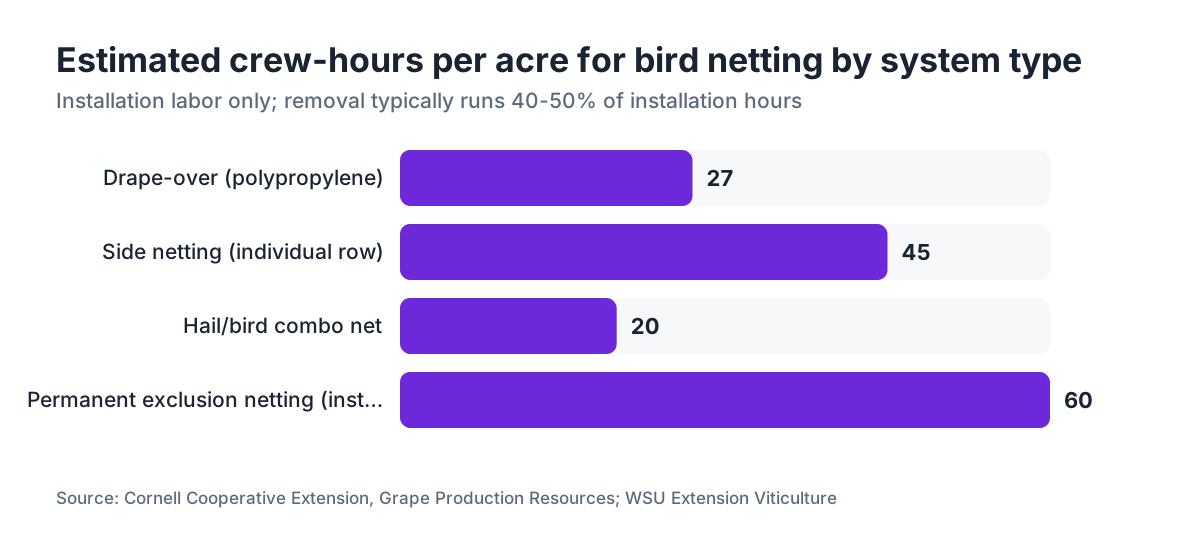
Then there's labor cost. Netting a vineyard eats crew hours. Cornell Cooperative Extension work on Eastern US grape operations puts hand-labor for netting installation and removal at roughly 20 to 40 hours per acre depending on vine architecture and netting style [3]. If you don't record what you spent, you can't benchmark it or bid it accurately next season.
What information should a bird netting installation record include?
The minimum useful record has six fields: date, block or row ID, netting type, crew, hours, and notes on conditions. Here's what each one does for you.
Date. Be specific to the day, not the week. Bird pressure can jump in 48 hours, especially for early-ripening varieties like Chardonnay or Pinot Gris. Knowing you netted August 14 versus August 21 tells you whether you were ahead of or behind veraison-triggered pressure.
Block or row ID. Use the same identifier your spray records use. Consistency across record types is the whole game at audit time. If your spray log says "Block 4B" and your netting log says "the hillside block," you've made reconciliation work for yourself later.
Netting type and dimensions. Record whether you're using drape-over, side-netting, or a hail-plus-bird net. Note mesh size (3/4 inch or smaller for starlings), color, and manufacturer if you're tracking durability across seasons. This matters when you're comparing net longevity and deciding whether an eight-cent-per-square-foot net beats a four-cent one over five seasons.
Crew. Names or worker IDs. This connects to WPS documentation and to labor cost accounting. If an injury happens during installation, you need this record.
Hours. Total crew hours, not clock-in and clock-out. Three people working four hours each is 12 crew-hours. This is the number that lets you calculate cost per acre over time.
Notes. Gaps left at row ends for equipment access, sections skipped for uneven canopy, tears found in stored netting before installation. These look minor in August. They matter a lot when you're diagnosing bird pressure in a specific zone in October.
When should you install bird netting relative to veraison?
Net at or just before veraison, when berries begin to soften and accumulate sugar, because that's when they turn attractive to birds. That's the standard recommendation from WSU Extension [4]. In practice, "at veraison" means different things depending on your pressure level and variety spread.
In high-pressure sites near riparian corridors, starling roosts, or urban areas, you may need to net 7 to 10 days before veraison to beat the early scouts. In low-pressure inland sites, you can sometimes wait until 50 percent veraison with minimal loss. Your own records, if you kept them, answer this better than any general guideline.
Variety timing complicates things. Grow Pinot Noir alongside Cabernet Sauvignon and those blocks hit veraison weeks apart. Your log needs to capture the sequence, not a single farm-wide install date. WSU's Viticulture and Enology program publishes variety-specific phenology guides that help you build a predictive calendar [4].
One honest caveat. Nobody has good published data on the exact loss-versus-timing curve for most American Vitis vinifera regions. The closest estimates come from economic threshold studies in Australian viticulture, which found damage escalates sharply within the first 10 days after veraison when netting is absent. Treat that as a directional signal, not a firm American number.
What should a bird netting removal record include?
Removal records get less attention than installation records. They close the loop on several things you need to know.
Log these at minimum: removal date, block ID, condition of the netting (tears, UV degradation, mesh fouling from leaves or bird waste), storage location, and crew hours. Add a column for whether the block stayed fully protected through harvest or whether gaps or early-removal events happened. That last item is what your crop insurance adjuster wants to see.
Netting condition at removal is the data point most growers ignore and then regret. A note that reads "20 percent of rows in Block 3 had tears along the top where clips failed" is exactly what you need when ordering replacement clips next spring and when figuring out why Block 3 took more damage than Block 2.
Storage location matters more than it sounds. Netting stored wet grows mildew and degrades faster. If you logged storage location and pulled that same net out two seasons later in poor shape, your records explain why. Some operations photograph the stored bales and attach the photos to the record. That takes about 90 seconds and saves a lot of guesswork.
Removal date also feeds your labor model. If installation took 15 crew-hours per acre and removal took 8, that gap is common (removal goes faster when the vines aren't in full canopy), and knowing it helps you schedule crews during the harvest rush.
How does bird netting documentation connect to EPA Worker Protection Standard compliance?
This is where growers most often have a gap between what they do in the field and what they can prove on paper.
The EPA WPS (40 CFR Part 170) requires agricultural employers to keep records of any early-entry into treated areas, including the pesticide product, the REI, the tasks performed, the specific early-entry provisions followed, and the names of workers [1]. Net a block on Day 2 of a 4-day REI and that's an early-entry event. You need a record of it.
The practical fix is to cross-reference your spray log and your netting log by block and date. Before scheduling a netting crew, check whether any block sits in an active REI. If it does, you either wait until the REI expires or you document the early-entry exception fully. UC Davis Cooperative Extension publishes a WPS compliance checklist that walks through exactly this sequence [5].
WPS records must be kept for two years from the date of the activity [1]. That lines up well with netting records generally. Two seasons of data is about the minimum before you start seeing useful patterns in your timing and damage relationship.
One thing worth knowing: the WPS 2015 revision tightened the documentation requirements. Pre-2015 templates that many operations still use may be missing required fields. Check yours against the current 40 CFR Part 170 text.
What's a practical record-keeping system for netting logs that won't fall apart at harvest?
The system that fails every year is the one that needs detailed data entry at a desk during the three most chaotic weeks of the farming calendar. Keep in-field capture dead simple. Do the full entry later.
A field form with checkboxes and blanks that a crew lead can fill out in five minutes beats a tablet app that needs Wi-Fi and a login. The form fits one side of a letter-sized sheet per block. At the end of each day, a manager photographs the forms and files them digitally. That's the whole field protocol.
For digital consolidation, a simple spreadsheet with one row per block-event works for operations under 100 acres. Columns: Block ID, Event Type (Install/Removal/Re-net), Date, Netting Type, Crew IDs, Hours, Condition Notes, Storage Location, Linked Spray Record ID. That last column is the link to your WPS documentation.
Operations running more blocks or multiple sites often find that purpose-built vineyard record software makes the linking between spray records, netting records, and labor logs much cleaner. VitiScribe, for example, was built to connect those record types so an audit-ready package doesn't need manual reconciliation across three binders. A well-maintained spreadsheet still gets you 80 percent of the way there at zero software cost.
Whatever you use, back it up somewhere that isn't the truck. Cloud sync, a weekly email to yourself, a copy on a USB drive in the office. Losing two seasons of records to a computer failure is avoidable and genuinely painful.
For growers running multiple varieties and blocks across larger production regions, a consistent block-ID schema is worth an hour before the season starts. See how operations around Paso Robles wineries and South Coast Winery handle block-level documentation for ideas on naming conventions.
How do you track partial netting, gaps, and re-netting events?
Real vineyards don't get netted in one clean pass. A block might be 60 percent netted on Day 1, finished on Day 3, torn by a tractor on Day 10, and re-netted on Day 11. Your record needs all of that, or the protection timeline has holes.
The cleanest way to handle partial coverage is to record each installation event separately instead of updating a single row. One row per event: date, block, rows covered ("Rows 1 to 18 of 30"), crew, hours. When the block is complete, a summary row notes 100 percent coverage with the final date. Now you have an accurate picture of when each portion of the block was actually protected.
Gaps for equipment access are worth noting explicitly. A 3-row gap left open for a tractor pass is a known bird entry point. Note its location ("rows 14 to 16, north end, left open for ATV access") and the date it closed if it closed before harvest.
Re-netting events should carry a damage description: what caused the failure (wind, equipment, deer entanglement), how large the gap was, how long it stayed open. If you had a 12-hour gap on a high-pressure day and found damage in that zone, your record explains what happened. Without it, that loss looks like random variation.
What do crop insurance and state agricultural programs require for wildlife damage claims?
USDA Risk Management Agency policies covering grape crops under Whole-Farm Revenue Protection (WFRP) or Actual Production History (APH) don't mandate a specific netting log format. They do require you to demonstrate you took reasonable measures to protect the crop [2]. "Reasonable measures" is exactly the kind of phrase a records-based argument settles cleanly.
When you file a wildlife damage claim, an adjuster may ask: when were protective measures installed, which blocks were covered, were there known gaps, and when did you find the damage. A dated netting log answers all four. A verbal account of what you think happened three months ago answers none of them convincingly.
Some states run supplemental wildlife damage programs. California's CDFA has administered assistance programs for bird and wildlife damage in high-pressure counties, and documentation of protective measures is typically a condition of eligibility. Check current CDFA program availability, since funding cycles shift year to year [6].
For growers pursuing organic certification, installation and removal of physical pest barriers including bird netting counts as a cultural practice that USDA National Organic Program (NOP) certifiers may review during your annual inspection [7]. Netting records that match your organic system plan show you're relying on physical controls as a primary pest strategy, which is exactly what NOP wants to see.
How much does bird netting cost per acre, and how should you track that in your records?
Material and labor costs for vineyard bird netting swing hard by system type, vine spacing, and regional labor rates. Here's a realistic range built from published extension budgets and industry estimates.
| System Type | Material Cost (per acre) | Labor (crew-hours/acre) | Notes |
|---|---|---|---|
| Drape-over (polypropylene) | $250-$600 | 20-35 | Most common; reusable 3-5 seasons |
| Side netting (individual row) | $400-$900 | 35-55 | Better for wine grapes; clips add cost |
| Hail/bird combo net | $800-$1,500 | 15-25 | Larger upfront; multi-threat protection |
| Exclusion netting (permanent) | $2,000-$5,000+ | High install, near zero annual | Capital investment; uncommon in small ops |
These ranges come from Cornell Cooperative Extension and WSU Extension published budgets, with the caveat that material prices moved after the 2021 to 2022 supply chain disruptions and should be checked against current supplier quotes [3][4].
Tracking your actual cost per acre gives you a number worth knowing. Over five years, if your drape netting averages 2.5 seasons before replacement and your labor runs $18 an hour in your region, you can calculate a real per-season, per-acre netting cost and set it against documented bird damage savings. That's the analysis that justifies (or challenges) your netting budget to a bank, a partner, or yourself.
Keep material cost and labor cost as separate fields in your netting log. They move independently. Material prices are a market variable. Labor rates are partly within your control through crew efficiency.
How can you use netting records to improve bird pressure management over multiple seasons?
The real payoff of good records isn't compliance. It's looking back across three or four seasons and seeing what actually cut losses.
Start by linking your netting installation dates to your harvest records by block. If Block 2 consistently shows more bird damage than Block 5, and your records show Block 2 got netted 5 days later on average, that's a hypothesis worth testing. If they were netted the same day and Block 2 still runs higher, look at proximity to tree lines, riparian cover, or adjacent unnetted properties.
Damage assessment at removal is the input most operations skip. Before you pull the nets, walk the block and note clusters with bird damage by percentage of the row or zone. This doesn't need a formal sample count. A quick visual estimate ("rows 1 to 8 clean, rows 9 to 12 show moderate damage near the east end gap") gives you spatial data that a total-block yield number never will.
Over time you build a simple table: year, block, install date relative to veraison, netting type, estimated bird damage percentage at removal, final yield. Patterns in that table are worth real money. Netting one week earlier in a 20-acre high-pressure block might save you 3 percent of yield at $2,000 a ton. That math closes fast.
UC Cooperative Extension publishes multi-year integrated pest management (IPM) data for bird pressure in California wine grape regions that works as a regional benchmark for your own block-level numbers [8].
What are common mistakes in netting records that create problems later?
The most common mistake is recording the plan instead of what actually happened. You planned to net Block 7 on August 10. You actually netted it on August 13 because the net was still drying from last season's wash. If your record says August 10, it's wrong, and wrong records are worse than no records when you're reconstructing events for an insurance claim or a WPS audit.
Second most common: one record for the whole farm instead of block-level records. "Netted everything the week of August 12" is useless for block-level damage analysis and inadequate for WPS cross-referencing if your blocks had different spray dates.
Inconsistent block identifiers are a silent problem that compounds over years. If Block 4 shows up as "Block 4," "B4," "the Cab block," and "hillside" across different records, reconciling them by hand takes hours you don't have. Pick a naming convention and enforce it on every record type from day one.
The last one is failing to record re-netting events. A net installed, then torn and repaired three times during the season, has a very different protection timeline than a net installed once and left alone. That difference matters for damage analysis and for warranty claims against the manufacturer if you're arguing premature degradation.
For operations running a vineyard across several blocks with different team leads, consistent record templates handed to every crew before the season prevents most of these problems before they start.
Frequently asked questions
Do I legally have to keep bird netting records?
No federal law specifically mandates bird netting logs. But EPA's Worker Protection Standard (40 CFR Part 170) requires records of any early-entry into pesticide-treated areas, and netting installation often happens near spray events. Crop insurance adjusters and organic certifiers may also require documentation of protective practices. The legal exposure comes from adjacent record-keeping requirements, not netting-specific rules.
How long should I keep bird netting installation and removal records?
Keep them at least two years to align with EPA WPS record-keeping requirements. For crop insurance, three years is safer since APH-based policies look back over multiple seasons. For your own damage analysis, the longer you keep them the more useful they get. A five-year archive stored digitally takes essentially no space and answers questions you don't know you'll have yet.
What's the best time of day to install bird netting in a vineyard?
Early morning, before full sun. Heat makes polypropylene nets stiffer and harder to work with. Morning dew makes nets slightly tacky and less likely to snag on cane tips, which sounds counterintuitive but matters in practice. Your crew is fresher and faster in cool conditions too, which cuts labor hours per acre. WSU Extension vineyard resources recommend early-morning installation for both efficiency and worker comfort [9].
Can I use one netting record template for multiple blocks?
Use one template, but fill it out per block, not per farm. A template covering one block per page or per spreadsheet row keeps things consistent while holding block-level resolution. A single farm-wide record loses the spatial detail you need for damage analysis and for matching spray records to specific treated areas under WPS requirements.
How does mesh size affect bird exclusion, and should I record it?
Yes, record it. The standard recommendation for European starlings, the most damaging vineyard bird across most American regions, is 3/4-inch mesh or smaller. Larger mesh keeps out robins and jays but lets starlings through. If you're testing mesh sizes across blocks, your records are the only way to know which worked better. Record mesh size in millimeters or inches per the manufacturer spec, more than a brand name.
What should I photograph when installing and removing bird netting?
At installation: a wide shot of each netted block showing coverage, plus close-ups of known gaps or damaged sections flagged for repair. At removal: any sections with visible damage or UV degradation, the condition of stored bales, and zones where bird damage showed up before removal. Photos don't replace written records but they add spatial context text can't fully capture. Your phone's date stamps come free.
Do bird netting records need to be kept separately from spray records?
They can live in separate documents as long as they share block IDs and dates that let you cross-reference. Keeping them in the same binder or digital folder by block is fine. The thing that matters is that you can pull the spray record and the netting install record for the same block on the same date within a few minutes. Auditors and adjusters don't care about your filing system. They want the information fast.
How do I record bird netting on trellised vines versus sprawling or bush vines?
The record fields stay the same. The notes differ. For sprawling or bush-trained vines, note that a drape-over method was used and record approximate coverage area rather than row count. For VSP or vertically trellised blocks, row count and row length give you a cleaner coverage calculation. Using side netting on individual rows? Note which side, because east-west orientation sometimes affects clip wear and UV exposure unevenly.
Can bird netting records help with yield forecasting?
Indirectly, yes. If your records show which blocks were netted, when, and what damage occurred anyway, you can build a block-level protection effectiveness history. Combined with yield data, you can estimate how much of your year-to-year variance is protection-related versus weather or vine-age related. It won't replace a formal yield estimate, but it removes one variable from the noise.
What's a reasonable crew-hours-per-acre benchmark for netting installation?
Cornell Cooperative Extension work on Eastern US grape operations found 20 to 40 crew-hours per acre for installation depending on vine architecture and netting type, with side netting toward the high end and drape-over toward the low. Removal runs roughly half that. Your first season with a new system always takes longer. Experienced crews on familiar trellises get faster. Track your own hours and within two seasons you'll know your real number.
Should I record bird netting information in my vineyard's organic system plan?
Yes. USDA National Organic Program certifiers review your organic system plan annually, and physical pest barriers including bird netting are a preferred cultural practice under NOP rules. Your netting records should match what your OSP describes. If your OSP says you use physical exclusion as a primary bird management strategy, your netting logs are the evidence you actually do it. A gap between the plan and the records is a common audit finding.
How do I track netting damage caused by deer or other wildlife?
Add a damage-cause field to your removal or re-netting records: bird pressure, equipment contact, deer entanglement, wind, or UV failure. This matters for the repair-versus-replace decision, for warranty claims, and for deciding whether deer exclusion fencing pays off. If deer keep destroying netting in a particular zone, your records quantify the cost of that problem and support the capital case for fencing.
Are there any digital tools designed specifically for vineyard bird netting records?
Most vineyard-specific farm management platforms include a custom activity or cultural practice log where you can add netting events linked to block records. VitiScribe is built around this kind of block-level record linking, connecting netting logs to spray records and labor tracking in one place. A well-structured spreadsheet works for smaller operations. The feature to look for in any tool is cross-referencing netting dates with spray application dates by block.
How does bird netting record-keeping differ between small family vineyards and large commercial operations?
The required fields stay the same. Scale and system differ. A 5-acre family vineyard can manage with a paper log and a simple spreadsheet reviewed once a season. A 200-acre operation with multiple crew leads and contractors needs a consistent template enforced across teams, digital storage with backup, and a way to query records by block across seasons. Block-level, event-by-event documentation holds regardless of scale.
Sources
- EPA, Agricultural Worker Protection Standard (40 CFR Part 170): WPS requires records of early-entry into pesticide-treated areas, including tasks performed, REI, provisions followed, and worker names; records must be kept two years.
- USDA Risk Management Agency, Whole-Farm Revenue Protection Handbook: Crop insurance policies require demonstration of reasonable protective measures when filing wildlife damage claims.
- Cornell Cooperative Extension, Grape IPM and Production Resources: Hand-labor for netting installation and removal runs roughly 20-40 crew-hours per acre depending on vine architecture and netting style in Eastern US grape operations.
- Washington State University Extension, Viticulture and Enology: WSU Extension recommends netting at or just before veraison when berries begin to soften and accumulate sugar; variety-specific phenology guides support timing decisions.
- UC Davis Cooperative Extension, Worker Protection Standard Compliance Resources: UC Davis Cooperative Extension publishes WPS compliance checklists for California agricultural operations, including early-entry documentation requirements.
- California Department of Food and Agriculture, Wildlife Damage Management: CDFA has administered assistance programs for bird and wildlife damage in high-pressure California counties; documentation of protective measures is typically a condition of eligibility.
- USDA Agricultural Marketing Service, National Organic Program: NOP certifiers review organic system plans annually; physical pest barriers including bird netting are a preferred cultural practice under NOP rules and netting records should align with OSP documentation.
- UC Statewide Integrated Pest Management Program: UC Cooperative Extension publishes multi-year IPM data for bird pressure in California wine grape regions that serves as a regional benchmark.
- WSU Extension, Vineyard Bird Management Resources: Early-morning installation is recommended for both efficiency and worker comfort; heat makes polypropylene nets stiffer and harder to install.
- Cornell Cooperative Extension, Vineyard Economics and Enterprise Budgets: Side netting material costs range from $400-$900 per acre and drape-over polypropylene from $250-$600 per acre based on published enterprise budget data.
Last updated 2026-07-11