How to assign block codes to match spray records with harvest records
TL;DR
- A block code is a short, consistent identifier you assign to each management unit in your vineyard.
- When that same code appears on every spray record and every harvest ticket for that unit, auditors and winemakers can trace pesticide applications to specific fruit with no guesswork.
- The system works only if the code is locked to geography, never to a variety name or a vendor lot number that changes year to year.
What is a block code and why does it matter for compliance?
A block code is a short alphanumeric label, maybe three to six characters, that you permanently attach to a defined patch of ground. Define it by geography, not by what's currently planted. Rip out Merlot, replant with Cab Franc, and the code stays the same. The variety and rootstock fields on your records change. The code does not.
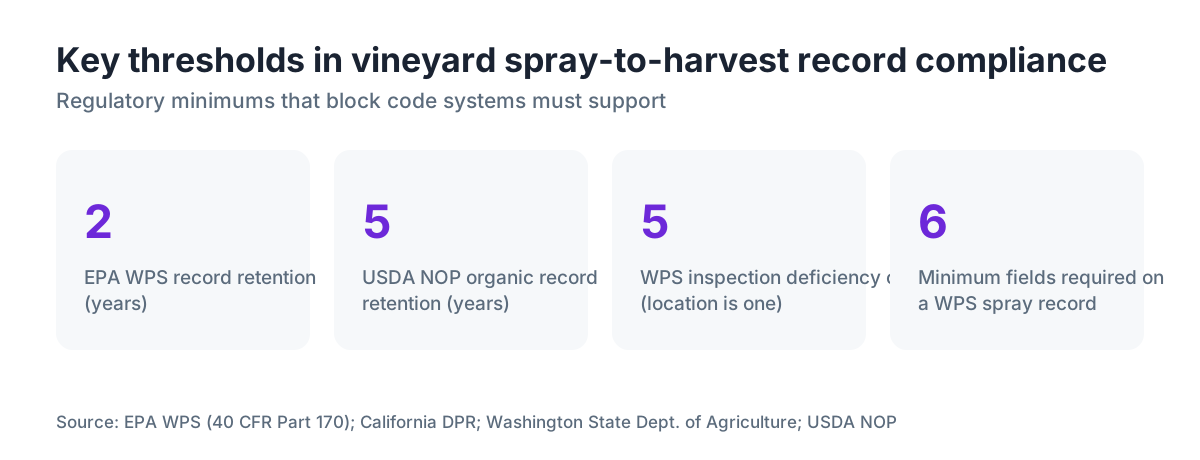
This matters because two separate regulatory tracks have to meet at harvest. The EPA Worker Protection Standard (WPS) requires records of pesticide applications including the location treated, and those records must be kept for at least two years [1]. On the other side, state departments of agriculture and TTB require harvest records documenting where fruit was grown, its weight, and its disposition. If your spray records say "East Block," your harvest tickets say "Block 4," and your winemaking notes say "Cab 2," you have three records that might describe the same three acres and might not. An auditor will not do that reconciliation for you.
The fix is one shared identifier, used everywhere, from the first pre-bloom application to the crush manifest. Get that right and traceability is almost automatic. Get it wrong and you spend the week before harvest matching paper by hand.
How should you design a block code structure?
Keep codes short enough to write by hand without error and structured enough to carry meaning at a glance. A common format from UC Cooperative Extension advisors is a two-part code: a two-letter ranch abbreviation plus a two-digit block number [2]. A property called Ridgetop Ranch running ten blocks uses RR01 through RR10. Short, unique, sortable.
Bigger operations with multiple ranches add a site prefix. Some growers run three segments: a two-letter site code, a two-letter variety or topography abbreviation, and a two-digit number. RT-CS-04 might mean Ridgetop Ranch, Cabernet Sauvignon area, block four. The trap here is obvious. The variety segment tempts you to rename the code when you replant. Don't. Let the code stay purely geographic and park variety data in its own field.
Think hard about sub-blocks before you plant a single stake. A 10-acre block with two soil types that gets split applications should be two codes from day one. Merging records later is easy. Splitting them after three years of combined spray history is a nightmare.
| Code format | Good for | Watch out for |
|---|---|---|
| RR01 (site + number) | Small to mid-size single ranch | Need prefix if you manage multiple sites |
| RT-CS-04 (site + variety + number) | Multi-variety estate | Tempts variety-based renaming on replant |
| GPS polygon ID (auto-generated) | Digital-only operations | Needs a human-readable alias for field use |
| Vineyard row range ("Rows 1-45") | Temporary or informal use | Breaks down when rows are renumbered |
How do you tie block codes to spray records specifically?
The EPA WPS at 40 CFR Part 170 requires application records to include the product name, EPA registration number, amount applied, date, location, and the restricted-entry interval [1]. Location is where your block code lives. Every spray record, paper or software, needs the code in a dedicated field. Not buried in a notes column where a search will miss it.
On paper, put the block code field in the header alongside date and applicator name. Spraying several blocks in one pass? List each code separately. Aggregating blocks on a single record line is fine for efficiency as long as every code appears and the application rate per acre is calculable for each code on its own. An auditor checking pre-harvest intervals (PHIs) needs to know exactly what went on RR04 and when, not what went on RR02-through-RR06 as a batch.
State rules stack on top of WPS. California's DPR requires pesticide use reports filed with the county agricultural commissioner, and the location entry must be specific enough to determine the site treated [3]. Washington requires pesticide use records kept for at least two years and available for inspection [4]. In both states, a vague location fails compliance even when every other field is filled in perfectly.
WSU Extension's integrated pest management resources note that location specificity is one of the most common deficiencies found during pesticide record audits [5]. From WSU guidance: "Records must identify the specific site with enough precision that an inspector can locate the treated area without additional information from the applicator." That is the bar your block codes have to clear.
How do you tie block codes to harvest records?
Harvest records come from two directions: field harvest tickets (weight, date, block, picker or machine) and winery intake records (variety, Brix, weight, lot assignment). The block code has to appear on both, in the same format, every time.
On the field side, print or write the block code on every bin ticket or weigh station slip before picking starts. Don't let pickers fill in block identification if you can help it. Pre-label the bins or tickets by block the night before. One transposed digit during harvest chaos is the kind of error that takes weeks to unwind.
On the winery intake side, your crush manifest or receiving log needs a "source block" field carrying the same code. Selling fruit to another winery? The purchase agreement should reference block codes so the buyer's records line up with your spray record obligations. Some state programs and organic certifiers require the buyer to keep the application history for the fruit they bought [6].
When you harvest multiple blocks into a single fermentation lot, keep a block-to-lot crosswalk table. It looks like this:
| Harvest lot | Source blocks | Harvest date | Combined weight (tons) |
|---|---|---|---|
| L2025-01 | RR02, RR03 | 09-04-2025 | 12.4 |
| L2025-02 | RR04 | 09-07-2025 | 6.1 |
| L2025-03 | RR07, RR08, RR09 | 09-12-2025 | 18.9 |
That table is the bridge between spray history and winery records. Lose it and traceability breaks. Keep it and any future TTB audit, organic certification review, or buyer verification request takes twenty minutes instead of two days.
What records do regulators actually check, and what will they look for?
In most states, pesticide inspectors from the county agricultural commissioner or the state department of agriculture can request spray records at any time. EPA inspection materials for the WPS list the location of treated areas among the deficiencies cited most often during vineyard inspections [1]. Location is where sloppy naming shows up first.
Organic certification is the second common trigger. The USDA National Organic Program requires certified operations to keep records that trace each product from field to sale, and the audit runs backward from the sales record to the field application log [6]. If your block codes aren't consistent across those two ends, your certifier flags it.
TTB audits for wine labeling, particularly American Viticultural Area (AVA) claims, require you to document origin at the vineyard level. For estate wine or single-vineyard designations, TTB looks for records linking the labeled fruit to the specific property and block [7]. Block codes that match from field to crush manifest to production records are the most direct way to satisfy that.
State food safety programs may also request field records for third-party audits driven by retail buyers. Wine grapes are generally exempt from the FDA FSMA produce safety rule under 21 CFR Part 112 [8], so this is usually a buyer requirement rather than a federal one, but consistent block codes speed those reviews all the same.
How many blocks is too many, and how do you handle small vineyard fragments?
There's no regulatory minimum block size. The real question is operational: does this area get managed differently from its neighbors? Different variety, different rootstock, meaningfully different spray timing, different harvest date, different buyer? If yes, it's a separate block and needs its own code.
Fragmentation is the practical headache. Some old vineyards carry twenty-seven variety blocks across twelve acres from decades of incremental replanting. You do need a code for each one if they're managed independently. A well-designed code structure handles any number of blocks without getting unwieldy. But nobody maintains codes they find confusing, so design for the person filling out harvest tickets at 5 a.m.
For a truly tiny block, under half an acre, managed identically to an adjacent larger one, you have a judgment call. You can fold the tiny block into the larger code if they share every decision: same applications, same harvest date, same buyer. Write that decision down somewhere, ideally in a block register you review every year. That register is your defense when someone later asks why five rows of old-vine Zinfandel aren't coded separately.
Managing multiple properties, VitiScribe's block registry function sets up location-based codes that auto-populate on both spray records and harvest entries. That kills the single biggest source of code drift: someone working off last year's field map.
What is a block register and how do you maintain it?
A block register is a master reference, one page per block or a single table with one row per block, that defines every attribute of each coded area. At minimum: block code, legal parcel or APN, GPS coordinates or polygon boundary, acres, variety, rootstock, year planted, trellis system, irrigation zone, and any buyer or lease agreement tied to that block.
Update it once a year, at the start of the season before any spray records open. If a block is replanted, change the variety field but keep the code and add a "replant date" column. If a block is subdivided, retire the old code and issue two new ones with a note cross-referencing the parent.
Cornell Cooperative Extension's viticulture and enology resources recommend that every vineyard over a couple of acres keep some form of block master record as the anchor document for all field-level records [9]. The format doesn't matter much. A spreadsheet, a binder, or a database all work. The discipline of reviewing it at the start of every season matters a lot, because block boundaries shift in people's memories faster than you'd expect.
Keep the block register with your pesticide records. When an inspector asks for spray records, having the register right there lets you explain the geography in thirty seconds instead of thirty minutes.
How do you fix a code mismatch discovered mid-season or after harvest?
First rule: don't alter original records. This is non-negotiable. Spray records submitted to the county agricultural commissioner are official records, and altering them is a violation. What you can do is create a reconciliation document.
A reconciliation document is exactly what it sounds like. A memo in your own file that reads: "Spray records from April through July 2025 reference 'Block 4.' Harvest tickets from the same period reference 'RR04.' These are the same 3.2-acre block located at coordinates [X,Y]. This crosswalk was created on [date] to reconcile the terminology difference." Attach supporting evidence, a field map or a copy of the block register that predates the discrepancy.
For organic certification, tell your certifier proactively. They would much rather see a clean reconciliation memo than find an unexplained gap during an inspection. Most certifiers accept a documented correction as long as there's no actual application-history problem, only a labeling inconsistency [6].
For future seasons, trace where the mismatch started. It's almost always one of three things: a new employee who used a different naming convention, a winery intake form that didn't match field terminology, or a software import that truncated or reformatted codes. Fix the cause, more than the symptom.
Should block codes be the same as APN parcel numbers or GPS polygon IDs?
Parcel numbers (APNs) are stable and legally defined, which makes them tempting as block identifiers. The trouble is that one APN can hold multiple management blocks, and one management block sometimes spans multiple APNs when a vineyard straddles a parcel line. APNs also say nothing about the farming subdivision inside the parcel. So APNs work well as a reference field in your block register and poorly as your operational code.
GPS polygon IDs, generated by mapping software or a GIS system, are precise and geographically unambiguous. UC Cooperative Extension's precision viticulture resources show that GPS-based block delineation improves record accuracy over hand-drawn maps, especially for spray-to-harvest traceability in large operations [2]. But a polygon ID like {38.2991,-122.4587}_poly_0047 does not survive a hand-written harvest ticket at 5 a.m. You need a human-readable alias.
The practical answer is to keep both. A short human-readable code for field operations, and a GPS polygon or APN reference in the block register. The short code goes on every form. The geographic reference is what you pull up when you need to prove in an audit exactly where that block sits. They cross-reference each other in the register, and neither one replaces the other.
What does a compliant spray-to-harvest record trail actually look like?
Walk it forward from first spray to final wine lot and the chain is obvious.
Step one: Spray application on April 18. The record shows block code RR04, product name, EPA reg number, rate per acre, total product used, applicator name, REI, PHI, weather. This gets filed with the county per state requirements [3].
Step two: A second application on June 3, same format, same block code. The spray log for RR04 now has two entries for the season.
Step three: Harvest on September 7. The ticket shows block code RR04, crew, bin count, gross weight, Brix, time. The winery intake form created that afternoon shows source block RR04, lot number L2025-02, crush date, tank number.
Step four: The block-to-lot crosswalk records that L2025-02 equals RR04 only, 6.1 tons.
Step five: The finished label says Napa Valley Estate. The TTB paperwork and your production record for L2025-02 trace back to RR04 on the property, which sits in the AVA.
Pull on one thread at any point and follow it to either end. That is what "matching" means. Not a cross-reference buried in a spreadsheet tab nobody opens, but a live link running through every field record from the first spray to the bottle.
Running this across multiple properties and buyers, a purpose-built system like VitiScribe keeps the block code as the primary key across spray, harvest, and production records, so the chain holds without manual re-entry.
What are the most common block code mistakes growers make?
Changing codes when varieties change is the most damaging mistake. You lose the ability to compare spray history across years on the same ground. Every question about disease pressure, application timing, and yield trends gets harder to answer.
Using the same code twice is the other catastrophic error, usually from a new property manager creating codes without checking existing records. Now you have two different blocks with one identifier and no clean way to separate their histories.
Inconsistent formatting is less catastrophic but still painful. If your spray records use "RR 04" with a space and your harvest software uses "RR04" with none, a data merge or an automated search misses the match. Pick one format and document it in the block register.
The last one is training. Your spray applicator, your harvest crew supervisor, your winery intake person, and your office staff all need to understand that the block code on the form is not optional and not improvable. It's a controlled vocabulary with exactly the entries in the block register. Nothing else goes in that field.
Frequently asked questions
How many characters should a vineyard block code be?
Four to six characters is the practical range. Short enough to write legibly on a harvest ticket in poor light, long enough to stay unique across all your blocks. A two-letter site prefix plus a two-digit number, like RR04, works for most small to mid-size operations. Longer codes get misprinted more often, which creates exactly the matching problem you're trying to avoid.
Do EPA WPS regulations require block codes specifically?
The WPS at 40 CFR Part 170 requires spray records to identify the location treated, but doesn't mandate any particular format. A block code is one way to satisfy that. What the rule won't accept is a vague description like "the vineyard" or "east side." The location has to be specific enough that an inspector can find the treated area without further guidance from the applicator.
Can I use the same block code across different seasons?
Yes, and you should. The code should be permanently tied to the geography, not the crop year. Reusing the same code every year is what builds a multi-year spray history, tracks PHI compliance across seasons, and shows auditors a consistent record. Only retire or replace a code when the physical boundaries of the block change materially.
What happens if my spray records use different block names than my harvest records?
You have a traceability gap, but it's fixable without touching original records. Write a reconciliation memo explaining that the two naming systems refer to the same geography, attach supporting evidence like a field map or block register, and keep it with both sets of records. Notify your organic certifier proactively if you're certified. Fix the root cause before next season so it doesn't repeat.
Do I need separate block codes for organically and conventionally managed areas?
Yes. Organic certification requires records that clearly separate certified ground from transitional or conventional ground. Distinct block codes for each management status are the simplest way to hold that separation in spray and harvest records. Your certifier will ask to see it, and a clean code boundary makes that review straightforward. Mixing certified and non-certified fruit under one code is a certification risk.
How do block codes work if I sell fruit to multiple buyers?
The code stays the same regardless of buyer. Your harvest records show block RR04, weight 6.1 tons, and buyer name. The block register carries the full context. If a buyer requests spray records for the fruit they bought, you pull all records for RR04 for that season. The buyer's own receiving records should reference your block code so both sides have a matching anchor.
What should a block register include at minimum?
Block code, property APN or legal description, GPS coordinates or polygon boundary, acres, current variety, rootstock, year planted, trellis system, and irrigation zone. Add a buyer or lease reference if the block has a dedicated destination. Review and update the register at the start of every season. Cornell Cooperative Extension recommends every operation over a couple of acres keep this kind of master reference document.
Can I use GPS polygon IDs from my mapping software as block codes?
As a back-end reference, yes. As your operational field code, no. Auto-generated polygon IDs are accurate but not writable by hand on a harvest ticket. The standard approach is a short human-readable code in the field, with the GPS polygon ID stored as a reference in your block register. Both point to the same ground. One is for people, one is for software.
How long do I need to keep spray records that are linked to harvest records?
The EPA WPS requires pesticide application records be kept for two years. California's DPR requires pesticide use reports filed with the county commissioner, kept accessible for at least two years at the site. Washington also requires two years. Organic certification typically requires five years of records back from any given audit. Keep the longer window to be safe, and hold harvest records for at least the same period.
What is a block-to-lot crosswalk and why do I need one?
A block-to-lot crosswalk is a simple table mapping each source block code to the winery lot number(s) it fed fruit into. You need it any time multiple blocks blend into one fermentation lot, because the lot number alone doesn't tell you which ground the fruit came from. Without the crosswalk, your spray history and your winery production records are two disconnected archives instead of one traceable record.
Do TTB wine label requirements care about block codes?
TTB doesn't mandate block codes, but for estate, single-vineyard, or AVA designations, you have to prove the labeled fruit came from the claimed source. A consistent block code system running from spray records through harvest tickets through crush manifests gives you that proof in a clean paper trail. Without it, a TTB audit of an estate claim turns into a reconstruction project.
Should sub-blocks within a larger vineyard block get their own codes?
If they're managed differently, yes. Different spray timings, harvest dates, or buyer destinations all justify separate codes. If two sub-areas within a larger block get identical applications, are harvested together, and go to the same buyer, you can run them under one code, but document that choice in your block register. The test is whether anyone ever needs to tell the sub-areas apart.
How do block codes integrate with state pesticide use reporting requirements?
Most state pesticide use reports require a location field, and the format varies by state. California's county agricultural commissioner forms have a site location field where your block code goes. Washington's forms similarly require site identification. In both cases, your block code is the bridge between internal records and the public filing. Using the same code in both places means your spray log and the state filing are automatically reconcilable.
Sources
- EPA, Worker Protection Standard (WPS) for Agricultural Pesticides: WPS at 40 CFR Part 170 requires application records include product name, EPA registration number, amount applied, date, location, and REI; records must be kept for two years.
- UC Cooperative Extension, Precision Viticulture resources: GPS-based block delineation improves record accuracy compared to hand-drawn maps for spray-to-harvest traceability in large operations.
- California Department of Pesticide Regulation, Pesticide Use Reporting: California DPR requires pesticide use reports filed with the county agricultural commissioner; location must allow determination of the site treated.
- Washington State Department of Agriculture, Pesticides and Fertilizers: Washington State requires pesticide use records kept for two years and accessible for inspection.
- WSU Extension, Integrated Pest Management for Vineyards: WSU Extension notes location specificity is one of the most common deficiencies found during pesticide record audits; records must identify the site with enough precision that an inspector can locate the area without additional information from the applicator.
- USDA National Organic Program, Organic Regulations: USDA NOP requires certified operations to maintain records that trace each product from field to sale; buyers of certified fruit may be required to maintain the application history for fruit purchased.
- TTB, Alcohol and Tobacco Tax and Trade Bureau: TTB auditors for estate wine and single-vineyard designations look for records linking labeled fruit to the specific property and block.
- FDA, Food Safety Modernization Act (FSMA): Wine grapes are generally exempt from the FSMA produce safety rule under 21 CFR Part 112.
- Cornell University, College of Agriculture and Life Sciences (Viticulture and Enology): Cornell Cooperative Extension recommends that every vineyard operating more than a couple of acres maintain a block master record as the anchor document for all field-level records.
Last updated 2026-07-09