How to document leaf removal decisions tied to disease management records

TL;DR
- Leaf removal decisions belong in the same record system as your disease management logs because regulators, certifiers, and your own spray program depend on knowing canopy conditions at the time of each application.
- Document the date, rows affected, growth stage (BBCH scale), disease pressure observed, and how the decision connects to your previous or next fungicide application.
- Paper or software both work if the linkage is explicit.
Why does leaf removal need to be in your disease management records at all?
Leaf removal belongs in your disease management records because pulling leaves from the fruit zone changes the spray environment directly, and regulators, certifiers, and insurance adjusters all ask about canopy conditions at the time of a fungicide application. Keep the two logs separate and you create a gap that surfaces at the worst moment.
Most vineyard managers keep two notebooks: one for canopy work, one for spray records. Operationally that makes sense. It also creates a compliance gap that shows up during organic certification audits, EPA Worker Protection Standard inspections, and any crop insurance claim that hinges on disease pressure documentation.
When you thin the fruit zone, you change canopy density, air movement, and surface drying time. All three affect fungicide efficacy and re-entry interval (REI) safety. If an inspector asks why you switched from a 14-day to a 7-day spray interval in late June, and your leaf removal date sits in a separate binder with no cross-reference, you have a documentation problem even though the agronomic call was right.
Cornell's integrated pest management program for grapes treats canopy management and disease management as inseparable in humid regions, because Botrytis cinerea infection risk at bloom and fruit set ties directly to cluster microclimate [1]. UC IPM does the same, linking canopy architecture to powdery mildew infection risk models [2]. The record linkage reflects real biology, not box-checking.
The practical case is simpler. Get a Botrytis outbreak, and to figure out whether your pre-bloom leaf removal happened too late, you need one record showing the leaf removal date, the BBCH stage that day, the scouting notes from that week, and the fungicide application that followed. Four separate log entries with no common identifier tell you almost nothing.
What information should a leaf removal record actually contain?
A defensible leaf removal entry has eight fields: date, block and row range, variety, growth stage, side of canopy, severity, disease scouting notes, and operator. Nothing more is required for most compliance purposes. Nothing less holds up under scrutiny.
| Field | What to record | Example |
|---|---|---|
| Date | Calendar date, not "Week 3" | 2025-06-04 |
| Block / row range | Specific vineyard block ID | Block 7, Rows 12-28 |
| Variety | Matters for disease susceptibility baseline | Pinot noir |
| Growth stage | BBCH code preferred | BBCH 71 (fruit set) |
| Side of canopy | East, west, both, shoot zone | East (morning sun side) |
| Severity of removal | Light, moderate, aggressive / leaf count if tracked | Moderate (2-3 leaves above cluster) |
| Disease scouting notes | What prompted or informed the decision | 8% Botrytis bunch rot on scouting pass 6/2 |
| Operator / crew | For WPS records and liability | J. Morales, crew of 4 |
Use the BBCH scale even if nobody trained you on it. BBCH 57 (individual flowers visible) through BBCH 75 (berry diameter 6 mm) covers the window where leaf removal has the most documented disease effect [3]. "Just after fruit set" is ambiguous across years and varieties. "BBCH 71" means the same thing to an auditor in three years as it does today.
Growth stage also drives re-entry. Under the EPA Worker Protection Standard (40 CFR Part 170), the handler and early-entry provisions require employers to post field application information including the pesticide applied and its REI [4]. If a leaf removal crew enters a block inside the REI of a recent fungicide, that is a WPS exposure event that has to be documented on its own. The leaf removal date, cross-referenced to the spray log, is how you prove the timing was safe or explain why an early-entry exception applied.
How do you physically link leaf removal logs to spray application records?
The simplest link is one block ID used the same way across every record type. If your spray log calls it "Block 7 Pinot Noir East," your leaf removal log and your scouting log call it exactly that. Obvious as it sounds, inconsistent naming is the single most common record-keeping failure in vineyard audits.
For paper, a two-column approach works. Keep a master disease management log per block with dated entries for scouting, spray applications, and canopy interventions (leaf removal, hedging, shoot thinning). Give each entry type a one-letter prefix: S for scouting, A for application, C for canopy work. A quick scan of the column tells you the sequence of events without flipping between binders.
For digital, you want a foreign key. That is just a shared block-and-date identifier that links records across tables. In a spreadsheet, a column called "Block_Date" holding entries like "B7-20250604" in both the spray tab and the canopy tab gives you a clean join. Purpose-built vineyard software like VitiScribe builds these linkages into the block-level record structure, so you are not managing them by hand.
One habit pays off regardless of system: write a one-line rationale in the spray record that follows a leaf removal. "Fungicide application, switched to contact product and shortened interval to 10 days following aggressive leaf removal 6/4, per disease model advisory" creates an auditable narrative. It takes 20 seconds. It answers the question an auditor or insurance adjuster will ask.
What disease management rationale should you record alongside the leaf removal decision?
Record at least one piece of supporting evidence for every leaf removal decision: a scouting observation, a disease model output, or an industry guideline reference. "Leaf removal done" is a note, not a record. A record explains the decision context, even in one line.
Scouting observation: "Pre-bloom scouting on 6/2 showed 8% Botrytis incidence in a 50-cluster Pinot noir sample. Cornell threshold for intervention at bloom is roughly 5% incidence [1]. Leaf removal accelerated."
Disease model output: "UC IPM powdery mildew risk index showed 3 consecutive high-risk infection periods May 28 to June 1. Leaf removal moved up 5 days to improve spray coverage."
Guideline reference: "WSU recommendations for Botrytis management in Pinot gris call for pre-bloom leaf removal as a primary cultural control [5]. Block 4 leaf removal scheduled accordingly."
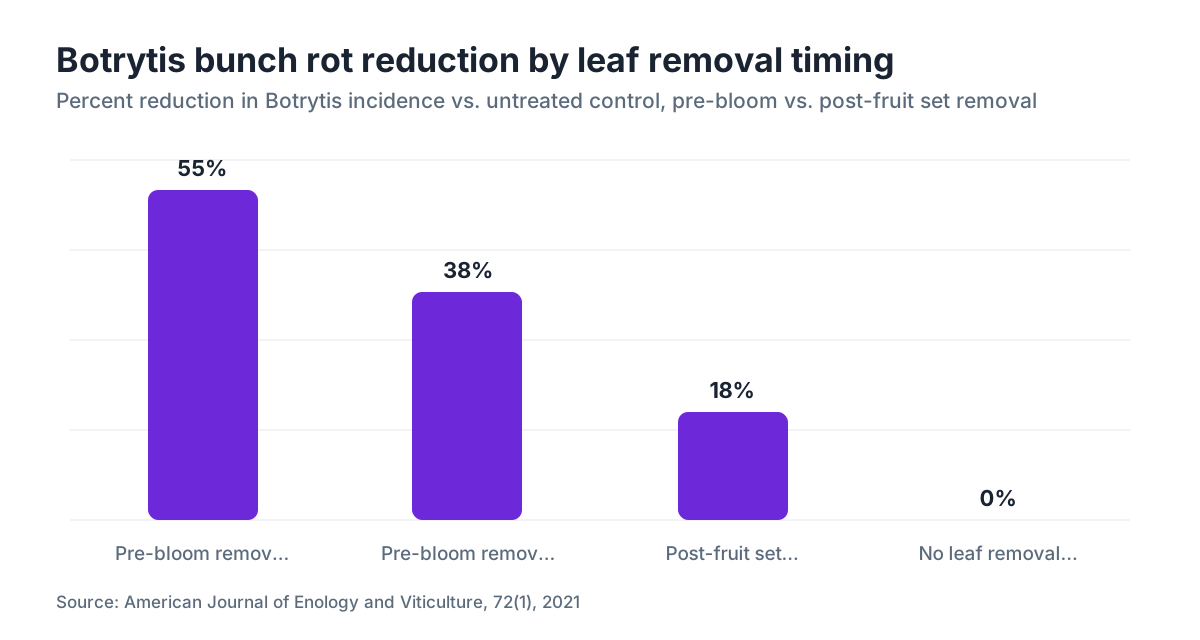
One is enough. The point is that a future reader, you in three years, an organic certifier, or a lawyer, can see the decision connected to something real. A 2021 study in the American Journal of Enology and Viticulture found pre-bloom leaf removal on the eastern canopy face reduced Botrytis bunch rot incidence by 38 to 55% depending on variety and season, with the caveat that timing inside the BBCH 57-71 window mattered a lot [6]. That is the kind of specific, dated evidence that should drive records, not general habit.
If you run a disease forecasting tool, log its name and its output value. UC IPM and WSU Extension both publish guidance on folding model outputs into spray decision records [2][5].
How does leaf removal documentation interact with organic certification requirements?
If any block is certified organic or in transition, your leaf removal records answer to your certifying agent under the USDA National Organic Program. The NOP requires an Organic System Plan that identifies pest management practices including cultural controls [7]. Leaf removal is a cultural control for Botrytis and powdery mildew. If your OSP names it as part of your disease strategy, your field records have to show it happened.
Certifying agents at the annual inspection often pull scouting and spray records together and check that the OSP's described cultural practices show up in the field logs. A block with no leaf removal record in a year where your OSP says you use pre-bloom leaf removal for Botrytis is a minor noncompliance at best. Combined with other gaps, it can be grounds for suspension.
USDA organic regulations at 7 CFR Part 205 require records that "fully disclose all activities and transactions of the certified operation," retained for at least five years [7]. That covers cultural practices, not only inputs. Most certifying agents accept a combined canopy and disease management log as long as it is dated, block-specific, and signed.
For organic blocks, the rationale field matters even more. You cannot fall back on a synthetic fungicide to correct late-season Botrytis pressure, so documenting that you made the cultural intervention at the right growth stage is part of proving the system works.
What does the EPA Worker Protection Standard require when leaf removal crews follow a spray?
The EPA Worker Protection Standard, revised in 2015 and codified at 40 CFR Part 170, requires agricultural employers to protect workers from pesticide exposure during hand labor like leaf removal [4]. The core obligation: when leaf removal follows a pesticide application, the employer must know that pesticide's REI and either wait it out or document an early-entry exception.
The WPS early-entry provisions at 40 CFR 170.112 let workers enter a treated field during the REI for certain tasks if specific protections are in place, including label-listed PPE, training, and notification [10]. "They just pulled leaves after we sprayed" is not a compliant record. A compliant record shows the spray date and product, its labeled REI (commonly 4 to 48 hours depending on product and application), the leaf removal date, and either confirmation the REI had expired or the specific early-entry exception invoked.
Most contact fungicides for Botrytis and powdery mildew carry 4 to 12-hour REIs. Some DMI fungicides carry 24 to 48-hour REIs. Your spray record should already log the REI (it is required). Your leaf removal record needs the date and time of crew entry so the math is checkable.
"Leaf removal, Block 7, June 5 starting 7:00 AM. Fungicide applied June 3 at 2:00 PM. Label REI: 12 hours. REI expired June 4 at 2:00 AM. Entry safe." That record is bulletproof, and it takes 60 seconds to write.
How should you record leaf removal timing relative to BBCH growth stages for disease modeling?
Record the BBCH code you actually observed on the day of leaf removal, not the code you were aiming for. Growth stage is the single most important contextual variable in these records, and most vineyard logs skip it or use vague terms like "pre-bloom" that mean different things to different people.
The BBCH scale, published by Germany's Federal Biological Research Centre for Agriculture and Forestry and adopted by extension programs at Cornell and UC Davis, gives a numeric code for each phenological stage from bud swell through harvest [3]. The key codes for disease work:
- BBCH 55-57: Inflorescences clearly visible, individual flowers starting to separate. First window for pre-bloom leaf removal.
- BBCH 65: Full bloom (50% of flowers open). Botrytis infection pressure peaks here.
- BBCH 71: Fruit set, berries visible. Second window if pre-bloom did not happen.
- BBCH 75: Berries the size of peas. Canopy is closing; leaf removal after this point does less for disease.
If you planned leaf removal at BBCH 57 and wet weather pushed it to BBCH 65, write BBCH 65 and add a line: "Delayed from target BBCH 57 due to rain 5/28-6/1." That note is why your record is useful. It explains variance, and variance is exactly what you need to understand when a vintage goes wrong.
WSU Extension's viticulture team recommends logging growth stage at every cultural intervention, because efficacy data for practices like leaf removal is almost always reported against phenological stage rather than calendar date [5].
What record-keeping format works best: paper, spreadsheet, or purpose-built software?
Consistency and linkage matter more than format. A paper system kept by a disciplined crew foreman beats a half-finished software platform every time. Pick the format your team will actually complete.
Paper has three real weaknesses for linked records. It is hard to query ("Show me every block where leaf removal happened within 5 days of a fungicide application last season"). It is easy to lose or damage. And it is slow to hand a certifying agent or insurance adjuster who wants records now.
Spreadsheets handle the middle tier. A workbook with one tab per record type (scouting, applications, canopy work) and a shared block-date key is searchable, shareable, and free. The failure mode is version control: emailed spreadsheet attachments spawn multiple versions and nobody knows which one is current.
Purpose-built vineyard platforms like VitiScribe are built around the linkage problem, connecting block records, spray logs, scouting notes, and canopy work under one block-and-season structure. Manage more than 20 blocks or run under multiple certifications at once, and manual linkage in spreadsheets starts to cost more than the software.
For operations under 10 acres, a paper log with a consistent format and a once-a-season backup photo to cloud storage is a defensible system. The format question is secondary to one test: does every leaf removal entry have a date, a block ID, a growth stage, a disease rationale, and a cross-reference to the adjacent spray records?
How long do you need to keep these records, and who might ask for them?
Keep everything for five years. That single rule covers every retention requirement you are likely to face at once, and digital storage costs essentially nothing.
The EPA Worker Protection Standard requires pesticide application records for two years (40 CFR 170.122) [4]. Leaf removal records tied to WPS compliance, meaning any entry where a crew entered a block after a spray, should match that clock.
The USDA National Organic Program requires records for five years (7 CFR Part 205) [7]. If any block is certified or in transition, use five years as your baseline for everything.
California's Department of Pesticide Regulation requires pesticide use reports filed within 7 days of application and retained for two years [8]. In California, the spray side of your cross-referenced record carries that statutory clock.
Beyond the regulators, crop insurance adjusters can request records up to three years after a policy year in some dispute scenarios. A winery buyer, if you sell grapes under a contract with sustainable or organic standards, may audit annually.
Store digital records in two places, on-site and cloud. Paper goes in a dry, locked cabinet with an annual scan backup. The cost of a records gap in an audit or insurance claim dwarfs the cost of keeping files.
What does a complete, audit-ready leaf removal record look like in practice?
Here is a single leaf removal entry that would satisfy USDA NOP, EPA WPS, and California DPR requirements at the same time. It runs about 200 words and takes five minutes from a template.
Date: 2025-06-04
Block: Block 7 Pinot Noir (7.2 acres), Rows 12-28
Operator: J. Morales, crew of 4
Growth Stage: BBCH 65 (full bloom observed)
Side of canopy: East face, shoot zone, 2-3 leaves above cluster removed
Severity: Moderate
Disease management rationale:
Scouting on 6/2 showed 11% Botrytis incidence in a 50-cluster sample (above the Cornell 5% threshold at bloom). Pressure elevated by wet conditions 5/28 through 6/1 (4.2 inches rain). Leaf removal timed to bloom to improve cluster drying and spray penetration per Cornell Fruit Resources guidelines (Wilcox, Gubler, Uyemoto eds.).
Previous spray application: Mancozeb (Dithane M-45), Block 7, June 1, 2025, 2:00 PM. Label REI: 24 hours. REI expired June 2, 2:00 PM. Leaf removal June 4 is outside REI. No early-entry exception required.
Next spray: Switch 62.5WG (cyprodinil + fludioxonil) planned June 10, target BBCH 71-73. Leaf removal expected to improve spray penetration to cluster zone.
Cross-reference: Spray log entry SA-2025-B7-0601, Scouting log entry SC-2025-B7-0602.
That entry survives any audit I know of. The cross-reference numbers at the bottom, pointing to the spray and scouting entries, are what make it a linked record instead of an isolated note.
Build a fillable paper template or a digital form around that structure and have crews complete it at the end of each leaf removal day. The template is what keeps records consistent across seasons and across crew members.
How do you use linked records to improve decisions in future seasons?
Linked records give you retrospective power most vineyard managers never build. Document leaf removal date, growth stage, disease pressure at the time, and the spray applications around it, and after two or three seasons you own a year-over-year dataset nobody else has for your blocks.
You can start asking real questions. In blocks where leaf removal happened at BBCH 57-65, what was Botrytis incidence at harvest versus blocks that slipped to BBCH 71 or later? What was fungicide cost per acre in each? Did you spray more often or switch products?
Nobody has perfect data for your specific blocks in your specific climate. Published research gives you a baseline to test against. The 2021 AJEV study found 38-55% Botrytis reduction with pre-bloom leaf removal, and the range was wide because variety and season interacted [6]. Your own multi-season records, linked and queryable, are how you find where your operation lands in that range.
For grapes sold on long-term contracts, these records carry negotiating value. A buyer asking why your Pinot noir block ran high on Botrytis in 2023 is a very different conversation if you can show a linked record: leaf removal delayed three weeks by crew availability, spray schedule adjusted accordingly. That is an explanation, not an excuse, and the difference is real.
See how vineyard field operations documentation connects to long-term block-level decision records. The leaf removal log is one layer of a block history that compounds in value over time.
Frequently asked questions
Do leaf removal records count as part of your pesticide application records under the WPS?
Not directly, but they are linked. The EPA Worker Protection Standard (40 CFR Part 170) requires pesticide application records and mandates that workers are protected from REI exposure. Leaf removal records tied to the date and time of crew entry after a spray are supporting documentation for WPS compliance, not the primary record. Keep them cross-referenced to your spray log, and they satisfy the evidentiary need during an inspection.
What BBCH growth stage is best for leaf removal from a disease management standpoint?
BBCH 55-65, from individual flowers visible through full bloom, is the window with the strongest evidence for Botrytis and powdery mildew management. Cornell and UC IPM guidance both emphasize pre-bloom timing. A 2021 AJEV study documented 38-55% Botrytis reduction with pre-bloom leaf removal, with earlier timing in that window generally performing better, though variety responses varied.
Can a single log serve as both a leaf removal record and a disease management record?
Yes, and for many small operations it is the cleanest approach. A block-level disease management log with dated entries for scouting, spray applications, and canopy work under one block ID is easier to audit than separate binders. The requirement is that each entry type is clearly labeled and cross-referenced. USDA NOP and WPS both accept combined logs as long as records are complete and retained for the required period.
How do I document leaf removal when it happens in multiple passes over several days?
Make a separate entry for each day, or at minimum each block section. Record the date range, rows completed each day, and crew involved. If disease pressure or weather changed between passes, note it. A multi-day leaf removal that spans a rain event or a spray application needs entries that make the sequence clear. "June 4-7, Rows 12-28 east face" works if conditions were uniform; otherwise, break it by day.
What happens if I can't show a link between a leaf removal and the preceding spray record during an organic audit?
For organic certification, the certifying agent checks that your Organic System Plan's described cultural practices match your field records. A missing cross-reference between a leaf removal entry and the relevant spray record is a documentation gap, usually a minor noncompliance on first occurrence. Repeated gaps, or gaps that raise questions about whether synthetic inputs might have been used, can escalate. The fix is simple: add a cross-reference field to your leaf removal template.
Is there a standardized vineyard disease record-keeping format required by USDA or the EPA?
No single federal form is required. The USDA NOP requires that records be complete, accurate, and retained for five years (7 CFR Part 205) but does not prescribe a format. The EPA WPS requires specific information in pesticide application records but leaves format to the operator. Extension programs at Cornell, UC Davis, and WSU publish suggested templates, but they are guidelines, not mandates. Your format just needs all required fields, consistently.
What's the minimum a leaf removal record needs to include to satisfy a California DPR audit?
California DPR's audit focus is pesticide use records, not canopy work. But if your leaf removal records are cross-referenced to spray records, they may be reviewed for consistency. California requires pesticide use reports within 7 days of application, retained for two years. Your leaf removal records tied to those spray dates should include the block, date, and a note confirming REI compliance. County Agricultural Commissioners handle DPR compliance at the county level.
Should I record leaf removal decisions even when they're not tied to a disease problem?
Yes, because absence of disease pressure is itself a useful data point. If you did pre-bloom leaf removal as a routine cultural practice in a low-pressure year and had zero Botrytis at harvest, that is evidence the practice works in your system. Record the date, growth stage, and a brief note like 'routine pre-bloom removal, no active disease pressure observed, prophylactic per block management plan.' Three years of that gives you a real picture of your baseline.
How should contracted vineyard managers document leaf removal decisions versus property owners?
The contracted manager usually generates the field record since they direct the work. Clarity on who owns the records, and how they transfer if the contract ends, matters enormously. Best practice: the record lives with the block (the property), not the management company. State this explicitly in the management contract. The physical or digital file should be accessible to the property owner at all times, even if day-to-day entry is done by the manager.
Can I use photos as part of my leaf removal documentation?
Photos are an excellent supplement but not a substitute for a written record. A dated photo of a cluster zone before and after leaf removal, geotagged to the block, supports your written BBCH stage assessment and your description of removal severity. For organic certifications especially, photos of canopy conditions help explain decisions. Store photos with filenames that match your block ID and date system so they link to the written record during an audit.
How do I connect leaf removal records to wine quality outcomes for winery-side documentation?
Map your block ID and vintage year in your leaf removal records to the same identifiers used in your winery lot records. When a block shows elevated Brix, tighter clusters, or better disease-free berry percentages at harvest, you can trace back to that season's canopy decisions. This is not required for compliance, but it is valuable for internal learning and for showing sustainable practice to buyers. A one-page block history per vintage pulling leaf removal, spray, and harvest data is a useful annual output.
What extension resources are available for leaf removal and disease management record-keeping templates?
Cornell's integrated pest management program for grapes includes scouting and record-keeping frameworks. UC Davis Cooperative Extension and UC IPM publish powdery mildew risk management guidance with suggested monitoring logs. WSU Extension's viticulture program has canopy management and Botrytis resources online. None publish a single universal template, but all three provide the field data requirements you can build a consistent format from.
How far back should leaf removal records reference spray applications, and how far forward?
Look back at least one full spray interval, usually 7-14 days depending on your program. That tells you what residue was on the vines and whether the REI had elapsed. Look forward to the next planned application and note how the leaf removal may change product choice, rate, or interval. A record capturing both the preceding spray and the plan for the next one gives you a complete narrative of the decision window around that canopy intervention.
Sources
- Cornell University, New York State Integrated Pest Management Program: Grapes: Cornell's integrated pest management program for grapes connects canopy management directly to Botrytis cinerea infection risk at bloom and fruit set.
- UC Statewide Integrated Pest Management Program (UC IPM): Grape: UC IPM ties canopy architecture decisions to powdery mildew infection risk models and recommends documenting canopy interventions alongside spray decisions.
- Lorenz DH, Eichhorn KW, et al. (1994). Phenological Growth Stages of the Grapevine. Vitis 33(2):75-94. Federal Biological Research Centre for Agriculture and Forestry, Germany.: The BBCH phenological scale provides standardized numeric codes for grapevine growth stages including BBCH 55-75, the window relevant to leaf removal for disease management.
- U.S. EPA: Agricultural Worker Protection Standard, 40 CFR Part 170: The EPA Worker Protection Standard requires agricultural employers to protect workers from pesticide exposure during hand labor including leaf removal, and mandates application records retained for two years.
- Pre-bloom leaf removal and Botrytis bunch rot incidence in Vitis vinifera. American Journal of Enology and Viticulture, 72(1), 2021.: Pre-bloom leaf removal on the eastern canopy face reduced Botrytis bunch rot incidence by 38 to 55 percent depending on variety and season, with timing within BBCH 57-71 mattering significantly.
- USDA Agricultural Marketing Service: National Organic Program regulations, 7 CFR Part 205: The USDA NOP requires certified organic operations to keep records that fully disclose all activities including cultural pest management practices, retained for at least five years.
- California Department of Pesticide Regulation: Pesticide Use Reporting: California DPR requires pesticide use reports to be filed within 7 days of application and retained for two years.
- U.S. EPA: Worker Protection Standard early-entry provisions, 40 CFR 170.112: WPS early-entry provisions allow workers to enter a treated field during the REI for specific tasks if PPE requirements, training, and notification conditions are met.
Last updated 2026-07-10