Botrytis risk assessment documentation before bunch rot spray applications

TL;DR
- Before spraying for botrytis bunch rot, write down the weather (relative humidity above 90% for 15 or more continuous hours is a key infection threshold), the vine growth stage, canopy density, your previous spray history, and the reasoning behind your risk score.
- That single record satisfies pesticide compliance, backs up your resistance rotation decisions, and gives you defensible data if a crop loss dispute lands on your desk.
Why do you need written risk assessment documentation before a botrytis spray?
Because "it looked bad" is not a record. Regulators don't care about your gut, and neither does a crop insurance adjuster.
Most state pesticide laws require that spray records document the pest or disease present or expected, the conditions that justified the application, and the product applied. [1] A risk assessment you write before you spray is what proves those conditions existed. Skip it, and you're relying on memory after the fact, which is exactly the kind of thing that falls apart under an EPA Worker Protection Standard (WPS) inspection or a crop insurance audit. [2]
There's also a purely agronomic reason. Botrytis cinerea develops fungicide resistance fast, especially to single-site fungicides like the SDHI and DMI classes. [3] Cornell's viticulture extension team has documented field populations that gained resistance to multiple chemistry classes within a few spray seasons. If you aren't tracking what you sprayed, when, and under what disease pressure, you have no rational basis for rotating chemistries. Your documentation is your resistance management program.
The assessment also forces you to slow down for ten minutes before you pull the trigger on a spray that costs $80 to $200 per acre in materials alone. That pause has real economic value.
What weather thresholds matter most for botrytis infection risk?
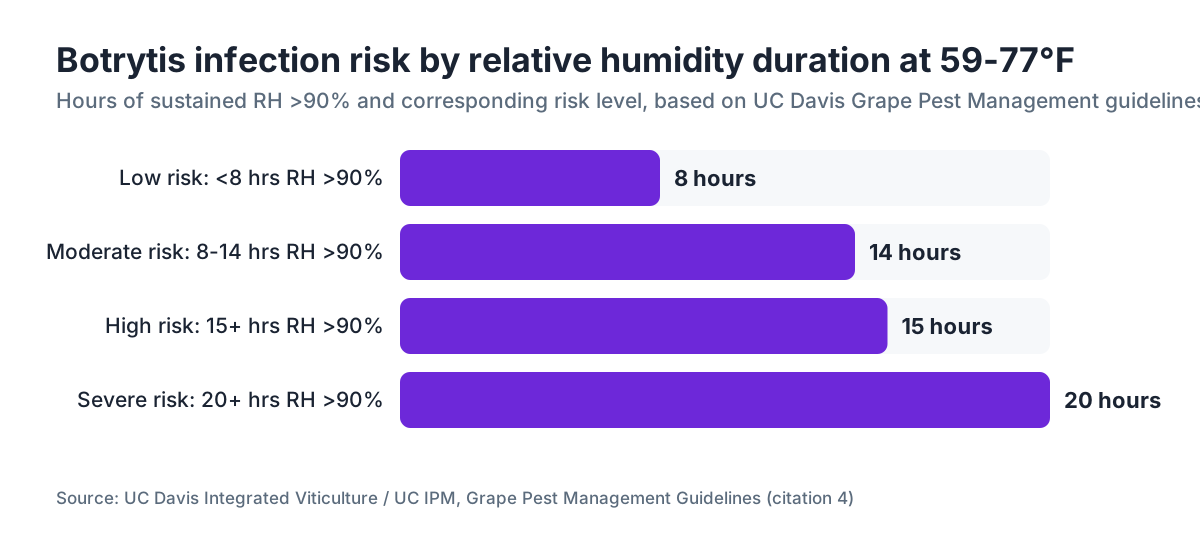
Botrytis cinerea needs free moisture or very high relative humidity (RH) to germinate and infect. The threshold cited in the UC Davis Grape Pest Management guidelines is that infection risk climbs sharply when RH stays above 90% for 15 or more continuous hours at temperatures between 59°F and 77°F (15°C to 25°C). [4] Outside that temperature window the fungus still works. It's just slower.
The table below covers the main weather variables your pre-spray assessment should capture:
| Variable | High-Risk Value | Notes |
|---|---|---|
| Relative humidity | >90% for 15+ continuous hours | Sustained periods matter more than peak RH |
| Temperature | 59°F to 77°F (15°C to 25°C) | Infection possible outside range, but slower |
| Leaf wetness duration | >10 hours | Dew and fog count; rain is obvious |
| Rainfall amount | Any rain at or after veraison | Berry skin integrity breaks down |
| Wind speed | Calm (<5 mph) | Low wind keeps the canopy dense and humid |
These aren't hard cutoffs. A dense canopy makes its own microclimate that holds humidity for hours after the air outside the vine row has dried out. Document what your on-site or nearest station data shows, not the regional airport reading. If you're running a Davis Instruments or Onset HOBO station in the vineyard, log the download date and time in your record. [4]
Many managers track a simple infection-event flag: did we get rain or dew plus warm temperatures within the last 48 hours? Yes or no, written down, dated. That one data point answers most after-the-fact questions about why you sprayed.
What vine growth stages carry the highest botrytis risk?
Botrytis has two danger windows in grapevines: flowering and post-veraison. They're different enough that your record should name which one you're managing.
At flowering (Eichhorn-Lorenz stages 23 to 26), the fungus infects the calyptras (flower caps) and senescing flower parts that get trapped inside the developing cluster. Those infected tissues become a latent infection that wakes up when the berries start to soften. [5] Washington State University's extension viticulture program calls this the bunch stem infection pathway and notes it's often underestimated by growers who only scout visually after veraison. [6]
Post-veraison (EL 38 and later), berry skin softens and sugar rises, and both favor rapid fungal growth. Any wound, whether from insects, bird pecks, or splitting from uneven water uptake, gives spores a direct entry point. Your pre-spray record at this stage should lean on berry condition more than weather. Are you seeing skin cracks? Insect damage? Early sporulation on nearby berries?
Recording the EL stage at application is also a legal requirement for some fungicide labels. Certain products aren't registered for use after EL 36, and if your records don't show the stage at application, you can't prove you followed label restrictions, which are federal law under FIFRA. [1]
How do you score and record canopy density as a risk factor?
Canopy density controls how long moisture stays trapped in the bunch zone and how well your spray actually reaches the fruit. A dense, shoot-crowded canopy adds two to four hours of effective leaf wetness after the surrounding air has dried out. That's enough to push a borderline infection event into a real one.
Most advisors use a point-in-time visual score on a 1-to-3 scale: open (you can see sky through the canopy at midday), moderate (partial closure), or closed (shoots touching across the row, dense leaf layer at the fruiting zone). Write the score down. It takes 30 seconds.
Want something more rigorous? UC Davis has published protocols for estimating shoot density per meter of cordon and percentage of fruit-zone leaf area. [11] For most operations, the 1-to-3 visual score plus a note on whether shoot thinning or leaf removal has been done is enough to justify your spray timing and show you're running an IPM-based approach.
Note the canopy score against your last cultural practice dates. "Canopy: closed. Last leaf removal: June 15, minimal. Shoot density: about 14 shoots per meter. No further thinning this season." That one line tells the whole story. For vineyard managers tracking this across multiple blocks, the year-over-year comparison of canopy score against actual disease incidence is genuinely useful data for adjusting training and pruning.
What does a complete pre-spray botrytis risk record actually look like?
Here's what the record needs, in plain terms:
- Date and time of assessment
- Block or vineyard identifier, variety, and approximate acreage
- EL growth stage at assessment
- Weather data: temperature range for the past 48 to 72 hours, RH range, any rainfall amount and date, leaf wetness hours if available
- Canopy density score and any relevant cultural practice notes
- Scouting observations: percentage of clusters showing visible sporulation, latent infection signs, insect damage, or berry cracking
- Risk conclusion: low, moderate, or high, with one sentence saying why
- Decision: spray or hold, and if spray, the product chosen and the rotation class (FRAC code)
- Applicator name and any required certifications
- Reference to the product label version or EPA registration number
That's the whole thing. It fits on a half-page form or in a digital field record. Tools like VitiScribe let you log these fields on a phone in the vineyard and attach the weather station download automatically, which helps when you're managing several blocks and the paper chain gets messy.
The FRAC (Fungicide Resistance Action Committee) code is worth calling out. Recording it with every spray is the floor for a defensible resistance management plan. FRAC Group 1 (benzimidazoles), Group 2 (dicarboximides), Group 7 (SDHIs), and Group 17 (anilinopyrimidines) all show up in botrytis programs, and no more than two consecutive applications from the same FRAC group should appear in your records without a written reason. [3]
How does botrytis risk documentation connect to EPA Worker Protection Standard requirements?
The EPA's Worker Protection Standard (40 CFR Part 170) requires that certain information be available to agricultural workers: the product name, EPA registration number, active ingredient, first aid information, and the location and timing of any restricted-entry interval (REI). [2] Your spray record is the primary document linking a specific application to those disclosures.
The 2015 revised WPS requires that application records be kept for two years and be available for inspection. [2] If your pre-spray risk assessment lives in the same record as the application log, you've bundled your agronomic notes with your legal requirement in one step. That's just efficient.
For fungicides like fenhexamid (Decree) or cyprodinil plus fludioxonil (Switch), REIs run from 4 to 24 hours depending on the formulation. [7] Your record should show when you assessed, when you sprayed, and what REI applied. If a worker re-enters a block before the REI expires without proper PPE and you can't document application timing, you're exposed to both an EPA violation and a liability problem.
WPS doesn't require a document called a risk assessment. It does require that the application be justified by label conditions, which for disease fungicides usually reads like "at the first sign of disease" or "when disease conditions are favorable." Your risk assessment is what proves those conditions were met.
What fungicide resistance management documentation should go into your records?
Resistance management is where your pre-spray records do double duty. They're more than compliance paper. They're the data that tells you whether your program is rational.
The core requirement is simple: record the FRAC code of every botrytis application, every season, across every block. Then review it before the next spray to make sure you aren't stacking consecutive applications from the same group. That review should be a written note in your assessment: "Last two botrytis sprays were Group 17 (pyrimethanil, 5/22) and Group 7 (fluopyram, 6/3). Next spray: Group 2 (iprodione) or tank mix." [3]
Cornell's Integrated Pest Management program publishes explicit guidance on botrytis fungicide rotation, recommending no more than two applications per season from any single FRAC group, with a preference for tank mixes at high-risk timings. [8] The spray interval matters too. Most botrytis fungicides have a 7-to-14-day protectant window, and applications outside that window in low-pressure conditions are money wasted and selection pressure you didn't need to create.
Some growers use disease forecast models to time applications, like the Botrytis Risk Assessment tool on NEWA (the Network for Environment and Weather Applications, run through Cornell). [9] If you act on a model output, include a screenshot or the model value in your record. Now you have an external, defensible data point instead of just your personal read.
How do you document scouting observations to justify a spray decision?
A weather-only assessment misses the actual disease state in the field. Before any bunch rot spray, walk the clusters and write down what you find.
The scouting record should include:
- Number of clusters inspected per block (30 to 50 is a reasonable minimum for a typical block)
- Percentage of clusters showing visible botrytis sporulation (gray mold)
- Percentage showing flower debris retention (trapped cap tissue in the cluster)
- Any latent infection signs: brown, dried tissue inside clusters without visible gray sporulation
- Presence of secondary vectors: grape berry moth damage, powdery mildew wounds, or other berry-breaking events
There's no universal spray threshold for botrytis the way there is for some insect pests. The call depends on variety, weather forecast, and stage. Pinot Noir and Chardonnay are notoriously susceptible because their clusters are so tight. Cabernet Sauvignon and Zinfandel less so, though late-season Zin with cracked berries can go sideways fast. [4]
Write down the variety and your susceptibility read. "Pinot Noir, tight clusters, history of 15 to 20% incidence at harvest without a spray program. Current scouting: 3 of 40 clusters (7.5%) showing visible sporulation, 12 of 40 (30%) with significant trapped cap debris." Anyone reading that six months later understands exactly why you sprayed.
What records do you need for crop insurance and crop loss claims involving botrytis?
File a crop insurance claim for botrytis and the adjuster's first question is predictable: what did you do to prevent it? Your pre-spray risk assessment records are the answer.
USDA Risk Management Agency (RMA) policies for grapes require the insured grower to follow "good farming practices," which includes following label directions and making application decisions consistent with recognized IPM standards. [10] A pre-spray record documenting weather thresholds, scouting data, and a rational spray decision is exactly the evidence that backs a claim. Missing records, or records showing sprays made without documented justification, can be used to argue that good farming practices weren't followed.
Keep your records at least three years, not two. WPS requires two, but crop insurance disputes can run across seasons, and the prior year's spray history is useful context when you're arguing that an outbreak was weather-driven rather than management-driven.
Digital records with timestamps are harder to dispute than paper. A phone-timestamped photo of a cluster at the moment of scouting, attached to a digital spray record, is strong evidence. VitiScribe and similar platforms export compliance-ready reports that fold scouting notes, weather data, and application details into one document, which is what an adjuster or inspector wants to see.
Expectations shift by region. Operators near the south coast winery appellation in Southern California face high late-season humidity events that make botrytis records especially important for claim justification. Growers in cooler coastal ground near paso robles wineries territory deal with similar late-fog risk in certain vintages.
How should you organize and store botrytis risk assessment records?
Paper binders work. They also get lost in a field office, soak through in an irrigation mishap, and take real time to search when someone calls asking about a spray from six weeks back.
The practical minimum is this: keep a block-by-block spray log, each entry including the pre-spray assessment fields above, filed chronologically, with a seasonal summary page up front that lists all FRAC codes used and the spray dates. Two years is the legal minimum for WPS. Three years is smarter. [2]
Digital storage beats paper in a few specific ways. A timestamped digital record is harder to dispute than handwritten notes. You can search it. And if you're managing several blocks, a spreadsheet or purpose-built platform makes it obvious at a glance that you've made four Group 7 applications without rotating, the kind of thing that slips past you on paper.
WSU's extension program publishes a free grape spray record template that includes most of the fields described here. [6] It's a reasonable start if you want paper. For cloud storage with automatic weather data integration, look at platforms built for vineyard compliance.
One tip that pays off: fill out the assessment in the field, before you head back to the shop or call the applicator. The detail you remember five minutes after scouting beats what you remember three hours later at the desk.
What are common mistakes growers make in botrytis pre-spray documentation?
The most common mistake is filling out the record after the spray. The point of a pre-spray assessment is that it captures your reasoning at decision time. Backfilled documentation is legally weaker and agronomically useless.
Second most common: recording the product without the FRAC code or active ingredient. "Pristine 0.5 lb/A" is incomplete. "Pristine (FRAC 7 + 11; boscalid + pyraclostrobin), 0.5 lb/A" is useful. If you ever have to defend your resistance program or explain a resistance failure, the active ingredient is what matters.
Third: airport weather data instead of on-site data. A hilltop vineyard and a valley floor two miles away can differ by 15 to 20% RH and several hours of leaf wetness. Cite a station that doesn't represent your microclimate and your whole assessment sits on bad inputs.
Fourth: no cluster count. "Scouted, saw some gray mold, sprayed" is not a scouting record. A percentage, even a rough one, is what makes the record useful.
Fifth: failing to record the REI and restricted-entry date. This is a WPS requirement and it's easy to skip in a hurry. Put the REI expiration time on the same line as the application time. Done.
The last one matters more than it looks: not recording a decision to hold. If you assessed and held off, write that down. A record showing only applications makes it look like you sprayed every time on reflex. A record with assessments, risk scores, and occasional hold decisions shows a real IPM program. That's exactly what an auditor, adjuster, or certifying agency wants to see.
Frequently asked questions
What is the minimum weather data I need to document before a botrytis spray?
At minimum, record relative humidity (was it above 90% for 15 or more continuous hours?), temperature range over the past 48 to 72 hours, any rainfall amount and date, and leaf wetness duration if your station captures it. Airport data is a poor substitute for on-site data. Even a simple weather station log download, attached to your record, satisfies most compliance and crop insurance documentation standards.
Do I legally have to document botrytis risk before spraying, or is it just good practice?
State pesticide laws vary, but most require that spray records include the pest or disease being managed and the conditions justifying the application. EPA Worker Protection Standard regulations (40 CFR Part 170) require application records be kept for two years. Many fungicide labels also condition use on favorable disease conditions, which makes your documented assessment the proof that label requirements were met. Legally required or not, the record is your protection.
What FRAC codes are used for botrytis in vineyards and how do I rotate them?
Common botrytis FRAC groups in vineyards include Group 1 (benzimidazoles, e.g., thiophanate-methyl), Group 2 (dicarboximides, e.g., iprodione), Group 7 (SDHIs, e.g., fluopyram, boscalid), Group 17 (anilinopyrimidines, e.g., pyrimethanil, cyprodinil), and Group 9 (fenhexamid). Rotate among groups each application and avoid more than two consecutive applications from the same FRAC group per season. Record the FRAC code with every spray entry.
How many clusters should I scout before deciding to spray for bunch rot?
Inspecting 30 to 50 clusters per block is a practical minimum for a typical vineyard block. Record the number inspected, the number showing visible gray sporulation, the number with trapped flower debris, and any berry wounds or cracking. No universally agreed spray threshold exists for botrytis; the decision depends on varietal susceptibility, weather forecast, and proximity to harvest. The count gives you a defensible baseline either way.
What growth stages are most important to spray for botrytis and should I document them?
Yes, document the Eichhorn-Lorenz (EL) stage at every spray. The two highest-risk windows are flowering (EL 23-26), when infected calyptras create latent infections, and post-veraison (EL 38+), when softening berries and rising sugars favor rapid spread. Some fungicide labels restrict use after specific growth stages, so recording the EL stage at application is both agronomically useful and legally required for certain products.
How does canopy density affect botrytis risk and what should I record about it?
Dense canopies trap humidity in the bunch zone for hours after surrounding air dries, extending effective leaf wetness duration and infection risk. Record a simple visual score (open, moderate, closed), note whether shoot thinning or leaf removal has been done this season, and estimate shoot density per meter of cordon if practical. This contextualizes your weather data and shows that your spray decision accounted for vineyard-specific microclimate conditions.
How long do I need to keep botrytis spray records?
EPA Worker Protection Standard regulations require application records be retained for two years from the date of application. For crop insurance purposes, keeping records for at least three years is wiser, since multi-year disputes do arise. Digital records with timestamps are more defensible than paper in disputes. Your pre-spray risk assessments should be retained alongside application logs as a single integrated record.
Can I use a disease forecast model output as documentation for my spray decision?
Yes, and it's a good idea. Models like the Botrytis Risk Assessment tool on NEWA (Network for Environment and Weather Applications, run through Cornell) generate a dated output tied to local weather data. Print or screenshot the model output and attach it to your pre-spray record. It provides an external, objective data point that goes beyond personal judgment and is particularly persuasive in crop insurance and compliance contexts.
What information does the EPA Worker Protection Standard require in a pesticide application record?
Under 40 CFR Part 170, records must include the crop or site treated, the date and location of application, the product name and EPA registration number, the active ingredient, and the applicator name. Records must be kept for two years and be available for inspection. Pre-spray risk assessment details aren't mandated by WPS itself, but they satisfy the label-compliance requirement that applications be made under appropriate disease conditions.
What should I document if I decide not to spray after a botrytis risk assessment?
Document the assessment exactly as you would for a spray decision: date, block, weather data, scouting results, canopy score, and risk conclusion. Then note: "Decision: hold. Risk assessed as low to moderate. No visible sporulation. RH did not exceed 90% threshold for 15 continuous hours. Next assessment scheduled in 5-7 days." A record of thoughtful hold decisions is evidence of a sound IPM program, more than a spray log.
How do botrytis spray records support a crop insurance claim?
USDA RMA grape policies require growers to demonstrate good farming practices. Pre-spray assessments showing documented weather thresholds, scouting data, and rational spray decisions are your evidence that you managed the disease appropriately. Claims are harder to deny when records show a weather-driven outbreak despite a well-documented spray program. Claims are easier to dispute if records are absent or show spray decisions made without documented justification.
Are there free templates for botrytis risk assessment documentation?
WSU Extension has published free grape spray record templates that include most of the key fields: block ID, date, growth stage, weather conditions, pest or disease target, product and rate, and REI. UC Davis Integrated Viticulture and Cornell Cooperative Extension also publish IPM record-keeping guides. These are reasonable starting points for paper-based systems. Digital platforms built for vineyard compliance add timestamp integrity and multi-block organization.
Does varietal susceptibility need to be part of my botrytis risk documentation?
It should be. Tight-clustered varieties like Pinot Noir, Chardonnay, and Gewurztraminer carry higher inherent risk than looser-clustered varieties at the same weather conditions. Noting the variety and a brief susceptibility note in your assessment explains why you sprayed at a lower observed disease level than you might in a different block. It also contextualizes multi-year records and helps you adjust your threshold for each block over time.
Sources
- U.S. EPA, Federal Insecticide, Fungicide, and Rodenticide Act (FIFRA) overview: Pesticide labels are federal law under FIFRA; applications must conform to label conditions including target pest and use timing restrictions
- U.S. EPA, Worker Protection Standard, 40 CFR Part 170: WPS requires pesticide application records be retained for two years and be available for inspection; requires disclosure of product name, EPA registration number, active ingredient, REI, and application location to agricultural workers
- Fungicide Resistance Action Committee (FRAC), FRAC Code List for Fungicides: Botrytis cinerea can develop resistance to single-site fungicides including SDHI (Group 7) and DMI classes; FRAC recommends no more than two consecutive applications from the same mode-of-action group
- UC Agriculture and Natural Resources, Pest Management Guidelines: Grape Botrytis: Botrytis infects calyptras and senescing flower parts at bloom, creating latent infections that activate post-veraison when berries soften
- Washington State University Extension, Viticulture and Enology Program, Grape Disease Resources: WSU extension documents the bunch stem infection pathway at flowering as often underestimated; WSU publishes free grape spray record templates
- UC IPM, Pesticide Information: Fenhexamid and Cyprodinil/Fludioxonil label summaries: REIs for common botrytis fungicides including fenhexamid (Decree) and cyprodinil/fludioxonil (Switch) range from 4 to 24 hours depending on formulation
- Cornell Cooperative Extension, Integrated Pest Management Program, Botrytis Bunch Rot of Grapes: Cornell IPM recommends no more than two applications per season from any single FRAC group and favors tank mixes at high-risk timings for botrytis management
- Network for Environment and Weather Applications (NEWA), Cornell University, Botrytis Risk Assessment Model: NEWA provides a Botrytis Risk Assessment forecasting model for grapes based on local weather station data, usable as a dated, objective input to pre-spray documentation
- USDA Risk Management Agency, Grape Crop Insurance Provisions: USDA RMA grape crop insurance policies require insured growers to follow good farming practices, including label-compliant applications and recognized IPM standards, as a condition of coverage
- UC Agriculture and Natural Resources, Canopy Management and Botrytis Risk in Winegrapes: UC has published protocols for estimating shoot density per meter of cordon and percentage fruit zone leaf area as canopy density metrics relevant to disease risk
Last updated 2026-07-09