How to document Pierce's disease risk assessment and spray response

TL;DR
- Start with a written, dated site assessment covering vector pressure, variety susceptibility, and distance to inoculum sources.
- Then tie every spray to that assessment inside a compliant pesticide use record.
- The link between the two is what protects you legally, satisfies EPA Worker Protection Standard rules, and gives you the seasonal data to make better calls next year.
What is Pierce's disease and why does documentation matter for compliance?
Pierce's disease is a lethal bacterial infection of grapevines caused by Xylella fastidiosa, spread mostly by sharpshooter leafhoppers. There's no cure once a vine is infected. Every management decision is preventive, which makes the paper trail matter more here than with almost any other vineyard disease. If you spray and the block dies anyway, your records show you acted on a documented risk. If you skip a low-risk block and an inspector asks why, you need more than "I didn't think it was necessary."
California's Department of Pesticide Regulation requires growers to keep a Pesticide Use Report for every restricted-material application [1]. Federal EPA Worker Protection Standard (WPS) rules at 40 CFR Part 170 require that application records be available to workers and handlers, that treated-area warning systems are in place, and that central posting happens within 24 hours of application [2]. A Pierce's disease program usually runs on neonicotinoids, pyrethroids, or kaolin deterrents, and several of those carry restricted-material status in California and WPS-level requirements everywhere.
The record isn't paperwork for its own sake. UC IPM guidance on grapes shows that early-season management of glassy-winged sharpshooter (GWSS, Homalodisca vitripennis), backed by structured monitoring, suppresses disease better than reactive sprays fired off without baseline data [9]. The record is the strategy.
What should a Pierce's disease site risk assessment include?
A risk assessment for Pierce's disease is a written, dated document that answers seven specific questions about your site. You don't need a consultant. A UC Cooperative Extension farm advisor can help you calibrate the ratings if you want a second opinion, but the writing is on you. Here's what it needs to cover.
1. Vector species present and population pressure. Which sharpshooter is the primary vector in your region? GWSS dominates Southern California and the San Joaquin Valley. Blue-green sharpshooter (Graphocephala atropunctata) is the main vector in coastal Northern California. In the East, Xylella strains differ and xylem-feeding insects behave differently, which Cornell's viticulture extension group covers in its PD material [4]. Record the species you're managing and your scouting counts from yellow sticky traps or beat-net samples.
2. Proximity to inoculum sources. Riparian corridors, citrus orchards, and weedy vegetation near drainage channels all host Xylella-infected plant material. Measure the linear distance from your block edges to the nearest known inoculum reservoir and write it down. UC IPM guidance flags blocks near riparian habitat as the high-risk tier, with 100 meters as a common working line [9].
3. Variety susceptibility. Vinifera cultivars range from very susceptible (Chardonnay, Pinot Noir, Cabernet Sauvignon) to more tolerant (Chenin Blanc). PD-resistant varieties from the UC Davis breeding program carry real field tolerance, though commercial acreage is still small. Note your variety and its susceptibility class.
4. Site history. Any confirmed PD-positive vines in this block or adjacent blocks in the past three seasons? Record the answer. If yes, note the inspection date and how it was confirmed (PCR test, visual symptoms, or both).
5. Regional alert status. California's Pierce's Disease Control Program issues seasonal vector alerts. Washington State University Extension covers GWSS movement windows and pathway risk for the Pacific Northwest [5]. Reference the current bulletin and file it with your assessment.
6. Irrigation and vine water status. Water-stressed vines show faster symptom progression. Record your irrigation schedule and any stress events, because that affects how quickly you need to respond if vectors show up.
7. Risk tier. Summarize as Low, Moderate, or High. Date it. This tier is the hinge that connects your assessment to every spray decision that follows.
What does a compliant pesticide use record for a PD spray look like?
A pesticide use record is not a field note. In California, a restricted-material report must be filed with the county agricultural commissioner within 30 days of application using the state's standard format [1]. Other states vary, but the floor is what EPA WPS requires: product name, EPA registration number, active ingredient, application date, location, treated area, and the restricted-entry interval (REI) [2].
For a Pierce's disease program, I add four fields to whatever the law makes me file.
Risk assessment reference. The date of your site assessment and its tier rating. This ties the "why" to the "what." Skip it and your spray record is just a list of chemicals.
Trigger event. What made you spray on this date? A sharpshooter trap count crossed your threshold. The regional alert moved to high. A new PD-positive vine turned up nearby. Or the block is high-risk and you're on a calendar-based preventive schedule. One sentence covers it.
Buffer and re-entry notes. Wind speed and direction at the time of application, the buffer distances you kept, and the exact time the REI expires. WPS requires this information posted at the site [2].
Spray outcome. At your next scouting interval (usually 7 to 14 days for sharpshooter), record trap counts or visual observations. That closes the loop and tells you whether the spray did anything.
Here's a table format you can copy:
| Field | What to record |
|---|---|
| Application date | MM/DD/YYYY, start and end time |
| Block ID | Match your vineyard map |
| Product name | Full label name |
| EPA Reg. No. | From the label |
| Active ingredient | From the label |
| Rate applied | Oz or lb/acre, actual |
| Water volume | Gallons/acre |
| Equipment | Airblast, handgun, etc. |
| Applicator name + cert. no. | Required for restricted materials |
| Wind speed/direction | At start of application |
| REI | Hours per label; expiration time |
| Risk assessment date | Links to your assessment doc |
| Trigger event | One sentence |
| Post-spray observation date | Next scouting date |
| Outcome notes | Trap counts or symptom check |
How do you set a spray threshold and document the decision?
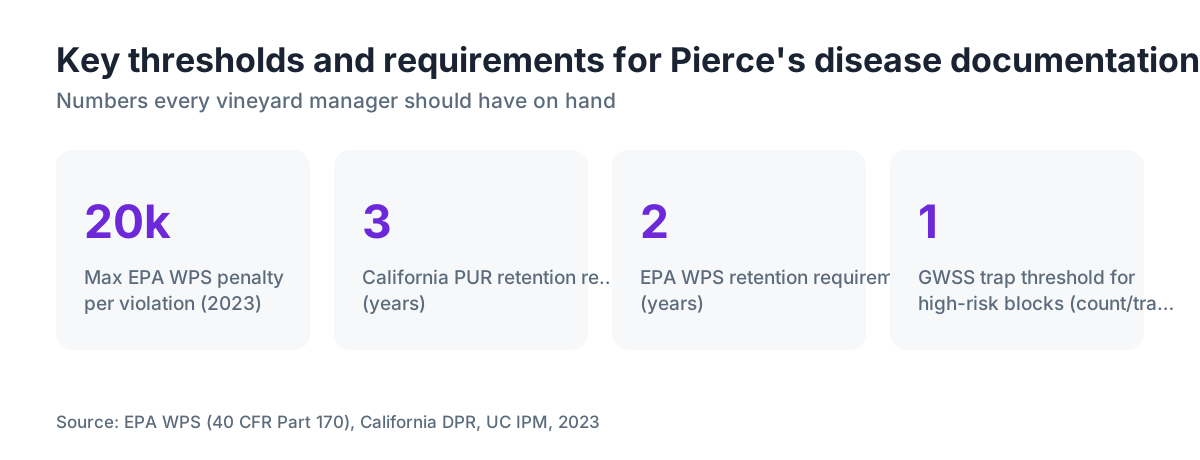
Sharpshooter thresholds are not standardized the way they are for some vineyard pests, and your records should say so plainly. The closest published number for GWSS comes from UC IPM: catch rates around 1 or more GWSS per yellow sticky trap per week in a high-risk block near riparian habitat warrant a management response [9]. For blue-green sharpshooter the threshold is looser, because populations run lower and the vector stays more localized.
Washington State University Extension notes that in eastern Washington, where GWSS isn't established, the work is pathway management and perimeter monitoring rather than in-vineyard trap thresholds [5].
Write your threshold down in plain language. Something like: "This vineyard uses a threshold of 1 GWSS per trap per week for high-risk blocks, consistent with UC IPM guidance, plus a calendar-based preventive spray in high-risk blocks during the April to June peak flight window regardless of counts." That one sentence tells an inspector exactly what standard you're holding yourself to.
When counts cross the line, write a decision record separate from the use report. A short paragraph does it: date, trap count, threshold, product picked, and why you picked it (a neonicotinoid at budbreak because systemic uptake improves efficacy, say, or kaolin later in the season to cut bee exposure). This is also where you note worker protection factors, like whether harvest is close enough that a given REI or pre-harvest interval (PHI) rules a product out.
What records do you need to satisfy EPA Worker Protection Standard requirements?
The EPA Agricultural Worker Protection Standard (40 CFR Part 170) was revised in 2015, with most provisions in force by January 2017 [2]. For a Pierce's disease program it touches your records in four places.
Central posting. Post WPS-compliant information at a central spot (break room, shop, equipment barn) within 24 hours of each application and keep it up until the REI expires. The posting has to include product name, EPA registration number, active ingredient, location and description of the treated area, application date and time, and REI expiration [2].
Application exclusion zones (AEZs). Since 2015, handlers must keep workers and bystanders out of a defined AEZ during application. For ground equipment the AEZ runs 100 feet in front of and 25 feet behind and to each side of the application point. Note that you kept it clear.
Record retention. WPS requires application information kept for two years [2]. Many states go longer for restricted-material reports. California requires three years [1]. Keep the longer one, which in California means three.
Training documentation. Workers need WPS safety training before they enter treated areas during an REI. Log training dates, trainer names, and worker names. Small operations skip this constantly, and it's one of the first things an inspection checks.
Running a digital system helps here. Tools like VitiScribe can generate WPS posting sheets and link them straight to your application records, so you're not typing the same information twice.
One line from the EPA's WPS regulation is worth keeping handy. The standard requires records be "available for inspection by EPA or State agency personnel" and provided "upon request to an agricultural worker or handler who was employed at the agricultural establishment" during the covered period [2].
How do you document scouting and monitoring that feeds your risk assessment?
Your risk assessment is only as good as the scouting behind it. One visual walk in March isn't monitoring. UC IPM recommends yellow sticky traps at several locations per block (more in blocks next to riparian habitat) checked weekly from March through October in high-risk California regions [9].
For each scouting event, record date, block ID, trap number or location, GWSS count, blue-green sharpshooter count, and any other pest or symptom notes. Find a vine with PD symptoms (leaf scorching with green islands, matchstick canes, uneven fruit ripening) and you record GPS coordinates, vine row and number, and pull a tissue sample for PCR confirmation. PCR is the only definitive test. Visual diagnosis on its own is too unreliable to trust.
Scout hardest for new infections in August and September, when symptoms show best. A confirmed positive triggers a documentation event: bump your risk tier, record the vine location, and if you're in a county where the Pierce's Disease Control Program operates, report it per program requirements [6]. Some counties make reporting mandatory.
Keep trap records and symptom maps in the same system as your spray records. When these live in separate binders, the line from "we found X insects" to "we sprayed Y product" disappears, and the whole system loses its analytical value.
What product choices and timing should you document for a PD spray program?
Nobody requires you to document why you chose a product. Do it anyway. It protects you if you're questioned and it lets you grade your own decisions next season. Here's the landscape and what's worth noting.
Neonicotinoids (imidacloprid, thiamethoxam, dinotefuran), applied as foliar sprays or systemic soil treatments, are the most common chemical approach for GWSS in California [9]. Imidacloprid put down at or just before budbreak has a soil-to-vine uptake window of roughly 4 to 8 weeks, depending on irrigation and soil texture. Record the application date relative to budbreak. Go in too late and systemic coverage is poor and the money's gone.
Pyrethroids (bifenthrin, cyfluthrin, zeta-cypermethrin) are contact materials with a shorter residual, usually 7 to 14 days. They're common as perimeter sprays or during high-pressure spikes. Note the target zone (perimeter versus whole block) in your record.
Kaolin clay (Surround WP) works as a physical deterrent rather than a killer. It's OMRI-listed and usable in certified organic programs, but it still carries an EPA registration number, so most state systems want it recorded as a pesticide application. Check your state's rule.
Cornell's PD extension work leans toward variety selection and rootstock rather than chemical control, given the lower GWSS pressure in the East [4]. If you farm in New York or Virginia, document your variety choice and any PD-tolerant rootstock as part of your cultural control record.
WSU Extension puts the main GWSS movement into vineyards in the April to June window, with a second push possible in late summer [5]. Record your application timing against those windows on purpose, not by accident.
How should you organize and store Pierce's disease documentation long-term?
The floor is two years under EPA WPS and three years for California restricted-material reports [1][2]. For Pierce's disease specifically, I'd keep complete records five to ten years back. PD pressure swings hard year to year. A block that was low-risk in a drought year can turn high-risk in a wet one, when riparian vegetation explodes and vector populations surge. Multi-year records are the only way to see that pattern coming.
Organize by block first, then by date. Store everything chronologically across 12 blocks and reconstructing the history of Block 7 becomes a project. Block-first lets you pull the full picture of one area in a minute.
For paper, a two-binder setup works. One binder for the current season as your active reference, one for archived years at the three-year minimum. Each block gets a tab. Inside each tab, file in this order: site risk assessment, trap records, spray records, WPS postings, outcome observations.
For digital, the requirement is that records export in a standard format (PDF or CSV) and back up off-site. A spreadsheet on a laptop that never gets backed up is not a compliant record once the laptop dies. If you want a purpose-built option, VitiScribe is made for vineyard compliance records and builds WPS posting sheets straight from your application entries.
Whatever you run, audit your records once a year before the next season starts. Confirm every application has a matching WPS posting, every high-risk block has a current assessment, and the training log is current.
What are the legal consequences of missing or incomplete PD spray records?
In California, failing to file a Pesticide Use Report for a restricted-material application can draw a civil penalty from the county agricultural commissioner, from a formal warning on a first offense up to fines in the hundreds or low thousands of dollars per violation [1][10]. The Department of Pesticide Regulation publishes enforcement data every year, and incomplete or missing reports land among the most common agricultural pesticide violations.
Under EPA WPS, failing to keep application records, post treated-area information, or hold workers out of the AEZ during application can bring civil penalties. As of the 2023 inflation adjustment, EPA can assess up to $19,736 per WPS violation, adjusted each year under the Federal Civil Penalties Inflation Adjustment Act [7].
Fines aren't the whole risk. Incomplete records can hit your crop insurance too. Some policies require documented pest management as a condition for disease-loss claims. Pierce's disease can gut a block in two to three seasons, and if you file a loss, your insurer may want proof you managed it.
Here's where small operations trip most often: they have the spray records but no linked risk assessment. Ask an inspector's question, "why this product and this timing," and a spray record alone can't answer it. The risk assessment is what makes the whole file defensible.
How do California's Pierce's Disease Control Program requirements add to standard record-keeping?
California runs a statewide Pierce's Disease Control Program under the Department of Food and Agriculture, funded partly by a grape acreage assessment [6]. The program centers on GWSS management and works hardest in Southern California, the Central Valley, and parts of the Central Coast.
If you're in a regulated area, the program may require you to allow survey access for state inspectors and cooperate with state-coordinated treatment. Some counties have mandatory treatment zones where specific applications are required or subsidized. Record state-coordinated treatments separately from your own, noting the agency and the authorization number if one is issued.
The program also funds a network of sentinel vineyard monitoring sites across the state. If your vineyard sits near a sentinel site, you can pull those trap counts through UC Cooperative Extension, and citing them in your assessment adds scientific backing to your tier rating.
For growers outside the current GWSS-established range, CDFA's pathway management rules aim at keeping the insect out. Document any plant material arriving on your property (nursery stock, cover crop seed, equipment) that could carry GWSS, plus any pre-arrival inspection or treatment. That's thin documentation for most operations, but it matters a lot if you ever land in a quarantine dispute.
How does documenting PD risk assessment improve your long-term disease management?
There's an operational case for documentation beyond staying legal: it makes you a better manager.
Read three or four seasons of trap records next to your confirmed infection maps and patterns jump out. Which blocks spike first in April? Is it always the northeast corner near the drainage? That tells you where to aim perimeter sprays. Which years ran hottest for vector pressure, and what was the January and February weather in those years? Wet California winters correlate with early, heavy sharpshooter populations, because the riparian vegetation comes in dense and lush.
Cornell's viticulture extension group makes the point that where PD is present but vectors stay at lower density, well-timed cultural work (aggressive roguing of infected vines, removing alternative host plants, managing cover crops) can cut inoculum and vector attraction a lot [4]. You can only measure whether it works with consistent baseline data from before and after.
UC IPM and the UC Davis Pierce's Disease Research Program have built decades of field data behind structured monitoring [9]. Blocks with documented programs catch new infections earlier than blocks managed on reflex, and early detection matters because a vine pulled at first symptom never becomes a spreading inoculum source.
For operations along California's coast or Central Valley, that head start can be the difference between losing a vine and losing a block.
Documentation also builds institutional memory. Sell the property, lease it, or hire a new manager, and the records hand over the site's risk profile on day one. A new manager with no records has to rebuild years of context from nothing.
Frequently asked questions
Do I need to file a pesticide use report for kaolin clay (Surround WP) applied for sharpshooter deterrence?
In California, yes. Kaolin clay carries an EPA registration number and counts as a pesticide application, so it needs a Pesticide Use Report regardless of its organic status. Rules vary by state, but if a product has an EPA registration number and you're applying it to a food crop, treat it as reportable and check with your county agricultural commissioner for local requirements.
How often should I update my Pierce's disease site risk assessment?
At minimum, once per season before the primary vector flight period starts, usually late February or early March in California. Update it right away if you confirm a new PD-positive vine in or next to the block, if CDFA changes the regional alert status, or if your scouting shows a real shift in trap counts against prior seasons.
What trap density is recommended for GWSS monitoring?
UC IPM recommends several yellow sticky traps per block as a starting point, with higher density (roughly one trap per 2 to 3 acres) in blocks next to riparian habitat or known inoculum sources. Check traps weekly from March through October in high-risk California regions, and record counts by trap location so you can map hot spots over time.
Does the EPA Worker Protection Standard apply to my family members who work in the vineyard?
WPS covers all agricultural workers and handlers at a farm, with an immediate-family exemption that applies only to the owner of the establishment and their immediate family. If family members are your employees and you're not the sole owner-operator covered by that exemption, WPS applies. Confirm the details with your state department of agriculture, since interpretation can get specific.
Can I use the same risk assessment document for multiple blocks, or does each block need its own?
Use one framework, but give each block its own dated tier rating based on that block's vector pressure, proximity to inoculum, and variety. The block-level approach is worth the extra ten minutes because it lets you justify different management intensities for different blocks, which is what actually happens in a real vineyard.
How do I document a Pierce's disease spray decision if I'm following a calendar-based schedule rather than a trap threshold?
Document the schedule in your risk assessment: state that the block is high-risk and that you're using a preventive calendar schedule consistent with UC IPM guidance for high-risk sites during the April to June flight window. Then record each application as usual. A calendar-based approach is legitimate for high-risk blocks. Just put the rationale in writing.
How long do I need to keep Pierce's disease spray records?
EPA WPS requires two years. California's Department of Pesticide Regulation requires three years for restricted-material Pesticide Use Reports. Keep the longer one, which means three years in California. For your own management, keeping complete block records five or more years is worth doing, because annual PD pressure swings so much that short records hide the pattern.
What happens if a state inspector finds that I sprayed an unregistered pesticide for Pierce's disease management?
Using a pesticide for a use not on its EPA label, including crops or pests it doesn't cover, violates FIFRA Section 12(a)(2)(G) [8]. Penalties can include civil fines and, for repeat violations, criminal charges. Before you apply, confirm the product lists grapevine or grapes as the crop and sharpshooter or leafhopper as the pest, and keep the label on file with your spray record.
Is there a standardized form for a Pierce's disease risk assessment, or do I create my own?
There's no single required form. County agricultural commissioners have their own report forms for the application record, but the risk assessment itself isn't a mandated state form. UC IPM and the UC Davis Pierce's Disease Research Program have published assessment guidance you can use as a template. The requirement is simply that the document is written, dated, and specific to each block.
Do I need to report a confirmed Pierce's disease-positive vine to the state?
In California, reporting requirements depend on your county and whether you sit inside a GWSS quarantine zone. Check with your county agricultural commissioner for local rules. In many areas reporting is encouraged, and in quarantine counties it can be mandatory. Always confirm a positive with PCR before reporting, because visual diagnosis alone isn't enough.
What's the best way to document PD risk assessment for a vineyard that's never had a confirmed infection?
Document the clean record as a positive finding, not a gap. Record your annual scouting, your trap counts, and the fact that no PD-positive vines were confirmed. Note your proximity to riparian habitat and your variety's susceptibility class. A clean multi-year record showing steady monitoring and no confirmed infections is exactly what you'd want if you ever had to dispute a regulatory action or insurance claim.
How does Pierce's disease documentation differ for organic certified vineyards?
Organic certification adds a layer: your certifier needs to see that every input is on the National Organic Program approved materials list. Kaolin clay and certain approved mineral oils are your main options for vector deterrence. Your spray records still need EPA registration numbers, and your organic system plan should reference your PD management approach. Keep certifier correspondence with your spray records so the audit trail is complete.
Sources
- California Department of Pesticide Regulation, Pesticide Use Reporting: California requires Pesticide Use Reports to be filed with the county agricultural commissioner within 30 days of restricted-material application, with three-year record retention.
- U.S. EPA, Agricultural Worker Protection Standard (40 CFR Part 170): EPA WPS requires central posting within 24 hours of application, two-year record retention, and that records be available to workers and inspectors.
- Cornell University, College of Agriculture and Life Sciences, grape and viticulture extension: In the eastern U.S., Xylella strains and vector behavior differ, and PD management leans toward variety selection, rootstock, and cultural practices rather than chemical control.
- Washington State University Extension, Pacific Northwest Pest Management Handbooks: WSU Extension identifies April to June and a secondary late-summer period as peak GWSS movement windows, and focuses on perimeter monitoring and pathway management where GWSS is not yet established.
- California Department of Food and Agriculture, Pierce's Disease Control Program: California's Pierce's Disease Control Program is funded by a grape acreage assessment and operates mandatory treatment zones in GWSS-established counties.
- U.S. EPA, enforcement and Federal Civil Penalties Inflation Adjustment Act penalty schedule: As of 2023, EPA can assess up to $19,736 per WPS violation, adjusted annually for inflation.
- U.S. EPA, Summary of the Federal Insecticide, Fungicide, and Rodenticide Act (FIFRA): Using a pesticide for a use not listed on its EPA label violates FIFRA Section 12(a)(2)(G) and can result in civil and criminal penalties.
- UC Statewide IPM Program, Pest Management Guidelines for Grape: UC IPM guidance covers sharpshooter identification, seasonal activity windows, trap-based thresholds around 1 GWSS per trap per week in high-risk blocks, and chemical options including neonicotinoids and pyrethroids.
- California Department of Food and Agriculture, County Agricultural Commissioners: California county agricultural commissioners enforce Pesticide Use Report filing requirements and can issue civil penalties for missing or incomplete records.
Last updated 2026-07-09