CSWA self-assessment spray record section: what you actually need

TL;DR
- The California Sustainable Winegrowing Alliance self-assessment includes a dedicated spray records section that scores your pesticide documentation across roughly seven practice areas, from label compliance and worker safety records to IPM decision logs.
- Most vineyards land in the mid-range on first pass.
- The fixes are almost always paperwork and process, not field changes.
What is the CSWA self-assessment spray record section?
The California Sustainable Winegrowing Alliance (CSWA) runs a voluntary sustainability certification called the California Sustainable Winegrowing Program (CSWP). Every participating vineyard fills out a self-assessment workbook built around the Code of Sustainable Winegrowing Practices. The spray record section sits inside the broader Pest Management chapter. That chapter is one of the longest in the workbook, because pesticide use is where compliance risk and environmental risk both run highest.
The section asks you to rate your vineyard's practices on a scale of 1 to 4 for each practice code. A 1 means the practice isn't used or documented. A 4 means it's done consistently, documented, and built into how you operate. CSWA doesn't publish a minimum passing score for individual sections, but third-party verification auditors (required for Certified California Sustainable Winegrowing status) review your documented evidence against your self-reported scores. If your spray records don't back up a 3 or 4, the auditor will drop it.
The self-assessment is built on the 5th edition of the Code of Sustainable Winegrowing Practices workbook, which CSWA last updated in 2019 [1]. The pest management chapter covers monitoring, IPM thresholds, application equipment calibration, and worker protection, so the spray record section doesn't live alone. It's woven through adjacent practice codes that all reference your documentation.
Which specific practice codes cover spray records in the workbook?
The workbook organizes practices by code numbers within each chapter. Inside Pest Management, the spray-record codes cluster into a handful of areas. Exact code numbers shift between editions, but the content has stayed consistent across the 4th and 5th editions.
Here are the main documentation areas the spray section scores:
| Practice Area | What the Code Asks | Typical Evidence Needed |
|---|---|---|
| Pesticide application records | Do you keep records meeting California DPR requirements? | PCA-signed records, operator info, site, rate, weather |
| Label and SDS access | Are labels and safety data sheets available at point of use? | Binder or digital file in field or shop |
| Restricted-use pesticide permits | Do you have required permits and are they current? | Copy of permit, DPR permit number |
| IPM decision documentation | Do you record pest monitoring data used to trigger sprays? | Scouting logs, threshold notes, PCA recommendations |
| Worker protection standard compliance | Are WPS training records, application exclusion times, and safety info maintained? | EPA WPS training logs, posted field safety info |
| Equipment calibration records | Is application equipment calibrated and documented? | Calibration log with date, equipment ID, gallons/acre |
| Pesticide storage and disposal | Are storage practices and disposal documented? | Inspection log, disposal receipts |
Not every operation scores all seven equally. Small owner-operators often have good field records but thin IPM decision logs. Larger operations tend to have the opposite problem: clean PCA paperwork but patchy worker safety documentation.
The underlying legal requirement for spray records in California comes from the Department of Pesticide Regulation. California Food and Agricultural Code Section 12981 and California Code of Regulations Title 3, Section 6624 require pesticide application records completed within 24 hours of application and submitted to the County Agricultural Commissioner monthly [2]. The CSWA assessment doesn't create new legal requirements. It asks whether you're meeting the ones already on the books and going past them.
How does the 1-to-4 scoring scale work in practice?
CSWA uses one rubric across the whole workbook. Learning it is worth a few minutes, because it changes how you think about what to write down.
A 1 means the practice isn't in place. No IPM decision logs, or spray records that don't get done. A 2 means the practice is partial, inconsistent, or in early stages. You keep records but they're missing fields, or you do it for some blocks and skip others. A 3 means the practice is consistent across your operation: records complete, timely, accessible. A 4 means you go past the baseline, actively improve the system, and can show results over time, like a documented trend toward lower pesticide use backed by monitoring data.
For third-party verification, auditors look for a preponderance of evidence at your claimed score. Score yourself a 3 on IPM decision documentation and the auditor expects scouting logs with dates, pest pressure observations, economic thresholds noted, and a clear link between the data and each spray decision. A PCA recommendation letter by itself usually won't hold a 3.
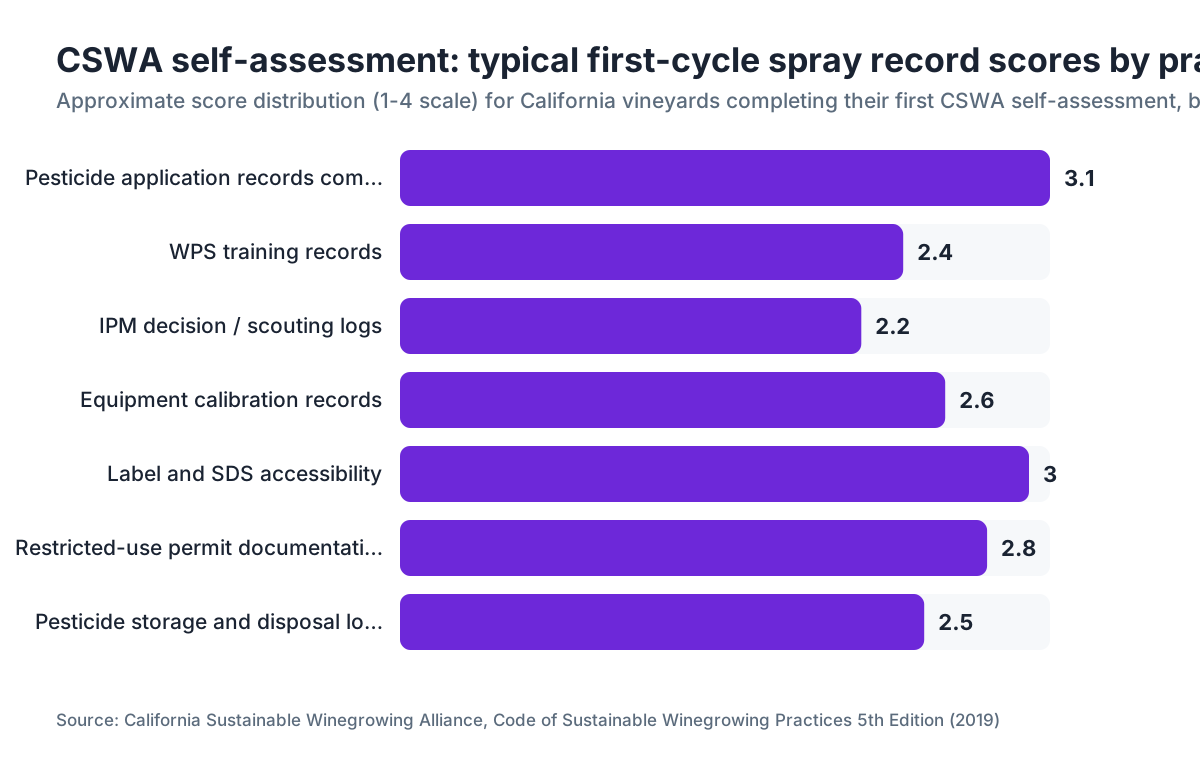
Most first-time audited vineyards land between 2 and 3 on spray-record codes. CSWA's own materials are honest about this: a 4 takes multi-year trend data and a documented continuous improvement process, more than good current-year records [1].
What do California law and the EPA Worker Protection Standard require you to document?
The CSWA self-assessment doesn't grade you against a standard it invented. It grades whether you're meeting existing law and then going further. Knowing the legal floor tells you what a baseline 2 or 3 actually looks like.
Under California DPR regulations, every pesticide application record must include the operator name and license number, the site treated (county, location, commodity), the pesticide product name and EPA registration number, the amount applied, the date and time, and the weather conditions at application [2]. These records go to the County Ag Commissioner within seven days of the end of the month the application happened in.
The EPA Worker Protection Standard (WPS), revised in 2015 and enforced under 40 CFR Part 170, adds its own documentation layer [3]. WPS requires agricultural employers to keep records of pesticide applications, including product name, EPA registration number, active ingredient, location, and application dates. Those records stay on file for two years and must be available to workers and handlers who might have been exposed. WPS also requires training records showing workers and handlers got their safety training before working treated areas. The CSWA self-assessment asks about WPS compliance directly and looks for training logs, posted safety information (the central posting requirement), and application-specific records.
The central posting requirement means you post safety information where all workers can reach it. That includes the treating employer's name and contact information, the location of the nearest emergency medical facility, and notice of any applications in progress or within the entry-restricted interval [3].
UC Davis and UC Cooperative Extension publish practical WPS guidance for California growers that lines up with what CSWA auditors look for [4]. The UC IPM program also publishes pest management guidelines that inform what a credible IPM decision log should reference [5].
What does an IPM decision log need to include to score well?
This is where most vineyards underperform relative to what they actually do in the field. Plenty of growers do solid IPM work. They scout, they track pest pressure, they make thoughtful spray decisions. They just don't write it down in a way an auditor can follow.
A credible IPM decision log for CSWA should capture, at minimum: the scouting date, the block or zone scouted, the pest or disease observed, the population level or severity rating, the economic or action threshold used (and its source), the decision (treat or hold), and if you treat, the product chosen and why. That last field matters, because sustainable winegrowing asks you to document that you picked the least-toxic effective option, more than that you followed the label.
The PCA recommendation letter helps, but it doesn't substitute for your own scouting records. An auditor wants to see that the decision-making happened at your vineyard, more than that a licensed advisor signed off. If your PCA gives written recommendations that reference their own monitoring data, attach those. They strengthen the file.
Disease management is harder to document, because you're often spraying preventively against powdery mildew or Botrytis. In those cases, document the weather data or disease risk model output you used (UC IPM's ipm.ucanr.edu has powdery mildew risk tools [5]), your spray timing rationale, and the product rotation logic if you're managing resistance.
WSU's wine grape pest management resources are written for Pacific Northwest conditions, but their scouting log templates translate cleanly to California documentation needs [6].
How does equipment calibration documentation fit the self-assessment?
Calibration is one of the easier sections to score well on, because the documentation is simple. You need a log showing when each piece of application equipment was calibrated, who did it, what the output was (gallons per acre, or gallons per minute per nozzle), and what got adjusted.
Each calibration entry should also note the target application rate from your spray program and confirm whether output matched it. If it didn't, write down what you adjusted. That adjustment record is a scoring positive. It shows the process caught a real variance and fixed it.
The CSWA workbook doesn't set a minimum calibration frequency, but industry practice and most PCA recommendations call for calibration at the start of each spray season and any time nozzles get replaced or equipment is repaired. Two calibrations per season (pre-season plus a mid-season check) is enough to support a 3.
A record that just says "calibrated, good" with a date won't cut it. The auditor wants the actual numbers: gallons per minute per nozzle, travel speed, calculated gallons per acre. Fifteen minutes with a catch jar and a stopwatch gives you data worth two seasons of credibility.
What are the most common gaps auditors find in vineyard spray records?
From publicly available CSWA audit guidance and the workbook's own descriptions of common shortfalls, the recurring gaps fall into a predictable pattern.
Missing weather data is the most common single gap in application records. The California DPR requirement to record weather at application often gets satisfied with just "calm" or "clear." What the regulation and the CSWA assessment actually want is temperature, wind speed, and wind direction.
Incomplete worker training records come second. Many farms send workers to WPS training but don't keep a sign-in sheet or a training summary showing what was covered. Without that paper, you can't demonstrate compliance and you can't score above a 2 on WPS codes.
Gaps in pest monitoring records are the third big one. If your spray records show applications but there are no scouting logs in the same weeks, auditors conclude you sprayed on a calendar schedule rather than in response to monitored pressure. Calendar-based spraying isn't prohibited, but it reads as a lower level of IPM integration and it pulls your IPM decision documentation score down.
Expired or missing restricted-use pesticide permits round out the list. If you use any RUP, a copy of the current permit belongs in your records file. California County Ag Commissioners issue these annually, so an expired permit in your file reads as a documentation failure even when you actually renewed it.
For operations managing multiple blocks across mixed terrain, like those around Paso Robles wineries where properties can run hundreds of acres, block-level record organization is worth getting right before an audit.
How do you organize spray records to prepare for CSWA third-party verification?
The single most useful thing you can do before a CSWA audit is organize your records by the practice code they support, not by date or product. Auditors work through the workbook systematically. Match that structure and the review moves faster, and your scores are less likely to take a hit for records that exist but never got found.
A working file for a vineyard spray program looks like this: one folder (physical or digital) per major practice area, each holding the relevant records for the current assessment period plus supporting reference documents like WPS training materials or calibration procedure sheets.
Within each application record, completeness beats format. California doesn't mandate a specific form for spray records as long as the required fields are present [2]. Use commercial spray record software, a custom spreadsheet, or a paper form from your County Ag Commissioner. What you can't do is reconstruct records after the fact from memory or billing invoices. Records completed within 24 hours of application, as California law requires, are the ones that hold up in both legal and audit contexts.
Digital tools built for vineyard compliance, like VitiScribe, capture field data at the point of application and auto-populate required fields, which cuts both the completion gap and the error rate on things like EPA registration numbers and application rates.
For smaller operations just starting to formalize their spray documentation, UC Cooperative Extension farm advisors in most California wine regions offer one-on-one consultations to help build record-keeping systems that satisfy both DPR and CSWA [4].
Does improving spray record scores actually affect your certification status?
Yes, but not the way most people assume.
CSWA certification (the Certified California Sustainable Winegrowing seal) requires third-party verification by an accredited auditor [1]. The auditor calculates your verified score across all chapters. CSWA hasn't published a minimum chapter score required for certification, but the program's framework makes clear that a score of 1 (not implemented) in legally required areas, like WPS compliance or pesticide record-keeping, blocks certification. You can't be certified sustainable while you're out of compliance with baseline law.
Past the threshold, spray record scores feed your Integrated Pest Management chapter score. That chapter carries more weight than most, given its direct line to environmental impact. A strong Pest Management chapter score can offset weaker scores elsewhere and move your overall average in a real way.
There's a business reason too. Major wine buyers and retailers increasingly ask for sustainability verification, and some ask about IPM practices specifically. A well-documented spray record file is the evidence behind any IPM claim. Without it, the claim is a talking point.
Operations that take the self-assessment seriously tend to improve their spray record scores by roughly half a point to a full point per practice code between their first and second cycles, based on CSWA's program participation reports, though CSWA doesn't publish granular code-level score distributions [1].
How often do you need to complete the CSWA self-assessment?
CSWA requires participating wineries and vineyards to complete the self-assessment annually [1]. The assessment covers your practices for the prior growing season. Third-party verification audits run on a cycle set by your program tier, currently every three years for most participants in the Certified California Sustainable Winegrowing program.
That annual cadence matters for spray records because you need to keep records going back at least to your previous audit. California DPR requires pesticide application records retained for two years [2]. CSWA's verification framework expects to see records covering the current assessment period plus everything since the last audit, which for a three-year cycle means you keep at least three years of spray records.
The EPA WPS has its own retention rule: application records and handler training records kept for two years [3]. Because CSWA verification audits may reach back to the prior audit cycle, setting your retention schedule to three years for all spray-related documents is the practical standard.
Self-assessment completion in the years between audits is still required and submitted to CSWA, but auditor review only happens during the verification cycle. Practicing complete record-keeping every year, rather than scrambling before a scheduled audit, is what separates operations that score consistently well from those that spike in audit years and slip in between.
What resources help you improve before the next assessment?
Several free, high-quality resources address the documentation the CSWA spray record section scores.
The California Department of Pesticide Regulation publishes its pesticide application record requirements and blank record forms through its website [2]. The County Agricultural Commissioner in your county is a direct resource too. They receive your monthly reports and can tell you which fields are commonly incomplete in their county's submissions.
UC IPM Online (ipm.ucanr.edu) publishes pest management guidelines for wine grapes that are the industry reference for economic and action thresholds in California viticulture [5]. Citing them in your IPM decision logs is legitimate and strengthens the file.
UC Davis Cooperative Extension and the UC ANR network have farm advisors covering most California wine regions with direct experience helping growers prepare for CSWA assessments [4]. This is free public support that not enough growers use.
Cornell's Department of Horticulture has published workbook-style IPM record keeping guides for wine grapes. They're written for New York conditions, but the monitoring and decision log templates transfer well.
For a vineyard in a high-scrutiny region where buyers increasingly want verified sustainability documentation, a day per season on documentation organization pays back at audit time. VitiScribe's spray log module generates CSWA-compatible records that link application data to monitoring events, which hits the IPM decision documentation gap most operations struggle with.
The CSWA workbook itself, downloadable from sustainablewinegrowing.org, is the primary reference. Read the 4-point rubric for each spray-related practice code, benchmark your current records honestly against the 3-point descriptor, and you'll know exactly where to spend your time before the next cycle.
Frequently asked questions
Do I need a PCA to score well on the CSWA spray record section?
A licensed PCA (Pest Control Adviser) in your spray program strengthens your IPM documentation, because PCA recommendations put a licensed professional's sign-off on spray decisions. California requires a PCA for any restricted-use pesticide application on commercial agricultural land. CSWA doesn't mandate PCA involvement for general use pesticides. The scoring weight is on the quality of decision documentation, not on who generated it.
What's the difference between the CSWA self-assessment spray section and what the County Ag Commissioner actually audits?
The County Agricultural Commissioner enforces California DPR regulations and reviews the monthly spray reports you submit. Their focus is legal compliance: correct fields, timely submission, valid permits. CSWA's self-assessment goes past legal compliance to ask about IPM integration, least-toxic product selection, and equipment calibration documentation. You can be fully compliant with DPR requirements and still score only a 2 on CSWA's IPM decision documentation codes.
How long do I need to keep spray records to satisfy both California law and CSWA?
California DPR requires spray records retained for two years from the application date. The EPA Worker Protection Standard requires application records and handler training records for two years. CSWA third-party verification audits occur every three years for most participants, so auditors may request records going back to the prior audit cycle. Keep all spray-related records for at least three years to cover your full CSWA audit cycle.
Can I complete the CSWA spray record self-assessment without hiring a consultant?
Yes. The CSWA workbook is free to download and the scoring rubric explains itself. Most vineyard managers and winery owners running their own field operations can complete the spray section on their own by comparing existing records against the 4-point rubric for each practice code. UC Cooperative Extension farm advisors can help interpret your scores and spot gaps at no cost in most California wine regions.
What weather data fields are required on California pesticide application records?
California Code of Regulations Title 3, Section 6624 requires application records to include weather conditions at time of application. Industry practice and County Ag Commissioner guidance specify wind speed and direction, temperature, and sky conditions at minimum. Entering only 'calm' or 'clear' gets flagged as incomplete. Capturing actual numerical values from a weather station or handheld meter is the standard that satisfies both DPR requirements and CSWA auditor expectations.
How does the CSWA spray record section score organically managed vineyards?
Organically managed vineyards follow the same rubric but get evaluated on the materials they actually use. OMRI-listed products still require complete application records under California DPR rules and EPA WPS. IPM decision documentation matters more for organic operations, because the choice to use an organic material over a synthetic one should be documented as a deliberate least-impact decision. Organic certification records can supplement but don't replace CSWA documentation.
What is the WPS central posting requirement and how does it connect to CSWA scoring?
The EPA Worker Protection Standard (40 CFR Part 170) requires agricultural employers to keep a central posting location accessible to all workers, containing the employer's contact information, the nearest emergency medical facility, and notice of applications within the entry-restricted interval. CSWA's WPS-related practice codes ask whether this posting is in place and current. An auditor will physically check the posting location and review whether application-specific information is updated within the required timeframe.
Does CSWA publish average spray record scores across participating vineyards?
CSWA publishes aggregate program-level data in its annual report, including overall average scores by chapter and trends over time. It doesn't publish granular code-level score distributions for spray record subcategories. The 2022 CSWA Annual Report shows Pest Management chapter scores improving across the program over successive cycles, but specific spray documentation sub-scores aren't broken out in publicly available reporting.
If I use a contract spray applicator, am I still responsible for the spray records?
Yes. Under California DPR regulations, the property operator is responsible for making sure spray records get completed and submitted to the County Ag Commissioner. A licensed pest control operator (PCO) applying pesticides commercially must maintain records too, but that doesn't relieve the grower of their own obligations. For CSWA purposes, your file should include records from any contract applicator working your blocks, obtained from them directly and filed with your operation's documentation.
What's the fastest way to close gaps in my spray record documentation before an audit?
Work in this order: first, fill any missing weather data in existing records by pulling historical data from a nearby weather station and noting the source. Second, create or reconstruct scouting logs from notes, PCA correspondence, or dated photographs. Third, pull your WPS training sign-in sheets and verify they're complete and cover all current workers. Fourth, document at least one equipment calibration for the current season with actual output numbers.
Are restricted-use pesticide permits part of the CSWA spray record section?
Yes. CSWA's Pest Management chapter includes practice codes that address whether your restricted-use pesticide permits are current and accessible in your records. California requires a permit from the County Agricultural Commissioner to purchase and use restricted-use pesticides. A copy of the current-year permit, with its expiration date visible, belongs in your spray records. An expired permit in your file, even if you renewed it, signals a documentation lapse to an auditor.
How do I document resistance management in my spray program for CSWA scoring?
Resistance management documentation shows you're rotating pesticide mode-of-action (MOA) groups rather than leaning on one chemistry. In your records, note the FRAC or IRAC code for each fungicide or insecticide applied and add a brief note explaining why you chose that product in the rotation sequence. Some vineyards attach a seasonal spray program table showing planned MOA rotation to the front of their file. This supports higher scores on IPM integration and responsible pesticide use codes.
Does CSWA scoring penalize vineyards for higher pesticide use volumes?
The rubric evaluates your decision-making process and documentation quality more than absolute use volumes. The IPM practice codes do reward evidence that you're moving toward lower overall inputs over time. If your spray records show five years of decreasing applications for a given pest, that trend supports higher scores on the continuous improvement dimension of the 4-point rubric. High-volume programs with no trend data and no documented least-toxic selection rationale will struggle to score above a 2 on those codes.
Sources
- California Sustainable Winegrowing Alliance, Code of Sustainable Winegrowing Practices 5th Edition and Program Overview: CSWA self-assessment uses a 1-to-4 scoring scale, requires annual completion, and third-party verification every three years for certified participants; 5th edition workbook published 2019
- California Department of Pesticide Regulation, Pesticide Use Reporting: California Food and Agricultural Code Section 12981 and CCR Title 3 Section 6624 require pesticide application records within 24 hours of application, submitted to County Agricultural Commissioner monthly, retained two years
- U.S. EPA, Agricultural Worker Protection Standard (40 CFR Part 170): EPA WPS requires agricultural employers to maintain pesticide application records and handler training records for two years; central posting of safety information is mandatory
- UC Agriculture and Natural Resources, Cooperative Extension Wine Grape Resources: UC Cooperative Extension farm advisors provide grower support on WPS compliance and CSWA documentation practices across California wine regions
- UC IPM Online, UC ANR, Wine Grape Pest Management Guidelines: UC IPM publishes economic and action thresholds for wine grape pests and disease risk models including powdery mildew risk tools for California conditions
- Washington State University Extension, Wine Grape Pest Management: WSU Extension publishes scouting log templates and pest monitoring guidance for wine grape operations applicable to vineyard IPM documentation
- California Department of Pesticide Regulation, Restricted Materials and Permits: California requires a restricted-use pesticide permit from the County Agricultural Commissioner to purchase and use restricted-use pesticides on commercial agricultural land
- U.S. EPA, Pesticide Registration: EPA registration number must appear on pesticide application records; label is the legal document governing application
- California Department of Food and Agriculture, County Agricultural Commissioners: County Agricultural Commissioners receive monthly pesticide use reports and issue restricted-use pesticide permits in California
Last updated 2026-07-09