Replant block history documentation for disease risk assessment
TL;DR
- Documenting a block's crop, pest, and treatment history before replanting predicts which soilborne pathogens are likely present and which preplant response fits.
- Gather previous host crops, prior fumigation dates, nematode and Armillaria observations, and any Agrobacterium or Phytophthora detections.
- Most extension programs want a lookback of 10 to 20 years.
- Armillaria alone can survive 50 years in buried roots.
Why does replant block history matter for disease risk?
Pull an old block and stick new vines in the same ground, and you are not starting fresh. The soil keeps a biological memory. Nematode populations from the last planting, Armillaria root rot mycelium that lives for decades in buried root debris, crown gall bacteria that rode in on pruning tools or infected stumps, Phytophthora species that arrived on water or equipment years before any symptom showed. Disease pressure on your new vines is not random. It is largely predictable if you know what lived in that soil before.
University of California Cooperative Extension has tracked replant disease losses in California vineyards for years. The pattern holds: replanted blocks on infested ground without preplant treatment establish more slowly, show higher vine-to-vine variability in first-year growth, and on Armillaria-positive sites lose 5 to 15 percent of new vines within three years [1]. You do not see that number in the moment. It shows up as dead spots in a block you just spent serious money on.
Build the case file early and your options multiply. Preplant fumigation, biofumigation cover crops, clean foundation stock, nematode-resistant rootstock, subsoil ripping to dry out Armillaria debris. Every one of those calls gets made well only when you know what you are dealing with.
History is the cheapest diagnostic tool you own.
What records should you collect for a replant risk file?
A complete replant history file has six categories of records. You rarely get all six, especially on ground that changed hands, but every one you reconstruct narrows the uncertainty.
1. Previous host crops and planting dates. The single most useful fact is what plant species occupied the block and for how long. Grapevines host a different nematode community than almonds or stone fruit, and each previous host predicts a different risk. Ring nematodes (Mesocriconema xenoplax) build up heavily under peaches and cherries. Root-knot nematodes (Meloidogyne incognita and M. arenaria) persist after cotton, tomatoes, and many vegetables [2]. Pull planting and removal dates so you can calculate years of host exposure.
2. Spray and fumigation records. California, Washington, Oregon, and most other grape states require pesticide application records for at least two years under state rules, and under the EPA Worker Protection Standard the agricultural employer keeps records of WPS-covered applications [3]. Many growers keep far longer logs. Pull them and note preplant fumigation dates, active ingredients (methyl bromide, 1,3-dichloropropene, metam sodium, chloropicrin), and acreage covered. A block fumigated with 1,3-D plus chloropicrin fifteen years back can still sit lower on the risk scale than adjacent ground that was never treated. The effect fades, though. It is not permanent.
3. Nematode sampling history. Where old samples exist, record the date, depth, genera found, and counts per 250 cc of soil. Washington State University Extension makes the point that a single pre-plant sample is a snapshot; a file showing rising populations over time tells you far more [4]. No past samples? You collect your own (see the sampling section below).
4. Visual disease observations and removal notes. When the old vines came out, did anyone find Armillaria mycelial fans under the bark at the crown? Crown gall tumors on removed vines? Dead-vine patterns hinting at Phytophthora or a water-mold problem in low spots? Notes from the removal crew, however rough, are worth digitizing.
5. Irrigation and drainage history. Phytophthora cinnamomi and P. megasperma thrive in poorly drained, saturated soil. A block with a documented history of standing water after rain sits structurally higher on the risk scale. Note drain tile locations, any re-grading work, and irrigation type (flood, drip, overhead), because overhead or flood irrigation on a site with poor internal drainage is a strong Phytophthora risk factor [5].
6. Equipment and source material history. Crown gall (Agrobacterium vitis) spreads on infected nursery material and on pruning equipment. If prior blocks carried Agrobacterium and equipment moved between them without sanitizing, that history belongs in the file. Same goes for Xiphinema index, the dagger nematode that vectors Grapevine fanleaf virus. One infected planting on infested nursery stock can leave a viable Xiphinema population for more than two decades [2].
How far back should your lookback period go?
As far as you can get. The practical floor is 10 years. The meaningful floor for Armillaria risk is 20.
Armillaria mellea colonizes buried root pieces and survives in infested soil for 50 years or more after the last host plant leaves [1]. That is not a stretch. It is well-documented in the California tree-crop replant literature. So if your ground grew walnuts or almonds 30 years ago, before the previous vineyard went in, that pre-vineyard history matters and belongs in your file.
Nematodes fade faster without a host. In fallow ground, ring nematode populations can drop sharply within two to three years. Root-knot populations decline too but hang on longer at low levels in weed hosts [2]. A five-year fallow with real weed control cuts nematode risk substantially. A fallow overrun with nightshade, bindweed, or bermudagrass does almost nothing, because those are excellent nematode hosts.
There is a regulatory angle too. California's Department of Pesticide Regulation requires a licensed pest control adviser (PCA) to review pre-plant sampling data before recommending a soil fumigant. A documented history file speeds that PCA consultation and strengthens the justification behind a fumigation permit application.
What soil sampling methods work best before replanting?
Pre-plant soil sampling is the one diagnostic you control entirely, no matter how thin the paper trail is. Done right, it gives you a current read on nematode populations and, with the right lab work, Phytophthora detection.
For nematodes, UC Davis and WSU Extension both point you to the old root zone rather than between-row soil. Collect cores to 24 to 30 inches where vine roots concentrated. Take at least 15 to 20 sub-samples per management zone (a zone being a continuous area with similar crop history and soil type), composite them in a clean bucket, and send 1 to 2 pints of mixed soil to a certified nematology lab. Sample within 60 days of expected planting so the count is current [4].
Armillaria has no reliable routine soil assay at commercial scale. The practical test is visual. During vine removal, have someone cut the bark at the crown and read the wood-soil interface for the white mycelial fans and the honey-mushroom smell. Mark GPS coordinates of every positive vine. That map becomes a required attachment to your replant file. UC Davis Plant Pathology recommends pulling and destroying root pieces from Armillaria-positive sites rather than leaving them to rot in place [1].
For Phytophthora, baiting assays or PCR-based soil tests detect inoculum before you plant. They run roughly $75 to $150 per sample at commercial labs (mid-2020s pricing), which is not nothing. On blocks with a history of standing water or prior Phytophthora symptoms, that is money well spent [5].
For Agrobacterium vitis, soil assays are less reliable than tissue testing on removed vines. If crown gall was confirmed in the previous planting, flag it in the file whether or not you run a formal soil test.
| Pathogen | Sampling method | Recommended depth | Lab cost range (approx.) |
|---|---|---|---|
| Root-knot nematode | Soil cores, 15-20 sub-samples | 12-30 in | $20-$50 per composite |
| Ring nematode | Soil cores, 15-20 sub-samples | 12-24 in | $20-$50 per composite |
| Dagger nematode (Xiphinema) | Soil cores + lab extraction | 18-30 in | $20-$50 per composite |
| Armillaria | Visual inspection at crown during removal | Crown/root zone | Low (labor only) |
| Phytophthora spp. | Baiting assay or qPCR | 12-18 in | $75-$150 per sample |
| Agrobacterium vitis | Tissue test on removed vines | Crown tissue | $50-$100 per sample |
How do you organize and store replant history records?
Loose papers in a field truck do not survive a regulatory audit, a ranch sale, or a consultant changeover. The structure matters as much as the records.
The minimum usable system has four parts: a block map with GPS boundaries, a chronological log of each documented event (crop planted, crop removed, fumigation applied, sample taken, disease observed), scanned copies of original lab reports and spray records, and a summary risk rating per pathogen.
The block map does not need to be fancy. A hand-drawn sketch with measured dimensions and GPS corner points works, as long as it ties to the rest of the file. Digital GIS files are better, because you can overlay sample locations, Armillaria-positive vine points, and drainage patterns in one view.
Field operations platforms built for vineyard compliance, including VitiScribe, let you attach lab reports and sample-location photos straight to block records, so everything stays tied to the physical geography instead of floating in a folder on someone's laptop. That geographic anchoring earns its keep when you run multiple blocks with overlapping histories, or when you hand the file to a consultant or a buyer.
Whatever the platform, keep at least two independent copies of the complete file. A single external hard drive can fail the week before a state DPR inspection, and 12 years of spray and sampling records can vanish with it. Redundancy is not optional.
California growers have one more source. Pesticide Use Reports (PURs) filed with the County Agricultural Commissioner are public records, retrievable for your own operation's APN. That is an often-overlooked well of historical fumigation data when internal records are thin [6].
How do you translate documented history into a disease risk rating?
A risk rating turns a stack of records into a decision framework. The output you want is a per-pathogen severity estimate (low, moderate, high) that maps to specific pre-plant actions.
Here is a practical framework built from UC Davis and Cornell recommendations.
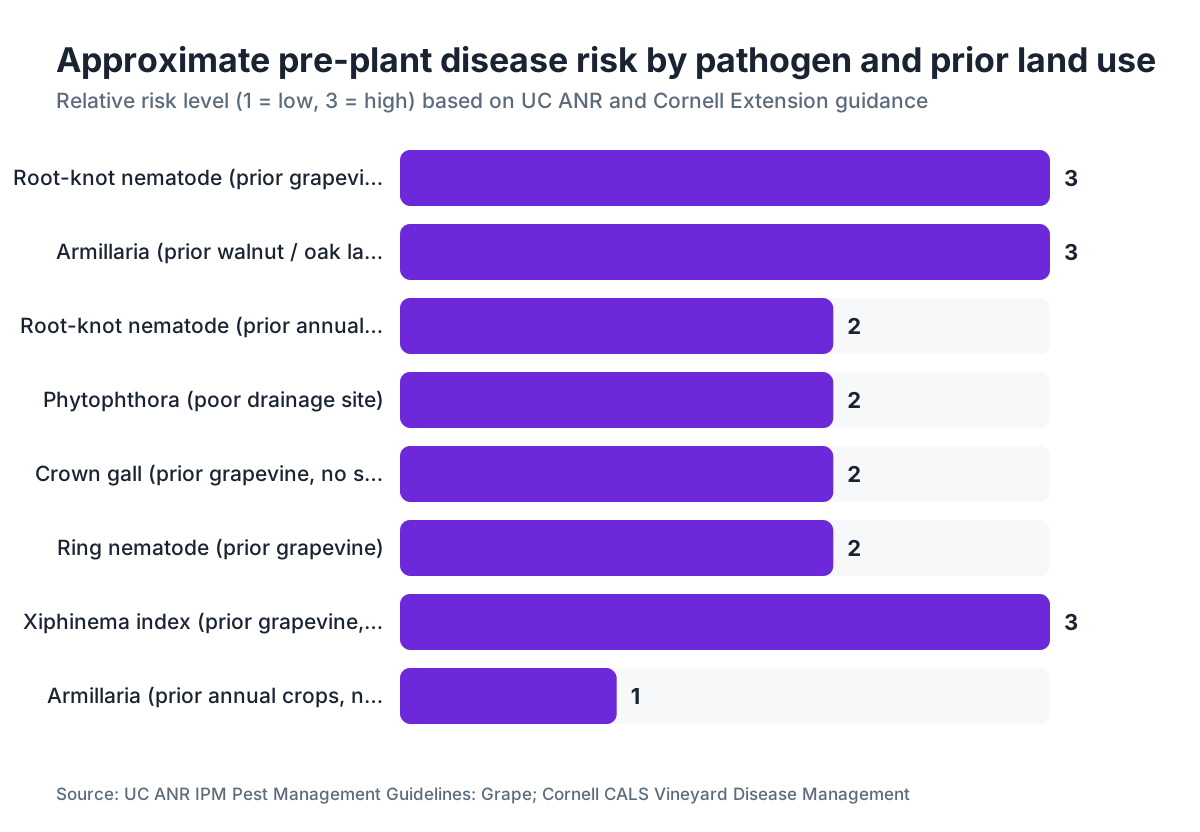
Nematode risk: High when previous soil samples show Meloidogyne spp. above 1 per 250 cc, ring nematode above 100 per 250 cc, or dagger nematode (Xiphinema index) at any detectable level on ground that carried a prior grapevine planting. Moderate when populations sit below those thresholds but the previous crop was a known nematode host. Low when the block has been fallow for 3 or more years with real weed control and current sampling shows near-zero populations [2][7].
Armillaria risk: High when mycelial fans turned up during vine removal, or when tree crops (walnut, almond, oak-adjacent) preceded the previous vineyard with no documented fumigation. Moderate when tree crops were present more than 20 years ago with documented fumigation. Low when no tree-crop history exists and no visual positives were found.
Crown gall risk: High when Agrobacterium vitis was confirmed in the previous planting, or when a shared-equipment event (pruning without sanitizing) is known. Moderate when gall-like symptoms were seen but not confirmed by tissue test. Low when no observation history exists and new-planting nursery stock is certified clean material.
Phytophthora risk: High when the block has documented standing-water history, a prior Phytophthora diagnosis, or a positive soil bait assay. Moderate when drainage is marginal and no prior soil test exists. Low when internal drainage is confirmed adequate and no prior disease history exists.
With per-pathogen ratings in hand, you map each to its mitigation options. A block rated High for nematodes, Moderate for Armillaria, Low for crown gall and Phytophthora is a strong candidate for broad-spectrum fumigation and nematode-resistant rootstock. A block that is High only for Phytophthora might skip fumigation entirely but needs subsoil tile, berm planting, and a Phytophthora-tolerant rootstock like 1103P.
What preplant actions does the risk assessment actually drive?
Documentation is only worth doing if it changes what you do on the ground. Here is how each risk tier maps to real decisions.
High nematode risk: consider a registered fumigant (1,3-dichloropropene, metam sodium, or the 1,3-D plus chloropicrin combination), timed so the soil has the temperature and moisture for good gas diffusion, typically above 50 degrees F. Just as important, pick a rootstock with the right resistance. Teleki 5C and 3309C hold moderate resistance to Meloidogyne. Harmony and Freedom carry higher resistance to M. arenaria and M. incognita but stay susceptible to dagger nematode and fanleaf virus [7]. Rootstock without fumigation, or fumigation without the right rootstock, each buys you partial protection.
High Armillaria risk: methyl bromide gave good control historically, but U.S. methyl bromide use is now limited to critical-use exemptions and is off the table for most growers [8]. Current management leans on thorough mechanical removal of root debris before replanting (subsoil ripping to 4 to 5 feet, cross-ripping), then a fallow period to let remaining debris dry and die. Biological controls based on Trichoderma spp. have shown promise in trials but are not proven at commercial vineyard scale. Cornell's vineyard program is blunt about this: no single practice clears Armillaria off heavily infested ground. The realistic goal is cutting inoculum density enough to carry the new vines through establishment [9].
High crown gall risk: buy certified heat-treated or tissue-culture-tested planting material. California's Foundation Plant Services (FPS) program at UC Davis distributes certified, virus-tested and Agrobacterium-screened foundation stock [10]. Sanitize pruning equipment with a registered disinfectant between vines, and avoid mechanical injury at the graft union during planting.
High Phytophthora risk: subsoil drainage work before planting is the most durable investment you can make. Phosphonate trunk injections after planting can cut damage, but they do not replace fixing the drainage.
What does a complete replant block history file look like in practice?
Take a worked example. A 4-acre block in Sonoma County is going back into vines after 28 years of Cabernet Sauvignon on AXR#1 rootstock. AXR#1 is highly susceptible to type B root-knot nematode biotypes. The grower pulls the following records before any soil prep begins.
From county PUR data: a methyl bromide plus chloropicrin application in 1994, before the original planting. No preplant fumigation since. From internal spray records: 22 years of logs, no post-plant nematicide applications recorded. From vine removal notes: two Armillaria-positive vines in the northwest corner during pull, GPS coordinates logged, no significant crown gall observed. Drainage map: one low-drainage area in the southeast corner with a history of ponding.
From current soil sampling: Meloidogyne arenaria at 3 per 250 cc in the central zone, 9 per 250 cc in the southwest corner; ring nematode at 45 per 250 cc throughout; Xiphinema index not detected; Phytophthora soil bait assay positive in the southeast low spot.
Risk ratings: nematode moderate-to-high (M. arenaria above threshold in one zone), Armillaria moderate (two positives, localized), crown gall low, Phytophthora moderate (one positive zone).
The file drives the plan. 1,3-D plus chloropicrin fumigation on the southwest nematode-hot zone and the northwest Armillaria zone. Aggressive root-piece removal and subsoil ripping to 5 feet in the Armillaria corner. Perforated drain tile in the southeast corner before fumigation. Rootstock 101-14 Mgt for moderate nematode resistance and good vigor on the clay-loam. Total preplant budget estimate: $8,000 to $14,000 per acre including fumigation, ripping, and drainage work, consistent with cost ranges reported by UC Farm Advisors for similar treatments in coastal California counties.
That is the whole point of a history file. It turns a generic, expensive preplant treatment into a targeted, justifiable, site-specific plan.
What are the legal and compliance dimensions of keeping these records?
Federal and state requirements overlap in ways that are easy to miss.
The EPA Worker Protection Standard (40 CFR Part 170) requires agricultural employers to keep records of pesticide applications, including restricted-use applications and early-entry worker activities, for a minimum of two years [3]. Most states stack more on top. California's CDFA and DPR require all licensed pest control operator applications to be filed as Pesticide Use Reports with the county agricultural commissioner, and PCAs must retain their recommendations for two years [6]. Washington requires commercial pesticide applicator records for at least two years under WAC 16-228 [11].
Two years is a legal floor, not a best practice. For replant risk documentation, records need to survive 10 to 20 years to be useful at the next replant cycle. The practical standard: keep everything, forever, in a retrievable format.
On the permit side, any soil fumigant application in California requires a pre-plant fumigation permit, and the county ag commissioner's office asks for a soil sampling report and a pest control adviser's recommendation. A well-organized history file gets that permit approved faster and cleaner than a verbal account of what you remember from past plantings.
Farm sales add another layer. A replant history file is a material disclosure item when selling vineyard property. In California, known pest and disease conditions fall under standard agricultural real estate disclosure practice. A documented file protects the seller (you disclosed) and hands the buyer something concrete to act on.
How does replant documentation differ for new ground versus re-plant of existing vineyard blocks?
New ground (never farmed, or farmed in non-grapevine row crops) carries a shorter documentation task, but a real one. The questions to answer: what was the prior land cover (rangeland, orchard, annual crops), what native or naturalized Xiphinema species are present in the area (some native dagger nematodes do not vector fanleaf virus), and what is the drainage and Phytophthora risk profile.
Rangeland that carried oaks for decades is Armillaria-suspect. The UC Davis Plant Pathology department notes that native California oaks (Quercus agrifolia, Q. lobata) host Armillaria mellea, and planting into ground where oaks were cleared, even decades back, carries real risk [1]. On such ground the documentation task is mostly current-condition sampling and a thorough root-debris survey during site prep.
Ground coming out of annual crops (grain, vegetables, row crops) puts nematode sampling first. Ring nematode and root-knot both persist in annual crop rotations. Fallow works better here, because annual-crop nematodes decline faster without perennial hosts.
Re-plant of an existing vineyard block gives you one big advantage: you have, or should have, a continuous record back to the original planting. The task is to pull that file, update it with removal observations and current sampling, and build the risk rating from a much richer data set than any new-ground scenario allows.
Running multiple blocks, you want tools that tie block history to a geographic record so the comparison stays tractable. Setting two adjacent blocks side by side, one re-plant and one new ground, in a shared format tells you where the preplant treatment budget does the most good. VitiScribe's block-level record structure is built for exactly this cross-block comparison, no GIS expertise required.
Which university extension resources are most useful for building your risk assessment framework?
Three institutions publish the most practically useful material for vineyard replant disease risk, and it is all free.
UC Davis Cooperative Extension (UC ANR) has the most California-specific guidance. Its Pest Management Guidelines for Grape cover every major soilborne pathogen, list population thresholds for nematode decisions, and get updated periodically by farm advisors [2]. The UC Davis Foundation Plant Services program is the authority on certified planting material and Agrobacterium screening [10].
Washington State University Extension's viticulture program covers Pacific Northwest nematode communities, including ring nematode research from Washington wine regions, and publishes practical sampling protocols [4]. Its team has also worked on biofumigation cover crops as fumigant alternatives, worth a read if you farm in an area with fumigant use restrictions.
Cornell University's College of Agriculture and Life Sciences covers New York and the Northeast, with real attention to Armillaria management and crown gall, both serious in the region's heavier soils and wetter climate [9]. Its Appellation Cornell publications cover rootstock-disease interactions in ways that translate to other cool-climate regions.
Beyond those three, USDA ARS has published peer-reviewed research on nematode population dynamics in replanted vineyard soils, and the California Department of Food and Agriculture publishes current registrations and permit requirements for soil fumigants [6]. For any California block, check CDFA's current fumigant label and permit requirements directly. Those change more often than extension guides get updated.
Frequently asked questions
How many years of crop history do I need before replanting a vineyard block?
Most extension programs recommend a minimum of 10 years, but 20 is more meaningful for Armillaria risk because the fungus can persist in buried root debris for 50 years or more. For nematode risk, even a 3 to 5 year fallow matters a lot if weed hosts were controlled. Go back as far as records allow. There is no upper limit on useful history.
What is the most dangerous soilborne pathogen for replanted vines?
It depends on your region and prior crop, but Armillaria mellea is consistently the hardest to manage once established, because no currently available commercial treatment reliably eliminates it. Root-knot nematode at high populations causes serious establishment delays, but good rootstock selection plus fumigation controls it well. Armillaria on heavily infested ground is a multi-decade management problem, not a single-treatment fix.
Can I do preplant soil sampling myself or do I need a certified consultant?
You can collect soil samples yourself for nematode and Phytophthora analysis. The lab does the diagnostic work. In California, though, you need a licensed Pest Control Adviser to recommend any registered soil fumigant based on those results. For Washington and Oregon, check your state's pesticide regulations for similar PCA or CCA requirements. Collecting your own samples and having a consultant interpret them is the most cost-effective route.
How much does preplant nematode fumigation cost per acre?
Cost varies by fumigant, application method, and region. In California, 1,3-dichloropropene plus chloropicrin applied through shanks typically runs $800 to $1,500 per acre for material and custom application (mid-2020s pricing). Adding the PCA recommendation, permit fee, and post-fumigation monitoring can push total cost to $1,200 to $2,000 per acre. These are estimates. Get current quotes from your local PCA and custom applicator.
What nematode population thresholds trigger a fumigation recommendation?
UC Davis Pest Management Guidelines recommend considering fumigation when pre-plant soil samples show Meloidogyne spp. above 1 juvenile per 250 cc of soil, ring nematode (Mesocriconema xenoplax) above 100 per 250 cc, or any detectable Xiphinema index combined with a site history of fanleaf virus. Thresholds shift with rootstock choice. Susceptible rootstocks warrant action at lower populations.
How do I find historical pesticide use records if I bought the property recently?
In California, Pesticide Use Reports filed with county agricultural commissioners are public records and can be requested by APN from the county ag office. Your county farm advisor can help with that request. In Washington and Oregon, contact the State Department of Agriculture for records tied to licensed applicator filings. Some records will be incomplete, which is exactly why current soil sampling fills the gap.
What rootstocks offer the best protection against root-knot nematode in replant situations?
Freedom and Harmony carry the highest resistance ratings to Meloidogyne arenaria and M. incognita in UC trials, but both stay susceptible to Xiphinema index and fanleaf virus. 1103 Paulsen and 110 Richter offer moderate resistance with good drought tolerance. Never plant AXR#1 in nematode-suspect ground; it is highly susceptible to the type B root-knot biotypes common in California. Consult the UC ANR grape rootstock guidance for current resistance ratings.
Does a preplant fumigation eliminate the need for post-plant nematicide treatments?
Not necessarily. Fumigation sharply reduces nematode populations at planting but does not sterilize soil permanently. Re-infestation can come from surrounding soil, irrigation water, or equipment movement within two to three years. Post-plant monitoring samples at years two and four track population recovery. Combining fumigation with a resistant rootstock is more durable than fumigation alone.
What should I document when vines are actually being removed from an old block?
Record the removal date and GPS locations of any vines showing crown gall tumors, Armillaria mycelial fans, or grapevine leafroll symptoms from the previous season. Note root-system condition: shallow roots, girdling, any evidence of Phytophthora collar rot. Photograph everything. This removal-time observation is often the most accurate disease mapping you will ever get for that block.
How do I handle replant documentation for a block with partial disease history, such as purchased land?
Start with what you have: county PUR data, satellite imagery from services like Google Earth's historical view to identify prior crops, and a conversation with the previous operator if you can reach them. Treat every gap as a reason to sample harder. Sample more intensively (shorter grid spacing, more sub-samples per composite), add Phytophthora baiting if drainage is uncertain, and default to a conservative risk rating where history is missing.
Are there any federal regulations that require keeping replant disease history records?
No federal regulation specifically mandates replant disease history files. The EPA Worker Protection Standard requires keeping pesticide application records for at least two years. State fumigation permit applications effectively require current soil sampling data. The strongest legal pressure toward long-term records comes from farm-sale disclosure obligations and from the practical need to justify fumigation permit applications to county agricultural commissioners.
How does Xiphinema index in the replant history change my decision-making?
Xiphinema index vectors Grapevine fanleaf virus (GFLV). Its presence in pre-plant soil samples at any detectable level, on a site with a prior grapevine planting, is serious, because there is no cure for GFLV once vines are infected. UC Davis recommends an extended fallow (ideally 5 or more years with strict weed control), fumigation to knock down Xiphinema populations, and delaying replant until post-fallow sampling confirms very low or zero detection.
What is the difference between a pest risk assessment and a disease risk assessment for a replant block?
A pest risk assessment covers all potential yield-reducing organisms, including insects, mites, and vertebrate pests. A disease risk assessment focuses on pathogens: fungi, oomycetes, bacteria, viruses, and nematodes. For replant decisions, the disease risk assessment is usually the more expensive and consequential evaluation, because soilborne pathogens require preplant intervention. Above-ground pest pressure can usually be managed after planting. Most soil pathogen problems cannot.
How often should I update a block's disease history file after the new planting is established?
Add to the file every time you have a reportable event: a spray application (required by law anyway), a soil sample result, a visual disease observation, or any drainage or soil modification work. A practical cadence is to update the file at the end of each season with that year's spray records, any lab reports, and your own field notes. A file that goes five or more years without an entry will not be useful at the next replant.
Sources
- UC ANR, Armillaria Root Disease of Grapevines (UC IPM Pest Management Guidelines: Grape): Armillaria mellea can persist in infested soil for 50 years or more after the last host plant; replanted blocks on infested ground can lose 5 to 15 percent of new vines within three years without preplant treatment
- UC ANR, UC IPM Pest Management Guidelines: Grape, Nematodes section: Nematode population thresholds for fumigation consideration: Meloidogyne spp. above 1 per 250 cc, ring nematode above 100 per 250 cc; previous host crop strongly predicts nematode community composition
- U.S. EPA, Worker Protection Standard (40 CFR Part 170): Agricultural employers must keep records of WPS-covered pesticide applications; the federal minimum retention period is two years
- Washington State University Extension, Viticulture and Enology, Nematode Management: A single pre-plant nematode sample is a snapshot; a file showing population trends over time is far more informative for management decisions
- UC ANR, UC IPM Pest Management Guidelines: Grape, Phytophthora Crown and Root Rot section: Phytophthora cinnamomi and P. megasperma thrive in poorly drained, saturated soils; overhead or flood irrigation in sites with poor internal drainage increases risk significantly
- California Department of Pesticide Regulation, Pesticide Use Reporting Program: Pesticide Use Reports filed with county agricultural commissioners are public records retrievable by APN; PCAs must retain their recommendations for two years
- UC ANR, Grape Rootstock Factsheet, Foundation Plant Services: Freedom and Harmony rootstocks offer high resistance to M. arenaria and M. incognita but are susceptible to Xiphinema index; Teleki 5C and 3309C offer moderate nematode resistance
- U.S. EPA, Methyl Bromide and Critical Use Exemptions: Methyl bromide use in the U.S. is now limited to critical-use exemptions under the Clean Air Act; it is not a practical option for most commercial vineyard growers
- Cornell University College of Agriculture and Life Sciences, Appellation Cornell, Vineyard Disease Management: No single practice eliminates Armillaria on heavily infested ground; the realistic goal is reducing inoculum density enough to get new vines through establishment; crown gall is a significant problem in Northeast heavy soils
- UC Davis Foundation Plant Services, Grapevine Certification Program: FPS distributes certified, virus-tested and Agrobacterium vitis-screened foundation grapevine stock to California nurseries; heat-treated and tissue-culture-tested material is available
- Washington State Department of Agriculture, Pesticide Management Division, Recordkeeping Requirements (WAC 16-228): Washington State requires commercial pesticide applicator records to be kept for at least two years under WAC 16-228
- USDA Agricultural Research Service, Nematode Population Dynamics in Replanted Vineyard Soils: Ring nematode populations can drop significantly in fallow ground within two to three years; root-knot populations persist longer at low levels through weed hosts
Last updated 2026-07-10