Canopy management in vineyards: the complete field guide
TL;DR
- Canopy management is the set of manual and mechanical practices (shoot positioning, leaf removal, hedging, shoot thinning) that control how a grapevine's foliage fills the trellis.
- Done well, it improves fruit exposure, reduces fungal disease pressure, and evens out ripening.
- Skip it or botch it and you lose fruit quality while your spray bill climbs.
- The payoff varies by variety, climate, and training system, but most research shows leaf removal alone can cut Botrytis incidence by 30 to 50 percent.
What is canopy management and why does it matter for grape quality?
Canopy management is everything you do to control the size, shape, and density of a grapevine's shoot and leaf zone between bud break and harvest. That means shoot thinning, shoot positioning, leaf removal, hedging, and sometimes tucking, topping, or lateral shoot removal. The goal is simple: get sunlight and air into the fruiting zone.
Why does that matter? Grapevine photosynthesis drives sugar accumulation in the berry, but a dense canopy does the opposite of what you want. Interior leaves shade each other and become net consumers of carbohydrates rather than producers. UC Davis viticulture research has shown that a well-exposed canopy, where more than 20 percent of sunlight penetrates through gaps (measured by point quadrat analysis), produces grapes with better color, higher anthocyanins, and lower malic acid than a dense, shaded canopy [1].
Fungal disease is the other big driver. Botrytis cinerea thrives in the humid, stagnant microclimate inside a congested canopy. Phomopsis, powdery mildew, and bunch rots follow the same pattern. Cornell research found that pre-bloom leaf removal in the fruit zone reduced Botrytis bunch rot incidence by an average of 40 percent across multiple seasons in Riesling and Chardonnay trials [2]. That number alone is worth understanding, because it turns straight into fewer fungicide applications and lower spray costs.
The connection to wine style is real too. Berry temperature, exposed surface area, and the ratio of skin to juice all shift when you open up the canopy. You're more than managing plants. You're setting the flavor path of the wine months before harvest.
What are the main canopy management techniques, and when do you do each one?
There are five core practices. Each has a different timing window and a different risk profile if you get it wrong.
Shoot thinning happens at 2 to 4 inches of shoot growth, usually 2 to 4 weeks after bud break. You remove weak, non-count, and excess shoots to hit your target shoot density, which for most VSP (vertical shoot positioned) systems runs between 4 and 6 shoots per foot of row. Timing matters here. Wait too long and you're breaking off hardened shoots with developed flower clusters, wasting potential crop and leaving wounds.
Shoot positioning and tucking runs from about 8 to 14 inches of shoot growth through 2 to 3 weeks post-bloom. You stand shoots upright in the catch wires and train them so they don't flop, cross, or shade each other. This is continuous work in high-vigor varieties. Some operations skip it and rely on hedging instead, which is a reasonable labor tradeoff but not identical in outcome.
Leaf removal in the fruit zone is the highest-impact single practice most vineyards underuse. Washington State University extension recommends removing 1 to 3 leaf layers on the morning sun side (east-facing side in the Northern Hemisphere) starting at fruit set and no later than berry softening (early veraison) [3]. Early leaf removal, even at pre-bloom, is more common now in cooler climates where Botrytis pressure runs high. The tradeoff: excessive removal in hot, arid sites can sunburn berries, especially thin-skinned varieties like Pinot Noir.
Hedging (topping) cuts shoot tips mechanically or by hand after the shoots have hardened, usually mid to late summer. The purpose is to remove excess shoot growth that would otherwise shade the interior and build a wind-blocking wall of foliage. Most operations run 2 to 4 hedging passes per season. Over-hedging promotes lateral shoot growth that fills right back in, so timing and intensity both matter.
Lateral shoot removal is selective trimming of secondary shoots arising from leaf axils. It's slow and rarely done at scale, but it earns its keep when done manually in the fruit zone right around clusters, where lateral growth creates the tightest microclimate.
The table below summarizes timing windows by growth stage:
| Practice | Timing (growth stage) | Primary goal |
|---|---|---|
| Shoot thinning | 2-4 in. shoot growth | Reduce shoot density, balance crop load |
| Shoot positioning | 8-14 in. through post-bloom | Improve light distribution |
| Pre-bloom leaf removal | Pre-bloom to fruit set | Botrytis prevention, cluster loosening |
| Post-fruit-set leaf removal | Fruit set to early veraison | Fruit exposure, color, ripening evenness |
| Hedging (topping) | Mid to late summer | Limit canopy height, reduce shading |
| Lateral removal | Ongoing summer | Fruit zone airflow |
How do you measure whether your canopy is actually well-managed?
The point quadrat method is the standard. You insert a thin rod horizontally through the canopy at fruiting wire height at random spots along the row and record what the tip contacts: a leaf, a shoot, a cluster, or open air. A well-managed VSP canopy shows at least 20 percent open gaps, a leaf layer count of 1.0 to 1.5, and no more than about 10 percent of contacts being interior leaves shading other leaves [1].
Easier field check: walk the rows at solar noon on a clear day and look at the fruit zone from the east side. You should see dappled sunlight moving through the canopy, not a solid green wall. If you can't see through the canopy at all, you have a problem.
Photographs are underused here. Consistent smartphone photos of a reference panel at standard growth stages each season give you a year-over-year comparison that beats any score. Some operations now run drone imagery with NDVI sensors to flag high-density zones across big blocks. The technology works, though nobody has fully standardized what NDVI threshold actually predicts fruit quality problems. The closest published work suggests NDVI values above 0.7 to 0.8 in the fruit zone correlate with higher disease incidence, but sample sizes in peer-reviewed literature are small.
Tracking spray outcomes is the other feedback loop. If your fungicide programs are underperforming and you're seeing Botrytis or mildew in blocks with otherwise adequate spray coverage, the canopy is probably the root cause, not the chemistry.
What does canopy management actually cost in labor and equipment?
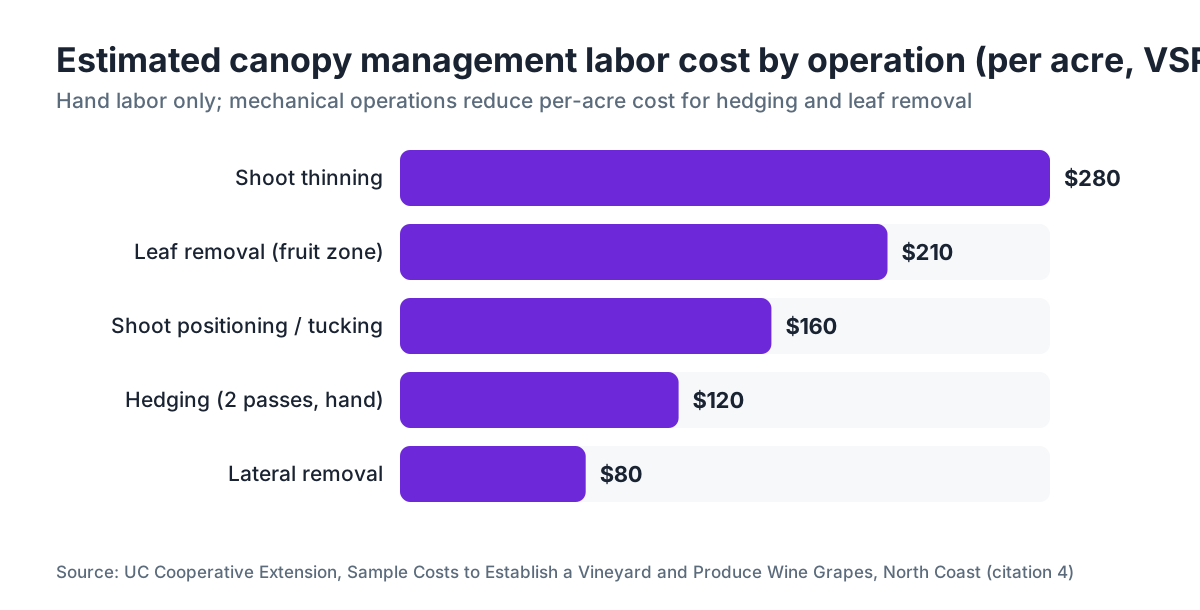
Labor is the dominant cost. UC Cooperative Extension farm budgets for North Coast California wine grapes (the most detailed public benchmarks available) put total hand labor for canopy management in VSP systems between $500 and $900 per acre per season, depending on vine spacing, row length, variety vigor, and how many passes you run [4]. Shoot thinning and leaf removal together usually account for 60 to 75 percent of that figure.
Mechanical leaf removal machines (Pellenc, Clemens, and similar brands) run roughly $25,000 to $80,000 new for a self-propelled or tractor-mounted unit. Custom hire rates in most California regions run $50 to $120 per acre per pass, which makes mechanical removal cost-competitive with hand labor at scale, especially if you run 3 or more passes per season. For smaller operations under 20 acres, hand removal usually pencils out better once you factor in equipment amortization.
Hedging is the cheapest mechanical operation to own. A good tractor-mounted hedger runs $5,000 to $18,000, and the per-acre pass cost is low. The mistake small operations make is skipping hedging passes to save time, then spending that time plus extra on fungicide applications that better airflow would have cut.
Honest summary: a well-run canopy management program costs $600 to $1,100 per acre in total labor and equipment per season in the western US. Poor canopy management drives up disease costs, so it runs you that and more, just less visibly.
For vineyards in regions like Paso Robles or the coastal vineyard blocks of Southern California, the actual cost varies because of different vigor levels and disease pressure profiles.
How does training system choice affect canopy management workload?
Your training system is the single biggest determinant of how much canopy work you'll do every year. VSP (vertical shoot positioned) on a bilateral cordon is the most common system in California and the Pacific Northwest, and it's also the most labor-intensive to manage well, because the compact fruiting zone creates dense shoot growth that has to be actively trained upright.
Guyot (replacement cane) systems have similar density issues. The advantage is more even bud distribution along the cane, which can reduce shoot crowding if you nail your cane length selection at pruning.
High-wire cordon systems (like the lyre or Geneva Double Curtain, or GDC) spread the canopy over more trellis surface area, which cuts interior shading on its own. WSU extension work in Washington State showed that GDC and Scott Henry divided-canopy systems consistently produced 20 to 30 percent more exposed leaf area per vine than VSP at equivalent vine spacing [3]. The tradeoff is higher trellis installation cost (GDC adds roughly $2,000 to $4,000 per acre to your establishment cost) plus the fact that most mechanical harvesters need adjustment to run on divided systems.
Cordons on high-wire systems with a downward-trained shoot (like Smart-Dyson) split shoots upward and downward, roughly doubling the trellis surface without adding rows. They're common in high-vigor situations and regions with productive varieties. Canopy work on these systems shifts from leaf removal and hedging toward careful cordon positioning and management of downward lateral shoots.
Bottom line: if you're establishing a vineyard or planning a replant, the training system decision carries more weight than any single canopy practice you'll run year to year.
What does the research actually say about leaf removal timing and fruit quality?
The short answer: early beats late, and there are diminishing returns past a certain exposure level.
Cornell's viticulture program ran multi-year trials on early versus late leaf removal in Riesling, Chardonnay, and Cabernet Franc at Geneva, NY. Early removal (pre-bloom to just after fruit set) consistently produced looser clusters, lower berry weight by 5 to 15 percent, and much lower Botrytis incidence. Late removal (at veraison or after) reduced disease less because the cluster architecture had already set [2].
In warmer climates, the picture gets more complicated. Research from UC Davis on Chardonnay in Napa showed that removing more than two full leaf layers on the afternoon (west) side raised sunburn incidence measurably in years with heat spikes above 100 degrees F. Morning-side removal of 1 to 2 leaf layers gave the airflow and disease benefits without the berry damage [1].
For red varieties targeting color and tannin structure, moderate fruit zone exposure raises anthocyanin concentration in the berry skin. A review of multiple Cabernet Sauvignon studies found that exposed berries had 15 to 35 percent higher anthocyanin levels than shaded berries [10]. The same berries also had lower pH and higher tartaric to malic acid ratios, which generally improves aging potential. The exact numbers vary by site and vintage (nobody has clean data normalizing across every variable), but the directional evidence holds.
One honest caveat: too much exposure in hot climates degrades aromatic precursors in white varieties. For Sauvignon Blanc especially, some shade protection preserves thiols and pyrazines that would otherwise volatilize. The balance point depends entirely on your regional heat summation and your target style.
How does canopy management connect to pesticide compliance and spray records?
Here's where vineyard operations get sloppy, and it costs them during inspections. The EPA Worker Protection Standard (WPS, 40 CFR Part 170) requires that restricted-use pesticide application records document the site treated, the product, the rate, and the reentry interval. If your canopy management crew enters a treated block before the REI expires, you have a compliance violation no matter how good your spray program looked on paper [5].
The practical intersection: leaf removal and shoot positioning crews are often the first people back into a block after a fungicide or insecticide application. Your spray log needs to clearly document application date, REI, and block ID so crew supervisors can confirm clearance before sending workers in. This sounds obvious but breaks down constantly on operations where the spray records live separately from the field crew schedule.
California's Department of Pesticide Regulation requires pesticide use reports (PURs) for all agricultural pesticides applied in the state. Those records must be filed monthly with the county agricultural commissioner. Canopy practices don't directly generate PURs, but they change the spray intervals and rates you need, so the two programs are operationally linked [6].
This is exactly where a field operations tool like VitiScribe earns its keep: linking spray application records to block-level canopy work schedules so your crew leads know when it's safe to enter, without anyone hand-cross-referencing two separate binders.
For EPA WPS requirements, the agency publishes its guidance on the EPA pesticide worker safety page [5]. UC Statewide IPM also maintains current pesticide use guidance for wine grapes [7].
What equipment do you actually need for canopy management at different scales?
For under 10 acres, the honest answer is that hand tools do most of the job. A good pair of Felco No. 2 pruning shears, hand-held leaf pullers, and a trained crew cover shoot thinning, leaf removal, and lateral management. Hedging still benefits from a tractor-mounted unit even at small scale, because hand-topping is impractically slow for anything beyond a demonstration block.
At 10 to 50 acres, a mechanical hedger is almost always worth the investment. Tractor-mounted units from Pellenc or similar makers handle topping and side hedging. Mechanical leaf removal at this scale is borderline: if you have high disease pressure (Atlantic Coast, Pacific Northwest wet springs), the machine pays off faster. If you're in a dry climate like Paso Robles wine country, hand removal of 1 to 2 leaf layers in the fruit zone may be all you need.
Over 50 acres, the economics shift hard toward mechanization. Mechanical leaf removers cut leaf removal labor by 60 to 80 percent compared to hand work. Shoot positioning systems (wire lifters or tuckers) on tractors cut that labor by 40 to 60 percent. You'll still need a hand crew for shoot thinning, because machines can't yet reliably tell count shoots from non-count shoots.
Drone scouting with NDVI or multispectral cameras is now accessible for blocks of any size through custom hire services. Expect $8 to $25 per acre per flight depending on resolution and analysis included. The output is a canopy density map that helps you prioritize which blocks need leaf removal passes first. This is a genuinely useful tool, not a gimmick, though it's an input to your decision, not a replacement for walking the rows.
How do you adapt canopy management for different climates and varieties?
Climate is the first filter. In cool, humid regions (Finger Lakes, Willamette Valley, coastal Sonoma), disease prevention drives almost every canopy decision. You open the canopy early and hard, prioritize fruit zone airflow, and accept some loss of shade protection because fungal pressure is the bigger risk. Cornell's extension program publishes variety-specific guidance for humid Northeast climates that's worth reading directly if you grow Riesling, Vidal, or hybrid varieties [8].
In hot, arid climates (interior Central Valley, high desert sites), the goals flip. You're managing against sunburn, water stress amplified by excessive leaf loss, and keeping enough canopy to moderate berry temperature. In these situations, afternoon shading of the fruit zone is actually desirable for many varieties. You still hedge and thin, but leaf removal is lighter and targeted to the morning side only.
Varietal differences within climate zones matter too. Zinfandel's uneven ripening (a structural trait, not a management failure) responds well to cluster thinning and aggressive lateral removal to help the laggard clusters catch up. Pinot Noir is notoriously touchy about too much exposure in warm years: the berries are thin-skinned and the aromatic compounds that define the variety are volatile. Cabernet Sauvignon is forgiving and handles relatively aggressive canopy opening across many climates. Chardonnay sits in the middle and varies most by clone and rootstock.
Hybrid varieties grown in the Midwest and East (Norton, Marquette, Vignoles) often have vigorous, sprawling growth habits bred for cold hardiness rather than canopy convenience. Extension resources from land-grant universities in those states are your best guidance, because West Coast practices don't translate directly.
What are common canopy management mistakes and how do you fix them?
The most common mistake is doing everything too late. Shoot thinning at 8 inches instead of 3 inches means you've already lost the early-season light competition and the crew is snapping off shoot sections with developed clusters. Leaf removal at veraison instead of fruit set means Botrytis had 6 to 8 weeks to establish before you opened up the canopy. Timing is the biggest variable most operations can actually control, and most run late.
Over-hedging is the second problem. Running a hedger when shoots are only 12 inches long forces lateral growth immediately, which works against you. Hedge after the shoots have substantially hardened and energy is no longer flowing hard to shoot tips. Hedging too short strips too many leaves and drops the leaf-to-fruit ratio below what's needed to ripen the crop. As a rough rule, you need around 8 to 10 mature leaves per shoot to ripen a normal cluster load [1].
Inconsistency across a block is underappreciated. End rows and headland vines usually get less attention because crews rush the transitions. Those vines become disease reservoirs and produce inferior fruit that pulls down the average. Standardize your crew's process with row-by-row checklists.
Failing to record what you actually did is both an agronomic and a compliance problem. If you can't go back and see which blocks got leaf removal, when it happened, and what the canopy looked like before and after, you can't build the institutional knowledge to improve season over season. Photograph reference panels. Log the date, crew, and scope of every canopy operation. Tools like VitiScribe make this faster than a paper binder, but even a well-organized spreadsheet beats nothing.
How do you build a canopy management calendar for your vineyard?
Start with your training system and target shoot density, because those set the timing and intensity of everything else. Then map your historical bud break and bloom dates for each variety and block. Canopy timing is degree-day and phenological-stage driven, not calendar driven, so a late spring shifts every window backward.
A working template for a VSP Cabernet Sauvignon block in a moderate California coastal climate:
- 2 to 4 weeks post-bud break: shoot thinning pass, target 4 to 5 shoots per foot
- 8 to 12 inches of shoot growth (late May to early June): first wire tuck and shoot positioning
- Pre-bloom to just after fruit set: leaf removal, morning (east) side, 1 to 2 leaf layers in fruit zone
- 4 to 6 weeks post-fruit-set: first hedging pass
- Late July to mid-August: second hedging pass, lateral removal in fruit zone if needed
- Spot checks at veraison: remove any cluster-blocking laterals, re-open any collapsed shoot positioning
Move windows earlier for warmer sites and later for cooler ones. In high-vigor blocks, add a second shoot thinning pass (called de-suckering or basal shoot removal) 3 to 4 weeks after the first.
Write this calendar down and hand it to your crew supervisor before the season starts. The single most effective thing you can do for consistent canopy outcomes is making sure the person directing field work knows the why behind each timing window, more than the what.
Frequently asked questions
What is the ideal shoot density for a VSP vineyard?
Most extension guidance targets 4 to 6 shoots per linear foot of row for VSP systems, which translates to roughly 12 to 18 shoots per meter of cordon. UC Davis viticulture researchers cite 15 to 20 shoots per meter as the upper limit before interior shading becomes a measurable problem. The right number depends on your row spacing, vine spacing, and variety vigor, so calibrate to your specific site rather than using one number across all blocks.
When is the best time to remove leaves from the fruit zone?
Pre-bloom to fruit set is the optimal window for Botrytis prevention and cluster loosening. Cornell research showed that pre-bloom removal produced measurably looser clusters and lower disease incidence than post-fruit-set removal. In hot climates, delay to just after fruit set and limit removal to the morning-sun side to reduce sunburn risk. Leaf removal at or after veraison gives much less benefit for disease prevention.
Does mechanical leaf removal work as well as hand removal?
For disease prevention, mechanical leaf removal performs comparably to hand removal in most trials when calibrated correctly. The machines remove more total leaf material and are less selective, so over-removal is a real risk on thin-skinned varieties in warm climates. Custom hire rates of $50 to $120 per acre per pass make mechanical removal cost-competitive for operations over roughly 20 acres running multiple passes per season.
How much does canopy management reduce the need for fungicide sprays?
Nobody has a clean controlled study isolating canopy management from fungicide programs, but the directional evidence is strong. Cornell trials showed a 40 percent reduction in Botrytis incidence from pre-bloom leaf removal alone, independent of spray program intensity. Better canopy airflow also reduces the number of fungicide applications needed to hold mildew below threshold. Most growers report dropping one to two spray passes per season when canopy management is tightened.
What is point quadrat analysis and how do you do it in the vineyard?
Point quadrat is a method developed by viticulture researcher Mark Kliewer and colleagues at UC Davis. You insert a thin rod horizontally through the canopy at fruiting zone level at random intervals (typically every 30 to 50 cm) and record what the tip contacts: leaf, shoot, cluster, or air. Tally 40 to 80 insertions per block. A healthy VSP canopy shows at least 20 percent open gaps and a leaf layer count below 1.5.
How does canopy management affect wine color and tannin in red varieties?
Multiple studies on Cabernet Sauvignon and Merlot show that fruit zone sun exposure raises anthocyanin concentration in berry skins by 15 to 35 percent compared to shaded berries. Exposed berries also tend to have higher tartaric to malic acid ratios and firmer tannin structure. The effect is strongest when exposure is established early in berry development, before color change begins at veraison.
Can you do too much leaf removal?
Yes. Removing too many leaves drops the leaf-to-fruit ratio below what's needed to ripen the crop. A rough minimum is 8 to 10 mature leaves per shoot to support normal cluster ripening. In hot climates, aggressive removal on the afternoon side causes sunburn in thin-skinned varieties like Pinot Noir and can degrade aromatic precursors in white varieties like Sauvignon Blanc. Target 1 to 2 leaf layers on the morning side as a starting point.
What canopy management practices are required for organic vineyard certification?
Organic certification under USDA NOP does not mandate specific canopy practices, but it prohibits synthetic pesticides, which makes canopy management more important because it's a primary non-chemical disease tool. USDA NOP requires an Organic System Plan documenting your management approach. Better canopy airflow often lets organic growers rely more on sulfur and copper-based materials at lower rates, reducing residue concerns.
How do you document canopy management for compliance purposes?
At minimum, log the date, block ID, crew size, and operation (leaf removal, hedging, shoot thinning) for each canopy event. California requires pesticide use reports for all agricultural pesticide applications, and your canopy records support those by showing when crews entered blocks relative to spray application dates and reentry intervals. The EPA Worker Protection Standard at 40 CFR Part 170 governs those reentry rules. Keep records for at least two years.
What training system is easiest to manage from a canopy perspective?
Divided canopy systems like Geneva Double Curtain (GDC) or Smart-Dyson distribute shoots over more trellis surface, which cuts interior shading without as much hand labor. WSU research found GDC produced 20 to 30 percent more exposed leaf area per vine than VSP at equivalent vine spacing. The tradeoff is higher trellis establishment cost and potential harvester compatibility issues. For existing VSP plantings, divided systems are generally not practical to retrofit.
How does shoot thinning differ from cluster thinning?
Shoot thinning removes entire shoots from the vine, typically at 2 to 4 inches of growth, to reduce total shoot number and improve light distribution. Cluster thinning (crop thinning) removes individual clusters or portions of clusters at fruit set or later to reduce crop load and even out ripening. Shoot thinning is a canopy management tool; cluster thinning is primarily a yield management tool. Both affect final fruit quality, but through different mechanisms.
Is canopy management different for hybrid varieties grown in cold climates?
Yes, significantly. Cold-hardy hybrids like Marquette, Frontenac, and Vidal Blanc often have vigorous, sprawling growth habits and high shoot density that need more aggressive thinning than vinifera varieties. Their winter hardiness training requirements (multiple cordons, cane replacement) also change how you position shoots. Land-grant extension programs in Minnesota, Michigan, and New York publish hybrid-specific canopy guidance that's more accurate for those varieties than California-focused resources.
How does canopy management interact with irrigation scheduling?
A dense canopy transpires more water and raises soil water demand, which pushes irrigation frequency up. After aggressive leaf removal, the vine transpiration rate drops and soil moisture lasts longer between irrigation events. In deficit irrigation programs common in California, this means your canopy timing affects your irrigation schedule: open the canopy at fruit set, then reassess your irrigation trigger points (typically soil tension or stem water potential thresholds) for the rest of the season.
Sources
- Cornell Cooperative Extension, Viticulture Program, Canopy Management and Botrytis: Pre-bloom leaf removal reduced Botrytis bunch rot incidence by an average of 40 percent across multiple seasons in Riesling and Chardonnay trials; early removal produced looser clusters and lower berry weight
- Washington State University Extension, Viticulture and Enology: WSU extension recommends removing 1 to 3 leaf layers on the morning-sun side starting at fruit set; GDC and Scott Henry divided-canopy systems produced 20 to 30 percent more exposed leaf area per vine compared to VSP
- UC Cooperative Extension, Sample Costs to Establish a Vineyard and Produce Wine Grapes, North Coast: Total hand labor for canopy management in VSP North Coast wine grape systems runs $500 to $900 per acre per season depending on vine spacing, row length, variety vigor, and number of passes
- EPA, Worker Protection Standard, 40 CFR Part 170: EPA WPS requires restricted-use pesticide application records document site treated, product, rate, and reentry interval; workers entering treated blocks before REI expires constitutes a compliance violation
- California Department of Pesticide Regulation, Pesticide Use Reporting: California DPR requires pesticide use reports for all agricultural pesticides applied in the state, filed monthly with the county agricultural commissioner
- UC Statewide Integrated Pest Management Program, Grape Pest Management Guidelines: UC IPM publishes current pesticide use guidance and spray timing recommendations for wine grapes including fungicide programs that interact with canopy management practices
- Cornell Cooperative Extension, Viticulture Program, Northeast Vineyard Management: Cornell extension publishes variety-specific canopy management guidance for humid Northeast climates covering Riesling, Vidal, and hybrid varieties
- USDA National Organic Program, Organic Regulations: USDA NOP requires an Organic System Plan documenting management approach; prohibits synthetic pesticides but does not mandate specific canopy practices
- American Journal of Enology and Viticulture, Anthocyanin accumulation in sun-exposed versus shaded Cabernet Sauvignon berries: Multiple studies on Cabernet Sauvignon and Merlot show fruit zone sun exposure increases anthocyanin concentration in berry skins by 15 to 35 percent compared to shaded berries, with higher tartaric to malic acid ratios
Last updated 2026-07-10