Cheapest reliable vineyard management apps for tracking sprays and labor

TL;DR
- The cheapest reliable vineyard management apps for spray and labor tracking run from free (Granular Insights free tier, AgWorld free plan) to roughly $50 to $150 per month for full compliance-ready platforms.
- For most vineyards under 50 acres, a purpose-built app in the $30 to $80 per month range handles EPA WPS spray records, re-entry intervals, and labor logs better than spreadsheets and cheaper than enterprise tools.
What does a vineyard management app actually need to do for sprays and labor?
A reliable vineyard app has one job before anything else: produce a spray record an inspector will accept. Cheap means nothing if the app can't do that. When CDFA or your state ag department walks in and asks for two years of applications, a pretty dashboard won't save you.
For spray tracking, you need at minimum: pesticide product name, EPA registration number, application date, target pest or disease, rate applied per acre, total acres treated, pre-harvest interval (PHI) confirmation, restricted-entry interval (REI) recorded, and the applicator's name and license number if required [1]. The EPA Worker Protection Standard (40 CFR Part 170) requires that this information be kept for two years and made available to workers, handlers, and inspectors on request [2]. A good app builds this record for you the moment you log an application. A bad one makes you re-key it into a separate form.
For labor tracking, the minimum is hours per employee per task, pay rate, and which block or field the work happened in. California under PAGA, Washington under RCW 49.46, and most other wine-growing states pile on meal break compliance, piece-rate documentation, and supervisor certification. If your state has mandatory agricultural labor reporting, your app needs an export format your bookkeeper or payroll service can actually open.
Here's the honest part. Very few apps do both spray compliance and labor payroll prep equally well. Most lean one way. Figure out which job hurts more, and you'll pick faster.
How much do vineyard management apps actually cost in 2025?
Pricing in this space is a mess. Vendors hide per-acre fees behind "contact us" buttons, and free trials swing from 14 days to 90. Here's what's actually out there, based on published rates and extension program reviews.
| App | Starting Price | Free Tier? | Spray Records | Labor Tracking | Best For |
|---|---|---|---|---|---|
| AgWorld | Free (1 user, 1 farm) | Yes | Yes | Basic | Solo operators, small crews |
| Granular Insights (Corteva) | Free basic / ~$60/mo pro | Yes | Yes | Yes | Mid-size vineyards |
| Conservis | ~$1,500/yr min | No | Yes | Yes | Larger operations |
| Vine Vision / FarmLogs | $30-$80/mo | 14-day trial | Yes | Limited | Row crops, adapted for vineyards |
| VinoTrak / AgriWebb | ~$49-$99/mo | 14-day trial | Yes | Yes | Livestock/mixed, adapted |
| Vintrace | ~$99-$299/mo | No | Winery-side | No | Winery, not field |
| Scouting apps (e.g., Fieldwatch) | Free | Yes | Beekeeper alerts, not records | No | Supplemental only |
These are published list rates as of mid-2025. Per-acre add-ons change the math hard for large operations. UC Cooperative Extension pest management guidance notes that per-acre pricing on enterprise platforms can reach $2 to $10 per acre per year, which puts a 200-acre vineyard at $400 to $2,000 in fees before any add-ons [3].
The genuinely cheapest option for a tiny vineyard (under 20 acres, one applicator) is still a well-built spreadsheet paired with a free app for scout records. Cornell's Integrated Pest Management program offers free spray record templates that meet New York DEC requirements [4]. But the labor cost of keeping that up by hand scales badly past one or two employees.
For most operations described in extension case studies, the sweet spot is $30 to $80 per month for a purpose-built platform that handles both spray logs and basic labor records with a usable export.
Which apps are purpose-built for vineyard spray records vs. adapted from row-crop tools?
This split matters more than most buyers realize. Row-crop apps built for corn and soy often skip the wine-grape data fields you need: block designations by variety, split blocks with different PHIs, cumulative sulfur and copper tracking for organic compliance, and canopy-stage re-entry decisions.
Purpose-built for viticulture, or at least seriously adapted: AgWorld, Granular, and a handful of regional tools like Farmobile and VineView. AgWorld has been piloted in UC Cooperative Extension projects for spray record accuracy and came out usable for small to mid-size California operations [3].
Adapted from row crops: FarmLogs (now part of Trimble), Conservis, and most ERP-style farm management platforms. They work. You'll just spend time mapping your vineyard's block logic into their field structure, and some choke on per-variety PHI tracking inside multi-variety blocks.
Winery-side only: Vintrace, InnoVint, and WinePulse are strong for cellar management and lot traceability, but they don't touch field spray records in any real way. If you see a vineyard manager using Vintrace for spray tracking, that's a workaround, not a feature.
WSU's viticulture extension work with small Washington wine grape growers flags two recurring adoption barriers for general farm apps: complicated initial setup and no crop-specific data validation [5]. Purpose-built tools take the edge off both.
What are the EPA WPS requirements your app must help you meet?
The EPA Worker Protection Standard, revised in 2015 and effective in 2017 for most provisions, sets concrete recordkeeping rules a good app should make nearly automatic [2].
For each application in a vineyard where workers or handlers might enter, you must keep: application date, location of the treated area, product name and EPA registration number, active ingredient(s), REI, and whether the posting or oral notification requirement was met. Keep these records for two years. The standard also says you have to hand this information to a treating medical provider within a reasonable time of a request, which in practice means your records need to be reachable anywhere, not stuck in a desktop spreadsheet at the shop.
The revised WPS added documentation for the application exclusion zone (AEZ) around certain products. Most vineyard spray apps don't calculate AEZ automatically. Check before you assume yours does.
EPA's WPS guidance is blunt about the baseline: agricultural employers must keep pesticide application and hazard information for each pesticide used at the establishment for two years after the date of application [2]. Your app needs to store this by application event, exportable and date-stamped.
Failing a WPS inspection is not a small fine. Civil penalties under FIFRA can run up to $20,000 or more per violation for commercial applicators under the current inflation-adjusted schedule, and EPA updates these figures annually [6]. One missed REI record on a large estate application could cost more than a full year of app subscriptions.
Can free apps like AgWorld or Granular Insights actually handle compliance records?
Short answer: the free tiers get you started, and they have real limits.
AgWorld's free plan (single user, one farm) logs spray applications with EPA registration number fields and exports to PDF. For a solo operator doing their own applications and employing nobody, that's genuinely enough for WPS recordkeeping. Add employees who enter treated areas, and you need the notification and posting documentation the free tier won't automate.
Granular Insights has a free tier tied to weather and field mapping, but the compliance-specific spray log features live behind the paid plans. Corteva markets the paid tier starting around $60 per month for small operations, though pricing shifts by region and dealer relationship.
The real risk with free tools isn't the features. It's the data. Read the terms of service line by line. Some free agricultural platforms keep the right to aggregate and sell your farm data. Your application records hold commercially sensitive information (what you spray, when, at what rate) that competitors or your landlord have no business seeing. Cornell's farm data privacy guidance recommends reviewing terms annually and favoring platforms with an explicit no-third-party-sale-of-individual-farm-data clause [4].
For plain compliance, a free tier can carry you. Push past solo operation or past basic PDF export, and you hit walls fast.
How well do these apps handle vineyard labor tracking and payroll compliance?
Labor tracking is where cheap apps show their seams. Spray records are a clean log: you applied X on date Y. Labor records are messier, and ag labor law makes them worse.
What you actually need: time-in and time-out by block, a job code (pruning vs. shoot thinning vs. harvest vs. irrigation), supervisor confirmation, meal break waivers where they apply (California ag carries a partial exemption under Labor Code 512(e), but piece-rate work adds complexity), and a piece count if you pay by the piece.
Granular and Conservis both handle crew-level labor tracking reasonably well. AgWorld's paid labor module works but isn't payroll-ready without an export step. FarmLogs/Trimble has time tracking, but it's built for equipment operators, not vineyard crews doing variety-specific hand work.
WSU viticulture economics research puts labor at 40 to 60% of total production costs for hand-harvested wine grapes [5]. Getting labor records wrong isn't only a compliance risk. It's a cost accounting problem. If you don't know your real labor hours per task per block, you can't price your fruit or plan next season's crew.
A mid-size app like Granular at $60 to $120 per month that keeps both spray logs and crew timesheets in one place almost always beats running two separate systems, even when it looks pricier than a free tool at first glance.
What's the real cost of using spreadsheets instead of an app?
Every grower says they'll just use Excel. Plenty do, for years, right up until something breaks.
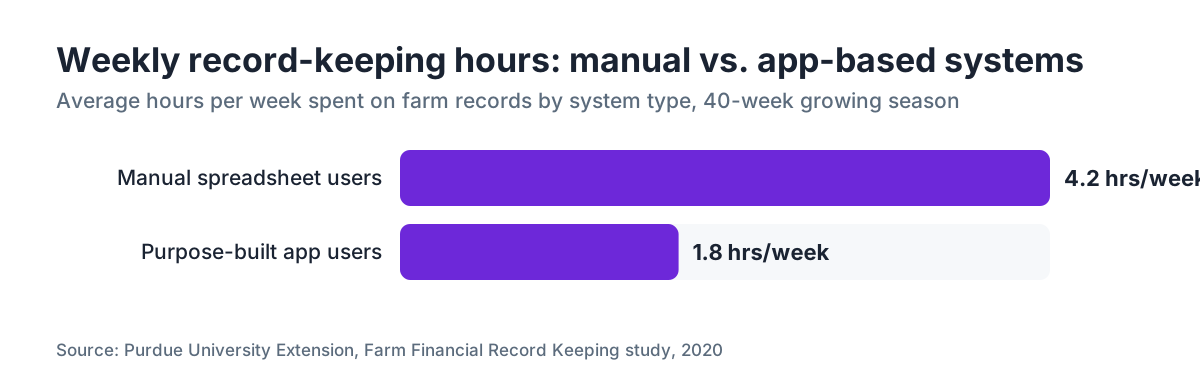
The real cost isn't the software. It's the hours. A 2020 Purdue Extension study on farm record-keeping found manual spreadsheet users spent about 4.2 hours per week on record maintenance versus 1.8 hours per week for purpose-built app users [7]. Over a 40-week growing season, that gap is nearly 100 hours a year. At $25 an hour for a manager's time, that's roughly $2,500 in hidden cost annually, more than a full year of a mid-tier app.
The other real cost is errors. PHI miscalculations. Missing REI entries. Pesticide names that don't match the label. Date slips on applications. In a manual system, these pile up quietly. An app with a real pesticide database pulls EPA-registered product names and intervals from a maintained list, so you're not free-typing "copper hydroxide" six different ways across six applications.
Managing a vineyard under 10 acres with one or two employees, and disciplined about data entry? Spreadsheets work. Bigger than that, the math on a paid app starts looking good in a hurry.
If you're weighing the switch, VitiScribe offers a trial built around spray record compliance and labor log exports. Worth testing against whatever your current system costs you in time.
Do vineyard management apps integrate with QuickBooks or payroll systems?
Integration quality is all over the map, and most apps oversell it.
Granular has a QuickBooks Online integration that syncs expenses and labor costs. It works for basic cost tracking, but it isn't payroll integration. You still move hours to your payroll processor yourself. Conservis also ships a QuickBooks connector. AgWorld has no native accounting integration on any tier as of 2025, so you're exporting CSVs.
For true payroll integration (straight into ADP, Paychex, or Gusto), almost no agricultural apps connect natively. ADP and Paychex both run API-accessible platforms, and some larger farm systems build against them, but at small-vineyard prices you're doing a manual export step.
The workflow at most small-to-mid vineyards: log hours in the ag app, export a CSV weekly, import to QuickBooks, run payroll from there. Two steps, not one, but not a big time cost if the export format holds steady. Ask any vendor to show you a real export file before you subscribe. Some export formats sit right on the edge of unusable, which makes "CSV export" a misleading claim.
What do UC Davis, Cornell, and WSU extension programs actually recommend?
The three big US viticulture extension programs have each touched farm record-keeping software, at different depths.
UC's viticulture guidance has produced spray record worksheets and compliance checklists used across California, and the UC IPM pest management guidelines list the required data fields for every major vineyard pesticide [3]. The guidance leans toward spelling out what records are required rather than endorsing specific apps, which is fair given funding rules. UC Cooperative Extension advisors in individual counties (Napa, Sonoma, San Luis Obispo) have reviewed specific apps in extension newsletters, and Sonoma UCCE farm advisor letters from 2021 to 2022 mentioned AgWorld favorably for small operations.
Cornell's Integrated Pest Management program offers New York-specific spray record forms that meet Department of Agriculture and Markets requirements, and its farm data privacy fact sheet is the most practical guide I've seen for reading app terms of service [4]. Cornell doesn't endorse commercial software by name, but its IPM program notes from 2022 to 2023 flag growers moving to tablet-based apps, with data export compatibility for the state's commercial pesticide use reporting system as the main friction point.
WSU's viticulture program, based in Prosser, publishes small vineyard economic studies that track technology adoption [5]. Its finding that only about 30% of Washington wine grape growers under 20 acres use dedicated farm software lines up with national patterns. WSU advisors generally recommend starting with any system that produces a legally compliant spray record, then upgrading as the operation grows.
How do you actually evaluate and choose the right app for your vineyard?
Here's the process that works, drawn from how extension programs describe grower technology adoption.
Step one: write down your three biggest record-keeping pain points. Spray logs that are hard to audit? Labor hours that won't tie to payroll? Block-level cost tracking your accountant nags you for every year? Different apps solve different problems.
Step two: list your compliance obligations by state. California growers report restricted-material pesticide use to their county agricultural commissioner monthly, and many counties require reporting of all pesticide use [8]. Washington growers report to WSDA [9]. New York reports to the Department of Agriculture and Markets [10]. Your app has to export in a format your state's system accepts, or the compliance value drops off a cliff.
Step three: run a free trial or free tier on one real spray event and one real labor week. Don't judge on the demo. Judge on whether entering a real record took you 10 minutes or 40, and whether the export looked like something you'd hand an inspector.
Step four: check the mobile app harder than the desktop. Vineyard spray records get entered in the field, often with muddy hands and one bar of signal. An app that demands constant connectivity or has a rough mobile interface won't get used, which kills the whole point.
Step five: call the support line before you subscribe. Not email. Call. See if a human picks up and whether they know what a pre-harvest interval is. Agricultural software support that doesn't understand agriculture is a real and common problem here.
For operations that want spray logs, labor records, and field notes in one exportable system, VitiScribe is built for that workflow and belongs on your trial list next to the better-known names.
What's the minimum viable setup for a small vineyard under 20 acres?
For a truly small operation, here's what I'd do.
Start with AgWorld's free tier for spray records. It has the right fields, it exports a PDF any state ag inspector will recognize, and it's free. Add the Cornell IPM spray record template [4] as a paper backup for each block, filed by application date.
For labor, if you have fewer than five employees and you're not in California, a Google Sheets template you standardize is defensible. California piece-rate and meal-break rules are complicated enough that even at five employees I'd pay for a tool that logs them properly rather than sit exposed to PAGA claims.
Cross 20 acres or add a third employee, and a paid app ($30 to $80 per month) beats the time cost of manual records. That's the point to move to Granular Insights or a similar platform with both spray and labor modules.
The one thing I'd never do: keep a paper log all season, then backfill an app in October. Spray records entered weeks after application are legally risky (most state rules require timely recording, often read as within 24 to 48 hours) and factually shaky. The record is the record. Enter it the day you spray.
Frequently asked questions
What is the cheapest vineyard app that keeps legally compliant spray records?
AgWorld's free tier (one user, one farm) captures the data fields required by the EPA Worker Protection Standard and exports to PDF. For solo operators handling their own applications with no workers entering treated areas, it meets the two-year recordkeeping requirement at zero cost. Add even one employee entering treated fields and you'll want a paid tier that automates REI notification documentation.
Do I really need a paid app or can spreadsheets handle vineyard spray records?
Spreadsheets can legally comply; there's no rule that records be digital. The practical problem is time and error rate. A Purdue Extension study found manual record keepers spent about 2.4 more hours per week on records than app users. Over a 40-week season that's roughly 96 hours of labor. At any reasonable manager pay rate, a $50 per month app pays for itself in time savings by mid-season.
What does the EPA Worker Protection Standard actually require vineyard managers to record?
EPA's WPS (40 CFR Part 170) requires application date, treated area location, product name, EPA registration number, active ingredient, restricted-entry interval, and whether notification requirements were met. Records must be kept for two years and provided to a treating medical provider on request. Your app needs to store all of these fields per application event, with a date stamp.
Can AgWorld handle multi-block vineyards with different varieties and PHIs?
Yes. AgWorld supports multiple fields and sub-fields you can map to individual blocks by variety. PHI tracking still needs manual entry per application. AgWorld pulls product data including labeled PHI from its pesticide database, but it doesn't automatically flag harvest conflicts across blocks with different maturity dates. For complex block structures, double-check PHI logic by hand before harvest.
How do vineyard apps handle California's monthly pesticide use reporting requirement?
California requires growers to report restricted-material pesticide use to their county agricultural commissioner monthly, and many counties require reporting of all pesticide use. Apps like Granular and AgWorld can export CSV formats compatible with county electronic submission systems, but you must verify your county's specific format. The California Department of Pesticide Regulation's Pesticide Use Reporting program is the regulatory reference for required fields.
What labor tracking features do I need for a vineyard with H-2A workers?
H-2A compliance requires accurate records of hours worked, pay rates, housing provided, and transportation. Your labor app needs time-in/time-out by worker, daily records (more than weekly totals), and wage documentation tied to the adverse effect wage rate for your state. Most agricultural apps handle timesheets fine; the H-2A-specific wage floor tracking usually happens in your payroll system, not the field app.
Are there any totally free vineyard management apps that also track labor hours?
Granular Insights has a free tier with basic field mapping and limited spray records, but full labor hour tracking sits behind the paid plan. AgWorld's free tier has no labor module. Practically, no current app handles both spray compliance records and crew labor hours well at zero cost. A $30 to $50 per month entry-level paid tier is the realistic floor for both features.
How do I know if a vineyard app's pesticide database is current?
Ask the vendor how often the database updates and what source it uses. The authoritative source is EPA's pesticide product registration data. A well-maintained app pulls from this or from a licensed third-party database like Greenbook or CDMS, which update within days of label changes. An app that relies on manual user entry of product data is a liability, not a feature.
What's the difference between vineyard management apps and winery management apps?
Vineyard management apps track field operations: spray applications, scouting records, irrigation, labor, and block-level production data through harvest. Winery management apps (Vintrace, InnoVint, WinePulse) track cellar operations: lot traceability, additions, analysis, and compliance from crush through bottling. They address completely different regulatory frameworks. Don't assume a winery app handles your EPA WPS spray records; it almost certainly does not.
How long does it take to set up a vineyard management app for the first time?
Most platform reviews and extension program notes put initial setup at 2 to 6 hours for a vineyard under 50 acres: entering block boundaries, varieties, employee list, and configuring spray record templates. The time cost is front-loaded. After that, logging a single spray application takes 3 to 7 minutes. Do the setup in the off-season or early spring, before spray season, so you're not learning the interface during your first disease pressure event.
Can vineyard apps help with organic or biodynamic certification spray records?
Some can, with caveats. For USDA organic certification, you need to document that every input applied complies with the National List (7 CFR Part 205). Apps like AgWorld let you flag products as organic-approved, but they don't automatically verify National List compliance for every label change. Your certifier wants your records as documentation; the app is the container, not the compliance engine. Verify National List status yourself for each product.
Do vineyard management apps work offline in areas with poor cell service?
It varies a lot. AgWorld and Granular both have mobile apps with offline modes that sync when connectivity returns. The offline capability is usually limited: you can add records but can't hit the full pesticide database lookup or generate reports offline. Test it before buying by putting your phone in airplane mode and walking through a complete spray record entry. If the app fails that test, assume it fails in your worst-coverage blocks.
What should I look for in a vineyard app's data export for an inspector visit?
The export should produce a single document (PDF or printable CSV) per application event or per date range showing product name, EPA registration number, application date, block or field treated, acres treated, rate applied, REI, PHI, and applicator name. If the export makes you pull data from multiple screens and assemble it by hand, that app isn't built for compliance inspections. Run a test export before your first real spray event.
Sources
- California Department of Food and Agriculture, Pesticide Use Reporting: Required data fields for pesticide application records including EPA registration number, application date, treated area, and applicator information
- EPA, Agricultural Worker Protection Standard (40 CFR Part 170): Agricultural employers must keep pesticide application and hazard information for each pesticide used at the establishment for 2 years after the date of application; records must be available to treating medical providers on request
- UC Statewide Integrated Pest Management Program, Grape Pest Management Guidelines: UC Cooperative Extension has produced spray record worksheets and compliance checklists used across California vineyards; per-acre software pricing can reach $2-$10 per acre per year on enterprise platforms
- New York State Integrated Pest Management Program, Cornell University: Cornell IPM offers New York-compliant spray record templates and farm data privacy guidance recommending growers prefer platforms with explicit no-third-party-sale-of-farm-data clauses
- Washington State University Viticulture and Enology: Only about 30% of Washington wine grape growers under 20 acres use dedicated farm software; labor typically runs 40-60% of total production costs for hand-harvested wine grapes; top adoption barriers were setup complexity and lack of crop-specific data validation
- EPA, Federal Insecticide, Fungicide, and Rodenticide Act (FIFRA): Civil penalties under FIFRA section 14 can run up to $20,000 or more per violation for commercial applicators under the current inflation-adjusted penalty schedule, which EPA updates annually
- Purdue University Extension: Farmers using manual spreadsheet systems spent an average of 4.2 hours per week on record maintenance compared to 1.8 hours per week for those using a purpose-built app (2020 study)
- California Department of Pesticide Regulation, Pesticide Use Reporting: California requires growers to report restricted-material and all pesticide use to county agricultural commissioners monthly; electronic submission required in most counties
- Washington State Department of Agriculture: Washington state pesticide use reporting requirements for commercial applicators and agricultural producers
- New York State Department of Agriculture and Markets: New York State commercial pesticide use reporting system requirements for agricultural producers
- USDA Agricultural Marketing Service, National Organic Program (7 CFR Part 205): USDA organic certification requires documentation that every input applied is compliant with the National List of allowed substances
Last updated 2026-07-09