Cost of IoT soil moisture sensors for vineyards, per acre
TL;DR
- IoT soil moisture sensors for vineyards run $200 to $1,200 per sensor installed, with most operations spending $400 to $800.
- At one sensor per 2 to 5 acres, a 10-acre block costs $1,500 to $8,000 upfront once you add hardware, connectivity, and a data platform.
- Annual subscription fees add $100 to $500 per sensor per year.
What does an IoT soil moisture sensor system actually cost per acre?
It depends on what you count. Price the probe alone and you get one number. Add the gateway, cellular connectivity, data platform subscription, and installation labor and you get a much bigger one.
Hardware alone runs $200 to $600 for a basic single-depth capacitance probe (a METER TEROS unit or an entry-level Sentek EnviroSCAN) and $800 to $1,200 for multi-depth probes with built-in telemetry [1]. A cellular or LoRaWAN gateway adds $300 to $800 each, though one gateway usually covers 10 to 40 acres depending on terrain. Installation in rocky vineyard soils often costs $100 to $250 per probe location.
Put those numbers into a real block. Twenty acres, sensors every 3 acres (7 sensors), one gateway, and a cloud subscription at $200 per sensor per year comes to roughly $5,600 to $9,800 upfront and $1,400 per year ongoing. That works out to $280 to $490 per acre upfront and $70 per acre per year in subscriptions.
Small blocks cost more per acre because the gateway spreads over fewer sensors. A 5-acre block with 2 sensors and one gateway runs $1,200 to $2,000 upfront, or $240 to $400 per acre, and that gateway cost is hard to amortize across so little ground [1][2].
How many sensors do you actually need per acre in a vineyard?
One sensor per 2 to 5 acres is the range extension research supports, but soil variability is the real driver, not raw acreage [2]. Most vendors dodge this question because more sensors mean more sales.
WSU's Irrigated Agriculture Research and Extension Center recommends at least one monitoring point per distinct soil type in a block, plus extra sensors in areas of known variability like hilltops, depressions, or transitions between sandy and clay-loam soils [2]. If your 10-acre block holds three soil types, you arguably need three sensor locations no matter the acreage.
UC Davis Cooperative Extension irrigation work notes that a single sensor in a representative spot can guide 5 to 10 acres of uniform soil, but that drops to 2 to 3 acres in variable terrain [3]. Nobody has clean data on the exact productivity gain per added sensor. The closest UC Davis guidance stays qualitative: more sensors reduce the risk of over- or under-irrigating a subzone.
Budget one sensor per 3 acres as a conservative middle estimate. Adjust after your first season, once you see how uniform your readings actually run across the block.
| Soil uniformity | Recommended sensor spacing | Sensors per 10 acres |
|---|---|---|
| High (one texture, flat) | 1 per 5 acres | 2 |
| Medium (some variation) | 1 per 3 acres | 3 to 4 |
| Low (multiple textures, slopes) | 1 per 2 acres | 5+ |
Source: Derived from WSU IAREC and UC Davis Cooperative Extension irrigation guidance [2][3].
What are the main hardware options and what do they cost?
Three sensor types show up in commercial vineyards: capacitance probes, tensiometers with digital readout, and neutron probes. You can ignore neutron probes for IoT work because of licensing and cost.
Capacitance or TDR (time-domain reflectometry) probes are the IoT mainstream. The METER Group TEROS 12, common in research and commercial viticulture, lists around $200 to $260 for the sensor alone with no datalogger [1]. Sentek Drill & Drop probes that read multiple depths at once run $600 to $900 per installation. Both need a separate logger or gateway to move the data.
Pressure transducer tensiometers with Bluetooth or cellular output, from Irrometer or Aquacheck, cost $250 to $500 per unit installed. They suit the tension range that matters for grapevines, roughly 20 to 80 kPa for most varieties under regulated deficit irrigation [3].
All-in-one nodes bundle sensor, logger, and cellular modem into one unit, and they keep getting more common. Arable, Teralytic, and Ceres Imaging sell subscription bundles. Expect $1,000 to $2,000 per node upfront, or lease deals that spread cost over 3 to 5 years at $30 to $80 per month. Leasing looks cheaper monthly. It usually costs more across a full five years.
Connectivity adds cost on top. Cellular SIM plans for IoT devices run $5 to $20 per month per device. LoRaWAN needs a gateway ($400 to $800) but sensor transmission after that is essentially free. Where cellular coverage is poor, LoRaWAN wins, but you own the gateway placement and maintenance [4].
What do the subscription and software platform fees actually add up to?
Hardware is a one-time hit. Software is the slow drain, and you need to model it carefully before you sign anything.
Most IoT soil moisture platforms charge per sensor per year. Market rates run $100 to $500 per sensor annually for dashboards, alerts, and data storage. Some vendors bundle this with hardware. Others charge separately. Buy open hardware (a METER TEROS 12 wired to a Campbell Scientific logger) and you can route data to free or low-cost tools like open-source dashboards, but you pay in setup time instead of dollars.
Viticulture-focused platforms like Tule Technologies, CropX, or Sentek's portal add ET (evapotranspiration) modeling, irrigation scheduling recommendations, and historical comparisons. That runs $200 to $400 per sensor per year for basic accounts and $400 to $600 per sensor per year for advisory-tier access [5].
For record-keeping, some growers pipe sensor exports into farm management software. If you already run a system like VitiScribe for spray records and irrigation logs, check whether it accepts API feeds from your sensor platform before you pay for a separate data service. Cutting one subscription matters when you carry per-sensor fees on 10 or more devices.
Here is a rough 5-year total cost of ownership for a 10-sensor system: hardware $6,000 to $10,000 upfront, subscriptions $5,000 to $25,000 over five years, connectivity $3,000 to $12,000 over five years. The subscription tail is the number most growers never calculate at purchase time.
How do per-acre IoT sensor costs compare to traditional moisture monitoring?
The comparison that matters is IoT sensors against manual tensiometers or feel-and-weigh methods, not IoT against nothing.
A simple manual tensiometer (Irrometer standard model) costs $60 to $120 per unit. You still need one per 2 to 5 acres. No subscription. The catch is that you have to walk out and read it, you get no alerts, and every log entry is by hand. If your labor runs $25 per hour and a monitoring walk takes 2 hours a week for five months, that is $1,000 a year in labor for a 20-acre block. IoT sensors kill most of that walk. Many growers find the labor savings alone cover the subscription fees within 2 to 3 seasons [3].
On water, UC Davis research on precision irrigation in California tree crops and vineyards has found 10 to 30% reductions in applied water when sensor-based scheduling replaces calendar-based scheduling, though vineyard-specific numbers vary by region and variety [3]. At California water costs of $100 to $400 per acre-foot in many districts, a 20% cut on 3 acre-feet of seasonal application across a 20-acre block saves $1,200 to $4,800 a year. That is a real payback calculation, not a marketing line, and it assumes the sensor data actually changes your decisions.
| Method | Upfront cost per acre | Annual ongoing per acre | Labor per acre/year |
|---|---|---|---|
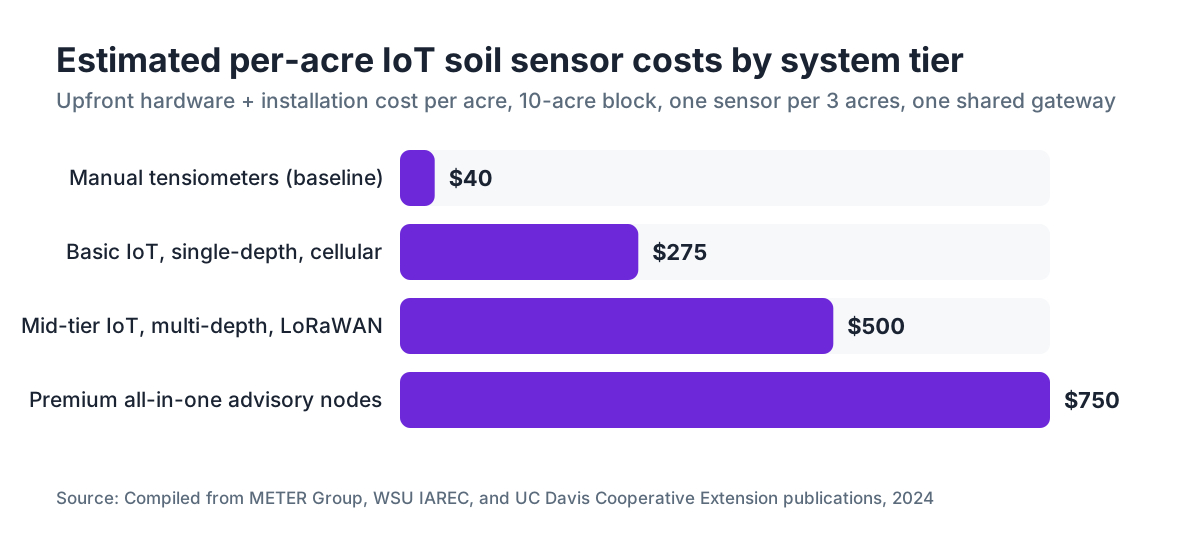
| Manual tensiometers | $20 to $60 | $5 to $15 (replacement parts) | $50 to $100 |
| Basic IoT (cellular, one platform) | $150 to $400 | $30 to $100 | $5 to $15 |
| Premium IoT (multi-depth, full advisory) | $400 to $800 | $80 to $200 | $2 to $8 |
Source: Compiled from METER Group, WSU IAREC, and UC Davis Cooperative Extension publications [1][2][3].
Are there grants or cost-share programs that offset sensor costs?
Yes, and this is where a lot of small vineyard operators leave money on the table.
USDA's Environmental Quality Incentives Program (EQIP) has funded precision irrigation technology, including soil moisture monitoring equipment, under Practice Code 449 (Irrigation Water Management) and Code 551 (Precision Land Application) [6]. Payment rates vary by state and are set every year. In California, EQIP has paid $15 to $60 per acre for approved irrigation scheduling technology upgrades, which offsets a meaningful chunk of sensor hardware cost.
The USDA Natural Resources Conservation Service (NRCS) state offices run EQIP. Applications are competitive, with signup windows usually in late summer or early fall for the following year. Contact your local NRCS office well before you plan to buy [6].
California's State Water Resources Control Board has funded on-farm water efficiency projects through its Agricultural Water Management Planning grant program, though availability shifts year to year [7]. Washington's Department of Agriculture has run similar programs under its Sustainable Farms and Fields grants.
University extension programs sometimes run subsidized sensor deployments as part of research trials. WSU and UC Davis both run trials where cooperating growers get equipment in exchange for sharing data. These are not guaranteed, but they are worth asking about at your local farm advisor office.
What hidden costs do vineyard managers miss when budgeting sensors?
Four costs catch growers off guard.
Installation in rocky or compacted vineyard soils is harder than vendors show in their videos. Drill-and-drop probes need an auger, often tractor-mounted, and in gravelly soils you may end up hand-digging. Budget $150 to $300 per sensor location for professional installation in difficult soils, not $50.
Calibration is the second one. Capacitance probes react to soil salinity and temperature. In the saline soils common to some California coastal valleys, an uncalibrated probe can read 10 to 20 percentage points off from actual volumetric water content [1]. Calibration means soil sampling and lab analysis at $30 to $80 per sample per depth, plus your time.
Third is data interpretation. A sensor that tells you soil moisture dropped to 18% VWC is useless unless you know the field capacity and permanent wilting point for that soil. Getting those numbers right takes lab analysis or good historical data. Plenty of growers buy sensors and then never trust the readings because they skipped this groundwork.
Fourth: cellular dead zones. A $700 sensor node that can't transmit because your hilltop block has no signal is just a manual sensor with extra steps. Survey your coverage before you spec the technology. LoRaWAN gateways fix this but add $400 to $800 to your infrastructure cost [4].
How do IoT soil sensors fit into vineyard compliance and record-keeping?
This angle stays underrated. EPA's Worker Protection Standard (WPS) under 40 CFR Part 170 does not require soil moisture records, but California's state water use reporting under SGMA increasingly asks for irrigation documentation in critically overdrafted basins [8][9].
California's Sustainable Groundwater Management Act, fully implemented for most basins by 2022, requires some agricultural users to report applied water volumes and, in some Groundwater Sustainability Agency plans, to show efficient irrigation practices [9]. Automated sensor logs with timestamped moisture readings and linked irrigation events are exactly the documentation that satisfies an auditor. A spreadsheet of manual readings is harder to defend.
Pesticide use reports (PURs) in California require recording applications and re-entry intervals. Irrigation records tie into these because irrigation timing affects spray efficacy and worker exposure windows under WPS restricted-entry intervals [8]. Digital, time-stamped irrigation data makes it easier to show you irrigated before a restricted-entry interval expired, or that you didn't wash product off target plants.
Connecting sensor exports to a vineyard management platform keeps all of this in one place. That is where something like VitiScribe earns its keep: if your IoT data and your spray records live in the same system, your compliance paperwork assembles itself instead of forcing manual cross-referencing at audit time.
What sensor placement strategy actually works in a vineyard?
Placement is where the research and the vendor pitch split hardest.
Vendors often push one sensor per block. WSU IAREC research suggests at least two locations per block: one in the area you expect to dry out fastest (usually a south-facing slope or sandy zone) and one in your median soil [2]. The fast-drying zone tells you when to start irrigating. The median zone tells you how much water the typical vine needs.
Depth matters. Grapevine roots concentrate in the top 18 to 36 inches in most Napa and Sonoma soils, though they push deeper in well-drained granitic ground. A single-depth probe at 12 inches captures the active root zone for young vines but misses where mature vines actually pull water in a dry year. Multi-depth probes reading at 12, 24, and 36 inches give you a drainage profile that shows whether water is moving through the root zone or sitting put [3].
Plant sensors tell you more than soil sensors. Stem water potential, measured with a pressure chamber, is still the gold standard for vine stress, and no soil sensor replaces it. The workflow most irrigation advisors use: soil sensors to set timing and volume, pressure chamber readings once a week to confirm the vines are responding as expected. Budget for both tools.
Starting out? Cornell's grape extension program recommends beginning with 2 to 3 sensors in your most variable block, spending one full season learning how the readings track vine performance, then expanding [10]. Buying 20 sensors on day one is how you end up with expensive noise you don't know how to read.
Which IoT soil moisture sensor brands are most commonly used in vineyards?
Here is a short, honest list of what you actually find in commercial vineyards across California, Oregon, and Washington.
METER Group (formerly Decagon) makes the TEROS 12 and TEROS 21 probes, among the most cited in peer-reviewed viticulture research. They are research-grade and need a logger to transmit, so they lean toward a build-your-own-system approach. Expect $200 to $300 per probe plus logger costs [1].
Sentek makes the Drill & Drop and EnviroSCAN systems, multi-depth continuous probes popular in Australian viticulture and increasingly used in Paso Robles and Napa. The portal is polished. Cost runs $600 to $1,200 per installation point with subscription [5].
Irrometer makes the Watermark sensor, a resistance-based device at $30 to $50 per sensor, with digital readout options at $150 to $300. Simple, reliable across the 20 to 80 kPa range, widely used in California processing grape districts. It gets less accurate in very dry soil (above 200 kPa) where resistance sensors lose precision [11].
Teralytic makes an all-in-one probe (NPK, moisture, salinity, and temperature at three depths) with built-in LoRa and cellular. List price runs $800 to $1,200 per probe including a year of data service. Good for growers who want one device that does a lot.
Arable and Ceres Imaging offer aerial and field-sensor combinations with strong analytics, but their pricing is quote-based and aimed at larger operations (50+ acres).
No single brand fits every operation. Pick based on your connectivity situation, your appetite for managing a DIY system, and whether you need multi-depth data or single-depth is enough.
How long do vineyard IoT soil sensors last and what does replacement cost?
Physical sensor longevity beats what most growers expect. METER Group rates the TEROS 12 for 5 to 10 years in field conditions. Sentek's probes are built for permanent installation and can last 10 years or more if nothing damages them physically. The weak link is usually the cable connector or the datalogger, not the sensor element [1][5].
Batteries in wireless nodes are the real maintenance item. Most cellular IoT nodes run on D-cell batteries or rechargeable packs and last 6 to 18 months between changes depending on transmission frequency. Solar-equipped nodes stretch that out a lot but add $50 to $150 to the node cost. Budget a few hours of labor per node per year for battery swaps and physical inspection.
Calibration drift is real. Capacitance sensors in organic-matter-rich soils drift as soil structure changes. Recalibrating every 2 to 3 years is reasonable, which means pulling a soil sample ($30 to $80 per sample) and comparing lab-measured VWC against the sensor during a known moisture event.
A 10-year total for a well-maintained IoT sensor node: $1,500 to $3,000 in hardware (initial purchase plus one partial replacement), $1,000 to $5,000 in subscriptions, $200 to $600 in batteries and connectivity, and $200 to $500 in calibration. That is $2,900 to $9,100 per node over 10 years, or $290 to $910 per node per year. Set against labor and water savings, most growers in water-limited regions find it pencils out within 3 to 5 years.
What should you ask a vendor before buying vineyard soil moisture sensors?
Most vendor demos look great in California's Central Valley in May. The questions that matter are about the hard cases.
What happens to my data if I cancel my subscription? Some platforms hold your history hostage or delete it on cancellation. Get a clear answer, and ideally a data export guarantee in writing, before you sign.
What connectivity does this actually need, and what's my backup if it fails? A cellular sensor offline for two weeks isn't managing your irrigation. It's sitting in the ground. Ask about the vendor's uptime commitment and what alert you get when a sensor stops transmitting.
Has this sensor been validated in my soil type? METER Group and Sentek both publish peer-reviewed calibration studies. If a vendor can't point to any third-party validation in soils like yours, that's a flag [1][5].
What's the total cost at five years, including subscriptions and connectivity? Get it in writing. Vendors are built to lead with hardware price and bury the recurring fees.
Is there an open API so I can pull my data into other systems? If you run a farm management platform, you don't want to export CSVs by hand every week.
Frequently asked questions
What is the typical upfront cost of an IoT soil moisture sensor for a vineyard?
A single IoT soil moisture sensor for vineyard use typically costs $200 to $1,200 installed, depending on sensor type, depth capability, and whether telemetry is built in. A gateway for connectivity adds $300 to $800, though one gateway usually covers 10 to 40 acres. For a 10-acre block with 3 to 4 sensors and one gateway, budget $2,500 to $6,000 upfront.
How many soil moisture sensors do I need per acre in a vineyard?
WSU and UC Davis extension guidance points to one sensor per 2 to 5 acres, adjusted for soil variability. A uniform, flat block can get by with one sensor per 5 acres. A block with multiple soil textures or big slope changes needs one per 2 to 3 acres. Count soil types, more than acreage, and put at least one sensor in your fastest-drying zone.
What annual subscription fees should I expect for a vineyard sensor platform?
Annual platform subscriptions run $100 to $500 per sensor per year for most commercial vineyard-focused IoT platforms. Basic dashboards with alerts sit at the low end. Advisory platforms with ET modeling and irrigation scheduling recommendations sit at the high end. On a 10-sensor system, that is $1,000 to $5,000 per year in software fees before connectivity costs.
Can EQIP or USDA grants help pay for vineyard soil moisture sensors?
Yes. USDA EQIP Practice Code 449 (Irrigation Water Management) has funded precision irrigation technology including soil moisture monitoring in multiple states. Payment rates vary by state and year. California has paid $15 to $60 per acre in some programs. Applications are competitive with annual signup windows, so contact your local NRCS office before you buy hardware to avoid missing the eligibility window.
Are IoT soil sensors better than manual tensiometers for vineyards?
For continuous, automated data and labor savings, yes. Manual tensiometers cost $60 to $120 each with no subscription, but require weekly field readings and give no alerts. IoT sensors cost more upfront and carry subscription fees, but they cut monitoring labor and catch moisture swings between site visits. Most growers in water-limited regions recoup the IoT premium through water and labor savings within 2 to 3 seasons.
What depth should vineyard soil moisture sensors be placed at?
Most grapevine roots concentrate in the top 18 to 36 inches, so single-depth probes at 12 inches work for young vines. Mature vines, especially in well-drained soils, pull water from 24 to 48 inches during dry periods. Multi-depth probes reading at 12, 24, and 36 inches give you a drainage profile single-depth sensors miss. Multi-depth usually adds $200 to $400 per installation but pays back in better irrigation decisions.
Do vineyard IoT soil moisture sensors help with water use compliance in California?
Increasingly, yes. California's Sustainable Groundwater Management Act (SGMA) requires some agricultural users in critically overdrafted basins to document applied water and show efficient irrigation. Automated, timestamped sensor logs are cleaner documentation than manual records. Some Groundwater Sustainability Agency plans specifically reference sensor-based irrigation scheduling as an approved efficiency practice.
How long do IoT soil moisture sensors last in a vineyard?
The sensor element itself typically lasts 5 to 10 years under normal field conditions, per manufacturer specs from METER Group and Sentek. The weakest point is usually the cable connector or the wireless module battery, not the probe. Budget for battery replacement every 6 to 18 months per node. Solar-equipped nodes reduce that maintenance at an added $50 to $150 per node.
What is LoRaWAN and is it better than cellular for vineyard sensors?
LoRaWAN is a low-power wide-area network protocol that lets sensors reach a gateway several miles away without cellular service. It wins where cellular coverage is poor, and ongoing transmission costs are essentially zero once the gateway is installed. The tradeoff: you own and maintain the gateway ($400 to $800), whereas cellular hands that infrastructure to the carrier at $5 to $20 per device per month.
Can vineyard soil moisture data integrate with irrigation controllers?
Yes. Many modern IoT platforms integrate directly with variable-rate irrigation controllers or can trigger valve controllers via API. The integration needs compatible hardware on both ends and some setup time. Not every sensor platform supports it, so confirm API availability before you buy. When it works, it closes the loop from sensor reading to irrigation action without manual steps.
What is the payback period for IoT soil moisture sensors in a vineyard?
Payback depends heavily on your regional water and labor costs. UC Davis research shows 10 to 30% water savings from sensor-based versus calendar-based scheduling. At California water district rates of $100 to $400 per acre-foot, a 20% cut on 3 annual acre-feet per acre saves $60 to $240 per acre per year. Add labor savings and most growers see payback in 2 to 5 years on a properly sized system.
Do soil moisture sensors replace stem water potential measurements in vineyards?
No. Stem water potential measured with a pressure chamber is the direct measure of vine stress and remains the gold standard for deficit irrigation. Soil sensors measure water available in the soil, not the stress the vine actually feels. The practical approach most irrigation advisors use: soil sensors to guide timing and volume, pressure chamber readings weekly to confirm vine response. Use both.
What are the most common mistakes when buying vineyard IoT soil sensors?
The top four: buying sensors before mapping your soil types (you put them in the wrong spots), ignoring 5-year subscription costs when comparing hardware prices, assuming cellular coverage exists in remote blocks without testing, and skipping soil calibration so readings drift off actual volumetric water content. Cornell's grape extension program recommends starting with 2 to 3 sensors in your most variable block and learning for a full season before scaling up.
Sources
- WSU Irrigated Agriculture Research and Extension Center, irrigation management publications: WSU IAREC recommends at least one sensor per distinct soil type per block, with additional sensors in areas of known variability such as hilltops and soil transitions, and at least two locations per block including the fastest-drying zone
- UC Davis Cooperative Extension, Irrigation of Agricultural Crops: UC Davis CE notes a single sensor can guide irrigation for 5 to 10 acres in uniform soil, dropping to 2 to 3 acres in variable terrain; 10 to 30% water savings documented with sensor-based versus calendar-based scheduling
- USDA Agricultural Research Service, IoT and precision agriculture technologies overview: LoRaWAN gateways reach several miles and support low-cost sensor transmission; cellular IoT SIM plans run $5 to $20 per device per month
- Sentek Technologies, EnviroSCAN and Drill & Drop product and portal documentation: Sentek multi-depth Drill & Drop probes run $600 to $1,200 per installation point with platform subscription; probes designed for permanent installation lasting 10 or more years
- California State Water Resources Control Board, Agricultural Water Management: SWRCB has funded on-farm water efficiency projects through Agricultural Water Management Planning grants available to California agricultural water users
- EPA Worker Protection Standard, 40 CFR Part 170: EPA WPS under 40 CFR Part 170 governs restricted-entry intervals and worker protection requirements; irrigation timing intersects with pesticide re-entry and application documentation requirements
- California Department of Water Resources, Sustainable Groundwater Management Act (SGMA): SGMA, fully implemented for most basins by 2022, requires some agricultural users in critically overdrafted basins to document applied water and demonstrate efficient irrigation practices
- Cornell University, grape and viticulture extension program: Cornell grape extension recommends starting with 2 to 3 sensors in the most variable block and learning for a full season before scaling up
- Irrometer Company, Watermark sensor product specifications: Irrometer Watermark resistance-based sensors cost $30 to $50 per unit with digital read-out options at $150 to $300; rated for 20 to 80 kPa soil tension range most relevant to irrigated viticulture, with reduced accuracy above 200 kPa
Last updated 2026-07-09