Best soil moisture sensors for vineyards: a practical buying guide
TL;DR
- The best soil moisture sensor for most vineyards is a capacitance or TDR probe at two depths (12 and 24 inches) wired to a data logger with remote access.
- Tensiometers cost less but need constant babysitting.
- Granular matrix sensors split the difference.
- Budget $150 to $800 per installation point by technology, plus logger cost.
What types of soil moisture sensors actually work in vineyards?
Four sensor types drive most vineyard irrigation decisions: tensiometers, capacitance (FDR) probes, granular matrix sensors (GMS), and time-domain reflectometry (TDR) probes. Each measures something slightly different. That difference matters more than most sales reps will tell you.
Tensiometers measure soil water tension directly, in centibars (cb) or kilopascals (kPa). A tensiometer is a sealed tube full of water, buried with a porous ceramic tip that equilibrates with the soil around it. When the soil dries, it pulls water out of the tube and a vacuum gauge rises. They read accurately from 0 to 85 cb, which covers most of the calls you actually make in a vineyard. In sandy soils the ceramic tip can crack. Above 85 cb (very dry), the tensiometer loses contact and stops reporting. Cornell Cooperative Extension notes that tensiometers need refilling every 2 to 4 weeks and must be pulled before hard freezes [1].
Capacitance sensors (also called FDR, frequency-domain reflectometry) put two or more electrodes in the soil and measure the dielectric constant of what surrounds them. Water reads around 80; dry soil sits closer to 2 to 5. More water, higher reading. They cost less per channel than TDR, log continuously, and work fine at depth. The tradeoff: they punish sloppy installation, and some brands read high in salty soil. EC above roughly 2 dS/m distorts the reading [2].
TDR probes send a microwave pulse down a waveguide buried in the soil and calculate volumetric water content (VWC) from how long the pulse takes to return. TDR is the accuracy reference (typical error of ±2% VWC), but the hardware runs more and the cables are long, so multi-depth setups get expensive fast. The physics are laid out in the USDA Agricultural Research Service soil and water literature [3].
Granular matrix sensors (GMS, often sold as Watermark sensors) bury a resistance measurement inside a gypsum or synthetic matrix block. They're cheap ($10 to $30 per sensor), hold up in cold, and never need refilling. The catch is speed. They lag, badly, in fast-draining sandy loam. WSU Extension puts the response lag at 2 to 6 hours after irrigation, so you can miss the wetting front entirely if you're reading them by hand [4].
How do you compare sensor technologies side by side?
Here's how the four main types stack up on the numbers vineyard managers actually care about.
| Technology | Typical sensor cost | Accuracy (±VWC%) | Maintenance | Salinity sensitivity | Freeze tolerance |
|---|---|---|---|---|---|
| Tensiometer | $40 to $120 | Direct tension, ±2 cb | High (refill, winterize) | Low | Poor (pull before freeze) |
| Capacitance/FDR | $100 to $400 | ±3 to 5% VWC | Low | Moderate | Good |
| TDR probe | $200 to $800 | ±1 to 2% VWC | Low | Low | Good |
| Granular matrix (Watermark) | $10 to $30 | ±5 to 10% VWC | Very low | Low | Good |
Those figures are per sensor only. They leave out data loggers, which run $200 to $1,500 depending on whether you need cellular or just Bluetooth. A realistic installed cost for a three-depth capacitance system with cellular logging is $600 to $1,200 per monitoring point.
For most vineyards, capacitance sensors at two depths hit the practical sweet spot. Accurate enough, log automatically, and the access tube lets you pull and swap probes without tearing up roots. TDR earns its extra cost only if you're running a research trial or your soils have odd mineralogy that fools capacitance. Tensiometers still pull their weight as a backup check, or in small blocks you'll actually walk every week. Granular matrix sensors fit dry-farmed blocks where you just need to know when the profile crosses a threshold and the budget is tight.
Where should you place sensors in a vineyard block?
Placement is where most sensor programs die. The sensor is usually fine. It's sitting in the wrong spot.
UC Cooperative Extension recommends two depths: one sensor in the active root zone (typically 12 to 18 inches, where 70 to 80% of roots live) and a second at 24 to 36 inches to catch deep percolation and confirm whether water is or isn't moving past the roots [5]. If you run deficit irrigation and worry about getting water down deep, a third sensor at 48 inches tells you whether you're losing any to percolation.
Horizontal placement matters as much as depth. Set sensors 12 to 18 inches from the drip emitter. Not directly under it, not out at the edge of the wetted bulb. Directly under the emitter reads the wettest point in the profile and overstates plant-available water. At the edge you're in the dry fringe, understating it. You want the midpoint of the wetted bulb.
Map your soil variability and represent it. A block with a clay lens at 18 inches behaves nothing like a well-drained block on the same row. UC extension guidance calls for one monitoring location per soil map unit in larger blocks, or at minimum one in the highest-stress and one in the lowest-stress zone identified by a soil survey or EC scan [5].
For a typical 5 to 10 acre block, two to three monitoring stations is a sane starting point. Running more sensors than you'll actually review is a waste of money. WSU Extension found that growers who installed sensors but didn't log or act on the data within 48 hours made irrigation decisions no better than growers with no sensors at all [4].
What soil moisture thresholds should trigger irrigation in a vineyard?
This is where grapes part ways with vegetables, and the goal is worth stating plainly. You aren't trying to keep the vine fully hydrated all season. Regulated deficit irrigation (RDI) during berry development is a standard tool for holding down berry size and driving concentration. The trigger threshold changes with growth stage.
UC Cooperative Extension guidance treats midday stem water potential, measured with a pressure chamber, as the gold standard for vine stress. Soil moisture sensors give you a continuous proxy without stopping to bag leaves [5]. The rough translation: at the 12-inch sensor, irrigation is generally indicated when VWC drops to 30 to 40% of field capacity in a loamy soil. In sand it arrives faster and the response window is shorter.
For tensiometer systems, WSU Extension recommends starting irrigation at 30 to 40 cb from berry set to veraison, then letting tension climb to 50 to 70 cb post-veraison to push vines toward flavor concentration [4]. Starting points, not commandments. Variety, rootstock, and vine age all shift them.
The 24-inch sensor works as a guard. If it stays dry while the 12-inch reads wet after irrigation, you're either under-irrigating (water isn't reaching deep roots) or a layer is choking infiltration. If the deep sensor turns wet before the vine shows any stress, you're over-irrigating and leaching nutrients out the bottom. Holding soil moisture through the season means keeping that deep sensor in the target range, consistently, all summer.
Nobody has clean, universal data on the exact VWC-to-water-potential translation for every soil. The closest work is from Levin and colleagues at UC Davis [6], who calibrated capacitance sensors against pressure bomb readings in Napa Valley soils. Outside well-studied California ground, do some field calibration yourself in year one.
What are the real limitations of soil moisture sensors in vineyard irrigation?
The limits are real, and you should know them before you spend money.
First, a sensor reads a small cylinder of soil, usually 2 to 6 inches around the body. Vines root across several feet sideways. One sensor is one spot. If your block has variable texture, one spot doesn't speak for the block.
Second, salinity distorts most sensors. In coastal vineyards or blocks with heavy fertilizer, soil EC above 2 dS/m inflates capacitance readings and makes the soil look wetter than it is. TDR handles salt better but isn't immune. Tensiometers ignore EC entirely, which is one reason they still show up in saline conditions despite the maintenance grind.
Third, sensors don't tell you what the vine feels. Soil moisture and vine water status track each other but they're different things. A vine on a dwarfing rootstock in clay can be stressed at a VWC that leaves a Cabernet on 110R in sandy loam perfectly comfortable. The pressure bomb stays the reference for vine stress. Sensors describe the reservoir.
Fourth, installation quality sets a ceiling on data quality. An air gap around a capacitance access tube produces false low readings for the life of the install. The fix is to backfill with a slurry of native soil and water, not the loose dirt you pulled from the hole. It takes 15 minutes and most installers skip it.
Fifth, drift is real. Capacitance sensors sitting in shifting soil chemistry can drift 3 to 8% VWC across a season with no obvious failure. Running a tensiometer in the same zone as a spot-check is a cheap way to catch drift before it corrupts a full season of data [1].
Which brands and models are worth considering for a vineyard?
Brand picks are hard without knowing your existing logger setup, but a handful of platforms have real track records in commercial vineyards.
AquaCheck (capacitance, access tube) is planted all over California and South African wine country. One probe reads up to five depths down a single tube, which is efficient when you want multi-depth data on one logger connection. Figure $300 to $500 per probe plus logger.
Meter Group (formerly Decagon Devices) makes the 5TE and GS3 capacitance sensors and the newer TEROS series. The TEROS 12 reads VWC, EC, and temperature at once, useful because temperature corrections matter in soils that swing wide day to night. TEROS probes run $100 to $200 each and need a compatible datalogger.
Irrometer makes the original Watermark granular matrix sensor and a tensiometer line. The Watermark 200SS costs roughly $15 to $25 each and connects to cheap loggers. Their tensiometers are the standard reference across UC and WSU extension trials [4][5].
Sentek makes the EnviroSCAN and Drill & Drop probes, common in Australian vineyards and climbing in California. The Drill & Drop drops into a 40mm hole with minimal disturbance, which helps with the air-gap problem.
Campbell Scientific and ICT International build datalogger-compatible TDR systems that are accurate and expensive. They make sense for research vineyards or blocks where you need the most precise data and can justify the bill.
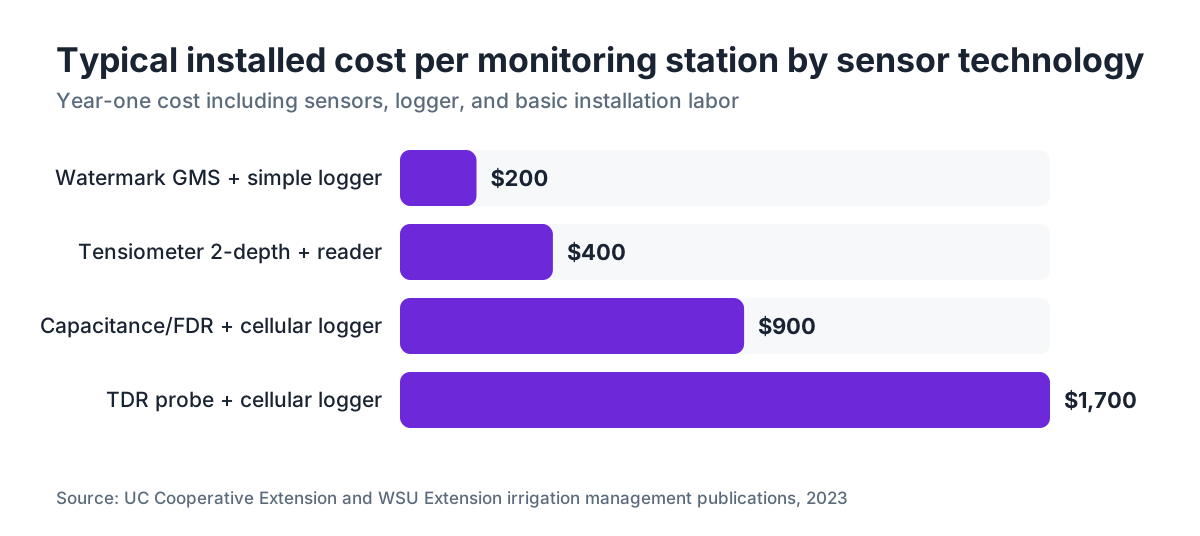
Starting small? Irrometer Watermark sensors on a simple logger is a fair entry point under $200 per station. Running 50-plus acres with telemetry? A TEROS or AquaCheck rig with a cellular logger is worth the money.
How do soil moisture sensors connect to irrigation controllers?
A soil moisture sensor pays off most when it feeds irrigation scheduling, instead of piling up data you skim once a week.
Most modern vineyard sensors output a signal (0-1V, 4-20mA, or SDI-12 digital) that connects to a datalogger or, for some, directly to an irrigation controller. SDI-12 is the standard digital protocol. Any sensor that speaks SDI-12 connects to any SDI-12 logger or controller without custom wiring.
Cellular dataloggers (Campbell Scientific CR300 series, Davis Instruments, Onset HOBO) push readings to a cloud dashboard every 15 to 60 minutes. Some let you set alert thresholds so you get a text when a zone crosses the trigger. That's genuinely useful at 2 a.m. when a drip valve fails and a zone goes dry with nobody watching.
Full closed-loop systems, where the sensor opens or shuts an irrigation valve on its own, exist. I'd hesitate to run one in a vineyard without a human in the loop. Vine water targets shift through the season on purpose. A system that opens a valve at 40 cb will apply water during post-veraison stress periods, exactly when you want the vine dry. Use sensor data to trigger a review, not to automate the call.
Record-keeping is a real operational issue here. If you track irrigation for a certification (LODI Rules, SIP, Fish Friendly Farming) or for your own water records, tie the sensor data to the irrigation log. VitiScribe field records let you attach sensor readings or screenshots to an irrigation event in the same workflow as your spray and cultivation records, so everything sits in one place when an audit shows up.
How do you calculate how many sensors you need for your vineyard?
It comes down to soil variability, block size, and irrigation layout. Here's a method that works.
Start with a soil EC scan or a USDA Web Soil Survey pull on your property [10]. Count the distinct soil map units inside your irrigated blocks. At minimum, put one monitoring station in every soil type that covers more than 5 acres.
Inside each zone, find the highest-stress spot (usually upslope, sandier, lower organic matter) and set your station there. Managing to the high-stress zone protects the weakest vines. It may over-irrigate the low-stress zone a touch, but less damage comes from that direction.
For a 20-acre block with two soil types, two stations at two depths each (four sensor points) is a solid starting config. That runs roughly $800 to $2,500 by technology, plus logger and labor. WSU Extension's irrigation scheduling program recommends a floor of one station per 10 to 15 acres in uniform soils and one per 5 to 8 acres in variable soils [4].
One caution. More sensors help only if someone reads them. If your operation is one person on 80 acres, three well-placed stations you actually look at beat twelve stations you open once a month and can't make sense of.
What do soil moisture sensors cost to buy and operate per year?
Real cost ranges swing on technology, logger choice, and whether you install yourself or pay someone.
Sensor hardware per monitoring station:
- Watermark GMS (3 sensors, shallow/mid/deep): $60 to $90 in sensors plus a $100 to $200 logger
- Tensiometer (2-depth setup): $150 to $280 in sensors plus a manual or electronic reader
- Capacitance probe (multi-depth, e.g. TEROS 12 x 2): $350 to $550 in sensors plus a $300 to $800 cellular logger
- TDR per station: $500 to $1,200 fully installed
Ongoing costs:
- Tensiometers: 30 to 60 minutes per station per month for refills, calibration checks, and winterization. At $25 an hour, that's $75 to $150 per station per season.
- Cellular data plans: $5 to $20 a month per logger. Budget $60 to $240 per station per year.
- Battery replacement: most loggers eat one set of AA or lithium batteries per season, about $5 to $20.
- Sensor replacement: capacitance probes usually last 5 to 10 years. Watermark sensors degrade and should be swapped every 3 to 5 years [11]. Budget 10 to 20% of sensor cost per year for replacement.
A realistic all-in budget for a four-station capacitance system with cellular logging across a 40-acre block is $3,000 to $5,000 in year one and $400 to $800 a year after. That's less than one extra irrigation event on 40 acres in a typical California water district, and UC Cooperative Extension reports most growers recoup the cost in water savings within one to two seasons [5].
What regulations affect soil moisture monitoring and vineyard irrigation records?
No federal rule requires soil moisture sensors in vineyards. But several compliance frameworks give you strong reasons to use them and document the data.
The USDA Natural Resources Conservation Service (NRCS) offers cost-share through the Environmental Quality Incentives Program (EQIP) for irrigation water management, including soil moisture monitoring equipment. Practices under Code 449, Irrigation Water Management, can cover 50 to 75% of installation cost depending on state and applicant tier [7]. Applications are competitive and deadlines vary by state office.
Many sustainability certifications, including LODI Rules, the California Sustainable Winegrowing Alliance (CSWA) program, and SIP Certified, require documentation of irrigation decisions and water use [12]. Sensor data and irrigation logs that show your calls came from soil moisture readings, not the calendar, are direct evidence for those audits.
The EPA Worker Protection Standard (WPS) doesn't govern irrigation gear, but it does require spray records and field-entry information to be kept and made available to workers [8]. If you log sensor data in the same field record system as your spray records, keep your WPS posting separate and compliant. The EPA WPS requirements live at 40 CFR Part 170 [8].
Water use reporting keeps getting heavier in western states. California's Sustainable Groundwater Management Act (SGMA) groundwater sustainability plans are starting to require agricultural water use reporting in critically overdrafted basins [9]. Detailed irrigation records tied to sensor data give you defensible numbers if a groundwater sustainability agency questions your use.
VitiScribe irrigation and field operations records export in formats that line up with EQIP practice documentation and sustainability audits, which saves real time when reporting season lands.
How do you calibrate and validate sensors after installation?
Factory calibration is fine for most uses, but it assumes your soil matches the soil the calibration curve was built on. It often doesn't.
The simplest field check is saturate-and-dry. After a soaking rain or a long irrigation, the sensor should read near field capacity for your texture (roughly 35 to 45% VWC in clay loam, 20 to 30% in sandy loam). If it reads 15% VWC in a clay loam after an irrigation that clearly wet the ground, you've got an air gap or a calibration problem.
For a tighter calibration, Meter Group and several university labs publish soil-specific procedures. You collect undisturbed cores from the sensor zone, wet them to known water contents, and compare sensor readings to the gravimetric values. Half a day per soil type, and worth doing once on a new install in unusual ground.
A tensiometer next to a capacitance sensor is the fastest ongoing check there is. If the tensiometer reads 60 cb (dry) and the capacitance sensor reads 40% VWC (wet), one of them is lying. That cross-check has caught more drift than any formal calibration protocol.
One field reality: readings shift slightly with soil temperature. Higher-end sensors (TEROS series, AquaCheck) run a temperature compensation algorithm. Budget sensors may not. Where soil temperature swings more than 30°F between morning and afternoon, uncorrected readings can move 2 to 4% VWC on temperature alone. Don't read a temperature swing as the soil drying or wetting.
Do soil moisture sensors work for dry-farmed or non-irrigated vineyards?
Yes, and they arguably matter more there, because you don't have irrigation as a correction tool.
In dry-farmed vineyards, sensors at 24, 36, and 48 inches show how fast the profile is draining through summer and whether enough stored water remains to carry the vine to harvest. This is most relevant on California's Central Coast and parts of Sonoma and Mendocino, where dry farming is common. For how coastal California's appellation conditions shape vineyard management, the paso robles wineries and south coast winery contexts show the range of regional climates that move soil moisture decisions.
WSU Extension research in eastern Washington found that even in dryland wheat systems, soil profile water content at planting predicted yield better than rainfall data alone [4]. The principle carries over to vines.
For dry-farmed vines, tensiometers at depth fit well because the range they cover (0 to 85 cb) matches the stress levels you're actually managing. You're not irrigating at 40 cb. You're watching the profile drain and making canopy calls (hedging, shoot thinning) to cut demand. The sensor tells you how much margin you have.
In very dry years, even dry-farmed blocks can push tensiometer readings past 85 cb by mid-August. When that hits across multiple blocks, it feeds harvest timing. A vine with a severely depleted profile may need picking earlier to avoid vine damage, no matter what the sugar says.
Frequently asked questions
What is the most accurate soil moisture sensor for vineyard use?
TDR (time-domain reflectometry) probes are the reference standard, accurate to around ±1 to 2% VWC. Meter Group's TEROS 12 and Campbell Scientific TDR probes show up most in research. For commercial vineyards where cost matters, a well-installed capacitance probe (FDR) at ±3 to 5% VWC is accurate enough for irrigation calls and costs far less per channel.
How deep should I install soil moisture sensors in a vineyard?
UC Cooperative Extension recommends a minimum two-depth setup: 12 to 18 inches for the active root zone and 24 to 36 inches to watch deep percolation. A third sensor at 48 inches helps if you apply heavy irrigation volumes or suspect a restrictive layer. Depth matters more than brand. A cheap sensor at the right depth beats an expensive one placed wrong.
How much do soil moisture sensors cost for a vineyard?
Per station, expect $150 to $300 for a basic Watermark granular matrix setup with a simple logger, $600 to $1,200 for a two-depth capacitance system with cellular logging, and $1,000 to $2,500 for a TDR system. Year-one install across a 40-acre block with four stations typically runs $3,000 to $5,000. USDA EQIP cost-share under Practice Code 449 can cover 50 to 75% in many states.
Can soil moisture sensors replace a pressure bomb for vine stress monitoring?
No, not fully. Soil moisture sensors read the water reservoir in the soil. A pressure bomb (pressure chamber) reads what the vine itself experiences. The two correlate but aren't interchangeable. Sensors win for continuous monitoring and scheduling. The pressure bomb stays the reference for confirming vine stress at key growth stages. Plenty of growers run both.
What are Watermark sensors and are they good enough for vineyards?
Watermark sensors, made by Irrometer, are granular matrix sensors that measure soil water tension by resistance. They cost $15 to $25 each, need no refilling, tolerate freezing, and last 3 to 5 years in most soils. They're accurate enough for threshold-based management but respond slowly (2 to 6 hour lag) with ±5 to 10% VWC uncertainty. For a budget-minded grower on drip, they're a fair starting point.
How many soil moisture sensors do I need per vineyard block?
WSU Extension recommends one station per 10 to 15 acres in uniform soils and one per 5 to 8 acres in variable soils. A practical minimum for any block is one station in the highest-stress zone (sandier, upslope) and one in the lowest-stress zone. Two stations with two-depth sensors each cover most 10 to 20 acre blocks. More sensors help only if you review the data.
Do soil moisture sensors work in clay soils?
Yes, but clay demands attention to installation. Clay's low hydraulic conductivity means slow equilibration after irrigation, and installation air gaps are worse because clay won't slump to fill voids. Tensiometers work well in clay since they read tension directly. Capacitance sensors in clay need soil-specific calibration; generic clay-loam curves can miss by 5 to 10% VWC. TDR is the most reliable technology in heavy clay.
Can I get USDA funding to install soil moisture sensors in my vineyard?
Yes. USDA NRCS offers cost-share through the Environmental Quality Incentives Program (EQIP) under Irrigation Water Management Practice Code 449. Depending on your state and applicant priority tier (beginning farmer, historically underserved, and others), rates typically run 50 to 75% of approved installation costs. Contact your local NRCS field office for application windows. They vary by state and funding year.
What is field capacity and why does it matter for soil moisture sensor readings?
Field capacity is the water left in soil after free drainage stops, usually 24 to 48 hours after saturation. It's the upper reference point for irrigation: you're refilling to field capacity without going over. Typical field capacity runs 30 to 45% VWC for clay loams and 20 to 35% for sandy loams. Knowing yours lets you read sensor numbers as a percentage of available water, not a raw VWC figure.
How do I prevent soil moisture sensor data from drifting over the season?
Run a cross-check. Place a tensiometer within 12 inches of your capacitance sensor. If tension rises (soil drying) while the capacitance reading stays flat or climbs, the capacitance sensor is drifting high. Causes include air gaps, salt buildup, or probe damage. Most makers recommend annual recalibration checks. Temperature compensation in better sensors (TEROS series, AquaCheck) kills most of the daily drift basic probes show.
Do I need to log soil moisture data continuously or are spot readings enough?
Continuous logging beats spot readings for irrigation management. Soil moisture can drop below a trigger and recover from a light rain or nighttime redistribution within 24 hours, so a weekly manual reading misses the event. Loggers set to 15 to 60 minute intervals show you the wetting front after irrigation and the drying rate between events. That drying rate, not the snapshot, tells you about vine water use and soil hydraulic conductivity.
What soil moisture level should I maintain post-veraison to improve wine quality?
Post-veraison deficit irrigation is a standard technique for concentrating flavors and holding down berry size. WSU Extension guidance suggests letting soil tension rise to 50 to 70 centibars (tensiometer) or VWC drop to 50 to 60% of field capacity after veraison. That induces mild stress without permanent damage. Exact levels depend on variety, rootstock, and flavor target. Monitor weekly with a pressure bomb alongside sensor readings during this window.
Are there sustainability certification programs that require soil moisture monitoring?
Several California programs, including LODI Rules and the California Sustainable Winegrowing Alliance (CSWA) program, award points or require documentation for soil moisture-based irrigation scheduling. SIP Certified similarly wants evidence that irrigation decisions come from vine and soil data rather than a calendar. A log of sensor readings tied to irrigation events is the documentation these audits look for.
What is the SDI-12 protocol and why does it matter for vineyard sensors?
SDI-12 is a standard serial digital protocol that lets soil sensors talk to dataloggers over a single three-wire cable. Any sensor that outputs SDI-12 (most modern Meter Group, Acclima, and AquaCheck sensors do) connects to any SDI-12 logger regardless of brand. That prevents vendor lock-in: switch sensor brands, keep your logger. It also simplifies multi-depth installs, with one cable carrying data from several sensors on the same line.
Sources
- Cornell Cooperative Extension, Irrigating Vineyards with Tensiometers: Tensiometers need refilling every 2 to 4 weeks and must be winterized before hard freezes
- Meter Group, TEROS 12 Soil Moisture Sensor User Manual: Soil electrical conductivity above approximately 2 dS/m can distort capacitance sensor readings
- USDA Agricultural Research Service, Soil and Water Science: TDR is considered the reference standard for volumetric water content accuracy, with typical error of ±2% VWC
- Washington State University Extension, Irrigation Scheduling Using Soil Moisture Sensors: WSU Extension recommends one monitoring station per 10 to 15 acres in uniform soils; Watermark sensor response lag is typically 2 to 6 hours; post-veraison tension targets of 50 to 70 cb are cited
- UC Cooperative Extension, Irrigation Management for Vineyards: UC Davis recommends two-depth sensor installation at 12 to 18 inches and 24 to 36 inches; one monitoring location per soil map unit in larger blocks; water savings from sensors typically recoup costs within one to two seasons
- Levin et al., UC Davis Department of Viticulture and Enology, sensor calibration research: Calibration of capacitance sensors against pressure bomb readings in Napa Valley soils to translate VWC to vine water potential
- US EPA, Worker Protection Standard, 40 CFR Part 170: EPA WPS requires that spray records and field-entry information be maintained and accessible to workers
- California Department of Water Resources, Sustainable Groundwater Management Act (SGMA): SGMA groundwater sustainability plans in critically overdrafted basins are beginning to require agricultural water use reporting
- USDA Web Soil Survey, National Cooperative Soil Survey: Soil map units and texture data used for sensor placement planning and field capacity estimation
- Irrometer Company, Watermark Soil Moisture Sensor Technical Specifications: Watermark granular matrix sensors cost $15 to $25 each and are rated for 3 to 5 years of field use
- California Sustainable Winegrowing Alliance, Sustainable Winegrowing Program Standards: CSWA sustainability program requires documentation of soil moisture-based irrigation scheduling decisions
Last updated 2026-07-09