Soil moisture sensor data logging for vineyard irrigation records

TL;DR
- Soil moisture sensors log volumetric water content or soil water tension at multiple depths, giving you a time-stamped, auditable record behind every irrigation decision.
- Most compliance programs want at least daily readings, sensor depth, crop growth stage, and applied water volume.
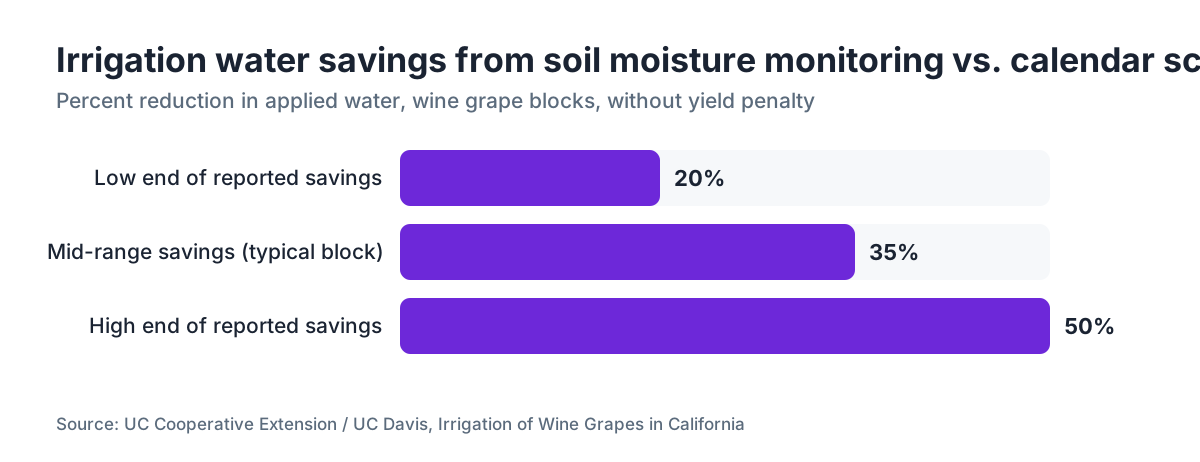
- Logged data also cuts water use 20 to 50 percent versus calendar scheduling, per UC Cooperative Extension.
Why does vineyard irrigation record-keeping matter beyond the obvious?
The easy answer is compliance. California's Sustainable Groundwater Management Act (SGMA), enacted in 2014, requires groundwater-dependent growers in critically overdrafted basins to document water use in ways that survive an audit [12]. Other western states have similar reporting rules, and more are coming. The paperwork obligation is only half the reason to do this well.
Good logged data changes how you farm. Pull up a graph of root-zone moisture at 12 and 24 inches over the past 30 days and you stop guessing whether last Tuesday's drip run was enough. You stop over-irrigating to hedge uncertainty, which is how most vineyards waste water. A UC Cooperative Extension study found deficit-irrigation programs guided by soil moisture monitoring cut applied water by 20 to 50 percent with no yield penalty in wine grape blocks [2].
There's a second compliance angle most managers miss. The EPA Worker Protection Standard requires restricted-entry intervals be respected after pesticide applications, and irrigation events often intersect field re-entry timelines because someone has to enter to run or check equipment. Time-stamped irrigation records tied to your spray records keep that audit trail clean [3].
Records are also your legal defense. If a neighbor files a nuisance complaint about runoff, or your water district challenges your reported usage, a year of hourly sensor logs beats a handwritten notebook every time.
What types of soil moisture sensors are used in vineyards, and how do they log data?
Sensors measure two fundamentally different things, and mixing them up causes real problems. One family measures how hard the vine has to pull water. The other measures how much water is actually in the soil.
The first type reports soil water tension in centibars (cb) or kilopascals (kPa). Tensiometers and granular matrix sensors (like Watermark sensors) work this way. A reading of 10 to 20 cb is wet. Above 70 to 80 cb in most vineyard soils, vines are under real drought stress. The relationship between tension and plant-available water depends on soil texture, which is why you still need a soil characterization to read the numbers right [4].
The second type reports volumetric water content (VWC), the water fraction of total soil volume as a percentage. Capacitance sensors, TDR (time-domain reflectometry) probes, and FDR (frequency-domain reflectometry) sensors work this way. A loamy vineyard soil at field capacity might read 28 to 32 percent VWC. Permanent wilting point for a sandy loam might sit around 10 to 12 percent VWC. These numbers move with soil texture and organic matter, so again, soil characterization is not optional [5].
Data logging runs through one of three pathways. The simplest is a standalone datalogger wired to the sensor that stores readings internally and waits for you to download them over USB or serial cable. The second is a cellular or LoRaWAN gateway that pushes readings to a cloud dashboard on its own, usually every 15 to 60 minutes. The third is a hybrid: a local logger that transmits when it has signal and stores data locally when it doesn't.
For compliance the logging method matters less than the output. You need a time-stamped, exportable record showing sensor location, depth, reading value, and units. If your system can't produce that as a CSV or PDF you can hand to a regulator, fix that first.
| Sensor Type | Measures | Typical Range | Common Brands | Data Output |
|---|---|---|---|---|
| Tensiometer | Soil water tension | 0-200 cb | Irrometer, Soil Moisture Corp | Manual or datalogger |
| Granular matrix (GMS) | Soil water tension | 0-200 cb | Watermark (Irrometer) | Datalogger, Bluetooth |
| Capacitance / FDR | Volumetric water content | 0-60% VWC | Sentek, Acclima, Campbell Sci | Datalogger, cloud |
| TDR | Volumetric water content | 0-60% VWC | Campbell Sci, IMKO | Datalogger |
| Neutron probe | VWC (lab-grade) | 0-60% VWC | CPN, Troxler | Manual, specialized |
The capacitance probe that installs in a single access tube and reads several depths at once (Sentek EnviroSCAN and similar) is what most serious vineyard operations have moved to over the last decade. One install, five to eight depth readings, continuous logging. They cost more upfront. The labor savings over pulling manual readings pays that back fast.
What sensor depths should you use in a vineyard?
The short answer: at least two depths, one in the active root zone and one below it. The exact numbers depend on your rootstock, soil profile, and irrigation system, but most extension programs land in the same place.
For drip-irrigated vineyards, WSU Extension recommends a minimum of two sensor depths, one in the active root zone (typically 12 inches / 30 cm) and one just below the expected maximum rooting depth (often 24 to 36 inches / 60 to 90 cm) [4]. The shallow sensor tells you when to irrigate. The deep sensor tells you whether you're over-applying (if it keeps getting wet) or whether roots are exploring further down than you thought.
A third sensor at 6 inches (15 cm) helps early in the season. It tracks how surface drying affects shallow root activity, and it catches partially clogged emitters that have shifted the wetting pattern.
If your vineyard sits on a layered profile, say a clay lens at 18 inches under loam, that middle placement stops being optional. Water perches above the clay and you'll see tension values that look like stress at 24 inches even when the upper root zone is fine. Get fooled by that and you either stress the vines or waste water.
For furrow or microsprinkler irrigation, run the deepest sensor out to at least 48 inches (120 cm) to catch deep percolation losses you'd otherwise never see.
How often should sensors log readings, and what's the minimum for compliance?
Hourly logging is the working standard for modern vineyard sensor systems, and daily is the usual compliance floor. Hourly gives you enough resolution to see diurnal VWC swings (which tell you something about plant uptake) without drowning in data. Storage costs almost nothing on cloud systems, so logging less often than hourly buys you nothing.
California's Irrigated Lands Regulatory Program (ILRP), run by the Regional Water Quality Control Boards, asks for irrigation records at daily resolution [12]. SGMA groundwater sustainability agencies often want monthly totals with daily underlying data available on request. Check your specific Groundwater Sustainability Agency (GSA) template, because requirements vary by basin.
The record you actually hand over combines sensor readings with applied water volume. A sensor log by itself isn't enough. You need the sensor data plus flow meter records showing how many acre-inches went on, and when. If a smart controller uses sensor data to trigger irrigation automatically, export those control logs too.
One thing worth knowing: if you're in a state with an approved irrigation water management plan under USDA NRCS EQIP, your plan likely sets a minimum data collection and record-retention period, often three to five years [6].
Fifteen-minute logging earns its keep when you're calibrating a new sensor placement or chasing an emitter problem. Run that interval the first full season, then decide whether hourly is enough going forward.
What data fields belong in a proper vineyard irrigation log?
A defensible irrigation record ties together four data streams: sensor readings, applied water, weather, and crop status. Most people log the first two and skip the last two. That's a mistake, because growth-stage context is what makes a sensor number mean anything to an auditor or agronomist who wasn't standing in the block.
Here's the minimum field set worth building into any logging template:
- Date and time of reading
- Block ID / sensor location identifier
- Sensor depth (inches or cm)
- Sensor reading (VWC % or soil tension in cb/kPa)
- Soil type at sensor depth (entered once at installation, referenced thereafter)
- Irrigation event: yes/no for that day
- If yes: start time, end time, flow rate (gph per emitter or gpm per zone), total volume (gallons or acre-inches)
- ET reference (daily ETo from CIMIS, Agrimet, or your on-site weather station) [7]
- Crop growth stage (budbreak, bloom, berry set, veraison, pre-harvest, post-harvest)
- Notes (emitter failures, unusual weather, repairs)
The ET reference field is where most small operations fall short. Without ETo you can't calculate crop water use or show that your irrigation tracks real vine demand. CIMIS (California Irrigation Management Information System) gives free daily ETo by station for California growers, and the Bureau of Reclamation's Agrimet network covers the Pacific Northwest [7][8].
Some programs also want a crop coefficient (Kc) applied to ETo to estimate vineyard crop evapotranspiration (ETc = ETo x Kc). Wine grape Kc values run from roughly 0.15 to 0.85 depending on growth stage and canopy size, and UC Davis has published stage-specific Kc tables you can use [2].
How do you set irrigation trigger points from sensor data?
This is where agronomic judgment lives. No sensor tells you what to do on its own. It gives you a number. You decide what the number means for this block, this variety, this target style.
For tension-based sensors, WSU Extension recommends keeping wine grapes in the 40 to 70 cb range through berry set and early berry growth, then letting the upper root zone reach 70 to 100 cb post-veraison to concentrate sugars and manage vigor [4]. Those are Columbia Valley starting points. Adjust for your soil and your wine.
For VWC sensors you have to establish your own field capacity and management-allowed depletion (MAD) thresholds. NRCS soil surveys give you textbook field capacity by soil series, but calibrate for yourself the first full season by watching how fast VWC drops after a known irrigation event [6]. A common practice sets the lower trigger at 50 percent depletion of plant-available water (PAW) through most of the season, then allows 65 to 70 percent depletion post-veraison for deficit finishing.
Log those trigger points as part of your record. Auditors don't just want the sensor data. They want to see you had a decision framework and stuck to it. A line in your irrigation plan that reads "Block 4, Merlot, Loam, irrigate when 12-inch sensor drops below 18% VWC through veraison, below 14% VWC post-veraison" is exactly the documentation that shows deliberate management.
A tool like VitiScribe can attach those decision rules directly to each block's sensor log, so the threshold that triggered an irrigation event sits next to the reading that tripped it. That's the level of documentation that holds up.
What are the regulatory and certification compliance requirements for irrigation records?
The requirements stack on top of each other depending on your state, your certification program, and your water source. Start with the federal floor and work outward.
At the federal level, USDA NRCS EQIP Conservation Practice 449 (Irrigation Water Management) requires participants to develop and implement an irrigation water management plan and keep records of water applied and system performance [6]. Retention under EQIP generally runs three to five years.
California growers face the most layered rules. SGMA requires Groundwater Sustainability Agencies to track extractions, and most GSAs push that reporting obligation to large extractors. The ILRP requires irrigation and nutrient management records for growers enrolled in third-party coalitions. The State Water Board has set a clear precedent that applied water documentation must match permitted water rights [12].
For organic certification under the USDA National Organic Program (NOP, 7 CFR Part 205), irrigation water records help show that water sources and application methods didn't introduce prohibited substances. That's more about source than volume, but the records overlap [9].
For sustainability certifications (Lodi Rules, SIP Certified, CCOF), irrigation efficiency documentation is usually required. Lodi Rules Certified, for example, requires growers to show they use ET-based scheduling or soil moisture monitoring and to keep those records [10].
The EPA Worker Protection Standard intersects here indirectly. If a pesticide application restricted re-entry for 24 to 48 hours and someone had to enter the field to run irrigation manually, your irrigation log and spray record together need to show no one entered during the REI [3].
Record retention: keep everything at least five years. That's the longest requirement across every program above, and one standard makes the filing system simpler.
What software and tools actually work for logging and storing this data?
Your options split into three buckets: sensor manufacturer platforms, general farm data platforms, and spreadsheets. Each does something well and something badly.
Manufacturer platforms like Sentek's data service, Campbell Scientific's LoggerNet, or Acclima's cloud portal are tightly built around their own hardware. They handle raw sensor data beautifully and give you clean graphs and exports. What they typically don't do is connect sensor readings to spray records, irrigation volumes, and block-level farm data. You end up running two or three separate systems.
General platforms built for vineyard operations try to pull those streams together. The compliance payoff is one record, time-stamped and exportable. If you're serious about water management documentation, VitiScribe is worth a trial specifically because it connects sensor thresholds, irrigation events, and spray records in a single block-level log. That integration is what makes an audit go smoothly.
Spreadsheets work. Don't let anyone tell you otherwise. A well-built Google Sheet with daily data entry, conditional formatting that flags readings outside your trigger thresholds, and a protected log tab you never edit after the fact is a completely defensible compliance record. The weak spots are version control, accidental edits, and the fact that it stops scaling past 20 or 30 blocks. Cornell Cooperative Extension has published vineyard record-keeping templates you can adapt [11].
Whatever you run, three outputs are non-negotiable: CSV or Excel export with time stamps intact, PDF or printable irrigation event summaries by block and date range, and a data backup that isn't just sitting on your phone.
How do you validate and calibrate sensor data before trusting it for decisions?
Skip this step and every downstream number is suspect. Validation is the difference between a sensor you act on and a sensor that lies to you.
Capacitance and FDR sensors react to air gaps around the probe, soil salinity, and temperature. A probe installed with even a small void will read lower VWC than reality and tell you to irrigate when you don't need to. Install in a pre-augered hole with soil packed firmly around the access tube. That part is not optional.
The basic validation routine: install the sensors, run a full irrigation to saturation, wait 24 to 48 hours for drainage to field capacity, and note the reading. That's your field capacity for that spot. Then let the block go unirrigated through a dry stretch long enough to see real stress (maybe slight midday leaf roll on Cabernet), note the reading, and call that your lower management threshold. Do this in year one. It takes the guesswork out of every season after.
For tension sensors, check tensiometers monthly during the irrigation season. They need de-aerated water and can develop air gaps. A tensiometer reading 0 cb in hot weather in an unirrigated block is broken, not wet soil.
Some university field trials found VWC sensor accuracy varies by plus or minus 3 to 5 percentage points from true gravimetric values without soil-specific calibration [5]. That's enough error to matter. If you're splitting hairs between 18 percent and 22 percent VWC, you want to know where your sensor sits relative to lab-measured truth.
How do you integrate soil moisture logs with your spray records and other field records?
This is where most small operations have a gap. Spray records live in one binder, irrigation logs in another, weather printouts in a third folder. That's legal in most cases, but it makes audits painful and retrospective analysis nearly impossible.
The fix is block-centric record-keeping. Every entry, whether it's a spray event, an irrigation event, a cultivation pass, or a phenology note, attaches to a specific block on a specific date. Pull up Block 7 for July 2024 and you see the sensor readings, irrigation volumes, pesticide applications, weather, and growth stage in one view.
The EPA Worker Protection Standard, updated in 2015 (40 CFR Part 170), requires employers to keep application information records for pesticide applications and make them available to workers and handlers on request [3]. That rule doesn't technically link to irrigation records. In practice, pesticide and irrigation logs that share the same date stamp and block ID make WPS compliance much easier to demonstrate.
For SGMA reporting, groundwater use records need to tie back to specific parcels (APN level in most GSA templates). If your irrigation logs are block-level and your blocks carry GPS coordinates or parcel cross-references, that connection is easy. If your blocks are labeled "Block 7" with no spatial reference, you'll burn hours during the first reporting cycle working out which parcels they map to.
Visit vineyards to see how other operations structure their block-level documentation.
What are the most common mistakes vineyard operators make with soil moisture logging?
The pattern is almost always the same: too few sensors, bad placement, silent data gaps, and records that don't use the data. Here's each one and how to avoid it.
Not enough sensors per block. One sensor across a 20-acre block tells you almost nothing about spatial variability. A 20-acre Cabernet block with a 6-acre clay patch in the southwest corner and sandy loam everywhere else has two different irrigation regimes, and a single probe in the loam is blind to the clay. WSU recommends a minimum of one sensor installation per soil mapping unit within a block [4].
Sensor placement near obvious outliers. Put a probe at the end of a drip line, in a low spot that collects water, or in full sun against a trunk, and you get readings that don't represent the block. Place sensors between emitters, in the middle of the active root-zone footprint, in shade like the rest of the block sees.
Not logging when the system goes offline. Cellular fails. Batteries die. A gap in your log is a compliance problem, because a regulator reading it might assume you skipped the data because it was inconvenient, not because a modem quit. Document outages in your notes field and decide whether a backup manual reading protocol is worth it.
Using the data only for scheduling and never for reporting. If you collect good hourly sensor data and then write "adequate moisture" in your paper log because that's what the last manager did, you're throwing away documentation quality. Your sensor data is a better compliance record than any hand-written description.
No clear chain of custody for the data. Who downloads it, where it goes, who has edit access. If the data lives only on one technician's laptop and they leave, the record leaves with them. Back up to a shared server or cloud storage the operation controls, not the individual.
Frequently asked questions
How long do I need to keep vineyard irrigation records?
For USDA EQIP conservation practices, retention runs three to five years. California's ILRP and SGMA programs typically require five years. Sustainability certifications like Lodi Rules also ask for five years. If you're enrolled in more than one program, keep everything five years minimum. Store backups in at least two separate locations so a single failure doesn't wipe the record.
Can I use a spreadsheet instead of dedicated software for soil moisture logging?
Yes. A well-structured spreadsheet with locked historical tabs, consistent field names, and regular cloud backups is a legally defensible compliance record in every major program. The practical ceiling is around 20 to 30 blocks before it gets unmanageable. Cornell Cooperative Extension publishes free vineyard record-keeping templates you can adapt for your operation.
What is the difference between VWC and soil water tension measurements for irrigation scheduling?
VWC (volumetric water content) tells you how much water is in the soil as a percentage of total volume. Tension tells you how hard the plant has to work to extract it. In sandy soils, tension sensors often give more actionable readings because VWC can look adequate while tension is already high. In heavy clay, VWC sensors are often more useful. Many serious vineyard operations run both.
How many soil moisture sensors does a vineyard block actually need?
WSU Extension recommends at minimum one sensor installation per distinct soil type or mapping unit within a block. A uniform 10-acre block with one soil type can often run on a single sensor station. A 20-acre block with two or three soil zones needs two or three stations. One sensor per block regardless of size is the most common under-investment in vineyard water management.
Do soil moisture records satisfy SGMA reporting requirements in California?
Sensor logs alone don't satisfy SGMA. SGMA requires reporting of groundwater extraction volumes, more than evidence you were monitoring moisture. Sensor data supports your extraction documentation by showing applied water matched crop demand, but you also need flow meter records tied to specific parcels (APN level). Check your Groundwater Sustainability Agency's reporting template for the exact requirements in your basin.
What sensor depth is best for drip-irrigated wine grapes?
The practical standard is a 12-inch (30 cm) sensor in the active root zone to guide irrigation timing, plus a 24 to 36-inch sensor below the expected rooting depth to catch over-application or deep root activity. A 6-inch sensor helps in early season. If your soil has layered horizons, put a sensor just above any restrictive layer. Three depths total is the sweet spot for most blocks.
How does soil moisture logging connect to EPA Worker Protection Standard compliance?
The WPS, updated in 2015 (40 CFR Part 170), requires restricted-entry intervals be strictly observed after pesticide applications. Irrigation events sometimes require field entry to run or check equipment. Time-stamped irrigation logs cross-referenced with spray records show that re-entry complied with posted REIs. The logs also help document that irrigation didn't begin until the REI expired.
What is a management allowed depletion threshold and how do I calculate it for my vineyard?
Management allowed depletion (MAD) is the percentage of plant-available water you let the soil lose before irrigating. A MAD of 50 percent means you irrigate when half the available water between field capacity and wilting point is used. Calculate plant-available water by subtracting your soil's wilting point VWC from its field capacity VWC. NRCS soil surveys give starting estimates by soil series; validate with your first season of sensor readings.
Can soil moisture sensor data prove water use efficiency for sustainability certifications?
Yes. Lodi Rules Certified, SIP Certified, and similar programs accept soil moisture monitoring logs as documentation of data-driven irrigation scheduling, which is a scored metric in their frameworks. The key is showing irrigation decisions responded to sensor readings rather than a fixed calendar. Export your logged thresholds and the matching irrigation events to demonstrate that connection explicitly.
What happens to my irrigation records if my sensor cloud platform shuts down or loses my data?
This is a real risk with any subscription cloud logger. Best practice is automated weekly or monthly CSV exports to your own server, Google Drive, or local backup. Don't rely on the platform vendor as your sole record keeper. For compliance, you're responsible for producing the records, not the software vendor. Two independent backup copies is a reasonable standard.
How do I document irrigation trigger points and decisions in a way that satisfies auditors?
Write an irrigation management plan at the start of each season stating your trigger thresholds by block, soil type, and growth stage. For example: irrigate Block 4 when the 12-inch sensor drops below 18 percent VWC through veraison. Then log each irrigation event with the sensor reading that preceded the decision. The plan plus a log showing you followed it is the combination auditors want to see.
Is ET-based scheduling or soil moisture sensor monitoring better for vineyards?
They work best together. ET-based scheduling (daily ETo from CIMIS or Agrimet times a crop coefficient) tells you how much water to apply. Soil moisture sensors tell you whether your estimate was right. Extension programs, including UC Cooperative Extension, generally recommend using ET calculations to set irrigation amounts and sensors to verify soil response and correct for site-specific variability.
What data should I export from my sensor system before switching to a new platform?
Export at minimum: all time-stamped readings for every sensor and depth, sensor ID and installation coordinates, calibration notes and soil characterization data, and any system event logs showing outages or maintenance. Request CSV or Excel format. Confirm the export covers your full retention window (five years is the safe standard). Some platforms charge for historical data exports, so budget for that before you cancel.
Sources
- UC Cooperative Extension, UC Davis, Irrigation of Wine Grapes in California: Deficit-irrigation programs guided by soil moisture monitoring reduced applied water by 20 to 50 percent without yield penalty in wine grape blocks; UC Davis has published stage-specific crop coefficient (Kc) tables for wine grapes.
- US EPA, Agricultural Worker Protection Standard (WPS), 40 CFR Part 170: The WPS, updated in 2015, requires restricted-entry intervals be observed after pesticide applications and requires employers to keep application information records available to workers and handlers on request.
- Washington State University Extension, Irrigation Scheduling Using Soil Moisture Sensors: WSU Extension recommends keeping wine grapes in the 40-70 cb soil water tension range through berry set, allowing upper root zone to reach 70-100 cb post-veraison, and using at minimum one sensor installation per soil mapping unit within a block.
- Cornell Cooperative Extension, Vineyard Irrigation and Soil Moisture Monitoring Resources: VWC sensor accuracy in the field varies by plus or minus 3 to 5 percentage points from true gravimetric values without soil-specific calibration.
- California Department of Water Resources, CIMIS (California Irrigation Management Information System): CIMIS provides free daily reference evapotranspiration (ETo) by station for California growers, used to calculate crop water demand.
- US Bureau of Reclamation, AgriMet Pacific Northwest Agricultural Weather Network: AgriMet provides free daily ETo and weather data for Pacific Northwest growers for ET-based irrigation scheduling.
- USDA National Organic Program, 7 CFR Part 205: NOP organic certification requires documentation that water sources and application methods did not introduce prohibited substances; irrigation records support this compliance.
- Lodi Winegrape Commission, Lodi Rules Sustainable Winegrowing: Lodi Rules Certified requires growers to demonstrate use of ET-based irrigation scheduling or soil moisture monitoring and to maintain those records.
- Cornell Cooperative Extension, Vineyard Record Keeping Templates: Cornell Cooperative Extension publishes vineyard record-keeping templates that can be adapted for soil moisture logging compliance.
- California Department of Water Resources, Sustainable Groundwater Management Act (SGMA): SGMA, enacted in 2014, requires groundwater-dependent growers in critically overdrafted basins to document water use in ways that can survive an audit; most GSAs pass extraction reporting obligations to large users, and the ILRP asks for irrigation records at daily resolution.
Last updated 2026-07-10