Cover crop establishment records for erosion control compliance
TL;DR
- Vineyards in most states must document cover crop establishment for stormwater permits, NRCS cost-share contracts, or conditional use permits.
- At minimum, records need seed variety and rate, seeding date, site preparation, and a post-establishment stand assessment.
- Thin or vague records are the most common reason growers lose cost-share payments or fail permit audits.
- Keep them five years.
Why do vineyard cover crop records matter for erosion control compliance?
Most vineyard operators know they're supposed to keep cover crop records. Fewer know why those records get examined, who does the examining, and what happens when the file is thin.
Here's the short version. Cover crops are the main erosion control practice in most vineyard Conservation Plans filed with USDA's Natural Resources Conservation Service (NRCS). When you take cost-share payments through the Environmental Quality Incentives Program (EQIP) or the Conservation Stewardship Program (CSP), the practice standard for cover crops (Practice Code 340) requires you to prove a cover was established, not merely seeded [1]. State and county stormwater permits stack on top of that. In California, the General Permit for Discharges of Stormwater Associated with Construction Activity (Order 2022-0057-DWQ) and many vineyard-specific conditional use permits require active erosion control documentation during and after new planting [2]. Washington's NPDES Construction Stormwater General Permit and New York's SPDES program run on similar logic.
Records also protect you in a fight. Say a downstream neighbor claims your vineyard is the sediment source in a creek complaint. A dated, signed establishment record is the difference between defending your management and guessing from memory.
Think of the record as a receipt. The practice happened. Here's the proof.
What specific information must a cover crop establishment record contain?
The NRCS Conservation Practice Standard 340 (Cover Crop) sets the minimum documentation. Extension guidance from UC Cooperative Extension and Cornell adds practical detail on top of that federal floor. Here's what every record should carry.
Field identification. Farm name, field or block number, acres, and legal or GPS-based location. Vague entries like "north blocks" won't satisfy an NRCS reviewer.
Seeding date. Month, day, and year. Some permits tie adequacy to a seasonal window (for example, seeded before October 31 in Northern California under many county grading permits).
Species or mix. Common name and, ideally, scientific name for each component. Used a commercial blend? Record the product name, the label lot number, and the species breakdown printed on the tag.
Seeding rate. Pounds of pure live seed (PLS) per acre for each species. NRCS Practice Code 340 sets minimum thresholds by region and species, and the practice standard sheet from your local NRCS office shows the applicable rate [1].
Seedbed preparation method. Tillage pass, flail mowing to knock down residue, or a no-till drill. Note the equipment and date.
Inoculant and fertilizer applied. Inoculated legumes or applied starter fertilizer? Document the product, rate, and date. Some cost-share contracts require it.
Stand establishment assessment. A dated field observation, at least 30 days post-seeding, noting percent ground cover, plant density, or canopy closure. UC Cooperative Extension recommends targeting at least 70 percent ground cover by the first significant rain event in your region [3].
Photographs. Two to four dated, geotagged photos per block. Modern smartphones embed GPS coordinates on their own. This one item has saved more growers at audit than anything else.
Signature and date of the person completing the record. Often skipped. Often the thing that matters.
Table: Minimum record fields by compliance context
| Compliance context | Seeding date | PLS rate | Stand assessment | Photos required? |
|---|---|---|---|---|
| NRCS EQIP Practice 340 | Yes | Yes | Yes (written) | Strongly recommended |
| NRCS CSP | Yes | Yes | Yes (written) | Yes |
| CA NPDES stormwater permit | Yes | Recommended | Yes | Yes |
| County grading/CUP (typical) | Yes | Varies | Varies | Usually yes |
| WA NPDES construction stormwater | Yes | Recommended | Yes | Yes |
| NY SPDES AG-GP | Yes | Yes | Yes | Recommended |
Which agencies and programs actually audit these records?
Several agencies can ask to see your establishment records, and they don't always call first.
NRCS. In an EQIP or CSP contract, a practice verification visit is standard before final payment goes out. The reviewing conservationist walks the field and compares what's growing to what's in the record. Practice Code 340 requires the practice to meet the standard at the time of payment certification [1].
State water quality boards. In California, the Regional Water Quality Control Boards inspect vineyards under the Irrigated Lands Regulatory Program (ILRP). The program covers roughly 6 million acres of irrigated agricultural land statewide and has flagged erosion and sediment control in wine grape regions as a priority [8].
County planning and agricultural departments. New vineyard projects almost always carry grading permits or conditional use permits with erosion control conditions. The county can inspect during any growing season the permit covers.
Third-party auditors for sustainability certifications. Lodi Rules, California Sustainable Winegrowing Alliance (CSWA), and LIVE Certification all put erosion control on the audit checklist. These aren't regulatory audits, but a failed one shows up in your marketing story and sometimes in your buyer contracts.
One thing surprises growers: the NRCS verification visit is usually the friendliest of the bunch. The agency wants you to meet the standard. A water board inspector shows up specifically because something may be wrong.
How long do you need to keep cover crop establishment records?
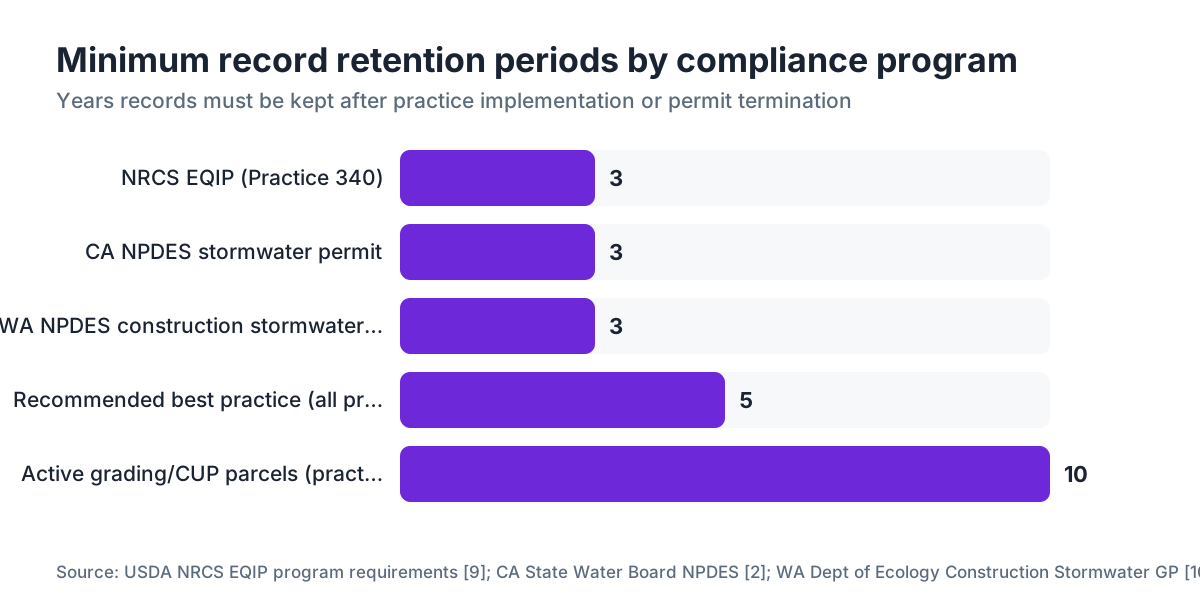
Retention rules vary by program, but the safe floor is three years after the end of the program year in which the practice went in [9]. EQIP contracts say so explicitly.
For stormwater permits, California's Porter-Cologne Water Quality Control Act and the NPDES system generally require inspection and BMP records for at least three years from the date of observation [2]. Washington's Construction Stormwater General Permit requires site logs for three years after permit termination [10].
If your property was developed under a grading permit with erosion control conditions, keep those records as long as you own the parcel. A successor owner may need them if a complaint surfaces years down the road.
My target is five years. Storage is cheap. Litigation is not.
What's the best way to organize and store these records?
Two approaches work: paper binders and digital systems. Neither is inherently better. The one you'll actually update is the right one.
Paper systems: a three-ring binder per block, or per field unit that matches your conservation plan, does the job. Tab it by year. Keep seed tags stapled to the establishment worksheet for that seeding. File dated print-outs of your geotagged photos with a map showing where each was taken.
Digital systems: a shared cloud folder with consistent file naming (Farm_Block_Year_Practice_Version) is the floor. Some growers run their agronomy software or a purpose-built compliance platform. VitiScribe, for one, lets you attach photos, seed tags, and signed field observations straight to a block record and export a dated PDF for permit submissions, which helps a lot when a reviewer wants records on short notice.
Whatever you use, the two failure modes are the same. Records created at seeding and never updated with a stand assessment. And records that exist but can't be found when someone asks. Build the stand assessment into your standard 30-day scouting calendar so it never gets dropped.
WSU Extension's viticulture program recommends keeping establishment records in the same location as your spray records and irrigation logs, so any single compliance inspection can be answered from one file [4].
What counts as an adequate stand assessment for compliance purposes?
This is where growers trip. A stand assessment isn't a note that says "cover crop looks good." For NRCS practice verification and most permit frameworks, it has to be specific enough for a stranger to evaluate.
The NRCS job sheet for Practice 340 asks for percent ground cover, which you can estimate visually with a gridded photo quadrat or a Daubenmire frame. The target shifts by practice standard version and region, but protecting 70 percent of the soil surface before the erosion season is a commonly cited threshold in Western vineyard guidance from UC Cooperative Extension and NRCS California [3].
For a written assessment record, include:
- Date of observation
- Block or field identifier
- Estimated percent cover by species or mix
- Any observed gaps, weed pressure, or areas that failed to germinate
- Corrective actions taken (overseeding, irrigation, replanting)
- Name of the person who assessed
If a section failed, document it and document what you did about it. Incomplete stands handled honestly look far better at audit than incomplete stands ignored or left off the page.
Photos taken at the assessment, with geotagged coordinates in the file metadata, are the strongest single piece of evidence you can hold. Cornell Cooperative Extension vineyard guides note that dated, coordinate-tagged photo documentation is increasingly expected by auditors even when the permit doesn't technically require it [5].
How do cover crop records connect to your NRCS conservation plan?
If you have an NRCS-written conservation plan (Form NRCS-CPA-026), your cover crop establishment records should match the practice schedule in that document exactly. The plan spells out which fields get Cover Crop Practice 340, which season, at what rate, and toward which resource concern (usually water erosion, resource concern code 1.1.1 or 1.1.2 under the National Planning Procedures Handbook) [7].
A mismatch between your plan and your records is a red flag at verification. If your plan says seeding by October 15 and your record shows November 3, be ready to explain the gap. Minor timing deviations don't automatically void payment. Unexplained ones do.
Your local NRCS field office can hand you the exact practice standard version in effect for your state and the performance criteria you'll be measured against. The national NRCS practice standards library carries them too. Read the applicable standard once, before you build your record template. It saves a lot of catch-up later.
Do cover crop records also apply to pesticide and worker protection compliance?
Indirectly, yes. The EPA Worker Protection Standard (WPS), revised in 2015 and codified at 40 CFR Part 170, requires agricultural employers to keep records of pesticide applications, including applications made to cover crops in areas where workers may enter [6]. Apply a pre-emergent herbicide to knock down weeds before seeding, or a fungicide seed treatment, and those applications belong in your pesticide records whether the target is the cover crop or the vineyard canopy.
The tie to erosion compliance is practical, not statutory. During an NRCS or permit inspection, an inspector who pulls your spray records and spots herbicide applications in a block you claimed had an established cover crop will want to understand the timing. Clean, coordinated records across both systems tell one coherent story.
Some growers keep spray records and cover crop records apart out of habit, then struggle to explain apparent contradictions. File them in the same year so you can cross-reference in seconds.
What are the most common record-keeping mistakes that cause audit failures?
From what NRCS field staff and extension advisors consistently report, the pattern is predictable.
Missing stand assessments. The seeding record exists. The follow-up doesn't. This is the single most common gap and the one most likely to delay or cut a cost-share payment.
Generic species entries. "Grass mix" or "cover crop blend" with no species, rate, or lot number doesn't meet Practice 340's documentation requirement.
No photographs, or photos without dates. Phone photos are fine, but if the metadata got stripped or the device's clock was wrong, the photos lose evidentiary value.
Records that don't match the field. The record says 50 acres. The conservation plan says 42. That gap triggers questions even when the seeding was done right.
Records stored only in one person's memory. This is a farm succession problem as much as a compliance one. When the person who did the seeding is gone, the record has to live on paper or in a system.
Spray records and establishment records filed in separate places, so the two can't be reconciled during an inspection.
The honest fix for most of these is a one-page field form, filled out at seeding and again at stand assessment, filed in one spot. It doesn't need to be fancy.
Are there record requirements specific to new vineyard development versus established vineyards?
Yes, and the standards run stricter for new development.
New vineyard development usually requires a grading permit, which in most California wine counties (Napa, Sonoma, Mendocino, San Luis Obispo, Santa Barbara) includes an approved Erosion and Sediment Control Plan (ESCP) or a Stormwater Pollution Prevention Plan (SWPPP) [2]. Those plans require active monitoring logs through every disturbed-land phase, including a seeding log showing what was planted, when, and at what rate. Monitoring frequency is often monthly during the rainy season.
Established vineyards face more variable rules. Vineyards in EQIP follow the practice schedule in their contract. Vineyards in regions covered by a state agricultural waiver (like California's ILRP) may carry management practice requirements but typically don't file establishment records unless the regional board asks [8].
The practical dividing line: if bare soil got moved in the last two years, assume development-level scrutiny applies. Once a block has two full growing seasons of cover, the documentation load lightens considerably.
You can read more about how field-level operations connect to overall vineyard compliance in the vineyard section of this site.
How can you build a record-keeping system that stays current without taking over your week?
The systems that actually get maintained share three traits: simple enough to fill out in the field, stored where more than one person can reach them, and tied to a calendar trigger so stand assessments don't slip.
A workable minimum for most vineyards is a two-stage field form. Stage one, filled at seeding: field ID, date, species and PLS rate, seedbed prep, seeder operator signature. Stage two, filled at the 30-day (and pre-rainy-season) stand assessment: date, percent cover, photo reference, corrective action if any, signature.
Hook the 30-day assessment onto your existing scouting calendar. If you're already in a block at 30 days for pest or vine monitoring, a five-minute cover crop check adds almost nothing.
For multi-block operations, or anyone who wants a permit-ready PDF without rebuilding records every time an auditor calls, vineyard compliance software earns its keep. VitiScribe is built for this, with field record templates that export straight to the formats NRCS and state agencies recognize. A well-organized paper binder does the same job if you stay consistent.
WSU Extension's Viticulture and Enology program publishes cover crop management guides for Washington growers with record-keeping templates you can adapt [4]. UC Cooperative Extension and Cornell both offer similar resources [3][5]. They're free and proven starting points.
The goal is 20 minutes per seeding event, 10 minutes per assessment, and no scramble when someone asks.
Frequently asked questions
What is NRCS Practice Code 340 and what does it require for documentation?
NRCS Conservation Practice Standard 340 (Cover Crop) defines the technical and documentation requirements for cover crops on agricultural land. For compliance, it requires records of species and seeding rate in pure live seed per acre, seeding date, seedbed preparation, and a stand establishment assessment confirming the practice met the performance criteria. Your state-specific version of the standard is available from your local NRCS field office or the NRCS national website.
Can seed tags substitute for a written seeding record?
Seed tags are strong supporting evidence and should always be kept, but they don't substitute for a completed establishment record. A tag proves what was purchased. A signed, dated record proves what was seeded, where, at what rate, and when. NRCS and permit reviewers want both. Staple the tags to your field form so they stay together.
How detailed do photographs need to be for an audit?
Photos should show the stand at a scale where ground cover density is visible, with a date stamp or embedded GPS metadata. Two to four photos per block from consistent reference points are standard. If your phone doesn't auto-embed GPS, note the field coordinates in the file name. Close-up shots of individual plants are less useful than wide-angle shots that convey canopy closure across the interrow.
Does every vineyard in California need cover crop establishment records?
Not every vineyard faces the same trigger, but most face at least one. Vineyards with EQIP contracts must document per Practice 340. New developments with grading permits need SWPPP-level seeding logs. Vineyards in ILRP-covered regions should keep records in case of a board inquiry. And certification programs like Lodi Rules and CSWA put erosion control in their audits. The default posture should be to keep records regardless.
What happens if my cover crop establishment failed and I didn't document corrective action?
A failed stand that was corrected but not documented looks the same as a failed stand that was ignored. NRCS field staff will typically note a stand failure during verification and may require a corrective action plan before releasing payment. Water quality agencies can issue notices of violation. The fix going forward is to document every corrective action, including the date you spotted the problem and what you did about it, as soon as it happens.
Do I need separate records for cover crops in vine rows versus interrows?
If your conservation plan or permit treats vine rows and interrows as separate management zones with different practice specifications, then yes. In most cases they can be recorded together per block, as long as you note which areas received which seed mix. Some NRCS practice standards in steep-slope regions specify different interrow and under-vine cover requirements, so check your applicable job sheet.
Are digital records legally acceptable for NRCS and water board purposes?
Yes. NRCS accepts electronic records as long as they're legible, include all required data fields, and can be printed for verification. California water boards accept electronic records under the same legibility standard. The key requirement is that records be maintained and available for at least three years, and ideally five. Cloud backups are prudent so records survive equipment failures.
How does the EPA Worker Protection Standard relate to cover crop records?
The WPS, at 40 CFR Part 170, requires pesticide application records for any application where workers may enter the area. If you apply herbicide or a seed treatment before or during cover crop establishment, those applications go in your spray records. The connection is practical: an inspector who sees herbicide timing in your spray log will want to understand how it fits your establishment timeline, so keeping both record sets in the same filing year helps.
What seed mix documentation is needed when I use a custom or commercial blend?
Record the product name, manufacturer, lot number, and the full species composition and PLS percentages as listed on the seed tag or datasheet. If the blend changes between purchases, note it per seeding event. Commercial blend labels vary in detail, so ask your seed supplier for a full species breakdown in writing if the label is vague. NRCS reviewers want to see that you know what went in the ground.
How early before the rainy season should cover crops be established to meet erosion control standards?
Most Western state guidance targets establishment at least 30 days before the first expected significant rainfall. In Northern California that generally means seeding by early to mid-October. NRCS California guidelines and UC Cooperative Extension recommend seeding by October 1 to October 15 in most wine grape regions to allow germination and ground cover before winter storms. Your specific permit or contract may set a firm date, which overrides general guidance.
Can I use the same form for cover crop records and my general field activity log?
Yes, and many growers do. The key is that the form captures every required data field for Practice 340 compliance, more than a general note that work was done. Some growers use a combined field activity log with a dedicated section for establishment records. That's fine as long as the cover crop section is complete. Separate forms are easier to pull for a single-purpose audit request.
Do sustainability certifications like Lodi Rules require the same records as NRCS?
Lodi Rules for Sustainable Winegrowing evaluates erosion control as part of its soil management chapter. The required documentation overlaps heavily with NRCS Practice 340: seeding records, stand assessment, and corrective actions. The audit is third-party rather than governmental, but auditors are trained to look for the same data fields. One solid set of records that meets the NRCS standard generally satisfies Lodi Rules and CSWA auditors as well.
What's the minimum stand cover percentage required for compliance?
No single universal threshold exists, but 70 percent ground cover before the first significant rainfall is the most commonly cited benchmark in Western vineyard guidance, including UC Cooperative Extension materials. NRCS Practice 340 ties the threshold to the applicable performance criteria in your state's version of the standard. Some steep-slope or high-rainfall regions require higher coverage. Check your specific practice standard or permit condition for the binding number.
Sources
- California State Water Resources Control Board, Construction General Permit Order 2022-0057-DWQ: California NPDES construction stormwater permit requires active erosion control documentation including seeding logs and monitoring records during disturbed-land phases
- UC Agriculture and Natural Resources (UC Cooperative Extension), Cover Crops for Vineyards guidance: UC Cooperative Extension recommends targeting at least 70 percent ground cover by the first significant rain event, and seeding by October 1 to October 15 in Northern California wine regions
- Washington State University Viticulture and Enology Program: WSU Extension recommends keeping establishment records in the same location as spray records and irrigation logs so any single compliance inspection can be answered from one file
- Cornell College of Agriculture and Life Sciences, Grapes and Viticulture Program: Cornell Cooperative Extension vineyard guides emphasize that photo documentation with dates and coordinates is increasingly expected by auditors even when not technically required by permit
- EPA, Agricultural Worker Protection Standard, 40 CFR Part 170: The EPA Worker Protection Standard requires agricultural employers to maintain records of pesticide applications including applications made in areas where workers may enter
- California State Water Resources Control Board, Irrigated Lands Regulatory Program: California's ILRP covers roughly 6 million acres of irrigated agricultural land and has specifically cited erosion and sediment control in wine grape growing regions as a priority issue
- Washington State Department of Ecology, Construction Stormwater General Permit: Washington's NPDES Construction Stormwater General Permit requires site logs and BMP records to be kept for three years post-permit termination
- Lodi Winegrape Commission, Lodi Rules for Sustainable Winegrowing: Lodi Rules evaluates erosion control as part of its soil management chapter, with documentation requirements that overlap substantially with NRCS Practice 340
Last updated 2026-07-11