Employee training documentation for pesticide handler certification

TL;DR
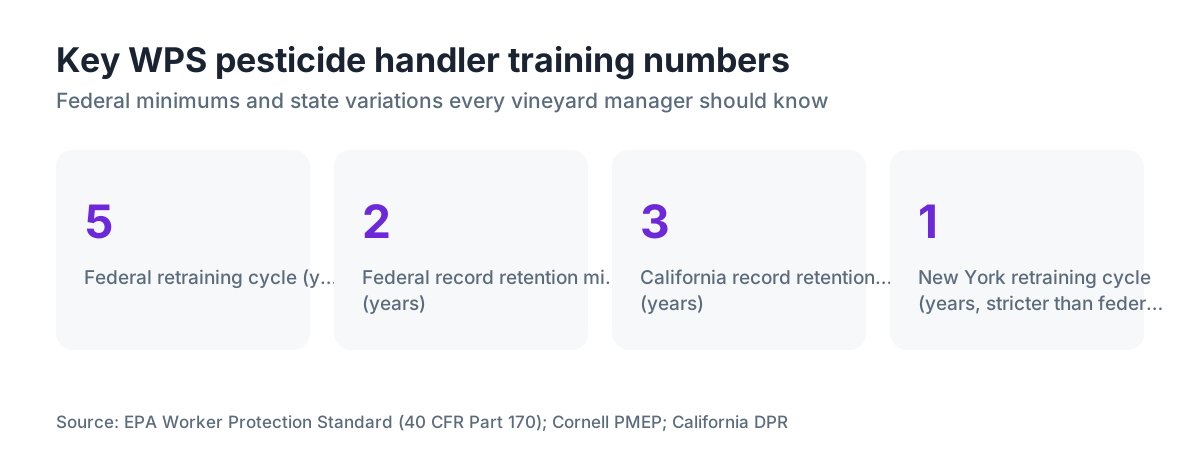
- EPA's Worker Protection Standard (40 CFR Part 170) requires that every person who handles pesticides on a farm gets trained every five years, and that training has to be documented.
- Each record must show the employee's name, the training date, the trainer's credentials, and the materials covered.
- Inspectors can ask for these records anytime.
- A missing record carries the same penalty as skipping the training.
What does federal law actually require for pesticide handler training documentation?
The EPA Worker Protection Standard, at 40 CFR Part 170, sets the floor for every state. Agricultural employers have to make sure workers and pesticide handlers get safety training before they work with pesticides, and they have to keep records proving it happened. [1]
Handlers get trained every five years. The 2015 revised WPS (effective January 2, 2017 for most provisions) changed this from annual refresher courses to a single five-year cycle, and it raised the bar on the training content at the same time. [8]
Here's the regulation in its own words: "The agricultural employer must ensure that each handler employer makes pesticide safety training available to handlers." The burden sits on the agricultural employer, not the handler employer. That distinction matters the moment you bring in labor contractors. [1]
Your documentation has to capture four things at minimum:
- The employee's full name
- The date training was completed
- The name and credentials of the trainer
- The specific materials or program used
When a state ag department inspector or OSHA compliance officer walks in, those four items are what they ask for first. Miss any one of them and you can draw a citation even when the training genuinely happened.
How long do you have to keep pesticide handler training records?
Two years from the training date. That's the federal floor under the 2015 revised WPS, and several states climb higher. [1]
California wants three years. Pesticide use records and the associated employee training records fall under the California Food and Agriculture Code and the DPR's regulations at 3 CCR Section 6728. [2] Washington State follows the federal two-year minimum, but state inspectors there routinely ask for records going back three years during audits, so WSU Extension recommends keeping them three years as a buffer. [3]
My default: keep everything for three years, everywhere. Storage is cheap. Penalties are not.
What form can records take? Paper binders work. So do spreadsheets. Digital systems work as long as you can print or export on demand. The EPA doesn't require a specific form, which sounds like freedom but sets a trap. People design their own forms and drop a required field. A sign-in sheet with names and dates but no trainer credential is an incomplete record, and an incomplete record is a citation waiting to happen.
Who qualifies as a trainer for pesticide handler certification, and does that need to be documented too?
Yes, and the trainer's qualifications go in the record right alongside the training itself. WPS says training has to come from either a certified applicator or someone who finished an EPA-approved train-the-trainer program. [1]
A trainer who is a certified pesticide applicator needs a current certification, and that certification number belongs on your training record. If you bring in an outside trainer, get a copy of their certificate and attach it to the session record. Don't just write "John Smith, certified applicator." Write the certification number, issuing state, and expiration date.
University extension services run approved programs that count as both handler training and train-the-trainer courses. UC Cooperative Extension offers WPS-approved handler curricula through its Pesticide Safety for Agricultural Workers program. [4] Cornell Cooperative Extension runs similar programs calibrated to New York State requirements. [5] WSU Extension has Spanish-language and English-language handler training built for tree fruit and vineyard operations in the Pacific Northwest. [3]
If you use a video or online module instead of a live trainer, the record has to show who supervised the viewing or completion, more than which video played. An unsupervised video room with a sign-in sheet is a gray area, and some state inspectors call it noncompliant. Play it safe: put a supervisor in the room and have them sign off.
What information must appear on each training record to survive an inspection?
A compliant training record answers six questions a stranger could verify on their own. Get all six down and an inspection turns into a formality.
- Who was trained? (Full legal name, not a nickname)
- When? (The actual date, not month and year)
- What were they trained on? (Name the curriculum, version, or EPA approval number)
- Who trained them? (Name plus credential type and number)
- Did the trainee acknowledge it? (Signature or initials)
- What language was used? (Note it if the training was not in English)
The language notation is the one people forget. WPS requires training in a language the employee understands. [1] If you ran a Spanish-language session, the record should say so. That protects you and shows you met the intent of the rule, more than the letter.
Signatures matter more than people think. An unsigned training record is hearsay in an enforcement proceeding. Get the signature at the time of training, not later. If someone is out that day and does a makeup session, document the makeup on its own with its own date.
Here's the minimum required fields against what a well-built record includes:
| Field | WPS Minimum | Best Practice |
|---|---|---|
| Employee name | Full name | Full name + employee ID |
| Training date | Date | Date + start/end time |
| Training topic/curriculum | Required | Name, version, EPA approval # |
| Trainer name | Required | Name + cert # + cert expiration |
| Trainer credential type | Required | Certified applicator or TOT program |
| Trainee signature | Not explicitly required by WPS | Get it anyway |
| Training language | Required | Note if Spanish or other language |
| Makeup session flag | Not required | Flag if different from group date |
What's the difference between WPS handler training and a pesticide applicator license?
People confuse these two constantly, and confusing them leaves you exposed on both fronts.
A pesticide applicator license is a state-issued credential that lets a person buy and apply restricted-use pesticides (RUPs). It takes an exam and continuing education, and it's tied to the individual. [6]
WPS handler training is a federally required safety briefing that every person who handles pesticides has to get, restricted-use or general-use, doesn't matter. A licensed applicator still needs WPS handler training documentation in their file. A trained handler is not automatically cleared to buy or apply RUPs.
So a vineyard usually needs both: licensed applicators on staff for RUPs, and WPS handler training records for everyone who does anything that counts as "handling," the licensed applicators included.
The WPS definition of "handling" is wide. It covers mixing, loading, applying, disposing of pesticides, repairing equipment, flagging for aerial applications, and early entry into treated areas in some cases. [1] If you're unsure whether a task counts as handling, assume it does and train for it. An extra training record costs nothing. A citation for an untrained handler costs real money and real hassle.
In a vineyard, workers who adjust drip lines carrying soil fumigants, or who calibrate sprayer nozzles, are almost certainly handlers under WPS, even if nobody has been treating them that way.
How do state requirements differ from the federal WPS baseline?
Federal WPS is the floor. States can and do go higher, and California is the clearest case. [2]
The California Department of Pesticide Regulation requires a Pesticide Safety Training (PST) program that overlaps with federal WPS but runs more prescriptive. California also requires a Hazard Communication component, pesticide safety instructions at the point of use, and a three-year record retention period under its own rules rather than the federal two years. Growers working in multiple counties sometimes face extra county commissioner requirements stacked on top of state rules. [2]
Washington State requires training that meets or beats WPS, and separately requires documentation of safe pesticide use training under the state's Farmworker Safety Standards. WSU Extension's Pesticide Safety Education Program is the go-to for Washington growers. [3]
New York State requires training every year, not every five, for workers and handlers. Cornell's Pesticide Management Education Program has guidance built around that annual requirement. [5]
Oregon, Arizona, and Michigan each have their own wrinkles. The honest answer: look up your state ag department's rules before you assume federal WPS covers you. The EPA lists states with more stringent requirements on its Worker Protection Standard page. [1]
If you operate across state lines, document training against the strictest state standard that applies to you. Building one strong record is less work than running two parallel systems.
What happens if your documentation is incomplete or missing during an inspection?
Missing records get treated as missing training. That's the enforcement reality. An inspector can't verify what nobody wrote down, and the presumption runs against you.
The EPA and state ag departments issue civil penalties for WPS violations. Under EPA's FIFRA penalty policy, first-time violations for missing handler training records can run from a few hundred dollars to several thousand per employee, depending on the gravity of the violation and how many employees are affected. [7] California DPR penalties can run higher and are assessed per violation, per day in some circumstances. [2]
Beyond the fine, a documented violation lands on your inspection history. That history can affect your ability to get certain certifications, join export programs, or pass a buyer's supplier compliance audit.
The bigger risk is practical. If a handler gets exposed to a pesticide and has a health incident, your training records become evidence in whatever claim follows. Records that are incomplete, backdated, or inconsistent hurt you in ways a fine never will.
Inspectors do look for backdating. Identical signatures across a record, or a whole crew's records completed at the exact same moment, draws scrutiny fast. Train in real time. Sign in real time. The alternative isn't worth it.
What's the best system for organizing and storing handler training records in a vineyard operation?
The test is simple. When someone asks for a specific employee's training records, you should produce them in under five minutes. How you get there is your call.
Paper binders organized by employee, with a master index, work fine for small operations. Keep originals in the office and a scanned backup offsite or in the cloud. The failure mode for paper is flood, fire, or the office reshuffle where nobody can find the 2022 binders anymore.
Spreadsheets with embedded scanned documents are a step up. One sheet per year, one row per session, PDFs of the sign-in sheets attached. This holds together until you've got eight tabs and forty employees and nobody remembers where the March session files went.
Dedicated field and compliance software closes the gap. For vineyards, platforms built around WPS and pesticide use records make it easier to link spray records to the employee training records that should ride alongside them. VitiScribe is one option built for vineyard field operations and compliance paperwork, including tracking handler training cycles and expiration dates.
Whatever you use, set a calendar alert 60 days before any employee's five-year window closes. Don't find out during the audit that someone's training lapsed eight months ago.
Seasonal crews need real planning. A harvest crew arriving in September has to be trained before they touch any pesticide, which means the session happens before they start, not after the first spray day.
Do seasonal or temporary vineyard workers need the same training documentation as full-time employees?
Yes. WPS draws no line between seasonal, temporary, and full-time workers. If the task counts as handling, the person doing it needs documented training before they start. [9]
This is where vineyards run into the most documentation gaps. A harvest crew arriving on short notice, a contractor brought in for a dormant-season spray, a tractor driver who occasionally loads the tank, each of them needs a training record.
For workers supplied by a farm labor contractor (FLC), the responsibility is shared. The agricultural employer has to verify that training happened. The minimum is getting a copy of the FLC's training records, or requiring the FLC to certify in writing that all employees have been trained. Some operations go further and require the FLC to use a specific curriculum and hand over all records before workers set foot on the property.
One approach that works: run a short handler training session on day one of any new crew, document it, and keep those records separate from your year-round employee files. Even if the FLC did their own training, your documented session covers the gap and shows good faith.
H-2A workers get training in their own language. [1] Plenty of vineyards source Spanish-speaking crews, and UC Cooperative Extension's Spanish-language WPS materials exist for exactly this. [4]
What are the key training topics that must be covered and documented under WPS?
WPS spells out the content of handler training, so your documentation needs to show the content actually got covered. A sign-in sheet alone doesn't prove that. Your record or a separate curriculum checklist should list which topics you addressed. [1]
Required handler training topics include:
- Safety requirements for handlers, including PPE
- Prevention, recognition, and first aid for pesticide poisoning
- How to find and use pesticide labeling information
- Restricted-entry intervals (REIs) and treated area notifications
- Environmental concerns, including protecting water, plants, and other nontarget organisms
- Decontamination supplies and where to find them
- Emergency assistance procedures
- The right to request information about pesticides used on the operation
The 2015 revision added or expanded several of these compared to the original 1992 standard, especially around pesticide safety information access and anti-retaliation provisions. [8] If your curriculum predates 2017, check whether it was updated to match the revised requirements.
EPA lists approved training resources on its Worker Protection Standard page. [1] Any curriculum that isn't on that list should be checked against the regulatory content requirements before you rely on it.
In California, the Pesticide Safety Training content requirements are laid out separately by DPR and include state-specific elements not in federal WPS, such as procedures for reporting pesticide illness. [2]
How does handler training documentation connect to your pesticide use records?
Pesticide use records and handler training records are separate documents, but inspectors read them as a pair. A pesticide use record shows a product was applied on a specific date by a specific person. That person's training record should show they were trained before the application date. [1]
If your use record shows an application by someone whose training record is missing or dated after the application, you've got a double problem: an untrained handler and a credibility hole in your whole record set.
California's required Pesticide Use Report (PUR) gets filed with the county agricultural commissioner, and those records can be cross-referenced against training documentation during inspections. [10] That cross-check happens more often than growers expect.
For vineyards tracking multiple employees across multiple spray events, the cross-reference risk climbs with complexity. A safeguard worth building: before each spray season, pull a report of who's on your handler list and confirm every person's training is current. Do the same check for any new hire mid-season.
This is where digital record-keeping earns its keep. A system that links spray event records to employee training records beats two separate paper binders by a wide margin. Some vineyards use a compliance platform like VitiScribe to hold spray records and training documentation in one place, which makes the cross-reference automatic instead of a manual audit chore.
Solo operators, don't skip your own training record. Owner-operators are not exempt from WPS once they employ any workers.
What resources do university extension programs offer for handler training compliance?
Extension programs are the most reliable, low-cost source of WPS-compliant training materials for vineyards. They build curricula vetted against federal and state requirements, updated when regulations change, and often offered in more than one language.
UC Cooperative Extension runs the Pesticide Safety for Agricultural Workers program, which includes handler training materials, Spanish-language versions, and train-the-trainer courses. The materials are used across California agriculture and available through county farm advisors. [4]
Cornell Cooperative Extension's Pesticide Management Education Program (PMEP) publishes WPS guidance, training materials, and state-specific compliance resources for New York growers. It also maintains one of the better online reference libraries for pesticide label interpretation. [5]
WSU Extension's Pesticide Safety Education Program has training modules built for Pacific Northwest agriculture, including vineyard operations in Washington and Oregon. Its materials cover both federal WPS and Washington's separate Farmworker Safety Standards. [3]
All three programs offer materials growers can download and use for in-house training. When you use extension materials, note the program name, version or publication date, and any EPA approval identifier in your training record. That shows your curriculum choice was deliberate and verifiable, not something scraped off a random search result.
Many farm bureaus and grower associations also run periodic WPS handler training workshops where an extension educator leads the session, provides the documentation, and hands each attendee a certificate. If your crew is small enough to attend one, the session certificate plus your own sign-in confirmation is a clean documentation package.
Frequently asked questions
How often do pesticide handlers need to be retrained under federal WPS?
Federal WPS requires handler training every five years. This five-year cycle came in with the 2015 revised Worker Protection Standard, effective January 2, 2017. Some states require more: New York mandates annual retraining for all agricultural workers and handlers. Check your state's rules, since federal WPS is only the floor.
Can I use an online course to satisfy WPS pesticide handler training requirements?
Yes, EPA-approved online courses can satisfy WPS handler training. But the documentation needs to show the training was supervised or that completion was verified by a qualified person. An unsupervised online module with only an automated certificate is a gray area. Check with your state ag department to confirm whether a specific platform is accepted where you operate.
Does the farm owner need WPS handler training if they apply pesticides themselves?
If the farm owner is the only worker and has no employees, WPS doesn't apply to that operation. But the moment the operation employs any agricultural workers or handlers, WPS applies to everyone, the owner included, if they perform handler tasks. Owners who personally mix, load, or apply pesticides need training documentation in their own records.
What's the penalty for missing pesticide handler training records during a California DPR inspection?
California DPR can issue civil penalties for missing or incomplete pesticide handler training records. Penalties are assessed per violation and can compound per day in ongoing noncompliance. Amounts vary with county agricultural commissioner discretion, but they can run from hundreds to several thousand dollars per employee record deficiency. Voluntary disclosure before an inspection generally results in lower penalties.
Do farm labor contractors need to provide their own WPS handler training, or does the grower cover it?
Both parties share responsibility. The grower must verify that all handlers on the operation, including those from farm labor contractors, have received WPS training. FLCs typically provide their own training and documentation. Growers should require a copy of those records or a written certification before letting FLC employees perform handler tasks. Running a backup session on arrival is common practice.
What languages must pesticide handler training be offered in?
WPS requires training in a language the employee can understand. If a worker's primary language is Spanish, the training must be in Spanish. The documentation should note the language used. UC Cooperative Extension and WSU Extension both publish Spanish-language WPS handler training materials. Training in a language the employee doesn't understand is treated as no training at all under enforcement.
What's the difference between worker training and handler training under WPS?
WPS defines two categories: agricultural workers, who do hand-labor tasks in fields, and handlers, who mix, load, apply, or work with pesticide equipment. Handlers face greater exposure and require more detailed training on pesticide safety, PPE, decontamination, and emergency procedures. Workers need a shorter safety training. Both require documentation, but the content requirements and some record-keeping details differ.
Can one training session cover both WPS handler training and state-required pesticide safety training?
Often yes, if the curriculum covers all required topics from both sets of rules. In California, a session using DPR-approved Pesticide Safety Training content typically satisfies both federal WPS and state requirements in one sitting. The training record should reference both the federal WPS and the state program. Confirm with your county agricultural commissioner that the curriculum meets state standards.
What records do I need to show that a trainer was qualified to give WPS handler training?
Your record should include the trainer's full name, their credential type (certified pesticide applicator or completion of an EPA-approved train-the-trainer program), their certification number, issuing state, and expiration date. If the trainer came from a university extension program or an outside organization, attach a copy of their credential documentation to the session record. Inspectors regularly ask to verify trainer qualifications.
How should I document makeup training for an employee who missed the group session?
Create a separate training record for the makeup session with its own date, trainer information, and the employee's signature. Don't add the employee's name to the original group sign-in sheet after the fact. Backdating is one of the first patterns inspectors check for. A makeup record with a clearly different date is clean. A name added to an old sheet creates a credibility problem for your entire record set.
Do I need to keep a copy of the training materials, or just the sign-in records?
WPS doesn't require you to store a copy of the curriculum, but keeping one is smart. If an inspector questions whether your training covered all required topics, the curriculum answers that immediately. For extension materials, note the publication name and date in your record. For homegrown curricula, keep the master copy and note when you last reviewed it against current regulations.
What's the WPS requirement for training before entry into a pesticide-treated area during a restricted-entry interval (REI)?
Handlers who enter a treated area during an REI must have completed handler training before that entry. The REI itself is not a substitute for training. Early entry during an REI also carries specific PPE and employer notification requirements separate from the training documentation. Any early-entry handler must be documented as trained, more than briefed at the gate on the day of entry.
How do I handle training records for workers who leave and return the next season?
If a returning seasonal worker's training is still within the five-year window (or your state's window), their prior record is valid and they don't need retraining. Keep their records through the retention period even after they stop working for you. Before the season starts, review each returning worker's training date to confirm it's still valid. If it lapsed, schedule a new session before they begin handler tasks.
Are there free templates for pesticide handler training records that meet WPS requirements?
Yes. UC Cooperative Extension, Cornell PMEP, and WSU Extension all publish sample training record forms. EPA's Worker Protection Standard page also links to sample documentation resources. These templates include the required fields and help you avoid the common mistake of building a form that omits trainer credentials or the language-of-training notation. Download one rather than building from scratch.
Sources
- EPA, Worker Protection Standard for Agricultural Pesticides (40 CFR Part 170): WPS requires pesticide handler training every 5 years, training in a language the employee understands, trainer must be a certified applicator or complete an approved train-the-trainer program, and records must be retained for 2 years
- California Department of Pesticide Regulation, Pesticide Safety Information Series: California requires pesticide safety training documentation and pesticide use records to be retained for 3 years under 3 CCR Section 6728; California DPR has more stringent requirements than federal WPS
- UC Cooperative Extension, Pesticide Safety for Agricultural Workers program: UC Cooperative Extension offers WPS-approved handler training curricula including Spanish-language versions and train-the-trainer courses used across California agriculture
- Cornell Cooperative Extension, Pesticide Management Education Program (PMEP): Cornell PMEP publishes WPS guidance and state-specific compliance resources for New York growers; New York State requires annual worker and handler training, stricter than the federal 5-year standard
- EPA, Certification of Pesticide Applicators (40 CFR Part 171): A pesticide applicator license is a state-issued credential authorizing purchase and application of restricted-use pesticides, requiring an exam and continuing education, and is tied to the individual
- EPA, FIFRA Civil Penalty Policy: EPA can issue civil penalties for WPS violations including missing handler training records; penalty amounts vary based on gravity and number of employees affected
- EPA, Revised Worker Protection Standard (2015 final rule, effective January 2, 2017): The 2015 revised WPS changed handler retraining from annual to every five years and added new content requirements including anti-retaliation provisions and enhanced pesticide safety information access rights
- USDA National Agricultural Library, Worker Protection Standard resources: WPS applies to all agricultural employers who use pesticides and employ workers or handlers regardless of full-time or seasonal status; farm labor contractor employees are covered under the standard
- California Department of Pesticide Regulation, Pesticide Use Reporting (PUR) program: California's Pesticide Use Report must be filed with the county agricultural commissioner and can be cross-referenced against handler training records during compliance inspections
Last updated 2026-07-09