Lodi Rules certification spray record documentation requirements

TL;DR
- Lodi Rules Sustainable Winegrowing certification requires growers to document every pesticide application with at least 13 specific fields: product name, EPA registration number, target pest, application date, rate, acreage, equipment, operator name, REI, PHI, weather conditions, adjuvants used, and timing relative to bloom.
- Records must be kept for three years and are audited annually by a third-party certifier.
What spray records does Lodi Rules actually require you to keep?
Lodi Rules ties every spray record to its Pest Management category, one of six areas a third-party auditor scores each year. The program is administered by the Lodi Winegrape Commission and follows the workbook scoring system of the Code of Sustainable Winegrowing (CSWA) [1].
Each spray event has to capture a specific field set. At minimum: product trade name, active ingredient, EPA registration number, target pest or disease, application date, start and end time, application rate (amount per acre or per 100 gallons), total acres treated, total product used, pre-harvest interval (PHI), restricted entry interval (REI), equipment type and calibration status, and the name of the pesticide applicator [2]. Weather at application time (wind speed and direction, temperature, relative humidity) goes on the record too, along with a note on whether the spray happened during or near bloom.
That list is a floor, not a ceiling. California's pesticide use reporting (PUR) system requires you to report any pesticide use to your county ag commissioner within one month of application [3], and those county filings become part of your record set. Auditors expect your internal spray logs to match your filed PUR reports. Gaps between the two get flagged fast.
How do Lodi Rules requirements compare to California state pesticide record-keeping rules?
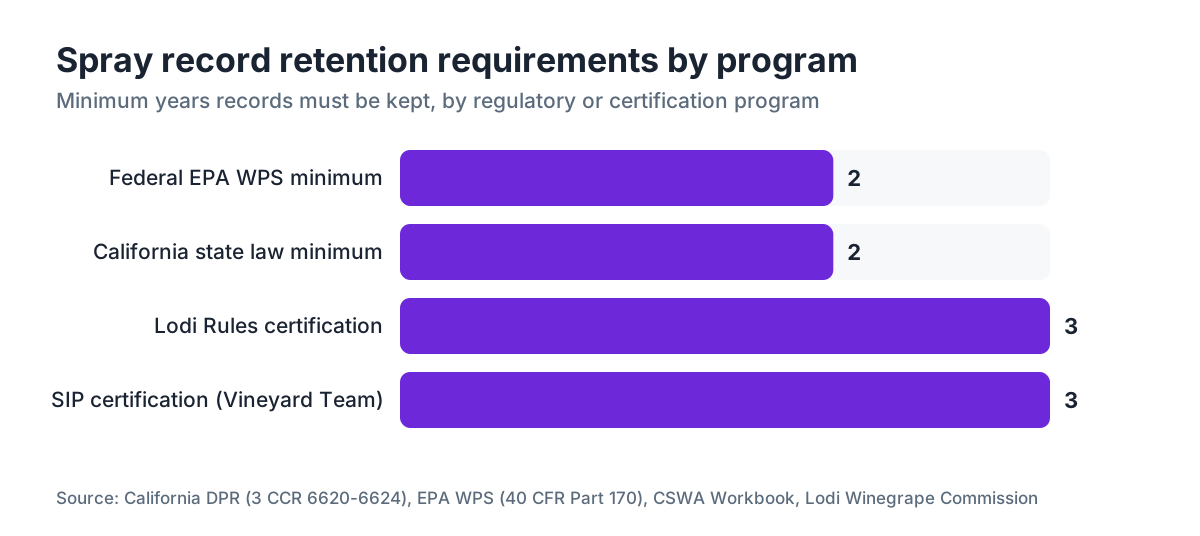
California law (Food and Agricultural Code sections 12981-12989 and the regulations at 3 CCR 6620-6624) requires anyone applying a restricted materials pesticide to keep records for at least two years [3]. Lodi Rules pushes that to three years. Three is the number auditors ask about when they pull your files.
The state form (the California DPR Pesticide Use Report) captures many of the same fields. The Lodi Rules workbook scores you on more than that. It scores practice-level data the state does not ask for: whether you recorded why you chose that product over alternatives, whether you consulted a pest management advisor before applying, and whether you tracked the field scouting that justified the spray. None of that lives on the state PUR form.
| Requirement | California State Law | Lodi Rules Certification |
|---|---|---|
| Retention period | 2 years | 3 years |
| EPA reg. number | Required | Required |
| Weather at application | Not required | Required |
| Bloom notation | Not required | Required |
| Product selection rationale | Not required | Scored (workbook) |
| Scouting records linking to spray | Not required | Scored (workbook) |
| PMA sign-off | Restricted materials only | Encouraged for all apps |
| Audit by third party | No | Annual |
The table reflects requirements as written in DPR regulations [3] and the CSWA workbook [1]. Confirm the current numbers with your Lodi Winegrape Commission advisor, because workbook editions get revised.
Which fields on a spray record trip up growers the most during audits?
A handful of fields come up over and over as the ones that end up blank or wrong. Here are the four that cause the most trouble at audit.
Bloom timing notation. Honeybee protection during bloom is a scored practice in Lodi Rules [1]. Auditors look at whether any application ran from 25% bloom through petal fall and whether you flagged it. If you sprayed during that window, note it and show the product was acceptable for that timing. A blank field reads as a failed practice, not a neutral one.
REI compliance documentation. The federal EPA Worker Protection Standard (WPS) requires the REI on the spray record and that workers stay out of treated areas for that period [4]. The WPS, revised in 2015, also requires that handlers and early-entry workers get specific training, with training records kept separately and cross-referenced. Plenty of small operations put the REI on the spray log but keep no matching worker training log. Auditors check both.
Equipment calibration. Lodi Rules asks whether your sprayer was calibrated in the current season. The calibration date does not have to go on every spray record, but auditors expect a calibration log somewhere in your files covering the period. If your records show a specific GPA rate and no calibration record backs it up, the numbers lose credibility.
Application rate units. Mixing oz/acre, fl oz/100 gal, and lb ai/acre is common. Inconsistent units across a season make your records hard to audit and harder for you to review for efficacy. Pick a convention and hold to it.
What is the three-year record retention rule for Lodi Rules, and how should you store files?
Three years is the window. Auditors can request records from the current certification year and the two prior years, so at any audit you should have roughly three full seasons of spray logs on hand [1].
Storage format is not specified. Paper binders and digital files both work. What matters is that records are legible, organized by block or APN, and retrievable fast during an on-site audit. No auditor is going to sit for three hours while you dig through an email archive.
Digital tools, including purpose-built vineyard compliance software, make the three-year retrieval requirement easier to hit. If you want to see how a digital spray log handles Lodi Rules fields specifically, VitiScribe offers a trial that lets you map your blocks and run a mock spray record to check whether the field set matches what your certifier expects.
Backup matters more than people think. Growers in the Lodi region have lost paper records to shed fires and water damage and had to rebuild from county PUR filings (this comes up in LWC advisory sessions). The county filings met the state requirement but could not prove bloom timing notation or scouting rationale, which dented their workbook scores. Keep at least a scanned copy or a digital export off-site.
Do Lodi Rules spray records need to be signed by a PCA or licensed applicator?
Yes, with some nuance. California requires that restricted materials (RM) applications happen under the supervision of a licensed pest control adviser (PCA) who holds a county permit [3]. Any RM spray needs a PCA recommendation on file, attached to or cross-referenced from your spray record. The record itself has to name the licensed applicator, the person who ran the equipment, who in a lot of small operations is the ranch owner.
For non-restricted materials, the state does not require a PCA signature. Lodi Rules still scores you on whether you consulted a PCA or qualified advisor before applying even general-use materials [1]. The distinction is real: you can legally spray a general-use fungicide without a PCA recommendation, but doing it without documenting the consultation costs points on the Pest Management section of your workbook.
Using a contract applicator? Make sure their license number and applicator certification category show up on your spray record. Their license is not your license. Record accuracy sits with the grower and operator.
How does EPA Worker Protection Standard affect what goes in a Lodi Rules spray record?
The EPA Worker Protection Standard for Agricultural Pesticides (40 CFR Part 170), last revised in 2015, requires agricultural employers to keep application and hazard information for any pesticide applied to an agricultural establishment [4]. The WPS says these items have to be kept for at least two years (the federal floor; Lodi Rules extends it to three): product name, EPA registration number, active ingredient(s), location and description of treated area, dates and times of application, and REI.
Central posting is part of the rule too. Within 24 hours of application, you post WPS-compliant warning signs at all entrances to treated areas, and they stay up until the REI expires [4]. Posting is not technically part of the spray record, but a note in your records that posting happened on a specific date shows compliance and reads well at audit.
The EPA states in its WPS materials that the standard "requires agricultural employers to provide workers and handlers with information about pesticide risks and protections" [4]. Lodi Rules auditors treat WPS compliance as a baseline, not a bonus. If your records show REI entries but your workers cannot recall getting safety information, that is a finding.
UC Cooperative Extension has published practical guidance on WPS implementation in California vineyards, and those materials are worth keeping in your compliance binder as evidence you engaged with the requirements [5].
What is a Lodi Rules spray record audit like, and how should you prepare?
Third-party audits for Lodi Rules run through CCOF or another CSWA-approved certifier, usually once a year. The auditor visits the property, reviews your workbook self-assessment, and pulls a sample of spray records from the prior certification year [1].
Auditors typically sample five to fifteen spray events across the season. They lean toward bloom-period applications, restricted materials uses, and anything that looks off (very high rates, very frequent applications, unlabeled materials). They cross-reference your internal records against county PUR filings. Discrepancies in acreage treated, rate, or product identity trigger more questions.
Preparation that actually helps:
Organize records by block and by month, more than by date. Auditors work through your vineyard map. If they are checking Block 7, they want Block 7's records without wading through everything else.
Keep your scouting logs next to your spray records. Lodi Rules wants to see that a spray decision followed a scouting observation. If your record says "powdery mildew" as the target pest but your scouting log from the prior week shows clean vines with no mildew pressure noted, the justification falls apart.
Check that your PCA recommendations are dated before the application date. An undated or post-dated recommendation is a compliance problem.
Know your PHIs. Auditors check whether any harvest date lands inside the PHI window of a recorded application. That is how adulteration violations start, and auditors take it seriously.
Can you use a digital app or spreadsheet for Lodi Rules spray records instead of paper forms?
Yes. The CSWA workbook and the Lodi Winegrape Commission do not mandate paper. Digital records are fine as long as they are organized, complete, printable for audit, and backed up [1].
Spreadsheets are the baseline digital option. A well-built Google Sheet or Excel file with locked column headers and a row per application event covers the field requirements. The risk is data entry errors and version control problems when several people are entering data.
Dedicated farm management software and vineyard compliance tools can auto-populate PHI and REI from the product database, flag bloom-period applications, and generate reports formatted for auditor review. Grow more than 20 acres, or manage multiple blocks with different spray programs, and a purpose-built system earns the subscription cost. That is not a marketing line, it is labor math. At 40-plus spray events a season, reconciling a spreadsheet against county PUR filings runs three to five hours a year. Software that auto-exports a PUR-compatible report recovers most of that time.
WSU Extension's precision ag group has published guidance on digital record-keeping in agricultural operations covering data format, backup protocols, and what counts as an acceptable electronic record for regulatory purposes [6].
What happens if your spray records are incomplete when a Lodi Rules auditor arrives?
Incomplete records do not trigger automatic decertification, but they lower your workbook score, and a weak Pest Management score can drop your overall certification level. Lodi Rules uses a tiered scoring system, and growers have to hit minimum scores in each category to keep certification [1].
When an auditor finds multiple spray events missing required fields (usually weather conditions, bloom notation, or REI), the finding goes into the audit report as a corrective action item. You typically get a defined period, often 30 to 90 days depending on the certifier, to supply the missing documentation or show how you will close the gap going forward.
Records that were never created cannot be reconstructed to fix that year's score. What you can do is commit to a corrective procedure in writing and show it to the auditor, which may soften the score impact.
Repeated findings of the same deficiency across years is where decertification risk gets real. One incomplete season with a corrective action is survivable. Two consecutive audits with the same gaps tells the certifier the operation is not running at the practice level certification requires.
How do Lodi Rules spray record requirements overlap with Vineyard Team SIP certification?
Sustainability in Practice (SIP) certification, run by the Vineyard Team, covers much of the same geography as Lodi Rules but uses its own workbook and audit process [7]. The spray record field requirements match at the factual level (product, rate, acreage, REI, PHI, applicator), but the scoring weight and the practice-level documentation differ.
SIP leans hard on Integrated Pest Management (IPM) decision thresholds. Where Lodi Rules asks whether you used a PCA and documented your decision, SIP asks whether you applied a material at or above a documented economic threshold. That means attaching a scouting record showing the pest count that crossed the threshold, which is a heavier documentation load.
Dual-certified, or thinking about it? A single well-designed spray log carrying all fields from both programs covers both audits without much redundancy. The main add for SIP is the threshold field, meaning which pest threshold model or action threshold you were applying when you decided to spray.
Growers at operations like Ponte Winery or in the Paso Robles wineries region who grow under SIP often find the threshold documentation the steepest new habit to build.
What are the specific weather condition fields required for Lodi Rules spray records?
Lodi Rules requires weather at the time of application, and the expected fields are wind speed, wind direction, temperature (degrees Fahrenheit in practice), and relative humidity [1]. Some growers also log cloud cover and inversion conditions. Good practice, but not a scored line item in the current workbook.
Wind speed is the field growers miss most. The label wind-speed threshold for most pesticides sits around 10 mph, and many products go lower or require calm conditions. Recording actual wind speed at application shows you checked and stayed within the label.
No weather station in or near the vineyard? The closest CIMIS (California Irrigation Management Information System) station supplies hourly data you can record after the fact, as long as the station is reasonably close [8]. CIMIS data is public and date-stamped, which meets the documentation burden even without a real-time on-site reading.
Temperature matters most for sulfur. Many label guidelines restrict sulfur use above 90 to 95 degrees Fahrenheit because of phytotoxicity risk. If your record shows a sulfur application on a day CIMIS logs as hot and you have no temperature notation, an auditor may ask whether you checked conditions before you sprayed.
How do spray records connect to Lodi Rules IPM scoring?
The spray record is not a standalone document in the Lodi Rules system. It feeds straight into the Pest Management section of the workbook, scored across roughly 25 practices covering IPM principles: pest monitoring, economic thresholds, selection of least-toxic materials, equipment calibration, and worker protection [1].
Your spray records supply the evidence for at least eight of those practices. If your records show 18 fungicide applications in a season with no scouting logs and no notation of disease pressure, the score for "spray decisions based on monitoring" comes out low no matter what you claim in the self-assessment. The record and the claimed practice have to agree.
Flip it around. Thorough spray records with attached scouting logs and PCA recommendations can lift your Pest Management score even when your total spray count was high, because high frequency driven by documented disease pressure and professional guidance scores differently than undocumented spraying.
Cornell's IPM program has published research on how documentation quality affects IPM outcomes in perennial crops, and the findings support the idea that the discipline of recording produces better decisions, more than better audit results [9]. That holds in the field too. Growers who keep detailed records tend to catch when a spray produced a different outcome than expected and adjust the program the following season.
Where can you find the official Lodi Rules spray record template or form?
The Lodi Winegrape Commission does not publish a single mandatory form. The requirements live in the CSWA workbook for wine grapes, distributed to enrolled growers by the commission and published by the California Sustainable Winegrowing Alliance [1]. Build your own form, use a commercial one, or use software. All that matters is that every required field is present.
The LWC website (lodiwinegrape.com) keeps resources for enrolled growers, including workbook guidance and, at times, example record templates [10]. These are not publicly linked but are available to certified operations. Your certifier (CCOF or equivalent) also usually provides a compliance checklist that maps required record fields to specific workbook practices, which is the most practical reference for building your own form.
Want a second opinion on form design? UC Cooperative Extension in San Joaquin and Stanislaus counties has advisors familiar with Lodi Rules who can review a draft form [5]. That is a free resource most operations underuse.
A template that works for Lodi Rules should carry all 13 core fields from the TLDR, a weather block, a bloom-period checkbox, a PCA recommendation reference field, and a line for application notes. One page per application event is the most audit-friendly format, though many operations consolidate events on one page by block.
Frequently asked questions
How long do I need to keep spray records for Lodi Rules certification?
Lodi Rules requires three years of spray records. California state law sets a two-year floor for most pesticide records, but Lodi Rules audits can pull records from the current year plus the two prior seasons. Keep three full seasons organized by block and accessible on-site. Digital backups stored off-site protect you if paper records are lost or damaged.
Do I need a PCA signature on every spray record for Lodi Rules?
A licensed PCA signature or written recommendation is legally required for restricted materials applications under California law. For general-use pesticides it is not legally required, but Lodi Rules scores you on whether you consulted a qualified advisor before each application. Documenting that consultation, even informally, strengthens your Pest Management workbook score at audit time.
What weather information is required on a Lodi Rules spray record?
You record wind speed, wind direction, temperature, and relative humidity at the time of application. Wind speed is the field growers miss most. If you lack an on-site weather station, the nearest CIMIS station provides free hourly data you can reference. Temperature matters especially for sulfur applications, where many labels restrict use above 90 to 95 degrees Fahrenheit.
What happens if I miss documenting bloom-period applications?
Missing bloom notation is one of the most common audit findings. Lodi Rules scores honeybee protection, which means any application from roughly 25% bloom through petal fall has to be flagged and show the product was appropriate for that timing. A blank bloom field reads as a failed practice in the workbook, not a neutral one, which costs points in the Pest Management category.
Do my Lodi Rules spray records need to match my county PUR filings?
Yes. Auditors cross-reference your internal spray records against your county pesticide use reports. Discrepancies in acreage treated, application rate, or product identity are red flags. California requires PUR filings with the county agricultural commissioner within 30 days of application for most pesticide uses. Keeping your internal records and PUR filings consistent is the simplest way to avoid audit complications.
Can I use a spreadsheet or phone app instead of paper spray records for Lodi Rules?
Yes. Lodi Rules and CSWA do not require paper records. Digital formats are fine as long as records are complete, organized by block, printable for auditor review, and backed up. Spreadsheets work fine for small operations. Purpose-built vineyard record software handles field auto-population and PUR-compatible exports more efficiently as spray event volume climbs across a season.
How many spray records does a typical Lodi Rules audit actually review?
Third-party auditors typically sample five to fifteen spray events from the prior certification year. They often focus on bloom-period applications, restricted materials uses, and any entries that stand out by rate or frequency. They also compare your internal records against county PUR filings for those sampled events. Records organized by block make the sampling faster for everyone.
What is the difference between Lodi Rules and SIP certification spray record requirements?
Both programs require similar factual fields: product, rate, acreage, REI, PHI, and applicator. SIP certification through Vineyard Team puts more weight on documenting the economic or action threshold that triggered the spray, requiring an attached scouting record showing the pest count that justified application. Lodi Rules focuses more on whether a PCA or qualified advisor was consulted and whether the decision was documented.
What is the EPA Worker Protection Standard and how does it affect my spray records?
The EPA Worker Protection Standard (40 CFR Part 170), revised in 2015, requires agricultural employers to keep spray records for at least two years covering product name, EPA registration number, active ingredient, treated area, application dates and times, and REI. It also requires posting warning signs at treated-area entrances within 24 hours of application. Lodi Rules extends retention to three years and treats WPS compliance as a baseline audit expectation.
Do I need to record adjuvants on a Lodi Rules spray record?
Yes. Any adjuvant mixed with a pesticide application belongs on the spray record, including product name and rate. Adjuvants are not pesticides and are not filed on county PUR reports in most cases, but Lodi Rules auditors may ask whether adjuvant use was appropriate for the product applied, especially for organosilicone surfactants used near bloom, which can affect bee exposure.
What score do I need in Pest Management to maintain Lodi Rules certification?
Lodi Rules uses the CSWA tiered scoring system across six resource categories. Minimum scores in each category are required to maintain certification, with higher scores needed for higher tiers. The exact numeric thresholds are published in the CSWA workbook and may change with each edition. Incomplete spray records most directly hit Pest Management scores, which in turn affect your overall certification standing.
How do scouting records connect to spray records in a Lodi Rules audit?
Scouting records are the justification for spray decisions. Auditors want to see that a spray event followed documented scouting that identified pest or disease pressure. If your spray record lists powdery mildew as the target pest but your scouting log from the prior week shows clean vines, the rationale breaks down. Keep scouting logs cross-referenced to spray events by date and block to demonstrate an IPM-based program.
Is there an official Lodi Rules spray record form I have to use?
No. The Lodi Winegrape Commission does not require a specific form. The CSWA workbook defines the required fields, and you can meet them with any format, including your own spreadsheet, commercial software, or a custom paper form. The LWC provides example templates to enrolled growers. What matters at audit is that all required fields are present, legible, and organized so an auditor can retrieve records by block and date.
What equipment information is required on a spray record for Lodi Rules?
At minimum, record the equipment type used (airblast sprayer, backpack, boom, and so on) and be able to reference a calibration record from the current season showing the gallons per acre the sprayer was set at. Calibration is a scored practice. If your records show a specific application rate but you have no calibration log to support that rate, the accuracy of your records is in question.
Sources
- California Sustainable Winegrowing Alliance, Code of Sustainable Winegrowing Workbook: Lodi Rules certification is based on CSWA workbook scoring across six resource categories including Pest Management, with annual third-party audits
- California Department of Pesticide Regulation, Pesticide Use Reporting: California FAC sections 12981-12989 and 3 CCR 6620-6624 require pesticide use records be kept for at least two years and county PUR filings submitted within 30 days of application
- U.S. EPA, Agricultural Worker Protection Standard (40 CFR Part 170): The 2015 revised EPA WPS requires application records kept for two years and requires posting WPS warning signs within 24 hours of pesticide application; the standard 'requires agricultural employers to provide workers and handlers with information about pesticide risks and protections'
- UC Agriculture and Natural Resources / Cooperative Extension, Pest Management in Vineyards: UC Cooperative Extension provides practical guidance on WPS implementation and IPM documentation requirements in California vineyards
- Washington State University Extension, Digital Record-Keeping for Agricultural Operations: WSU Extension has published guidance on acceptable electronic record formats, backup protocols, and regulatory compliance for farm records
- Vineyard Team, Sustainability in Practice (SIP) Certification: SIP certification requires spray records with IPM decision threshold documentation, including scouting records showing pest counts that triggered application decisions
- California Department of Water Resources, CIMIS (California Irrigation Management Information System): CIMIS provides publicly available, date-stamped hourly weather data from stations across California that growers can use to document weather conditions at time of pesticide application
- Cornell University Integrated Pest Management Program: Cornell IPM program research supports that documentation discipline in perennial crop spray programs improves decision-making outcomes, not just audit compliance
Last updated 2026-07-09