How to document pesticide handler training hours for license renewal

TL;DR
- Most states require pesticide applicator license holders to earn 15 to 40 continuing education units (CEUs) per renewal cycle, usually 2 to 5 years, and to keep signed attendance records, trainer credentials, and course approval numbers for at least 2 years after renewal.
- Your county ag commissioner or state lead agency sets the exact numbers.
- Fail an audit and your license gets suspended.
What records do you actually need to renew a pesticide handler license?
You need proof of completion, more than proof you showed up. Every state that runs a CEU-based renewal wants four things at minimum: the name of each course or seminar, the sponsor's approval or accreditation number, the date and location the training happened, and the number of CEUs or hours you earned. That's the floor. Some states add a fifth item: the trainer's name and credential number.
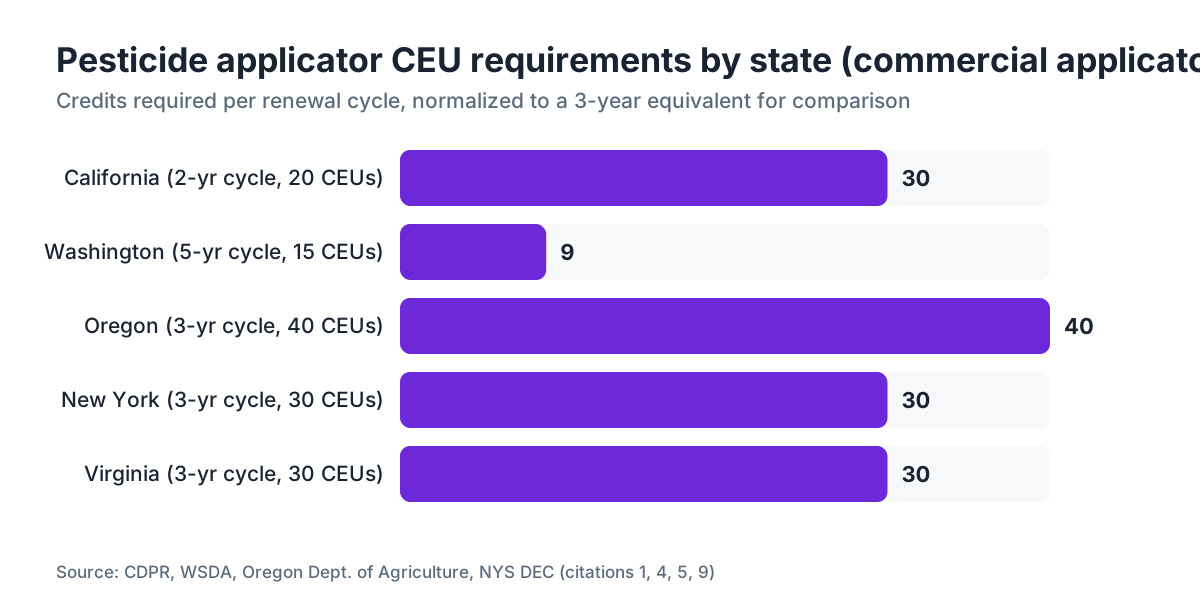
California requires licensed pest control advisers and qualified applicators to earn 20 CEUs per two-year renewal cycle. The California Department of Pesticide Regulation (CDPR) runs an online CEU tracking system, so accredited providers submit your hours directly. CDPR still tells licensees to keep their own paper backup, because provider uploads can lag by weeks. [1]
Washington State requires commercial pesticide applicators to complete 15 credits per five-year cycle. Washington State University Extension runs one of the most-used training programs in the Pacific Northwest, and WSU's online portal spits out a printable transcript you can hand to a state auditor on the spot. [2]
New York, through the Department of Environmental Conservation, requires 22.5 hours of recertification for private applicators on a 3-year cycle and 30 hours for commercial applicators. Cornell Cooperative Extension delivers a big share of those courses, and Cornell keeps a database of approved course codes that you match against your completion certificates. [3]
Wherever you farm, the documentation question comes down to one thing. Can you produce a paper trail an auditor doesn't have to take on faith?
How do state CEU requirements differ across major wine-grape-growing states?
The requirements swing hard from state to state, and private and commercial categories often carry different thresholds inside the same state. Here's a comparison of the major grape-growing states, based on current agency guidance.
| State | License category | CEUs required | Cycle length | Recordkeeping window |
|---|---|---|---|---|
| California | QAL / QAC | 20 | 2 years | 2 years post-renewal |
| Washington | Commercial applicator | 15 | 5 years | 3 years |
| Oregon | Commercial applicator | 40 | 3 years | 3 years |
| New York | Commercial applicator | 30 | 3 years | 3 years |
| Pennsylvania | Private applicator | 10 | 3 years | Not specified by PA |
| Virginia | Commercial applicator | 30 | 3 years | 2 years |
Sources: CDPR [1], WSDA [4], Oregon Department of Agriculture [5], NYS DEC [3].
Oregon's 40-credit rule for commercial applicators is the highest in the country among major wine states, and it catches vineyard managers off guard when they move up from California. The category breakdown matters too. Oregon splits credits between core pesticide safety topics and commodity-specific topics, so you can't just stack wine-industry seminars and call it done.
One rule holds across all of these states. The record you keep for yourself should always be more complete than what the state portal shows. Systems go down. Providers forget to submit. You don't want to be the person calling a training organization six months after an event, begging for a re-issued certificate because renewal season snuck up on you. Building a running spray records log that includes training events keeps that from happening.
What does the EPA Worker Protection Standard require for handler training records?
The EPA's Agricultural Worker Protection Standard (WPS), revised in 2015 and implemented through 40 CFR Part 170, sets its own handler training rules that sit apart from your state license renewal. Don't confuse the two. They cover different compliance jobs. [6]
Under the WPS, handlers must get pesticide safety training before they work with pesticides without direct supervision. Agricultural employers have to keep records of that training for two years. The records must show the handler's name, the training date, the type of training, and the trainer's name plus certification number where it applies.
EPA's guidance puts it plainly: "The agricultural employer must keep records of training for two years following completion of the training." That's a verbatim requirement from EPA's WPS training provisions [6], and it applies whether the handler is a family member, a seasonal picker, or a full-time viticulture crew member.
WPS training and CEU training often overlap in content, but they don't automatically stand in for each other on paper. A vineyard owner who attends a UC Cooperative Extension pesticide safety workshop might earn 2 CEUs toward license renewal and satisfy a WPS training requirement for the year, but the paperwork for each goes in a different file. The license file shows CEU credits toward your applicator renewal. The WPS file shows your handlers got legally required safety training before touching restricted-use pesticides.
Run a crew in a vineyard with multiple pesticide handlers and the WPS record requirement alone means you're keeping a training log for every person on your spray team, every year. That's mandatory, and EPA has stepped up WPS enforcement in recent years.
What format should training documentation be kept in?
Paper still works, but it has to be organized. A manila folder per renewal cycle, holding originals or clean photocopies of every completion certificate, is honestly fine for a solo operator or a small family vineyard. Trouble starts when you have multiple employees, multiple applicators, and multiple licenses renewing on different cycles.
At minimum, each training record should contain:
- The course title and sponsor name
- The state approval or accreditation code for that course
- The date(s) of training
- The location (even "online" counts, but note the platform)
- Hours or CEUs earned
- The trainer or presenter's name
- Your signature or a certificate issued in your name
Digital records are fine in every state I'm aware of, as long as they're legible, complete, and you can produce them fast when an auditor asks. Scanned PDFs work. Screenshots of online completion confirmations work, as long as they show all the required fields. A photo of a conference badge does not.
Managing records for five or more licensed applicators? Set up a spreadsheet tracker. Columns for employee name, license number, renewal date, each CEU event attended, credit hours, and approval code. One row per training event per person. It isn't glamorous, but a state auditor can read a clean spreadsheet in about 90 seconds and confirm you're compliant. That speed works in your favor.
For operations juggling multiple applicators and spray records across several blocks, VitiScribe's field operations tools include a compliance log that ties training records to individual applicator profiles. Pulling documentation for a renewal audit gets a lot faster than digging through paper.
How do you verify that a training course actually counts toward your renewal?
This is where people get burned. They sit through a four-hour pesticide seminar, collect the handouts, and learn at renewal time that the course was never approved by their state lead agency and the hours don't count.
Every state with a CEU renewal system keeps a list of pre-approved courses, or a process by which providers apply for approval before each offering. Before you register for anything, check two things. First, that the course is listed in your state's approved course database. Second, that the approval covers the category or license type you actually hold.
California's approved course search runs through CDPR's online CEU provider and course database. [1] WSU Extension's pesticide programs are approved by the Washington State Department of Agriculture (WSDA). [2] Cornell's pesticide safety courses are approved by NYS DEC and carry course codes you can verify on the DEC website. [3]
Multistate operators, take note: most states have no reciprocal CEU agreements. A course approved in California does not automatically count in Oregon. Some exceptions exist for courses offered through national organizations like the American Society of Agronomy, but verify with each state lead agency before assuming a credit transfers.
At a conference session or field day, ask the organizer flat out before the event: "What's your state approval code for CEUs?" If they can't give you a straight answer, assume the hours don't count. Write down the content you covered in your own notes in case you need to apply for an exemption later.
What happens if you lose your training certificates before renewal?
It happens. A computer crashes. A file cabinet floods. You clean out the office and recycle the wrong folder.
First move: contact the training provider. Most university extension programs and approved training organizations keep participant records for at least three years. UC Cooperative Extension often keeps event registration and completion records that can be reissued. WSU Extension's online courses generate electronic transcripts you can re-download any time from your account.
Second move: if the provider no longer has the record, contact your state lead agency before your renewal deadline, not after. Some states let you submit a signed affidavit describing the training in detail, backed by evidence like a program agenda or a canceled registration check, in place of a formal certificate. That's not guaranteed, and the bar for adequate evidence is high. You don't want to find out the agency rejects affidavits after your renewal has already lapsed.
Third move: look at what you have. Bank statements showing a registration payment, an email confirmation from the organizer, a receipt from the event, even a photo of a conference name badge. None of these is a completion certificate, but they beat nothing when you're making a good-faith case to a licensing agency.
The lesson is annoyingly simple. Back up every certificate to a cloud folder organized by renewal cycle, the same week you receive it. A five-minute habit kills a problem that can kill your license.
Can online courses count toward pesticide handler license renewal?
Yes, in most states. Online CEU courses have been approved by most state lead agencies since at least 2015, and the pandemic-era jump to virtual training pushed acceptance further. There are nuances, though.
California's CDPR accepts online CEUs from approved providers through its standard course approval process. Many CDPR-approved courses are now fully online, including some through UC Agriculture and Natural Resources. [1]
Washington accepts online courses offered through WSU Extension and other WSDA-approved providers. [2] Cornell Cooperative Extension offers online pesticide recertification credits for New York license holders. [3]
The documentation requirement for online courses matches in-person exactly: course title, approval code, completion date, and a certificate or transcript showing your name and hours earned. Completing it from your kitchen table doesn't change the paper trail you have to keep.
Some states cap how many CEUs you can earn through online or self-study formats in a single cycle. Oregon has historically limited the number of credits from home-study formats. Check your state agency's current rules, because these caps have been shifting as online formats become the default.
One real upside to online courses: providers almost always send an immediate email with a completion certificate attached. Save that PDF the moment it lands. You've got your documentation before you close the browser tab.
How long do you need to keep pesticide training records after renewal?
The recordkeeping window depends on the purpose.
For WPS handler training records under federal law, the requirement is two years from the date the training occurred. [6] That's a federal floor, and states can demand longer.
For CEU records tied to license renewal, most states want documentation kept for at least the renewal cycle length plus one year. Some specify two years post-renewal. CDPR recommends keeping records through the next renewal cycle, which in practice means four years of documentation on hand at any moment for a two-year cycle. [1]
For restricted-use pesticide (RUP) application records, EPA requires certified applicators to keep records for two years under 40 CFR Part 171. [7] Those differ from training records but often live in the same filing system in a vineyard office, which is fine as long as the categories are labeled clearly.
A practical policy for a small vineyard: keep everything for five years. It's longer than any state requires, but pesticide application disputes, worker injury claims, and water quality complaints can surface years after the fact, and complete records covering training, applications, and WPS compliance put you in a much stronger spot during any investigation. Storage costs almost nothing. An expired statute of limitations is worth a lot.
What's the best way to track training hours for multiple employees?
Start with a master log. One document (spreadsheet, simple database, even a shared Google Sheet) that lists every person who holds a pesticide applicator license or handles pesticides under your supervision, with their license number, renewal date, and a running tally of CEUs earned this cycle. Add a row every time someone attends training. Attach the completion certificate to that row or file it in a named folder.
With three or more licensed applicators, the renewal dates rarely line up, so you're almost always mid-cycle for somebody. A master log shows at a glance who's behind, who's current, and who's about to hit a deadline.
For larger operations, VitiScribe's compliance module ties applicator license profiles to training records and flags renewal windows automatically, which lifts the calendar-watching off the vineyard manager and keeps the whole system auditable in one place.
Keep WPS training documentation separate from CEU documentation inside your filing system. They meet different legal requirements, and mixing them creates confusion during audits. A simple folder structure does the job: one folder per employee, subfolders labeled "WPS Training" and "CEU Records," documents named with the date and course title. Boring, but auditors love boring.
University extension programs sometimes offer group enrollment discounts for training multiple crew members, which is worth asking about. UC Cooperative Extension farm advisors, WSU Extension county offices, and Cornell Cooperative Extension district offices all run in-person programs that handle groups and issue individual certificates to each participant on the day.
What should you do before your renewal deadline to make sure your hours are complete?
Start at least 90 days before your license expires. Not 30 days. Ninety. Here's why.
First, log into your state's online license portal and check what credits the system shows for you. Compare that against your own log. Gaps between what providers submitted and what the portal shows are common, and fixing them takes time. CDPR's online system, WSDA's licensing portal, and NYS DEC's license lookup all show current CEU balances for active licenses. [1][4][3]
Second, add up your verified credits. If you're short, find training options that still have enough lead time for the provider to submit credits before your deadline. Many providers submit weekly or monthly, not daily, so finishing a course three days before your renewal date is a gamble.
Third, pull your physical documentation and confirm every certificate matches what the portal shows. Missing a course? Contact the provider now. A provider error that surfaces 90 days out is fixable. The same error at 10 days out may not be.
Fourth, file your renewal application the moment your credit requirement is met. Don't wait for the last week. Processing backlogs vary by state and by season, and a lapsed license means you legally cannot apply or supervise application of restricted-use pesticides until reinstatement clears. During spray season, that disruption hits hard.
If you're managing spray records and compliance alongside all this, keeping a vineyard field calendar that puts license renewal dates next to spray windows and harvest restrictions keeps the whole thing in view. A shared team calendar covering employee onboarding and training deadlines closes the last gap.
Do vineyard workers who don't hold applicator licenses need training documentation too?
Yes. The WPS draws a clear line. Agricultural handlers are any workers who mix, load, apply, or handle pesticides in closed systems, and they need training before they work unsupervised. But even workers who only enter fields during restricted-entry intervals (REIs) must get WPS worker safety training. That training needs documentation too, though the specifics differ from handler training.
For WPS-covered workers (as opposed to handlers), the employer must keep a training record, including the worker's name, the training date, and the trainer's name and credentials, for two years. [6] Workers don't need a state applicator license to work in a vineyard, but if they handle pesticides, the WPS record is mandatory and auditable by EPA and by state departments of agriculture in states with WPS enforcement agreements.
California runs one of the strictest state frameworks for handler training documentation, requiring records that go past WPS minimums. California's Code of Regulations Title 3 adds specific requirements for supervisor verification signatures and training content documentation. [1]
For a small family operation where one licensed applicator handles all spraying personally, the WPS worker training documentation load may be light. For any operation with employees who handle pesticides, even in a limited way, the documentation burden is real and belongs in your standard onboarding and annual training calendar.
Frequently asked questions
How many CEUs do I need to renew a pesticide applicator license in California?
California requires 20 CEUs per two-year renewal cycle for both Qualified Applicator Licensees (QAL) and Qualified Applicator Certificate holders (QAC). CDPR tracks approved CEUs through its online system, but keep your own completion certificates too. Some categories require specific minimum credits in restricted-use pesticide topics. Check your license category on the CDPR website for any category-specific breakdowns.
What happens if my pesticide applicator license expires before I finish my CEU hours?
A lapsed license means you cannot legally apply or supervise the application of restricted-use pesticides until reinstatement. Most states require you to reapply, pay reinstatement fees, and sometimes retake the written exam. In California, a lapsed QAL must reapply as if new. The disruption to vineyard spray schedules during critical spray windows can be severe, so never let a renewal deadline slide.
Do online pesticide CEU courses count the same as in-person training for renewal?
In most states, yes. Online courses from state-approved providers count equally toward renewal hours. The documentation requirement is identical: course title, state approval or accreditation code, completion date, and a certificate issued in your name. Some states cap the number of credits from home-study or online formats per cycle, so check your state's current rules before planning to complete all hours online.
How long do I need to keep pesticide handler training records?
Federal WPS requires employers to keep handler training records for two years from the training date. For CEU records tied to license renewal, most states require retention for at least the renewal cycle length plus one year; some specify two years post-renewal. A practical policy for vineyards is to keep all pesticide training and application records for five years, which covers most dispute and audit windows.
What information must be on a pesticide training completion certificate to be accepted for renewal?
At minimum: course title, sponsoring organization's state approval or accreditation code, training date and location, CEUs or hours earned, your name, and the trainer's name. Some states also require the trainer's credential number. If any field is missing from a certificate you received, contact the provider immediately and request a corrected version before the document goes into your renewal file.
Can I use a pesticide safety course to satisfy both WPS training requirements and CEU renewal requirements?
Often yes in terms of content, but the documentation goes in two separate files serving two different compliance functions. The WPS file shows your employer met the mandatory handler training requirement under 40 CFR Part 170. The CEU file shows progress toward state license renewal. Confirm with your state lead agency that a specific course satisfies both before relying on it for both purposes.
Where do I find a list of approved pesticide CEU courses in my state?
Each state lead agency keeps an approved course list or database. California uses CDPR's online CEU provider and course search. Washington uses the WSDA approved course list. New York uses the NYS DEC recertification course database. For university extension programs, UC Davis, WSU Extension, and Cornell Cooperative Extension all list currently approved courses with state approval codes on their pesticide safety program pages.
Do I need to keep training records for vineyard employees who don't hold applicator licenses?
Yes, for any employees who handle pesticides or work in fields during restricted-entry intervals. The EPA's Worker Protection Standard requires agricultural employers to keep training records, including employee name, training date, and trainer credentials, for two years. These WPS worker training records are separate from applicator CEU records but equally auditable by EPA and state departments of agriculture.
What if a training provider never submitted my CEU credits to the state?
First, contact the provider and ask them to submit or resubmit. Keep your completion certificate as proof of attendance. Most approved providers must submit records within a specific window after each event. If the provider no longer has records, contact your state lead agency before your renewal deadline and explain the situation. Some states allow supplemental documentation like email confirmations or registration receipts, but this varies by state.
Does completing a pesticide handler training course in one state count toward renewal in another state?
Usually not automatically. Most states have no reciprocal CEU agreements, so a course approved in California does not automatically count in Oregon or Washington. Some national organization courses are approved in multiple states individually, but verify each state's acceptance before relying on those credits. If you hold licenses in multiple states, track credits separately for each and confirm course approval before registering.
What records do I need to show if a state agricultural inspector audits my vineyard?
For applicator license renewal: CEU completion certificates with course name, approval code, date, and hours earned, plus your current license in good standing. For WPS handler training: a training record for each handler showing name, training date, and trainer credentials. For RUP applications: application records under 40 CFR Part 171. An auditor should be able to verify all three categories from your files in a single visit.
How does WSU Extension pesticide training work for Washington vineyard operators?
WSU Extension's Pesticide Safety Education Program offers in-person and online courses approved by the Washington State Department of Agriculture (WSDA) for commercial and private applicator renewal. Participants earn WSDA-approved credits that WSU submits to the WSDA licensing system. WSU also provides an online transcript you can download immediately, which is useful backup if the state portal shows a discrepancy.
What is the penalty for applying restricted-use pesticides with a lapsed or expired license?
Penalties vary by state but are serious. California penalties can include civil fines of up to $5,000 per violation per day under California Food and Agricultural Code provisions, plus potential criminal liability for egregious violations. Federal violations under FIFRA carry civil penalties of up to $19,636 per violation (adjusted for inflation). License reinstatement may also require re-examination. State enforcement is handled by county agricultural commissioners in California and equivalent agencies elsewhere.
Sources
- California Department of Pesticide Regulation, CEU Program: California requires 20 CEUs per two-year renewal cycle for QAL and QAC license holders; CDPR maintains an online CEU tracking system and recommends licensees keep their own records.
- Washington State University Extension, Pesticide Safety Education Program: WSU Extension offers WSDA-approved pesticide recertification courses and provides online transcripts participants can download to document their credits.
- Cornell Cooperative Extension, Pesticide Safety Education Program: Cornell Cooperative Extension delivers pesticide recertification courses approved by NYS DEC; New York commercial applicators require 30 hours per 3-year cycle.
- Washington State Department of Agriculture, Pesticide Licensing: Washington State requires commercial pesticide applicators to complete 15 credits per five-year renewal cycle, with records retained for three years.
- Oregon Department of Agriculture, Pesticide Division: Oregon commercial pesticide applicators are required to earn 40 CEUs per three-year renewal cycle, the highest requirement among major wine-grape-growing states.
- U.S. EPA, Agricultural Worker Protection Standard, 40 CFR Part 170: The WPS requires agricultural employers to retain pesticide handler training records for two years, including the handler's name, training date, type of training, and trainer's name and certification number where applicable.
- U.S. EPA, Pesticide Applicator Certification, 40 CFR Part 171: EPA requires certified applicators to keep restricted-use pesticide application records for two years under 40 CFR Part 171.
- U.S. EPA, Federal Insecticide, Fungicide, and Rodenticide Act (FIFRA) Civil Penalty Policy: Federal FIFRA violations can result in civil penalties of up to $19,636 per violation for certified applicators applying restricted-use pesticides without a valid license.
- NYS Department of Environmental Conservation, Pesticide Certification and Recertification: New York requires private applicators to complete 22.5 hours and commercial applicators 30 hours of recertification per 3-year cycle; NYS DEC maintains an approved course code database.
- UC Agriculture and Natural Resources, Statewide Integrated Pest Management Program: UC ANR offers CDPR-approved online and in-person pesticide safety courses that count toward California CEU renewal requirements.
Last updated 2026-07-09