EPA worker protection standard posting requirements for small vineyards

TL;DR
- The EPA Worker Protection Standard (40 CFR Part 170) covers every agricultural employer who uses pesticides, including a vineyard with one non-family worker or handler.
- You must post the WPS safety poster plus application-specific information at a central location workers can reach.
- Postings go up before the spray starts and stay up until 30 days after the restricted-entry interval ends.
- No small-farm exemption exists.
What is the EPA Worker Protection Standard and does it apply to my vineyard?
Yes, it applies. The EPA Worker Protection Standard (WPS) is a federal rule at 40 CFR Part 170 that covers nearly every agricultural employer who uses pesticides on farms, forests, nurseries, or greenhouses. Grow grapes and hire one worker who enters treated areas, or one handler who mixes, loads, or applies pesticides, and you are in. There is no size exemption. A single-employee family vineyard is covered if that employee is not an immediate family member of the owner. [1]
EPA issued the WPS in 1992, revised it in 2015, and those revisions took full effect by January 2017. That current version is the one you follow. EPA's stated purpose is plain: the rule requires agricultural employers to "provide workers and handlers with information and protections to reduce their risk of occupational exposure to pesticides." [1]
The immediate family member exemption trips up small growers all the time. If the only people working your vineyard are your spouse, children, parents, or siblings, WPS posting requirements skip you. Bring in a paid employee, a labor contractor crew, or even one unpaid non-family helper, and the full standard kicks in. Know where you stand before the first spray of the season.
What exactly do you have to post under the WPS?
Two things, at a central location every worker and handler can reach: the WPS safety poster, and application-specific information for each pesticide application. Both must be readable and current, during and after any restricted-entry interval (REI).
The safety poster has to include the name, address, and telephone number of the nearest emergency medical facility, information about WPS worker rights, and the basic WPS safety requirements. EPA prints a compliant one, "Protect Yourself from Pesticides: Guide for Agricultural Workers," in English and Spanish. [2] It's free to download.
For each application, the posted information must show the product name, EPA registration number, and active ingredient(s); the location and description of the treated area; the date and time the application starts; the REI; whether the label requires personal protective equipment for early entry; and a warning that the area is treated and the REI has not expired. [1]
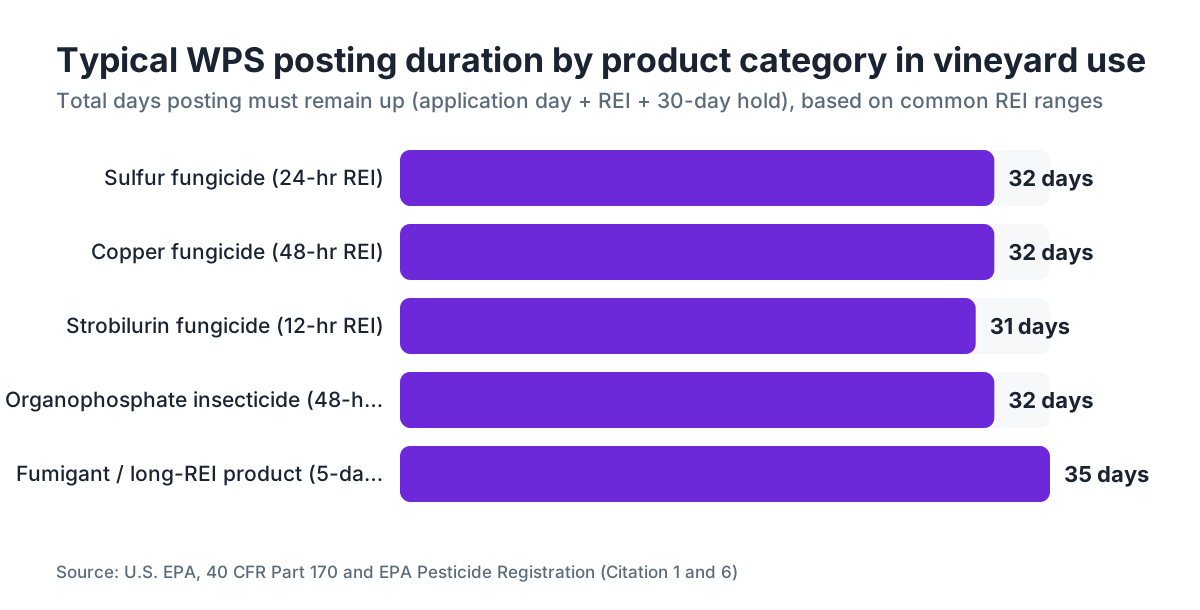
That application-specific information goes up before the application begins, or before workers can enter treated areas, whichever comes first. It stays up until 30 days after the REI expires. Most contact fungicides and insecticides used in vineyards carry REIs of 4 to 48 hours, so your posting obligation runs roughly 31 to 32 days past the REI. Fumigants and other long-REI materials stretch that window further. [1]
Where exactly does the central posting location have to be?
It has to be a "central location" that sits on or near the establishment, stays accessible to workers and handlers during their work hours and normal business hours, and is not inside a toilet facility, a locked room, or anywhere workers can't enter. [1]
In vineyard terms, that usually means a bulletin board in the break room, the shop, the barn, or a covered outdoor structure where the crew gathers. A binder locked in your office does not count. A sheet taped inside a tractor cab does not count. A worker has to be able to walk up to it on their own, without asking anyone, during the workday.
If you house workers on-site, you need a second posting location in or near that housing. [1] This comes up mostly at larger operations with a labor camp, but keep it in mind if you provide any worker housing.
Some growers want to run the posting off a tablet or screen. EPA's current guidance doesn't ban electronic display, but the traps are real: the display has to stay on during all work hours, sit behind no password, and be physically reachable. A printed backup is the low-risk choice. Cornell's pesticide safety education program recommends physical copies precisely because paper leaves no argument about access during a power outage or a dead connection. [3]
What is the 24-hour rule, and when does the posting clock actually start?
The "24-hour rule" gets tossed around loosely, but the WPS language is tighter. Application-specific information must be posted before the application begins, not within 24 hours of it. [1] If your crew starts spraying at 6 a.m. Tuesday, the posting is up before 6 a.m. Tuesday. Full stop.
The 24-hour figure in WPS training points to a different duty: employers must hand over application-specific information to any worker or handler who asks, within 24 hours of the request. [1] Two separate obligations. Don't blend them.
For the posting itself, update your central board the evening before or the morning of every spray event. Multiple applications in one week means multiple entries. You can keep them on one board, but each entry needs its own product name, location, timing, and REI so a worker can tell them apart.
WSU Extension recommends a spray-record-to-posting workflow where the data you enter in the spray log moves to the central posting the same day, with a sign-off confirming the posting was done before the rig left the shop. [4] That kind of procedural lock kills the most common gap. The gap is rarely the poster itself. It's forgetting to update the application-specific information for an individual spray event.
What are the WPS training and safety information requirements that go alongside posting?
Posting is one piece. The WPS also requires that every agricultural worker get pesticide safety training before entering treated areas, or within five days of hire if entry into treated areas isn't required in those first five days. [1] The training has to cover the EPA-approved WPS worker content, delivered in a way the worker understands, which usually means their primary language.
Handlers face a stricter bar. They must get handler pesticide safety training before they do any handler work. [1]
You also have to give workers and handlers access to the labeling for any pesticide used on the establishment in the last 30 days. [1] This doesn't have to be posted centrally, but it has to be available within 24 hours of a request.
For a small vineyard, a physical binder at the central posting location does a lot of the work in one spot: the WPS safety poster, current application-specific sheets, and labels or Safety Data Sheets for recently used products. UC Davis Cooperative Extension publishes a WPS compliance checklist for small farms that organizes the paperwork this way, and it's a solid place to start if you're building a system from nothing. [5]
Want a digital setup that ties spray records to your posting documentation? Tools like VitiScribe let you log an application and generate a WPS-compliant information sheet at the same time, so a posting is less likely to slip during a busy spray week.
What are the decontamination and emergency assistance requirements under WPS?
Two WPS duties get underestimated on vineyards: decontamination supplies and emergency assistance.
For decontamination, you provide handlers and early-entry workers with water for routine washing, soap, single-use towels, and an eye-flushing supply (at least a gallon of water for early-entry workers, and enough for emergency flushing for handlers). [1] The station has to sit within a quarter mile of where handlers work, or at the nearest point of vehicle access if the site is more than a quarter mile from a road. On vineyard blocks, that usually means a setup on the spray rig or at the end of the row.
For emergency assistance, the WPS requires you to arrange prompt transportation for any worker or handler who may have been poisoned or injured by pesticides, and to give the treating medical professional the product name, EPA registration number, and active ingredients involved. [1] That's why the nearest emergency medical facility's name and phone number belong on the central posting, not buried on a list in your office.
These cost almost nothing. A basic decontamination kit for a spray rig runs $20 to $50 in supplies. Take them seriously anyway. Pesticide exposure happens fast, and these requirements exist to cut permanent harm in the 30 to 60 minutes before medical care arrives.
How do restricted-entry intervals affect what you need to post, and for how long?
Every registered pesticide carries an REI on its label. The REI is the minimum time that must pass after an application before workers can enter the treated area without required personal protective equipment. REIs for products common in vineyards run from 4 hours (many copper-based fungicides) to 48 hours (some organophosphate insecticides) or longer. [6]
Your posting stays up until 30 days after the REI for each listed application expires. [1] Apply a product with a 24-hour REI on June 1, the REI ends June 2, and the posting can come down July 2 at the earliest. Apply multiple products with different REIs to the same block on the same day, and the 30-day clock starts from the end of the longest REI.
Here's the operational headache. In a busy season you might run six to ten applications in a single block between bud break and harvest. Each one needs its own posting entry, and early-season entries have to stay up deep into summer even after you've moved to different spray intervals. A casual logbook or whiteboard breaks down here. You need to track more than when you posted, and when you're legally clear to take it down.
| Product type (common vineyard use) | Typical REI | Posting must stay up until |
|---|---|---|
| Copper fungicide (contact) | 24-48 hours | 30-31 days after application |
| Sulfur (contact fungicide) | 24 hours | 31 days after application |
| Strobilurin fungicide | 12-24 hours | ~31 days after application |
| Organophosphate insecticide | 24-48 hours | 31-32 days after application |
| Fumigant (pre-plant) | Often 5+ days | 35+ days after application |
Note: REIs vary by specific product and formulation. Always confirm on the current registered label. [6]
What are the penalties for WPS violations at a small vineyard?
EPA can assess civil penalties up to $20,014 per violation per day under the Federal Insecticide, Fungicide, and Rodenticide Act (FIFRA) for WPS violations. [7] That ceiling was last adjusted for inflation in 2023 under the Federal Civil Penalties Inflation Adjustment Act. Penalties for small farms usually land far lower, especially for a first administrative violation with no worker harm, but they are real and they go on the record.
State agricultural agencies run most WPS inspections under cooperative agreements with EPA. In California, county agricultural commissioners handle the bulk of WPS compliance investigations. [8] Washington and Oregon's state agriculture departments run similar programs. Small vineyards get inspected less often than large operations, mostly because of where inspectors spend their time, but read nothing safe into that. Labor contractor audits, worker complaints, and pesticide incident reports are the common triggers at small farms.
The most expensive WPS outcomes for a small operation aren't the fines. They're the litigation costs when a worker suffers pesticide exposure and you can't produce documentation showing you met your posting, training, and decontamination duties. That documentation gap is the real financial exposure.
Keep a consistent spray record and posting log in the same place. VitiScribe ties that documentation together, but a well-kept paper binder works too, as long as you update it every time a product goes out.
Do WPS posting requirements apply if I only use exempt or minimum-risk pesticides?
Mostly no, but check carefully.
Pesticides registered under FIFRA Section 25(b) as minimum-risk products (rosemary oil, garlic, clove oil, that sort of thing) sit outside WPS requirements because they're exempt from federal registration. [11] If your entire program is 25(b) exempt products, WPS posting requirements technically don't apply to those applications.
But most vineyards that use any 25(b) products also reach for conventionally registered ones (copper, sulfur, strobilurins, insecticides). Use one registered pesticide in a season and your WPS obligations for that application go fully active. Since you're already keeping a central posting location for that registered product, post every application there regardless of registration status. It simplifies recordkeeping and removes the risk of misclassifying a product.
Organic certification doesn't lower your WPS obligations either. Organically approved pesticides that are conventionally registered (copper sulfate carries an EPA registration number, for example) still require WPS-compliant posting under USDA National Organic Program rules. [9]
What records do you need to keep, and for how long?
The WPS doesn't set a standalone retention period for the posted application information itself, but 40 CFR Part 170 does require you to keep records of pesticide safety training, including dates, topics covered, and names of trainees, for two years from the training date. [1]
State pesticide use reporting adds another layer. California growers submit monthly pesticide use reports to their county agricultural commissioner, and those records must be kept for three years. [8] Washington requires pesticide use reporting for agricultural operations. [10] Most states with real viticulture set their own retention rules, often longer than the federal WPS minimum.
UC Davis Extension and most state ag extension programs land on the same practical advice: keep every pesticide record, application logs, posting logs, training records, and labels, for at least three years and ideally five. [5] If a worker compensation claim or a pesticide exposure investigation opens years later, you want documentation that spans the full limitation period.
For the posting log specifically, a simple spreadsheet or written logbook does it: product name, EPA registration number, treated block, application date and time, REI, date posting went up, date posting came down. That log is what proves you actually posted the information, more than that you had it on hand.
Where can you get WPS training resources and compliant posting materials?
Several reliable sources give away free, accurate WPS materials.
EPA's National Pesticide Safety Education Center holds the official WPS safety poster and application information templates. The poster comes in English and Spanish, and EPA's site has a section for agricultural employers laying out their obligations under 40 CFR Part 170. [2]
Cornell University's Pesticide Management Education Program publishes WPS guidance aimed at small and mid-size farms, including templates for the application-specific posting information. [3]
UC Davis Cooperative Extension runs a farm labor and pesticide safety section with compliance checklists built alongside California's Department of Pesticide Regulation. [5] Farm in California and the CDPR's own guidance adds important state-specific layers on top of the federal baseline.
WSU Extension's Pesticide Education Program covers WPS requirements for Pacific Northwest growers, down to the products and practices common in Washington wine grape production. [4]
For Spanish-language training, the National Center for Farmworker Health and EPA both offer translated versions of the core worker training content. The WPS requires training in a language workers understand, and posting materials in both English and Spanish is standard practice at any vineyard with a bilingual crew. [1]
Frequently asked questions
Does the WPS apply to a family vineyard where only the owner and spouse work?
No. The WPS exempts immediate family members of the agricultural employer. If your entire workforce is your spouse, children, parents, or siblings, WPS posting and training requirements don't apply. The exemption disappears the moment you employ someone outside that immediate family circle, including non-family labor contractors or unpaid non-family volunteers.
Do I have to post WPS information in Spanish if my workers speak Spanish?
The WPS requires pesticide safety training in a language workers understand, but the central posting requirement doesn't explicitly demand bilingual text. In practice, EPA and extension programs strongly recommend posting the safety poster in both English and Spanish if you have Spanish-speaking workers, since the posting backs up the training and should be readable by the people it protects. EPA provides the poster in both languages for free.
Can I use a digital screen or tablet instead of a physical bulletin board for my WPS posting?
EPA's current rules don't prohibit electronic displays, but the posting has to stay accessible during all work hours without a password or special access. A screen that locks, sleeps, or loses connectivity fails the accessibility test. Most compliance advisors recommend physical printouts as the primary posting and treat digital displays as a supplement. A paper backup is cheap insurance against electronic failure.
How soon before a pesticide application does the WPS posting have to go up?
Before the application begins. There's no grace period. If your rig starts spraying at 6 a.m., the information for that application is posted before 6 a.m. Updating the posting the evening before is the safest move, especially for the early-morning spray windows common during cooler summer mornings.
What happens to my WPS posting when the REI ends? Can I take it down right away?
No. Application-specific posting information stays up for 30 days after the restricted-entry interval expires, more than until the REI ends. For a product with a 24-hour REI applied June 1, the REI ends June 2, and the posting stays up until July 2. This 30-day requirement catches many small growers off guard, especially during a busy season with overlapping applications.
Does my vineyard's WPS posting location have to be indoors?
Not necessarily, but it has to be accessible to workers during work hours without asking permission to approach, and it can't be inside a locked space or a toilet facility. Many small vineyards use a covered outdoor structure like a barn or an equipment shed entrance. Whatever you pick, the materials need to be legible and protected from weather. A rain-damaged poster nobody can read doesn't satisfy the requirement.
What if my vineyard uses a labor contractor? Who is responsible for WPS compliance?
Both the vineyard owner and the labor contractor share WPS duties, but the owner is responsible for posting and for providing access to the central location. The contractor is responsible for making sure their workers get WPS training. You can't hand off your posting obligation. If the owner's posting isn't current, the owner is in violation, no matter what the contractor did or didn't do.
Are there WPS requirements specific to California grape growers beyond the federal standard?
Yes. California's Department of Pesticide Regulation enforces rules at least as strict as federal WPS, and stricter in places. California requires monthly pesticide use reports, sets its own safe-use requirements, and has county agricultural commissioners run inspections. California growers comply with both federal WPS (40 CFR Part 170) and California's Food and Agricultural Code pesticide provisions at the same time.
Do pesticide labels with a 4-hour REI still require a full WPS posting?
Yes. Every application of a registered pesticide to a vineyard where workers or handlers are present requires WPS-compliant posting, whatever the REI length. A 4-hour REI doesn't shrink the posting obligation. The REI only affects how long workers stay out of treated areas and when early-entry protections expire. The 30-day post-REI posting requirement applies even to very short REIs.
What does the WPS require for decontamination supplies at a small vineyard?
For handlers, you provide decontamination supplies within a quarter mile of where they work, or at the nearest vehicle access point. Supplies include water for washing, soap, and single-use towels. An eye-flushing supply of at least one gallon of water is required for early-entry workers. For handlers, enough water for emergency eye flushing has to be at the work site. This usually means a setup on or near the spray rig.
What records of WPS training do I have to keep, and for how long?
Federal WPS rules require you to keep worker and handler pesticide safety training records for two years from the training date. Records should include the date, the name and topics of the training, and the names of those trained. Many states require longer retention for pesticide records generally (three years in California), so check your state and use the longer period as your standard.
Where can I get a free WPS safety poster that meets federal requirements?
EPA provides a compliant WPS safety poster, 'Protect Yourself from Pesticides: Guide for Agricultural Workers,' free through the National Pesticide Safety Education Center and EPA's website. It comes in English and Spanish. Cornell's Pesticide Management Education Program and UC Davis Cooperative Extension also link to approved posting materials and templates for the application-specific information you add for each spray event.
Sources
- U.S. EPA, 40 CFR Part 170, Worker Protection Standard (Agricultural Worker Protection Standard section): Federal WPS requirements for posting, training, decontamination, and emergency assistance for agricultural employers; immediate family member exemption; 30-day post-REI posting requirement; 24-hour information request rule.
- U.S. EPA, National Pesticide Safety Education Center, WPS worker training materials and safety poster: EPA-approved WPS safety poster 'Protect Yourself from Pesticides' available in English and Spanish at no cost.
- Cornell University, Pesticide Management Education Program (PMEP), College of Agriculture and Life Sciences: Cornell PMEP provides WPS guidance and posting templates for small and mid-size farms; recommends physical printed postings to ensure accessibility.
- Washington State University Extension, Pesticide Education Program: WSU Extension recommends tying spray log entries to posting updates on the same day, with a sign-off step confirming posting before the spray rig leaves the shop.
- University of California Agriculture and Natural Resources (UC ANR / UC Cooperative Extension), Farm Labor and Pesticide Safety: UC Cooperative Extension publishes a WPS compliance checklist for small farms and recommends keeping all pesticide records for at least three to five years.
- U.S. EPA, Pesticide Registration, Restricted-Entry Intervals guidance: REIs for common agricultural pesticides range from 4 hours for many contact fungicides to 48 hours or longer for organophosphate insecticides; REI is stated on the registered label.
- U.S. EPA, Enforcement, FIFRA civil penalty policy and inflation adjustments: Civil penalties for WPS violations under FIFRA can reach up to $20,014 per violation per day as adjusted for inflation in 2023 under the Federal Civil Penalties Inflation Adjustment Act.
- California Department of Pesticide Regulation (CDPR), pesticide use reporting: California requires monthly pesticide use reports submitted to county agricultural commissioners; records must be kept for three years; county commissioners handle WPS compliance investigations.
- USDA Agricultural Marketing Service, National Organic Program: USDA NOP organic certification does not reduce WPS obligations; organically approved pesticides that carry EPA registration numbers (such as copper sulfate) still require WPS-compliant posting.
- Washington State Department of Agriculture, Pesticides: Washington State requires pesticide use reporting for agricultural operations and conducts state-level WPS compliance oversight under cooperative agreement with EPA.
- U.S. EPA, Pesticide Registration, FIFRA Section 25(b) minimum risk pesticides: Pesticides exempt from federal registration under FIFRA Section 25(b) are not subject to WPS requirements; once any registered pesticide is used in a season, full WPS compliance applies to those applications.
Last updated 2026-07-09