Helicopter frost protection costs for orchards and vineyards
TL;DR
- Hiring a helicopter for frost protection in orchards and vineyards typically costs $75 to $175 per acre per frost event, or $400 to $900 per flight hour, depending on region, acreage, and operator.
- Wind machines and heaters often cost less per event but require capital investment.
- Helicopters win as backup, or on irregular terrain where fixed equipment can't reach.
What does it actually cost to hire a helicopter for frost protection?
Most growers in the western U.S. pay between $400 and $900 per flight hour for frost helicopter work, according to farm cost surveys compiled by University of California Cooperative Extension [1]. At a low mixing speed of 20 to 40 mph over a block, one helicopter covers roughly 100 to 300 acres per hour depending on flight pattern, canopy height, and inversion strength. That puts the per-acre cost for a single frost event at around $75 to $175. The honest answer is a range, and the range is wide.
Those numbers shift fast. Minimum billing hours matter a lot. Most operators bill a 2- to 4-hour minimum, so a short 45-minute inversion event that needed one pass still costs you 2 hours of flight time. Mobilization fees are separate from flight time at many operators, running $150 to $500 depending on how far the machine travels to reach you. Fuel surcharges are real, and they move with avgas prices.
Then there's the question of on-call versus seasonal retainer. A retainer locks in priority service and sometimes a lower hourly rate, but you pay whether the helicopter flies or not. Seasonal retainers in Napa and Sonoma counties have historically run $2,000 to $8,000 per season depending on block size and the number of frost events guaranteed [1]. That figure comes from what growers report to UC Farm Advisors after frost seasons, not from any single published database, so treat it as a working estimate rather than a quote.
For context, UC Cooperative Extension cost studies put total frost protection cost across all methods for North Coast wine grapes at roughly $150 to $350 per acre per season, averaged across frost-prone blocks [1].
How does helicopter frost protection actually work in a vineyard or orchard?
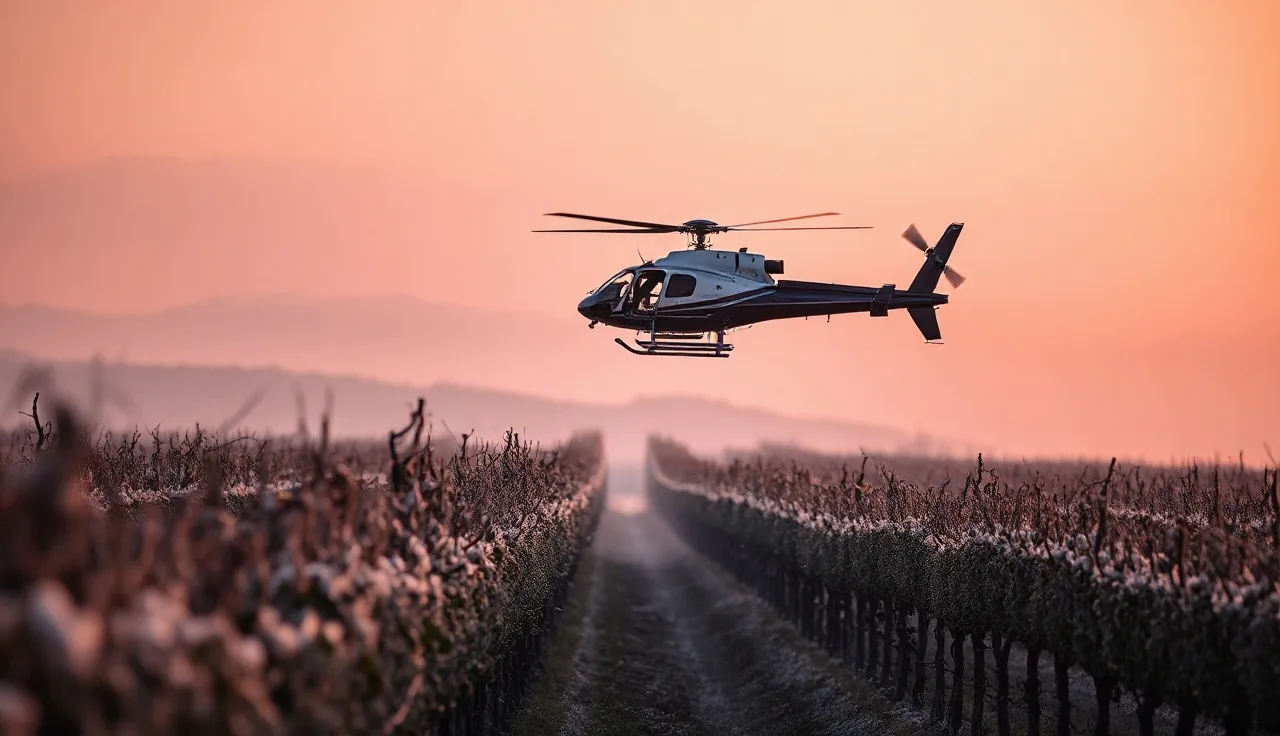
Helicopters protect against radiation frost. On a still, clear night, the ground and plant tissue radiate heat upward and cool faster than the air above them. That builds a temperature inversion: a layer of warmer air, sometimes 5 to 15°F warmer, sitting 50 to 200 feet above the canopy [2]. A helicopter flying slow, low passes breaks up that inversion and mixes the warm air down into the vines.
The pilot usually flies 50 to 150 feet above the canopy in a back-and-forth pattern, repeating passes every 10 to 15 minutes to keep the mixing active. It's not subtle. Neighbors a mile off will hear it all night.
The method works because it exploits physics that's already happening. The warm air is there. The helicopter just moves it.
Advective frost is a different animal. That's when a cold air mass moves in with wind, and there's no warm inversion layer to mix down, so helicopters do almost nothing. Know this before you sign a contract. If your frost events are mostly advective, common in high-desert growing regions, helicopter service buys you very little protection for the money.
UC Davis viticulture guidance describes helicopter protection as most effective when the inversion differential is at least 5°F and wind is below 5 mph [2]. Below that differential, mixing doesn't move the needle enough to hold buds above critical thresholds.
How do helicopter costs compare to wind machines and other frost protection methods?
Capital cost versus operating cost is the whole game. Here's a straight comparison across the common methods.
| Method | Approx. capital cost | Approx. operating cost per event | Effective radius/coverage |
|---|---|---|---|
| Wind machine (electric) | $25,000, $45,000 installed [3] | $15, $40/acre (electricity) | 10 to 15 acres per unit |
| Wind machine (propane) | $20,000, $38,000 installed [3] | $40, $90/acre (fuel) | 10 to 15 acres per unit |
| Helicopter (contract) | $0 capital | $75, $175/acre per event [1] | 100 to 300 acres/hour |
| Sprinkler (under-vine) | $800, $2,500/acre installed [4] | $10, $30/acre (water, pumping) | Entire irrigated block |
| Propane heaters (smudge pots/orchard heaters) | $5, $20 per heater | $20, $60/acre per night [3] | Limited, labor-intensive |
Wind machines are the standard in most Napa and Sonoma vineyards because the capital cost amortizes well over 15 to 20 years of useful life. Washington State University Extension puts the break-even point for a wind machine versus contract helicopter at roughly 3 to 5 frost events per season, depending on acreage [3]. Average more than that and you should own the machine. Average one or two events a season and contract helicopter often wins per year.
Sprinklers are the most reliable method for budbreak frost when water supply is adequate. They use the latent heat of water freezing to hold tissue at 32°F even as air drops below that. Cornell Cooperative Extension recommends 0.1 inches of water per hour as the minimum application rate during a frost event [4]. The catch is capital cost and water supply. Not every site has the well or reservoir capacity to run full-block sprinklers through a 6-hour frost.
Helicopters fill a real niche: large, irregular blocks with varied terrain a single wind machine can't cover, or emergency backup when your wind machine dies mid-event. They also make sense for high-value tree crops like almonds and cherries, where frost windows are narrow and per-acre value is steep. A single lost cherry crop can run $2,000 to $5,000 per acre in lost revenue, which reframes $150/acre for a helicopter in a hurry.
What factors drive helicopter frost protection costs up or down?
Terrain is the biggest cost driver most growers miss upfront. A flat, contiguous 200-acre block is an operator's dream. The pilot makes efficient passes, clears the block in under an hour, and moves on. A vineyard broken up by ridges, draws, and road crossings takes longer per acre because the pilot has to adjust altitude and flight path constantly. Some operators charge a complexity premium for mountainous terrain, typically 10 to 25% above base rate.
Time of night matters too. Frost that triggers at 3 a.m. and needs the helicopter on-site by 3:30 a.m. tests your contract language. Does the operator guarantee response time? Many retainer contracts specify a 30- to 60-minute window from your call to wheels-up, which means the helicopter and pilot have to be staged locally. That staging cost is real and gets baked into retainer pricing.
Season length hits orchard crops differently than vineyards. An almond grower in the San Joaquin Valley has a frost vulnerability window of roughly 4 to 6 weeks at bloom, February into early March. A Pinot Noir vineyard in the Willamette Valley may be exposed from April through mid-May. The longer the window, the more a retainer structure beats per-event billing, because the operator has to hold capacity for you the whole time.
Sharing the machine is a legitimate cost reducer. Cooperative arrangements, where four or five neighboring operations pool their retainer contributions to share one contract, are common in Napa, Sonoma, and the Willamette Valley. UC Cooperative Extension farm advisors have helped set several of these up, and they can cut individual retainer costs 30 to 50% [1].
What temperature thresholds actually trigger the call for helicopter service?
There's no universal number. The threshold that matters is the critical damage temperature for your crop's current growth stage, not the air temperature at the weather station.
UC Davis and WSU Extension both publish growth-stage frost damage tables for wine grapes. At budbreak (woolly bud stage), most Vitis vinifera varieties show damage at 28°F for 30 minutes [2]. A few weeks later at the 1-inch shoot stage, the critical temperature rises to 30°F. At full bloom, damage starts at 32°F. Those aren't the temperatures your NOAA station reports. Canopy temperature can run 2 to 5°F colder than screen-height air on a still night with a high sky-view factor.
Tree fruit varies by species and stage. UC Cooperative Extension orchard frost guidelines put damage to almond open flowers at 29°F and young nutlets at 28°F for 30 minutes [5]. Sweet cherry blossoms in full bloom are damaged at 28°F, but the pre-bloom cluster stage tolerates down to 24°F [5].
Most growers who use helicopter service set their call threshold 2 to 3°F above the critical damage temperature, buying time from the call to effective mixing over the block. If your critical temperature is 30°F and the helicopter has a 30-minute response, call at 33°F to build in buffer.
Remote temperature monitoring earns its keep here. One weather station in one corner of a 200-acre block tells you one temperature. Cold air drainage fills low spots first, and you might see a 4°F spread across a single block on a calm night. WSU Extension recommends at least one temperature sensor per 10 to 15 acres in frost-prone terrain, and more where elevation changes sharply [3].
How do you budget for helicopter frost protection in your annual farm plan?
Frost is variable, so budgeting for helicopter service means making a probability estimate. That's less mysterious than it sounds. Start with your local frost history.
NOAA's Climate Data Online has station-level minimum temperature records going back decades for most agricultural regions [6]. Pull the last 20 years for your nearest station during your crop's vulnerability window. Count the nights that would have triggered your call threshold (say, below 31°F during a 4-week window). Average that count. If your average is 1.5 events per season, budget 2 events worth of flight time plus one mobilization fee as a conservative baseline.
Here's a sample budget for a 150-acre wine grape block using helicopter as backup to one wind machine:
- Annual retainer (shared with two neighbors, 50-acre portion): $1,500 to $3,500
- Per-event flight cost (2 hours at $650/hour, 2 events): $2,600
- Mobilization fee (per event): $300 to $600 total
- Weather monitoring equipment maintenance: $200 to $400
- Total annual helicopter budget estimate: $4,600 to $7,100
Now divide by your projected revenue per acre and the number looks small. At $5,000 per acre in grape value (reasonable for many North Coast blocks), 150 acres means $750,000 in crop value exposed to a single frost night. A $7,000 helicopter budget is less than 1% of that exposure.
Keeping a consistent log of frost events, protection hours, and costs pays off when you have to justify the number to a bank, an insurance adjuster, or a joint venture partner. Tools like VitiScribe let you log field events alongside your spray records and crop notes, which helps when you're tracking several blocks across one frost night.
What are the FAA and aviation regulations affecting agricultural frost helicopter operations?
Agricultural helicopter operations for frost protection fall under FAA 14 CFR Part 137, which governs agricultural aircraft operations [7]. Operators must hold an agricultural aircraft operator certificate, and pilots must hold a commercial pilot certificate with a rotorcraft-helicopter rating plus an agricultural aircraft operator rating.
For you, that means asking any prospective operator to show their Part 137 certificate before you sign anything. This isn't optional compliance. An operator without it is flying without the right certification, which creates liability exposure for both of you if something goes wrong.
Night operations are common, since that's when frost happens. Night VFR (Visual Flight Rules) work requires the pilot to hold an instrument rating or meet specific night flight recency requirements. Low-altitude night flying over vines and trees, often below 200 feet AGL, is demanding work. Experience and reputation matter more than price here. The cheapest contract isn't worth much if the operator has a spotty safety record.
Flight over populated areas and near airports needs extra coordination. If your block sits inside the airspace of a Class D, C, or B airport, the operator has to coordinate with the tower before operations. Most agricultural operators in frost country already know this and price it in.
Some states layer their own rules on top of the FAA. California's Department of Pesticide Regulation has rules that apply when helicopters apply pesticides but not for mechanical frost protection, since no material gets applied. Still, call your county agricultural commissioner if you're in California to confirm what applies to your specific situation [8].
Does crop insurance cover frost damage even if you used helicopter protection?
Yes. The interaction between protection costs and insurance is just more layered than most growers expect.
USDA Risk Management Agency (RMA) crop insurance for grapes and tree fruit covers frost and freeze damage above the deductible. The standard policy doesn't require any specific protection method. You won't lose a claim because you chose helicopter over wind machines [9]. What matters is documenting the event: temperature logs, time of event, protection measures taken, and observed damage.
The interaction gets interesting with Whole Farm Revenue Protection (WFRP) and enterprise policies that ask for your actual production costs. Helicopter expenses are legitimate production costs that belong in your records. Clean cost tracking, including flight invoices with dates, hours, and acreage, strengthens your documentation if you file a claim.
Under the Federal Crop Insurance Act, no provision penalizes you for choosing a higher-cost protection method, and none reimburses protection costs beyond what was reasonable for your situation. Your Approved Insurance Provider (AIP) agent is the right person to walk you through how your specific policy handles those cost decisions [9].
One thing to watch: if you're in a high-risk frost area and you've consistently skipped protection for years, some policies carry "good farming practices" language. This is policy-specific, not a blanket rule, so read your policy's Special Provisions carefully.
What records should you keep for helicopter frost protection expenses and events?
Keep everything. For crop insurance claims, tax deductions, and neighbor relations, your records are your only protection.
For each frost event where you use helicopter service, log the date, start time, end time, block name and acreage, minimum temperature recorded (with the sensor location), operator name and Part 137 certificate number, pilot name, flight hours billed, invoice total, and any observed crop damage before and after.
For taxes, helicopter frost protection expenses are deductible as ordinary and necessary farm business expenses under IRC Section 162 [10]. If you're treating it as a capital expense (unlikely, but possible with a prepaid multi-year retainer), the treatment differs. Most per-event and per-season billing is fully deductible in the year incurred. Confirm your case with a farm CPA.
On compliance: if your vineyard sits in a region with an Air Quality Management District (AQMD) or Air Pollution Control District (APCD) that regulates burning, you don't need permits for helicopter operations since there's no combustion or material applied. But if you combine helicopter passes with propane orchard heaters during the same event, the heaters may need permits.
The EPA Worker Protection Standard (WPS) governs agricultural pesticide exposure broadly [11]. Helicopter frost operations involve no pesticide, so WPS doesn't govern the helicopter itself. If workers are in adjacent blocks during operations, tell them the flight plan. It's basic safety and clears up any confusion about whether the aerial activity is a spray.
For vineyards running several blocks across a hard frost season, VitiScribe can hold the central log for frost events, block temperatures, and protection activities alongside your spray and field records.
Are there alternatives to helicopters worth considering for difficult terrain?
Yes, and a few are underused.
Large oscillating wind machines, sometimes described as multi-blade fans on towers, cover 15 to 25 acres per unit and increasingly come with remote monitoring and auto-start. They don't mix the inversion as hard as a helicopter, but they run all night with no call, no pilot, and no mobilization fee. WSU Extension has published data showing properly sited wind machines deliver 2 to 4°F of canopy temperature lift during radiation frost [3].
Drone-based frost protection is emerging. Operators in Australia, Japan, and more recently California have tested agricultural drones flying mixing patterns similar to a helicopter's. The physics holds, but the scale is wrong. Current farm drones (a DJI Agras T40, say) carry far smaller rotors than a Bell 206 and cover far less ground per flight. As of early 2024 there's no published U.S. trial showing drone frost protection at commercially viable scale. Watch it, but don't count on it yet.
Floor management is underrated. Bare soil under vines or trees absorbs more heat by day and releases it at night, raising canopy temperature 1 to 3°F over dense cover crops [2]. That won't replace active protection in a serious frost, but in a marginal event, where the inversion only dips to 31°F for an hour, it can be the difference between a call to the operator and a quiet night.
Overhead sprinklers stay the highest-reliability method where water is available. The latent heat physics works whether or not an inversion layer forms. The limit is water supply and system capacity, an engineering problem with a real solution: if you're planting a new block in frost country, sizing irrigation for frost protection doubles as your drought-year resource.
For more vineyard operations context, the vineyard overview and regional pieces on Paso Robles wineries and South Coast winery operations show how frost risk plays out across different California climates.
How do you find and vet a helicopter frost protection operator?
Start with your county Farm Bureau or local Farm Advisor. In frost-prone regions (Napa, Sonoma, Lake County in California; the Willamette Valley in Oregon; Yakima and Walla Walla in Washington), most Farm Advisors keep a short list of operators they've watched work reliably for years.
Verify the FAA Part 137 certificate yourself. You can search the FAA Airmen Inquiry database at faa.gov to confirm a pilot's certificate and ratings [7]. Ask for the operator's current certificate of insurance. Agricultural aviation work should carry at least $1 million per occurrence in liability coverage, and many growers require $2 million or more in their contracts.
Ask for references from growers in your immediate area, more than any grower they've worked with. Local references matter because terrain, typical frost patterns, and logistics are region-specific. An operator who does excellent work on the flat Sonoma Valley floor may be the wrong pick for your ridgeline Pinot block.
Negotiate the contract terms that bite: response time from call to arrival over your block (30 minutes is reasonable if the machine is staged locally), per-event versus retainer billing, cancellation terms, what happens if equipment breaks down mid-event, and who's liable if a pass damages infrastructure.
Get at least two bids. Pricing varies meaningfully, and the cheapest bid is sometimes a red flag (under-insured, aging equipment, green pilots) and sometimes just a newer operator building a client base. Do the verification work and let that drive the decision, not price alone.
Frequently asked questions
How many acres can one helicopter cover during a frost event?
At typical low-altitude mixing speeds of 20 to 40 mph, one helicopter covers roughly 100 to 300 acres per hour depending on flight pattern, canopy type, and inversion conditions. Flat, contiguous blocks land at the high end. Hilly, broken terrain with lots of turns drags coverage down. Most operators can give you a site-specific estimate once they've flown or scouted your block.
Is helicopter frost protection tax deductible as a farm expense?
Yes. Helicopter frost protection costs are ordinary and necessary farm operating expenses deductible under IRC Section 162. Per-event billing and seasonal retainers both qualify as expenses in the year incurred for most operations. Prepaid multi-year retainers may require different treatment. Keep all invoices with event dates, acreage, and hours. Confirm specifics with a farm CPA given your entity structure.
Does helicopter frost protection work for advective frost?
No. Helicopters work by mixing a warm inversion layer down into the canopy. Advective frost arrives with wind from a cold air mass, so there's no warm inversion to mix down. If the forecast shows wind above 5 mph and a true airmass change, helicopter service won't meaningfully protect your crop. Know your frost type before committing to helicopter as your primary protection method.
What temperature threshold should trigger a call to the helicopter operator?
Call when canopy-level temperature is 2 to 3°F above your crop's critical damage temperature, accounting for response time. For wine grapes at budbreak, damage begins around 28°F, so call at 30 to 31°F if your helicopter has a 30-minute response. Critical temperatures vary by growth stage. UC Davis and WSU Extension publish growth-stage frost damage tables by crop type and variety.
What should a helicopter frost protection contract include?
At minimum: operator's FAA Part 137 certificate number, pilot qualifications, guaranteed response time from call to block arrival, hourly rate and minimum billing hours, mobilization fee structure, cancellation and weather-abort terms, proof of liability insurance (at least $1 million per occurrence), and liability language covering infrastructure damage. Many growers also add a clause requiring the operator to notify them if a scheduled frost window leaves the helicopter unavailable.
How do neighboring growers share helicopter frost protection costs?
Cooperative arrangements usually run on a shared retainer, where three to six growers split the annual cost proportionally by acreage. Each grower gets defined priority in the call queue. UC Cooperative Extension farm advisors in Napa and Sonoma have helped set several of these up. They can cut individual retainer costs 30 to 50%. The key is a clear written agreement on call priority, cost allocation, and what happens when two growers need coverage at once.
How does helicopter frost protection affect crop insurance claims?
Using helicopter protection doesn't invalidate a frost damage claim. USDA RMA crop insurance policies cover frost and freeze losses regardless of which protection method you chose. Document everything: temperature logs, flight invoices, observed damage before and after. Accurate cost records support your production expense documentation. Consult your Approved Insurance Provider agent to understand how your specific policy handles frost protection costs and damage documentation requirements.
What FAA certification does a helicopter frost protection operator need?
Operators must hold an FAA Agricultural Aircraft Operator Certificate under 14 CFR Part 137. Pilots must hold a commercial pilot certificate with rotorcraft-helicopter rating. You can verify both through the FAA Airmen Inquiry database at faa.gov. Night operations, common since frost happens after dark, require additional night flight currency. Always ask for the Part 137 certificate before signing a contract.
How does helicopter cost per acre compare to wind machines over 10 years?
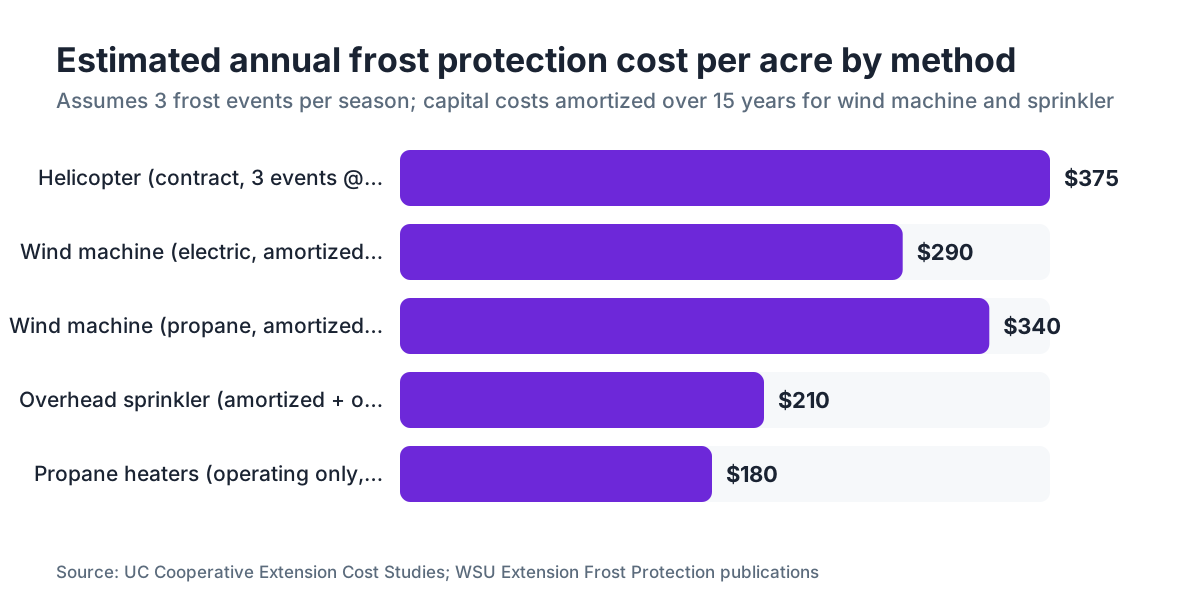
A wind machine installed at $35,000 covering 12 acres has a capital cost of about $2,900 per acre. At $30 per acre per event and 3 events a year, that's $90/acre/year operating plus roughly $200/acre/year amortization (15-year life), around $290/acre/year total. Helicopter at $125/acre per event times 3 events is $375/acre/year with no capital. Wind machines break even in most scenarios above 2 to 3 events per season.
Can drones replace helicopters for vineyard frost protection?
Not yet at commercial scale. Agricultural drones carry much smaller rotors than manned helicopters and cover far less ground per flight. No published U.S. trial as of 2024 has shown drone frost protection at commercially viable scale across a full vineyard block. The physics holds in theory, but the power and rotor diameter needed to move enough air over 100-plus acres efficiently is still beyond current drone platforms.
What records should I keep for each helicopter frost protection event?
Log the date, event start and end time, block name and acreage covered, minimum temperature recorded with sensor location noted, operator name and Part 137 number, pilot name, flight hours billed, invoice total, and any observed crop damage. These records support insurance claims, tax deductions, and multi-year budgeting. Store them with your other field records so frost events and spray activities sit in one accessible history.
What's a seasonal retainer for helicopter frost protection and is it worth it?
A retainer is an upfront fee that guarantees the operator holds capacity and priority for your property through the frost season. Retainers in California's North Coast run roughly $2,000 to $8,000 per season depending on block size and contracted events. They're worth it if your frost window is long, your block is hard to reach, or an unavailable operator has burned you during a surprise frost. For properties with one or two light frost risks a year, per-event billing often makes more financial sense.
Does the EPA Worker Protection Standard apply to helicopter frost operations?
Not directly, since helicopter frost protection involves no pesticide application. The EPA Worker Protection Standard (40 CFR Part 170) governs agricultural pesticide exposure. If workers are present in adjacent blocks during helicopter operations, communicating the flight plan clears up confusion about the aerial activity. If you combine helicopter passes with propane heater use in the same event, the heaters may trigger separate local air district notification requirements.
What's the minimum temperature differential for helicopter frost mixing to be effective?
UC Davis viticulture guidance indicates helicopter mixing is most effective when the inversion layer differential is at least 5°F above canopy temperature and wind is below 5 mph. Below a 5°F differential, mixing the inversion down doesn't raise canopy temperature enough to clear critical damage thresholds. If the inversion is weak or the event is advective rather than radiative, helicopter service delivers little benefit.
Sources
- UC Cooperative Extension, Sample Costs to Establish a Vineyard and Produce Wine Grapes: Helicopter frost protection in North Coast vineyards typically runs $400 to $900 per flight hour; total frost protection costs average $150 to $350 per acre per season for frost-prone blocks
- UC Davis Viticulture and Enology, Frost and Freeze Protection for Vineyards: Helicopter frost mixing is most effective when inversion layer differential is at least 5°F and wind is below 5 mph; Vitis vinifera at budbreak shows damage at 28°F for 30 minutes
- Washington State University Extension, Frost Protection in Orchards and Vineyards: Wind machine capital cost runs $20,000 to $45,000 installed; break-even versus helicopter service is roughly 3 to 5 frost events per season; properly sited wind machines provide 2 to 4°F canopy temperature lift
- Cornell Cooperative Extension, Frost Protection for Grapes: Overhead sprinkler frost protection requires a minimum application rate of 0.1 inches of water per hour during a frost event
- UC Cooperative Extension, Frost Protection for Deciduous Orchards: Almond open flowers are damaged at 29°F; sweet cherry blossoms in full bloom are damaged at 28°F; pre-bloom cluster stage tolerates down to 24°F
- NOAA National Centers for Environmental Information, Climate Data Online: Station-level frost event frequency and minimum temperature records available for most agricultural regions going back decades
- FAA, 14 CFR Part 137 Agricultural Aircraft Operations: Agricultural helicopter operators must hold FAA Part 137 Agricultural Aircraft Operator Certificate; pilots must hold commercial certificate with rotorcraft-helicopter rating
- California Department of Pesticide Regulation, Agricultural Aircraft Regulations: California DPR regulations apply to helicopters applying pesticides; mechanical frost protection (no materials applied) does not trigger pesticide application permit requirements
- USDA Risk Management Agency, Crop Insurance Policies for Grapes: USDA RMA crop insurance covers frost and freeze damage; policies do not require a specific frost protection method; growers should document temperature logs and protection activities
- IRS, Publication 225 Farmer's Tax Guide: Helicopter frost protection expenses are deductible as ordinary and necessary farm business expenses under IRC Section 162
- EPA, Worker Protection Standard 40 CFR Part 170: EPA Worker Protection Standard governs agricultural pesticide exposure; mechanical frost protection operations without pesticide application are not directly governed by WPS
Last updated 2026-07-09