Spray record requirements: organic vs. conventional vineyards

TL;DR
- Both organic and conventional vineyards must keep pesticide application records under the EPA Worker Protection Standard and most state ag codes, but organic operations add a second layer: every input must be logged against the USDA National Organic Program's approved materials list, retained for five years, and made available to your certifier during annual inspections.
- Conventional records typically need only two to five years retention depending on state law.
What spray records does every vineyard have to keep, organic or not?
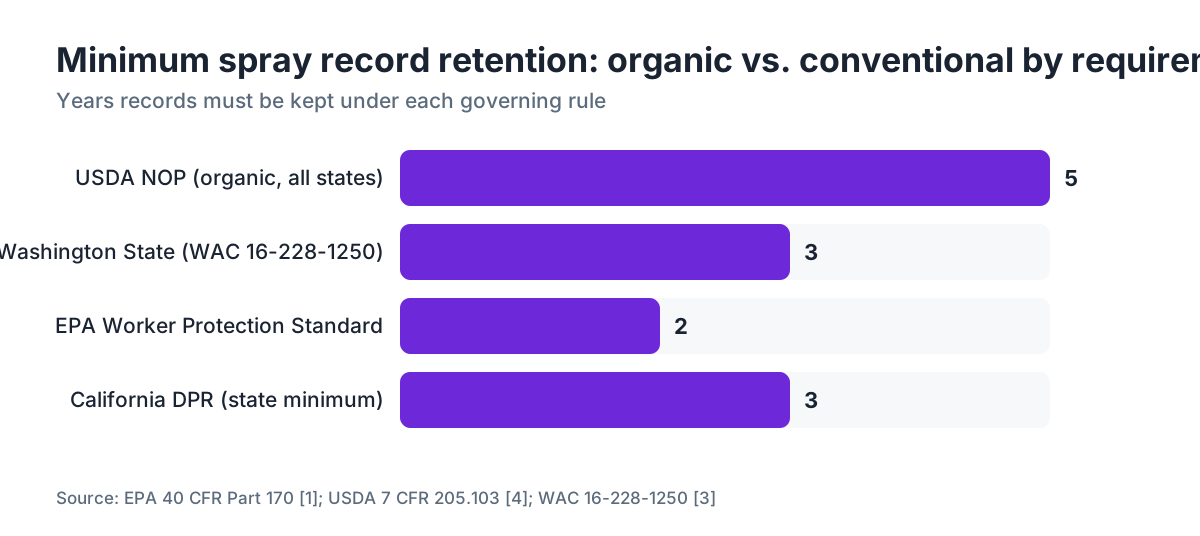
The baseline is the same regardless of your certification status. The EPA Worker Protection Standard (WPS), revised in 2015 and codified at 40 CFR Part 170, requires any agricultural employer who directs workers or handlers to maintain pesticide application records accessible on the establishment for two years [1]. Those records must include the product name, EPA registration number, active ingredient(s), location and size of the treated area, date of application, and the restricted-entry interval (REI).
Most states stack their own requirements on top of WPS. California requires licensed pest control operators and growers to file a Notice of Intent before applying any restricted-use pesticide, and the county agricultural commissioner must receive a use report within seven days after application under California Food & Agricultural Code Section 12981 [2]. Washington State requires pesticide application records to be retained for three years under WAC 16-228-1250 [3]. New York holds to the federal two-year minimum but recommends five for growers selling to regulated markets.
So before you even think about the organic layer, your conventional record for each application needs: the product label name, EPA reg number, field ID, treated acreage, application date, application method, and REI posted date. That's your floor.
How do organic vineyard spray records differ from conventional ones?
The gap is significant. An organic vineyard operating under USDA National Organic Program (NOP) certification must keep records that let a certifier audit every input applied to certified acres, trace it back to an approved source, and confirm it wasn't prohibited [4]. The USDA NOP regulation at 7 CFR Part 205.103 states that certified operations must "maintain records for not less than 5 years beyond their creation" and must make those records available to the certifier and to USDA-accredited certifying agents at any time during business hours [4].
That five-year retention is longer than WPS's two years and longer than most state minimums. It's also stricter in content. Here's where organic records go further than conventional:
1. Material source documentation. Conventional growers don't need to prove where their copper fungicide came from. Organic growers do. The certifier needs to confirm the product is listed on the National List (7 CFR 205.601 for crop production) or has passed an annotation-compliant formulation review. You'll need the product's Organic Materials Review Institute (OMRI) listing, the certifier's own approved materials list notation, or a Materials Review document from your certifying agent [5].
2. Lot or batch traceability. Some certifiers ask for purchase invoices or delivery receipts tied to each spray application so they can confirm the actual lot used matches the approved formulation. Conventional growers never face this.
3. Buffer and drift documentation. When an organic vineyard neighbors a conventionally treated block or farm, the certifier may require written documentation of buffer widths applied, wind conditions at time of spray, and any drift-incident investigations. This isn't a universal NOP mandate, but most USDA-accredited certifiers write it into their system plans.
4. Prohibited-substance contact records. If a prohibited substance accidentally contacts an organic block (neighbor drift, equipment contamination), NOP requires the incident to be documented and the certifier notified promptly. There's no analog for conventional operations.
What specific fields must appear on an organic vineyard spray log?
Think of the organic spray log as a conventional log plus five extra columns. Here's a comparison:
| Field | Conventional (WPS minimum) | Organic (NOP + certifier) |
|---|---|---|
| Product name | Required | Required |
| EPA registration number | Required | Required |
| Active ingredient(s) | Required | Required |
| Application date | Required | Required |
| Treated location / field ID | Required | Required |
| Treated acreage | Required | Required |
| Application method | Required | Required |
| REI posted date/time | Required | Required |
| OMRI or certifier approval reference | Not required | Required |
| Material source (supplier invoice ref.) | Not required | Required by most certifiers |
| Lot or batch number | Not required | Required by some certifiers |
| Prohibited-substance contact notation | Not required | Required if incident occurs |
| Buffer width / neighbor notification | Not required | Required by most certifiers |
| Record retention | 2 years (WPS) / varies by state | 5 years (NOP 7 CFR 205.103) |
The extra columns aren't bureaucratic padding. They exist because the organic certification system is audit-based rather than complaint-based. A state ag inspector for a conventional operation usually shows up after something goes wrong. Your organic certifier shows up every year and reads every line [4].
Cornell Cooperative Extension's organic production guides for New York grape growers specifically call out the need for "complete and contemporaneous records of all materials applied, including supplier name and invoice number," a standard that goes beyond what WPS requires [6].
What is the five-year retention rule for organic records and where does it come from?
The five-year rule lives in 7 CFR Part 205.103(b)(2), which reads: "Records must be maintained for not less than 5 years beyond their creation" [4]. It applies to all records that demonstrate compliance with NOP regulations, and spray logs are explicitly included because they're part of the audit trail the certifier uses to confirm that only allowed substances touched your certified ground.
Compare that to the WPS two-year minimum at 40 CFR 170.310(b) [1]. If you farm both organic and conventional blocks under the same operation, the practical move most compliance consultants recommend is keeping everything on the five-year schedule. Sorting records by retention tier is an invitation to accidentally discard organic documentation early.
A few states exceed the NOP floor on their own. California's Department of Pesticide Regulation requires certain records be retained for three years under state law, but for organic operations the NOP's five years controls since it's stricter. Federal preemption doesn't apply here the way you might expect: NOP sets a floor, states can be stricter on the state side, and you comply with whichever is longest for a given field.
Does the USDA NOP require a specific spray record format?
No. The NOP doesn't mandate a particular form or software. What it mandates is completeness, accessibility, and retention length [4]. Your certifying agent may have a preferred template they'll hand you, and using it makes your annual inspection go faster. But a well-maintained spreadsheet, a field notebook, or a digital record system all satisfy the regulation as long as the required data fields are present and the records can be produced on request.
WSU Extension's organic certification guidance for Washington grape and hop producers notes that "the format of records is less important than their completeness and your ability to retrieve them quickly during an inspection" [7]. That's practical advice. Certifier site visits are often unannounced or short-notice, and an operation that keeps records in six different places tends to fail not because the data doesn't exist but because they can't produce it fast enough.
This is the one place where record-keeping software earns its keep. A tool like VitiScribe, which logs spray applications by block with automatic timestamp and REI calculation, gives you a searchable, exportable audit trail that satisfies both WPS and NOP fields without duplicate data entry. For operations with mixed organic and conventional blocks, the ability to filter by certification status alone is worth the subscription cost.
How does the EPA Worker Protection Standard apply differently to organic vineyards?
It applies identically. The WPS has no organic carve-out. If you employ workers or handlers on organic acreage and any WPS-listed pesticide (including copper hydroxide, sulfur, or pyrethrin, all allowed under organic) is applied, you owe those workers full WPS protections: safety training, access to application records, posted REIs, and decontamination supplies [1].
Many organic growers are surprised that sulfur and copper products carry REIs. Copper hydroxide (Kocide, for example) typically carries a 24-hour REI. Sulfur products often carry a 24-hour REI as well. Lime sulfur can run 48 hours. Those REIs must be posted and logged just as they would be for a synthetic fungicide on a conventional block.
The UC Davis Department of Plant Sciences and the UC ANR Cooperative Extension both stress in their IPM materials that the organic label on a product does not reduce worker protection obligations; the WPS key information must still be posted at a central location and application records must be accessible within an hour of a worker's or handler's request [8].
What happens if an organic vineyard's spray records are incomplete during a certifier audit?
Consequences scale with how incomplete the record is. Minor gaps, a missing lot number or an unsigned application date, typically result in a corrective action request (CAR) from your certifying agent. You get a specified window, often 30 days, to provide supporting documentation or a corrective procedure.
More serious gaps, missing records for an entire spray season, inability to document the source of an input, or evidence that a prohibited substance was used, can trigger a Notice of Noncompliance (NON), suspension of certification, or in the worst case, revocation. Under 7 CFR Part 205.662, a certifying agent can suspend or revoke certification when "a certified operation fails to comply with the Act or regulations," and that failure includes inadequate record-keeping [9].
Revocation isn't common for pure paperwork failures unaccompanied by substantive violations, but suspension is real. Losing certification mid-season means you can't market that year's fruit as organic. At current organic price premiums (the USDA Economic Research Service estimated organic wine grapes received $200 to $500 per ton more than conventional in California in recent survey years, though exact numbers vary by variety and market), a single suspended season erases years of record-keeping effort [10].
Conventional vineyards face fines under state pesticide law for record-keeping violations, but they don't face the loss of a marketing premium tied to a third-party certification.
Do organic and conventional vineyards need to keep records differently for restricted-use pesticides?
Restricted-use pesticides (RUPs) add another layer for both types of operations, but organically approved materials rarely fall into the RUP category. Most copper and sulfur products aren't classified as RUPs. Synthetic RUPs like certain pyrethroid insecticides are prohibited under organic, so by definition an organic operation using only allowed materials will have few or no RUP records to keep.
For conventional vineyards applying RUPs, federal law under FIFRA requires that only certified pesticide applicators purchase and supervise RUP applications, and state laws typically require the certified applicator to sign the application record [2]. California's county ag commissioner reporting requirement for RUPs is more detailed than for general-use pesticides and requires submission within seven days rather than the longer window for general-use materials.
Organic operations that do hold a certified applicator license on staff (some do, for emergency situations or consulting work on conventional blocks) need to keep their RUP records separate from organic field records to avoid any appearance of cross-contamination documentation.
How should a vineyard with both organic and conventional blocks manage spray records?
Mixed operations are where record-keeping discipline matters most. The single biggest risk is commingling records in a way that makes it hard to demonstrate a conventional product was never applied to organic acres. Certifiers know this is the high-risk scenario and they look for it specifically.
The practical approach most mixed-operation managers use is to maintain physically or logically separate record systems by block designation. Each block has a clear organic or conventional tag. Every spray application entry references a specific block ID. Equipment cleaning logs (required by most certifiers to prevent cross-contamination) link to the block IDs that the cleaned sprayer then treated.
WSU Extension's guidance on mixed organic/conventional farm management recommends "buffer logs" that document which blocks border which certification status, and notes that certifiers will often trace drift events by overlaying spray records from both sides of a boundary [7].
For a vineyard like those in the paso robles wineries region where estate blocks can span large parcels with multiple certification statuses, color-coded block maps filed alongside spray records are a simple, effective tool that certifiers respond well to.
What records do you need when transitioning a block from conventional to organic?
The NOP three-year transition period is itself a record-keeping exercise. Under 7 CFR Part 205.202, land must have had no prohibited substances applied for 36 months prior to harvest of the first certified organic crop [4]. That means you need documentation covering the three years before certification that proves what was applied, more than after you decided to go organic.
This is where many growers run into trouble. If you're managing a conventional block today and thinking you might certify it in three years, start keeping organic-quality records now. You'll need to show your certifying agent the complete spray history for each of those 36 months, and "I didn't spray anything prohibited" without records to back it up is not a statement certifiers accept.
Previous records from a former owner or manager create extra complexity. Get copies of those records before you close any land transaction involving blocks you plan to certify. The certifying agent needs the records; they can't take your word for what a prior operator applied.
Go back and read the actual NOP regulation at 7 CFR 205.202(b)(2): it says the land must not have had any prohibited substance applied to it "for a period of 3 years immediately preceding harvest of the crop." [4] That phrase "immediately preceding" is what makes contemporaneous conventional records so important during the transition window.
What are the state-level differences in spray record requirements that organic growers should know?
Federal NOP sets the floor; state organic programs can be stricter. California operates the California Organic Food and Farming Act (COFFA), which in some respects mirrors NOP but is administered by CDFA and includes state-specific residue testing programs that can require additional documentation if a residue is detected [2].
Washington State runs its own Organic Food Program under WSDA, and certifiers operating under WSDA accreditation follow state-specific record forms that include a Washington-specific material approval column [3]. Oregon's Organic Certification Program is administered by ODA and requires that records be produced within 24 hours of a certifier's request, which is faster than NOP's general "upon request" language.
New York, home to a large share of the East Coast wine industry, requires that organic handlers and producers file annual summary reports with their certifier that include total application volumes by product, more than individual application events. Cornell's Small Farms Program has detailed guidance on how to compile these summaries from individual spray log entries [6].
Conventional vineyards in these same states face their state's pesticide use reporting requirements, which are substantial in California (seven-day county reporting) and lighter in states like Virginia or Texas where general-use products carry minimal reporting obligations beyond WPS.
How can vineyard managers build a record-keeping system that satisfies both sets of requirements?
Design for the stricter standard and let the conventional records benefit from the upgrade. Since organic records need five-year retention, a supplier invoice reference, a lot number, and an OMRI cross-reference, a system built to those specs automatically satisfies WPS's two-year, minimal-field requirement for conventional blocks.
The practical workflow most experienced managers land on looks like this: record every application in real time (not at the end of the week), tie every record to a specific GPS-referenced block ID, attach or reference the purchase invoice for every product lot, and run a quarterly internal audit to catch gaps before your certifier does.
For growers managing multiple vineyard properties, the complexity multiplies because each property may sit in a different county reporting jurisdiction, use a different certifier if some are organic, and keep different equipment-cleaning logs. A digital record system that handles all of that in one place is worth evaluating seriously. VitiScribe's spray log module is built for this: it tracks block-level inputs, flags REI conflicts, and exports in formats common certifiers accept.
Whatever system you use, the habit that matters most is contemporaneous entry. A spray log filled in from memory three weeks later isn't a compliance document. Under both WPS and NOP, records should reflect what happened at the time it happened.
Frequently asked questions
How long do organic vineyards need to keep spray records?
The USDA NOP requires organic operations to retain all records for at least five years beyond their creation, per 7 CFR Part 205.103(b)(2). This is longer than the EPA Worker Protection Standard's two-year minimum for conventional operations. If you manage both organic and conventional blocks, keeping everything on the five-year schedule is the simplest and safest approach.
Does sulfur or copper sprayed on an organic vineyard require a WPS record?
Yes. The EPA Worker Protection Standard applies to any pesticide application involving workers or handlers, regardless of whether the product is organically approved. Copper hydroxide and sulfur both carry REIs (often 24 hours) that must be posted and documented. The organic label on a product does not reduce WPS record-keeping obligations in any way.
What is an OMRI listing and why does it matter for organic spray records?
OMRI, the Organic Materials Review Institute, evaluates inputs against the USDA National List and publishes approved products. For spray records, the OMRI listing number or your certifier's own approval notation is the documentation that proves a product you applied was allowed. Without it, your certifier cannot confirm compliance during an audit, even if the product genuinely is on the National List.
Can an organic vineyard get certified if it doesn't have records from before the transition?
This is genuinely difficult. NOP requires 36 months of prohibited-substance-free land history, and certifiers need documentation to verify it. If records don't exist, you'll need to provide affidavits from previous operators and any available purchase receipts, and your certifier makes the final call on whether the evidence is sufficient. Gaps in pre-transition records are a common reason certifications are delayed.
Do organic and conventional vineyards file spray records with the same government agencies?
Not exactly. Conventional vineyards in states like California must report restricted-use pesticide applications to the county agricultural commissioner within seven days. Organic vineyards report to their USDA-accredited certifying agent rather than to a state agency. However, if an organic vineyard also uses any state-reportable pesticide on non-organic blocks, those county reports are still required for those applications.
What triggers an inspection of an organic vineyard's spray records?
Annual inspections are mandatory for all NOP-certified operations; they're not triggered by a complaint. Your certifying agent reviews spray logs, purchase invoices, and system plan compliance every year. Unannounced inspections can happen any time USDA or the certifier has reason to investigate. Residue test results above 5% of the conventional tolerance level can also trigger follow-up record audits under NOP policy.
If I farm organic and conventional blocks, do I need separate spray logs for each?
Yes, in practice. While nothing in the NOP regulation explicitly prohibits a combined log, certifiers universally expect records that clearly separate organic blocks from conventional ones. Combined logs that aren't clearly labeled create the appearance of commingled inputs, which is exactly what certifiers watch for. Separate logs, or a single system with clear block-level filtering, are both acceptable.
What is a corrective action request from an organic certifier and how serious is it?
A corrective action request (CAR) is the least severe enforcement step. The certifier identifies a specific gap or deficiency and gives you a defined window (typically 30 days) to correct it and provide documentation. CARs for minor record gaps, a missing lot number, an undated entry, are common and don't threaten certification if resolved promptly. Repeated or unresolved CARs can escalate to a Notice of Noncompliance.
Are there different spray record requirements for grapes sold to a winery versus grapes consumed on-site?
The record-keeping rules apply to the production operation, not the downstream use of the fruit. Whether you sell to a large winery, a small estate producer, or operate a tasting room, WPS and state pesticide records are required if workers are present. The organic certification layer is tied to the block's certification status, not whether the wine is marketed as organic. Winery-side organic wine labeling has additional TTB rules.
How does the NOP handle spray records for a prohibited substance that drifted onto an organic block from a neighboring farm?
You're not automatically decertified by drift you didn't cause, but you must document it. NOP expects you to investigate, record the incident (date, product suspected, source), notify your certifier, and take steps to prevent recurrence where possible. If residue testing confirms a prohibited substance, your certifier decides whether your management response was adequate. Good records of your prevention efforts are your best protection.
What do state extension programs say about organic spray record-keeping best practices?
UC Cooperative Extension, Cornell's Small Farms Program, and WSU Extension all recommend real-time contemporaneous entry rather than end-of-week reconstruction, physical or digital attachment of purchase invoices to application records, and quarterly self-audits before the annual certifier inspection. Cornell specifically recommends including the supplier name and invoice number in every organic spray log entry, beyond what NOP technically mandates.
Is there a federal form for organic vineyard spray records?
No. USDA NOP does not prescribe a specific form. Your certifying agent may provide a template, and using it makes inspections faster. UC ANR and Cornell both offer downloadable spray log templates adapted for organic operations that include the extra fields certifiers look for. Whatever format you choose, completeness and retrievability matter more than the specific layout.
How do restricted-use pesticide records differ between organic and conventional vineyards?
Most organically approved inputs are general-use pesticides, not restricted-use. So organic vineyards rarely generate RUP records for certified acres. Conventional vineyards applying RUPs must ensure a certified applicator signed off and must meet state reporting windows, which can be as short as seven days in California. If an organic operation also manages conventional blocks where RUPs are applied, those records stay entirely separate from the organic operation's logs.
Sources
- EPA, Worker Protection Standard for Agricultural Pesticides (40 CFR Part 170): WPS requires pesticide application records to be retained for two years and accessible on the establishment; records must include product name, EPA registration number, active ingredient, treated area, date, and REI.
- California Department of Food and Agriculture, Pesticide Use Reporting: California Food and Agricultural Code Section 12981 requires pesticide use reports to be filed with the county agricultural commissioner within seven days of application.
- USDA National Organic Program, 7 CFR Part 205: 7 CFR 205.103 requires certified organic operations to maintain records for not less than five years beyond their creation; 7 CFR 205.202 establishes the 36-month transition period requiring no prohibited substances on the land immediately preceding harvest.
- Organic Materials Review Institute (OMRI), OMRI Products List: OMRI evaluates inputs against the USDA National List of allowed and prohibited substances and publishes approved product listings used by certifiers to verify input compliance.
- Cornell Cooperative Extension, Small Farms Program, Organic Certification Resources: Cornell's guidance calls for complete and contemporaneous records of all materials applied to organic acres, including supplier name and invoice number, as part of the certifier audit trail.
- Washington State University Extension, Organic Farming Systems: WSU Extension guidance states that the format of records is less important than their completeness and retrievability during inspections, and recommends buffer logs for mixed organic/conventional operations.
- UC Division of Agriculture and Natural Resources, Statewide IPM Program: UC ANR IPM materials state that the organic label on an input does not reduce WPS obligations; REIs must be posted and application records must be accessible within one hour of a worker or handler request.
- USDA National Organic Program, 7 CFR Part 205.662, Suspension and Revocation of Certification: Under 7 CFR 205.662, a certifying agent may suspend or revoke certification when a certified operation fails to comply with the Act or regulations, including inadequate record-keeping.
- USDA Economic Research Service, Organic Agriculture: USDA ERS data indicate organic wine grapes in California have received price premiums of $200 to $500 per ton over conventional grapes in recent survey periods, varying by variety and market.
Last updated 2026-07-09