Vineyard water source protection requirements before pesticide applications

TL;DR
- Before any pesticide application in a vineyard, check the product label for buffer distances, follow EPA and state setback rules for surface and groundwater, post required notifications, and document everything before you spray.
- Label setbacks run from 25 to 300 feet depending on the product.
- Some states require permits near drinking water sources.
- Non-compliance can void insurance and trigger fines above $19,000 per violation per day.
What water source protection rules apply to vineyard pesticide applications?
Federal label law sets the floor. State regulations add to it. Local groundwater ordinances go further still. Every pesticide label is a legal document under FIFRA (the Federal Insecticide, Fungicide, and Rodenticide Act, 7 U.S.C. § 136 et seq.) [1], and the label's environmental hazard section spells out buffer distances, prohibited application conditions, and water body restrictions. Break any of those and you've broken federal law, no matter what your county allows.
Beyond the label, EPA's pesticide program sets aquatic buffer requirements during registration review. Many fungicides and insecticides now carry mandatory aquatic buffers of 25 to 300 feet from water [2]. If a product's label was revised after 2016, there's a decent chance it now carries a numeric buffer that wasn't printed five years ago.
State agriculture departments stack their own rules on top. California's Department of Pesticide Regulation (CDPR) requires permit-level review for applications near certain groundwater protection areas, and county agricultural commissioners can impose site-specific restrictions [3]. Washington's WSDA and Oregon's ODA run similar frameworks. Cornell Cooperative Extension's pesticide management program covers New York's setback rules for groundwater-vulnerable soils, which catch a lot of Finger Lakes vineyard blocks [4].
Here's the practical part. No single source gives you the full picture. You need the label, your state's pesticide use requirements, and your county agricultural commissioner's guidance. All three, before you spray.
What setback distances are required from streams, ponds, and irrigation canals?
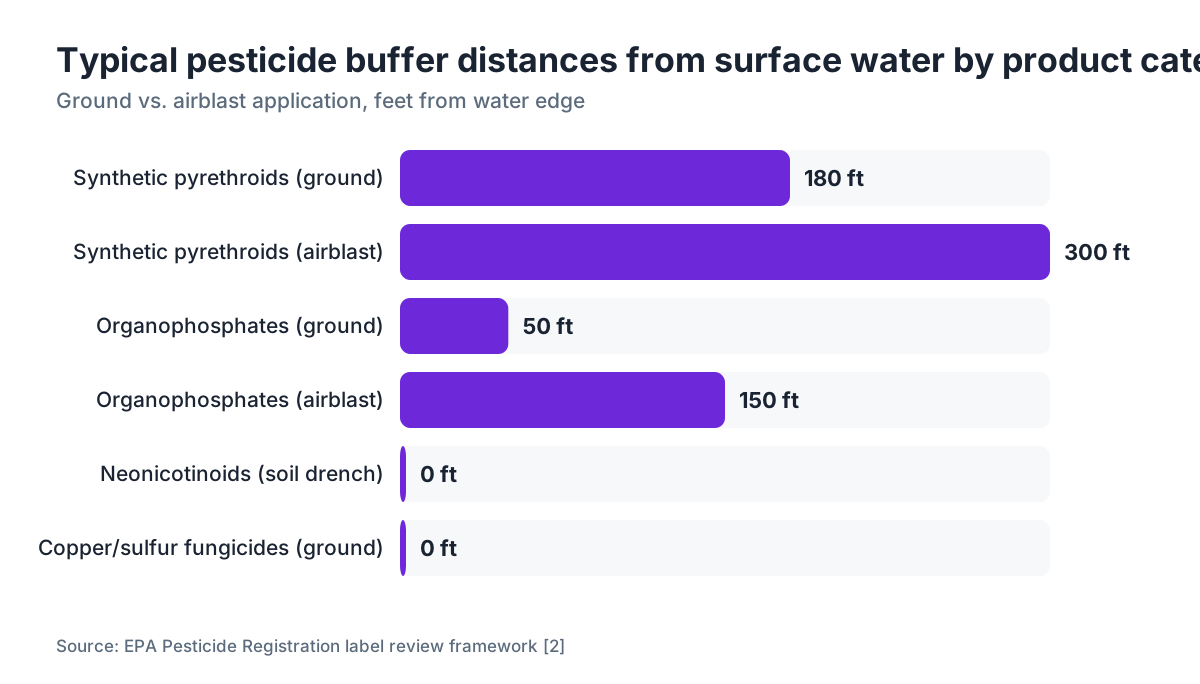
Setbacks change with product chemistry, application method, and water body type. The table below covers the categories you'll run into most in a vineyard program.
| Product type | Typical label buffer (ground application) | Typical label buffer (aerial/airblast) | Water body covered |
|---|---|---|---|
| Synthetic pyrethroids (e.g., bifenthrin, permethrin) | 60 to 300 ft | 300 ft | All surface water |
| Organophosphates (e.g., chlorpyrifos) | 25 to 75 ft | 150 ft | All surface water |
| Neonicotinoids (e.g., imidacloprid soil drench) | No spray buffer; runoff restriction applies | N/A (soil only) | Groundwater, surface |
| Sulfur/copper fungicides | No numeric buffer on most labels | Drift restriction only | N/A unless local rule |
| Glyphosate (aquatic-labeled vs. standard) | Standard label: 0 ft; aquatic label required within water | Aquatic label required | Surface water direct |
These are general ranges pulled from product labels and EPA registration documents [2]. Read the specific label you're holding. A reformulation or a label revision can move these numbers a lot.
Airblast sprayers, the workhorse of most vineyards, get special treatment. They throw fine droplets, so label buffers for airblast usually run 2 to 3 times wider than ground boom buffers for the same chemistry. WSU Extension's integrated pest management guides flag this for Washington wine grape regions where irrigation canals run right up against the vine rows [5]. If your block borders a ditch, that ditch almost certainly counts as surface water under your state's definition, even if it runs dry half the year.
Setbacks near domestic wells and community water intakes work differently. There the rule shifts from a buffer distance to notification, and sometimes to an outright ban. California's Groundwater Protection Areas (GWPAs) name specific restricted materials that need a permit variance before you apply within a defined zone around wellhead protection areas [3].
Does the EPA Worker Protection Standard affect water source requirements?
The EPA's Worker Protection Standard (WPS) under 40 CFR Part 170 is mainly about protecting workers and handlers, not water bodies. It crosses into water source compliance in one spot people miss: the requirement to keep application records accessible for two years [6].
Under the WPS, revised in 2015 and effective January 2017, handlers get specific training, safety information goes up at a central location, and application records must list the product name, EPA registration number, application date, location, and handler name. That record also has to show you checked the label for environmental restrictions, and that's where water source buffers live.
In an inspection, a missing or incomplete record of your pre-application checks gets treated the same as never doing the check at all. EPA's enforcement posture on this hardened after 2017. Fines under FIFRA Section 14(b) for certified applicator violations can reach $19,787 per violation per day [1], and the agency adjusts that ceiling for inflation. State fines stack on top of federal ones in most places.
The WPS also bars workers from entering a treated area during a restricted-entry interval (REI). That's separate from the water buffer question, but the same inspector looks at both on the same visit. Clean spray records, including your pre-spray water source check, are your best defense either way.
How do you identify whether your vineyard blocks are in a sensitive water area?
Start with the USGS National Hydrography Dataset and your state's GIS water layer. Both are free, and they cover every named and unnamed water body the agencies have mapped [7]. Export the layer for your property and measure your blocks against the nearest water feature. A lot of growers skip this and eyeball it. That works right up until a creek that looks like a drainage ditch turns out to be a jurisdictional water of the U.S.
The EPA's ECHO database shows your property's proximity to regulated water bodies and active permits nearby [2]. It's not the friendliest tool, but it tells you whether there are NPDES permits issued for nearby operations that could shape what buffer a regulator expects.
For groundwater, the USDA's Web Soil Survey gives you hydrologic soil groups and depth-to-water-table data for every mapped soil unit on the property [8]. If a block sits on a Hydrologic Group A or B soil with shallow depth to groundwater (under 5 feet), you're in the zone where groundwater-sensitive product restrictions kick in. For California operations, CDPR's GWPA map viewer is the best tool going. It maps specific restricted materials against groundwater vulnerability at the section level [3].
Cornell's pesticide management program recommends ground-truthing your GIS maps with a physical walk of the block perimeter before the first application each season [4]. Things change. A neighbor drops in a new irrigation pond. A seasonal drainage gets deepened. An old tile drain gets exposed. The map shows you what was surveyed. The walk shows you what's there now.
What must you document before each spray application near water?
Documentation is where most small vineyards get tripped up. The rule is specific, and the record has to exist before the application, not get reconstructed the week after.
At a minimum, your pre-application water source check should include the product name and EPA registration number, the date and time you documented it, a description of the nearest water body and estimated distance from the application area, the label buffer for the specific method you're using, confirmation that wind speed and direction were checked (with actual numbers), and the name of the person who did the check. If a state notification or permit condition applies, note the permit number or notification date.
The WPS requires records for two years [6]. State law can require longer. California requires most pesticide use reports to be retained for three years under Food and Agriculture Code Section 12979 [3]. When in doubt, keep five years. Disk space is cheap. An enforcement action is not.
If you use a digital system, the timestamp metadata in the file helps in a dispute because it shows the record was created before the spray, not after. VitiScribe was built for exactly this workflow: you log the pre-spray check in the same interface where you record the application, and the system timestamps both separately, which is what a state inspector wants to see.
One more thing. If the label tells you to notify a water system operator before applying near a drinking water intake, that notification goes in your records too, with the date, time, and name of the person you notified. Several newer organophosphate labels carry this requirement.
Are buffer requirements different for organic vineyard operations?
Yes, but not in the direction most people expect. Organic certification under the USDA National Organic Program [9] does not exempt you from EPA or state pesticide setbacks. Spray a copper fungicide or an organically approved insecticide and the label still governs. If that label sets a buffer from water, the buffer applies whether you're certified organic or not.
Copper is the most common friction point. Copper-based fungicides are broadly allowed under NOP but carry real aquatic toxicity concerns. California limits cumulative copper applications in ways that partly reflect those concerns, and some county agricultural commissioners have issued site-specific restrictions on copper use near coastal streams [3]. Sulfur is lower risk to water systems than copper, but heavy sulfur applications near irrigation ponds can drop pH if there's significant surface runoff after irrigation.
The practical difference for organic operations is that many synthetic options with long setbacks are off the table anyway. The materials you do use, copper, sulfur, spinosad, kaolin, still need a label review for aquatic effects before every application near water. The UC Davis Integrated Pest Management program has solid label-reading guidance for organic materials, and it covers the aquatic hazard sections of things like spinosad, which carries genuine restrictions near aquatic invertebrates [10].
What happens if pesticide drift or runoff reaches a water source?
You have a short window and a legal duty to act. Most states require immediate notification to the state environmental or agriculture agency once a pesticide release reaches surface water, and some set the threshold at any detectable amount. California's requirement is notification within 24 hours of discovery [3]. Washington requires notice to the WSDA within 24 hours as well [5].
Beyond notification, you may face liability under the Clean Water Act if the release involved a navigable water of the U.S. [11]. The EPA's NPDES general permit for agricultural stormwater covers some situations, but intentional or negligent application that causes a water quality violation gets no shelter under that permit.
Your field response matters legally too. Document the incident with photos and GPS coordinates before any cleanup. Note the weather, the equipment, the quantity of product involved, and the time you found the problem. That contemporaneous record is your evidence that the release was unintentional and that you moved fast.
Pesticide liability claims in grape country can pull in downstream growers, municipalities, and fish and wildlife agencies all at once. Crop insurance policies increasingly exclude pesticide misapplication events. Read your policy language now, before you need it. The National Agricultural Law Center has a good summary of pesticide drift litigation trends if you want the legal framework in plain English [12].
What are the pre-application notification rules for water systems operators?
Some pesticide labels require you to notify a public water system operator before applying near a drinking water intake. It's not universal. It applies to certain organophosphates, carbamates, and a growing number of newer chemistry labels where EPA added the condition during registration review.
EPA's label language usually reads close to this: "Do not apply when weather conditions favor drift from treated areas. Notify water systems operators and public health officials at least 48 hours before application when application is made within [X] feet of a surface water intake." That's a composite of language the agency uses across labels, so read your actual product. The exact wording varies.
In California, Notices of Intent (NOIs) are required for certain restricted materials before any application, and the NOI system electronically routes the information to affected parties including water districts [3]. That process takes time. Many counties require 24 to 72 hours of advance notice depending on the material and site.
WSU Extension's pesticide safety education program covers Washington's notification framework, including when written versus verbal notice satisfies the rule [5]. The general pattern across states is that verbal notification followed by written confirmation within 24 hours is acceptable, but check your state's specific rule.
For vineyards near municipal water supply reservoirs or in watershed overlay zones, call your local water district at the start of the season and ask whether they have a standing communication protocol for agricultural applicators. Many do. Registering with them early beats scrambling after a post-application problem.
How do wind speed and temperature affect whether you can spray near water?
Most labels prohibit applications when wind tops a threshold, commonly 10 mph for ground applications and 15 mph for airblast, though product limits vary [2]. At those speeds, fine droplets from an airblast sprayer can travel several hundred feet and cross a buffer you measured on a calm day.
Wind isn't the only hazard. Temperature inversions create a different one. During an inversion (typically late evening into early morning), a layer of cool air traps fine droplets and moves them sideways across the landscape, sometimes for miles. UC Davis IPM guidance warns that applications made at low wind speeds during inversion conditions can produce more drift exposure than applications at moderate wind speeds under normal atmospheric conditions [10]. If your block sits within 300 feet of any water body, skip dawn and dusk applications when you can.
Rain forecasts matter for runoff the way wind matters for drift. Applying a soluble product within 24 to 48 hours of forecasted rain sharply raises runoff potential, and several newer labels flat-out prohibit application when rain is forecast within 24 hours. Check the NOAA forecast and log it in your pre-application record. That documentation shows due diligence.
Soil moisture at application time drives runoff too. Spraying saturated or near-saturated soil raises the odds that irrigation-mobilized product reaches a drainage ditch or stream. UC Cooperative Extension's water quality program in California has documented this pathway for vineyard blocks with furrow or flood irrigation [10].
What records do you need to keep and for how long?
Federal WPS requires two years of pesticide application records, accessible to workers and handlers on request [6]. California Food and Agriculture Code requires pesticide use reports filed with the county agricultural commissioner within seven days of application, with records kept three years [3]. Oregon and Washington run similar report-and-retain frameworks. Operate in more than one state and you should keep everything three years minimum. Managing separate retention schedules isn't worth the headache.
For water-source documentation, here's what a solid record looks like:
- Product name, EPA registration number, and label version date
- Application date, start and end time
- Block ID and acreage
- Application method (airblast, ground boom, hand spray) and equipment
- Nearest water body, type, and measured distance
- Label buffer distance for this application method
- Wind speed and direction at application time (measured, not estimated)
- Temperature and relative humidity
- Rain forecast for the next 48 hours
- Name and certification number of the applicator
- Any pre-application notifications made (to whom, when, how)
That list looks long. It takes three minutes on a mobile-friendly form. VitiScribe's spray record module is built around this exact field set, and the records export in formats accepted by California, Washington, and Oregon county commissioners. The bigger point: keep these records consistently and a compliance inspection turns into a paperwork review instead of a fight.
EPA recommends, though doesn't mandate, that growers also keep the SDS and label copies for every material applied in a season [2]. Attach them to your season-end file. Labels get revised. Having the one you relied on at application time matters if a question surfaces later.
How do state-specific programs like California's GWPA or WSU guidelines change your obligations?
California's Groundwater Protection Areas are the most developed state framework in the country for restricting pesticide use near water. CDPR updates the GWPA maps periodically, and if your parcel falls inside a designated area, a list of "restricted materials" effectively forces you to apply for a variance or pick a different product [3]. That restricted materials list includes several common vineyard chemicals, among them some nematicides and soil fumigants. Check the CDPR GWPA viewer at the start of each season, because maps and restricted materials lists do get updated.
Washington adds a layer through its Pesticide Management Zone (PMZ) program, which flags areas of groundwater vulnerability where applications require enhanced record-keeping and, sometimes, pre-application notification to the WSDA [5]. WSU Extension's pesticide safety publications are the clearest plain-English guide to working through this system for Washington wine grape growers.
Oregon works mostly through its Groundwater Management Area (GWMA) framework, where some contaminated groundwater areas trigger extra restrictions on pesticide use in the zone. ODA publishes a current list of active GWMAs and the pesticides of concern in each.
New York's Department of Environmental Conservation keeps a Pesticides Groundwater Restriction Area map covering parts of Long Island and some Hudson Valley parcels, relevant to any vineyard operations in those regions [4]. Cornell Cooperative Extension's pest management guidelines are the practical companion to that regulatory framework.
None of these state programs replaces the federal label requirement. They all add to it. The order runs federal label law first, then state program requirements, then local (county) agricultural commissioner conditions.
Frequently asked questions
How far do I need to stay from a creek when spraying fungicide in a vineyard?
It depends entirely on the specific product label. Synthetic fungicides like azoxystrobin may carry a 25-foot surface water buffer; others carry none. Copper fungicides generally lack a numeric buffer but may face local restrictions near coastal streams. Read the label's environmental hazard section for the buffer that matches your application method. In California, county agricultural commissioners can add setbacks beyond the label.
Does an irrigation ditch count as a water body for pesticide buffer purposes?
Yes, in most regulatory frameworks. Irrigation ditches that connect to a natural water body are generally treated as surface water under both EPA pesticide label interpretation and state agriculture codes. Even seasonal or intermittent ditches can qualify. Check your state's definition; California treats connected ditches as surface water for pesticide purposes. If the ditch drains to any stream or water body, treat it as a regulated water feature.
What wind speed is too high to spray near a stream or pond in a vineyard?
Most labels prohibit ground and airblast applications above 10 mph, though some extend to 15 mph. At higher speeds, airblast droplets can travel hundreds of feet past the stated buffer. Beyond the label limit, temperature inversions at dawn and dusk can carry fine droplets far even at low wind speeds. UC Davis IPM guidance recommends avoiding applications during inversion conditions near water regardless of stated wind speed.
Are there special water source rules for organic vineyard spray programs?
Organic certification does not exempt you from EPA or state pesticide setbacks. Copper and spinosad, both organically approved, carry aquatic toxicity concerns on their labels. Spinosad in particular has restrictions near aquatic invertebrates. Run the same pre-application water source check on every product you use, organic or not, and read the aquatic hazard section of the label before each application near water.
What do I do if I accidentally spray too close to a water source?
Document the incident immediately with photos, GPS coordinates, weather conditions, and product details. Most states require notification to the state agriculture or environmental agency within 24 hours of discovery, including California and Washington. Do not alter or destroy records. If the release reached navigable water, Clean Water Act obligations may apply on top of state pesticide law. Contact an agricultural attorney before making any public statements about the incident.
How do I find out if my vineyard is in a California Groundwater Protection Area?
Use the CDPR's online GWPA map viewer at cdpr.ca.gov. Enter your parcel or address and it shows whether you fall within a designated groundwater protection area. If you do, CDPR publishes a list of restricted materials that require a permit variance before application in that zone. Check the map at the start of each season, because both the boundaries and the restricted materials list get updated periodically.
How long do I need to keep pesticide application records that mention water source checks?
Federal WPS requires two years. California requires three years under the Food and Agriculture Code, and reports must be filed with the county agricultural commissioner within seven days of application. Oregon and Washington run similar timelines. If you operate in multiple states, keep all records at least three years. For water-source documentation, five years is reasonable insurance given the litigation timelines in pesticide cases.
Do airblast sprayers require wider buffers than boom sprayers near water?
Yes. Product labels typically set airblast buffers at two to three times the width of ground boom buffers for the same chemistry, because airblast generates finer droplets with higher drift potential. A product with a 25-foot ground buffer might carry a 75-foot or greater airblast buffer. Always look up the buffer for your specific application method rather than the generic number. WSU Extension's pesticide safety guides cover this distinction for Washington wine grape operations.
When am I required to notify a water system operator before spraying?
Some product labels include a mandatory pre-notification requirement for water system operators near drinking water intakes, typically 24 to 48 hours in advance. This applies to certain organophosphates and carbamates. California's Notice of Intent system routes pre-application information to affected parties including water districts for restricted materials. Check your product label's environmental hazard section for notification language, and contact your county agricultural commissioner if you're unsure whether a local rule applies.
What is FIFRA and how does it govern vineyard pesticide use near water?
FIFRA is the Federal Insecticide, Fungicide, and Rodenticide Act (7 U.S.C. § 136 et seq.), the federal statute that makes every pesticide label a legally binding document. Using a pesticide inconsistently with its label, including ignoring buffer distances from water, is a federal violation. Fines can reach $19,787 per violation per day for certified applicators. State law adds to FIFRA but cannot reduce the label's requirements.
Does rain forecast at application time affect whether I can spray near water?
Several newer product labels explicitly prohibit application when rain is forecast within 24 hours, because rainfall raises runoff potential and can carry dissolved pesticide to nearby water bodies. Even where the label is silent, applying to near-saturated soils before rain raises runoff risk sharply and is generally treated as a due diligence failure in enforcement actions. Log the 48-hour rain forecast as part of your pre-application record.
What is the EPA's Endangered Species Act buffer and does it affect vineyard spraying?
Yes, this is a growing compliance area. EPA has added Endangered Species Act (ESA) protection zones to some pesticide labels, particularly for aquatic species. These zones can require buffers of 250 feet or more from certain water bodies in regions with listed species habitat. The EPA's ESA pesticide effects determinations pages list affected products and regions. California's Central Valley, Pacific Northwest salmon watersheds, and coastal wine regions are most affected.
Can a county agricultural commissioner impose setbacks stricter than the product label?
Yes. County agricultural commissioners in California can impose site-specific or county-wide conditions stricter than the federal label, and they use that authority. Common examples include added setbacks near community water intakes, specific wind speed limits for airblast applications, and seasonal spray blackout periods near sensitive water bodies. Check with your local commissioner at the start of each season; conditions change and aren't always widely publicized.
Sources
- EPA, Federal Insecticide Fungicide and Rodenticide Act (FIFRA): Every pesticide label is a federal legal document under FIFRA; fines for certified applicator violations can reach $19,787 per violation per day under FIFRA Section 14(b)
- EPA, Pesticide Registration and Aquatic Buffer Requirements: EPA registration review sets mandatory aquatic buffer distances of 25 to 300 feet for many fungicide and insecticide products; labels also specify prohibited application conditions including wind thresholds
- California Department of Pesticide Regulation, Groundwater Protection Areas: California's CDPR GWPA framework lists restricted materials requiring permit variances before application within designated groundwater protection zones; pesticide use reports must be filed within 7 days and records kept 3 years under Food and Agriculture Code Section 12979
- Cornell Cooperative Extension, Pesticide Management and Groundwater Guidelines: Cornell's pesticide management program covers New York setback requirements for groundwater-vulnerable soils and recommends physical block perimeter walks before each season's first application
- EPA, Agricultural Worker Protection Standard (40 CFR Part 170): The WPS as revised in 2015 and effective January 2017 requires pesticide application records including product name, EPA registration number, date, location, and handler name to be retained for two years
- USGS, National Hydrography Dataset: The USGS National Hydrography Dataset provides free GIS mapping of all named and unnamed surface water bodies for property-level setback distance measurement
- USDA NRCS, Web Soil Survey: Web Soil Survey provides hydrologic soil group and depth-to-water-table data for every mapped soil unit, allowing identification of groundwater-sensitive vineyard blocks
- USDA Agricultural Marketing Service, National Organic Program: Organic certification under the USDA NOP does not exempt growers from EPA or state pesticide setback requirements; organically approved materials still require label compliance for water body buffers
- UC Davis IPM Program, Pest Management Guidelines for Wine Grapes: UC Davis IPM guidance warns that temperature inversion conditions at dawn and dusk can produce more drift exposure than moderate wind conditions, and documents the runoff pathway from vineyard blocks with furrow or flood irrigation
- EPA, Clean Water Act Section 404 Permit Program: Pesticide releases reaching navigable waters of the U.S. may trigger Clean Water Act Section 404/401 obligations in addition to state pesticide law
- National Agricultural Law Center, Pesticide Drift and Liability: Pesticide liability claims in agricultural regions can involve downstream users, municipalities, and wildlife agencies simultaneously; the NALC summarizes pesticide drift litigation trends and applicable law
Last updated 2026-07-09