Grape berry moth degree day tracking and spray timing documentation
TL;DR
- Grape berry moth management runs on degree day accumulation using a 50°F base temperature.
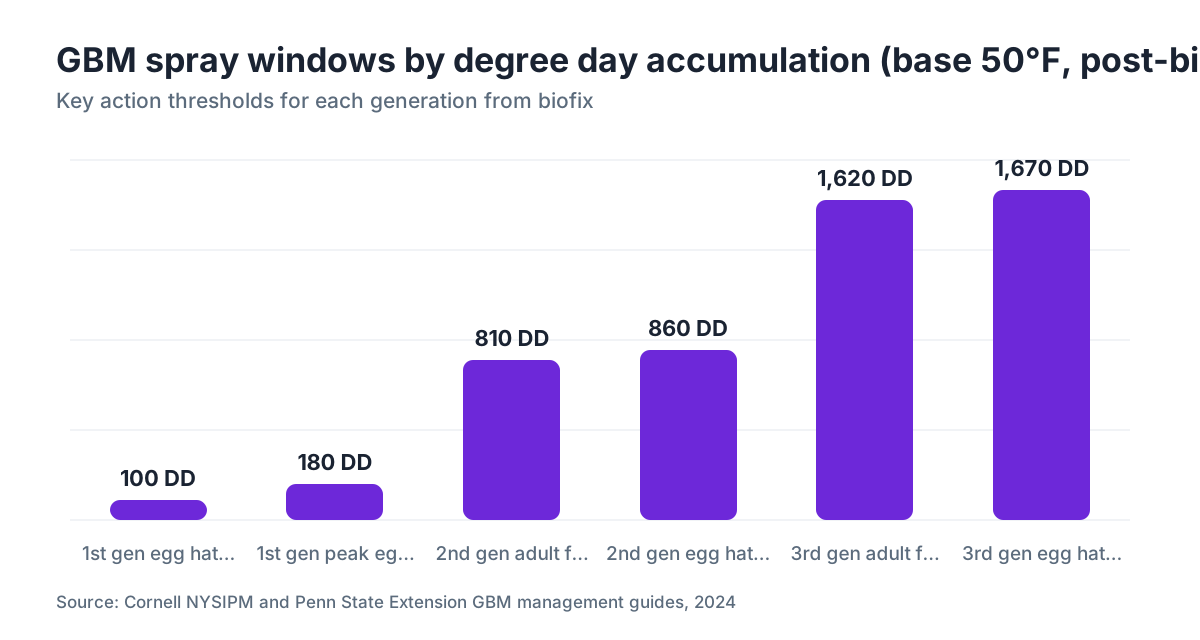
- The three key spray windows open at roughly 100, 810, and 1620 degree days after biofix, the date you first catch adult moths in a pheromone trap.
- Accurate degree day logs paired with timestamped application records are what make control work and what satisfy a state spray-record audit.
What is grape berry moth and why does degree day tracking matter?
Grape berry moth (Paralobesia viteana) is the most damaging caterpillar pest of wine, table, and juice grapes in eastern North America, and it has pushed into parts of the Pacific Northwest [1]. The larvae tunnel into berries. Those entry wounds invite Botrytis and other rots, and a single missed generation can wreck 30 to 80 percent of a block depending on variety and location [2].
Calendar spraying fails because the moth doesn't read a calendar. Its development tracks accumulated heat, not dates. A warm spring in the Finger Lakes can push first-generation egg hatch two full weeks ahead of the date you'd expect. Spray on a fixed date and you miss the window. Spray on degree days and you hit it nearly every year.
Degree day (DD) tracking gives you a biological clock. You add up heat units above a threshold temperature (50°F, or 10°C, for this moth) starting January 1, then correct with a biofix once you trap the first adults. From that adjusted start, published thresholds tell you when eggs are hatching, when larvae are entering berries, and when the next generation is spinning up.
Every serious grape extension program, Cornell, Penn State, Michigan State, and Virginia Tech among them, now builds GBM programs on degree days instead of dates [2][3][11].
What base temperature and start date do you use for GBM degree days?
Use 50°F (10°C) as the base and January 1 as the start. Development basically stops below 50°F. Take the simple average: add the daily high and daily low, divide by two, subtract 50. Negative result counts as zero. Add each day's number to a running total.
Formula: DD = ((Tmax + Tmin) / 2) - 50
You run that January 1 accumulation forward until biofix, the day you first catch adult moths in pheromone traps. After biofix, switch to accumulating from that biofix date for the generation-specific thresholds your extension program publishes.
Cornell's New York State Integrated Pest Management program uses this exact method and posts real-time DD maps updated daily through the season [2]. Penn State Extension's GBM model runs on the same 50°F base with a January 1 start [3].
One practical note. Use your on-site weather station, not the nearest airport. A hillside vineyard with cold air drainage can run 100 to 200 DD behind a flatland station five miles away. That gap is real, and it moves your spray date.
What are the key degree day thresholds for each GBM generation?
The thresholds below come from Cornell and Penn State extension publications and apply to the eastern US. Western programs may use slightly different values, so check your local extension office [2][3].
| Generation | Event | Degree Days (base 50°F, from biofix) |
|---|---|---|
| Overwintering adults | First flight (biofix trigger) | ~100 DD from Jan 1 |
| 1st gen | Egg hatch begins | 100 DD post-biofix |
| 1st gen | Peak egg hatch | 160 to 200 DD post-biofix |
| 2nd gen | Adult flight begins | ~810 DD post-biofix |
| 2nd gen | Egg hatch begins | 810 to 910 DD post-biofix |
| 3rd gen | Adult flight begins | ~1620 DD post-biofix |
| 3rd gen | Egg hatch begins | 1620 to 1720 DD post-biofix |
| 3rd gen | Spray cutoff (pre-harvest) | Check label PHI |
Source: Cornell NYSIPM and Penn State Extension GBM management guides [2][3]
The 100, 810, and 1620 DD marks are where most growers make their spray calls. The 5 percent egg hatch point, roughly 100 DD after biofix for first generation, opens your spray window. Wait until 250 or 300 DD and the larvae are already inside berries, where no surface-applied insecticide reaches them.
Third-generation timing is the tricky one. It overlaps with late-season canopy work and harvest scheduling, and the pre-harvest interval (PHI), not the DD threshold, usually becomes the limiting factor. More on that in the documentation section below.
Great Lakes growers can pull real-time GBM degree day accumulations keyed to individual weather stations from Michigan State Extension's Enviro-weather platform [4]. WSU's Decision Aid System (DAS) covers Pacific Northwest populations with its own validated thresholds [5].
How do you set a biofix and why does it change your degree day count?
Biofix is the date of first sustained adult moth capture in a pheromone trap. Sustained usually means two or more consecutive nights with catches, though the exact trigger varies by extension recommendation. Penn State uses a consistent, repeated catch as the trigger [3].
Hang traps before overwintering adults fly, typically by tight cluster or early bloom in your region. Check them every two to three days. The moment you confirm biofix, reset your DD accumulation to zero from that date for the generation-specific thresholds. Your January 1 total tells you when to start expecting flight. The biofix-reset total tells you when to spray.
Without biofix, you're guessing. A warm February can inflate January 1 totals and push generation thresholds earlier than the actual biology. Biofix anchors the model to what the moths are doing in your specific blocks.
One trap per 5 to 10 acres is the general recommendation. Place traps at canopy height inside the block, not at row ends where edge effects distort catches. Replace lures every four to six weeks or on the manufacturer's schedule. An exhausted lure hands you a false zero, and a false zero moves your biofix late.
How do you document spray timing decisions for regulatory compliance?
Most states require pesticide application records for any commercial use, and California, New York, Washington, and Oregon all layer grape-sector rules on top. The federal floor is the EPA Worker Protection Standard (WPS) at 40 CFR Part 170 [6]. WPS records must include, at minimum, the product name and EPA registration number, the active ingredient, the crop treated, the location, the date and time of application, the application method, and the total amount of product used.
Beyond that floor, your state ag department likely wants the applicator's name and certification number, the rate per acre, and the re-entry interval (REI) posted at field entry points. New York requires records kept for three years. California requires pesticide use reports filed monthly with the county ag commissioner [7].
For GBM, good documentation goes past the legal minimum. Your records should show the DD accumulation at the time of the spray decision, the biofix date you used, the trap catch data that triggered or confirmed the call, and the weather at application. No state law demands most of that. You need it anyway, because it's what lets you reconstruct your decision when a crop insurance claim or a neighbor complaint lands on your desk.
A log that reads "Altacor, 5/14, Block 4" tells an auditor you sprayed. A log that reads "5/14, Block 4, DD = 112 post-biofix (biofix 4/28), first-gen egg hatch window, trap catch 6/night on 5/12" tells a crop loss investigator you made a defensible, science-based decision. That difference is worth money.
For operations juggling multiple blocks with different microclimates, a tool like VitiScribe can track degree day accumulations block by block and attach each spray decision to the underlying DD log, which keeps record reconstruction simple during an audit.
What information must a GBM spray record legally contain?
At the federal level, EPA WPS (40 CFR Part 170) sets the floor, and most states add to it [6]. Here's a working checklist.
Federal WPS minimums:
- Product name and EPA registration number
- Active ingredient(s)
- Crop treated and application site (field ID or block name)
- Date and time of application
- Application method (airblast, backpack, drone, etc.)
- Amount of product applied
Common state add-ons (vary by state):
- Applicator name and pesticide license number
- Application rate per acre and total acreage treated
- REI posted at all block entry points
- Wind speed and direction at time of application
- Target pest
- Pre-harvest interval noted
Best-practice additions for GBM:
- Degree day total at time of decision (base 50°F, from biofix)
- Biofix date for the season
- Pheromone trap catch data that supported timing
- Block-specific weather station used for DD calculations
PHI compliance is non-negotiable. Applying a product inside the PHI window is a violation regardless of the DD threshold, so always check the label for the specific product. Under FIFRA Section 12, it is unlawful "to use any registered pesticide in a manner inconsistent with its labeling" [8]. The label is the law.
Retention: three years is the federal standard under WPS [6]. Some states require longer. Keep digital backups. Paper spray logs have a way of vanishing in floods, fires, and office moves.
Which insecticides are registered for GBM and what are their PHI and REI windows?
Registered products shift as labels change and new chemistries clear registration, so always verify current status with your state pesticide registration database and read the label. With that caveat, these are the product classes most commonly used for GBM as of 2024.
| Product Class | Example Active Ingredients | Typical PHI (days) | Typical REI (hrs) |
|---|---|---|---|
| Organophosphates | chlorpyrifos*, phosmet | 14 to 28 | 24 to 48 |
| Pyrethroids | zeta-cypermethrin, lambda-cyhalothrin | 7 to 21 | 12 to 24 |
| Spinosyns | spinosad | 7 | 4 |
| Diamides | chlorantraniliprole | 1 to 3 | 4 |
| Mating disruption (dispensers) | GBM pheromone | N/A | N/A |
*Chlorpyrifos is restricted or canceled for food uses in several states. Check your state registration.
Diamides like chlorantraniliprole (sold as Altacor) have become the first pick in a lot of integrated programs. The draw is the short REI, the favorable environmental profile, and real efficacy against early instar larvae [2]. Mating disruption with pheromone dispensers is a legitimate strategy for high-pressure blocks, and it drops both PHI and REI worries entirely.
Organic certification narrows the shelf. Organically managed vineyards lean mostly on Bacillus thuringiensis var. kurstaki (Btk) products timed to egg hatch using, yes, the same degree day thresholds [3].
Document which label version you used for each application. Labels do change mid-season on occasion, and you want the paper trail.
How do you use online tools and weather networks for GBM degree day tracking?
You don't have to run degree days by hand. Several public platforms do it for you, and they cost nothing.
Cornell's Network for Environment and Weather Applications (NEWA) gives you GBM degree day accumulations for stations across New York, Pennsylvania, and neighboring states. Pick your nearest station, enter your biofix date, and you get current DD plus a 5-day forecast [2]. It's the most polished free interface in the eastern US.
Michigan State's Enviro-weather covers the Great Lakes region with similar functionality [4]. WSU's Decision Aid System handles Pacific Northwest GBM populations and pairs the pest model with local variety phenology models [5]. For California and the wider West, UC Davis's Integrated Pest Management program has degree day calculators you can run off CIMIS weather station data or your own records [9].
A few things to watch. These tools are only as good as the weather station feeding them. If your nearest public station sits on the far side of a ridge or five miles out, the accumulation can be meaningfully off from what's happening in your rows. An on-site HOBO or Davis station is worth the $300 to $800 for any vineyard over 20 acres. Log the raw Tmax and Tmin yourself as a backup, because if a station drops offline during a key window, your own record is the only way to rebuild the accumulation.
Whatever tool you use, write down which station you relied on in your spray records. An auditor or crop insurance adjuster can pull that station's historical data and confirm your DD calculation was reasonable.
How does mating disruption fit into a degree-day-based GBM program?
Mating disruption (MD) doesn't retire your degree day tracking. It changes how you use the numbers. MD dispensers flood the vineyard air with synthetic GBM pheromone, which scrambles male-female communication and cuts mating success. Trap catches drop to near zero, so pheromone traps stop giving you reliable biofix inside a disrupted block.
In an MD program you still need degree days to know when to expect flight and when to scout, for larvae at shoot tips in the first generation and at berry entries in the second and third. You're not timing insecticide sprays. You're monitoring to confirm the program is holding. If larval damage crosses threshold, typically 3 to 5 percent infested clusters for second or third generation, you may need to supplement with an insecticide [3].
For biofix in a disrupted block, use a non-disrupted sentinel trap at the vineyard perimeter, or lean on regional trap data from nearby cooperators.
MD shines on third-generation control because it sidesteps the PHI timing squeeze entirely. For a high-value block with a history of third-gen damage and a tight harvest window, it may be the cleanest option on the table.
What records do you need for organic certification and IPM program compliance?
Certified organic operations carry a heavier paper trail. Your certifier, accredited under USDA's National Organic Program (7 CFR Part 205), needs to see [10]:
- A current Organic System Plan documenting your pest management approach
- Records showing only approved materials were used (OMRI-listed or otherwise cleared by your certifier)
- Application records meeting WPS standards plus whatever organic-specific documentation your certifier requires
- Any emergency-use application of a material not in your plan, with written certifier approval
For GBM, the organic toolbox is Btk (Bacillus thuringiensis var. kurstaki), kaolin clay, and mating disruption. Btk timing is entirely DD-dependent and aimed at egg hatch windows. Your spray records should show the DD accumulation at application to prove you targeted the right biological window.
IPM program compliance, whether through a state program or a buyer requirement (some large buyers demand documented IPM), usually means showing that spray decisions followed economic thresholds and rested on monitoring data. Your DD logs and trap catch records are that evidence.
Cornell Cooperative Extension publishes IPM record-keeping templates for New York vineyards that cover GBM monitoring and spray decision documentation [2]. They're worth adapting even outside New York.
How should you organize and store GBM spray records across multiple seasons?
Three years is the federal minimum under WPS [6]. Experienced growers keep more. A five-year archive lets you line up block-level DD accumulations against actual crop loss, tune your timing season over season, and hand a buyer or certifier real history when they ask about your pest management.
Organize by season, then by block, then by application date. Each file, paper or digital, should tie together the DD log for that season, the trap catch data, the spray decisions with their DD justifications, and the application records. Split those apart and you lose half the value.
Paper binders work for small operations, but they don't travel and a wet spring can ruin them. A simple spreadsheet backed up to cloud storage beats paper. Once you're running five or more blocks, maintaining parallel DD logs and spray records by hand for each one turns into a chore that eats your evenings. That's where purpose-built vineyard record software earns its cost. VitiScribe was built for exactly this kind of block-level tracking, linking pest model data to spray records in one audit-ready log.
Whatever the system, do a season-end review every November. Pull the season's records, confirm every application has a complete entry, check that PHIs and REIs were respected, and file the full set somewhere fireproof. You won't remember the details in March.
Frequently asked questions
What base temperature do you use to calculate grape berry moth degree days?
Use 50°F (10°C) as the lower development threshold. Add the daily high and low, divide by two, and subtract 50. If the result is negative, count it as zero. This matches the models published by Cornell, Penn State, and Michigan State extension programs. Start accumulation on January 1, then reset from biofix once you confirm first adult moth flight in traps.
When is the first-generation GBM spray window in degree days?
First-generation egg hatch begins around 100 degree days (base 50°F) after biofix, with peak hatch from 160 to 200 DD post-biofix. Your effective window for surface-applied insecticides targeting newly hatched larvae runs from 100 to 250 DD post-biofix. Once larvae enter shoot tips or berries, contact products stop working because the larvae are protected inside plant tissue.
How many pheromone traps do you need per vineyard block to set a reliable biofix?
Cornell and Penn State recommend one trap per 5 to 10 acres. Place them at canopy height inside the block, not at row ends where edge effects inflate catches. Replace lures every four to six weeks. In mating disruption blocks, use perimeter or sentinel traps outside the disrupted zone, because in-block catches are suppressed and won't give you reliable biofix data.
What records does the EPA Worker Protection Standard require for grape pesticide applications?
Under 40 CFR Part 170, WPS requires the product name and EPA registration number, active ingredient, crop and application site, date and time, application method, and total product applied. Records must be kept at least three years and made available to state and federal inspectors. Most states add requirements, including the applicator's certification number and the posted re-entry interval.
Can you use the same degree day model for GBM in California as in New York?
The 50°F base applies across populations, but western GBM may show slightly different phenology than eastern. UC Davis and WSU both publish region-specific guidance. The bigger practical difference is the weather network: NEWA and Enviro-weather cover the East, while CIMIS and WSU's DAS cover the West. Use the extension resources calibrated to your region rather than assuming eastern thresholds translate exactly.
How do you document GBM spray decisions for a crop insurance claim?
A strong file shows you followed a science-based process. Include your DD accumulation log with the weather station identified, your trap catch records showing the biofix date, the published threshold that triggered the spray, the product applied with its label rate and PHI, and scouting notes on pest pressure before and after application. This evidence shows the loss wasn't from negligence or a missed window.
What is the pre-harvest interval for the most common GBM insecticides?
PHI varies by product: chlorantraniliprole (Altacor) is typically 1 to 3 days, spinosad is 7 days, pyrethroids run 7 to 21 days depending on the formulation, and organophosphates like phosmet run 14 to 28 days. Always read the current label for your specific product. PHI violations can trigger failed residue tests, crop rejection, and regulatory action. Third-generation timing often collides with short harvest windows, which pushes growers toward low-PHI products or mating disruption.
Does mating disruption eliminate the need for degree day tracking?
No. Even under mating disruption, degree day tracking tells you when to expect adult flight, when to scout for larval damage, and whether supplemental sprays are needed. The difference is that traps inside a disrupted block don't give reliable biofix, because dispensers suppress catches. Use perimeter sentinel traps or regional monitoring data for biofix in those blocks.
How long do you need to keep grape pesticide application records?
The EPA Worker Protection Standard requires a minimum of three years. Several states require longer: California requires pesticide use reports filed monthly with the county agricultural commissioner, and organic certifiers under USDA NOP (7 CFR Part 205) generally require five years. Keeping five years across the board is the simplest policy, and it also gives you enough history to tune your timing season over season.
What is a good degree day threshold to stop worrying about GBM for the season?
Third-generation adult flight begins around 1620 DD post-biofix. Once you pass 1800 to 2000 DD post-biofix in most eastern US climates, meaningful larval activity drops off and harvest is close. Late-season third-gen damage still happens in warm years, though. The real cutoff is your product's PHI against your harvest date. Once you can't spray safely and harvest on schedule, monitoring is your only tool left.
What's the best free online tool for tracking GBM degree days?
Cornell's NEWA (Network for Environment and Weather Applications) is the strongest free option for the eastern US, with real-time DD accumulations, biofix input, and a 5-day forecast. Michigan State's Enviro-weather is strong for the Great Lakes. WSU's Decision Aid System covers the Pacific Northwest. UC Davis's IPM program has degree day calculators for California. All are free and just need your biofix date.
How do you handle GBM record-keeping for multiple blocks with different microclimates?
Each block needs its own DD accumulation if you have on-site stations or meaningful topographic differences. A north-facing hillside block can run 150 to 200 DD behind a south-facing block in the same vineyard during critical spring windows. Keep separate DD logs, separate trap catch records, and separate spray decisions per block. One generic entry for the whole vineyard won't hold up under a detailed audit or insurance review.
Are there organic-approved products for GBM timed to degree day thresholds?
Yes. Bacillus thuringiensis var. kurstaki (Btk) products are OMRI-listed and effective when timed to egg hatch, typically 100 to 200 DD post-biofix for first generation. Kaolin clay and pheromone mating disruption dispensers are also approved for organic systems. All three depend on DD-based timing. Btk in particular has to contact newly hatched larvae before they enter plant tissue, so hitting the window is everything.
What does a complete GBM season spray record look like in practice?
A complete record has four layers: the seasonal DD accumulation log (Tmax, Tmin, daily DD, running total, weather station ID), the trap catch log (date, trap location, catch count, lure change dates, biofix date), the spray decision log (date, block, DD at decision, threshold used, product, rate), and the WPS-compliant application record (product, EPA reg number, applicator, acreage, amount used, REI posted). Kept together, these four layers satisfy an audit and tell the full biological story.
Sources
- Cornell New York State Integrated Pest Management, Grape Berry Moth pest profile: Grape berry moth (Paralobesia viteana) is the most damaging lepidopteran pest of grapes in eastern North America
- Cornell New York State Integrated Pest Management, Grape Berry Moth management guide and NEWA: Cornell NYSIPM uses 50°F base temperature, January 1 start date, and biofix-adjusted DD thresholds of 100, 810, and 1620 for GBM generation timing; NEWA provides real-time DD accumulations
- Penn State Extension, Grape Berry Moth management: Penn State Extension GBM model uses base 50°F with January 1 start; biofix defined as sustained consistent trap catch; mating disruption and Btk timing also DD-based
- Michigan State University Extension, Enviro-weather GBM model: MSU Enviro-weather provides real-time GBM degree day accumulations for Great Lakes region stations
- Washington State University, Decision Aid System (DAS): WSU's Decision Aid System covers Pacific Northwest GBM populations with region-specific validated degree day thresholds
- EPA, Worker Protection Standard 40 CFR Part 170: WPS requires application records including product name, EPA registration number, active ingredient, crop, location, date, time, method, and amount applied; records retained three years
- California Department of Pesticide Regulation, pesticide use reporting: California requires pesticide use reports filed monthly with the county agricultural commissioner
- EPA, FIFRA Section 12 label requirements: Under FIFRA Section 12, it is unlawful to use any registered pesticide in a manner inconsistent with its labeling; the label is the law
- UC Statewide IPM Program (UC ANR), degree day models: UC IPM provides degree day calculators compatible with CIMIS weather station data for California vineyard pest management
- USDA National Organic Program, 7 CFR Part 205: USDA NOP requires certified organic operations to maintain an Organic System Plan and application records showing only approved materials were used; certifiers generally require five-year record retention
- Virginia Cooperative Extension, Grape Berry Moth in Virginia vineyards: Virginia Cooperative Extension uses degree day accumulation rather than calendar dates for GBM management recommendations in Virginia vineyards
Last updated 2026-07-10