Trunk disease spray records and timing documentation for vineyards
TL;DR
- Trunk disease protection depends almost entirely on hitting the right window, usually within 24 to 48 hours of pruning cuts.
- Spray records must capture product, rate, REI, PHI, application date, and the applicator's license number to satisfy the EPA Worker Protection Standard and state pesticide reporting rules.
- Miss the window or the paperwork, and you face both disease pressure and regulatory fines.
Why does timing matter so much for trunk disease applications?
Trunk diseases infect through fresh pruning wounds and almost nothing else. That single fact drives your whole spray calendar. Eutypa dieback, Botryosphaeria dieback, and Esca all enter the vine at the cut, and the window they can enter through is short. UC Davis plant pathology research has consistently shown wounds are most susceptible during the first 24 to 48 hours after cutting, with some risk stretching several weeks if the wounds stay wet and spores are around [1]. After those first two days, callusing tissue starts closing the entry point, though it never fully shuts before the next rain reopens the risk.
This is not academic. A UC Davis trial found that wound protection applied on the day of pruning cut infection rates sharply compared to delayed treatment, while unprotected wounds in wet conditions showed infection rates above 80 percent in some trial blocks [1]. That number should change how you schedule your pruning crews and your spray rig on the same day.
Spray timing is not a decision you make after pruning wraps up. It has to live inside the pruning schedule itself, block by block. A delay of even 48 hours during a rainy stretch in February or March can be the difference between a clean block and one you're pulling dead vines out of in five years.
What do spray records for trunk disease applications actually need to include?
Federal law sets the floor. The EPA Worker Protection Standard (WPS), codified at 40 CFR Part 170, requires pesticide application records for agricultural establishments to include the product name, EPA registration number, active ingredient(s), application date, location of application, and total amount applied [2]. Your state almost certainly piles on more.
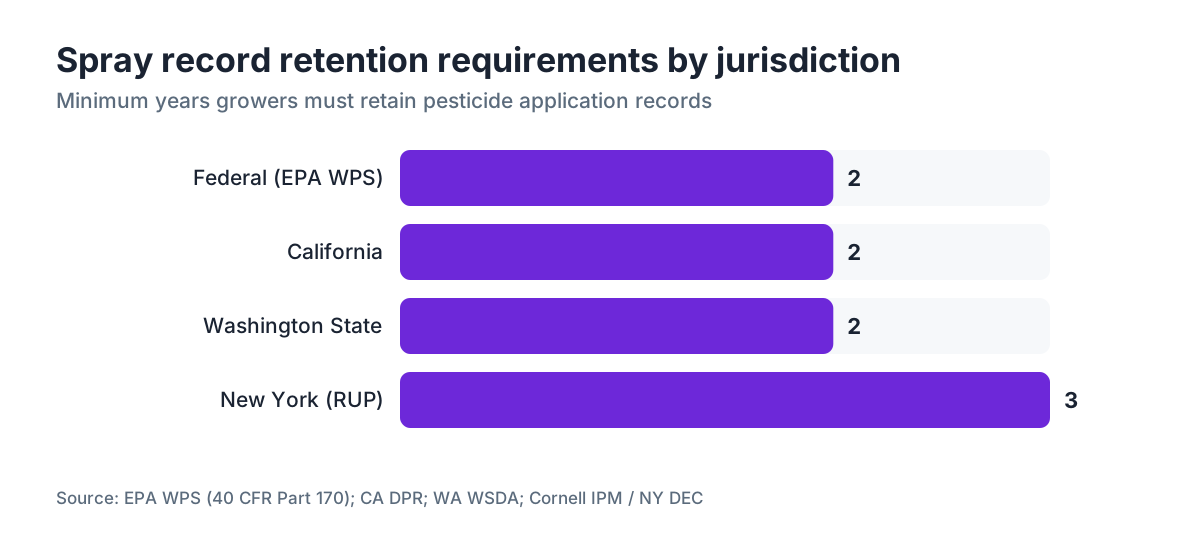
California requires licensed applicators to file a Pesticide Use Report (PUR) with the county agricultural commissioner within seven days of each restricted-material application, and the Department of Pesticide Regulation mandates two-year record retention [3]. Washington State requires application records for any pesticide use and sets the same two-year retention period [4]. New York growers under Cornell Cooperative Extension guidance face state DEC rules that keep restricted-use pesticide records for three years [5].
Every trunk disease spray record entry should capture, at a minimum:
- Product name and EPA registration number
- Active ingredient and formulation
- Application date and time (time matters more here than for most applications, because the pruning-to-spray interval is the key metric)
- Block or vineyard location, including acreage treated
- Application method and equipment used
- Rate per acre and total volume applied
- Restricted Entry Interval (REI) and Pre-Harvest Interval (PHI)
- Wind speed and direction, temperature, and relative humidity at time of application
- Name and license number of the applicator
- Time elapsed since pruning cuts were made
That last field, time elapsed since pruning, is not legally required under WPS or most state rules. But it's the single most operationally useful number you can record for trunk disease, and it belongs in your log even if no auditor ever asks for it. Years later, it tells you whether a symptomatic block was mismanaged at application time or whether the product simply failed.
Which products are registered for trunk disease wound protection, and how long is the application window?
The list of fungicides with solid efficacy data for wound protection is short. Topsin-M (thiophanate-methyl) and Rally (myclobutanil) show up most in university extension recommendations, along with Bordeaux mixture (copper sulfate plus hydrated lime) and biological options like Trichoderma-based products [6].
WSU Extension's Botryosphaeria dieback guidance says wound protectant should go on immediately after pruning, ideally the same day, with a second application if rain hits before the wounds callus [6]. UC Cooperative Extension recommends the same approach for Eutypa and is blunt about it: thiophanate-methyl applied on the day of pruning beats applications made 24 or more hours later, consistently [8].
Here are the common options side by side:
| Product | Active Ingredient | Timing Target | REI | PHI |
|---|---|---|---|---|
| Topsin-M 70WP | Thiophanate-methyl | Day of pruning | 12 hr | 1 day |
| Rally 40WSP | Myclobutanil | Day of pruning | 24 hr | 7 days |
| Bordeaux Mixture | Copper sulfate + lime | Day of pruning, repeat after rain | 24 hr | 0 days |
| RootShield / Bio-Tam | Trichoderma spp. | Day of pruning | 4 hr | 0 days |
Confirm REI and PHI values against the current product label every time. Labels are the law, and formulations change. Cornell's integrated pest management program keeps updated label summaries for New York-registered products [5].
The Trichoderma biologicals have real UC Davis trial data behind them and work well applied right at pruning. But their performance drops off faster than synthetic fungicides if you delay the application or if rain lands right after treatment [1]. Worth a spot in a rotation or as a resistance management tool. I wouldn't lean on them alone in a wet spring.
How do you document the pruning-to-spray interval in your field records?
This is the gap most vineyard managers leave in their paperwork. It's also the gap that makes post-season analysis nearly useless.
The simplest fix is to log pruning start and finish times by block right next to spray start and finish times by block. Your crew finishes Block 12 at 2:00 PM on February 14, the sprayer gets in there at 7:00 AM on February 15, and the interval is 17 hours. Write that number down. Over a few seasons you'll see whether your operation reliably hits the sub-24-hour window or whether logistics keep dragging you past it.
Some managers just bolt two columns onto their standard spray log: "Pruning complete (date/time)" and "Spray applied (date/time)." That's it. The interval falls out of those two fields. The hard part is coordination between the pruning supervisor and the spray operator, who are often different people and sometimes work for different contractors.
This is the kind of handoff problem record-keeping software actually solves. Tools like VitiScribe let pruning and spray records share a block-level data structure, so the timestamp from the pruning crew's entry shows up for the spray operator in real time before they make the application. The alternative is a paper log that shuttles between two people, which works fine until it doesn't.
If you're running paper logs, have the field supervisor sign off on both the pruning completion time and the spray start time for each block. That dual signature creates accountability and gives you a defensible audit trail if disease problems or a compliance question surface later.
What are the EPA Worker Protection Standard requirements that apply to trunk disease sprays?
The EPA WPS, updated in 2015 and effective for most provisions by January 2017, applies to any agricultural pesticide application where workers may be present [2]. For trunk disease fungicides, the requirements that matter are these.
Posting the Application Exclusion Zone (AEZ) during and after application. The AEZ for ground equipment is 100 feet in the direction of the sprayer and 25 feet in all other directions under the 2015 rule [2].
Training workers before they enter treated areas within the REI period. WPS requires training that covers the pesticide labeling, the REI, and what to do if someone shows symptoms of exposure [2].
Keeping a pesticide application record accessible to workers and their designated representatives for the period the label or state law requires, whichever is longer. WPS specifies a minimum 30-day on-site retention and a two-year total retention period for application records [2].
The WPS record-keeping requirement is satisfied by the same document you already keep for state pesticide reporting in most states, so one well-built spray log entry covers both. The gap most vineyards actually have is access. The records exist, but they aren't reachable by workers the way WPS demands. The regulation says records must be available for inspection by workers and their representatives, which means locked in the ranch manager's truck doesn't cut it.
Do restricted-use pesticide applications for trunk disease require additional documentation?
Yes. If a trunk disease product is classified as a Restricted Use Pesticide (RUP) under EPA regulations, the purchaser has to be a certified applicator or work under the supervision of one, and both the purchase and the application must be documented [2].
Topsin-M 70WP (thiophanate-methyl) is generally not an RUP at the federal level, which keeps it accessible for smaller operations. Rally 40WSP (myclobutanil) is also generally not federally restricted, though state classifications vary. Copper materials like fixed copper or Bordeaux are usually unrestricted.
Your state may classify products differently from the federal designation. California's DPR keeps a list of state-restricted materials that can differ from the EPA federal RUP list [10]. Check with your county agricultural commissioner's office before buying any new product.
For RUP applications, California growers must use a licensed private or commercial applicator and file the PUR within seven days of application [3]. Washington requires a pesticide license or licensed applicator supervision for RUP use, with application records kept through the Department of Agriculture [4].
How should you handle spray records when using contract labor or a custom applicator?
This one comes up constantly in regions where spray equipment is contracted out rather than owned. The short version: the grower and the custom applicator share the record-keeping work, but the grower carries the compliance risk if records go missing.
Under the WPS and most state pesticide laws, the agricultural employer (the grower or vineyard manager) is the responsible party for keeping application records and making sure workers can access them [2]. The custom applicator should hand you a completed application record at the time of, or shortly after, each application. If they don't, ask. Put it in the contract: a completed spray record is a condition of payment.
The record from a custom applicator has to include their license number and license type. In California, commercial applicators hold a Qualified Applicator License or Qualified Applicator Certificate, and the license number belongs on every record they generate [3]. In Washington, a Commercial Pesticide Applicator License number does the same job [4].
If the custom applicator is also filing state use reports, confirm they're filing for your specific property address and location. Location-code errors on California PUR filings are common, and they turn into real headaches when the county ag commissioner cross-references field locations.
What records do you need for biological fungicide applications to pruning wounds?
Biological products registered as pesticides, including Trichoderma-based wound protectants like RootShield Plus or Bio-Tam 2.0, fall under the same record-keeping rules as synthetic fungicides. They carry EPA registration numbers and are regulated as pesticides under FIFRA [7].
The practical difference is that most Trichoderma products are not restricted-use, run very short REIs (typically four hours), and carry zero-day PHIs. That simplifies the compliance picture a lot. You still need a complete application record covering date, location, rate, equipment, and applicator.
Growers often shortcut the weather field with biologicals, figuring a low-toxicity product doesn't need the same rigor. That's a mistake, for two reasons. Your records should be internally consistent no matter the product type. And biological efficacy is highly sensitive to weather, especially temperature and relative humidity, so weather data at application time has real agronomic value when you're picking apart what worked and what didn't after the season.
How do you structure a seasonal trunk disease spray log for a multi-block vineyard?
Organize the log by block, not by date. Date-based logs are fine for a single-block operation. On a property with fifteen or twenty blocks pruned across a six-week window, a date-sorted log makes it nearly impossible to reconstruct the pruning-to-spray interval for any given block without flipping through multiple pages.
A block-organized log gives you a row or a page per block, with columns for:
- Pruning date and time completed
- Weather at pruning (temperature, precipitation, forecast)
- Spray application date and time
- Interval (hours from pruning complete to spray start)
- Product(s) applied, rate, and total volume
- Equipment and calibration date
- Applicator name and license number
- REI expiration date/time
- PHI expiration date
- Weather at spray (temp, wind, RH)
- Notes (any re-entry, rainfall after application, equipment issues)
That structure lets you see the full season's trunk disease management for Block 7 in one view. Which is exactly what you want three years from now when you're trying to work out why that block looks worse than its neighbors.
Building this in a spreadsheet? One tab per variety, or one tab per block cluster, works. If you're on a platform like VitiScribe that ties spray logs to block mapping, the block-centric structure is built in. That saves real time when you're spreading applications across dozens of blocks during a compressed pruning season.
What are the common record-keeping mistakes that lead to compliance problems?
Missing REI documentation is the most common WPS violation found in routine farm inspections, according to EPA enforcement summaries [2]. An inspector shows up, asks where the REI is posted for a recent fungicide application, and you can't produce either a posted notice at the field entry or a log entry with the REI expiration. That's a violation. WPS penalties run from a warning notice for first-time minor violations up to civil penalties that can reach $19,246 per violation under the current EPA civil monetary penalty schedule [9].
Second most common is incomplete location data. Spray records that say "the vineyard" instead of a specific block name, GPS coordinates, or legal description are inadequate for California PUR filings and for WPS purposes generally [3].
Third is missing applicator license information. In states that require a licensed applicator or licensed supervision for restricted-use products, a record without the license number is functionally incomplete.
Fourth, and this one is specific to trunk disease, is no record of the interval between pruning and application. It isn't a regulatory requirement anywhere I'm aware of. But its absence leaves you unable to defend your program when disease develops and a vineyard owner asks whether protocols were followed.
How long do you need to keep trunk disease spray records?
The retention requirements stack across federal and state rules, and you keep records for whichever period runs longest.
EPA WPS requires two-year retention from the date of application [2]. California DPR keeps PUR data indefinitely as a public record through the county agricultural commissioner, but the grower's copy of the underlying application record must be held for two years [3]. Washington State requires two years for pesticide application records [4]. New York requires three years for restricted-use pesticide records [5].
| Jurisdiction | Retention Period | Source |
|---|---|---|
| Federal (WPS) | 2 years | 40 CFR Part 170 |
| California | 2 years (grower copy) | CA DPR |
| Washington | 2 years | WA WSDA |
| New York | 3 years (RUP) | NY DEC |
In practice, keep everything at least three years to cover the most stringent state requirement, and store it so it's actually retrievable. Paper binders in a barn are technically compliant and practically useless when a block is replanted, a property changes hands, or an auditor wants records from two seasons back. Digital records backed up off-site beat paper every time.
What do university extension programs recommend for trunk disease spray timing documentation?
UC Cooperative Extension is the most research-heavy source on this topic in the U.S., given California's Eutypa dieback pressure and the scale of affected acreage. UC Davis plant pathology field trials show that wound protectant timing is the single largest variable in efficacy, more so than product choice in many cases [1].
Cornell Cooperative Extension's integrated pest management program covers Botryosphaeria and Eutypa with practical guidance for northeastern growers, noting that wet spring conditions in New York and the Finger Lakes make wound protection matter even more than in drier climates [5].
WSU Extension's viticulture program at Prosser handles trunk disease management with specific attention to the Botryosphaeria species common in the Pacific Northwest. It recommends documenting the specific date and time of pruning for each block, so you can check after the season whether application timing lined up with disease incidence [6].
All three programs land on the same practical point. Document your timing precisely, past "pruning season." The phrase "applied at pruning" in a spray log is not enough. The time of day and the interval since the cuts were made are the numbers that mean something.
Frequently asked questions
What is the ideal window to apply wound protectant after pruning for trunk disease?
Apply within 24 hours of making pruning cuts, ideally the same day. UC Davis research shows wound susceptibility peaks in the first 24 to 48 hours after cutting, with infection rates above 80 percent in some unprotected trial blocks during wet conditions. A same-day application consistently beats delayed applications in field trials, regardless of which product you use.
Does the EPA Worker Protection Standard require spray records for vineyard fungicide applications?
Yes. Under 40 CFR Part 170, agricultural employers must keep pesticide application records that include the product name, EPA registration number, active ingredient, application date, location, and total amount applied. Records must be retained for two years and be accessible to workers and their designated representatives. WPS applies to any agricultural pesticide application, including fungicides used for trunk disease.
Which fungicides are registered and recommended for Eutypa and Botryosphaeria wound protection?
Thiophanate-methyl (Topsin-M) and myclobutanil (Rally) are the most widely referenced synthetic options in UC Davis and WSU Extension guidelines. Bordeaux mixture is a low-cost copper-based alternative. Trichoderma-based biologicals like RootShield Plus and Bio-Tam 2.0 have good efficacy data when applied immediately at pruning. Always confirm current registration status for your state before purchase.
What information must be on a pesticide application record in California?
California requires the product name, EPA registration number, active ingredient, application date, location and acreage, application method, rate and total amount used, and the applicator's license number. Restricted-material applications must be filed as a Pesticide Use Report with the county agricultural commissioner within seven days. Records must be retained for two years. The California DPR publishes the full requirements online.
How do you document the pruning-to-spray interval in a spray log?
Log the date and time pruning was completed for each block alongside the date and time the spray application began. Calculate the interval in hours and add it as a field. It isn't required by federal or most state rules, but it's the most useful agronomic data point for evaluating your trunk disease program across seasons and for accountability if disease develops later.
Do biological fungicides like Trichoderma products require the same spray records as synthetic fungicides?
Yes. Any product carrying an EPA registration number is regulated as a pesticide under FIFRA and requires a full application record: date, location, rate, equipment, applicator, and REI notation. Most Trichoderma products have short REIs of four hours and zero-day PHIs, which simplifies compliance, but the record-keeping obligations match those for synthetic fungicides exactly.
What are the penalties for failing to keep proper pesticide application records?
Under the EPA WPS, civil penalties can reach $19,246 per violation under the current penalty schedule. Minor first-time violations may draw a warning notice rather than a fine. State penalties vary. California county agricultural commissioners can issue stop-use orders and refer cases to DPR for civil penalties. Missing REI documentation is one of the most common violations found in routine farm inspections.
How do you handle spray records when a custom applicator makes the application?
Require the custom applicator to provide a completed spray record at or immediately after each application, including their license number. Put this in your service contract as a condition of payment. The grower stays the responsible party under WPS and state pesticide law for record maintenance and worker access. Verify the applicator files state use reports correctly for your property location.
How long do I need to keep vineyard spray records for trunk disease applications?
Federal WPS requires two years. California and Washington require two years for grower copies. New York requires three years for restricted-use pesticide records. Keep records at least three years to satisfy the most stringent applicable requirement, and store them in a retrievable format. Paper records in a barn frequently become unreadable or lost within that window.
Should weather conditions be recorded in trunk disease spray records?
Yes, for two reasons. Many state pesticide regulations require weather data in application records, especially temperature and wind speed. And trunk disease fungicide efficacy is weather-sensitive: rainfall right after application can wash off protectants, and temperature affects both synthetic and biological product performance. Logging temperature, wind speed and direction, and relative humidity at application time gives you useful data for post-season analysis.
What records does Washington State require for pesticide applications in vineyards?
Washington State requires application records for any pesticide use, including the product name, application site, date, and applicator information. Records must be retained for two years. Restricted-use pesticide applications require a licensed Commercial Pesticide Applicator or licensed supervision. The Washington State Department of Agriculture administers pesticide licensing and can audit application records.
Can I use a spreadsheet to manage trunk disease spray records, or do I need specialized software?
A spreadsheet works legally. The regulatory requirements say nothing about format, only content and retention. The practical problem with spreadsheets is coordination across a multi-block vineyard with separate pruning and spray crews. Block-organized logs beat date-sorted ones for multi-block properties. Software that ties spray records to block maps adds real value when you're managing dozens of applications in a compressed pruning window.
What does the WPS require regarding posting after a trunk disease fungicide application?
Under the 2015 WPS rule, you must maintain an Application Exclusion Zone during application: 100 feet in the spray direction for ground equipment, 25 feet otherwise. After application, the treated area must be posted with a warning sign at each point of entry if the REI exceeds 48 hours. For most trunk disease fungicides with REIs of 4 to 24 hours, post-application posting is not required, but the REI must be communicated to workers.
How should records differ between dormant-season pruning wound applications and growing-season trunk disease treatments?
Dormant-season wound protectant records focus on the pruning-to-spray interval as the key timing metric. Growing-season applications, often on fresh cuts from thinning or canopy management, need more attention to PHI because harvest is closer. Confirm the PHI for each product against your expected harvest date and document that calculation. Both require the same base record fields under WPS and state rules.
Sources
- UC Davis Department of Plant Pathology, Eutypa Dieback and Trunk Disease Research Program: Pruning wounds are most susceptible in the first 24 to 48 hours after cutting; unprotected wounds in wet conditions showed infection rates above 80 percent in some trial blocks; same-day application consistently outperforms delayed applications.
- U.S. EPA, Worker Protection Standard (WPS) for Agricultural Pesticides, 40 CFR Part 170: WPS requires application records including product name, EPA registration number, active ingredient, date, location, and amount applied; two-year retention; AEZ of 100 feet in spray direction for ground equipment.
- California Department of Pesticide Regulation, Pesticide Use Reporting: California requires PUR filing with the county agricultural commissioner within seven days of restricted-material application; two-year retention of grower records; applicator license number required on all records.
- Washington State Department of Agriculture, Pesticide Management Division: Washington requires pesticide application records retained for two years; restricted-use pesticide applications require a licensed Commercial Pesticide Applicator or licensed supervision.
- Cornell Cooperative Extension, New York State Integrated Pest Management Program: New York DEC requires three-year retention for restricted-use pesticide records; wet spring conditions in New York and the Finger Lakes raise the importance of wound protection; Cornell maintains updated label summaries for New York-registered products.
- Washington State University Extension, Viticulture and Enology Program: WSU Extension guidelines recommend wound protectant applied immediately after pruning, same day if possible, with a second application if rain occurs before wounds callus, and documenting pruning date and time per block.
- U.S. EPA, Pesticide Registration under FIFRA: Biological products with EPA registration numbers are regulated as pesticides under FIFRA and subject to the same record-keeping requirements as synthetic pesticides.
- UC Statewide Integrated Pest Management Program, Grape Pest Management Guidelines: Thiophanate-methyl applied on the day of pruning consistently outperforms applications made 24 or more hours later; wound protection timing is the single largest variable in efficacy.
- U.S. EPA, Enforcement and Civil Monetary Penalties: Maximum civil penalty per WPS violation is $19,246 under the current EPA civil monetary penalty schedule.
- California Department of Pesticide Regulation, Restricted Materials: California's state-restricted materials list may differ from the federal EPA restricted-use pesticide classification.
Last updated 2026-07-09