What does a grape grower actually do? The full career and operations guide
TL;DR
- A grape grower plans and runs every field operation that keeps grapevines alive and productive, from dormant pruning through harvest.
- The work covers pest and disease control, irrigation scheduling, trellising, spray record-keeping, and regulatory compliance.
- Entry wages run roughly $28,000 to $42,000 a year; experienced vineyard managers can clear $90,000.
- The job is physical, detail-heavy, and deeply seasonal.
What does a grape grower do day to day?
A grape grower decides what the vines need and makes sure it happens. On a Tuesday in late spring that might mean scouting for powdery mildew before breakfast, adjusting drip emitters after lunch, logging a fungicide application before dinner, and texting the crew about a blocked lateral you found on the walk. The job never really stops.
The formal list of duties runs long: pruning and training decisions, canopy management (shoot positioning, hedging, leaf pulling), irrigation scheduling, pest and disease scouting, spray program planning, harvest sampling, crew supervision, equipment maintenance, and all the paperwork those tasks generate. In California, growers must keep pesticide application records that meet the requirements of the California Department of Pesticide Regulation, and most counties require submitting those records monthly [1].
At a small family operation, one person handles every bit of it. At a larger estate, a vineyard manager hands work to a crew foreman and a spray operator, but the manager still owns the decisions. Either way the work is hands-on. You cannot manage a vineyard from a spreadsheet.
What skills and training do you need to become a grape grower?
No single credential makes you a grape grower. Most working growers got there through field experience and coursework mixed together, in whatever order life allowed.
On the formal side, UC Davis offers a B.S. in Viticulture and Enology and a respected online Viticulture Certificate through UC Division of Agriculture and Natural Resources [2]. Cornell's viticulture program at the College of Agriculture and Life Sciences covers cool-climate varieties and integrated pest management built for the Northeast [3]. Washington State University Extension runs workshops and a viticulture certificate aimed at Pacific Northwest conditions, including irrigation for semi-arid sites [4]. These programs are not interchangeable. If you grow Riesling in the Finger Lakes, WSU's drip irrigation module matters less than Cornell's Botrytis content.
The experience side teaches what no classroom does. Two or three seasons as a crew member or harvest intern show you how a vine looks water-stressed versus heat-stressed, how to run a tractor safely on a hillside, and how fast a fungicide window slams shut when rain is coming. Most vineyard managers say the internship years mattered more than the degree, though the degree helped them understand why.
Core knowledge areas: plant physiology, soil science, irrigation basics, pesticide chemistry and safety, and the regulatory setup in your state. Soft skills count too. Crew management, record-keeping discipline, and the nerve to make a spray call when the forecast shows a 40% chance of rain and you have four hours of daylight left.
How much do grape growers earn?
Pay swings hard by role, region, and operation size. The U.S. Bureau of Labor Statistics groups grape growers under agricultural managers and agricultural workers, so clean grape-grower-specific wage data is hard to find [11]. The closest published figures come from BLS Occupational Employment data and state surveys.
As a rough guide:
| Role | Typical annual range (U.S.) |
|---|---|
| Vineyard crew / farm worker | $28,000 - $42,000 |
| Crew foreman / lead hand | $38,000 - $58,000 |
| Vineyard manager (small estate) | $50,000 - $75,000 |
| Vineyard manager (large estate or corporate) | $75,000 - $120,000+ |
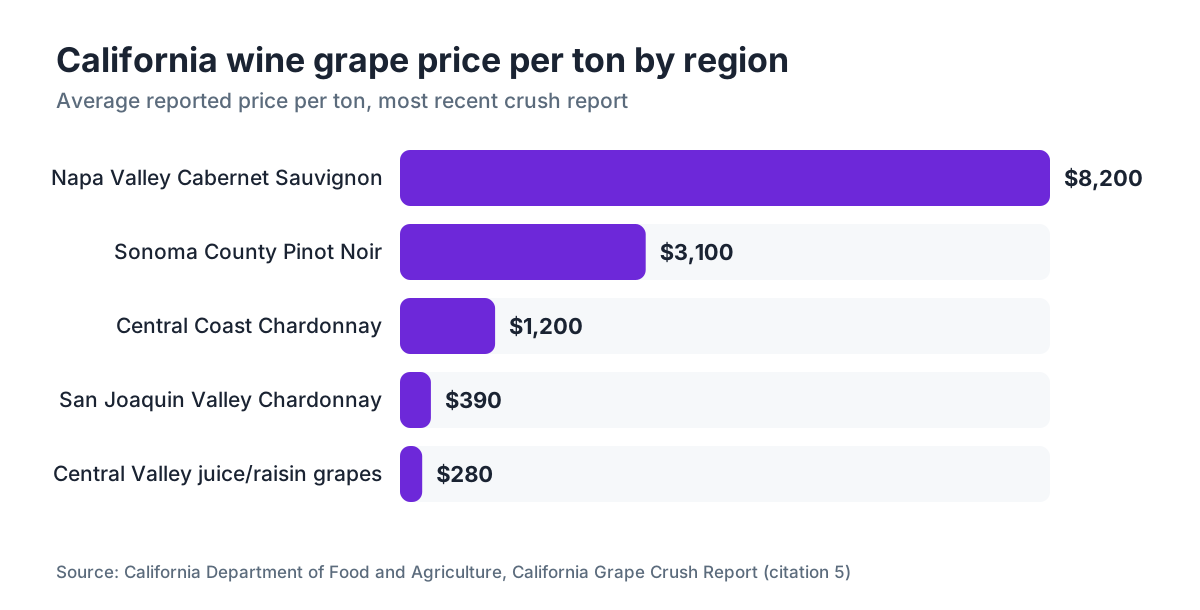
| Independent grower (contract fruit) | Highly variable; $2,000 - $8,000+ per ton depending on variety and AVA |
Those contract-fruit numbers track the real market in California and Washington, where premium Napa Cabernet can sell above $8,000 per ton and Central Valley juice grapes might fetch under $300 [5]. An independent grower's income is crop revenue minus operating costs, which in California run $2,000 to $5,000 per acre a year depending on labor, water, and spray bills [5].
Housing often comes with the job at estate wineries in rural areas. That can add $10,000 to $20,000 in effective value a year, but it also makes changing jobs complicated.
What does a typical vineyard year look like for a grape grower?
The vine doesn't care about your calendar. Here's an honest month-by-month sketch.
January and February are pruning months across most U.S. wine regions. Dormant pruning sets the vine's yield potential for the season and is the most consequential decision a grower makes all year. It's cold, slow work, and hard on your hands.
March and April bring budbreak and the first disease pressure. Powdery mildew (Erysiphe necator) can infect tissue within a day of budbreak in warm, humid weather. Spray programs start here. Cover sprays go on every 7 to 14 days depending on the product and weather [6].
May and June are canopy months: shoot thinning, positioning shoots on the trellis wires, and the first leaf pulling around the fruit zone to open up air flow and spray penetration. Irrigation scheduling gets real once the soils dry out.
July and August are about watching and managing. Veraison, the color change in red varieties, usually lands late July to mid-August depending on region and variety. After veraison the disease risk shifts and many growers stretch out fungicide intervals. Harvest samples start heading to the lab.
September and October are harvest, the most intense stretch of the year. Timing the pick, coordinating with the winery, running crews at odd hours, dealing with rain or smoke. Everything from the past nine months comes down to these weeks.
November and December mean cover crop seeding, equipment maintenance, end-of-year record submission, and planning. Good growers use this window to review spray records, scout for trunk pathogens that surface after leaf fall, and think through training decisions for the next pruning season.
What compliance and record-keeping requirements do grape growers face?
This is where small growers underestimate the workload. Compliance is not a once-a-year box to check.
At the federal level, the EPA Worker Protection Standard (WPS) covers any agricultural employer who uses or supervises the use of pesticides. It requires training workers within 30 days of hire (or before they handle pesticides), posting pesticide safety information at a central location, keeping decontamination supplies in the field, and holding onto records of pesticide applications for at least two years [7]. The EPA revised the WPS in 2015, and the revised rule took full effect in 2018.
The EPA says the WPS "protects over 2 million agricultural workers and pesticide handlers who work at farms, forests, nurseries, and greenhouses" [7]. If you have even one hired worker, you're in it.
State rules stack on top. California growers must file pesticide use reports with their county agricultural commissioner monthly, and restricted materials require a permit from that same office [1]. Washington requires pesticide application records be kept for two years and available for inspection by the Department of Agriculture [8]. Oregon, New York, and most other states run similar structures with their own timelines and forms.
Traceability tightens the screws further. Many large wineries now require growers to submit block-level spray records as part of the grape purchase agreement. If you can't produce clean records by block, variety, and date, you can lose the contract.
That's the real reason record-keeping systems matter. A spiral notebook works until it doesn't. VitiScribe was built for this exact problem: logging applications by block, auto-calculating restricted entry intervals, and generating the formatted reports counties and wineries actually want.
For the vineyard operations picture beyond compliance, UC Davis Cooperative Extension publishes annual cost-of-production studies by region and variety. Read them every year even if your numbers differ.
How do grape growers manage pests and diseases?
Integrated Pest Management (IPM) is the standard framework. Use the least disruptive tools first (monitoring, cultural practices, biological controls) and escalate to chemical applications only when thresholds are crossed. In practice most growers run a backbone fungicide program, because the cost of a Botrytis or powdery mildew outbreak dwarfs the cost of preventive sprays.
The major fungal diseases in U.S. vineyards are powdery mildew, downy mildew (Plasmopara viticola, mostly an eastern-humidity problem), Botrytis bunch rot, and the trunk diseases (Eutypa dieback, Botryosphaeria, Esca). Insect pests vary by region: leafhoppers, mealybugs, grape berry moth, and at some western sites, vine mealybug is the main worry. Phylloxera (Daktulosphaira vitifoliae) is the historical boogeyman and still dictates rootstock choices on many sites [6].
Spray timing leans on disease models. The UC IPM guidelines publish disease-risk thresholds based on temperature and leaf wetness duration [6]. WSU Extension runs analogous tools for cool-climate sites. With these models a grower can sometimes stretch intervals or skip an application when conditions don't favor disease, cutting both cost and chemical load.
Personal protective equipment, restricted entry intervals (REIs), and pre-harvest intervals (PHIs) are non-negotiable parts of any spray decision. Send workers into a block before the REI expires and you're breaking federal law and stacking up liability. Getting the REI math right, every time, on every product, is part of the daily record-keeping job.
What are the main business models for grape growers?
There are roughly four ways to make money growing grapes, and many operations run two or three at once.
Farming for a winery under contract is the most common model for mid-scale growers. The winery buys the fruit at a negotiated price per ton, often with quality bonuses tied to Brix, pH, and vine management. Contract length runs from one vintage to multi-year deals. One-year contracts give the winery flexibility and give the grower almost no room to plan capital investments.
Owning the vines and selling bulk wine is less common but real. The grower ferments the fruit, often under a custom-crush arrangement at a licensed facility, and sells the wine in bulk to wineries or negociants. That adds a processing margin and adds inventory risk.
Estate production, where the grower is also the winemaker and seller, is the full vertical. The economics can be excellent if the direct-to-consumer channel is strong, but the capital ask is serious. A small estate winery in California needs $300,000 to $500,000 in equipment and licensing before it sells a bottle, and that's before land.
Leasing vineyard land to another grower or winery is the fourth model. The landowner takes predictable income without operating headaches. Returns run lower than farming the land yourself, but so does the risk.
Region shapes all of these. A Paso Robles Cabernet grower plays a different market than a Hudson Valley Riesling grower. The paso robles wineries page gives a good sense of scale and style on California's Central Coast.
For how large destination wineries like Gervasi Vineyard or Ponte Winery blend estate growing with hospitality, those operations show the full vertical model at scale.
How do grape growers decide when to harvest?
Harvest timing is a judgment call built on data. There is no single right answer, and anyone who says there is hasn't grown enough fruit.
The inputs are Brix (sugar content, read with a refractometer or hydrometer), pH and titratable acidity from a lab, berry flavor and seed development by tasting, and the weather forecast. The winery's target specs layer on top. Most wineries hand over a picking range, say 24 to 26 Brix for a Napa Cabernet, but the grower knows whether the numbers are tracking ahead or behind.
Seed color and crunch matter more than Brix for flavor maturity. A berry can hit 26 Brix with green, bitter seeds and hard skin tannins. Good growers taste the fruit daily in the two weeks before target, more than they pull refractometer readings.
Weather overrides everything. A credible rain forecast five days out changes the whole calculation. You might pick a touch early to protect quality rather than risk split berries and a Botrytis explosion. That call costs yield but saves the wine and the contract.
For sampling method, UC Davis Cooperative Extension recommends collecting 100 to 200 random berries per block, from multiple vine positions and both sides of the canopy, for a representative read [2]. Pull samples at the same time of day across weeks so temperature-driven Brix swings don't skew the comparison.
How does a grape grower manage irrigation and water rights?
Water is the input with the most legal complexity outside of pesticides. In the western U.S., water rights run on prior appropriation: first in time, first in right. If your right is junior to a senior user upstream, drought years can cut you off entirely. Knowing your priority date and annual allocation is as basic as knowing your soil type [9].
On the agronomic side, vine water status gets measured with a pressure bomb (stem water potential). The pressure bomb reads how tightly water is held in leaf tissue. Values more negative than about -1.2 MPa at midday usually signal real water stress in most varieties, though target ranges shift by growth stage and management style [2]. Some growers run moderate deficit irrigation on purpose after veraison to concentrate flavor, slow berry growth, and trim disease pressure.
Drip irrigation is standard in the West. Surface irrigation (flood or furrow) hangs on in some older Central Valley plantings. Overhead sprinklers still appear in frost-prone spots to protect budbreak, though wind machines have replaced them for most frost events in wine regions.
Scheduling tools include soil moisture sensors (capacitance probes, tensiometers), weather-based evapotranspiration models (California's CIMIS network publishes daily ET data by region [9]), and direct vine measurement with the pressure bomb. Most serious growers use at least two of the three.
What are the biggest financial risks grape growers face?
Frost is the fastest way to lose a year's revenue. A single frost event at budbreak can wipe out 50 to 100% of a crop in the affected blocks. Frost protection (wind machines, heaters, overhead sprinklers) is expensive to install and run, and cheap next to a crop loss.
Smoke taint from wildfire has become a material risk in California, Oregon, and Washington since roughly 2017. Smoke compounds (guaiacol, 4-methylguaiacol, and bound glycoconjugates) can make wine unsalable even when grapes look and taste fine at harvest. There's no agreed action threshold, and smoke taint testing runs $150 to $400 per sample. Nobody has clean public data on crop insurance coverage or industry-standard thresholds here yet.
Contracting risk is underappreciated. A winery that cancels a one-year contract leaves a grower holding fruit and no buyer 60 days before harvest. This happened at scale during the 2008 to 2009 recession, and again in 2023 to 2024 when several California wineries cut grape purchases over inventory buildups [5].
Input costs have climbed hard since 2020. Fertilizer, diesel, and labor costs all rose 20 to 40% between 2020 and 2023 across most California growing regions [5]. Growers on thin margins felt it.
Crop insurance through USDA's Risk Management Agency covers some of this. Multi-Peril Crop Insurance (MPCI) is available for wine grapes in most major AVAs, with coverage levels from 50 to 75% of established yield history [10]. The application deadline is typically March 15 for the current crop year in California.
How do grape growers stay current on research and regulations?
Extension services are the honest answer. UC Cooperative Extension farm advisors visit vineyards, run field days, and publish free research-based guides on everything from rootstock performance to nematode management [2]. Cornell's viticulture team covers the Finger Lakes and Hudson Valley closely, including variety trials for cold-hardy cultivars that matter in the Northeast [3]. WSU Extension covers the Columbia Valley and Washington's growing wine regions with solid irrigation and cover crop research [4].
The American Society for Enology and Viticulture (ASEV) publishes the American Journal of Enology and Viticulture, the peer-reviewed research source most relevant to U.S. growers. Membership runs about $95 to $175 a year depending on category and gets you full journal access.
For regulatory updates, get on your county agricultural commissioner's email list and check your state department of agriculture's site directly. Pesticide label changes, new restricted material permits, and WPS enforcement priorities land there before they land anywhere else.
For the day-to-day records behind all of this, VitiScribe organizes spray logs, scouting notes, and compliance documents by block, so pulling a season's records for a winery audit or county inspection takes minutes instead of a half-day in the binders.
Industry groups like the Wine Institute, the Washington Wine Commission, and regional grower associations (the California Association of Winegrape Growers, for example) send legislative updates and often run compliance workshops in the off-season. Worth attending at least every few years.
Frequently asked questions
How long does it take to become a grape grower?
Most people who become vineyard managers or independent growers spend 3 to 7 years in the field before taking primary responsibility. A two-year viticulture certificate from UC Davis or a similar program, paired with two or three harvest internships, is a realistic fast path. A four-year degree adds depth but takes longer. Field experience is not optional; classroom time alone won't prepare you for real vine management calls.
Do grape growers need a license or certification?
There's no single national license for grape growers. Anyone applying pesticides commercially needs a Qualified Applicator License or Certificate in most states, or must work under a licensed applicator. California requires a County Agricultural Commissioner permit for restricted materials. EPA Worker Protection Standard training is mandatory for any operation with hired workers. Some states also require continuing education credits to keep applicator licenses current.
What is the difference between a grape grower and a viticulturist?
In practice the terms overlap. Viticulturist usually implies formal training in vine science and is the job title at larger estates or consulting outfits. Grape grower is broader and covers anyone farming wine or table grapes commercially, degree or no degree. A viticulturist advises on vine physiology, rootstock selection, and canopy architecture; a grape grower does those things plus runs the crews, equipment, and records.
How many acres can one grape grower manage?
One person without much crew support can realistically handle 20 to 40 acres of wine grapes through a full season, depending on how mechanized the operation is. With a crew foreman and three to five seasonal workers, a vineyard manager can oversee 200 to 500 acres. Highly mechanized flat-ground operations in the Central Valley run at much larger scales with proportionally less labor per acre.
What are the EPA Worker Protection Standard requirements for grape growers?
The WPS requires growers who employ agricultural workers to train workers within 30 days of hire (before any pesticide exposure), post pesticide safety and application information at a central location, provide decontamination supplies in the field, provide emergency assistance if workers are exposed, and keep records of pesticide applications for two years. The rule applies to any farm using pesticides with hired workers, including H-2A visa workers.
What pesticide records are grape growers required to keep?
Federal law (FIFRA and the WPS) requires keeping records of restricted-use pesticide applications for two years, including product name, EPA registration number, total amount applied, location, date, and applicator name. State rules often go further: California requires monthly reporting to the county agricultural commissioner for all pesticide applications, not only restricted-use products. Most states require records be available within 24 to 72 hours of an inspector's request.
How do grape growers price and sell their fruit?
Pricing is typically negotiated before the season in a written purchase agreement setting price per ton, quality parameters (Brix range, pH, absence of smoke or mold), and delivery terms. Prices vary enormously by variety and AVA: Napa Valley Cabernet Sauvignon averaged over $8,000 per ton in recent California crush reports, while Central Valley Chardonnay averaged under $400. The California Department of Food and Agriculture publishes annual crush reports with district-level pricing.
Can a small-scale grape grower make a living without owning a winery?
Yes, but margins are tighter than most people expect. A 20-acre vineyard in a premium AVA producing 3 to 4 tons per acre at $2,000 to $4,000 per ton grosses $120,000 to $320,000. After operating costs of $2,000 to $5,000 per acre, net income before debt service often lands at $40,000 to $120,000. In lower-priced regions the math gets very tight. Long-term contracts with established wineries and low debt are the main survival factors.
What cover crops do grape growers use and why?
Cover crops in row middles reduce erosion, add soil organic matter, fix nitrogen (legumes), and manage vine vigor by competing for water and nutrients. Common choices include cereal rye, mustard, clovers, fescues, and grass-legume mixes. WSU Extension and UC Cooperative Extension both publish regional cover crop guides. The choice depends on whether the grower wants to suppress or add vine vigor and how much rain the site gets.
What is a restricted entry interval (REI) and how does it affect grape growers?
A restricted entry interval is the period after a pesticide application when workers cannot enter the treated area without full personal protective equipment. REIs range from 4 hours to several days depending on the product's toxicity. The REI is printed on every pesticide label, and the label is a legal document. Sending workers into a block before the REI expires violates EPA WPS rules and can bring fines, permit suspension, or liability if a worker is harmed.
How do grape growers handle frost protection?
The main tools are wind machines (large fans that mix warmer air above the inversion layer with cold air near the ground), overhead sprinklers (which release latent heat as water freezes on vine tissue, protecting buds down to about 28 degrees F if water keeps flowing), and propane or diesel heaters for small blocks. Wind machines are most common at estate scale. Growers watch overnight temperature forecasts obsessively during budbreak, when vines are most vulnerable to frost.
What rootstocks do grape growers use and why does it matter?
Rootstocks are chosen to resist soil pests (mainly phylloxera and nematodes), tolerate soil conditions (high pH, salinity, drought), and shape vine vigor. Common California choices include 101-14 Mgt, 3309C, 110R, and 1103P, each with different drought tolerance and vigor. Replanting on a site with the wrong rootstock for the soil and water is an expensive multi-decade mistake, so rootstock selection gets serious attention from extension advisors and consultants.
How does smoke taint affect grape growers and what can they do about it?
Wildfire smoke deposits volatile phenols on and inside berries, which winemaking can convert into smoke-flavored compounds that make wine unsalable. The risk window runs from budbreak through harvest. Growers in fire-prone regions now test fruit for smoke markers (guaiacol and related glycoconjugates) before harvest. There's no proven field mitigation; kaolin clay sprays show some early promise but are not standard practice. Crop insurance coverage for smoke taint varies by policy and is still evolving.
What are the best educational programs for aspiring grape growers?
UC Davis offers a four-year B.S. in Viticulture and Enology and an online Viticulture Certificate through UC ANR, well-suited to California and warm climates. Cornell CALS covers cool-climate varieties and Northeast pest management. WSU Extension serves Pacific Northwest growers with irrigation and arid-site content. Hands-on internships through the ASEV and regional grower associations supplement all of these. Community college viticulture programs in California and Oregon offer affordable entry points for career changers.
Sources
- California Department of Pesticide Regulation, Pesticide Use Reporting: California growers must file pesticide use reports with their county agricultural commissioner monthly, and applications of restricted materials require a permit.
- UC Davis Department of Viticulture and Enology: UC Davis offers B.S. and certificate programs in viticulture; extension publishes sampling methodology recommending 100-200 random berries per block and stem water potential thresholds.
- Cornell University College of Agriculture and Life Sciences, Viticulture and Enology: Cornell's viticulture program covers cool-climate varieties and integrated pest management specific to the Northeast.
- Washington State University Extension, Viticulture: WSU Extension runs viticulture workshops and a certificate oriented toward Pacific Northwest conditions, including irrigation for semi-arid sites and cool-climate disease tools.
- California Department of Food and Agriculture, California Grape Crush Report: Premium Napa Cabernet can sell for over $8,000 per ton; Central Valley juice grapes under $300 per ton; operating costs average $2,000-$5,000 per acre per year in California; input costs rose 20-40% from 2020 to 2023.
- UC IPM, Grape Pest Management Guidelines: Powdery mildew can infect tissue within a day of budbreak; cover sprays go on every 7-14 days depending on product and weather; disease-risk thresholds based on temperature and leaf wetness are published.
- U.S. EPA, Agricultural Worker Protection Standard (WPS): The WPS requires worker training within 30 days of hire, central posting, decontamination supplies, and two-year record retention; EPA states it protects over 2 million agricultural workers and pesticide handlers.
- Washington State Department of Agriculture, Pesticide Recordkeeping: Washington requires pesticide application records be kept for two years and available for inspection by the Department of Agriculture.
- California Department of Water Resources, CIMIS Network: CIMIS publishes daily evapotranspiration data by region for irrigation scheduling; western U.S. water rights governed by prior appropriation doctrine.
- USDA Risk Management Agency, Crop Insurance: Multi-Peril Crop Insurance is available for wine grapes in most major AVAs with coverage levels from 50-75% of established yield history; California application deadline is typically March 15.
- U.S. Bureau of Labor Statistics, Occupational Employment and Wage Statistics: BLS groups grape growers under agricultural managers and agricultural workers; wage data used to construct the compensation table.
Last updated 2026-07-09