First year pruning grape vines: what to cut, when, and why it matters
TL;DR
- In year one, your only real job is picking one strong upright shoot and cutting everything else off.
- No fruit.
- No complex decisions.
- That single cane becomes the permanent trunk.
- Get it right and years two and three go easy.
- Get it wrong and you fight a weak, multi-stemmed vine for the next decade.
What does a grape vine look like in its first year?
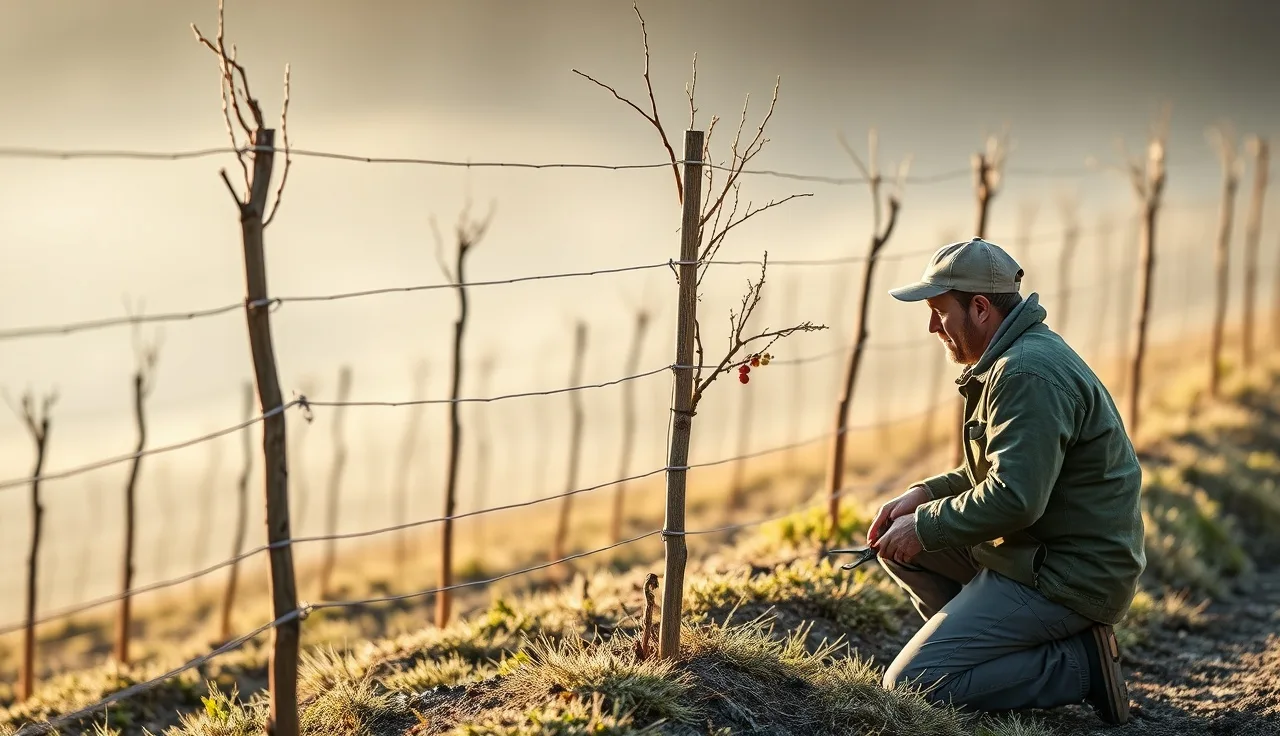
A newly planted grape vine looks almost nothing like a mature one. You get a small dormant cutting or bare-root plant with a few short canes, maybe one or two buds pushing, and a root system still finding its feet. That's it. No trunk, no cordons, no canopy.
By midsummer of year one, a healthy vine in decent soil with enough water might carry three to six shoots reaching two to four feet, sometimes longer in a good spot. The shoots are soft and green. Bark at the base is starting to harden but still shows plenty of green tissue. You'll see tendrils forming, leaves expanding, and often lateral shoots branching off the primaries.
What a first-year vine does NOT look like is a fruit-bearing plant. That's the whole point. Every bit of energy this vine makes should go straight into root development and the permanent wood that will hold up your future canopy. Cornell Cooperative Extension puts it plainly: a vine planted in spring should not be allowed to set fruit in year one under any circumstances [1].
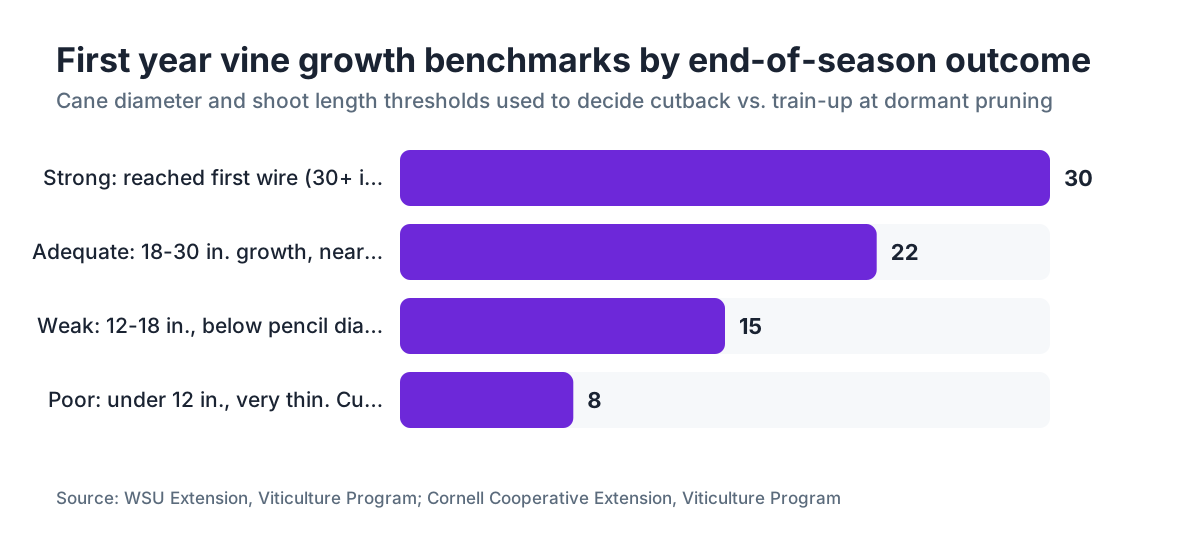
Knowing what the vine looks like at each stage helps you cut well. The shoot you keep by fall is the one that grew hardest from the lowest point on the plant, ideally near the graft union on grafted vines or from the base on own-rooted plants. It should be straight, lignified brown by November, and at least pencil thick (roughly 3/8 inch) at the base.
Why does first year grape vine pruning matter so much?
The cuts you make in year one echo across the 30 to 50 year life of a commercial vine. That sounds like pressure. The cuts themselves are simpler than most new growers expect.
First-year pruning is not about shaping a canopy. It's about building a single straight trunk of good diameter before the vine goes dormant. Washington State University Extension explains that training a vine to one upright shoot in year one sends carbohydrate reserves into the roots and the base of the trunk, which hands you a sound plant to work with in years two and three [2].
A vine left to sprawl in year one, shoots running every direction with no guidance toward the wire, is a headache to train later. You end up with a short crooked trunk, or several trunks fighting each other. Poor first-year management drives some of the retraining commercial blocks face in year two [10].
There's a disease angle too. Too many shoots and too much leaf on a young vine makes a humid pocket that powdery mildew and botrytis love. Neither one ruins your year one, since there's no crop to lose. But early infection seeds inoculum that comes back to haunt you. UC Davis notes that Botrytis cinerea overwinters in infected tissue and turns into a recurring problem [3].
When should you do first year pruning? Timing by season
First-year vine work involves two separate rounds of cutting, and mixing them up is the mistake beginners make most.
Round one happens at planting or right after bud break in spring. When you set a bare-root vine or rooted cutting, prune the top back to two or three buds. It looks brutal. It forces energy into a few shoots instead of scattering it across a big weak canopy. A pot-grown vine with an established root system gives you a little more room, but the idea holds.
Round two is the one that counts, and it happens during dormancy, usually November through February depending on where you are. After the vine drops its leaves, you read what grew. Pick the single best shoot (now a cane). Cut it to two to four buds if the vine was weak, or train it up toward your first wire if it grew well. Everything else comes off completely.
A rough seasonal timeline looks like this:
| Timing | Action |
|---|---|
| Planting (spring) | Cut top back to 2-3 buds |
| Early summer | Remove all flower clusters immediately |
| Midsummer | Tie the strongest shoot loosely to a stake |
| Late summer | Pinch lateral shoots to 1-2 leaves each |
| After leaf drop (fall/winter) | Select one cane, remove all others, cut to target bud count |
The dormant window matters. Prune too early, while the vine still moves carbohydrates, and you can knock down its cold hardiness. Prune too late, after buds have pushed, and you waste the energy the vine already spent on those early shoots. Most extension programs say prune after the coldest temperatures pass but before bud swell, which across most US wine regions lands in late January to early March [2].
How to prune grape vines in the first year, step by step
Here's the actual process, no theory.
Step 1: Read the vine before you touch it. Walk the row in fall after leaf drop. Look at the base of each plant. Count the shoots. Note which one is longest, thickest, and closest to vertical. That's almost certainly your keeper.
Step 2: Check diameter. A cane under 3/8 inch at its base (roughly pencil thick) didn't grow hard enough to carry good bud development. If that's your only decent shoot, you have a choice. Cut back to two buds and give the vine another partial season to load reserves, or accept a weak start in year two. Most experienced growers cut back and wait.
Step 3: Make the cut. Once you've picked the keeper, take everything else back to the base. No stubs. Stubs hold fungal pathogens. Then decide how to handle the keeper based on its length and your trellis. For a vertical shoot positioning (VSP) trellis with a first wire at 30 to 36 inches, a cane that reached the wire gets tied in and cut just above it, two buds left to push in spring. A cane that fell short gets cut to two to four buds and you train again next year.
Step 4: Seal large cuts if you farm where Eutypa lata or trunk disease is a problem. UC Davis research points to wounds larger than 1 cm benefiting from a wound sealant within 30 minutes of the cut, especially in wet conditions [3].
Step 5: Tie the selected cane to the training stake. Use a soft tie, never wire or anything that can girdle. The vine moves as it grows and a rigid tie cuts into young tissue.
Step 6: Write down what you did. This is where small operations fall apart. You want a record of which vines needed cutback, which reached the wire, and which showed disease or structural trouble. Those notes are the start of a real vine health map. Tools like VitiScribe let you log pruning decisions vine by vine and flag problem plants, which earns its keep once you're running a few hundred vines and can't hold it all in your head.
Step 7: Get rid of the pruning brush. Don't leave it in the row. Shred it or haul it out. Diseased wood on the vineyard floor is a reservoir.
What tools do you need and how should you sanitize them?
First-year vines need nothing fancy. A sharp pair of bypass hand pruners handles year-one wood, which is all one-year-old cane. Anvil pruners crush tissue. Bypass pruners cut clean. Clean cuts callus faster and give pathogens less to work with.
Sanitizing is not optional, and it gets skipped constantly. Pruning shears are the most efficient disease-spreading tool in a vineyard when they aren't cleaned between vines or at least between rows. Eutypa lata, Botryosphaeria species, and other wood pathogens ride from infected to healthy wood on dirty blades.
The EPA Worker Protection Standard (WPS) under 40 CFR Part 170 sets decontamination rules for workers handling pesticide-treated tools or working in treated areas [4]. Sanitizing pruners between vines doesn't technically fall under WPS, but using a disinfectant with pesticide-like properties (some quaternary ammonium compounds or sodium hypochlorite solutions) puts you in a chemical-handling situation worth knowing about.
In practice, a 10 percent bleach solution (1 part household bleach to 9 parts water) works, but it eats metal over time. Plenty of growers now run 70 percent isopropyl alcohol in a spray bottle or a commercial pruner disinfectant. Whatever you pick, wipe the blades after. Wet blades carry disinfectant into the cut and that can slow callus formation.
Keep the pruners sharp. A dull blade tears and crushes instead of slicing. Sharpen at the start of the season and check every two to three hours of use.
How do you look after grape vines during the first growing season?
First-year care runs well past pruning. Getting a vine through its first season healthy takes attention to water, nutrition, weed pressure, and a handful of pests and diseases.
Water is the biggest single driver of first-year performance. A young vine with a small root system can't outcompete grass and weeds for soil moisture. Drip at one to two gallons per hour, two to three times a week in dry stretches, is a reasonable place to start, though real needs shift with soil texture and heat. Sandy soils may want daily water in August. Heavy clay wants far less. WSU Extension recommends checking soil moisture with tensiometers or a feel test at 12-inch depth instead of watering on a fixed calendar [2].
Weed control under the vine matters more than people think. A two-foot weed-free strip down the row cuts competition for water and nutrients enough to show up in cane diameter by fall. Hand cultivation, mulch, or a contact herbicide labeled for vineyards (read your state label) all work.
Go light on nitrogen in year one. A small vine pushed into heavy vegetative growth makes soft, poorly lignified wood that cold and disease pick apart. UC Davis guidelines say hold off on real nitrogen until the vine is established and keep year-one feeding to a modest starter rate [3].
Strip flower clusters the moment you see them. Yes, the vine might try to set a berry or two. Pull them. The energy that fruit steals from root building is never worth the thrill of a first cluster.
What should a healthy first year vine look like by fall?
By October in most wine regions, a well-run first-year vine should carry one dominant shoot lignified tan to brown down most of its length. The cane should show nodes spaced two to four inches apart. (Internode length is a rough vigor read: very long ones point to excess nitrogen or water, very short ones to stress.) The base of the cane should be pencil thick or better.
You can't see root development, but a vine that grew well up top almost certainly grew well below. Cornell research on Vitis vinifera establishment shows a positive correlation between first-year shoot length and root dry weight at season's end [1].
If your vines fall short of that picture, the usual causes are planting too late, too little water, too much weed competition, gopher or vole root damage, or weak nursery stock. Nursery quality swings a lot. A vine that arrived with a thin, underbuilt root system will always start slow, and there's not much you can do beyond giving it time and good conditions.
A vine that put on only six to twelve inches total, with a cane thinner than a pencil, is a candidate for cutback at the end of year one. That means treating year one as a lost season and restarting the clock in year two. Frustrating, often the right call.
What changes for 2nd year grape vine pruning?
Second-year pruning keeps the same dormant timing but the goal shifts hard. In year two you have (ideally) a trunk of some height tied to a stake, and now you're building either a bilateral cordon or a head-trained form, depending on your system.
For a VSP trellis headed toward a bilateral cordon, year-two dormant pruning usually means picking two shoots from the top of the trunk to become your permanent cordon arms. Those get tied horizontally to the first wire and run outward. Everything below the cordon zone comes off. In year three you start managing fruiting positions along the cordons, which is where spur pruning or cane pruning becomes the annual habit for the rest of the vine's life.
The jump in difficulty from year one to year two is real. Year one is one decision: keep this shoot, cut the rest. Year two asks you to understand your training system and lock in the permanent architecture of the vine.
Common year-two mistakes: cordon arms too thin or too short, not pulling every sucker from below the graft union hard enough, and letting too many trunk shoots run, which drains energy from cordon extension. WSU Extension's viticulture training materials walk through these second-year decisions in detail and are worth reading before you pick up the shears [2].
What training systems affect how you prune in year one?
The system you're building toward shapes a few year-one decisions, though less than it will later on.
Headed toward a bilateral cordon (the common commercial system for mechanized or semi-mechanized blocks), you want your year-one trunk to reach at least the first cordon wire, usually 30 to 42 inches. If it got there, good. If not, prune to two or three buds and aim for the wire in year two.
For a head-trained system (traditional in places like California's old-vine Zinfandel blocks and much of Spain), the target height is lower, often 24 to 30 inches, and the permanent structure is a compact head with spur positions radiating out. The year-one job is identical (single shoot, single trunk), but the height target and later branching call differ.
VSP with cane pruning, popular for cool-climate varieties like Pinot Noir and Riesling, follows the same year-one logic, but years two and three turn on picking renewal canes instead of laying down permanent cordons.
Here's the point: know your end-state system before you plant. The trellis you install, the spacing you set, and the first-year staking all flow from it. Switching systems after the vine is three or four years old is expensive and sets the vine back badly.
What are the disease and pest risks you need to manage during year-one pruning?
Pruning wounds are the main door for the most damaging perennial diseases of grapevines. This is not a small concern.
Eutypa lata causes Eutypa dieback (also called dying arm), and it enters through pruning wounds, mostly in wet weather. Even 2.5 mm of rain after pruning can trigger ascospore release and infection in the wrong conditions. UC Davis research found wounds stay open to Eutypa infection for up to six weeks after pruning [6]. Timing your cuts after the major winter rains in California's North Coast cuts that risk a lot.
Botryosphaeria species drive a complex of trunk diseases that are showing up more in warm, dry wine regions. Like Eutypa, they come in through pruning wounds. Cornell University research has documented Botryosphaeria trunk diseases in New York vineyards at incidence rates high enough to move long-term vineyard economics [7].
On a year-one vine, the wound is large relative to the whole plant, so protection counts. Applying a registered wound protectant paste or paint (products with Trichoderma species, Bacillus subtilis, or registered fungicides like thiophanate-methyl) within 30 minutes of cutting is the standard in disease-prone climates.
Phylloxera isn't a pruning issue in year one, but it should drive your rootstock choice before you plant. In regions with phylloxera (most of California's wine country and many others), own-rooted Vitis vinifera will fail. Use grafted vines on the right rootstock.
For crews pruning, the EPA Worker Protection Standard (40 CFR Part 170) applies if any pesticide went on the vineyard within the restricted-entry interval [4]. Even with no dormant sprays, confirm the situation before you send workers into the rows.
Record-keeping for first year vine pruning: what to track and why
Plenty of growers write off year-one pruning as too simple to record. That's a mistake that costs them information for years.
What to capture per vine, or at least per row block: planting date, planting material source and rootstock/variety, whether the vine reached the first wire in year one, whether it needed cutback, any disease symptoms seen, and any vines dead or missing on arrival. That record is your baseline vine health map.
By year three, when vigor and yield start to vary across the block, your year-one notes tell you whether a weak vine was always weak (usually a root or planting issue) or whether it fell off after a strong start (disease, damage, or management). The diagnostic value is real.
On compliance, pesticide application records, including any wound sealant that's a registered pesticide, have to be kept at least two years under most state rules and longer under some. California's Department of Pesticide Regulation requires written records of all restricted materials applications [5]. Check your state.
Digital records pay off fast even at small scale. VitiScribe is built for vineyard field operations and compliance records, and the vine-level tracking is exactly right for this kind of multi-year vine history.
Frequently asked questions
How many buds should you leave on a grape vine after first year pruning?
If the vine was vigorous and reached your first trellis wire, leave two buds at the top of the selected cane to push next spring. If the vine was weak and fell short, cut back to two or three buds total and let it rebuild. The rule is simple: weak vine, fewer buds. Extra buds on a weak vine just spread thin resources across shoots that won't develop well.
Can you let a grape vine fruit in its first year?
No. Pull any flower clusters as soon as you see them. A first-year vine lacks the root system and stored carbohydrates to carry fruit without wrecking trunk establishment. One season of grapes is never worth the setback to long-term structure. Cornell and WSU extension both call for zero crop in year one as standard practice on commercial plantings.
What is the difference between pruning grape vines in the first year versus later years?
First-year pruning is almost entirely about picking and training a single trunk shoot. You're not managing fruiting positions, shoot density, or canopy shape yet. From year two on, pruning shifts to building and then maintaining the permanent cordon or head, and eventually to balancing vegetative growth against fruit load each season. Complexity climbs sharply with every year.
Should you use wound sealant when pruning first year grape vines?
In regions with Eutypa lata or Botryosphaeria pressure (most of California, parts of the Pacific Northwest, and humid Eastern regions), yes. Apply a registered wound protectant within 30 minutes of cutting on any wound larger than roughly 1 cm. UC Davis research shows wounds stay open to Eutypa infection for up to six weeks. In low-pressure regions, small cuts on young wood may not need it, but it's cheap insurance.
How do you look after grape vines in the first winter?
After dormant pruning, check tie material so nothing girdles the trunk as wood swells, confirm your stakes are solid, and manage cover crop or growth in the row middles. In cold climates (USDA zones 5 to 6), hill soil up around the base of the vine for freeze protection. Pull that mound back down in spring before growth starts.
What does a grape vine look like when it needs to be cut back rather than trained up?
A vine that needs cutback rather than training shows one or more of these: cane diameter thinner than a pencil (under 3/8 inch), total shoot growth under 12 inches for the season, several weak shoots with no dominant one, or root stress signs (pale leaves, early leaf drop). Cutting back to two or three buds buys the vine another season to build reserves before you push it toward the wire.
How far apart should first year grape vines be staked?
Each vine needs its own training stake, separate from the trellis end posts. Individual stakes at each vine position, usually bamboo or fiberglass, 48 to 60 inches tall, give the growing shoot something to tie to as it climbs. Spacing within the row comes from your planting plan, typically 4 to 8 feet between vines depending on variety, vigor, and system. The stake just keeps the trunk growing straight up.
When is it too late to prune grape vines in the first year?
Dormant pruning after buds start pushing in spring wastes the energy the vine already put into those early shoots. Generally, pruning after you see half-inch green tip counts as late, though it isn't a disaster in year one. If you miss the window, do it as soon as you can and take the minor setback. Leaving the vine unpruned through a whole second season does far more harm than slightly late dormant pruning.
Do grafted and own-rooted grape vines need different first year pruning approaches?
The mechanics are the same, but on grafted vines you must remove every shoot below the graft union, hard and permanently. Those suckers come from the rootstock, not the scion, and left alone they eventually take over the vine. On own-rooted vines, basal shoots below your chosen trunk are simply competition and get removed, but there's no graft union to protect.
How does 2nd year grape vine pruning differ from first year?
In year two you move from building a trunk to building canopy architecture. Dormant pruning that year means choosing the shoots that become your permanent cordon arms or, in cane-pruned systems, picking the canes that carry this year's crop and the renewal spurs for next year's canes. The single-shoot simplicity of year one gives way to real decisions about balance, position, and your training system.
What pests should you watch for on first year grape vines?
Leafhoppers, spider mites, and grape berry moth can hit young vines, though crop loss isn't a year-one worry. The bigger threats are below ground: gophers and voles can destroy a root system outright, and phylloxera kills own-rooted vinifera over time. Above ground, powdery mildew can settle on young shoot tissue in humid weather. Scout weekly from bud break through midsummer even in year one.
How much water does a first year grape vine need?
A first-year vine with a small root system needs steady, moderate irrigation. In warm, dry climates, one to two gallons per dripper per day during peak summer heat is a reasonable start, adjusted for soil texture and temperature. Sandy soils need more frequent water; heavy clay holds it longer. Aim to keep the top 18 to 24 inches of soil at field capacity without waterlogging, which favors root rot pathogens.
What are the most common mistakes in first year grape vine pruning?
The big ones: leaving multiple shoots instead of picking one, letting the vine fruit, skipping the stake and tie so the shoot grows crooked or flat, using dull or dirty pruners, leaving stub cuts that hold disease, pruning too early in fall while the vine still stores carbohydrates, and recording nothing. Every one of these is fixable in later seasons except maybe disease introduced through a bad cut.
Does the grape variety change how you approach first year pruning?
Timing and selection logic hold across varieties, but vigor differences matter. High-vigor varieties like Zinfandel or Grenache on rich soil may shoot past your first wire in year one and need earlier tying and lateral management. Lower-vigor varieties, or any variety on poor, shallow soil, may need a second season of trunk building. Variety-specific extension resources from UC Davis or Cornell note typical first-year growth for varieties grown in your region.
Sources
- Cornell Cooperative Extension, Viticulture Program: A vine planted in spring should not be allowed to set fruit in year one; Cornell research documents positive correlation between first-year shoot length and root dry weight
- Washington State University Extension, Viticulture and Enology: Training a vine to a single upright shoot in year one directs carbohydrate reserves into the root system and trunk base; WSU recommends pruning after coldest temperatures but before bud swell, typically late January to early March
- UC Davis Cooperative Extension, Viticulture: Botrytis cinerea can overwinter in infected tissue; wound sealant application within 30 minutes of cuts is recommended for wounds larger than 1 cm; conservative nitrogen in year one
- U.S. EPA, Worker Protection Standard, 40 CFR Part 170: EPA Worker Protection Standard requires specific decontamination protocols for workers handling pesticide-treated tools or working in treated areas within restricted-entry intervals
- California Department of Pesticide Regulation: California requires written records of all restricted materials pesticide applications, relevant to wound sealant products that are registered pesticides
- UC Davis Department of Viticulture and Enology, Trunk Disease Research: Eutypa lata infects through pruning wounds; rainfall of even 2.5 mm after pruning can drive ascospore release and infection; wounds remain susceptible up to six weeks; timing pruning after major winter rains reduces risk
- Cornell University, Viticulture and Enology Program, Trunk Disease: Cornell research has documented Botryosphaeria trunk diseases in New York vineyards at incidence rates significant enough to affect long-term vineyard economics
- WSU Extension, Soil Moisture Monitoring in Vineyards: WSU Extension recommends monitoring soil moisture with tensiometers or feel-testing at 12-inch depth rather than irrigating on a fixed calendar schedule
- UC Davis Cooperative Extension, Vine Nutrition and Fertilization: UC Davis guidelines recommend conservative nitrogen application in year one, holding off significant applications until after the vine is established and keeping year-one fertilization to a modest starter rate
- Cornell Cooperative Extension, Grape IPM Guide: Poor first-year management drives retraining of vines in year two; early disease infection establishes inoculum in the vineyard
Last updated 2026-07-09