Grapevine canopy management: the complete field guide
TL;DR
- Canopy management is how you control the amount and arrangement of leaves, shoots, and fruit clusters inside the vine's fruiting zone.
- Done right, it improves air circulation, light penetration, spray coverage, and fruit quality.
- The main tools are shoot thinning, leaf removal, hedging, and shoot positioning.
- Timing and intensity depend on your trellis system, variety, and target wine style.
What is canopy management in grapevines, and why does it matter?
Canopy management is every deliberate move you make to control how a vine's shoots and leaves fill the space around its fruiting zone. That covers shoot thinning, leaf pulling, hedging, shoot positioning, and summer pruning, all aimed at one thing: getting the right amount of sunlight and air into the cluster zone at the right time.
A dense, unmanaged canopy is one of the most reliable ways to lose money in a vineyard. Shaded clusters produce fruit with lower sugar accumulation, weaker color, elevated malic acid, and more bunch rot [1]. Cluster light exposure is the single biggest controllable driver of anthocyanin and tannin development in red varieties, outweighing soil or irrigation decisions in many seasons [2].
Here is the part growers underestimate. Canopy density also decides whether your fungicide actually reaches the target. A thick canopy deflects spray before it hits the cluster zone. If you're spending $40 to $80 per acre per application on fungicide and it isn't penetrating, you're burning inputs and getting no protection.
The goal is not a bare vine. Leaves are your photosynthetic engine. You want a canopy where roughly 50 to 90 percent of the leaves are sunlit, where you can see light flecks on the ground at midday, and where the cluster zone has 1 to 3 leaf layers between the fruit and open sky on the sun-exposed side.
What are the main canopy management techniques used in vineyards?
There are five core techniques. Most vineyards run some mix of all five across the season.
Shoot thinning comes earliest, usually at 6 to 12 inches of shoot growth. You strip excess shoots from the cordon or head, leaving a target density, usually 4 to 6 shoots per foot of cordon in most VSP (vertical shoot positioning) systems. This is your highest-leverage move because you're controlling density before it becomes a problem instead of chasing it after.
Shoot positioning means tucking or training shoots into the trellis wires so they grow vertically instead of sprawling. Sounds trivial. It isn't. Positioned shoots form an even, single-layered curtain of foliage instead of a tangled mass. WSU Extension work on positioning in Riesling and Chardonnay blocks showed steady light-exposure gains even without leaf removal when positioning was done before bloom [3].
Leaf removal is pulling leaves from the cluster zone, usually the first 4 to 8 leaves from the base of each shoot, on one or both sides. Early removal (before or at bloom) beats post-set removal for disease control. It's also harder on the vine, so you calibrate by variety and climate. In hot inland blocks, aggressive early removal on the afternoon side can sunburn clusters.
Hedging (also called topping) cuts the tops off shoots that have climbed above the top trellis wire. Most commercial operations do it mechanically. The catch: it triggers lateral shoot growth, which can re-densify the canopy fast. Hedge too early and you end up with a thicker canopy by veraison than you started with.
Lateral shoot removal or trimming is the follow-up to hedging. Laterals push from the axils of primary leaves once you hedge or once the shoot hits a certain length. Removing or shortening them is tedious but stops the re-densification problem. In systems like Scott Henry or Smart-Dyson, lateral management often matters more than primary shoot management.
How does canopy management affect fruit quality and wine style?
The link between light exposure and fruit chemistry is well-documented. Sunlit clusters in red varieties build more anthocyanins (color compounds) and more of the tannin structures tied to wine stability and mouthfeel [2]. Shaded clusters run higher in methoxypyrazines, the bell-pepper, herbaceous aromas most obvious in Cabernet Sauvignon and Sauvignon Blanc. If you want ripe dark-fruit Cabernet, you need light on your fruit.
White varieties change the math. Some methoxypyrazine character is desirable in Sauvignon Blanc. Cooler-climate Riesling holds onto acidity and aromatic complexity better with some cluster-zone shade. You aren't always chasing maximum exposure. You're hitting a target.
Cluster temperature matters too. In a hot climate, a canopy that shades fruit keeps it 5 to 10 degrees Fahrenheit cooler at midday, which slows sugar accumulation and preserves acidity [4]. In Paso Robles, Napa's warmer sub-appellations, and parts of Washington's Horse Heaven Hills, holding afternoon shade on the west-facing side of a north-south row is sometimes the right call for heat-sensitive varieties like Pinot Noir or Chardonnay. The Paso Robles wineries context matters here because big diurnal swings already help, but afternoon sun on west-facing clusters can still cook fruit.
Yield is the other lever. A canopy that pushes too much shoot growth sets too much fruit. Too much fruit per vine means delayed ripening, diluted flavor, and vulnerability to botrytis if late-season rain hits. Cornell viticulture research documented that Vitis vinifera vines carrying more than about 8 to 10 pounds of fruit per foot of row consistently show delayed, uneven ripening in northeastern US conditions [5].
What is the right timing for each canopy management task?
Timing is where most growers go wrong. The instinct is to wait until you can see a problem, then fix it. Canopy management works best as prevention, not repair.
| Task | Optimal Timing | What You Miss If Late |
|---|---|---|
| Shoot thinning | 6-12 inches shoot growth | Shoots tangle, removal causes more damage |
| Shoot positioning | Pre-bloom (12-18 inch shoots) | Canopy sets in poor form before fruit set |
| Early leaf removal | At or just before bloom | Disease window closes; berry-set benefits lost |
| Post-set leaf removal | 2-4 weeks after fruit set | Still useful, harder labor, less disease payoff |
| First hedging | After top wire (18-24 inches above) | Tangling and shading accelerate |
| Lateral removal/trim | 2-3 weeks after hedging | Laterals refill canopy faster than primary shoots did |
Shoot thinning at 6 to 12 inches is the one task where delay costs you the most. At 6 inches a shoot is a thumb-sized growth you snap off with two fingers. At 18 inches it's a woody stem that leaves a wound, disturbs its neighbors, and takes three times as long per vine.
Leaf removal at bloom is the hardest to get crews to run on schedule because it feels aggressive when clusters are tiny. But early leaf removal in cool, humid climates consistently cuts Botrytis bunch rot incidence by 30 to 50 percent compared to late or no removal [5]. That's a big deal in a year with a wet July.
Hedging timing rides on your variety's vigor and your trellis height. High-vigor Syrah on deep clay can reach the top wire by late May on California's Central Coast and needs its first hedging then. Low-vigor Grenache on shallow rocky ground might never need hedging at all.
What trellis systems work best for canopy management?
Your trellis is the scaffold everything else hangs on. Some systems make canopy management easy. Others make it a daily fight.
Vertical Shoot Positioning (VSP) is the most widely used system for Vitis vinifera in the US. Shoots grow upward between pairs of catch wires. It mechanizes cleanly, positions the cluster zone consistently, and works with mechanical leaf removal. The downside: VSP caps how much leaf area a vine can carry, which hurts very low-vigor blocks where vines already struggle to ripen fruit.
High-wire cordon systems (common in Washington's Columbia Valley and California's Central Valley for higher-volume fruit) let shoots hang down. They set up fast and need little positioning labor. But the cluster zone sits at the top of the vine, hard to spray and hard to work by hand.
Scott Henry and Smart-Dyson are divided canopy systems. They split shoots into upward and downward portions to raise leaf area per acre without raising shoot density per foot. These work well for high-vigor blocks that overwhelm a VSP. They cost more in setup and trellis hardware. WSU Extension recommends divided canopies specifically for blocks where mid-season nitrogen pushes shoot growth past 6 feet [3].
Lyre (U-shaped) systems open the canopy into two vertical walls with the cluster zone exposed at the bottom. Light and air exposure jump, but the rows have to be wide and the system fights mechanization. You see them here and there in California and New Zealand, rarely in the eastern US.
For most small and mid-sized operations, VSP with aggressive shoot thinning and timely leaf removal does the job if you nail the timing. Divided-canopy systems solve a vigor problem. If you don't have a vigor problem, you're paying for infrastructure you don't need.
How much does canopy management labor actually cost per acre?
Labor is where canopy budgets live or die. Mechanical operations are cheap. Hand operations are not.
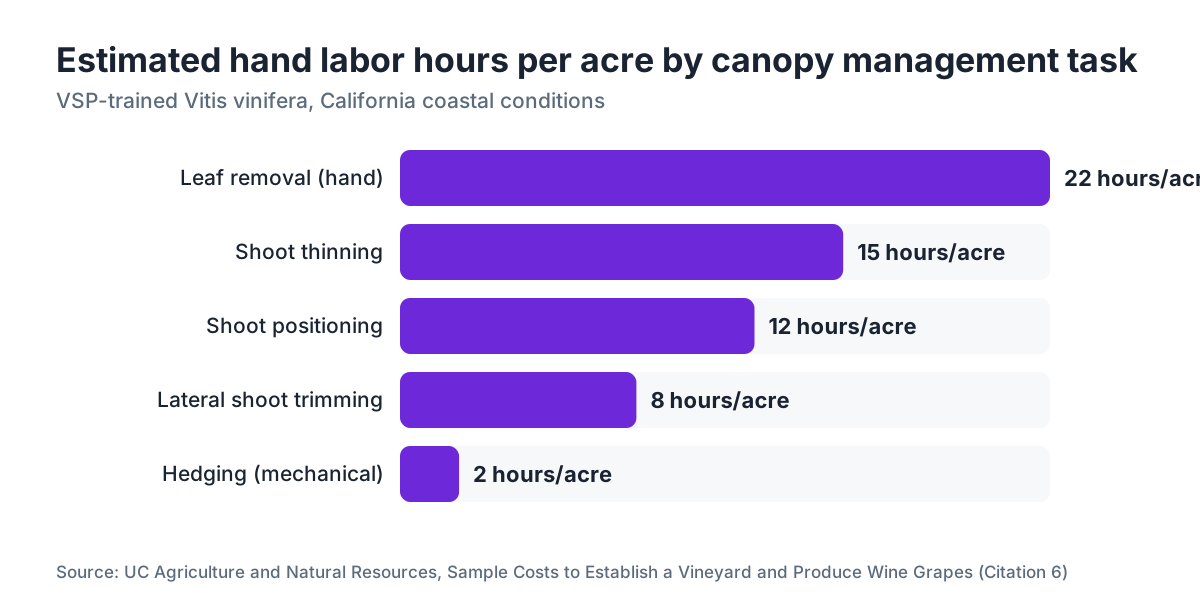
Shoot thinning by hand runs roughly 10 to 20 hours per acre depending on vine spacing and starting shoot density [6]. At California's 2024 vineyard labor rates (roughly $18 to $22 per hour for general labor, higher in premium coastal areas), that's $180 to $440 per acre for thinning alone. Positioning adds another 8 to 15 hours per acre.
Leaf removal by hand is the priciest single task. It runs 15 to 30 hours per acre depending on canopy density and how many sides you pull. Mechanical leaf removers (pneumatic or roller-type) do the same work for $30 to $80 per acre in operating cost, though the machine costs $15,000 to $50,000 for a self-propelled unit [6]. For any block over 50 acres where leaf removal is routine, mechanical removal pays back in two to four seasons.
Hedging is almost always mechanical above 20 acres. A tractor-mounted hedger runs $15 to $35 per acre per pass, and you might make two to four passes a season.
Total seasonal canopy costs in a hand-managed, densely planted VSP block in coastal California run $600 to $1,200 per acre per season per UC Cooperative Extension farm budget data [6]. In the eastern US, Cornell budget models show a similar $500 to $900 per acre, with year-to-year swing driven by winter injury rates that change shoot density [5].
These are real dollars. A 25-acre vineyard running full hand operations on canopy work might spend $15,000 to $30,000 a season on that alone. That math decides whether you invest in mechanization or rethink vineyard design.
How does canopy management reduce disease pressure in vineyards?
Powdery mildew and botrytis bunch rot are the two diseases tied most directly to canopy conditions. Both need humidity, dead air, and shade to take hold.
Powdery mildew (Erysiphe necator) is an obligate parasite that grows on the surface of green tissue. A dense canopy builds pockets where relative humidity stays high and temperatures stay moderate, exactly what the pathogen wants. Cluster-zone leaf removal moves enough air to drop interior humidity measurably and shrink infection periods. UC Davis research found that removing the first three to four leaves in the cluster zone on both sides at fruit set cut powdery mildew severity on clusters by 40 to 60 percent in Cabernet Sauvignon trials [2].
Botrytis cinerea is a wound and senescence pathogen that loves the same conditions. It also thrives in tight cluster architecture, a variety trait you can't change. You can manage the canopy around tight clusters to cut ambient humidity. Early leaf removal before bloom in Pinot Noir, which has notoriously tight clusters, is standard practice in Oregon's Willamette Valley for exactly this reason.
Spray penetration deserves its own line. The EPA Worker Protection Standard and state pesticide rules both require adequate coverage to claim a label-compliant application [7]. A canopy with more than 3 leaf layers between the outside and the cluster zone routinely fails coverage on interior fruit no matter the rate. If you're applying sulfur or copper on a dense canopy, you may be applying legally but not effectively. Better canopy management is the cheapest fungicide-efficacy upgrade you can buy.
For vineyards keeping spray records, logging leaf removal dates next to fungicide applications builds a defensible record of why you chose a given rate or interval. Tools like VitiScribe let you attach field operation records (leaf pull date, rows completed, crew size) directly to spray applications so the connection is documented.
What do canopy management best practices look like for specific varieties?
There's no single recipe. Variety, rootstock, site, and climate all interact. Still, you can lay out a reasonable starting point for the common varieties.
Cabernet Sauvignon is moderately vigorous and takes well to VSP with shoot thinning to 4 to 6 shoots per foot and leaf removal on the east (morning sun) side only in hot climates. It benefits strongly from light exposure for color and flavor. Late shading depresses anthocyanin accumulation noticeably.
Chardonnay is lower-vigor on many sites and can get over-thinned if you're heavy-handed. In cool coastal California (Sonoma Coast, Santa Barbara), holding some cluster shade slows ripening. In warmer areas, open it up more. Cornell notes Chardonnay in New York rarely needs bilateral leaf removal unless disease pressure is high [5].
Pinot Noir has the tightest clusters of the major reds. Early leaf removal is nearly universal in quality-focused production, but manage the afternoon side carefully to dodge sunburn. Oregon and Burgundy-style producers usually pull leaves on the morning (east) side only.
Sauvignon Blanc can carry more canopy than most growers allow if you're after green aromatic character. Full exposure converts all the methoxypyrazines. Want Marlborough-style pungency? Leave some shade. Want ripe tropical fruit? Open it up.
Zinfandel ripens unevenly within a single bunch. Canopy work can't fix that biological trait, but good air movement reduces botrytis on the overripe berries, which is the real risk with Zinfandel's ragged ripening.
Riesling in the eastern US (Finger Lakes, Lake Erie) often needs aggressive leaf removal simply because the wet season demands maximum air circulation. WSU's Washington work shows Riesling in the arid Columbia Valley needs far less removal [3].
How do you measure whether your canopy management is actually working?
Good canopy management isn't judged by hours spent. It's judged by measurable outcomes at fruit set, veraison, and harvest.
Point Quadrat Analysis (PQA), developed by Dr. Richard Smart and now a standard in many extension programs, works like this: you push a thin rod horizontally into the canopy at points along the cluster zone and record each contact as a leaf, a cluster, a gap, or a lateral shoot [10]. From 80 to 100 insertions per block, you calculate the leaf layer number (LLN) and the percent of interior clusters and gaps. Target LLN for VSP is 1.0 to 1.5. Above 2.0 and you have a shading problem.
A faster field check: stand in the row at solar noon on a clear day and look at the ground under the canopy. You want at least 20 to 30 percent of the ground covered in light flecks. A dense canopy throws shade with no flecks.
Brix curves are another proxy. Take weekly Brix readings from veraison on. If accumulation is slow and you're 5 to 10 days behind your historical curve, check the canopy before you blame the weather. Slow Brix in warm conditions usually traces back to shading.
Disease scouting at bunch closure and veraison tells you whether air circulation is doing its job. Botrytis in a well-managed open canopy is usually a weather event. Botrytis in a dense canopy during a dry summer is a management failure.
Tracking this data across seasons beats any single observation. The vineyard shifts year to year with vigor cycles, so what was right last year may need a change this year. Dated records of when leaf removal happened, how many passes, and which blocks tie canopy decisions to downstream quality in a way that's actually useful for planning.
What are the worker safety requirements for canopy management tasks?
Canopy work sits squarely inside agricultural labor, so federal and state worker protection rules apply any time pesticide-treated plants are involved.
The EPA Worker Protection Standard (40 CFR Part 170) sets restricted entry intervals (REIs) for all registered pesticides [7]. If you've applied a fungicide with a 4-hour REI and you want crews in for leaf removal that afternoon, the REI has to have expired and workers must have had pesticide safety training. The WPS also requires decontamination supplies, access to labeling, and emergency assistance information at the site.
For hand leaf removal and shoot thinning, heat illness is a bigger day-to-day risk than pesticide exposure. OSHA's outdoor heat guidance requires water, shade, and rest breaks, and federal heat rulemaking is still in progress [8]. California's Heat Illness Prevention regulation (Title 8, CCR section 3395) is the most specific in the country: it triggers shade and water requirements at 80 degrees Fahrenheit and adds high-heat procedures at 95 degrees Fahrenheit, and it applies to every California vineyard operation regardless of size [9].
PPE for canopy tasks without chemical exposure is minimal: gloves for pruning wounds, eye protection when suckering near wire level. When canopy work falls inside a spray program, check each product label for re-entry PPE, which can require chemical-resistant gloves or long sleeves even during REI-compliant early entry.
Tool safety: hedging machinery is one of the leading causes of serious injury in vineyard operations. Blade guards, PTO shields, and operator training are not optional. Make sure anyone running mechanical hedging equipment has documented training under your farm safety plan.
How do you build a seasonal canopy management schedule for your vineyard?
A canopy calendar isn't complicated, but it has to run on your phenology, not a generic template.
Start by knowing your variety's heat unit accumulation to each phenological stage. UC and WSU extension materials publish growing degree day (GDD) targets for shoot growth stages [3][2]. In warm climates, track degree days from January 1. In cool climates, from April 1 or bud break, whichever comes first.
Map your blocks by vigor. High-vigor blocks (younger vines, deeper soils, or heavy-N irrigation) need shoot thinning 7 to 10 days earlier than moderate-vigor blocks, and they'll want a second pass after the first round. Low-vigor blocks may skip thinning entirely and go straight to positioning.
Set trigger points, not calendar dates. "Shoot thin when the most advanced shoots hit 10 inches" beats "shoot thin in May." In a cool spring, May thinning may be too early. In a warm spring, it may already be late.
Build in float time for wet weather. Crews can't pull leaves in the rain, and if you miss the bloom window for early removal, you drop back to the weaker post-set window. Have a contingency: rank your blocks by priority for early removal (tight-clustered varieties, historically high-botrytis blocks) and hit those first.
Operations software that logs field work by block and date lets you see, in later seasons, whether your timing lined up with better or worse disease outcomes and harvest data. VitiScribe attaches canopy operation records to individual blocks with photos and crew logs, which helps when you're comparing block performance across seasons or handing off knowledge to a new vineyard manager.
Document everything. If a pesticide violation or a worker safety audit ever lands on you, dated records of when crews entered treated fields, what they did, and what PPE they wore are your protection. Those records come from a canopy log, not from memory.
Frequently asked questions
When should I do leaf removal on grapevines?
The highest-value timing is at or just before bloom, when removing leaves in the cluster zone shrinks disease infection periods and can improve fruit set uniformity. Post-fruit-set removal (2 to 4 weeks after set) still improves air circulation and spray penetration but delivers less disease benefit. In hot climates, avoid afternoon-side early removal on heat-sensitive varieties like Pinot Noir because it can sunburn clusters.
How many shoots per foot of cordon should I leave during shoot thinning?
The standard target for VSP systems is 4 to 6 shoots per linear foot of cordon, which puts shoots roughly 4 to 6 inches apart. High-vigor blocks and varieties tolerate the lower end. Low-vigor blocks or vines recovering from damage might sit at 6 to 8 shoots per foot temporarily to build carbohydrate reserves. UC extension budgets use 4 to 6 shoots per foot as the working standard.
Does canopy management affect wine quality directly?
Yes, and the relationship is well-documented. Sunlit clusters in red varieties build more anthocyanins and structured tannins and less green methoxypyrazine character. Shaded clusters in any variety accumulate less sugar at a given temperature and hold higher malic acid. UC Davis research identifies cluster light exposure as the single biggest controllable factor in anthocyanin development in red varieties, larger than irrigation or soil management in many situations.
Can canopy management replace fungicide applications?
No, but it cuts fungicide needs and improves efficacy. A well-managed open canopy lowers the number of infection periods by reducing interior humidity and can cut Botrytis incidence by 30 to 50 percent versus a dense canopy, per Cornell viticulture research. You still need a fungicide program, especially in humid climates. The payoff is fewer applications for the same disease control, which matters for cost and resistance management.
What is point quadrat analysis and how do I use it in my vineyard?
Point quadrat analysis (PQA) is a fast field method for quantifying canopy density. You push a thin rod horizontally into the canopy at random points in the cluster zone and record each contact as a leaf, cluster, gap, or lateral. From 80 to 100 insertions per block, you calculate the leaf layer number and percent gaps. A well-managed VSP canopy targets a leaf layer number of 1.0 to 1.5. Above 2.0 signals shading that hurts fruit quality and spray penetration.
What is the difference between hedging and shoot thinning?
Shoot thinning removes entire shoots at or near the cordon early in the season to cut total shoot number. Hedging cuts the tops off shoots that have grown above the trellis, done later to control canopy height. They fix different problems. Thinning controls density from the start. Hedging controls excessive vertical growth. Leaning on hedging without enough thinning usually triggers lateral regrowth that densifies the canopy more than you started with.
Is mechanical leaf removal as effective as hand leaf removal?
For most blocks, pneumatic or roller-type mechanical leaf removers match hand removal in the cluster zone, especially at the right timing (around bloom to fruit set). Mechanical removal is faster and cheaper per acre, typically $30 to $80 per acre in operating cost versus $270 to $660 per acre for hand labor at California rates. The limit is precision: machines work best on well-positioned, uniform canopies and can damage clusters if positioning is poor.
How does canopy management differ between hot and cool climates?
Cool climates (eastern US, cooler coastal California, Pacific Northwest) generally need more aggressive opening because humidity and fewer sun hours make disease pressure the main concern. Hot climates balance light exposure against sunburn and heat damage, often holding afternoon shade on west-facing cluster zones. In both cases the aim is an open, sunlit canopy, but the intensity of intervention and which side you open first differ significantly.
What re-entry rules apply to vineyard workers doing canopy management after spraying?
The EPA Worker Protection Standard (40 CFR Part 170) requires the restricted entry interval (REI) on each pesticide label to expire before workers enter treated areas for canopy tasks. Workers must also have had WPS pesticide safety training and have access to decontamination supplies and product labeling. Some products require PPE even after the REI for early-entry activities. Always check the specific product label rather than generic guidance.
How many hours of labor does canopy management take per acre?
In a fully hand-managed VSP block, expect 35 to 65 hours per acre per season across all tasks: shoot thinning (10 to 20 hours), positioning (8 to 15 hours), and leaf removal (15 to 30 hours). At $18 to $22 per hour for California vineyard labor, that's $630 to $1,430 per acre per season. Mechanizing leaf removal and hedging can cut total hours 40 to 60 percent in well-suited blocks. UC Cooperative Extension farm budgets document these ranges.
Does canopy management affect spray coverage and pesticide efficacy?
Directly and significantly. A canopy with more than 3 leaf layers between the outer surface and the cluster zone routinely shows poor interior coverage no matter the rate. EPA WPS and state pesticide rules require label-compliant application, but a dense canopy can produce a legally compliant application that still fails to protect fruit. Opening the canopy with leaf removal before a fungicide application is one of the cheapest ways to improve the return on pesticide inputs.
What trellis system makes canopy management easiest?
For most small to mid-scale Vitis vinifera operations, Vertical Shoot Positioning (VSP) is the easiest to manage and mechanize. Shoots grow upward in a consistent plane, cluster zones are predictable, and both mechanical leaf removal and hedging work well. Divided canopy systems (Scott Henry, Smart-Dyson) solve specific high-vigor problems but add cost and complexity. High-wire cordon works for volume production but makes cluster-zone access harder for spraying and hand work.
How does canopy management affect irrigation and water use?
A larger, denser canopy transpires more water. Overly vigorous vines with excessive shoot growth have higher water demand and can push you toward more irrigation to feed the canopy, which then drives more vigor in a loop. Managing the canopy to a moderate, well-positioned size actually lowers total seasonal water use per vine. In regulated deficit irrigation programs common in California and Washington, canopy size at shoot thinning is a key variable for dialing in per-block water needs.
What records should I keep for canopy management operations?
At minimum, log the date, block or rows completed, task performed (shoot thinning, leaf removal, hedging, positioning), crew size, and any observations (disease seen, canopy density notes). If the work happens inside a pesticide REI period, document PPE worn and REI compliance. Linking these records to your spray log and harvest data by block lets you correlate canopy decisions with disease outcomes and fruit quality across seasons, which beats any single-year snapshot.
Sources
- University of California Agriculture and Natural Resources, viticulture and wine grape resources: Shaded clusters produce fruit with lower sugar accumulation, weaker color development, elevated malic acid, and higher rates of bunch rots
- University of California Agriculture and Natural Resources, research on light exposure, anthocyanin development, and cluster-zone leaf removal: Cluster light exposure is the single biggest driver of anthocyanin and tannin development in red varieties; removing the first three to four cluster-zone leaves at fruit set reduced powdery mildew severity by 40 to 60 percent in Cabernet Sauvignon trials
- Washington State University Extension, wine grape production resources: WSU Extension documents shoot positioning improvements in Riesling and Chardonnay; recommends divided canopies for high-vigor blocks; provides GDD targets for canopy management timing
- University of California Agriculture and Natural Resources, canopy and cluster temperature research: A canopy that shades clusters in a hot climate can keep them 5 to 10 degrees Fahrenheit cooler at midday, slowing sugar accumulation and preserving acidity
- Cornell College of Agriculture and Life Sciences, viticulture and enology program: Vitis vinifera vines carrying more than 8 to 10 pounds of fruit per foot of row consistently show delayed and uneven ripening; early leaf removal reduces Botrytis bunch rot incidence by 30 to 50 percent compared to late or no removal
- UC Agriculture and Natural Resources, Sample Costs to Establish a Vineyard and Produce Wine Grapes (cost study series): Total seasonal canopy management costs in hand-managed VSP blocks in California coastal regions range from $600 to $1,200 per acre per season; mechanical leaf removers cost $15,000 to $50,000 capital and $30 to $80 per acre operating; shoot thinning by hand runs 10 to 20 hours per acre
- US EPA, Agricultural Worker Protection Standard (40 CFR Part 170): The EPA Worker Protection Standard sets restricted entry intervals for all registered pesticides and requires decontamination supplies, access to labeling, and pesticide safety training for agricultural workers
- US Department of Labor OSHA, heat illness prevention resources: OSHA outdoor heat guidance calls for water, shade, and rest breaks, and federal heat-specific rulemaking is ongoing
- Smart, R.E. and Robinson, M., Sunlight into Wine: A Handbook for Winegrape Canopy Management, Winetitles 1991: Point Quadrat Analysis method developed by Dr. Richard Smart; target leaf layer number for VSP is 1.0 to 1.5; higher than 2.0 indicates a shading problem affecting fruit quality and spray penetration
- Washington State University Extension, viticulture notes on divided canopy systems: WSU Extension recommends divided canopy systems specifically for blocks where mid-season nitrogen pushes shoot growth past 6 feet
Last updated 2026-07-09