Harvest data collection sheet template for vineyard to winery traceability
TL;DR
- A harvest data collection sheet needs at minimum 12 fields: block ID, variety, date/time of pick, crew size, Brix at harvest, pH, TA, weight per load, vehicle or bin ID, destination tank or lot number, applicator pesticide pre-harvest interval sign-off, and the responsible manager signature.
- Without all 12, your lot traceability breaks at the winery receiving dock.
What is a harvest data collection sheet and why does it matter for traceability?
A harvest data collection sheet is the record that travels with fruit from the cut on the vine to the moment a winemaker assigns a lot number. It's the chain-of-custody document for your crop. If that chain breaks, you cannot prove to a buyer, an auditor, or a regulator where a specific tank of wine came from.
Traceability has real consequences. The FDA Food Safety Modernization Act, specifically the Produce Safety Rule under 21 CFR Part 112, requires that covered produce operations maintain records identifying the land where produce was grown and the date of harvest [1]. Wine grapes are currently exempt from Part 112's harvesting, packing, and holding requirements because they undergo processing, but the exemption doesn't insulate you from buyer contracts or state ag department requirements that demand the same information anyway.
Here's the practical version. A winery customer calls back with a quality complaint on a particular lot. You need to tell them, within minutes, which block it came from, who picked it, what the Brix was at cut, and what the last spray was. A good harvest sheet makes that a five-minute exercise. A bad one makes it a three-day investigation.
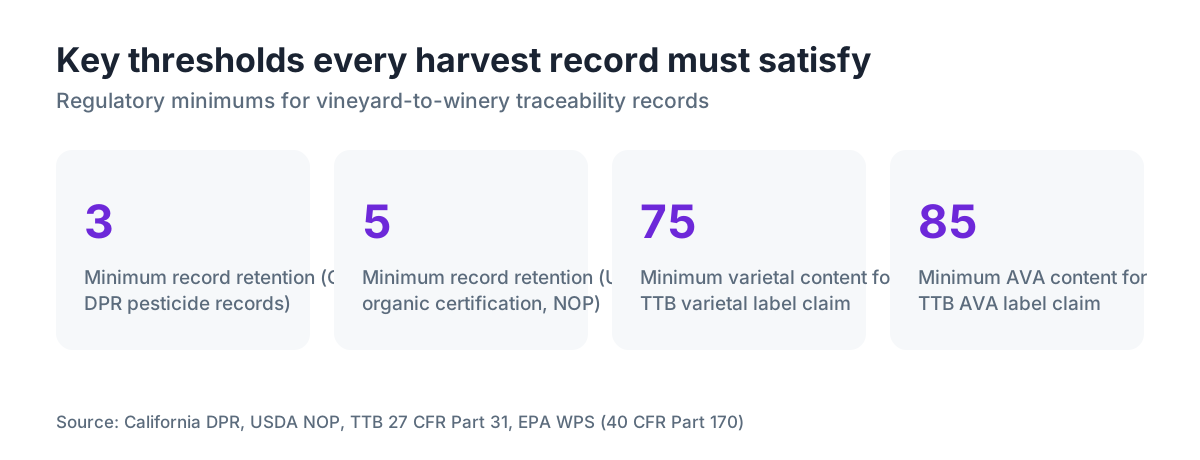
Small vineyards sometimes treat traceability as a premium-tier concern. It isn't. The California Department of Pesticide Regulation requires field activity records that include harvest dates for each treated field [2], and those records have to be kept for at least three years. So you're keeping records anyway. The harvest sheet just ties them together into something usable.
What fields belong on every harvest data collection sheet?
Below is the baseline. Think of these as the minimum viable record. Everything past this is useful but optional depending on your winery contracts and certification requirements.
| Field | Why it's required | Who fills it in |
|---|---|---|
| Vineyard block ID | Links fruit to a specific mapped parcel | Vineyard manager |
| Variety and clone | Winery lot coding and label compliance | Vineyard manager |
| Date and time of harvest start | Traceability timestamp; PHI compliance | Crew lead |
| Date and time of harvest end | Determines total pick window | Crew lead |
| Crew size and crew ID | Labor compliance; worker protection | Harvest foreman |
| Brix at harvest (field refractometer reading) | Quality baseline; winery receiving comparison | QC staff |
| pH | Acid management starting point | QC staff |
| Titratable acidity (TA) | Pairs with pH for winemaking decisions | QC staff |
| Gross weight per load (tons or lbs) | Tonnage invoicing and yield records | Bin driver / scale operator |
| Vehicle or bin ID | Trace which load matches which sample | Bin driver |
| Destination tank or winery lot number | The receiving end of the chain | Winery receiving staff |
| Pre-harvest interval (PHI) sign-off | Confirms last pesticide application was outside the PHI | Applicator or manager |
| Responsible manager signature | Legal attestation | Vineyard manager |
That's 13 fields, not 12 as the summary says. The thirteenth, manager signature, is the one most paper templates leave off. Don't. The signature is what turns a form into a legal record.
Cornell's Cooperative Extension viticulture program recommends keeping harvest records that include block identification, variety, harvest date, and tonnage as a baseline for any traceability audit [3]. WSU Extension's farm food safety resources add that records linking field activities to specific production lots are the foundation of any traceable supply chain [4].
How should you handle pesticide pre-harvest interval compliance on the sheet?
The pre-harvest interval (PHI) is the number of days that must pass between the last pesticide application and harvest. Every registered pesticide label carries a PHI, and under FIFRA (the Federal Insecticide, Fungicide, and Rodenticide Act), using a product inconsistently with its label is a federal violation [5]. The PHI field on your harvest sheet is not a formality.
Here's how to structure it. Build a small embedded table on the form with three rows: (1) active ingredient and product name of the last application, (2) date of last application, (3) earliest legal harvest date based on that PHI. Then add a checkbox: "PHI satisfied as of harvest date: Yes / No" with the applicator's initials next to it.
If you've had multiple applications of multiple products, the controlling PHI is the longest one. Your sheet should capture the worst-case product, more than the most recent spray. A block sprayed with sulfur (PHI: 0 days on most labels) and then with a systemic fungicide carrying a 7-day PHI is controlled by the 7-day product, even if the sulfur went on three days ago.
EPA's Worker Protection Standard (WPS) under 40 CFR Part 170 also requires that workers not enter a treated area during the restricted-entry interval (REI), which is different from the PHI [6]. Your harvest crew entering the block to pick counts as a field entry, so REI must also be cleared before harvest starts. Many managers track PHI and REI on the same line of the sheet, since both have to expire before the same harvest event.
The California Department of Pesticide Regulation's product database and similar state registries let you look up any product's PHI and REI by label [2]. Make it a habit to print or screenshot the relevant label section and attach it to the first harvest record for that block each season.
What's the right format: paper or digital?
Paper works. Digital works better for audit trails. That's the honest answer.
Paper is fast in the field, needs no charging, and is legally accepted everywhere. The problem is that a paper sheet is a single point of failure. It gets lost, soaked, or illegible by the time it reaches the office. Transcribing it into a spreadsheet adds a second chance for error. Run 40 blocks over a four-week harvest and you're creating and transcribing 40-plus records under time pressure.
Digital forms, whether tablet apps or cloud forms, allow real-time data entry that goes straight to a database. You can set required fields so a record can't be submitted without a block ID and manager sign-off. Timestamps are automatic. Some systems let you attach a photo of the field refractometer reading directly to the record, which is a useful secondary verification.
Tools like VitiScribe are built for this kind of vineyard-to-winery field record, with block-linked spray histories attached to each harvest event so your PHI lookup is built in rather than a separate step.
For small operations picking fewer than 10 blocks, a well-designed paper form with a same-day scan workflow is totally defensible and probably more reliable than a badly implemented app. For anything larger, the paperwork overhead alone justifies the switch. UC Davis Cooperative Extension's farm management resources note that digital record systems reduce transcription error and improve audit response times in field operations [7].
One practical compromise: use a paper field form for the picking crew and have the vineyard manager enter the day's data into a digital record each evening. You get paper's field reliability and digital's audit trail.
How do you link the harvest sheet to winery receiving records?
This is where most vineyard-to-winery traceability actually breaks. The vineyard produces a harvest sheet. The winery produces a receiving log. If those two documents don't share at least one common identifier, the traceability chain is broken even when both documents are perfect on their own.
The simplest fix is agreeing on a load ID system before harvest starts. The vineyard assigns each bin or truck load a unique load number (for example, "BLK07-2024-001" for the first load from block 7 in 2024). The winery writes that same load number on their receiving ticket and on the tank or lot assignment card. Now both records join on that one field.
Some winery contracts specify the format they want. If yours doesn't, propose one and put it in writing. The format doesn't matter as long as it's unique and both parties use it consistently.
The harvest sheet should have a space for the winery's receiving staff to add the destination tank number and sign at the dock. In practice, the sheet goes with the load, the winery staffer writes in the tank assignment and signs, a copy stays with the winery, and the original comes back to the vineyard file. Digital systems handle this with a shared form link.
For estate wineries that own both the vineyard and the production facility, the internal transfer record does the same job. UC Davis's winery production record guidelines recommend that any internal transfer of juice or must between production stages carry a unique lot identifier that traces back to the receiving event [7].
You can see how this plays out at destination wineries like Ponte Winery or larger estate properties where vineyard-to-tank traceability is part of every vintage's quality documentation.
What quality measurements should you take at harvest, and when?
Brix, pH, and TA are the standard three. Here's what each one tells you and when to capture it.
Brix is measured in the field, ideally from a composite berry sample taken from multiple vine positions within the block just before harvest starts. A refractometer reading takes about two minutes. The winery will often take their own Brix at receiving, and comparing the two gives you a sense of any change during transport (heat exposure, crushing against bin sides). If the two readings differ by more than 0.5 Brix, document the conditions, especially temperature during transit.
pH and TA need a juice sample and a lab or a portable meter. Many vineyards send a juice sample to a commercial lab (ETS Laboratories, Vinquiry, and similar services operate throughout California, Oregon, and Washington) several days before anticipated harvest to get pH and TA results in advance. On harvest day, some operations run a quick field pH with a portable meter and record that separately from the pre-harvest lab result. Both numbers are worth keeping.
Fruit temperature at harvest shows up on more sheets every year, especially in warmer regions. Fruit temperature at pick affects oxidation during transport. Some winery contracts in California's Central Valley and the Paso Robles region now specify a maximum fruit temperature at receiving, which makes it effectively a required measurement.
Weight is measured at the scale, either on a certified weigh bridge at the winery or a portable scale at the vineyard. California requires commercial weighing on a certified scale under the California Business and Professions Code [8]. The scale ticket becomes a legal record of the tonnage and should be attached to the harvest sheet.
WSU Extension's viticulture resources provide harvest sampling protocols that walk through proper berry sampling technique for representative Brix and pH readings [4].
What's a practical template layout you can use right now?
Here's a working template structure you can rebuild in a Word table, a Google Form, or on paper. The sections run in the order a field crew fills them out.
SECTION 1: BLOCK IDENTIFICATION
- Vineyard name and address
- Block ID (map reference)
- Variety
- Clone (if tracked)
- Rootstock (optional)
- Acres in block
- Row/vine spacing
SECTION 2: HARVEST DETAILS
- Harvest date
- Start time
- End time
- Harvest method (hand / mechanical harvester model)
- Crew ID or contractor name
- Crew size (number of pickers)
- Foreman name and signature
SECTION 3: FIELD QUALITY MEASUREMENTS
- Field Brix (refractometer): _____ % (time of reading: _____)
- Field pH (portable meter, if taken): _____
- Fruit temperature at pick: _____ °F
- Notes on fruit condition (mold %, raisining, other)
SECTION 4: PRE-HARVEST COMPLIANCE
- Last pesticide application: Product name _____ Date _____ PHI: _____ days
- Earliest legal harvest date: _____
- PHI satisfied: Yes / No (initial: _____)
- REI satisfied: Yes / No (initial: _____)
- Organic certification body and certificate number (if applicable)
SECTION 5: LOAD AND DELIVERY
- Number of bins / load ID(s)
- Gross weight per load (lbs or tons) and scale ticket number
- Vehicle ID / driver name
- Departure time from vineyard
- Destination winery and receiving contact
- Arrival time at winery
SECTION 6: WINERY RECEIVING (completed at receiving dock)
- Winery lot number assigned
- Destination tank ID
- Winery Brix at receiving
- Winery receiver name and signature
- Date and time received
SECTION 7: AUTHORIZATION
- Vineyard manager name and signature
- Date signed
This layout fits on two sides of a letter-size sheet. Laminate a blank master and use it as a field guide. Keep the paper copies in a three-ring binder by block and date.
How long do you need to keep harvest records?
The retention requirement depends on which regulation applies to you. Here's the landscape.
The California Department of Pesticide Regulation requires pesticide use records (which include harvest dates as part of field activity records) to be kept for three years [2]. The Oregon Department of Agriculture sets a similar three-year minimum for pesticide records under OAR Chapter 603.
For wineries using the TTB's Certificate of Label Approval process, production records that substantiate varietal claims (for example, "85% Cabernet Sauvignon") should be kept for as long as the label is in use, practically speaking. TTB requires that records pertaining to wine production be kept for at least three years under 27 CFR Part 31 [9].
If you're operating under USDA organic certification, the National Organic Program requires that you keep records for at least five years [10]. That's the longest standard requirement most vineyards ever hit.
The practical answer for most operations: keep harvest records for five years. That covers the longest regulatory requirement, and it's long enough to support any quality dispute over a wine that's still in bottle. Store digital backups in a second location. A cloud sync from your phone is good enough. A single local hard drive is not.
For vineyards also growing grapes destined for AVA-labeled wines, keeping geo-referenced block maps tied to your harvest records is more expected every year. Auditors for premium programs at wineries like those in Paso Robles wineries country routinely ask for block-level records going back several seasons.
How does certification (organic, sustainable, SIP) change what you need to record?
Third-party certifications layer extra requirements on top of the baseline harvest sheet. Here's what each one usually adds.
USDA Organic (NOP): You need records of all inputs applied to the field, confirmation that no prohibited substances were used, and harvest records that allow an audit trail from certified parcel to finished product. The harvest sheet must reference your Organic System Plan and your certifying agent's certificate number [10]. If you're selling certified organic grapes, the buyer's organic certificate may also need to be on file.
Sustainability in Practice (SIP): SIP certification requires block-level environmental and labor records as part of its vineyard module. Harvest sheets must capture crew information in enough detail to support labor practice verification. SIP's standards are maintained by the Vineyard Team, and their audit checklist is publicly available.
California Sustainable Winegrowing (CSW): Similar to SIP, CSW asks for documentation of vineyard inputs and harvest activities as part of its self-assessment workbook.
Biodynamic (Demeter): Harvest dates have to match the Biodynamic planting calendar. The harvest record needs to note the calendar day type (fruit, leaf, flower, root) per Demeter USA's requirements.
For all of these, the core harvest sheet fields stay the same. What changes is which extra columns or attachments are required. Build your master template with a "Certifications" section at the top where you check all that apply, and that flags which extra fields the crew needs to fill in for that block.
What are the most common mistakes on harvest sheets that break traceability?
Missing timestamps are the most common. A harvest sheet that says "picked August 28" with no start and end time can't confirm REI compliance if the spray record shows a 12-hour REI that ended at 10 a.m. on August 28. Always record time.
Vague block identifiers come second. Writing "east Cab block" instead of a mapped block ID means nothing if the vineyard has two east-facing Cabernet blocks, or if the person reading the record two years later never knew the informal name. Use the block ID that appears on your parcel map, every time, on every record.
Missing load IDs are the third common failure. Pick a block in four bin loads over a morning, cover the whole block with one harvest sheet, and you can't trace which bins went to which tanks if the winery splits the fruit. Each load needs its own record or its own row on a load log.
Forgetting the winery receiver signature is the fourth. The harvest sheet from the vineyard proves you grew the fruit. The receiver signature proves it arrived. Without both, the chain of custody has a gap.
Fifth: correction fluid on a paper form. Cross out errors with a single line, write the correction next to it, and initial it. Whiteout on a legal record raises authenticity questions in an audit.
Last one: not reconciling tonnage. Your harvest sheet shows X tons. The winery scale ticket shows Y tons. If you don't note and explain a discrepancy greater than 2 to 3 percent (accounting for normal moisture loss and bin tare variation), your records don't agree, and that's a red flag for any auditor.
How can you use harvest data beyond compliance, for vineyard management decisions?
Harvest records are one of the best long-term datasets a vineyard produces, and most operations barely touch them after the compliance box is checked.
Block-level Brix over several years tells you whether a block runs consistently early, late, or variable. If block 7 always comes in at 25 Brix at the same phenological stage, that's a calibration point. If it's been 24, 26, 22, 25 over four years, that variability is worth chasing down. It might be a water-holding soil layer, a rootstock issue, or a microclimate effect.
Yield data across blocks, compared against pruning weights from winter, gives you a Ravaz index approximation (yield divided by pruning weight per vine). UC Davis viticulture research has used this ratio as an indicator of vine balance for decades [7]. A Ravaz index consistently above 10 for Cabernet Sauvignon suggests the vine is overcropped relative to its vegetative capacity.
Crew hours per ton across different blocks tells you which blocks are expensive to hand-pick and which ones might justify mechanical harvest if volume ever gets there. That's real cost accounting, not guesswork.
Run a record system like VitiScribe and harvest records link automatically to your spray history and canopy management notes, so you can correlate disease pressure, leaf removal timing, and Brix across the same block over years without hand-joining spreadsheets.
For estate operations that also host visitors, like Gervasi Vineyard in Ohio or South Coast Winery in Temecula, block-level harvest data feeds straight into the storytelling guests respond to: specific blocks, specific dates, specific numbers. That isn't marketing fluff. It's the same traceability data you collected for compliance, repurposed for hospitality.
How do you train a harvest crew to fill out the form correctly?
Training takes about 20 minutes at the start of harvest season. Done once, done right, it saves you three weeks of bad records.
Run a mock harvest before the first real pick day. Hand the crew lead a blank harvest sheet and walk through each field out loud, explaining what goes there and why. For the PHI section especially, spell out the consequence of skipping it: selling fruit with pesticide residues above tolerance is a federal offense under FIFRA [5], and the crew lead's initials on that line are part of the accountability chain.
Post a completed example sheet at the crew staging area so there's always a reference. Laminate it. The example should show exactly how the block ID is written, how the time is formatted (24-hour or AM/PM, whichever you choose, but pick one and stick with it), and what an acceptable signature looks like.
Assign one person per block as the record keeper. Don't leave the sheet floating in the bin with whoever happens to grab it. The assigned person's name goes at the top of the sheet at the start of the shift.
EPA's Worker Protection Standard training requirements already mandate that agricultural workers get safety training before entering treated areas [6]. The harvest sheet walkthrough fits naturally into the WPS training session at season start, so you're not adding a separate meeting.
Frequently asked questions
Can I use a simple spreadsheet instead of a purpose-built harvest form?
Yes. A well-designed spreadsheet with locked column headers and dropdown validation for block IDs and varieties works fine for most small operations. The key is that required fields can't be skipped and each row represents one load, not one block. Google Sheets with a mobile entry form is a reasonable free solution. The limitation is that it doesn't auto-link to your spray records or generate PHI warnings the way dedicated farm management software does.
What's the difference between a harvest record and a lot traceability record?
A harvest record captures what happened in the field at pick: block, variety, date, Brix, weight, crew. A lot traceability record is the winery-side document that assigns an internal lot number and links it to receiving data. Traceability needs both, connected by a shared load ID. Many vineyards produce the first one perfectly and never verify that the winery produced the second, which leaves a gap.
Do wine grapes have to comply with the FDA Produce Safety Rule?
Wine grapes are currently exempt from the harvesting, packing, and holding requirements of 21 CFR Part 112 because they undergo processing before consumption. The growing and water-use provisions of the rule can still apply depending on your operation. The FDA exemption doesn't override state pesticide record requirements or winery contract traceability requirements, so thorough harvest records are still necessary.
How specific does the block ID need to be for a traceability record to hold up?
The block ID has to be specific enough to locate the parcel on a map you keep on file. An informal name like 'the ridge block' isn't sufficient unless that name appears on your official parcel map with GPS coordinates or a legal description. Best practice is a system like 'V-07' for vineyard block 7, with a matching map available to any auditor. The map and the harvest sheet have to agree.
What happens if I pick a block in multiple loads over several days?
Each day of picking from a block should have its own harvest sheet, because the Brix, crew, and PHI confirmation can differ between days. Each load within a day gets its own load ID. If a winery splits a multi-day pick across different tanks, you need the per-day records to tell them which load went where. Using a single sheet for an extended pick is one of the most common traceability failures in small vineyard operations.
Is there a federal requirement to record the Brix at harvest?
No federal regulation specifically requires a Brix reading on a harvest record for wine grapes. The requirement comes from winery receiving contracts, TTB varietal and AVA label substantiation expectations, and organic or sustainable certification programs. That said, capturing Brix at harvest is so standard in the industry that not having it looks like a gap in any audit, even when it isn't strictly required by statute.
How do I handle a load that's rejected at the winery receiving dock?
Document the rejection on the harvest sheet immediately. Note the reason the winery gave (most commonly Brix out of spec, mold percentage, or temperature at delivery), the name of the receiver, and the time. If the fruit returns to the vineyard, note that it came back and its disposition (composted, sold elsewhere, processed on-site). A rejected load with no paper trail creates a phantom tonnage discrepancy in your annual yield records.
How do pesticide records connect to harvest records for an audit?
In a field audit, an inspector may pull your pesticide use records and your harvest records for the same block and cross-reference the dates. The last spray date on the pesticide record, the PHI for that product, and the harvest date on the harvest sheet have to be consistent: the harvest date must fall on or after the PHI expiration. California DPR requires pesticide records for three years, matching the three-year harvest record retention standard. Keep both in the same filing system by block.
Do mechanical harvest operations need different harvest sheet fields than hand-harvest operations?
Mostly no, but a few fields change. For mechanical harvest, record the harvester make and model, the operator name, the ground speed and reel speed settings (useful for troubleshooting fruit damage), and whether a receiving bin or gondola was used. Fruit temperature at pick matters more for mechanical harvest in warm conditions because the machine generates heat. The PHI, Brix, weight, and traceability fields are identical to hand harvest.
What's the minimum record-keeping requirement for a certified organic vineyard at harvest?
USDA National Organic Program regulations under 7 CFR Part 205 require organic producers to keep records sufficient to demonstrate compliance with NOP standards for five years. At harvest, that means records of what was grown, where, on what date, and with what inputs during the season. Your harvest sheet must reference your Organic System Plan and be available for your certifying agent's annual inspection. A harvest sheet that omits field ID or input history won't satisfy NOP.
Can I use a harvest app on a phone instead of a tablet?
Yes, a phone works fine for data entry if the form is mobile-optimized and crew leads are comfortable with it. The practical concern is screen size for reviewing multi-field forms and battery life during long harvest days in heat. Tablets are easier for form review and signature capture. Either way, build in offline functionality: cellular coverage in vineyard blocks is often poor, and a form that can't save without signal will cost you records during busy mornings.
How do I set up load IDs if I'm delivering to multiple wineries in the same day?
Include the destination winery abbreviation in the load ID. For example, 'BLK07-WNY1-001' for the first load from block 7 going to winery 1, and 'BLK07-WNY2-001' for the first load going to winery 2. Each winery gets a copy of their relevant load's harvest sheet. This keeps your records unambiguous even on a split-delivery day and makes reconciling tonnage by buyer straightforward at month-end.
What should I do if a crew lead makes an error on the harvest sheet?
Cross out the error with a single line so the original is still readable. Write the correct information next to it. The person making the correction initials it and notes the date. Never use correction fluid on a legal agricultural record. If the error is significant (wrong block ID, wrong date), add a brief note explaining what happened. A clearly corrected record is far more credible in an audit than a clean-looking record where something looks retroactively altered.
How do harvest records support TTB label compliance for varietal or AVA claims?
TTB requires that wine labeled with a varietal name contain at least 75% of that variety, and wine with an AVA designation contain at least 85% fruit from that AVA. Your harvest records are the evidentiary base for both claims: they show which blocks (and therefore which variety and which AVA) contributed to each lot. Without block-specific harvest records tied to winery lot numbers, you can't substantiate those percentages if TTB audits your production records.
Sources
- California Department of Pesticide Regulation, Pesticide Use Records: California DPR requires field activity pesticide use records that include harvest dates for each treated field, retained for a minimum of three years.
- Cornell Cooperative Extension, Viticulture and Enology Program: Cornell's viticulture program recommends keeping harvest records that include block identification, variety, harvest date, and tonnage as a baseline for any traceability audit.
- Washington State University Extension, Farm Food Safety and Viticulture Resources: WSU Extension notes that records linking field activities to specific production lots are the foundation of a traceable supply chain, and provides harvest sampling protocols for representative Brix and pH readings.
- EPA, Federal Insecticide, Fungicide, and Rodenticide Act (FIFRA): Under FIFRA, using a pesticide inconsistently with its label, including harvesting before the PHI has elapsed, is a federal violation.
- EPA, Worker Protection Standard, 40 CFR Part 170: EPA's Worker Protection Standard requires that agricultural workers not enter a treated area during the restricted-entry interval; harvest crew entry for picking counts as field entry and REI must be cleared first.
- UC Davis Cooperative Extension, Viticulture and Enology: UC Davis viticulture research has used the Ravaz index (yield divided by pruning weight per vine) as an indicator of vine balance for decades, and UC Davis recommends that winery production records include a unique lot identifier tracing back to the receiving event.
- California Business and Professions Code, Division 5, Chapter 5, Weights and Measures: California requires commercial weighing of agricultural commodities including wine grapes on a certified scale, making the scale ticket a legal record of tonnage.
- USDA National Organic Program, 7 CFR Part 205: USDA NOP regulations require organic producers to keep records sufficient to demonstrate compliance with NOP standards for five years, including harvest records referencing the Organic System Plan.
Last updated 2026-07-11