Heat illness prevention plan documentation for vineyard harvest crews
TL;DR
- California, Washington, and other major wine states require a written Heat Illness Prevention Plan for outdoor agricultural workers.
- The plan must cover water access (one quart per worker per hour), shade at 80°F, emergency procedures, and a 14-day acclimatization schedule.
- Keep it on-site, in the workers' language, and hand it to an inspector on demand.
- Train every worker before they set foot in the heat.
What is a heat illness prevention plan and who has to have one?
A Heat Illness Prevention Plan is a written document that spells out how your operation keeps workers from overheating, what to do if someone does, and how supervisors are trained to catch early symptoms. It's not optional if you have outdoor agricultural workers in California, Washington, Minnesota, or any state that adopted rules mirroring Cal/OSHA's Title 8, Section 3395 standard [1].
California's rule is the strictest and the most litigated, so it gets most of the attention. Washington's Department of Labor and Industries adopted its own heat rule (WAC 296-62-095) in 2023 with nearly identical documentation requirements [2]. If you grow grapes in the Central Valley, Lodi, Paso Robles, Sonoma, or anywhere the daytime harvest temperature regularly clears 85°F, you're inside the rule's scope every August and September.
The plan has to be in writing. A verbal policy is not enough. It has to be available at the worksite, and if your crew speaks Spanish, Mixtec, or another language, you need a version in that language too [1].
That second copy is not a courtesy. Cal/OSHA inspectors have cited growers for keeping an English-only plan on crews that were entirely Spanish-speaking.
What exactly does the written plan have to include?
Cal/OSHA Section 3395 lists the required elements, and the plain answer is: more than most vineyard operators have written down. Here's the actual list.
First, water. The plan must state that you provide potable water at no cost, at least one quart per employee per hour for the entire shift, and that workers are encouraged to drink often [1]. The rule says "encouraged," which in practice means supervisors actively remind crews rather than park a cooler at the end of a row and call it done.
Second, shade. You must provide shade when the temperature equals or exceeds 80°F. The shade must hold everyone on recovery or rest at any given time, at no less than 33 square feet per employee [1]. Grapevine canopy does not count. A tarp on the west side of a pickup does.
Third, acclimatization. New employees, and employees returning after more than a week away, must follow a specific schedule for their first 14 days [1]. Your written plan has to describe how you handle this. It's one of the most commonly missed pieces.
Fourth, high-heat procedures. At 95°F or above, extra rules kick in: mandatory 10-minute preventive cool-down rest periods every two hours (or another Cal/OSHA-approved alternative), regular check-ins on employees, and a supervisor observation requirement [1].
Fifth, emergency response. The plan must include the steps for calling emergency medical services, the location of the nearest emergency room, and how you'll keep clear communication (phone signal, radio, or another method) to every work area [1].
Sixth, training. Every employee and supervisor has to be trained before they start work in the heat, and the plan must reflect how and when that training happens.
What does acclimatization actually require you to document?
Acclimatization is where a lot of plans fall apart, because the science is real and the paper trail has to match it.
The body takes 7 to 14 days of repeated heat exposure to adapt: plasma volume expands, sweat rate climbs, and heart rate under heat load drops [3]. Cal/OSHA wrote this into the rule by requiring employers to closely watch new employees during a heat wave and during their first 14 days on the job [1]. The regulation also says a supervisor must monitor new employees more closely during their first few days, and that employees shall not be assigned to unusually strenuous work during acclimatization.
For your written plan, that means spelling out your specific protocol: how many hours a new worker starts with on day one, how you ramp up exposure, and who the supervising person is each day. A table works well and satisfies an inspector fast.
| Day Range | Max Hours of Peak-Heat Exposure | Supervisor Check-In Frequency |
|---|---|---|
| Days 1-3 | 4 hours | Every hour |
| Days 4-7 | 6 hours | Every 2 hours |
| Days 8-14 | Full shift | Every 3 hours |
Statute doesn't require this table format. But it's the kind of specific, auditable documentation that protects you. Anyone who steps in for you in the field that day knows exactly what the expectation is.
For returning employees who've been gone more than a week, you restart the protocol from the beginning. Build that into your plan in plain words.
How do you handle high-heat procedures when temperatures exceed 95°F?
The 95°F threshold is where Cal/OSHA's rules get much more demanding, and your written plan should treat it as a separate operating mode rather than a hotter version of normal.
At 95°F and above, you must ensure effective communication by voice, observation, or electronic means so a supervisor or designee can check on employees [1]. The plan should name the exact method: two-way radios, cell phones confirmed to have signal, a buddy system. It should not say "telephone" and leave the inspector wondering whether coverage reaches your Cabernet block three miles up the canyon.
The preventive cool-down rest periods belong in your plan too. Workers must be allowed and encouraged to take a preventive cool-down rest in the shade for no less than 5 minutes when they feel the need, and you must run mandatory cool-down rest periods of at least 10 minutes for every 2 hours of work [1]. The plan should say who calls those breaks, how the crew is notified, and where the shade sits relative to each block.
One thing most plans miss: you need a way to monitor whether employees are showing symptoms during these high-heat periods. Your plan should include a symptom checklist supervisors actually use. UC Davis and UCANR have published Spanish and English symptom guides you can reference and attach as an appendix [4].
If a worker shows symptoms, the plan must describe what the supervisor does before calling emergency services. Early heat exhaustion is often reversible with shade, water, and rest. Heat stroke is a medical emergency. Your plan needs to draw that line clearly.
What are the training documentation requirements?
Training records are the part inspectors ask for first, because they're easy to audit and easy to falsify, and inspectors know both.
Cal/OSHA requires that all employees, not only new ones, get training on heat illness prevention before they begin working in the heat [1]. The content is spelled out: environmental and personal risk factors, the employer's compliance procedures, the importance of water consumption, the importance of acclimatization, the types of heat illness and their common signs, the importance of reporting symptoms immediately, the procedures for responding to heat illness including first aid, procedures for emergency response, and procedures for contacting emergency medical services.
That's a lot of content. You need a training sign-in sheet dated on or before the first day of harvest, with each worker's printed name, signature, and the language the training was delivered in. Keep these records at least three years. Cal/OSHA can look back three years on a complaint-driven investigation.
Supervisor training has its own requirements. Supervisors must be trained on all employee topics plus the procedures they follow when a worker is suspected of heat illness, including the authority to call emergency services without prior management approval [1].
Don't skip that last clause. Your plan needs to state, in plain words, that any supervisor can call 911 without checking with the owner first. That specific language has come up in litigation.
How do you format and store the plan so it's actually usable in the field?
A heat illness prevention plan that lives in a binder in the office is not a plan. It's a liability. The regulation says it must be available at the worksite [1]. In a vineyard, that means on-site during every harvest shift.
Practically, that's a laminated copy in your crew vehicle, a digital copy on a supervisor's phone, or both. The plan should be short enough to read fast. A 25-page document is not a plan anyone reads. Aim for 4 to 6 pages for the core document, with training materials and symptom guides as appendices.
For multilingual worksites, the plan itself, more than a summary, must be in the language understood by the majority of workers [1]. Mixed crew? Keep both versions. The Spanish agricultural worker safety publications from UC Davis's Western Center for Agricultural Health and Safety are a good model for how to write plainly [5].
Keeping records organized across harvest weeks is where a field operations tool helps. If you're logging daily crew assignments, temperature readings, and shade deployment notes, having them in one place saves real time when an inspector shows up unannounced. VitiScribe's field record module is built for this kind of daily compliance logging, so the paper trail exists without anyone doing extra work after the last bin comes in.
Date-stamp every record. If you update the plan mid-season because you moved a shade structure or changed an emergency contact, keep the old version with a note about what changed and when.
What do Washington state's heat rules require that's different from California?
Washington adopted an emergency rule in 2021 after a heat dome killed hundreds of people across the Pacific Northwest, farmworkers among them. The permanent rule (WAC 296-62-095) took effect in 2023 [2].
Washington's rule shares most of California's structure but has a few differences worth knowing if you're growing Riesling in the Yakima Valley or Syrah in the Columbia Gorge.
The first meaningful difference is the temperature trigger. Washington's rule kicks in at 89°F for outdoor work, not California's 80°F for shade and 95°F for high-heat procedures. Above 100°F, Washington requires the same preventive cool-down rest periods California requires at 95°F [2].
The second difference is record retention. Washington keeps training records three years, same as California, but also requires you to document daily temperature monitoring and hold those logs. California doesn't explicitly require you to log ambient temperatures, though it's smart to anyway.
For vineyards operating in both states, the safest move is one plan that meets the California standard in full. California's thresholds are lower and its documentation at least as detailed, so a Cal/OSHA-compliant plan also clears WAC 296-62-095.
What are the penalties for not having a plan or having an inadequate one?
Cal/OSHA can cite Section 3395 as either a general or a serious violation, and the penalty gap between the two is large.
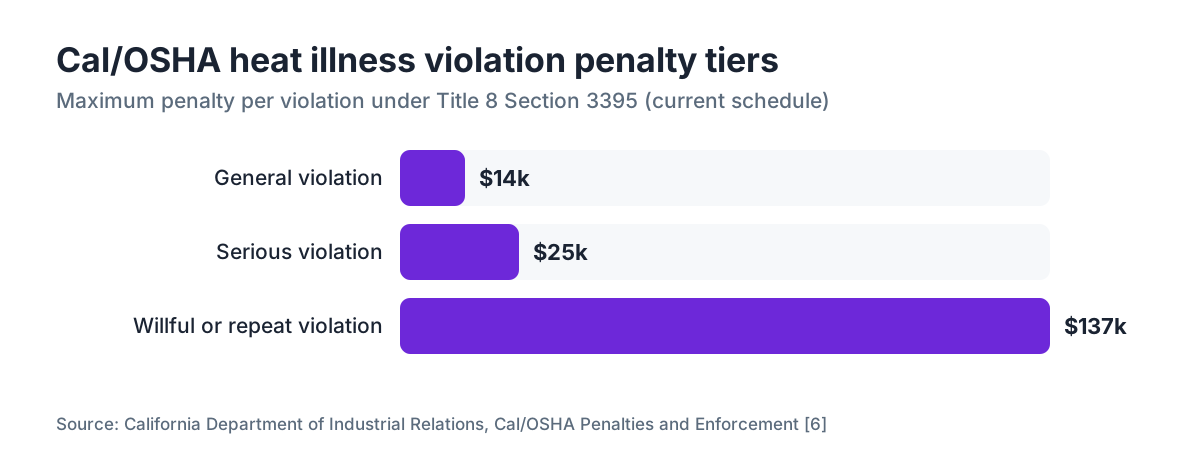
A general violation (inadequate plan, missing shade, no training records) runs up to $13,653 per violation under the current penalty schedule [6]. A serious violation, triggered when the violation creates a realistic probability of death or serious physical harm, runs up to $25,000 per violation [6]. Willful or repeat violations reach $136,532 per violation.
In practice, if a worker is hospitalized for heat stroke and the investigation finds no written plan, no training records, and no shade, you're looking at multiple serious violations stacked on each other. The tab hits six figures fast.
Penalties aren't the whole exposure. There's workers' compensation cost and potential civil liability if the absence of a compliant plan contributed to a serious injury. Cal/OSHA enforcement data shows agricultural heat illness citations concentrated in Fresno, Tulare, Kern, and Riverside counties [6].
Washington L&I's structure is similar, with serious violations up to $12,459 per violation as of 2024 [2]. Oregon, which adopted its own heat rule in 2021, has issued citations starting at $1,000 for first-offense general violations [7].
Does the EPA Worker Protection Standard add any heat illness documentation requirements?
The EPA's Worker Protection Standard (WPS) is about pesticide exposure, not heat, and it doesn't independently require a heat illness prevention plan [8]. But there's an overlap worth knowing.
The WPS requires employers to provide a safe work environment free from prohibited retaliation and to give workers information and training to protect themselves. Some enforcement actions have paired the WPS with Section 3395 when workers faced combined heat and pesticide hazards, say during sulfur applications in August.
More directly useful: the WPS requires a designated central location with safety information, including emergency contact numbers and directions to the nearest emergency medical facility [8]. Your heat illness plan's emergency response section should live in or beside this WPS central posting. Combining them in one laminated packet satisfies both requirements without duplicating anything.
UC Davis's Western Center for Agricultural Health and Safety has published guidance on where WPS and heat illness requirements overlap for California growers [5].
How do you train harvest supervisors on the specific heat illness protocols?
Supervisor training is legally distinct from worker training under Section 3395, and the content requirements run deeper [1]. The rule says supervisors must recognize early symptoms in others, not only in themselves. That's a different cognitive task than knowing your own warning signs.
The most effective supervisor training described in extension literature focuses on two things: the decision tree for escalation (when to move someone to shade, when to call 911) and the authority to act. A supervisor who waits 15 minutes to call for help because he's unsure whether the owner wants to spend money on an ambulance is a supervisor whose training failed.
WSU Extension has published a heat illness prevention supervisor training outline for Pacific Northwest agricultural operations [9]. It covers symptom recognition, the difference between heat exhaustion and heat stroke (the latter involves confusion, slurred speech, and loss of coordination), and communication protocols. UC Cooperative Extension's Ventura County office has similar materials tuned to coastal California conditions [4].
For documentation, log supervisor training separately from worker training. The log should include the supervisor's name, the date, the trainer's name, and a note that the supervisor-specific content (emergency authority, monitoring procedures) was covered. A one-page form does it. Keep it with your plan documentation.
Run a tabletop drill once a season. Ask your lead supervisor: a worker is confused, not responding normally, skin hot and dry. What do you do first? If the answer is anything other than "call 911 and move them to shade," the training isn't working.
What records should you have ready if Cal/OSHA shows up during harvest?
An unannounced Cal/OSHA inspection during harvest is the norm in hot counties, not the exception. The agency runs a heat illness enforcement program from May through October, and agricultural operations are a priority target [6].
Here's what an inspector will typically ask for, roughly in order.
First, the written plan itself. They'll check that it's at the worksite, in the workers' language, and covers every required element. Second, training records for the current season and possibly prior ones. Third, your water supply: they may walk your rows and confirm a quart per person per hour is accessible. Fourth, shade: they'll measure or eyeball whether the structure meets the 33-square-feet-per-employee standard. Fifth, temperature monitoring records on an over-95°F day.
Keep these in a dedicated binder or digital folder any supervisor can reach without calling the owner. The gap between an inspector arriving at your gate and reaching your crews in the field is often 10 minutes or less.
For operations spread across multiple blocks or ranches, a field operations platform like VitiScribe gives you one searchable record store, so if an inspector asks for the training sign-in from three weeks ago, you're not digging through a box of paper.
One check that surprises a lot of growers: whether your emergency procedure includes specific GPS coordinates or cross-streets for each block. "Call 911" isn't enough if the dispatcher doesn't know where to send the ambulance. Your plan should carry field location details for every block where work happens.
Where can you find free heat illness prevention plan templates?
Several reliable free templates exist. Cal/OSHA's own website has a model plan built for agricultural employers, available in English and Spanish [10]. It's a decent starting frame, though it doesn't handle acclimatization tracking or block-level emergency locations well. Plan to add those sections yourself.
UC Agriculture and Natural Resources (UCANR) publishes supplemental materials through its Cooperative Extension offices, including county-specific resources from Fresno, Kern, Ventura, and Napa [4]. Cornell's agricultural health and safety program has published heat stress guidance for the Northeast, useful if you grow in the Finger Lakes or Hudson Valley [11].
The National Center for Farmworker Health has multilingual heat illness materials that reach past English and Spanish into Mixtec, Hmong, and Haitian Creole, all relevant in some California labor markets [12].
When you use a template, modify it. A plan listing a generic shade structure and a generic emergency number is less defensible than one that says "shade is provided by the 20x30 foot tarp canopy deployed at the west end of Block 7" and "nearest emergency room is Adventist Health Hanford, 115 Mall Drive, (559) 582-9000, roughly 18 minutes from our furthest block." Specificity is protection.
Frequently asked questions
Does a small vineyard with only a few harvest workers still need a written heat illness prevention plan?
Yes. Cal/OSHA Section 3395 applies to all employers with outdoor agricultural workers, with no minimum employee count. If you have even one worker harvesting grapes outdoors in California when temperatures exceed 80°F, you need a written plan. Washington's WAC 296-62-095 has the same universal scope. Size of operation has no bearing on the requirement.
How often do we need to update the heat illness prevention plan?
There's no mandatory update cycle in the regulation, but you should review and re-date your plan at the start of each harvest season and any time you change shade infrastructure, emergency contacts, or block layout. If you add work areas mid-season, update the emergency response location section immediately. Inspectors look at the date on the plan and compare it to your current operation.
Can we use electronic records for our training sign-in sheets?
Cal/OSHA does not prohibit electronic records, and many operations use digital sign-in tools. What matters is that the record is complete (name, date, content covered, language delivered), accessible during an inspection, and retained at least three years. A PDF with electronic signatures stored in a cloud folder satisfies this. A group text message does not.
What counts as adequate shade under California's heat rule?
Shade must sit as close as practical to where workers are working and keep them from experiencing heat. The structure must provide at least 33 square feet per employee using the shade at any given time. Canopy shade from grapevines does not qualify. Tarps, shade structures, and vehicles (positioned correctly) generally do. Shade must be available from the start of the shift, not brought out only when workers ask.
What temperature triggers the high-heat procedures in California?
Cal/OSHA Section 3395 requires high-heat procedures when the outdoor temperature equals or exceeds 95°F. At that point, mandatory preventive cool-down rest periods of at least 10 minutes per 2 hours of work apply, along with more frequent supervisor check-ins and effective communication requirements. Standard requirements (water, shade, training) apply starting at 80°F.
Does the heat illness prevention plan need to cover H-2A workers specifically?
H-2A workers are employees under state labor law and are covered by the same plan requirements as any other harvest worker. There are no separate documentation requirements specific to H-2A status under the heat rules. Because H-2A workers are often new to a specific site and climate, they fall squarely inside the acclimatization provisions, and your plan should address how you onboard H-2A arrivals during hot weather.
What's the difference between heat exhaustion and heat stroke, and why does it matter for the plan?
Heat exhaustion involves heavy sweating, weakness, nausea, dizziness, and pale skin. The worker is still alert. First aid (move to shade, give water, cool the skin) is often enough. Heat stroke involves a body temperature above 103°F, confusion, slurred speech, absence of sweating, and possible loss of consciousness. It's a medical emergency requiring immediate 911. Your plan must distinguish the two, because the response is completely different and a delay in calling 911 for heat stroke can be fatal.
How do I document acclimatization for workers who return after a week-long break mid-harvest?
Cal/OSHA requires you to treat returning employees who've been away more than a week the same as new employees for acclimatization. Your plan should include a returning-worker acclimatization form that logs the re-start date, the reduced-exposure schedule for days 1 through 14, and the name of the supervising person each day. Keep these forms with your training records.
Are there federal OSHA heat rules that apply to vineyard workers, or is this all state-level?
As of mid-2024, there is no finalized federal OSHA heat illness standard. Federal OSHA proposed a heat illness rule in 2024 [13], but it had not been finalized. In states with their own OSHA plans (California, Washington, Oregon, Arizona), state rules apply. In states without a state OSHA plan, federal OSHA's General Duty Clause has been used to cite heat hazards, but documentation requirements are less specific than California's.
Does a heat illness prevention plan cover machine harvest crews differently than hand harvest crews?
The plan must cover all outdoor workers, including machine harvest operators. Operator cab conditions matter: if a harvester cab lacks air conditioning or has a broken AC, the operator can face heat exposure inside the machine. Your plan should address both crew types. Hand harvest crews face higher physiological heat load due to physical exertion, which affects your acclimatization scheduling and rest period frequency.
What emergency contact information must the plan include?
Your plan must include the method for contacting emergency medical services (usually 911, but may include a radio relay procedure if cell signal is absent), the physical address or GPS coordinates of your work areas, and directions to the nearest emergency room. Including the name, address, and phone number of the hospital is strongly recommended, and is required separately under the EPA Worker Protection Standard's central location posting.
How do I handle heat illness prevention if I'm a labor contractor supplying crews to vineyard operators?
Both the farm labor contractor and the vineyard operator (as the agricultural employer at the site) may share responsibility under Section 3395. In California, the rule applies to the entity that controls the working conditions, which in practice can mean both parties. Labor contractors should keep their own plan covering their employees, and vineyard operators should confirm that contractors' plans meet the standard before granting site access.
Sources
- Cal/OSHA, Title 8 Section 3395, Heat Illness Prevention in Outdoor Places of Employment: California's Heat Illness Prevention regulation requires written plans, one quart of water per worker per hour, 33 sq ft of shade per worker, acclimatization protocols, high-heat procedures at 95°F, and training before work begins
- Washington State Department of Labor and Industries, WAC 296-62-095, Outdoor Heat Exposure: Washington's permanent heat rule (WAC 296-62-095) took effect in 2023 and requires written prevention plans, documentation of temperature monitoring, and mandatory cool-down rest periods above 100°F
- National Institute for Occupational Safety and Health (NIOSH), Occupational Exposure to Heat and Hot Environments: The body takes 7 to 14 days of repeated heat exposure to fully acclimatize, with adaptations including plasma volume expansion, increased sweat rate, and lower working heart rate
- UC Agriculture and Natural Resources (UCANR), Heat Illness Prevention Resources: UCANR Cooperative Extension publishes county-specific heat illness prevention materials in English and Spanish for California agricultural workers and supervisors
- UC Davis Western Center for Agricultural Health and Safety, Farmworker Safety Resources: UC Davis's Western Center for Agricultural Health and Safety publishes guidance on the intersection of EPA Worker Protection Standard requirements and Cal/OSHA heat illness prevention for California growers
- California Department of Industrial Relations, Cal/OSHA Penalties and Enforcement: Cal/OSHA general violations for Section 3395 can reach $13,653 per violation; serious violations up to $25,000; willful or repeat violations up to $136,532 per violation
- Oregon OSHA, Heat Illness Prevention Rule (OAR 437-002-0156): Oregon adopted its heat illness prevention rule in 2021; first-offense general violations start at $1,000
- U.S. EPA, Agricultural Worker Protection Standard (WPS): The EPA Worker Protection Standard requires a designated central location with safety information, including emergency contact numbers and directions to the nearest emergency medical facility
- WSU Extension, Heat Illness Prevention for Agricultural Supervisors: WSU Extension has published a heat illness prevention supervisor training outline covering symptom recognition, the heat exhaustion vs. heat stroke distinction, and communication protocols for Pacific Northwest agricultural operations
- Cal/OSHA, Model Heat Illness Prevention Plan for Agriculture: Cal/OSHA publishes a free model heat illness prevention plan for agricultural employers in English and Spanish
- Cornell University, Agricultural Health and Safety Program: Cornell's agricultural health and safety program publishes heat stress guidance for Northeast agricultural operations, including the Finger Lakes and Hudson Valley
- National Center for Farmworker Health, Heat-Related Illness Prevention Resources: The National Center for Farmworker Health provides heat illness educational materials in languages including Mixtec, Hmong, and Haitian Creole in addition to English and Spanish
- Federal OSHA, Heat Injury and Illness Prevention in Outdoor and Indoor Work Settings (Proposed Rule, 2024): Federal OSHA proposed a heat illness prevention rule in 2024 that had not been finalized as of mid-2024; in the absence of a federal standard, states with their own OSHA plans enforce state-level heat rules
Last updated 2026-07-10