FQPA tolerance documentation requirements for vineyard export markets

TL;DR
- The Food Quality Protection Act sets U.S.
- pesticide tolerances, but export markets enforce their own MRLs, often far stricter.
- Vineyard managers need spray records, pesticide labels, residue test results, and chain-of-custody documents that match the destination country's limits.
- Gaps between U.S.
- tolerances and EU or Japanese MRLs are common and trigger shipment rejection.
What does FQPA actually require, and why does it matter for export?
The Food Quality Protection Act of 1996 rewrote how the EPA sets pesticide tolerances on food crops. Before FQPA, the agency weighed risks against benefits. After it, the EPA had to apply an extra 10-fold safety factor for infants and children unless aggregate and cumulative exposure data proved a smaller margin was safe [11]. For grapes, that shift changed the legal residue limits on dozens of fungicides and insecticides over the following decade.
Here is the catch for export. FQPA tolerances are U.S. domestic limits, and nothing more. The EU, Canada, Japan, China, and most other importing countries set their own maximum residue limits (MRLs). When a shipment of grapes or bulk wine crosses a border, the receiving country's MRL governs, not the U.S. EPA's tolerance. A chemical with a perfectly legal 5 ppm U.S. tolerance can trigger rejection in the EU if the EU's MRL is 0.01 ppm, the default "limit of determination" applied when no specific MRL exists [2].
So the real question for any vineyard manager planning exports goes past "did I stay under the EPA tolerance?" It is this: do my spray records and residue data prove I stayed under every destination market's MRL for every active ingredient I applied?
That proof takes documentation most domestic-only operations never bother to keep.
How do U.S. FQPA tolerances compare to EU and Japanese MRLs for common vineyard pesticides?
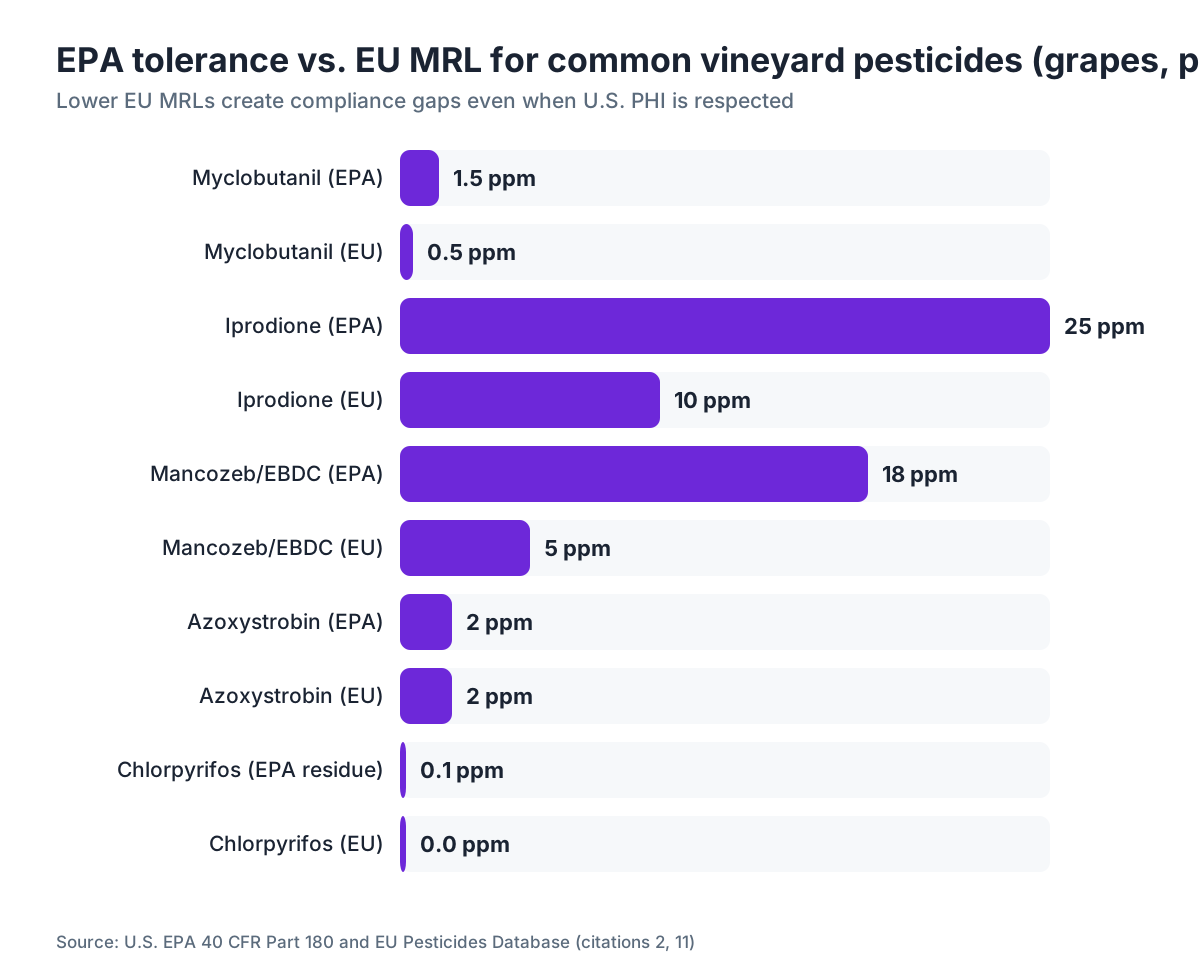
The gap between domestic tolerances and export MRLs is the single biggest compliance shock for new exporters. Below is a comparison for several pesticides commonly used on wine grapes, drawn from EPA, EU, and Codex Alimentarius values as of the most recent updates. Verify current figures directly with the EPA's tolerance database and the EU Pesticides Database before each season, because these numbers move.
| Active ingredient | EPA tolerance (grapes, ppm) | EU MRL (grapes, ppm) | Japan MRL (grapes, ppm) |
|---|---|---|---|
| Myclobutanil | 1.5 | 0.5 | 0.5 |
| Chlorpyrifos | 0.1 (post-2022 cancellation, residue tolerance only) | 0.01 | 0.01 |
| Iprodione | 25 | 10 | 10 |
| Mancozeb (as EBDC) | 18 | 5 | 5 |
| Azoxystrobin | 2 | 2 | 2 |
| Spirotetramat | 3 | 3 | 3 |
Chlorpyrifos is the sharpest example. The EPA canceled most food uses in 2022 after litigation, but residue tolerances technically remain in the Code of Federal Regulations for monitoring purposes. The EU has held the MRL at the default 0.01 ppm for years [2]. Any detectable residue in an export sample is effectively a violation in the EU, even when the grapes came from a block where chlorpyrifos was applied legally in prior years and the residue carried over.
Myclobutanil is another regular offender. It is a workhorse DMI fungicide for powdery mildew, carrying a 1.5 ppm EPA tolerance. The EU MRL is 0.5 ppm. That looks like a comfortable margin until you apply at full rate late in the season, and hitting the pre-harvest interval alone does not guarantee residues drop below 0.5 ppm by harvest.
Cornell's viticulture extension has published guidance noting that EU MRL compliance often means more than respecting pre-harvest intervals. In some cases it means choosing different active ingredients entirely [3].
What spray records do you need to document FQPA and MRL compliance for exports?
A complete export-ready spray record for a vineyard block should carry, at minimum:
- Date of each application
- Pesticide product name and EPA registration number
- Active ingredient and percentage
- Application rate (per acre and per 100 gallons of water, if applicable)
- Total product applied and total area treated
- Growth stage of the vines at application (the BBCH scale is now the international standard)
- Pre-harvest interval (PHI) as listed on the label, with actual days to harvest calculated from that application date
- Equipment used and calibration records
- Applicator name and, where required, license number
- Lot or tank serial number if applicable
- Destination market at the time of application, if known
Federal law under FIFRA requires commercial applicators to keep records for two years, and the EPA's Worker Protection Standard requires pesticide application records to be available to workers on request [4]. Those minimum federal requirements fall well short of what export customers and destination market regulators want to see.
The EU's import control program, run by the European Commission's Directorate-General for Health and Food Safety (DG SANTE), and Japan's Ministry of Agriculture, Forestry and Fisheries (MAFF) both want documentation that lets an inspector reconstruct every pesticide decision made in the block back to at least 90 days before harvest. Canada's Pest Management Regulatory Agency (PMRA) expects similar traceability under the Safe Food for Canadians Regulations [5].
Paper records are legal. They are also a slog to pull and copy when a customs broker or importer needs everything fast. A field record system that timestamps entries and exports by block and date range saves that scramble. VitiScribe is one option built specifically for block-level spray records with export report outputs, though any organized system works if the underlying data is complete.
WSU's viticulture and enology extension publishes a practical recordkeeping template that meets USDA and Washington State requirements, and it lines up well with EU audit expectations [6].
What is the MRL "default" and why does it matter so much for wine grapes?
When a country has not set a specific MRL for a pesticide on a crop, most importing countries fall back to a default limit. The EU's default is 0.01 mg/kg (0.01 ppm), essentially the lowest reliably detectable concentration [2]. Japan uses 0.01 ppm as its "uniform limit" under the Positive List System, in force since 2006 [7].
For vineyard operators, this is where obscure fungicides and tank-mix adjuvants turn into a problem. A product might be fully registered in the U.S. under FQPA with a legitimate tolerance, but if nobody filed an MRL petition in the destination country, the default 0.01 ppm applies. Trace residues that would be entirely fine for domestic sale trigger automatic rejection.
The EU's Pesticides Database lets you check any active ingredient against the current MRL table. Japan's MAFF runs a similar searchable database. The honest operational advice is simple: check your planned spray program against destination MRLs before the season starts, not after harvest.
The Codex Alimentarius MRL database, maintained jointly by FAO and WHO, works as a baseline because many countries either adopt Codex MRLs directly or use them as a benchmark [8]. Codex values are not automatically accepted by the EU or Japan, though. Codex sets mancozeb on grapes at 5 ppm. The EU matches that number, but only because the EU specifically chose to adopt it.
Do you need pre-shipment residue testing, and who requires it?
Residue testing is not universally required by law before export, but it is effectively mandatory if you want to ship with any confidence. Here is the practical reality.
The EU runs a coordinated monitoring program and a targeted import inspection program. Under the targeted program, certain origins and commodities face mandatory documentary and physical checks at EU borders. If your shipment gets flagged, the importer may have to present test results before release. If you have none, the shipment sits pending sampling, which adds weeks and cost [2].
Japan's Positive List System gives customs the authority to test any imported food product. Shipments that exceed the 0.01 ppm uniform limit for any substance not on the positive list are rejected or destroyed [7].
Bulk wine is different. Ethanol and the fermentation process degrade or concentrate residues in ways that do not track linearly with grape residue levels. Wine exported to the EU faces EU MRLs expressed in terms of the wine itself, and the EU runs a dedicated analytical program for wines from third countries.
Most serious exporters take the same approach: accredited residue testing from a lab certified under ISO 17025, run on the harvested fruit lot or the wine before shipment. Testing costs typically run $150 to $600 per sample depending on the panel size (the number of active ingredients screened), with multi-residue panels covering 200-plus compounds at the higher end. Prices vary by lab and region, so contact a specific accredited lab for a current quote.
UC Davis's viticulture and enology department has published guidance on matching residue panel selection to destination market risk [9].
How does the FQPA aggregate and cumulative risk framework affect your documentation?
FQPA introduced two ideas that reshaped how the EPA evaluates tolerances: aggregate risk (all routes of exposure to a single chemical) and cumulative risk (combined exposure to chemicals with a common mechanism of toxicity). The organophosphate insecticides are the textbook cumulative risk group [11].
For documentation, this matters in one specific way. If you are using multiple products in the same chemical class (say, two organophosphates in one season), the EPA's tolerance-setting assumes combined exposure, and the destination country's MRL may be built on the same logic. Your records need to show that the combined residue load from the whole season's applications stayed within the MRL for each compound independently, because MRLs are set per compound, not per class.
What this means in the field: if you rotated three different DMI fungicides across the season, document each one separately and test for each one separately. Do not assume that being below the MRL on one tells you anything about the others, or that some aggregate fungicide load gets evaluated as a whole. Each active ingredient carries its own MRL, and the inspector's checklist runs down each one.
EPA tolerance data is published in 40 CFR Part 180. The current search interface is the EPA's Pesticide Chemical Search tool, which lets you query by chemical name, crop, and tolerance value [11].
What are the USDA and FDA roles in export documentation, and how do they interact with FQPA?
FQPA is an EPA statute. The EPA sets tolerances, the FDA enforces them on domestic food, and the USDA's Agricultural Marketing Service (AMS) and Food Safety and Inspection Service handle certain commodity programs. For fresh grape exports, USDA's Animal and Plant Health Inspection Service (APHIS) issues phytosanitary certificates, which confirm plant material is free of regulated pests. APHIS certificates are not residue certificates. They say nothing about MRL compliance.
For wine, the Alcohol and Tobacco Tax and Trade Bureau (TTB) is the primary federal agency for label approvals and certificates of label approval (COLAs), required for export in many markets. TTB certificates also do not address residue compliance.
The FDA's job is domestic enforcement of FQPA tolerances under the Federal Food, Drug, and Cosmetic Act. The FDA does not issue export residue certificates. Exporters who need country-of-origin residue certificates typically go through USDA's AMS or a private accredited testing laboratory.
Some importing countries ask for a "health certificate" or "certificate of free sale" from a U.S. government agency. For wine, the FDA can issue these under specific programs, but they are declarations about product freedom from adulteration, not residue test results. Know which document your importer wants and which agency or lab can actually produce it.
What are the specific documentation gaps that cause export shipments to fail?
Published import rejection data from the EU's RASFF (Rapid Alert System for Food and Feed) portal and Japan's MAFF import refusal records show that vineyard-related residue failures fall into a few clear patterns.
First, late-season fungicide applications where the PHI was observed for U.S. purposes but residues still cleared the destination MRL at harvest. This happens because PHI is calibrated to the EPA tolerance, which may sit three to five times higher than the export MRL.
Second, use of products with no established MRL in the destination country. The applicator assumed EPA registration was enough. It is not.
Third, incomplete chain-of-custody records linking specific vineyard blocks to the grapes in the shipment. A residue test result is only useful if you can show it represents the lot being shipped.
Fourth, mixing juice or wine from MRL-compliant and non-compliant blocks without tracking lot separation.
Fifth, no record that a product was applied at the labeled rate. If a residue test comes back high and your records show only a product name and date with no rate, you have no defense.
The EU's RASFF database is publicly searchable and worth reviewing every year to see what is actually triggering alerts on grapes and wine from U.S. origins [10]. Treat it as a planning tool, not a cautionary tale.
How should you build an MRL compliance program before the season starts?
The time to check MRL compliance is February or March, when you are choosing products for the spray program, not September when the fruit is on the vine.
Start with your destination markets. Know before planting season which countries will buy your grapes or wine. Then pull the MRL table for each destination country for every active ingredient you plan to use. The EU Pesticides Database, Japan's MAFF database, and the Codex database are all free and searchable [2][7][8].
Compare your planned rates and frequencies against each MRL. If the gap between your expected residue level and the MRL is narrow, either switch products or plan pre-harvest residue testing. Extension programs at WSU and Cornell publish residue decline curves for common fungicides on grapes, which give you realistic estimates of what to expect at harvest for a given rate and PHI [3][6].
Document your selection logic. A one-page record showing that you reviewed MRLs for your target markets and picked products accordingly is solid evidence of good faith if a shipment ever gets flagged.
Set up your block records so every application entry includes the EPA registration number, the application rate in oz/acre or lb/acre exactly as written on the label, and the calculated days-to-harvest from that date. For paper records, UC Davis Extension publishes a spray record template that covers these fields [9]. For something digital that auto-flags PHI conflicts and generates export-ready reports, VitiScribe was built for exactly this workflow.
Schedule residue testing at least two weeks before your intended harvest date. That buffer lets you delay harvest if results come back borderline, or document a clean lot for your importer.
Are there any FQPA exemptions or lower-risk designations that simplify export compliance?
Yes, and this one is genuinely useful. FQPA lets the EPA exempt certain pesticide chemical residues from the requirement to set a tolerance if the residue is "safe," defined as presenting a negligible dietary risk [11]. These exemptions cover many biopesticides and minimum-risk pesticides.
For export, products with a FQPA exemption from tolerance are often exempt from tolerance requirements in other countries too, though this is not automatic. The EU keeps its own positive list of basic substances and low-risk active ingredients under Regulation (EC) No 1107/2009 that overlaps substantially, but not perfectly, with the EPA's exempt list.
Common vineyard products with EPA tolerance exemptions include sulfur, copper-based fungicides (in their basic formulations), kaolin clay, and certain biological controls like Bacillus subtilis and Trichoderma spp. These also tend to carry either no MRL requirement or very permissive MRLs in the EU and Japan, which makes them attractive from a documentation standpoint.
The takeaway: if your spray program leans hard on exempted or organic-listed materials, your export documentation burden gets lighter. You still need records showing what you applied and when, but you are not carrying the same residue risk. OMRI-listed products and NOP-compliant spray programs map fairly well to minimum-risk export profiles, though organic certification in the destination country is a separate, harder process.
What records should you keep specifically for export audits, and for how long?
Federal minimum retention under FIFRA for commercial applicator records is two years [4]. Most export market requirements and private certification standards expect five to seven years. The EU's food traceability requirements under Regulation (EC) No 178/2002 effectively demand traceability back through the supply chain without naming an exact retention period, but auditors routinely ask for five years.
Keep the following, organized by vintage and by block:
- Complete spray records as described above
- Pesticide purchase invoices and lot numbers (useful if you ever need to prove the product was what the label said)
- Residue test reports with lab accreditation number and method cited
- Harvest records linking block to lot to shipment
- Phytosanitary certificates from APHIS for fresh fruit exports
- Any import broker or importer correspondence about destination MRL requirements
- Records of PHI calculations for each application
For wine, add fermentation records, fining agent records (some fining agents carry MRL implications in certain markets), and blending records if grapes from multiple blocks or origins were combined.
Storage matters. Records stashed in a damp equipment barn for five years are rarely readable when you finally need them. Digital copies with a backup are the practical answer.
Frequently asked questions
What is the difference between an EPA FQPA tolerance and an MRL?
An EPA tolerance, set under the Food Quality Protection Act, is the legal residue limit for a pesticide in the United States. An MRL (maximum residue limit) is the equivalent limit set by another country or an international body like Codex Alimentarius. Tolerances and MRLs are often different numbers for the same pesticide on the same crop, and the destination country's MRL is what governs for any exported shipment.
Does having a valid EPA pesticide registration mean I can export without MRL concerns?
No. EPA registration means you can legally use the product in the U.S. on the labeled crop. It says nothing about export markets. If the destination country has no established MRL for that active ingredient on grapes, the default limit (0.01 ppm in the EU and Japan) applies automatically, and any detectable residue may trigger rejection. Check each destination country's database before using any product on export-intended fruit.
What is Japan's Positive List System and how does it affect grape exports?
Japan's Positive List System, which took effect in 2006, applies a uniform default limit of 0.01 ppm to any pesticide that does not have a specific MRL established in Japan. For grapes, this means any product not on Japan's approved list with a set MRL will be flagged if residues exceed 0.01 ppm. Japan's MAFF maintains the searchable database of approved MRLs for imported commodities.
How do I find the current EU MRL for a specific pesticide on grapes?
Use the European Commission's EU Pesticides Database, available at ec.europa.eu/food/plant/pesticides/eu-pesticides-database. Search by active substance and select "grapes" or "table grapes" or "wine grapes" as the product. The database reflects the current regulation and updates when MRLs change. Cross-check with your importer or an EU-based food safety consultant before finalizing your spray program for an export vintage.
Can I use a USDA organic certification to satisfy export MRL requirements?
Not directly. USDA organic certification means you used only approved organic inputs, which are generally lower-residue, but it does not guarantee residues will fall below every destination MRL. Sulfur and copper, both organic-approved, are exempt from tolerance in the U.S. and carry permissive or no-MRL status in most export markets, so organic programs do cut your residue risk substantially. Still run residue testing on organic export lots.
What is the RASFF database and how can vineyard managers use it?
RASFF is the EU's Rapid Alert System for Food and Feed, a public database of food safety alerts across EU member states. Vineyard managers can search RASFF for alerts on grapes and wine from U.S. origins to see exactly which pesticides and MRL exceedances have triggered recent rejections. It is free, searchable at ec.europa.eu/food/safety/rasff, and genuinely useful for deciding which residues to test before export.
Do wine exports face different MRL documentation requirements than fresh grape exports?
Yes, though the underlying logic is similar. Wine MRLs in the EU apply to the wine itself, not the grapes, and processing factors (concentration or degradation during fermentation) affect which grape-level residues translate to detectable wine residues. The EU also runs dedicated wine import monitoring programs. Bulk wine exporters should test the finished wine rather than the grapes, and carry documentation of the grape origin and spray program for each lot blended.
How long do I need to keep spray records for export compliance?
Federal law under FIFRA requires commercial applicator records for two years. Most export market audits and buyer requirements ask for five to seven years of records. The EU's food traceability regulation and most retailer certification programs effectively require at least five years. Keep records in a format that stays readable and can be organized by block and by vintage for fast retrieval.
What residue testing panel do I need for EU grape exports?
The EU's coordinated monitoring program tests for a list of several hundred active ingredients each year, but a multi-residue screening panel from an ISO 17025-accredited lab covering 200 to 400 compounds is standard practice for serious exporters. Focus the panel on every active ingredient applied during the season plus any persistent residues from prior seasons. Costs run roughly $300 to $600 per sample for a broad panel; contact an accredited lab for current pricing.
Does the FQPA extra 10-fold safety factor for children apply to export MRLs?
The FQPA's 10-fold safety factor is a U.S. EPA risk assessment tool used when setting domestic tolerances. It does not directly dictate export MRLs. The EU's MRL-setting process under Regulation (EC) No 396/2005 uses its own risk assessment framework that also applies conservative factors for vulnerable populations. Many EU MRLs end up lower than U.S. tolerances, but for different regulatory reasons.
What should I do if my pre-shipment residue test comes back above the destination MRL?
Do not ship that lot to the destination market where the MRL is exceeded. Check whether a different destination market has a higher MRL that the lot would meet. If the lot is for domestic sale only, verify it is below the U.S. EPA tolerance. Revise your spray program for next season. Document the whole process: the test result, your decision, and the lot's actual disposition. Transparency in your own records matters if you ever face an audit.
Are there university extension resources specifically on export MRL compliance for vineyards?
Yes. UC Davis Viticulture and Enology extension publishes guidance on residue management and export market requirements. WSU's viticulture extension (Irrigated Agriculture Research and Extension Center, Prosser) covers MRL compliance for Pacific Rim export markets, given Washington's strong apple and grape export programs. Cornell Cooperative Extension addresses EU requirements with a focus on Northeast grape varieties. All three publish updated spray program recommendations aligned with export MRL limits.
What is a pre-harvest interval and how does it differ from what I need for export MRL compliance?
A pre-harvest interval (PHI) is the minimum days between a pesticide application and harvest, set by the EPA to ensure residues fall below the U.S. tolerance at harvest. Complying with the PHI does not guarantee compliance with a stricter export MRL. A PHI calibrated to a 2 ppm U.S. tolerance may leave residues well above an export market's 0.3 ppm MRL. Residue decline data for specific products and climates, available from extension programs, gives better estimates than PHI alone.
Do I need a separate certificate of analysis for each shipment lot?
Most importers and destination market authorities expect a certificate of analysis (COA) tied to the specific lot by lot number or harvest date range. A COA from a different lot or a prior vintage does not satisfy this. Make sure your testing lab's COA references your block name or number, harvest date, and lot number as you define it, and that the lot definition matches your other shipping documents consistently.
Sources
- European Commission, EU Pesticides Database: The EU applies a default MRL of 0.01 mg/kg to any pesticide with no specific MRL established for that crop; MRL tables for grapes are searchable by active ingredient
- Cornell Cooperative Extension, Integrated Crop and Pest Management: Cornell extension guidance notes that EU MRL compliance for wine grape exports may require selecting different active ingredients, not just observing domestic PHI requirements
- U.S. EPA, Agricultural Worker Protection Standard and pesticide recordkeeping: Federal law under FIFRA requires commercial applicators to keep pesticide application records for two years, and the Worker Protection Standard requires application records to be available to workers on request
- Canada, Safe Food for Canadians Regulations (SOR/2018-108): Canada's Safe Food for Canadians Regulations require traceability documentation for imported food products, including pesticide application records consistent with PMRA MRL limits
- Washington State University Viticulture and Enology Extension: WSU viticulture and enology extension publishes a pesticide recordkeeping template that meets USDA and Washington State requirements and aligns with EU audit expectations
- Japan Ministry of Agriculture, Forestry and Fisheries (MAFF), Positive List System: Japan's Positive List System, effective 2006, applies a uniform 0.01 ppm default limit to any pesticide residue not covered by a specific established MRL on imported food
- Codex Alimentarius, Pesticide MRL database (FAO/WHO): Codex Alimentarius maintains the international reference MRL database; the Codex MRL for mancozeb on grapes is 5 ppm, which the EU has adopted; Codex values are not automatically binding on individual countries
- UC Davis Viticulture and Enology, Extension and Outreach: UC Davis extension publishes guidance on residue decline curves, spray record templates, and matching residue panel selection to destination market export risk for wine grapes
- European Commission, RASFF (Rapid Alert System for Food and Feed) portal: RASFF is a public, searchable database of EU food safety alerts including MRL exceedances on grapes and wine from third-country origins; useful for identifying which residues drive recent rejections
- U.S. EPA, Pesticide Tolerances in 40 CFR Part 180: All U.S. pesticide tolerances for food commodities, including grapes, are codified in 40 CFR Part 180 and searchable through the EPA's Pesticide Chemical Search tool; FQPA requires an extra 10-fold safety factor for children and allows tolerance exemptions for residues presenting negligible dietary risk
Last updated 2026-07-09