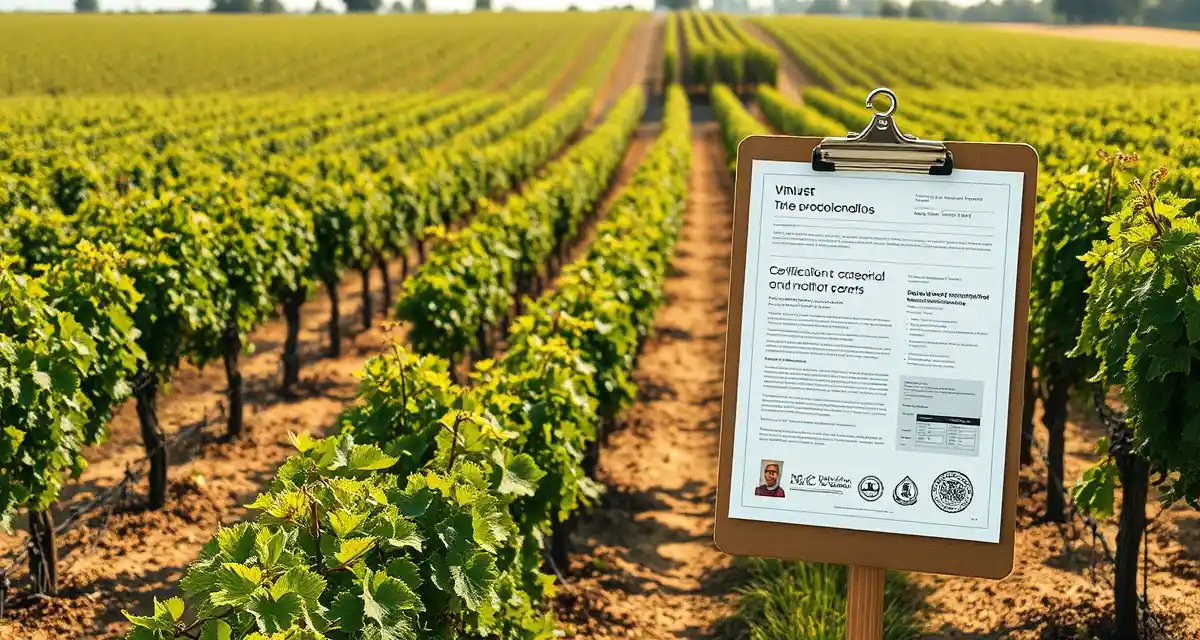
How to Apply for Organic Vineyard Certification
Organic certification requires a 3-year transitional period with full input records kept throughout. That means the documentation work starts long before you can sell your first bottle labeled as organic. If you're considering certification, understanding the timeline and record requirements upfront will save you notable frustration.
TL;DR
- The mandatory transition period is 36 months from the last application of a prohibited substance on your land -- this period cannot be shortened, and transition grapes cannot be sold as organic during this period
- Complete input records for the full 3-year transition period are required for certification -- common application delays occur when applicants lack records for one or more seasons of transition
- The Organic System Plan (OSP) is the core application document; certifiers compare what the OSP said you would do with what your spray and scouting records show you actually did
- For parallel production (conventional and organic blocks on the same operation during transition), block-level records must clearly document which inputs went to which blocks and how organic material was handled separately
- Every input applied during transition must be verified against the NOP National List of Allowed and Prohibited Substances before application -- "natural" does not automatically mean allowed under NOP
- CCOF is the most widely used certifier for California vineyards; Oregon Tilth is the primary certifier in the Willamette Valley; WSDA Organic covers Washington; NOFA-NY serves the Finger Lakes and Hudson Valley
This guide covers how to apply for organic vineyard certification through CCOF (California Certified Organic Farmers) or USDA NOP accredited certifiers, what the timeline looks like, and what records you'll need to produce.
What Certifying Agents Offer Organic Vineyard Certification?
The USDA National Organic Program (NOP) doesn't certify directly. Instead, it accredits third-party certifying agents who conduct inspections and issue organic certificates. For vineyards, the most common certifying agents include:
CCOF (California Certified Organic Farmers): The largest certifier for California vineyards and widely used in the western US. CCOF has specific experience with wine grape production and understands vineyard-specific record requirements.
Oregon Tilth (OTCO): Strong presence in Oregon and the Pacific Northwest. Widely used for Willamette Valley operations.
WSDA Organic: Washington State Department of Agriculture's organic certification program, accredited by USDA NOP.
NOFA-NY Certified Organic: New York's certifier with experience in Finger Lakes and Hudson Valley operations.
PCO (Pennsylvania Certified Organic): Used in mid-Atlantic states including Virginia.
You can use any USDA NOP-accredited certifier regardless of where you're located. Choose based on experience with vineyards and wine grape production, cost, and local support resources.
How Long Does Organic Vineyard Certification Take?
The timeline has two distinct phases:
Transition period: 3 years. Your land must be managed without prohibited substances for 36 months prior to harvest of the first certified organic crop. The 36 months is measured from the last application of a prohibited substance. This is not negotiable, there's no way to shortcut the transition period.
During transition, you manage your vineyard using only allowed inputs, but you can't label or sell your grapes as organic. Many producers sell transition grapes at conventional prices while building toward certification.
Application processing: 2-6 months. Once you apply, your certifier reviews your Organic System Plan, conducts an inspection, and issues a certificate. This process typically takes 2-6 months from application submission. Apply well ahead of your target harvest date.
So realistically: if you're starting today without any transition period behind you, you're looking at 3-4 years before your first certified organic crop.
What Records Do I Need to Apply for Organic Vineyard Certification?
This is where most applicants underestimate the requirement. Organic certification is an evidence-based process. Your certifier needs to verify that your land was free of prohibited substances during the transition period. That means you need records.
Input Records (3-Year History)
For every material applied to your vineyard during the transition period:
- Product name
- Application date
- Block/field applied
- Rate applied
- Purpose (what pest or disease problem was being addressed)
- Compliance status (allowed, restricted, or prohibited under NOP)
VitiScribe's organic input tracking is designed to support CCOF and NOP application processes. Every spray log entry includes the input record information your certifier needs. At application time, you can produce a complete input history organized by block and season.
Land History Records
If your land was previously farmed conventionally, you need to document when the last prohibited substance was applied. This might be:
- Prior operator's spray records
- Land purchase documentation
- Affidavits from prior operators
If you can't produce records showing the last application of a prohibited substance, your transition period starts from the date you can verify organic management began.
Organic System Plan (OSP)
Your Organic System Plan is the core application document. It describes:
- How you'll manage your vineyard organically
- What pests and diseases you face and how you'll address them
- What inputs you plan to use
- How you'll prevent contamination from prohibited substances
- Your record-keeping system
The OSP is essentially a commitment document. Your certifier will compare what you said you'd do with what your records show you actually did.
Parallel Production Documentation
If you grow both conventional and organic grapes (common during transition), you need clear documentation of which blocks are which and that organic material is handled separately from conventional.
Step-by-Step Application Process
Step 1: Begin transition. Identify your start date, the last date a prohibited substance was applied to any block you plan to certify. This is your transition start date. From this date, manage all applicable blocks with only NOP-allowed inputs.
Step 2: Choose your certifier. Research NOP-accredited certifiers with vineyard experience. Contact them early, they can answer questions about your specific situation during transition.
Step 3: Keep input records throughout transition. Every application to every certified block needs to be documented. Don't wait until year 3 to start keeping records, you'll need the complete 3-year history.
Step 4: Verify your inputs against the National List. Not all "natural" products are allowed under NOP. Check every input against the National List of Allowed and Prohibited Substances before you apply it. Materials reviews databases (like OMRI) can help verify compliance.
Step 5: Submit your application. Typically about 6 months before your target first certified harvest. Include your completed OSP and required records.
Step 6: Inspection. Your certifier conducts an inspection of your operation. Be prepared to show them your blocks, your records, and your input storage.
Step 7: Certificate issued. If everything checks out, your certificate is issued. It specifies your certified operation, the products covered, and the effective date.
For record-keeping requirements specific to CCOF applications, see the organic vineyard record keeping guide. For USDA NOP documentation requirements, see the USDA organic vineyard certification records guide.
See the IPM records for organic transition guide for how scouting and non-chemical practice records support the transition period documentation your certifier reviews.
Related Articles
FAQ
What certifying agents offer organic vineyard certification?
Any USDA NOP-accredited certifying agent can certify organic vineyards. Common choices for US wine regions include CCOF (widely used in California), Oregon Tilth (Pacific Northwest), WSDA Organic (Washington), NOFA-NY (New York), and PCO (mid-Atlantic). Choose a certifier with specific experience in wine grape production, they understand the input and record requirements for viticulture specifically, which makes the process substantially smoother.
How long does organic vineyard certification take?
The mandatory transition period is 3 years (36 months) from the last application of a prohibited substance on your land. You cannot shortcut this period. After transition, the application and inspection process typically takes 2-6 months. Start keeping detailed input records from the moment you begin transition, you'll need them to demonstrate compliance throughout the 3-year period.
What records do I need to apply for organic vineyard certification?
You need: a complete input application history for the 3-year transition period (product name, application date, block, rate, purpose), land history documentation showing when prohibited substances were last used, a completed Organic System Plan describing your management approach, and any parallel production documentation if you manage conventional blocks alongside organic blocks. Your records need to show that only NOP-allowed inputs were applied during the transition period.
What happens if I applied a restricted substance during transition that I didn't realize was prohibited?
The consequence depends on what was applied and when. Some NOP-restricted substances (like copper above a certifier-specified rate threshold) may require documented review by your certifier rather than automatic decertification. Others (synthetic pesticides prohibited under NOP) restart the transition clock from the date of application. If you discover a prohibited application during transition, contact your certifier immediately to discuss how to proceed -- attempting to conceal a prohibited application and then certifying is a more serious violation than disclosing it. VitiScribe's organic input compliance flag, which marks products as OMRI-listed, restricted, or prohibited, is a pre-application verification step that catches these situations before the application is made rather than after.
How do I document scouting and non-chemical practices for the OSP compliance comparison?
Your Organic System Plan commits to specific non-chemical practices alongside input restrictions -- canopy management for disease control, cover crops for beneficial insect habitat, physical barriers for pest exclusion. During your annual inspection, your certifier compares the OSP commitments against your records. If your OSP says you will conduct weekly scouting from budbreak through harvest, your scouting records need to show that actually happened. VitiScribe's scouting module creates timestamped scouting records by block that directly answer this comparison -- the certifier can see the date, block, and observations for each scouting visit alongside the input applications that followed threshold-based decisions.
What is How to Apply for Organic Vineyard Certification?
[FAQ_ANSWER_PLACEHOLDER: This answer needs to be generated by AI with specific data, examples, and actionable advice relevant to How to Apply for Organic Vineyard Certification. Target 50-150 words.]
How much does How to Apply for Organic Vineyard Certification cost?
[FAQ_ANSWER_PLACEHOLDER: This answer needs to be generated by AI with specific data, examples, and actionable advice relevant to How to Apply for Organic Vineyard Certification. Target 50-150 words.]
How does How to Apply for Organic Vineyard Certification work?
[FAQ_ANSWER_PLACEHOLDER: This answer needs to be generated by AI with specific data, examples, and actionable advice relevant to How to Apply for Organic Vineyard Certification. Target 50-150 words.]
Sources
- California Department of Pesticide Regulation (CDPR)
- UC Cooperative Extension Viticulture
- Wine Institute
- American Vineyard Foundation
- American Society for Enology and Viticulture (ASEV)
Get Started with VitiScribe
Organic certification is built on 3 years of records -- and the format of those records matters when your certifier reviews them at application time. VitiScribe's organic input tracking, OMRI compliance flags, and block-level input history organized by season give you the complete documentation infrastructure that CCOF, Oregon Tilth, and WSDA Organic certification applications require. Try VitiScribe free and start your organic transition input records from day one.
Getting Your Records Ready
The most common reason organic certification applications are delayed is incomplete records. Either the applicant doesn't have complete input records for the full transition period, or the records they have are in a format that's hard for the certifier to review.
Starting your input record-keeping in a structured digital format from day one of transition eliminates this problem. When you apply 3 years later, you can produce a complete, organized history by block and season, exactly what your certifier needs to verify compliance efficiently.