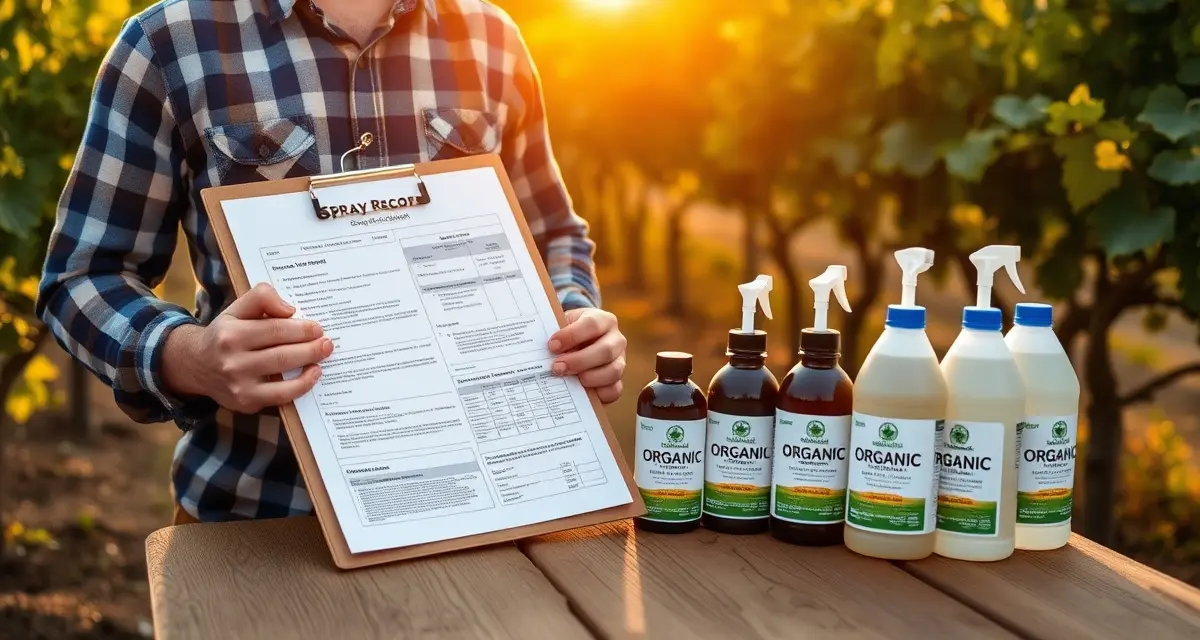
Vineyard Spray Records for Organic Certification Audits
CCOF auditors require spray records that include product OMRI status and application justification -- that's the field that most generic spray log templates miss, and it's the one that creates the most friction at organic certification audits. A spray record that shows the product applied but doesn't document that it was OMRI-listed or otherwise approved under the NOP is an incomplete record for organic purposes, even if the product itself was compliant.
VitiScribe's organic input tracking generates CCOF-compliant spray records with OMRI status pre-populated from the product library. When you select a product for a spray record, the system already knows whether it's OMRI-listed, and that status appears in your record automatically. You don't have to look it up or add it manually.
TL;DR
- CCOF auditors require spray records that include product OMRI-listed status and application rationale -- two fields that most generic spray log templates don't include; a record showing the product applied without documenting that it was OMRI-listed is incomplete for organic audit purposes even if the product was compliant
- Application rationale is the field most frequently missing in organic spray records at audit: it documents why the application was made -- "favorable infection conditions based on temperature and humidity," "post-rain preventive application based on infection risk model" -- distinguishing evidence-based IPM management from calendar spraying
- NOP organic certification requires 5-year spray record retention -- the longest of any regulatory or certification requirement; California's state minimum is 2 years, CCOF's is 5 years under USDA NOP standards; plan your retention system around the certification requirement
- Copper applications in organic programs require special attention: NOP regulations permit copper as a plant disease control but note accumulation and leaching potential; CCOF auditors may ask about annual copper application rates; records should show elemental copper rate per acre, not just product rate, so you can respond accurately to certifier questions
- Input traceability at CCOF audit includes cross-referencing spray records against purchase invoices and inventory; quantities used in your spray records should be consistent with what you purchased and what remains in inventory; discrepancies are audit flags
- If you're uncertain whether a product is approved mid-season, don't apply it until you have certifier confirmation; document that you made the inquiry; if you apply with approval, note that approval in the spray record
What Organic Certification Auditors Look For in Spray Records
Organic certification under the USDA National Organic Program (NOP) requires maintaining records that allow auditors to verify the following:
Only approved materials were used. Every spray record must reflect a product that's permitted under NOP standards. For fungicides and insecticides, this typically means OMRI-listed products, materials compliant with 7 CFR 205.601, or materials approved by your certifier. Products like copper-based fungicides, sulfur, neem oil, spinosad, and kaolin clay are commonly approved. Products like synthetic fungicides (DMIs, QoIs, SDHIs) and conventional insecticides are prohibited.
Applications were justified. NOP requires that organic producers demonstrate that prohibited substances weren't used and that approved materials were used only when needed. "Needed" doesn't mean you have to wait until you see disease -- it means your spray decision has a documented rationale. For powdery mildew in an organic program, the rationale might be "favorable infection conditions based on temperature and humidity" or "post-rain preventive application based on infection risk model." That rationale should appear in your spray record.
Records are complete and consistent. Auditors look for records that cover the entire growing season without unexplained gaps. A spray record that jumps from April to July raises questions. Even "no-spray" scouting decisions should be documented -- they show that you monitored and chose not to apply, which is the IPM framework the NOP expects.
Inputs are traceable. CCOF auditors may ask for purchase receipts or invoices for inputs used during the season. Your spray records should match what you purchased -- the quantities used in your spray records should be consistent with what you bought and what's left in inventory.
Required Fields for CCOF-Compliant Organic Spray Records
A spray record that satisfies CCOF audit requirements needs all of these fields:
| Field | Organic-Specific Requirement |
|---|---|
| Application date | Standard |
| Block/location | Standard |
| Crop | Standard |
| Product name | Must be same product name as appears on OMRI listing or certifier approval |
| OMRI-listed status | Required -- yes/no, with listing number if available |
| EPA registration # | Standard |
| Active ingredient | Standard |
| Approved use basis | NOP 205.601 subsection, OMRI listing, or certifier pre-approval |
| Target pest | Required -- must justify the application |
| Application rationale | Weather conditions, scouting data, or infection risk basis |
| Rate per acre | Standard |
| Total product used | Standard |
| Applicator | Standard |
| Weather conditions | Standard |
| PHI | Standard |
The "approved use basis" and "application rationale" fields are what distinguish an organic spray record from a conventional spray record. They document that you knew the material was approved and that you had a reason to use it.
Copper and Sulfur Records in Organic Programs
Copper and sulfur are the workhorses of organic disease programs, but they require specific attention in certification records.
Copper: NOP regulations (7 CFR 205.601) permit copper-based materials as a plant disease control, but they include an "accumulation and leaching potential" restriction -- meaning excessive copper applications that might accumulate in soil can be questioned. CCOF and other certifiers may ask about your annual copper application rate. Your spray records should show total copper applied per season and per acre. When entering copper applications in VitiScribe, recording the elemental copper rate (not just the product rate) gives you the data you need if the certifier asks.
Sulfur: Generally permitted without specific rate restrictions under NOP, but your records should still document the product (not all sulfur formulations are identical), the rate, and the application rationale. In blocks where sulfur is applied frequently, records showing the spray interval and rationale (powdery mildew prevention based on conditions) demonstrate that applications are purposeful.
Transitional Period Records
If you're in the 36-month transition period from conventional to organic certification, your records need to cover both pre-transition and transition-period applications. CCOF auditors review the transition period spray history to verify that no prohibited substances were used during the three years before certification.
Keep transition-period records separate from certified-organic period records if they're in different formats, but maintain them for the same 5-year retention period. A clean break -- a date from which all records forward reflect only approved organic inputs -- should be identifiable in your records.
Organic vineyard record keeping for CCOF certification covers the complete documentation framework including input purchasing, field activity logs, and the CCOF system plan requirements beyond spray records alone.
What to Do When You Have a Compliance Question Mid-Season
If you're unsure whether a product is approved for your organic program mid-season, don't apply it until you have confirmation from your certifier. This sounds obvious, but pressure to manage a disease outbreak sometimes leads to applications that create certification problems later.
Contact your CCOF inspector or the CCOF technical support line with the product name and EPA registration number. Ask specifically whether it's approved for your operation under your current system plan. Document that you made this inquiry -- if you later apply the product with certifier approval, your spray record should note that approval.
Your spray log compliance hub in VitiScribe flags any product not in its OMRI-approved product category when you're working in an organic operation setup. This happens before you finalize the record, giving you a check before the application happens rather than a discrepancy you find at audit time.
Frequently Asked Questions
What spray record fields does CCOF require for organic vineyard audits?
CCOF requires spray records to document: the product name (matching the OMRI listing or certifier approval), OMRI-listed status, the basis for approval under NOP regulations (typically an OMRI listing number or 7 CFR 205.601 subsection), the target pest, an application rationale (weather conditions, scouting data, or infection risk basis), rate per acre, total product used, applicator name, and standard compliance fields like application date, block, and crop. The application rationale is the field most frequently missing in audits -- it documents that the application was made for a reason, which is what distinguishes IPM-based organic management from conventional calendar spraying.
How do I document that I used only approved organic inputs in my spray records?
Each spray record should include the product's OMRI-listed status (or other approval basis) and the specific NOP regulation or OMRI listing that authorizes its use. In practice, this means selecting products from a pre-approved library where this information is already attached. Keep OMRI listing printouts or certifier pre-approval letters in your records file alongside your spray logs, so that at audit time you can demonstrate both that you used approved materials and that you verified their approval at the time of use. For copper products, record elemental copper rate per acre so you can respond to certifier questions about annual accumulation.
Can VitiScribe generate CCOF-compliant spray records for organic vineyard audits?
Yes. VitiScribe's organic operation mode flags products by OMRI status, includes application rationale fields, and generates records that include all CCOF-required fields. When you set up your operation as organic-certified or in transition, the product selection workflow highlights OMRI-listed materials and prompts for application rationale at record entry. At audit time, VitiScribe exports block-level organic spray logs in formats suitable for CCOF review, including the OMRI status and approval basis fields that auditors specifically look for.
How should a vineyard in organic transition handle spray records from the conventional period before transition started?
Your CCOF audit for initial certification will review the 36 months preceding your expected certification date. You need records for this period that demonstrate no prohibited materials were used. If those records are on paper, organize and scan them now -- don't wait until the certification application. The audit will request records from the entire transition period. A clean transition record set shows an identifiable date from which forward only approved inputs were used. If pre-transition conventional records are incomplete, disclose this proactively in your certification application; unexplained gaps in the transition period are a more serious concern than acknowledged documentation limitations from the pre-digital era.
What is Vineyard Spray Records for Organic Certification Audits?
[FAQ_ANSWER_PLACEHOLDER: This answer needs to be generated by AI with specific data, examples, and actionable advice relevant to Vineyard Spray Records for Organic Certification Audits. Target 50-150 words.]
How much does Vineyard Spray Records for Organic Certification Audits cost?
[FAQ_ANSWER_PLACEHOLDER: This answer needs to be generated by AI with specific data, examples, and actionable advice relevant to Vineyard Spray Records for Organic Certification Audits. Target 50-150 words.]
How does Vineyard Spray Records for Organic Certification Audits work?
[FAQ_ANSWER_PLACEHOLDER: This answer needs to be generated by AI with specific data, examples, and actionable advice relevant to Vineyard Spray Records for Organic Certification Audits. Target 50-150 words.]
What are the benefits of Vineyard Spray Records for Organic Certification Audits?
[FAQ_ANSWER_PLACEHOLDER: This answer needs to be generated by AI with specific data, examples, and actionable advice relevant to Vineyard Spray Records for Organic Certification Audits. Target 50-150 words.]
Who needs Vineyard Spray Records for Organic Certification Audits?
[FAQ_ANSWER_PLACEHOLDER: This answer needs to be generated by AI with specific data, examples, and actionable advice relevant to Vineyard Spray Records for Organic Certification Audits. Target 50-150 words.]
How long does Vineyard Spray Records for Organic Certification Audits take?
[FAQ_ANSWER_PLACEHOLDER: This answer needs to be generated by AI with specific data, examples, and actionable advice relevant to Vineyard Spray Records for Organic Certification Audits. Target 50-150 words.]
What should I look for when choosing Vineyard Spray Records for Organic Certification Audits?
[FAQ_ANSWER_PLACEHOLDER: This answer needs to be generated by AI with specific data, examples, and actionable advice relevant to Vineyard Spray Records for Organic Certification Audits. Target 50-150 words.]
Is Vineyard Spray Records for Organic Certification Audits worth it?
[FAQ_ANSWER_PLACEHOLDER: This answer needs to be generated by AI with specific data, examples, and actionable advice relevant to Vineyard Spray Records for Organic Certification Audits. Target 50-150 words.]
Related Articles
- Managing Contract Spray Applicators with Digital Records in Your Vineyard
- DTC Winery Compliance: Vineyard Spray Records and Regulations
Sources
- USDA National Organic Program (NOP) -- 7 CFR Part 205
- CCOF (California Certified Organic Farmers)
- OMRI (Organic Materials Review Institute)
- California Department of Pesticide Regulation (CDPR)
- UC Cooperative Extension Organic Agriculture
Get Started with VitiScribe
CCOF audit friction most commonly comes from missing OMRI status documentation and missing application rationale -- two fields that VitiScribe auto-populates and prompts for at entry, so they're present in every record without additional steps. VitiScribe's organic operation mode flags products by OMRI status and generates records in CCOF-ready format for annual audit submission. Try VitiScribe free and generate your first CCOF-compliant organic spray record today.