How to audit your own vineyard spray records before a regulatory inspection

TL;DR
- Before any inspection, pull every pesticide application record from the past two years and check five things: the license number of each applicator, the correct restricted-entry and pre-harvest intervals for every product, the field location and acreage, the water source notation if your state requires it, and the submission date to your county agricultural commissioner.
- Most cited violations are clerical, not chemical.
Why auditing your own spray records before an inspection actually matters
Regulatory inspections of vineyard pesticide records are not rare. County agricultural commissioners in California, Washington, and New York run routine compliance checks under authority delegated to them through FIFRA and state pesticide law. California counties log large volumes of pesticide use reporting activity every year, tracked in the California Department of Pesticide Regulation's annual pesticide use report data [1].
Here's the uncomfortable part. Most violations found during those inspections are paperwork problems, not illegal applications. Missing applicator license numbers. Unsigned records. Wrong unit conversions. Use reports filed late. The chemistry in the field was usually fine. The file was the problem.
A self-audit two to four weeks ahead of a scheduled or anticipated inspection gives you time to find those gaps and fix what's fixable. Some things can still be corrected. A missing signature on a record from 18 months ago can take an explanatory addendum. Other things cannot be invented after the fact, like a record that simply doesn't exist, and those you disclose up front. Knowing which is which before an inspector walks in is worth real money.
This guide runs the audit the way a working compliance consultant would, covering federal requirements under the Worker Protection Standard and FIFRA, state pesticide use reporting rules, and the retention timelines that trip up the most operators.
What records are you legally required to keep for vineyard pesticide applications?
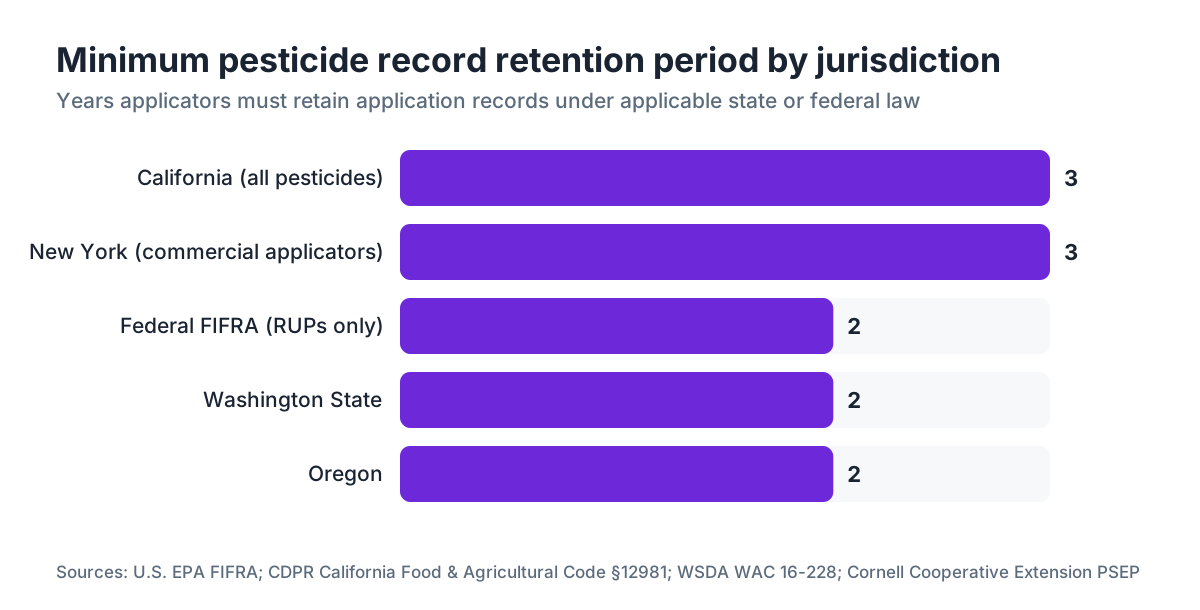
Federal law under FIFRA section 8 requires certified private and commercial applicators to keep records of restricted-use pesticide (RUP) applications for two years from the date of application [2]. That two-year minimum is the floor, not the target. Several states run longer. Washington requires pesticide application records be kept for two years under WAC 16-228 [3], matching the federal floor. California goes further: use reports must reach the county agricultural commissioner within one month of each application, and the underlying records must stay available for three years under California Food and Agricultural Code Section 12981 [4].
At the federal level, every restricted-use pesticide record must include:
- The brand name and EPA registration number of the pesticide
- The crop or site treated
- The location of the application (field name or legal description)
- The date of application
- The amount of pesticide applied
- The size of the area treated
- The name and certification number of the certified applicator who made or supervised the application [2]
General-use pesticides don't trigger a federal written record. But California, Washington, Oregon, and most other major wine grape states require records for every pesticide application regardless of use classification [4]. Check your own state's rules. The Cornell Cooperative Extension pesticide safety education program has a clear breakdown of northeast state requirements if you're in New York [5].
On top of the application log itself, the EPA Worker Protection Standard (WPS) at 40 CFR Part 170 requires you to maintain and post pesticide safety information, keep records of WPS-required training for agricultural workers and handlers, and keep application-specific information (including the REI) posted or accessible at a central location for as long as the REI runs and for 30 days after [6].
So you're managing at least two parallel record systems. The application log is one. The WPS documentation set is the other. Treating them as one file is where audits go sideways.
What does a complete spray record entry look like field by field?
Pull up your spray log and go entry by entry. For each application, you should be able to check off every element in the table below before you'd call that record complete.
| Field | What to check | Common gap |
|---|---|---|
| Date | Actual application date (not the date you logged it) | Logged a day or two late, or a range instead of a specific date |
| Pesticide name | Full brand name and EPA Reg. No. | Reg. number missing or wrong |
| Active ingredient | Listed separately per label | Often omitted on informal log sheets |
| Application rate | Oz or lb per acre, or per 100 gal | Unit errors (oz vs fl oz vs lb) |
| Area treated | Acres, with specific block or field ID | Vague descriptor like "upper vineyard" |
| Applicator name | Person who made the application | Missing when owner does the spraying |
| Applicator license/cert number | Certification number for RUPs | Frequently missing |
| REI | Correct interval from the label | Transcribed from an old label version |
| PHI | Pre-harvest interval in days | Missing entirely, especially for early-season materials |
| Wind speed/direction | Required in many states | Left blank |
| Water source | Required in some states for dilution | Often skipped |
| Equipment used | Sprayer type and settings | Often informal or absent |
| Supervisor signature | Required for commercial applicators | Missing when the operator is also the owner |
The PHI column earns extra attention. Pre-harvest intervals matter for food safety and for your own defensibility if a residue question ever surfaces. The EPA label is the legal document, so transcribe the REI and PHI from the label version in effect at the time of application, not from a current label if the product has been reformulated since.
WSU Extension's pesticide record-keeping guide recommends keeping a copy of the label, or at least the label version number, alongside each application record for exactly this reason [7].
How far back do you need to check your spray records?
Start with two full calendar years and work backward from today. That covers the federal two-year floor for RUP records and captures the most recent two harvest seasons, which is the window an inspector focused on residue would care about most.
In California, push to three years to match the state requirement. If your state requires you to submit pesticide use reports to a county or state agency, pull a copy of every report you filed and cross-check the submitted version against your underlying field records. Discrepancies between the two are a red flag inspectors notice fast.
For WPS training records, the federal rule requires you to keep records of worker and handler training for two years from the date of training [6]. Each record needs the trainee's name, the training date, the topics covered (or a reference to the WPS training materials used), and the name of the trainer or the training program.
Here's what a lot of small operators miss. If you hired labor through a farm labor contractor, the WPS training responsibility may be shared, but the central posting obligation and the records of what was posted stay with the agricultural employer running the establishment. That's you [6].
How do you check that your REIs and PHIs are correct?
This is where auditors spend the most time. Make a list of every product you applied in the audit window. For each one, pull the label from EPA's pesticide label system and compare the REI and PHI on the label to what you recorded [9].
Two things to watch. First, labels get revised. The EPA registration number stays the same, but the REI or PHI can change when a label is amended. If you applied a product in 2023 under a label with a 4-day REI and that label later moved to a 7-day REI, the 4-day REI was correct for that application. Your current label copy just needs to reflect the current requirement for future work. Second, some products carry multiple formulation concentrations under one brand name, and the REI can differ by formulation. Make sure you're reading the right label.
For wine grapes, watch any product where the PHI runs up against your actual harvest date. If your records show a fungicide with a 14-day PHI and your harvest records show you picked eight days later, that's a violation whether or not any residue turned up. The label interval is a legal requirement, not a suggestion.
UC Davis's Integrated Pest Management program keeps a reference library of pesticide use approvals for wine grapes by pest and product [8]. Cross-checking your product list against it also confirms each product was used on a permitted crop site, which is a separate compliance question that inspectors sometimes fold into the same visit.
What Worker Protection Standard records do inspectors specifically look for?
The WPS inspection checklist that EPA and state agencies use is public. Based on EPA's WPS compliance materials, inspectors check the record-keeping category for the following [6][11]:
- Evidence that workers and handlers received WPS safety training within the past year, tracked from each training date
- Records showing the content of training and who provided it
- A central posting location with the required pesticide safety information, plus application-specific information (product name, location treated, REI, and whether the product is a fumigant)
- Documentation that early-entry workers (those entering during an REI under an exception) received the additional early-entry training and the required PPE
The 2015 revised WPS rule, which took full effect in January 2017, changed several requirements, including annual training and tighter application exclusion zone (AEZ) rules [6]. If your training records predate 2017, confirm the training content matches the current rule rather than the pre-revision version.
One line from EPA's WPS guidance is worth keeping in front of you: the standard requires agricultural employers to provide handlers and early-entry workers with "specific information about each pesticide application, including the location and description of the area to be treated, the product name, the EPA registration number, the REI, and whether the product requires an AEZ" [6]. That's a specific list. Match your records to it item by item.
How do you audit records for custom application contractors or PCAs?
Plenty of vineyards split application work between their own equipment and a licensed pest control operator or pest control adviser (PCA). That split creates a record-keeping gap that catches operators off guard.
As the agricultural employer and pesticide use permit holder, you're responsible for making sure complete records exist for every application on your property, no matter who held the sprayer. The contractor carries their own license and may file their own use reports in states like California, but you're still expected to keep your own record of what went on your site and to confirm the application matched your county pesticide use permit conditions.
So build a standard data handoff into any contractor relationship. When they leave the property after an application, you get a written record with every field from the table above. Some contractors are excellent about this. Others hand you a receipt. Push for the full record and file it next to your own spray log.
If a contractor applied a restricted-use pesticide, their certified applicator license number goes on your record. Ask for it every time. This is awkward exactly once, then it's routine.
What's the fastest way to find gaps in a large spray record file?
If your records are on paper, run a column-by-column pass. Print or draw the field table from earlier in this article, then flip through the spray log and put a check or an X in each column for each entry. The gap pattern shows up in about 20 minutes. Missing applicator license numbers tend to cluster on entries made by one specific person. Missing REIs cluster on entries from before you switched to a better log form. Patterns tell you where the systemic problem lives.
Digital records follow the same logic, faster. A spreadsheet filter on blank cells in the license number column finds every gap at once. If you use dedicated vineyard compliance software like VitiScribe, the application record form enforces required fields at entry time, so gaps surface as incomplete drafts instead of filed records that fail inspection.
After the field-by-field pass, run a second check at the product level. List every product you sprayed in the window and confirm you have an application record for every day that product was applied. Cross-check against purchase records and dealer invoices. If you bought 30 gallons of a fungicide and your spray log only accounts for 22 gallons' worth of applications, either something went unlogged or you have an inventory discrepancy to explain.
The WSU Extension pesticide record-keeping fact sheet recommends this purchase-versus-use reconciliation as a closing audit step [7].
What can you fix before an inspection, and what can't you fix?
This is the question that makes compliance consultants earn their fees. The honest answer has edges.
You can fix these. Adding a missing applicator certification number to an existing record, if you can verify the correct number from the applicator's license documentation. Adding a clarifying note to an ambiguous entry, something like "field ID 'North Blocks' refers to blocks 4, 5, and 6 as mapped in attached vineyard map dated [date]." Locating a missing label copy and attaching it. Submitting a late pesticide use report to your county commissioner, with a cover letter noting the late filing, before an inspection rather than after.
You cannot retroactively create a record for an application you didn't log at the time. Backdating records to look compliant is document falsification. Inspectors are trained to catch it, partly through the purchase-versus-use reconciliation above and partly by cross-referencing contractor submissions in states where contractors file independently.
Don't correct a historical REI or PHI to match a current label if the current label differs from what was in effect then. That record reflects what you knew and what the law required at that specific time. If the old REI was correct then, leave it alone. Add a note explaining the label version if it helps.
For genuinely missing applications, prepare a written disclosure memo for the inspector: what you couldn't locate, what you believe happened, and what process changes stop it from happening again. Inspectors respond much better to an operator who found their own problems than to one who looks like they're hiding something.
How do state pesticide use reporting rules differ from federal requirements?
FIFRA sets the federal minimum, and states stack requirements on top. The table below summarizes key differences across the main wine grape states.
| State | Record retention | Reporting frequency | Submitted to | All products or RUPs only? |
|---|---|---|---|---|
| California | 3 years | Monthly, due within 1 month of application | County Agricultural Commissioner | All pesticide applications |
| Washington | 2 years | Annual for most applicators | WA Department of Agriculture | All applications by licensed operators |
| Oregon | 2 years | Annual | ODA Pesticides Division | All applications by licensed operators |
| New York | 3 years | Annual (some categories) | NYSDEC | All commercial applications |
| Federal (FIFRA) | 2 years | No periodic report required | N/A | RUPs only |
Sources: CDPR [4], WSDA [3], Cornell Cooperative Extension [5].
California is the most demanding of the group. Monthly reporting means your use reports have to match your underlying application records 12 times a year instead of once. A California grape grower can count on a county agricultural commissioner inspection cross-referencing submitted use reports against the field spray log. Any application in the log that never showed up in a report, or any quantity in a report that doesn't match the log, generates a question.
Grow grapes in Paso Robles or anywhere in San Luis Obispo County and the county commissioner's office runs its own inspection protocols aligned with CDPR requirements [4][10]. Knowing your specific county's enforcement priorities is useful context before an audit.
What should your audit checklist actually look like?
Here's a checklist you can print and use. Work it in order.
Step 1: Pull the full records set
Gather your spray log, submitted pesticide use reports, contractor application records, WPS training logs, posting records, and pesticide purchase invoices. Keep them together in one place.
Step 2: Confirm your retention window
Find your state's required retention period (two or three years in most cases). Confirm you have records covering that full window.
Step 3: Check each entry for completeness
Use the field table from earlier in this article. Flag every entry missing any required field.
Step 4: Verify applicator license numbers
For every restricted-use pesticide application, confirm the applicator's license or certification number is on record and was valid on the application date. Most states have an online license lookup.
Step 5: Reconcile REIs and PHIs
For the five to ten products you use most, pull the current EPA label and confirm the REI and PHI match what you've been recording. Flag any discrepancy.
Step 6: Cross-check submitted use reports
If your state requires periodic use reports, pull copies of every report from the audit window. Confirm each application in your field log appears in a submitted report and that quantities match.
Step 7: Audit WPS records separately
Check training records for every worker and handler who could have contacted treated areas. Confirm the posting record for every application. Confirm your central location posting is current.
Step 8: Do the purchase-versus-use reconciliation
Add up total product usage from the spray log by product. Compare to total purchases from invoices. Chase any gap larger than typical mixing losses or container heel.
Step 9: Document what you found and what you corrected
Write a short internal memo: which records were complete, which had gaps, what you corrected, what you couldn't. Keep it in your file. If an inspector asks whether you reviewed your records first, you can answer honestly.
To keep this from becoming an annual fire drill, VitiScribe's spray record module timestamps every entry and requires the mandatory fields before saving, which catches most step-3 gaps at the point of entry instead of after the fact.
What happens if the inspector finds violations you didn't catch?
Inspectors have discretion on minor first-time violations. A missing certification number on one record from 18 months ago probably won't generate a formal compliance order if the rest of your file is solid and you're cooperative. A pattern of missing required fields across dozens of records, or reports that were never submitted, is a different animal.
In California, CDPR civil penalties for pesticide law violations run from a warning letter for first-time minor violations up to $5,000 per violation per day for willful or knowing violations under California Food and Agricultural Code Section 12999.5 [4]. For federal FIFRA violations, civil penalties can reach $1,000 per violation for private applicators and $25,000 per violation for commercial applicators, per EPA's FIFRA enforcement policy [2].
The best thing you can do before an inspection is be ready to walk the inspector through your record system. Know where everything is. Know your submission dates. Know your applicators' license numbers from memory or have them a keystroke away. An organized, transparent operator gets more benefit of the doubt than one who's scrambling.
Frequently asked questions
How long do I have to keep vineyard pesticide application records?
Federal law under FIFRA requires two years for restricted-use pesticide records. California requires three years for all pesticide application records under the Food and Agricultural Code. Washington and Oregon match the two-year federal floor. Keep records for the longest period your state requires, and store them somewhere you can actually find them during an inspection.
Do I need to keep records for every pesticide I apply, or only restricted-use pesticides?
Federal law requires records only for restricted-use pesticides, but most major wine grape states (California, Washington, Oregon, New York) require records for all pesticide applications regardless of classification. California's monthly use reporting system covers all pesticides applied by anyone holding a pesticide use permit, which means virtually all commercial vineyard operators.
What is a pesticide use report and how is it different from my spray log?
A spray log is your internal field record, made at the time of application. A pesticide use report is the periodic submission you send to a county or state agency summarizing those applications. In California, use reports go to the county agricultural commissioner monthly. The two documents need to match. Discrepancies between them are a primary focus of compliance inspections.
What records does the Worker Protection Standard require vineyard operators to keep?
The WPS at 40 CFR Part 170 requires records of worker and handler safety training, kept two years from the training date, plus a central posting with application-specific information during and for 30 days after each REI. Records need trainee names, training dates, topics covered, and trainer identity. The 2015 revised WPS rule tightened these requirements, including annual training.
Can I correct a mistake in a historical spray record before an inspection?
You can add clarifying notes and attach supporting documentation to existing records, like adding an applicator's verified license number. What you cannot do is change the substance of what was originally recorded to make it look compliant after the fact. That crosses into document falsification. If you have genuinely missing or incorrect records, prepare a written disclosure for the inspector explaining what happened.
What is the REI and where does it have to be recorded?
The restricted-entry interval is the period after a pesticide application when workers are barred from the treated area without specific PPE and early-entry training. The label sets it, and it varies by product from a few hours to several days. The REI must appear in your application record and must also be posted at your central WPS location during the interval.
Do I need to keep records for pesticides applied by a contractor or PCA?
Yes. As the agricultural employer and permit holder, you need records for every application made on your property regardless of who held the sprayer. Contractors may file their own use reports in some states, but you still need a copy of the full application record for your own file. Set up a written data handoff requirement with any contractor you hire.
How do I check that the pre-harvest interval was respected for every application?
Pull the PHI from the EPA label for each product applied in the 60 days before harvest. Compare the application date plus the PHI to your actual harvest date for each block. If any application falls inside the PHI window, that's a potential violation worth documenting and disclosing. The label's PHI is a legal requirement, not a guideline.
What happens if I find that I missed submitting a pesticide use report?
Submit the missing report right away, before any inspection, with a cover note acknowledging the late filing and briefly explaining why. A late voluntary submission is treated much more leniently than a missing report found during an inspection. In California, late use reports go to your county agricultural commissioner. Check with your county on the specific late-filing procedure.
How do California county agricultural commissioner inspections work?
County agricultural commissioners in California are delegated enforcement authority by CDPR and can run routine, complaint-based, or post-application inspections. They typically review your spray log, submitted use reports, and pesticide use permit conditions. They can request WPS training records, label copies, and equipment calibration records. Inspections can be announced or unannounced.
What's the difference between a pesticide use permit and a certified applicator license?
A pesticide use permit is issued to the operation or property and covers what materials you're authorized to apply on your specific site under conditions set by the county. A certified applicator license belongs to an individual and certifies that person's authority to buy and apply restricted-use pesticides. Both numbers should appear in your records, and both need to be valid on the application date.
How often do county agricultural commissioners actually inspect vineyard spray records?
Inspection frequency varies by county and state. California CDPR data shows counties conduct large volumes of compliance contacts each year, though not all are full record inspections. High-value crops in counties with significant acreage, like Napa, Sonoma, San Luis Obispo, and Fresno, typically see more active inspection programs. Complaint-triggered inspections can happen anytime, regardless of routine schedules.
Do organic vineyards have the same record-keeping requirements?
Organic vineyards still comply with all state pesticide use reporting requirements for any material with an EPA registration number, including OMRI-listed products that require state registration. They also carry additional NOP record-keeping requirements under USDA organic certification, covering all inputs and their audit trail. WPS requirements apply to organic operations exactly as they do to conventional ones.
What's the best way to organize spray records so they're audit-ready year-round?
Keep a single chronological spray log per property or permit, with application records filed in date order and submitted use reports clipped to the corresponding month's entries. Store label copies in a separate binder organized by EPA registration number. Keep WPS training records in their own file. Review completeness once a month when you prepare your use report, not only before an inspection.
Sources
- California Department of Pesticide Regulation, Pesticide Use Reporting: California county agricultural commissioners conduct large volumes of pesticide use report compliance activity annually under state-delegated authority
- U.S. EPA, FIFRA Section 8 and Pesticide Record-Keeping Requirements: Certified applicators must maintain RUP application records for two years; federal civil penalties reach $1,000 per violation for private applicators and $25,000 for commercial applicators
- Washington State Department of Agriculture, Pesticide Recordkeeping (WAC 16-228): Washington requires pesticide application records be kept two years under WAC 16-228, matching the federal floor
- California Department of Pesticide Regulation, Pesticide Laws and Regulations: California Food and Agricultural Code Section 12981 requires pesticide application records be kept for three years; Section 12999.5 sets civil penalties up to $5,000 per violation per day for willful violations
- Cornell Cooperative Extension, Pesticide Safety Education Program: Cornell Cooperative Extension publishes comparison of northeast state pesticide record-keeping requirements including New York's three-year retention rule
- U.S. EPA, Agricultural Worker Protection Standard (40 CFR Part 170): WPS requires training records kept two years from date of training; annual training under the 2015 revised rule; central posting of application-specific information during REI and for 30 days after; applicators must disclose product name, EPA reg. number, REI, and AEZ status to handlers and early-entry workers
- Washington State University Extension, Pesticide Record-Keeping for Agricultural Operations: WSU Extension recommends keeping a copy of the label alongside each application record and performing a purchase-versus-use reconciliation as a closing audit step
- UC Davis Integrated Pest Management Program, Grape Pest Management Guidelines: UC Davis IPM program maintains pesticide use approval reference library for grapes organized by pest and product, useful for verifying registered crop site at time of application
- U.S. EPA, Pesticide Registration and Labels: EPA registration numbers and current labels are available through EPA's pesticide label system, allowing verification of current REI and PHI for each registered product
- California Department of Pesticide Regulation, County Agricultural Commissioners: California county agricultural commissioners are delegated enforcement authority by CDPR and can conduct routine, complaint-based, or post-application pesticide record inspections
- U.S. EPA, Worker Protection Standard Compliance and Enforcement: EPA publishes WPS inspection guidance used by state agencies covering training records, central posting, application-specific information, and early-entry worker documentation
Last updated 2026-07-11