How to create a vineyard block history file for new management

TL;DR
- A vineyard block history file is the single package that tells new management what a block has been treated with, what it has produced, and how it was built.
- At minimum it covers variety and rootstock, planting year, soil maps, spray records going back at least two years (three for restricted-use pesticides), irrigation logs, yield history, and the worker training records required under the EPA Worker Protection Standard.
What is a vineyard block history file, and why does new management need one?
A block history file is a paper or digital dossier for one vineyard block that answers the questions a new manager hits first: what pesticides went on and when, what the land has yielded, and why the infrastructure got built the way it did. Without it, the incoming manager is guessing at the worst possible moment, usually right before a spray call or the day a harvest crew shows up.
The stakes are real. Pre-harvest intervals (PHIs) are legally binding, and a manager who doesn't know what was sprayed last season can't schedule harvest without risking a residue violation [1]. Soil amendment history tells you which inputs actually pay off this year. Irrigation notes keep new staff from guessing at pump settings that took someone years to dial in.
The file protects the outgoing owner too. If a worker exposure incident gets investigated three years later, documented training records and spray logs are the difference between a clean record and a fine. Cornell's viticulture extension puts it plainly: good records are your first defense in any regulatory audit [2].
Think of the file less like a report and more like a key. The vineyard already exists. The file just lets the next person use it.
What records should go into a vineyard block history file?
Not everything belongs at the same priority. Some records are legally required to exist, some are operationally critical, and some are just nice to have. Triage accordingly.
Legally required records (keep these no matter what)
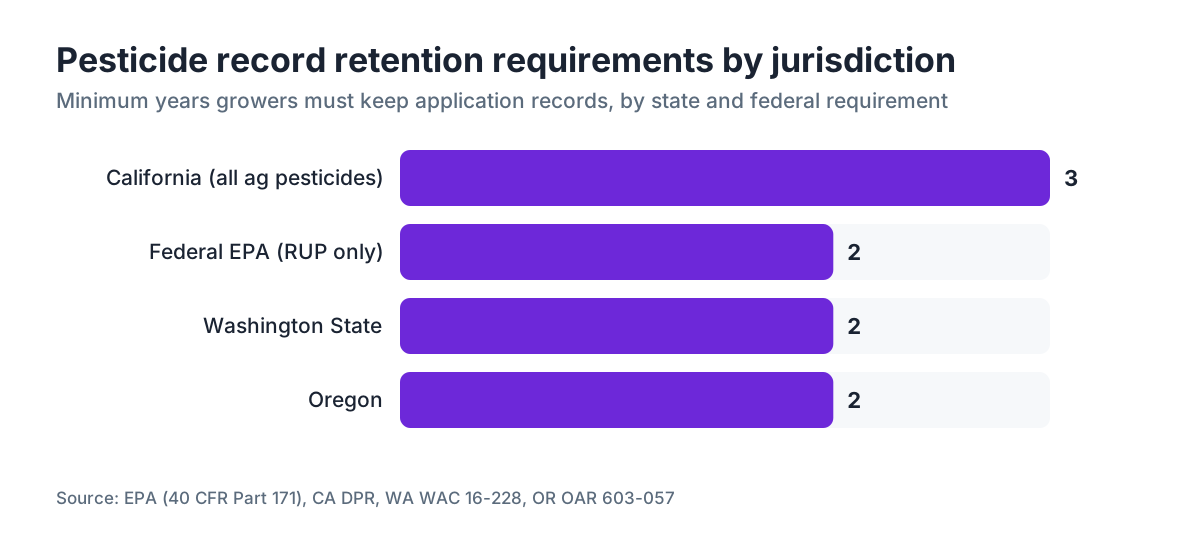
Restricted-use pesticide (RUP) applications must be recorded under federal law. EPA requires that RUP application records be kept for two years from the date of application [1]. Many states go further. California's DPR requires three years for most agricultural pesticide records, and Washington requires two years minimum under WAC 16-228 [3]. If the previous manager can't produce those logs, raise it with your county agricultural commissioner before you apply anything new.
EPA's Worker Protection Standard (WPS), revised in 2015 and codified at 40 CFR Part 170, requires employers to keep records of pesticide handler and early-entry worker training for two years [4]. Those records belong to the worksite, not the employer. When the operation changes hands, the new manager needs to know which workers have current training and which have to be retrained before they enter treated areas.
Operationally critical records
Yield history by block, five years if you can get it. You need this to set realistic crop estimates and to catch blocks underperforming for their variety and age. Vintage swing is real, so a single year's number tells you almost nothing. You want the trend.
Soil and tissue test results, with dates. UC Davis extension recommends annual petiole sampling at bloom and veraison as the baseline monitoring protocol, and those lab reports are useless without knowing what amendments went on in response [5].
Irrigation logs: gallons or inches applied per block, by date, system type, and emitter spacing. This matters most in regions where water use reporting is required, as it is across many California districts.
Variety and rootstock records, including clone if known, with planting year and nursery source. Vine spacing and trellis system. These don't change, but someone has to write them down once.
Good-to-have records
Pruning weight data, if the previous manager tracked it (a useful vigor proxy). Disease pressure notes from past seasons. Frost event dates and any heater or wind machine logs. Infrastructure history: when the drip lines were last replaced, when the deer fencing got fixed. None of these are required, but every one saves a new manager from rediscovering the same problem the hard way.
How far back should spray records go in the file?
The legal floor depends on your state. The practical floor sits higher.
Federal RUP records: two years [1]. California DPR: three years for all agricultural pesticide use reports [3]. Washington under WAC 16-228: two years [6]. Oregon: two years under OAR 603-057-0400 [11].
| State | Minimum pesticide record retention | Governing authority |
|---|---|---|
| California | 3 years | CA DPR, FAC Section 12981 |
| Washington | 2 years | WAC 16-228 |
| Oregon | 2 years | OAR 603-057-0400 |
| Federal (RUP) | 2 years | 40 CFR Part 171 / EPA |
Aim for three years no matter where you farm. Three years gives you full context on disease resistance patterns, two or three seasons of PHI history to audit, and coverage of the window most agencies examine in a compliance review. If the previous manager kept five, take all five.
Format matters less than content. Handwritten spray logs are fine as long as they carry the required fields: application date, product name and EPA registration number, rate, total amount applied, target pest, crop, and applicator name. UC Davis IPM publishes spray record templates that include every required California field and get accepted by county ag commissioners [5].
How do you organize a block history file so it's actually usable?
The fastest way a block file dies is a manila folder stuffed with loose paper nobody opens twice. Organization has to follow the questions a manager asks in the field, not the order the paper arrived.
The structure that holds up:
Section 1: Block identity sheet. One page. Variety, rootstock, clone, plant date, vine and row spacing, trellis type, block acreage, GPS boundary or parcel map reference, irrigation system type. If you only ever hand someone one page, this is it.
Section 2: Spray records, most recent year on top. Organized by application date, not by product. A manager confirming a PHI for harvest works backward from today, not forward from a product list.
Section 3: Soil and tissue test results. By sample date, with the amendment or fertigation response noted on the same page or clipped right behind the test. A test result without the follow-up action is half a record.
Section 4: Irrigation logs. By season, then by date. Include sensor calibration notes and any system changes.
Section 5: Yield history. A simple table by vintage. Tons per acre, Brix at harvest, and any weather or disease notes that explain the outlier years.
Section 6: Worker protection and training records. Current safety data sheets for all products used. Training records for every worker who enters treated areas.
Section 7: Infrastructure and equipment notes. Not a novel. A dated log of repairs, replacements, and system changes.
Digital or paper? Both have defenders. Paper survives power outages and needs no password. Digital is searchable and easier to hand off. The honest answer: a well-organized binder on a shelf beats a cloud folder only the previous manager can navigate. A field records platform like VitiScribe structures this automatically by block, so nothing lands in the wrong place, but the logic is the same whether you run software or a three-ring binder.
What does the EPA Worker Protection Standard require in a vineyard transition?
The WPS (40 CFR Part 170, revised November 2015) applies to any agricultural establishment that uses pesticides and employs agricultural workers or pesticide handlers [4]. When management changes, several WPS obligations carry over or reset.
Training records must be kept two years from the date of training. If a worker's training is current (within 12 months for both workers and handlers), that record stays valid under the new employer. If the new management can't produce the documentation, they have to treat those workers as untrained and run the full WPS training before letting anyone into a treated area or an area under a restricted-entry interval (REI).
The central posting requirement doesn't change with ownership. WPS application information (product, location, REI, application time) must be posted at a central location accessible to workers within 24 hours of an application [4]. New managers need to set up that location and make sure workers know where it is on day one.
Safety data sheets (SDS) for every pesticide used on the operation must be accessible to workers and handlers. In a transition, audit the SDS binder against the spray records and replace any outdated sheets. EPA's agricultural worker safety page has the current requirements and training materials [4].
WSU's viticulture extension publishes a practical WPS compliance checklist worth printing and dropping into Section 6 of the block file [7].
How do you reconstruct a block history when records are missing or incomplete?
Missing records are common, especially on older properties that changed hands on a handshake. Here's where to look before you give up.
Your county agricultural commissioner's office holds copies of every pesticide use report (PUR) filed by licensed applicators. In California these are public records, requestable by APN or operator name, covering the three-year retention window [3]. If a licensed PCA or CCA made the applications, their copies may still exist even when the grower's don't.
USDA's Web Soil Survey has historical and current soil data for most agricultural parcels in the country, which partly covers missing soil test records [8]. It won't give you amendment history, but it gives you the baseline soil series a new manager needs regardless.
USDA Farm Service Agency records can turn up historical aerial imagery and, if the operation joined any federal programs, production history. Crop insurance records through USDA's Risk Management Agency sometimes document yield by year [9].
Talk to the people who worked the ground. Longtime crew often remember spray programs, frost events, and block quirks better than the paper does. That knowledge isn't legally defensible, but it's operationally gold, and a good file can hold a "notes from prior crew" section that captures what got said out loud.
For missing WPS training records, there's no shortcut. If you can't document it, retrain. A half-day retraining costs almost nothing next to a WPS violation, which can run up to $19,787 per violation under EPA's civil penalty policy [4].
What soil and tissue test information belongs in the block history file?
Soil and tissue data without history is only half useful. What you want in the file is the test result and the response, together, in date order.
For soil tests, the standard package covers pH, organic matter, CEC (cation exchange capacity), macro and micronutrient levels, and texture. UC Davis extension recommends soil sampling every three to five years for established vineyards, with samples pulled to at least 24 inches in wine grape blocks [10]. If the previous manager sampled shallower or less often, note it, because it changes how much you can trust the baseline.
For tissue tests, petiole analysis at bloom (opposite a basal cluster) and again at veraison is the common protocol for California wine grapes. WSU extension recommends the same timing for Washington vineyards [7]. Carry forward N, P, K, Ca, Mg, Zn, Fe, Mn, and B. Any deficiency or excess history on those changes what you apply this season.
Include the lab name and method on each report. Results from different labs aren't always comparable because extraction methods vary, especially for phosphorus. If the previous manager switched labs mid-tenure, flag it so a new manager doesn't read a trend that's really a method change.
Cornell's viticulture extension publishes nutrient sufficiency ranges for Vitis vinifera and hybrid varieties. Staple one to the inside cover of the soil section as a quick reference [2].
How should yield and fruit quality history be documented?
Yield history is the most consistently useful section of any block file, and it's the one most often kept on a cocktail napkin or in someone's head.
Record this for each vintage: tons harvested, block acreage, tons per acre, harvest date, Brix at harvest, pH and TA if available, any real disease or weather event, and what the fruit became (estate wine, custom crush, sold off, or dropped). That last point carries more weight than it sounds. A block cropped at 6 tons per acre for bulk will behave very differently the year new management wants to push it toward 2 tons per acre for a reserve program.
Brix at harvest alone isn't enough. A block that hit 24 Brix three years running while the fruit went into a high-volume blend tells you something different than 24 Brix going into a single-vineyard bottling where the winemaker was dialing in whole-cluster percentages. Context is the whole point.
If the previous manager broke picking records out by crew or by pass, include them. Mechanical versus hand-pick notes change how you plan labor and equipment for the current season.
For a block with a long record, one table covering the last ten vintages beats paragraphs of prose. A table lets a new manager spot the pattern (the vintage that always underdelivers, the block that started sliding after an irrigation retrofit) in about thirty seconds.
What infrastructure and equipment notes should the block file include?
This section doesn't have to be exhaustive to earn its place. The goal is to spare a new manager from finding out, mid-July, that the pump on Block 7 has a known pressure drop above 45 PSI and that the previous manager worked around it with a night cycle.
Irrigation: system type (drip, overhead, under-vine), emitter flow rate and spacing, pump model and capacity, filtration type and last backflush or media replacement date, and any block-specific pressure settings. If a valve is permanently closed or bypassed, say so. Someone who opens the wrong valve can flood a block or starve it for a week before anyone works out what happened.
Trellis and training: the trellis system (VSP, Scott Henry, GDC), wire heights and tensions if non-standard, any blocks with different training on old-vine sections, and the date of any major trellis replacement. Old staples and brittle wire are a safety hazard. If sections are known to need replacement, that's planning information.
Frost protection: heater type, fuel supply details, wind machine model and service history, thermometer locations and calibration date. If a specific corner of the block sits in a frost pocket, document it.
Deer and bird exclusion: fence perimeter, gate locations and locking mechanisms, net storage and deployment notes. If bird netting got damaged and patched, note where.
None of this needs to be prose. A dated bullet log works fine. The discipline is adding an entry every time something is repaired or changed, not only at a management transition.
How do you hand off a block history file to new management?
The handoff is where block files fail most, not the creation but the transfer. A file left in a filing cabinet with no walkthrough is a file a new manager opens once and then ignores.
The handoff that works is a physical walk of each block paired with a review of the file. Walk the rows, point to the frost thermometer, show where the irrigation valve manifolds sit, explain why the spray record shows two applications of a particular fungicide on Block 4 in 2022 (downy mildew pressure that came back after a late rain). That context won't fit in a file, but it sticks when someone shows you in person.
When an in-person walk isn't possible (estate sales, absentee-owner transitions), a short narrated video of each block is a fair substitute. Nothing fancy. A phone walking the rows, narrating what the file can't capture.
The file itself should be dated with a cover page naming the outgoing manager, the transfer date, and any open issues: upcoming spray obligations, pending soil test results, or infrastructure repairs left unfinished. Open issues matter most because they're the thing most likely to slip through a transition.
For managers building their first block file and wanting a structure set up for clean digital handoff, VitiScribe organizes records by property and block with export options that make compliance sharing simple. A well-organized binder handed over at the gate works too. Format is secondary to content.
For anyone managing or researching vineyards across multiple properties, understanding how a vineyard runs at the block level is the foundation for everything else, from compliance to quality calls.
What are the most common mistakes when creating a block history file?
A few patterns show up again and again.
Filing by product instead of by date. If your spray records live in folders sorted by pesticide, a new manager auditing PHIs before harvest has to flip through every folder for every product to find the last sixty days. Organize by date, always.
Lumping multiple blocks together. Records for "the east vineyard" are close to useless if that's three blocks with different varieties, different spray programs, and different irrigation zones. Block-level records are the only kind precise enough to make good decisions.
Skipping the interpretation layer. A petiole test showing low zinc means little to a new manager who doesn't know the previous manager applied zinc sulfate at veraison three years running and was still chasing the deficiency. The response to a result matters as much as the result.
Leaving out the block identity sheet. Every record should be readable without the previous manager in the room. A spray record that says "Block 4" means nothing without a document telling you Block 4 is a 2.3-acre Cabernet Franc block planted in 1998 on 110R rootstock.
Waiting for a transition to build the file. The only right time to start a block history file is when you start managing the block. Reconstructing years of records under time pressure during an ownership change is stressful and always comes up short. Build it forward. Hand it off clean.
Frequently asked questions
How long do I need to keep vineyard spray records?
Federal law (EPA) requires two years for restricted-use pesticide records. California requires three years for all agricultural pesticide use reports under Food and Agricultural Code Section 12981. Washington and Oregon require two years. As a practical matter, keep three years minimum regardless of state, because that's the window most regulatory audits examine and it gives new managers enough context to make safe spray decisions.
Do WPS training records transfer when vineyard ownership changes?
The training transfers if the worker's record is current (within 12 months) and the new employer can document it. If records are missing, the new employer must treat those workers as untrained and provide full WPS training before allowing them into treated areas or restricted-entry intervals. The cost of retraining is far lower than an EPA WPS violation, which can reach $19,787 per violation.
What if the previous manager didn't keep any records at all?
Start with your county agricultural commissioner's office, which holds pesticide use reports filed by licensed applicators for the required retention period. USDA's Web Soil Survey covers baseline soil data. FSA records may document production history. For worker protection records, there's no reconstruction option: if you can't document training, retrain. Then build your file forward from day one and don't repeat the problem.
Does a block history file need to be digital, or is paper acceptable?
Either format is legally acceptable as long as records are legible, complete, and available for inspection. Paper survives power outages and needs no password. Digital is searchable and easier to copy for a handoff. The honest recommendation is to use whatever format the operation will actually maintain consistently. A filled-in paper binder beats an empty cloud folder every time.
What rootstock and clone information should be documented?
At minimum: rootstock variety (e.g., 110R, 3309, SO4), scion variety and clone number if known, planting year, and nursery source. Clone information helps with replanting decisions and understanding vine performance. If the original nursery tags or invoices exist, include them in the block identity section. This information rarely changes but is surprisingly hard to reconstruct without documentation.
How often should a block history file be updated?
Spray records should be updated within 24 hours of an application, which is both best practice and a requirement for certain records under state law. Irrigation logs should be updated weekly during the growing season. Soil and tissue test results get filed as soon as lab reports arrive. Yield records go in at harvest. Infrastructure notes get a new entry whenever a repair or change happens. The file is a living document, not an annual report.
What's the minimum a new manager needs on their first day?
Block identity sheet (variety, rootstock, acreage, trellis, irrigation type), the last two to three years of spray records, current WPS training records for all workers who will enter treated areas, and the SDS binder for all pesticide products on site. Everything else helps but can be reconstructed. A spray record gap that causes a PHI violation on day thirty cannot be undone.
Do I need a separate block file for each block, or can I combine them?
Separate files by block is strongly preferred. Blocks with different varieties, rootstocks, spray programs, or irrigation zones produce records that are meaningless when combined. The only reason to combine is simplicity, and simplicity in record-keeping usually means important details go missing. If you manage more than three or four blocks, a block-per-file system saves you real time every time you audit or hand off records.
What soil sampling frequency is recommended for a block history file?
UC Davis extension recommends soil sampling every three to five years for established wine grape vineyards, with samples taken to at least 24 inches. Tissue (petiole) analysis is recommended annually at bloom and veraison. Both the test results and the management responses should be filed together. Sampling more often than every three years for soil is generally unnecessary unless you're actively correcting a deficiency or pH problem.
Can I request historical pesticide application records from a government office if the previous manager won't provide them?
Yes. In California, pesticide use reports are public records held by county agricultural commissioners, available by APN or operator name for the retention period. Other states have similar public records structures through their departments of agriculture. These records only capture applications made by licensed applicators and filed under their license, so they may not capture everything. Check with your state department of agriculture for the request process.
What's the best format for documenting yield history in a block file?
A simple table by vintage covering tons per acre, harvest date, Brix at harvest, and any significant conditions (heat events, disease pressure, crop thinning decisions) works better than narrative notes. Ten vintages in a table gives a new manager an immediate read on block trends. Add a column for end use (estate, custom crush, bulk sale) because crop load and quality targets differ a lot by use.
Are there extension program templates I can use to build a block history file?
Yes. UC Davis's integrated pest management program publishes spray record templates accepted by California county agricultural commissioners. Cornell's viticulture extension has nutrient tracking worksheets and vineyard record templates. WSU extension has a WPS compliance checklist and spray records guidance for Washington growers. All are available through their extension program websites at no cost.
What happens if a new manager applies a pesticide before knowing the previous spray history?
The risk is a pre-harvest interval violation if a product from the prior season has a PHI that runs into the current harvest window, or a resistance problem if a new application repeats the same mode of action. Beyond compliance risk, some products carry plant-back restrictions or replant limitations that matter for any planned vine removal. Reviewing spray records before any new application isn't optional; it's the only way to make a safe, legal call.
Sources
- EPA, Pesticide Registration and Recordkeeping Requirements: Federal EPA requires restricted-use pesticide application records to be kept for two years from the date of application.
- Cornell University, Grapes and Wine (CALS Extension): Cornell's viticulture extension recommends good recordkeeping as a first defense in regulatory audits and publishes nutrient sufficiency ranges for Vitis vinifera.
- California Department of Pesticide Regulation, Pesticide Use Reporting: California DPR requires agricultural pesticide use reports to be retained for three years and filed with the county agricultural commissioner.
- EPA, Agricultural Worker Protection Standard (40 CFR Part 170): The WPS requires training records for handlers and early-entry workers to be kept two years; WPS application information must be posted within 24 hours; civil penalties can reach $19,787 per violation.
- UC Statewide Integrated Pest Management Program: UC IPM recommends annual petiole sampling at bloom and veraison and publishes spray record templates accepted by California county agricultural commissioners.
- Washington State Legislature, WAC 16-228 (Pesticide Regulations): Washington State requires pesticide application records to be retained for a minimum of two years under WAC 16-228.
- Washington State University Extension: WSU extension recommends petiole sampling at bloom and veraison for Washington wine grape vineyards and publishes WPS compliance checklists for growers.
- USDA Natural Resources Conservation Service, Web Soil Survey: USDA's Web Soil Survey provides historical and current soil data by parcel for most US agricultural land, usable as a baseline substitute for missing soil test records.
- USDA Farm Service Agency: USDA FSA records can provide historical aerial imagery and production history for operations that participated in federal programs.
- University of California Agriculture and Natural Resources: UC extension recommends soil sampling to at least 24 inches every three to five years for established wine grape vineyards.
- Oregon Secretary of State, OAR 603-057 (Pesticide Control): Oregon requires pesticide application records to be retained for two years under OAR 603-057-0400.
Last updated 2026-07-10