How to record Esca management practices in vineyard block history
TL;DR
- Record every Esca observation and action by block ID, row, and vine number: scouting dates and severity ratings, wound protection applications (product, rate, timing), roguing decisions, and dead-arm removals.
- Link each entry to a dated spray record and a vine map.
- That builds the audit trail regulators and crop insurance adjusters want, and it shows you which blocks are declining fastest.
What is Esca and why does your block history need a dedicated record for it?
Esca is a complex of wood-rotting fungi that colonize the permanent wood of grapevines. The main players are Phaeomoniella chlamydospora, Phaeoacremonium minimum, and Fomitiporia mediterranea. [1] It shows up as tiger-stripe leaf scorch, berry spotting, and in the acute "apoplexy" form, sudden whole-vine collapse in the heat of summer. Chronic Esca kills 1 to 3% of infected vines a year. In blocks with heavy inoculum and hot summers, single-season losses of 10 to 15% have been reported in UC extension literature. [2]
Esca needs its own record layer because it runs across multiple seasons and multiple record types at once. You're tracking disease observations, wound-protection sprays, structural pruning calls, vine removal and replant, and biological product applications. They all interact. Scatter them across a generic spray book, a paper scouting notebook, and somebody's memory, and you can't reconstruct why a block is dying when you need to defend a crop insurance claim or answer your pest control adviser three years later.
California's Department of Pesticide Regulation requires pesticide application records be kept for three years and be available for inspection. [3] EPA's Worker Protection Standard adds rules on re-entry intervals and applicator records. [4] The regulatory floor is not the same as a useful block history, though.
A useful Esca history tells a story. When the disease appeared, how it spread, what you tried, and what happened next.
What information belongs in a vineyard block history for Esca?
A complete Esca block history has four data layers, and each one earns its place.
Observation layer. Date, scouter initials, block ID, row number, and vine number for every symptomatic vine. Note the symptom type: tiger-stripe leaf scorch, apoplexy, dead arm (the Eutypa-like dieback sector that often shows up alongside it), or internal wood discoloration found at pruning. A severity scale keeps this comparable across seasons. UC extension work uses a simple 0-3 scale: 0 = no symptoms, 1 = mild foliar on one shoot, 2 = moderate on multiple shoots, 3 = apoplexy or vine dead. [2] Pick a scale and stick with it. Changing midstream wrecks your trend analysis.
Pruning and surgery layer. Record every corrective pruning event: date, who did the work, which vines were touched, what cuts were made (spur removal, cordon removal, head renewal), and how fast wound protection went on after cutting. Timing is the whole game here. UC research shows wound protectant efficacy drops sharply when application is delayed more than a few hours after cutting in high-inoculum sites. Thiophanate-methyl products and Trichoderma-based biologicals are the most studied categories. [2][9]
Spray record layer. Every wound protectant or trunk-injection product needs a full pesticide record: EPA registration number, product name, active ingredient, rate per acre or per vine, water carrier volume, application method (airblast, hand-gun, backpack), applicator name, re-entry interval, and weather at application. This layer overlaps with your mandatory DPR or state pesticide records. [3]
Vine fate layer. Track whether a vine was kept (and at what productivity), removed and replanted, or left as a missing-vine gap. Note the rootstock and clone of any replacement. This is the layer that lets you calculate real economic loss over time and justify the money you spend on replanting.
How do you set up a physical or digital block record system for Esca?
Start with a block map. A vineyard map with individual vine positions labeled by row and vine number is the spine everything else hangs on. You don't need GIS software. A printed aerial photo with a hand-drawn grid works fine. What matters is that everyone who scouts, prunes, or sprays can find the same vine using the same coordinates.
For paper systems, a loose-leaf binder per block beats a bound notebook, because you can add pages by season without losing earlier records. Use a consistent form with pre-printed fields: date, block ID, row range, action type, product (if any), rate, applicator, and a notes column. Cornell's IPM program publishes sample scouting forms for trunk disease monitoring that are worth adapting. [5]
For digital systems, the floor is a spreadsheet with one row per event, filtered by block. Better is a system that links scouting records to spray records by a shared block ID, so one query pulls the full timeline. VitiScribe is built for this, with Esca-specific observation fields and spray record linkage baked in. Any well-designed spreadsheet with consistent field names works too, if you have the discipline to maintain it.
One rule the good managers follow: never merge blocks in the record system, even if you treat them identically in the field. Block ID is immutable. If you remap the vineyard or move block boundaries, create new block IDs and note the predecessor. Retroactive remapping destroys longitudinal disease data, and you can't get it back.
What severity rating scale should you use for Esca symptoms?
There's no single national standard, which is honestly a problem for the industry. The most widely cited scale in North American research is the 0-3 system used in UC and UC Cooperative Extension Esca work: 0 is asymptomatic, 1 is mild (up to 25% of canopy affected), 2 is moderate (25 to 75% canopy or multiple sectors symptomatic), and 3 is severe (apoplexy or vine functionally dead). [2]
Washington State University extension plant pathology materials use a similar categorical approach for grapevine trunk diseases broadly. Their guidance makes a point worth repeating: consistent annual scouting matters more than which scale you pick. [6]
The table below compares the two common approaches:
| Scale | 0 | 1 | 2 | 3 | 4 |
|---|---|---|---|---|---|
| UC 0-3 | Asymptomatic | Mild foliar, 1 shoot | Moderate, multiple shoots | Apoplexy or dead | (not used) |
| IPM 0-4 | Asymptomatic | < 25% canopy | 25-50% canopy | 51-75% canopy | > 75% or dead |
Pick one and write it in your block history header. The scale you chose in 2021 should still read cleanly in 2031, when you're explaining a replanting decision to an estate buyer or a bank.
When exactly should you record Esca observations during the growing season?
Esca symptoms show up when vines are under water stress, usually during summer heat spikes. In California's Central Valley and warmer coastal regions, the window runs roughly late June through early September. In cooler regions like the Willamette Valley or the Finger Lakes, it compresses into July and August. [2]
Scout at least twice during the symptom window. Once at first appearance (the first symptomatic vine you see in a block) and once at peak expression, usually four to six weeks later. In heavily infected blocks, weekly counts during heat events are worth the labor, because apoplexy can appear and run its course within days.
Record observations even when you see zero symptomatic vines. A dated zero count is data. It tells anyone reading the record that the block was actually checked, which is not the same as nobody writing anything down.
At pruning, record every vine where you open the wood and find internal discoloration, black streaking, or sector necrosis. Pruning-time observations often catch infection in vines that showed no foliar symptoms the summer before. This is your only shot at spotting early-stage Esca before it costs you a crop.
How do you document wound protection products in an Esca spray record?
Wound protection is the main tool for stopping new Esca infections in established vineyards. Two product categories carry the most research support:
- Thiophanate-methyl fungicides (for example, Topsin-M), applied immediately after pruning cuts. Field trials show significant reduction in trunk disease pathogen colonization. [9]
- Trichoderma-based biological products (for example, Vinevax, and Serenade in some programs), registered as wound protectants and the main option for organic operations. [9]
For each application, your spray record needs the following to satisfy both EPA WPS and state pesticide rules [3][4]:
- Date and time of application start and finish
- Block ID and acreage or vine count treated
- Product name and EPA registration number
- Active ingredient(s)
- Amount of product used and rate (ounces per gallon, fl oz per acre, or per vine for hand-applied products)
- Application method (hand-gun, backpack, electrostatic sprayer)
- Water volume and carrier
- Applicator name and license number (if applicable)
- Weather: temperature, wind speed and direction, relative humidity
- Re-entry interval and the date and time it expires
- Who posted the field, if posting is required
For wound protectants applied by hand-gun to individual cuts, "acres treated" means nothing. Record vine count or linear feet of cordon cut instead. That's the number that makes sense in three years when you're reconstructing what was done.
How should you record roguing and vine removal decisions?
Roguing (pulling symptomatic vines) is a legitimate response to Esca, though the economic break-even point is argued about. Cornell's viticulture extension group notes that roguing is most defensible when symptomatic vines pass roughly 10% of a block. Past that point, replanting with clean material on a new rootstock often pencils out better than nursing sick vines along. [5]
The rogue record should include:
- Date of removal
- Block ID, row, vine number (every single vine)
- Reason for removal (symptom type and severity score)
- Disposition of removed material (chipped in place, hauled off property, burned where permitted)
- Replant date, if any, with rootstock name and clone
- Source nursery for the replacement vine
Why track disposition? Some trunk disease pathogens survive in wood chips for multiple seasons. If you chipped symptomatic vines in-row and a new planting in that spot shows early symptoms two years later, the chip history is relevant. There's no federal requirement to document disposition, but it's the kind of detail that makes a block history actually earn its keep.
For crop insurance, the USDA Risk Management Agency requires documentation of crop losses and management practices to support prevented planting or crop loss claims. [7] A dated vine-by-vine rogue record is exactly what an adjuster asks for.
What records do you need to satisfy EPA Worker Protection Standard requirements for Esca management?
EPA's Agricultural Worker Protection Standard (WPS), revised in 2015 and in effect since 2017, applies to any pesticide application in an agricultural setting. [4] For Esca work it comes up most on wound protectant fungicide applications and trunk injection products.
The WPS requires that handlers get training, that a safety data sheet be accessible at the application site, that re-entry intervals be followed, and that a central posting of WPS information stay up at the establishment. [4] EPA's WPS guidance states that agricultural employers must provide handlers and early-entry workers with specific information about each pesticide applied, which includes the product name, the location treated, and the REI.
For your records, this means the spray record you keep for compliance must carry the REI expiration date and time, plus evidence the field was posted. Keep it at least two years per WPS, though three years is smarter, since that lines up with most state pesticide record laws. [3][4]
If you use a licensed pest control adviser to recommend Esca products, California law requires the PCA recommendation be kept on file too. [3] Attach that recommendation to the matching spray record in your block history.
How do you build a multi-year block history that actually shows Esca trends?
One season of Esca records is useful for compliance. Five seasons is useful for management. That's the difference.
The most valuable thing a multi-year history shows is incidence trajectory: is the percentage of symptomatic vines per block rising, holding, or falling? Pair that trajectory with your wound protection records and you have real evidence about whether your program works. Nobody else has good longitudinal data on your specific blocks. You're the only one generating it.
At the end of each season, calculate and record:
- Block incidence: symptomatic vines divided by total vines, as a percentage
- Block severity index: average severity score across all vines, including the zeros
- Vine mortality rate: vines removed divided by total vines
- Wound protection coverage: percentage of pruning cuts that got protectant inside the recommended window
Graph incidence over years. This is not complicated. A hand-drawn line graph in the front of the block binder does the job. If incidence keeps rising despite wound protection, that tells you something: your timing or coverage is short, the inoculum pressure is overwhelming the product, or the block has structural problems (old cordons, too many pruning wounds) that make management harder every year.
WSU extension research on trunk diseases suggests blocks with incidence above 20% are good candidates for whole-block renewal rather than vine-by-vine management. [6] Having the data to make that call, instead of guessing, is the whole point of keeping the record.
What format should multi-year Esca records be stored in to stay readable long-term?
Paper or PDF. Seriously. Proprietary software formats change, companies fold, and a binder in a fireproof cabinet is still readable in 20 years with no subscription attached.
If you use digital tools (spreadsheets, farm management software, or a platform like VitiScribe), export a PDF summary of each block's full history at the end of every season and store it offline. Cloud storage is fine as a working copy. It is not an archive.
For paper records, use a consistent naming convention: block ID first, then year, then record type. "B12-2024-ESCA-SCOUT" is unambiguous. "Scouting spring" is not.
The USDA National Agricultural Library has published guidance on farm record retention suggesting records tied to crop insurance, pesticide compliance, or property transactions be kept at least seven years. [8] For Esca records there's one more reason: a block history is a material disclosure item in vineyard sale due diligence. The buyer's agronomist will ask for it, and a thin file costs you money at the table.
What common mistakes do vineyard managers make when recording Esca practices?
The most common error is recording the spray event and skipping the observation record. You end up with proof you applied Topsin-M on March 5th but no record of which vines were symptomatic, what severity they showed, or whether protection went on inside the post-cut window. The spray record is legally necessary and agronomically useless on its own.
Second most common: inconsistent block IDs across record types. Your spray log calls it "Block 3," your scouting notes call it "North Cab," your map calls it "B-03." Three years later nobody can reconcile them without walking the field.
Third: not recording negatives. Scout a block, find nothing, write it down. Undated absence of records looks exactly like no scouting at all.
Fourth: lumping Esca in with Eutypa dieback or Botryosphaeria canker. Different diseases, different management, different prognoses. [1] If you're seeing dead arms, record what the internal wood looked like when you cut it, and note whether you sent a sample to a lab. UC diagnostic services can differentiate the pathogens by culture or PCR. [2] Attach the lab report to the block record when it comes back.
What are realistic benchmarks for Esca incidence and does any research give numbers?
The honest answer is that reliable population-level incidence data for North American vineyards is thin. The closest published numbers come from European surveys and a handful of California studies.
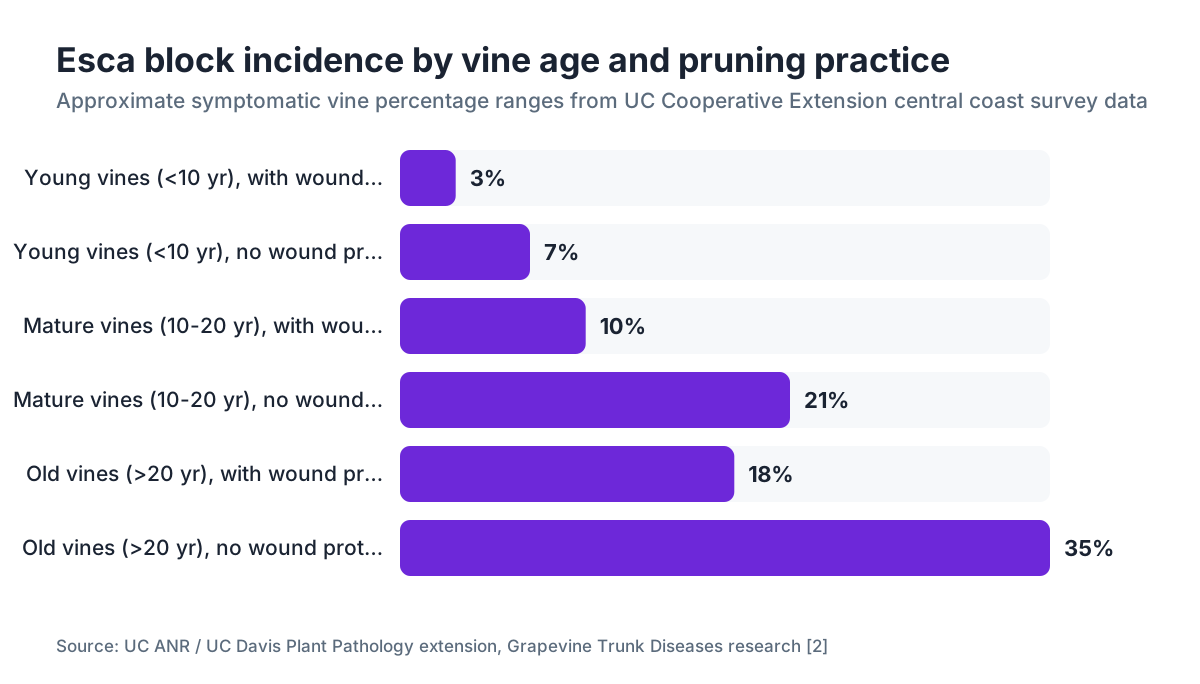
A UC Cooperative Extension survey of California central coast vineyards found Esca-complex symptomatic vines in roughly 18 to 35% of blocks surveyed, with block-level incidence running from under 1% to over 30% depending on vine age and pruning history. [2] Older vines (over 15 years) consistently showed higher incidence. Blocks pruned with mechanical hedgers and no wound protection showed incidence about twice that of hand-pruned blocks with same-day protectant.
In France, national surveys have reported Esca causing estimated losses of 7 to 12% of vineyard surface area a year in some appellations, with apoplexy years correlated with hot, dry summers after wet winters. [1] Those numbers don't transfer directly to California or the Pacific Northwest, but they show what a severe epidemic looks like.
For your own benchmarking, here's the rough rule. A block below 5% annual incidence with a stable or falling trend is manageable with wound protection and targeted roguing. Above 15% with a rising trend, call your farm advisor and run the replant economics.
Frequently asked questions
How long do I need to keep Esca spray records?
Most states require keeping pesticide application records three years, and California's DPR explicitly requires three-year retention and availability for inspection. EPA's Worker Protection Standard requires a minimum of two years for WPS-specific records. Practically, keep everything for seven years. Crop insurance claims, property sales, and audits can surface long after the three-year minimum has passed.
Can I record Esca observations on the same form as my spray records?
You can, but it creates confusion. Spray records are mandatory legal documents with specific required fields. Scouting observations are agronomic notes. Mix them and your regulatory record fills with non-regulatory clutter while your scouting data hides in a legal file. Separate forms that share a block ID and date field, cross-referenced to each other, work better in practice.
Do I need a pest control adviser recommendation to apply wound protectants for Esca?
In California, a licensed PCA recommendation is required before applying any restricted-use pesticide, and some wound protectant fungicides (including certain thiophanate-methyl formulations) are restricted use. For general-use products a PCA recommendation is not legally required but is considered best practice by DPR. Check the label category before application. Other states differ, so verify with your state department of agriculture.
What is the best timing for applying wound protectants to prevent Esca?
Apply as close to the cut as you can, ideally within a few hours. UC research shows spore germination and early colonization can begin within 24 hours of wounding under humid, high-inoculum conditions. Same-day application is the standard recommendation. If you're mechanically hedging large blocks, follow right behind with a hand-gun crew hitting the fresh wounds. Delay even one day in warm wet weather and efficacy drops.
How do I record Esca in a vineyard block that has mixed infections of Esca and Eutypa?
Record each vine with separate entries for each suspected disease based on visual symptoms and, ideally, lab confirmation. Eutypa shows stunted spring shoot growth from infected cordons; Esca shows summer leaf scorch. They can co-occur. Note the symptom type for each vine in your scouting record and flag vines where lab confirmation was done. UC plant pathology can differentiate the causal fungi by culture or PCR from fresh wood samples.
Does USDA crop insurance require Esca records to file a claim?
USDA Risk Management Agency policies for grapes require that you show you followed good farming practices and that the loss came from a covered cause. A documented Esca management history (scouting records, wound protection applications, vine removal records) is the evidence that supports the claim and shows you weren't negligent. Without those records, an adjuster has no way to verify the loss or your response.
Can I use a mobile app to record Esca scouting in the field?
Yes, and for scouting it often beats paper, because you can capture GPS coordinates, attach photos, and timestamp observations automatically. The one requirement: the data must export to a stable format (PDF, CSV) that stays readable without the app in the future. Whatever tool you use, export and archive a season-end PDF for every block. Don't rely on a cloud app's database as your permanent record.
How many vines do I need to scout to get a reliable block incidence estimate?
For a block under 5 acres, count every vine in the symptom window. For larger blocks, a valid sample is roughly 100 vines per block or 10% of total vines, whichever is larger, spread across the full block rather than clustered at the access rows. Cornell's IPM program recommends systematic transect sampling: scout every fifth row and every fifth vine within the row. Record the sample size and method so future comparisons stay apples-to-apples.
Should I send wood samples to a diagnostic lab for every suspected Esca vine?
No, that's not practical at scale. Reserve lab confirmation for uncertain diagnoses (atypical symptoms, no previous confirmed Esca in the block), for blocks where a major decision hinges on the diagnosis (whole-block replant, changing your wound protection program), or when an insurer or buyer wants documented confirmation. UC, Cornell, and WSU all offer plant disease diagnostic lab services for commercial growers.
What does a vineyard buyer or lender look for in an Esca block history during due diligence?
Annual incidence trends by block, evidence wound protection was applied consistently, a roguing record with vine fate noted, and diagnostic confirmation where disease was uncertain. Rising incidence with no documented response is a red flag. A block at 12% incidence with a clear downward trend backed by three years of wound protection records is a much easier conversation than one with no records at all.
Is there a standard form or template for Esca vineyard records?
No single national standard exists. UC Cooperative Extension, Cornell Cooperative Extension, and WSU Extension each publish trunk disease scouting guides with suggested formats, but they vary. The practical move is to build your own form with the fields listed in this article and document which severity scale you're using at the top. Consistency within your own operation matters more than matching any outside template.
How do I record the outcome of a trunk surgery or retraining operation done to manage Esca?
Record it in the pruning/surgery layer: date, vine ID, the specific operation (cordon removal, spur removal, trunk bisection, head renewal), who performed it, how much symptomatic wood came off, and whether wound protectant went on and which product. Note the vine's condition at the next season's observation. Over two to three seasons you'll see whether the surgery extended productive life or just delayed the decline.
Sources
- USDA Agricultural Research Service, Esca and Grapevine Trunk Diseases overview: Esca is caused by a complex of fungi including Phaeomoniella chlamydospora, Phaeoacremonium minimum, and Fomitiporia mediterranea that colonize permanent grapevine wood
- UC Agriculture and Natural Resources, Grapevine Trunk Diseases extension resources: UC research on wound protectant timing, 0-3 symptom severity scale, and block incidence ranges of 18-35% in surveyed California central coast vineyards
- California Department of Pesticide Regulation, Pesticide Use Reporting requirements: California DPR requires pesticide application records to be kept for three years and available for inspection
- US EPA, Agricultural Worker Protection Standard (WPS) overview: EPA WPS requires agricultural employers to provide handlers and early-entry workers with specific information about each pesticide applied, including product name, location, and REI; records must be kept a minimum of two years
- Cornell University Integrated Pest Management program, grape trunk disease scouting resources: Cornell IPM publishes sample scouting forms for trunk disease monitoring and notes roguing is most defensible when symptomatic vines exceed roughly 10% of a block
- Washington State University Extension, Grapevine Trunk Disease management and scouting: WSU extension plant pathology research on trunk diseases suggests blocks with incidence above 20% are good candidates for whole-block renewal, and consistent annual scouting is more important than the specific scale chosen
- USDA Risk Management Agency, Specialty Crop and Vineyard crop insurance provisions: USDA RMA crop insurance policies require documentation of crop losses and management practices to support prevented planting or crop loss claims
- USDA National Agricultural Library, Farm record retention guidance: USDA NAL guidance suggests records tied to crop insurance, pesticide compliance, or property transactions should be kept for at least seven years
- UC ANR Pest Management Guidelines, Grapevine trunk diseases: Thiophanate-methyl fungicides and Trichoderma-based biological products are the primary wound protectant categories with research support for preventing trunk disease pathogen colonization in grapevines
- EPA, Agricultural Worker Protection Standard rule, 40 CFR Part 170: EPA WPS 2015 revision requires field posting, safety data sheet access at application site, and handler training for all agricultural pesticide applications
Last updated 2026-07-09