How to document label compliance for restricted use pesticide applications

TL;DR
- Federal law (FIFRA Section 11) requires certified applicators to keep restricted use pesticide records for at least two years after each application.
- Those records must capture the product name and EPA registration number, application date, location, crop, target pest, rate, total amount applied, and the certified applicator's name.
- State rules often add fields and shorter submission deadlines.
What records are you actually required to keep for restricted use pesticides?
The federal floor is two years. FIFRA Section 11(c)(2) says any certified applicator who applies a restricted use pesticide (RUP) must keep records for at least two years after the application [1]. EPA's implementing rule at 40 CFR Part 171 lists the minimum data fields. Every RUP record has to include:
- Product name and EPA registration number as they appear on the label
- Month, day, and year of application
- Location of application (field name, parcel ID, or GPS coordinates all work)
- Crop, commodity, stored product, or site treated
- Target pest
- Total amount of RUP applied
- Size of area treated
- Name and certification number of the certified applicator
That's the baseline. Your state agency almost certainly stacks more on top of it. California's Department of Pesticide Regulation (CDPR) requires a pesticide use report submitted to the county agricultural commissioner within one month of application, and its fields run more granular than the federal list [2]. Washington State requires applicators to file RUP records with the state Department of Agriculture within 30 days in some cases [3]. Check your state lead pesticide agency before you build anything, because the state rule is usually what an inspector cites you against.
Here's what a lot of vineyard managers miss: the label is a legal document. The language on every EPA-registered pesticide label carries the force of law under FIFRA. Recording that you applied the product at a rate, timing, and PHI that match the label is the whole point of this paperwork. If your records show a rate above the label maximum, that isn't a filing error. That's a FIFRA violation.
What does 'label compliance' actually mean when you're logging an application?
Label compliance means you applied the product exactly as the label directs, and your records prove it. EPA puts it plainly in its label guidance: "The label is the law" [4]. Applicators are legally obligated to follow it.
In practice, your record has to demonstrate compliance with several label sections:
Rate. Your logged rate (oz, fl oz, or lbs of product per acre, or per 100 gallons of spray solution) should fall inside the label's minimum and maximum. If the label says 8 to 12 fl oz per acre and your record says 14, that's a violation. Doesn't matter that the application worked and hurt nobody.
Pre-harvest interval (PHI). The record has to show the application date. Whoever pulls your records should be able to calculate whether the PHI was respected at harvest. Log the label PHI right on the record so the math is transparent.
Restricted entry interval (REI). Under the EPA Worker Protection Standard (WPS) at 40 CFR Part 170, you have to post the REI and notify workers [5]. Your record should include the REI, when the block was re-entered, and confirmation that the interval was honored. WPS record-keeping runs parallel to FIFRA's RUP requirements, and inspectors from two different agencies can check them.
Crop and site. The label lists approved crops. "Grapes" has to appear on the label. If you're spraying a non-bearing block and the label restricts use to bearing vines, document the vine status.
Application method. Airblast, air-assisted, hand-gun, chemigation: the label spells out which methods are allowed. Capture the equipment type on the record.
A good record clears the minimum fields and then some. It tells a complete story. Who, what, where, when, how much, and how it matched the label.
How long do you need to keep RUP application records?
Two years is the federal minimum under FIFRA [1]. That word "minimum" is doing a lot of work.
California requires pesticide use records to be available for inspection for three years [2]. Some states tie retention to the statute of limitations for enforcement, which can run longer. A handful require you to submit records to the state agency, so the state ends up holding the authoritative copy.
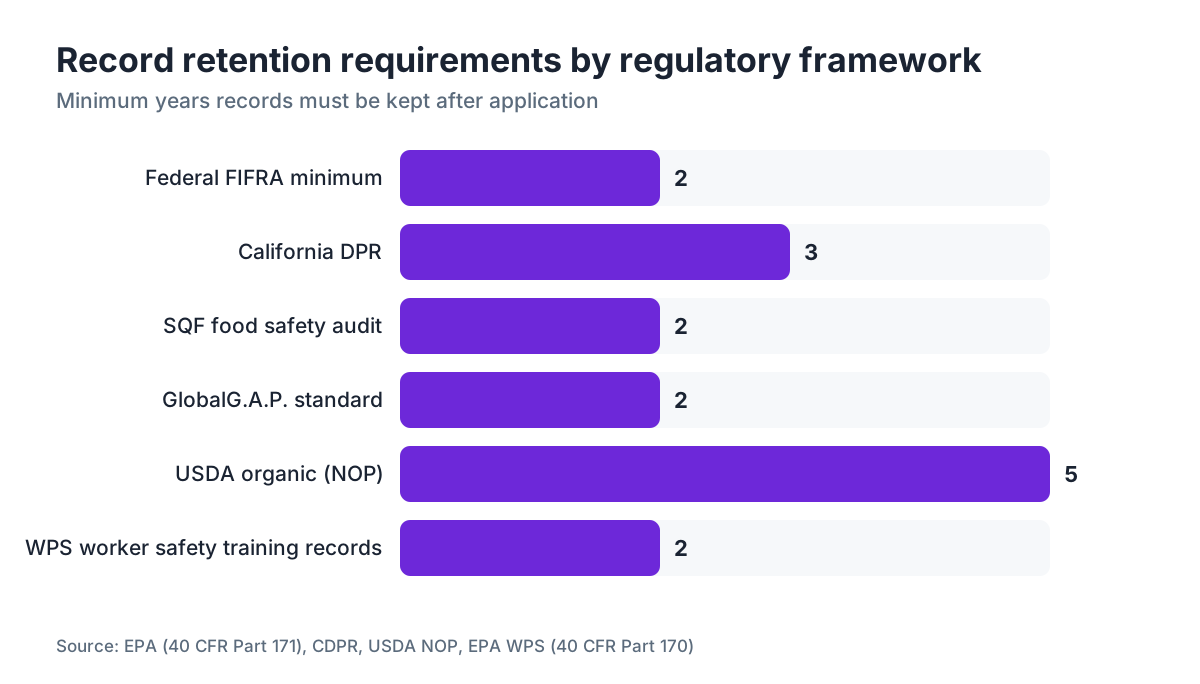
My advice: keep records at least three years everywhere, five years in California or any other high-regulation state. Food safety audits (SQF, GlobalG.A.P., California LGMA) routinely ask for two to three years of spray records as part of buyer qualification. Organic certification requires tracking pesticide history for the 36 months before certification [6]. Sell a block or renew a lease, and buyers and lessors will ask for spray records too. Five years is cheap insurance.
| Retention requirement | Source | Years |
|---|---|---|
| Federal FIFRA minimum | 40 CFR Part 171 | 2 |
| California DPR | CCR Title 3 | 3 |
| USDA organic certification | NOP 205.201 | 5 |
| SQF food safety audit | SQF Code Edition 9 | 2 (rolling) |
| GlobalG.A.P. standard | IFA v5.4 | 2 |
The five-year row is a practical standard I'd hold any commercial vineyard to. Nobody has ever been cited for keeping records too long.
What format do RUP records have to be in, paper or digital?
The federal rule doesn't require paper. 40 CFR Part 171 says records must be maintained and made available to authorized officials, and it stays silent on paper versus digital [1]. Most states followed suit. California's use report submission is increasingly electronic, and CDPR's electronic use reporting portal is the preferred method for agricultural operators [11].
A few caveats. Some states still want a wet signature or a printed copy available on-site during field work. Check your state's exact language. Washington's paper form is built as a printed document, though electronic equivalents are accepted [3].
For digital records, you need a system that can produce a printed or exportable report on demand. An inspector standing in your vineyard is not going to wait while you hunt for a forgotten password. The record has to come up in minutes. Tools like VitiScribe are built for vineyard spray record-keeping and can generate inspection-ready reports by block, by date range, or by product. That last one matters when a county ag commissioner asks for every application of a specific active ingredient over the last 18 months.
Spreadsheets are legal, but they have no audit trail. Edit a cell and there's no way to prove what the original entry said. A timestamped, locked digital record is harder to dispute. If you're on paper, use bound field notebooks instead of loose sheets, and never write in erasable ink.
What happens during a pesticide use inspection and what do they actually check?
County agricultural commissioners and state department of agriculture inspectors run RUP record inspections. They have authority to enter your property and examine records under FIFRA Section 9 [7]. In California, CDPR works through county agricultural commissioners, who are the first-line enforcement agents.
Here's what an inspection usually covers.
Record completeness. Do you have records for every RUP application? A missing record for even one application is a violation. Inspectors cross-reference your use reports against any label compliance complaints or worker injury reports.
Rate verification. They check your logged rate against the label rate. Keep a copy of every label you've used, or confirm you can pull the current label from EPA's Pesticide Product Label System [4]. Labels get revised, so keep the version current as of the application date.
REI documentation. Under WPS [5], you have to maintain records of pesticide applications in a central location accessible to workers and handlers for two years, and keep records tied to worker exposure much longer. The WPS fields include product name, EPA registration number, active ingredient, REI, and location treated.
Applicator certification. The inspector verifies the person who made the application held a valid certified applicator license at the time. Keep certification copies on file next to the spray records.
Penalties run from warning letters for a minor first-offense gap to civil penalties in the thousands per violation per day. EPA can assess up to $5,000 per offense against commercial applicators under FIFRA Section 14, and California's own penalty schedule reaches similar figures [10]. That math turns ugly fast if you're missing records for a whole season.
How do you document the pre-harvest interval to prove label compliance?
The pre-harvest interval is one of the most audited fields in a vineyard spray record, because it sits where pesticide compliance meets food safety.
The PHI on the label is the minimum number of days between the last application and harvest. Your record has to make it easy for anyone to verify the interval was honored without calling you to ask.
The cleanest way to do it: on each application record, log the label PHI for that product next to the application date. Then at harvest, log the harvest date and the number of days since the last application of each product used in that block. The record does its own math.
Washington State University Extension recommends logging the "last allowable application date" (harvest date minus PHI) as a planning field, then comparing it against actual application dates [3]. That makes the compliance story visible at a glance.
For blocks with multiple products applied on different dates, track the most restrictive PHI. Product A has a 7-day PHI, Product B has a 14-day PHI, and you applied Product B 10 days before harvest. You have a violation, even though Product A is clear. Your record system should flag conflicts like that, whether it's a formula in a spreadsheet or a built-in check in purpose-built software.
Sell grapes to a winery and their food safety program will ask for this data. In Napa and Sonoma, many wineries now require a pre-harvest spray record as part of the fruit purchase agreement. Clean, detailed records turn that into a 10-minute job instead of a full day.
What records does the EPA Worker Protection Standard require alongside RUP records?
The WPS (40 CFR Part 170, revised in 2015) has its own record-keeping rules that run parallel to, and sometimes past, the FIFRA RUP requirements [5].
Under WPS, agricultural employers must keep records of every pesticide application in establishments where workers or handlers could be exposed. The required fields:
- Product name and EPA registration number
- Active ingredient(s)
- Location and description of the area treated
- Date(s) of application
- REI
- Whether the product is a RUP
WPS application records have to be posted and kept for at least 30 days after the REI expires, and displayed for workers throughout that window. Employers also have to give workers access to application-specific information on request, which drives a longer retention practice for exposure documentation. Keep those exposure records well beyond the two-year FIFRA floor if your workers might one day need to reconstruct their exposure history.
WPS also carries a posting obligation. The current EPA WPS safety poster must be displayed, and workers have to get pesticide safety training before they enter treated areas. Training records must be kept for two years.
Most vineyard operators fold WPS and RUP records into a single application log, since the fields overlap heavily. That's fine and efficient, as long as every required field is present.
UC's statewide Integrated Pest Management Program covers WPS record-keeping and pesticide compliance for California growers in its pest management guidelines [8].
How should you organize spray records by block, date, and product for easy retrieval?
Organization is where most small operations fall apart. The records exist, somewhere, but finding every application of a specific product across a 40-acre vineyard inside a 60-second window during an inspection is another matter.
A workable system, paper or digital, organizes records along three axes at once.
By block or location. You need to pull all applications made to Block 7 for any date range, fast. On paper, a binder-per-block system with tabs indexed by month works. Digitally, a block field on every record makes it a filter.
By product. If a product gets a label amendment, a voluntary cancellation, or a recall, you need to know every time you used it and where. An inspector can also ask for every use of a specific active ingredient.
By date. Chronological order within a season is the baseline. Label year-over-year archives clearly by season and store them apart from active records.
Cornell's Integrated Pest Management program recommends completing each spray record within 24 hours of application, not at the end of the week or the end of the season [9]. Memory fades and details blur. The person filling out the record should be the applicator or the supervisor who watched the application.
For paper: use a pre-printed form with every required field so nothing gets skipped. Date-stamp incoming forms. Store completed records in a fire-resistant cabinet, away from where you store chemicals.
For digital: a system like VitiScribe lets you attach a photo of the label, log tank mix calculations, and export a full season of block-level records as a PDF or CSV for an audit or a winery. Even without purpose-built software, back up digital records to the cloud rather than a local drive that can fail.
Do private applicators have the same record-keeping requirements as commercial applicators?
This trips people up. FIFRA recognizes two categories of certified applicators: commercial and private.
A private applicator uses RUPs to produce an agricultural commodity on land they own, rent, or manage. A vineyard owner spraying RUPs on their own vines is almost always a private applicator. A commercial applicator applies RUPs for hire, or on land they don't own or operate.
Federal law puts the same core record-keeping rules on both: two-year retention, the same minimum fields [1]. The historical difference was in certification, not record-keeping. States can and do add requirements that split by category. Some make commercial applicators submit records more often or carry extra insurance documentation.
For vineyard operators, the private versus commercial line matters most when you hire a spray contractor. If that contractor is a commercial applicator making RUP applications on your property, get a copy of their application records. Some states put the submission obligation on the property operator, not the contractor. You can be cited for incomplete records on an application you never touched. Write it into your contractor agreements: records delivered to you within 48 hours of application.
How do you handle tank mixes and adjuvants in your RUP documentation?
Tank mixes are the rule in vineyards, not the exception. A typical fungicide spray might pair a RUP with a general-use fungicide, a spreader-sticker adjuvant, and a nutritional. The RUP drives the compliance obligation, but how you document the whole mix matters.
For each tank mix, your record should capture:
- Every product in the tank, with its EPA registration number and rate
- The order of mixing (relevant for compatibility and label requirements)
- Total tank volume and number of tanks applied
- Area covered per tank load
Adjuvants registered as pesticides carry their own EPA registration numbers and have to be logged. Spray oils and silicone-based spreaders are often registered pesticides. Check the container for an EPA Reg. No. If it's there, it goes on the record.
For RUP documentation, the active ingredient rate in the tank matters more than the product rate. Some labels state the rate as pounds of active ingredient per acre instead of product per acre. Record your conversion math so anyone can check it.
One field inspectors watch closely: the maximum seasonal use rate. If a label says "do not apply more than 24 fl oz per acre per season" and you made three applications at 10 fl oz each, you have a violation, even though each single application sat under the maximum. Your records need to let you sum seasonal use by block.
What's the fastest way to set up a compliant RUP record system from scratch?
Start with a template. EPA publishes guidance on what records must contain, and your state lead pesticide agency usually offers a sample form [4]. CDPR publishes a Notice of Intent form, and county agricultural commissioners hand out paper use report forms. WSU Extension offers downloadable spray record templates [3]. Cornell IPM has printable spray log sheets [9].
Starting from zero in the next 30 days, here's the sequence I'd run:
- Pull your state's required fields from the state lead pesticide agency website.
- Download or adapt a template that carries every federal and state field.
- Assign one person, with a backup, to complete records within 24 hours of application.
- Set up physical or digital storage labeled clearly by season and block.
- Build a calendar reminder for state submission deadlines (California's is monthly).
- Write a one-page SOP for when an inspector shows up: who to call, where records live, how to produce a report by product or by block.
The expensive part of compliance isn't the system. It's the time you burn reconstructing records after the fact because you didn't keep them current. A California grower facing a CDPR audit with incomplete use reports can spend 40-plus hours rebuilding records from invoices and memory, and still come up short on required data.
Run more than 20 acres, or apply more than a handful of RUP products a season, and purpose-built software makes the time math work in your favor. The one feature to insist on: generating an inspection-ready report by product, by block, and by date range without manually compiling anything.
Frequently asked questions
How long do I have to keep restricted use pesticide records?
Federal law sets a two-year minimum from the application date under FIFRA Section 11(c)(2). California requires three years. USDA organic certification requires five years of input records covering the transition period. In practice, keeping records five years protects you across the widest range of compliance, food safety audit, and buyer due diligence scenarios.
Do I need to keep a copy of the pesticide label with my spray records?
Federal rules don't require you to staple the label to every record, but you must produce it for an inspector on request. FIFRA Section 12 prohibits applying a pesticide inconsistently with its labeling, and inspectors cross-reference your logged rates against the current label. Keep a paper or digital copy of the exact label version current as of each application date.
What is the EPA registration number and where do I find it?
The EPA registration number is a unique identifier assigned to every federally registered pesticide product. It appears on the label as "EPA Reg. No. XXXXX-XXXXX." You can verify it and pull current label language through EPA's Pesticide Product Label System at epa.gov. This number has to appear on every RUP application record.
Can I use a spreadsheet for RUP record-keeping, or do I need special software?
A spreadsheet is legally acceptable as long as it captures every required field and you can produce a readable report on demand. The catch is the lack of an audit trail: edited cells leave no trace. For operations with multiple applicators, multiple blocks, or state submission rules like California's monthly use report, purpose-built software cuts errors and retrieval time.
What happens if I apply a RUP and forget to log it?
A missing record is a FIFRA violation. Penalties run from a written warning for a minor first offense to civil penalties reaching $5,000 per offense against commercial applicators under FIFRA Section 14. If you find a gap, reconstruct what you can from the best available information, mark it as a reconstructed record, and fix your process. Reconstructed records beat none but carry less evidentiary weight.
Are there special record-keeping rules for RUP applications near water or in a pesticide management zone?
Yes. Many RUP labels carry specific buffer-zone language near water bodies, and some pesticides fall under Endangered Species Act measures that require logging compliance with county-level geographic restrictions. California's Department of Fish and Wildlife also imposes reporting requirements for certain active ingredients near waterways. Check the label's Environmental Hazards section and your county's restricted materials permit conditions.
Who is allowed to make a restricted use pesticide application in a vineyard?
A RUP may be applied only by a certified applicator or by someone working under the direct supervision of one. "Direct supervision" has a specific legal meaning: the certified applicator must be available and reachable, on-site or nearby depending on state law. The certified applicator's name and license number must appear on every record, even if someone else ran the equipment.
What do I need to document for the Worker Protection Standard alongside my RUP records?
WPS (40 CFR Part 170) requires logging the product name, EPA registration number, active ingredients, REI, application location, and date for any pesticide where workers could be exposed. WPS application records must be posted and kept accessible during and after the REI, and employers must give workers access to exposure information. Worker safety training records must be kept two years. These can live in a combined log if all fields are present.
Does California's pesticide use reporting requirement replace or add to FIFRA record-keeping?
It adds to it. California's use reporting system (enforced by CDPR through county agricultural commissioners) requires monthly submission of use reports for all agricultural pesticide applications, including RUPs. The fields California requires overlap with FIFRA but go further, capturing weather conditions, application method codes, and precise acreage. California growers must satisfy both the federal retention rule and the state submission deadlines.
How do I document label compliance for a restricted use pesticide in an organic transition block?
Transition blocks add complexity: you can't apply synthetic RUPs after the transition start date without resetting the three-year clock. Your records must document which blocks are in transition, the transition start date, and that no prohibited materials were applied after it. USDA NOP records must be kept five years and are subject to audit by your certifying agent.
What records does a hired spray contractor need to give me after a RUP application?
At minimum, the contractor must give you a record with every federally required field: product name, EPA registration number, date, location, crop, pest, rate, amount applied, area treated, and the certified applicator's name and license number. In California the contractor handles use report submission, but you should still receive and keep a copy. Build a 48-hour delivery requirement into the contract.
How do I calculate and document the pre-harvest interval across multiple products in the same block?
For each application, log the product's PHI alongside the application date. Then at harvest, find the most restrictive (longest) PHI among all products applied that season and confirm the harvest date is at least that many days after the last application of that product. Document the calculation explicitly: product name, last application date, PHI, earliest allowable harvest date, and actual harvest date.
Sources
- EPA, Certification of Pesticide Applicators (FIFRA Section 11, 40 CFR Part 171): Federal FIFRA Section 11(c)(2) requires certified applicators to keep RUP application records for at least two years with specific minimum data fields.
- California Department of Pesticide Regulation, Pesticide Use Reporting: California requires monthly pesticide use report submission to county agricultural commissioners and retention for three years.
- Washington State University Extension: WSU Extension guidance on state record-keeping requirements, record templates, and last-allowable-application-date planning for PHI compliance.
- EPA, Pesticide Labels and the Pesticide Product Label System (PPLS): The EPA label carries the force of law; applicators are legally obligated to follow label directions, and current labels can be retrieved from EPA's PPLS database.
- EPA, Agricultural Worker Protection Standard (40 CFR Part 170): WPS requires agricultural employers to maintain and post pesticide application records, provide worker access to exposure information, and keep worker safety training records for two years.
- USDA Agricultural Marketing Service, National Organic Program (7 CFR Part 205): USDA NOP 205.201 requires organic operations to maintain records demonstrating compliance for five years, covering inputs applied during and before the 36-month transition period.
- EPA, Pesticides Enforcement under FIFRA: FIFRA grants EPA and state agency inspectors authority to enter agricultural premises and examine RUP application records.
- UC Statewide Integrated Pest Management Program (UC ANR): UC IPM covers WPS record-keeping obligations and pesticide compliance requirements for California agricultural operations including vineyards.
- Cornell University Integrated Pest Management Program: Cornell IPM recommends completing spray records within 24 hours of application and provides printable record templates for agricultural producers.
- EPA, Enforcement (FIFRA Section 14 civil penalties): Civil penalties for FIFRA violations can reach $5,000 per offense against commercial applicators under EPA enforcement, with comparable state schedules.
- California Department of Pesticide Regulation, Electronic Use Reporting: CDPR's electronic use reporting portal is the preferred method for agricultural operators to submit monthly pesticide use reports in California.
- EPA, Introduction to Pesticide Labels: EPA states that pesticide labels carry the force of law, obligating applicators to follow all label directions and restrictions.
Last updated 2026-07-09