How to document a pesticide application under a 24c special local need label

TL;DR
- A 24c Special Local Need label is a state-issued pesticide registration that lets you use a product in ways the federal label doesn't cover.
- Documenting that application requires everything a standard pesticide record demands, plus the SLN registration number, the state-issued label itself on file, and proof the use was within the SLN's approved parameters.
- Federal law mandates records be kept at least two years; most states require three.
What is a 24c special local need label and why does it change your paperwork?
A 24c label is a state-issued registration granted under Section 24(c) of FIFRA, the Federal Insecticide, Fungicide, and Rodenticide Act [1]. The EPA approves each state's authority to grant these registrations, and then the state's lead pesticide agency, say the California Department of Pesticide Regulation or Washington State Department of Agriculture, issues the actual SLN certificate for a specific product and use [2]. The certificate number looks something like CA-120021 or WA-990043.
The SLN label does not replace the federal label. It sits alongside it. That matters a lot for documentation because you're legally bound by both documents at once. If the federal label says "do not apply within 30 days of harvest" and the SLN says nothing different, you still honor the federal restriction. If the SLN modifies a pre-harvest interval or expands use to a new pest or crop, the SLN terms govern for that specific modification only.
For vineyard managers, SLN labels come up most often for powdery mildew materials on wine grapes, applications to cover crop species not on the federal label, and occasionally for nematicides or soil fumigants where local resistance or pest pressure differs from national assumptions. If you farm in California, Oregon, Washington, or New York, your state DPR or agriculture department likely has active SLN registrations relevant to wine grapes right now [3].
Here's the practical consequence. Your spray record must prove you had a valid SLN in hand, that the SLN was still active on the application date, and that every parameter the SLN specifies, rate, timing, buffer zone, PPE, was met. Inspectors from state ag departments are trained to check this specifically.
What does federal law actually require you to record for any pesticide application?
FIFRA Section 8 and the EPA's pesticide recordkeeping regulation at 40 CFR Part 171 set the federal floor [1]. The EPA's worker protection standard, 40 CFR Part 170, adds safety posting and notification requirements on top [4]. Here's what must be in every record regardless of label type:
- Product name (as it appears on the label)
- EPA registration number
- Total amount of product applied
- Size of area treated
- Date of application
- Location of application (field or block identification)
- Crop or site treated
- Pest targeted
- Name and certification number of the licensed applicator, or the name of the person supervising the application
Those nine fields are the federal minimum. Most states add a few more: application method, equipment type, water volume, wind speed and direction, temperature, and pre-harvest interval or re-entry interval compliance are common additions [3].
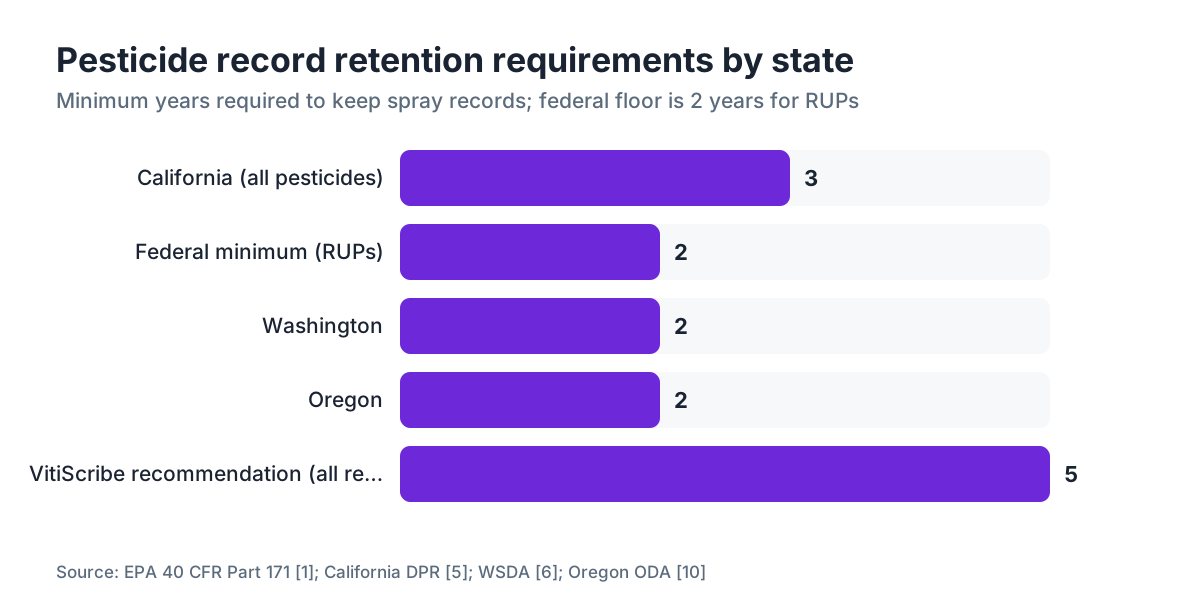
For commercial vineyards using restricted-use pesticides (RUPs), records must be kept for two years from the date of application under federal rules [1]. California requires three years for all pesticide records, more than RUPs [5]. Washington requires two years but has additional reporting requirements for applications over one acre [6]. Check your state's specific regulation. The federal floor is the minimum, not the ceiling.
The EPA's worker protection standard requires that application-specific information be available to workers and handlers for 30 days after the restricted-entry interval (REI) expires, and that the central posting location carry WPS information during any REI [4]. This is separate from your spray record but the dates must be consistent across both.
What additional fields does a 24c SLN application require in your records?
Standard records won't cut it for an SLN application. You need five extra pieces of information beyond the federal minimum.
The SLN registration number. This is the state-issued certificate number, not the EPA registration number for the product itself. Both belong in your record. Write them on separate lines so an inspector doesn't confuse them.
The expiration date of the SLN. SLN registrations are not permanent. They typically last one to five years and must be renewed [2]. If your SLN expired on April 30 and you sprayed on May 3, you're out of compliance even if the product itself is still federally registered. Record the expiration date from the certificate every single time.
Confirmation that the specific use was within the SLN's approved parameters. Some SLN labels cover only certain grape varieties, certain application timings, or certain counties. Your record should include a brief notation: "Application consistent with SLN terms: rate 8 fl oz/acre, within approved counties, pre-bloom timing as specified on SLN."
The physical or electronic SLN label on file. You don't write this in the spray record itself, but you need a filing system that links the record to the label document. In an inspection, you'll be asked to produce the label. If you can't, you can't prove compliance. Scan it. Store it somewhere tied to the year's records.
Pre-harvest interval and REI as stated on the SLN, if they differ from the federal label. When an SLN modifies these intervals, the modified values govern. Write down which document you're drawing the PHI and REI from and what the values are.
WSU Extension guidance on pesticide recordkeeping for Washington growers recommends creating a dedicated column or field for SLN numbers and noting whether the SLN modifies the rate, timing, or use site compared to the base label [9]. That's good practice regardless of state.
How do you verify a 24c SLN is still valid before you spray?
This step is where most violations start. Growers assume an SLN they've used for two seasons is still current. Sometimes it isn't.
Every state that issues SLN registrations maintains a public database or list. California's DPR publishes its active SLN list through its pesticide registration program [5]. Washington State Department of Agriculture posts active SLNs on its website under pesticide registrations [6]. The EPA also tracks state-issued 24c registrations through its pesticide registration program [2].
Before the first application of any season under an SLN, pull the current certificate. Don't rely on a copy from last year. Check the expiration date. Check whether any conditions have been amended, which happens more often than growers expect. Print or save a dated copy and note in your records that you verified currency on a specific date.
If an SLN has been cancelled mid-season, you must stop using the product under those terms immediately. Applications made after cancellation are illegal under FIFRA even if you didn't know about the cancellation. That's harsh, but it's the law [1]. Build the verification step into your standard spray planning routine, not as a one-time-per-year check.
What does a compliant 24c spray record look like, field by field?
Here's a practical field-by-field breakdown. This follows the federal minimum, California DPR requirements as one of the most demanding state models, and the SLN-specific additions above.
| Field | Example Entry | Regulatory Source |
|---|---|---|
| Operator/Applicator name | Jane Reyes, CA Cert. No. QAL-12345 | 40 CFR Part 171 [1] |
| Application date | 2025-05-14 | FIFRA Section 8 [1] |
| Property/Block ID | Block 7, North Syrah, Vineyard Rd. APN 012-345 | CA DPR Req. [5] |
| Crop treated | Vitis vinifera (wine grape) | Federal label requirement |
| Pest targeted | Erysiphe necator (powdery mildew) | Federal label requirement |
| Product name | Quintec (quinoxyfen) | EPA label |
| EPA Reg. No. | EPA Reg. No. 62719-XXX | FIFRA [1] |
| SLN Reg. No. | CA-120021 | 24c SLN certificate |
| SLN expiration date | 2026-12-31 | SLN certificate verified 2025-04-01 |
| Application rate | 4 fl oz/acre | Per SLN terms |
| Total product used | 12 fl oz (3 acres treated) | Calculated |
| Application method | Airblast sprayer, 50 gal/acre | CA DPR Req. [5] |
| Wind speed/direction | 4 mph NNW | CA DPR Req. [5] |
| Temperature | 68°F | CA DPR Req. [5] |
| PHI (per SLN) | 7 days (SLN modifies federal 14-day PHI) | SLN terms |
| REI | 12 hours | SLN terms |
| WPS posting completed | Yes, posted 2025-05-14 at 06:30 | 40 CFR 170 [4] |
| SLN label on file | Yes, scan in 2025 Records Folder | Best practice |
The WPS posting row matters. You must confirm that workers and handlers got notification before the application and that REI information was posted at the central location [4]. Your spray record and your WPS posting log should be cross-referenceable by date and block.
For vineyards using a field operations platform like VitiScribe, building these fields into a template means you can't accidentally submit an incomplete record. The SLN number field won't let you close the entry without it. That kind of forced completion is worth something when you're running 40 spray events a season.
How long do you need to keep 24c pesticide records?
Federal law requires commercial applicators to keep pesticide records for two years from the application date [1]. This applies to restricted-use pesticides specifically. Most SLN-covered applications involve RUPs, so the federal two-year minimum almost always applies.
States routinely require longer. California mandates three years for all pesticide use records, including general-use products [5]. Oregon requires two years [10]. New York requires two years but recommends three for liability purposes. Washington's rule is two years, but because Washington requires pesticide use reports for applications over one acre, those reports (which mirror your spray records) become filings with their own retention implications [6].
My honest recommendation: keep everything for five years. Drift claims, neighbor disputes, worker exposure complaints, and audit trails can all reach back further than two years in practice. The storage cost is essentially zero if you're scanning records anyway. The legal and financial downside of not having records when you need them is not zero.
Keep SLN certificates themselves as long as you keep the spray records that reference them. An inspector asking about a 2023 application under a specific SLN needs to see that the SLN was valid in 2023. If the SLN expired in 2024 and you tossed the old certificate, you can't produce the document.
Do you need to file a pesticide use report separately from your internal records?
In several states, yes, and the SLN use can trigger reporting even where a standard-label application at the same rate would not.
California has the most extensive pesticide use reporting (PUR) system in the country. Any grower or PCA who directs a pesticide application must file a monthly pesticide use report with the county agricultural commissioner [5]. Applications under SLN labels are included. The report goes to the county by the 10th of the following month. Your internal spray record and the PUR must match; inspectors routinely cross-check them.
Washington requires pesticide use reports for applications over one acre that involve RUPs. An SLN application involving an RUP over one acre triggers this requirement [6]. The report goes to WSDA.
Oregon and New York have narrower reporting requirements, generally tied to specific high-risk pesticide categories rather than all RUPs [10].
Check with your state's lead pesticide agency before assuming your SLN application is report-exempt. The filing deadlines are short, typically 30 to 60 days after application, and late filings can trigger fines separate from any label-compliance issue.
What happens during a pesticide records inspection and what will they check for SLN applications?
State agricultural department inspectors can show up with or without notice. In California, county agricultural commissioners conduct routine inspections of pesticide use records; violations can result in civil penalties starting around $500 per violation and escalating to $5,000 or more for willful or repeated violations [5]. EPA can also conduct inspections if the operation has federal program involvement.
For a standard pesticide record, an inspector checks completeness of required fields, legibility, timely maintenance of records (records should be written or entered within 24 hours of application in most states), and consistency between records and physical evidence like empty containers and purchase invoices.
For an SLN application, the inspector adds these checks:
Is the SLN registration number recorded? A missing number is a missing record, which is a violation.
Was the SLN valid on the application date? They'll pull the state database right in front of you. If the SLN had expired, the application was unregistered.
Was the application within the SLN's approved parameters? Rate, timing, site, geographic restrictions. If the SLN covers only counties A, B, and C and your vineyard is in county D, no amount of otherwise-perfect documentation fixes that.
Is the SLN label document available? They will ask to see it. Not a description of it, the actual label.
Does your WPS posting record match the application date and REI on the SLN? Mismatches here trigger worker protection violations, which are a separate category with their own penalty structure [4].
Cornell Cooperative Extension publishes guidance for New York growers on preparing for pesticide records inspections, and the preparation checklist maps closely to what California and Washington inspectors use, which points to a reasonably consistent national practice at the inspection level [3].
Can a PCA (pest control adviser) handle SLN documentation on your behalf?
Yes, partially. In states like California, a licensed PCA who directs a pesticide application is responsible for filing the pesticide use report and for the recommendation that led to the application [5]. If your PCA recommends an SLN-covered product and writes the work order, they share compliance responsibility for that recommendation.
But the spray record itself is your responsibility as the operator or applicator. The PCA's recommendation doesn't substitute for your record. A good PCA will include the SLN registration number in the written recommendation, confirm the SLN is current before issuing it, and flag any geographic or timing restrictions from the SLN that affect your block.
If you're using a contract application crew, the certified applicator directing the crew is responsible for the accuracy of the application record they generate. You should still receive a copy of that record within 24 to 48 hours and verify it contains the SLN-specific fields. Don't assume a contract applicator's generic spray record template includes SLN fields. Most don't by default.
How should you store and organize 24c records for easy retrieval?
The single biggest practical problem with SLN documentation is retrieval, not collection. Growers fill out complete records and then can't find the SLN certificate when an inspector asks for it six months later.
Set up your filing structure like this: one folder per year, subfoldered by application event or by block depending on your scale. Each application event folder holds the spray record and a copy of every label document used, including the SLN certificate. Pulling the record for Block 7 on May 14 also surfaces the SLN. No hunting.
For electronic records, PDF scans of SLN certificates stored in the same folder as the corresponding spray log entries work well. If you're using a vineyard management platform like VitiScribe to log field operations, attach the SLN PDF directly to the spray event record so the link is permanent.
Paper records are legal everywhere but they carry real risk: fire, flood, coffee spills, illegibility. If you're paper-based, scan weekly. A $150 portable scanner or a phone scanning app is enough. Store the scans in a cloud folder with at least one local backup. California DPR accepts digital records as long as they're readily retrievable and printable on demand [5].
Label each scanned SLN certificate with the registration number and expiration date in the filename itself. "SLN-CA-120021-exp2026-12-31.pdf" tells you everything you need without opening the file. When you're verifying at the start of each season, sort by expiration date and you'll see what needs renewal at a glance.
What are the most common 24c documentation mistakes vineyard operators make?
After reviewing what state ag departments and extension programs flag most often, these are the recurring failures.
Using an expired SLN. The registration expired in December; you're spraying in February and haven't checked. This is the most common and the most avoidable. Build the expiration date check into your annual spray plan review, not your spray day routine.
Recording the EPA reg number but not the SLN number. Operators conflate the two. The EPA number is on the federal label. The SLN number is on the state certificate. Both belong in your record.
Applying at the federal label rate rather than the SLN rate. Some SLN labels modify the allowable rate. If the SLN authorizes a lower rate for the specific crop or pest, applying at the higher federal rate violates the SLN terms. Read the SLN before every season, more than when you first get it.
No geographic confirmation. Many SLN labels are county-specific or region-specific. If your vineyard spans a county line, check which blocks fall within the approved geography.
WPS records not updated for SLN-modified REI. If the SLN changes the REI from 24 hours to 12 hours or the reverse, your WPS posting must reflect the SLN figure, not the federal label figure [4]. Mismatches here create two violations: the record error and the WPS compliance failure.
Discarding the SLN certificate when it expires. You need the expired certificate to prove a past application was valid. Keep it with the spray records for the years it was active.
None of these are complicated to avoid. They're process failures, not knowledge failures. A checklist on your spray planning template catches every one of them.
Frequently asked questions
Is a 24c SLN label legal to use in all states?
No. A 24c SLN is issued by a specific state and is only valid in that state. An SLN issued by California DPR cannot be used in Washington or Oregon. Each state that wants to authorize a special local need use must apply to the EPA for that specific registration. If you farm in multiple states, you need the SLN for each state where you intend to use it.
Do I need a certified applicator to apply a product under a 24c SLN?
If the product under the SLN is a restricted-use pesticide, yes, the application must be made by or under the direct supervision of a certified applicator. Some SLN labels carry additional restrictions beyond the federal label's applicator requirements. Always check the SLN certificate itself, since it can impose stricter requirements than the federal label, including requiring a certified applicator even for a general-use product in certain situations.
What is the difference between a 24c SLN and a Section 18 emergency exemption?
A Section 18 emergency exemption is a temporary EPA authorization for use of an unregistered pesticide or unregistered use in a crisis. It has an expiration date tied to the emergency and involves EPA approval, more than state approval. A 24c SLN is a permanent state registration for an ongoing special local need. Documentation requirements overlap, but Section 18 exemptions have additional notification requirements and EPA crisis tracking that SLN registrations do not.
How do I find active 24c SLN registrations for wine grapes in my state?
Contact your state's lead pesticide regulatory agency: California DPR, Washington State Department of Agriculture, Oregon Department of Agriculture, New York DEC, or equivalent. Most publish searchable online databases of active SLN registrations. The EPA also tracks 24c registrations through its pesticide registration program. Your county agricultural commissioner or local university extension office often keeps a current list for common vineyard crops.
Can I use the SLN label to justify a higher application rate than the federal label allows?
Only if the SLN explicitly authorizes a higher rate for the specific crop and pest situation you're treating. SLN labels can modify rates, but they can also restrict them. Never assume an SLN expands your rate authority without reading the certificate directly. Applying above the federal label rate without explicit SLN authorization is a federal FIFRA violation, regardless of what you thought the SLN permitted.
What should I do if I discover I applied under an SLN that had already expired?
Stop further applications under that SLN immediately. Document when you discovered the error. In California and most states, contact your county agricultural commissioner proactively; voluntary disclosure generally results in lower penalties than violations found during an inspection. Notify your PCA if one was involved. Check whether the product has an alternative registration path you can use going forward, and apply for SLN renewal if you need continued coverage.
Do pre-harvest intervals on an SLN override the federal label PHI?
For the specific use the SLN covers, yes. The SLN PHI governs for that use. Record the SLN's PHI explicitly in your spray log, not the federal label PHI, and note that you're drawing it from the SLN. If the SLN is silent on PHI, you must follow the federal label's PHI. Never assume a shorter PHI applies just because the SLN doesn't mention it.
Does the EPA worker protection standard apply differently to SLN applications?
The WPS requirements at 40 CFR Part 170 apply to any pesticide application to an agricultural establishment, regardless of label type. If the SLN modifies the REI, your WPS posting and worker notification must reflect the modified REI. Field posting, central posting, oral warnings where required, and the 30-day post-REI record availability all still apply in exactly the same way they do for any other application.
Can I submit electronic spray records for a 24c application or does it need to be paper?
Electronic records are accepted in California, Washington, Oregon, and most other states as long as records are readily retrievable, printable on demand, and backed up. California DPR explicitly accepts electronic records. The EPA's federal recordkeeping rule does not require paper. Some counties prefer specific formats for PUR submissions; check with your local agricultural commissioner. The SLN certificate itself should be stored as a PDF alongside the electronic record.
How often are pesticide records inspected in wine grape vineyards?
This varies by state and county. In California, county agricultural commissioners conduct routine pesticide use record inspections; the frequency depends on county resources and prior violation history. Complaint-triggered inspections can happen anytime. Washington WSDA inspects agricultural operations with pesticide use reports. Extension programs at UC Davis and Cornell both note that commercial grape operations face higher inspection frequency than most row crop operations, given the volume and variety of pesticide use.
What penalties apply for failing to document an SLN application correctly?
Under FIFRA, failing to maintain required records is a civil violation. Federal civil penalties for recordkeeping violations can reach $500 to $5,000 per violation for commercial applicators. California's civil penalties for pesticide record violations start at $500 and can reach $25,000 for willful violations. Washington can impose fines and license suspension. An undocumented SLN application can also be treated as an unregistered pesticide use, which carries higher penalty exposure than a simple recordkeeping failure.
If my SLN covers only certain counties, do I need to document which county each block is in?
Yes. Your spray record should always include the field or block identification and the legal location sufficient to confirm county. If your property spans a county line, document each block separately and confirm which county it falls in before applying under a county-restricted SLN. This documentation protects you and shows you verified geographic eligibility at the time of application.
Do I need to record SLN application information if I'm a small vineyard exempt from some pesticide rules?
Federal exemptions from FIFRA recordkeeping rules generally apply to operators who don't sell agricultural commodities and to very small farms below specific thresholds, but commercial wine grape operations almost never qualify. If you're selling grapes or wine, you're commercial. State rules may also impose recordkeeping on any operator who applies a pesticide, regardless of size. Assume you must keep records; verify your specific exemption status with your state agency if you believe an exemption applies.
Sources
- EPA, FIFRA Section 8 and 40 CFR Part 171, Pesticide Recordkeeping Requirements: Federal law requires commercial pesticide applicators to retain records for two years from the date of application; Section 24(c) of FIFRA authorizes states to register pesticides for special local needs.
- EPA, Pesticide Registration and FIFRA Section 24(c) Special Local Need Registrations: States must apply to EPA for authority to issue 24(c) SLN registrations; each SLN is issued by the state agency for a specific product and use within that state only.
- Cornell Cooperative Extension, Pesticide Safety Education Program, Recordkeeping for Agricultural Pesticide Applicators: Cornell Extension provides guidance on pesticide record inspection preparation and notes that commercial grape operations face heightened inspection frequency.
- EPA, Agricultural Worker Protection Standard, 40 CFR Part 170: The WPS requires central posting of application information, worker notification before entry, and that application records remain accessible for 30 days after REI expiration.
- California Department of Pesticide Regulation, Pesticide Use Reporting and Recordkeeping Requirements: California mandates three-year retention for all pesticide use records, monthly county PUR filing by the 10th of the following month, and accepts electronic records that are readily retrievable and printable.
- Washington State Department of Agriculture, Pesticide Management, SLN Registrations and Use Reporting: Washington requires two-year record retention and pesticide use reports for RUP applications over one acre.
- UC Statewide Integrated Pest Management Program, Pesticide Recordkeeping for Vineyards: UC IPM publishes pesticide recordkeeping guidance for California wine grape growers, including fields required under California DPR rules and inspection preparedness.
- EPA, Pesticide Enforcement and FIFRA Civil Penalty Policy: Federal civil penalties for FIFRA recordkeeping violations range from $500 to $5,000 per violation for commercial applicators; unregistered use carries higher penalty exposure.
- WSU Extension, Pesticide Safety and Recordkeeping for Washington Growers: WSU Extension recommends that spray record templates for SLN applications include a dedicated column for the SLN registration number and notation of any modified rates or timing.
- Oregon Department of Agriculture, Pesticides Program, Special Local Need Registrations: Oregon requires two-year retention for pesticide records; SLN registrations are issued by ODA and must be current on the application date.
Last updated 2026-07-09