How to identify powdery mildew early in vineyard canopy

TL;DR
- Powdery mildew (Erysiphe necator) first shows up as faint, oily-green spots on young leaves and shoot tips, often before any white powder is visible.
- Scout shoot tips and basal leaves weekly starting at 1-inch shoot growth.
- Infections can begin at 50°F with no free water required.
- Catch it in the first two to three weeks and you prevent the most damage.
What does powdery mildew look like in its earliest stage?
Forget the white powder for a second. The first thing you'll actually see is a pale, slightly oily or water-soaked discoloration on the upper surface of young leaves, usually on the basal leaves closest to the trunk and on the shoot tips that are growing fastest. The spots are roughly circular, anywhere from a few millimeters to about a centimeter across, and they don't have the crisp edges you'd get with a downy mildew lesion.
Within three to five days of that first spotting, if temperature and humidity cooperate, the white to grayish-white powdery mycelium and conidia (spores) show up on the leaf surface [1]. By then the infection has been running for days. The gap between first infection and first visible mycelium is roughly five to seven days at 68 to 77°F, which is exactly why weekly scouting is the floor, not the target.
Flip the leaf. On the underside, an early infection often looks like nothing at all, or a very faint chlorotic patch. That asymmetry matters. Check the top and the bottom before you call a leaf clean.
Shoot tips give you another early tell. Infected tips show a whitish-gray coating on the young internodes and petioles before the leaf blade shows anything obvious. Some growers call it the flour-dusted look. If your shoot tips look like someone breathed a fine white haze onto them, that is powdery mildew until proven otherwise.
When should you start scouting for powdery mildew?
Start at 1-inch shoot growth. That single trigger point shows up in UC IPM, Cornell, and WSU extension guidance alike [1][2][3]. Watching the calendar around budbreak is fine, but the pathogen infects new growth the moment it exists and temperatures pass 50°F (10°C).
Erysiphe necator overwinters two ways: as chasmothecia (fruiting bodies) tucked into bark and as dormant mycelium sitting inside dormant buds. That bud-internal mycelium produces flag shoots, which are one of the most reliable early indicators you can find. Flag shoots come out of dormancy already infected, coated white on leaves and internodes. They are not subtle [2].
One flag shoot in a block tells you three things at once: the pathogen is present, it overwintered in that block, and pressure this season is likely to run high.
Growers in high-pressure regions (coastal California, the Finger Lakes, western Washington, the Willamette Valley) should be walking the vineyard weekly from 1-inch shoot growth through berry set. That six-to-eight-week window is when the fruit is most susceptible. After berry set the berries toughen up and grow progressively more resistant, though a late infection can still hit the rachis and cause shot berries [1].
Scout in the evening or the morning. The mycelium has a faint iridescent sheen in low-angle light that washes out under direct overhead sun.
Which parts of the vine are most vulnerable early in the season?
Young tissue is the target. Erysiphe necator is an obligate biotroph, meaning it feeds only on living plant cells, and it goes straight for rapidly dividing, thin-walled cells [1]. In practice that means:
- Shoot tips and the first two to four leaves back from the tip
- Basal leaves (leaves 1-5 from the base of the shoot), which sit in the dense, humid interior of the canopy
- Young cluster stems (rachis) and developing berries before berry set
- Tendrils, which get infected fast and show it readily
The rachis earns extra attention. Rachis infections hide because they blend into green tissue, but infected rachis turns brown and brittle, and that leads to bunch stem necrosis or clusters that shatter at harvest. Run a 10x hand lens over the main rachis and the laterals, looking for a powdery white coating or brownish scarring.
Berry infections before the berries reach about 8 to 10 mm across (roughly pea size) produce the ugliest outcomes: russeting, ring scarring, cracking, and secondary Botrytis. The UC IPM grape powdery mildew guidelines put the highest berry susceptibility from just before bloom through three to four weeks after bloom [1]. That is your highest-risk scouting window, full stop.
How is powdery mildew different from downy mildew or other leaf problems?
Mixing these two up is a real, expensive mistake. Here's the clean separation.
| Feature | Powdery mildew | Downy mildew | Botrytis |
|---|---|---|---|
| Surface affected | Upper surface primarily | Upper and lower | Any senescent tissue |
| Color of growth | White to gray powder | White cottony sporulation (underside only) | Gray-brown fuzzy sporulation |
| Free water required? | No | Yes (6+ hours) | Yes |
| Lesion shape | Circular, diffuse | Angular, oil-spot pattern (oily upper surface) | Irregular, often at wounds |
| Tissue preference | Young, actively growing | Young leaves | Wounded or stressed tissue |
| Odor | None at early stages | None | Musty, vinegar-like at advanced stage |
Downy mildew (Plasmopara viticola) needs free moisture to release sporangia and infect. Powdery mildew does not [2]. That one fact shapes your entire management approach. A dry spring that shuts down downy mildew risk does nothing for powdery mildew pressure. If anything, moderate temperatures and low humidity (below about 50% relative humidity) help powdery mildew conidia move.
Edge-of-leaf scorch from sunburn, salt, or herbicide drift can look similar from twenty feet away. Get close. Powdery mildew sits on top of the leaf as a distinct layer you can smear with your thumb. Abiotic injury is in the tissue, not on it.
Phyllosticta (black rot) shows pale lesions with a dark margin and, later, dark pycnidia (tiny black dots) in the center. Nothing like powdery mildew, but worth carrying in your head so you don't second-guess a real find.
What temperature and humidity conditions drive early infections?
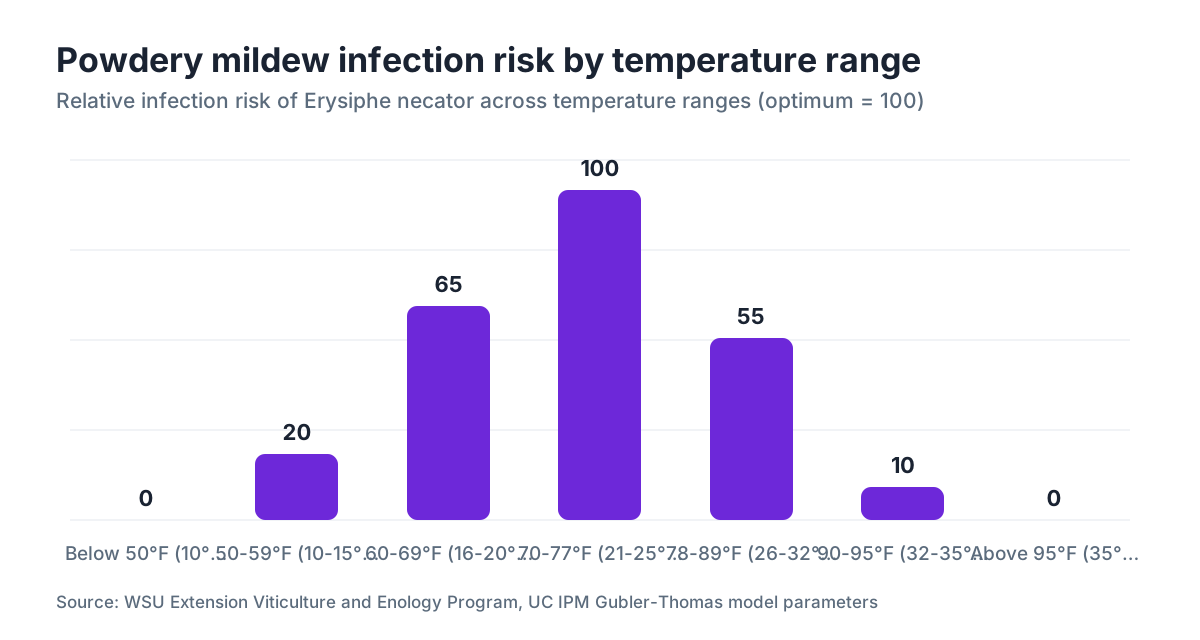
Erysiphe necator is odd among fungal pathogens because it infects without any free water on the leaf. The numbers that matter [3]:
- Minimum temperature for infection: 50°F (10°C)
- Optimum range: 68 to 77°F (20 to 25°C)
- Upper threshold: growth slows hard above 90°F (32°C) and stops above 95°F (35°C)
- Spore release: conidia disperse mostly during the day, peaking mid-morning
- Relative humidity: very high humidity (above 85 to 90% RH) and free water on the leaf actually suppress conidia germination
The UC IPM Powdery Mildew Risk Index (often called the Gubler-Thomas model, after the researchers who built it) uses cumulative temperature to score infection risk [1]. It assigns a risk index value from a 6-hour running average temperature. When that 6-hour average sits at 70 to 85°F across consecutive periods, the index climbs quickly. Growers with a weather station can run it themselves, and the model is free through the UC IPM website.
WSU's decision aid for the Pacific Northwest works the same temperature windows and asks growers to track growing degree days (base 50°F) to time the first fungicide application relative to budbreak [3].
Here's the trap. Warm days in the 70s, cool nights, no rain: that is not a safe stretch for powdery mildew. It is a high-risk stretch. Growers who relax during dry weather are the ones who get hit.
How do you set up a scouting protocol that actually catches early infections?
A scouting protocol that works has three parts: a fixed schedule, a fixed sampling frame, and a written record. Skip any one and you're guessing.
Schedule: weekly from 1-inch shoot growth through berry set. After berry set you can stretch to every ten to fourteen days if pressure has stayed low. Find active infection, go back to weekly.
Sampling frame: Cornell's IPM program recommends at least five shoots per vine and five vines per block, focused on basal leaves (leaves 1-5) and shoot tips [2]. In a 5-acre block that's 25 vines minimum. If a block runs bigger than 10 acres, sample from at least three spots inside it, because pressure swings with topography, air drainage, and vine spacing.
What to record: date, location (row and vine number or GPS point), tissue type examined, percent incidence (share of leaves or shoots with symptoms), and severity (share of leaf area or berry surface affected). Incidence above 10% on leaves before bloom is a threshold that demands attention now, not next week.
Keep records in a notebook, a spreadsheet, or dedicated software. The point is being able to hold this week's count against last week's and see whether the infection is accelerating. A record that lives only in your head is not a record. Platforms like VitiScribe let you log spray and scouting records in one place, which matters when you have to show compliance with your pesticide use reporting or certify under a third-party sustainability program.
The EPA Worker Protection Standard (WPS) requires pesticide application records, including fungicide sprays triggered by what you found scouting, be kept and available for inspection [4]. Your scouting log is the paperwork that justifies the timing of the application.
Which grape varieties show powdery mildew symptoms earliest, and which hide them?
Variety changes everything about early detection, because susceptibility drives both how fast symptoms appear and how bad they get before they're visible.
Highly susceptible varieties include Chardonnay, Cabernet Sauvignon, Merlot, Pinot noir, Pinot gris, and Zinfandel. On these, early symptoms are easier to catch because the pathogen grows fast and visible mycelium turns up sooner after infection.
More tolerant varieties (tolerant, not immune) include Cabernet franc, Riesling, and several PIWI (fungus-resistant) varieties bred with introgressed resistance genes from Muscadinia rotundifolia or other wild Vitis species. On resistant varieties you might see only small chlorotic spots with no visible mycelium even while infection is underway. The pathogen is there. Your naked eye just can't confirm it.
Vitis vinifera as a species has essentially no natural immunity to E. necator, which is a North American native pathogen [9]. American species like Concord and Niagara carry real tolerance, but they aren't fully immune either.
A practical move: in a mixed-variety vineyard, use your most susceptible block as a sentinel. Check Chardonnay or Zinfandel first. Find infection there and go straight to your other blocks. The lag between varieties runs days to a week, not months.
Leaf surface plays tricks too. Varieties with waxy, glaucous leaves (some Grenache clones, for instance) can look white-coated at first glance when it's just normal bloom. Rub gently. Natural bloom feels different from mycelium and won't smear the same way.
What tools help you confirm a powdery mildew diagnosis in the field?
You rarely need a lab to confirm powdery mildew, but a few cheap tools make field confirmation reliable instead of a coin flip.
A 10x hand lens is the single most useful thing you can carry into the canopy. At 10x the mycelium reads clearly as a network of white threads (hyphae) sitting on the leaf, and you can tell it apart from trichomes (leaf hairs), which are rooted in the epidermis rather than lying on top of it.
A piece of clear tape and a glass slide get you a quick field spore mount. Press the tape gently to a suspicious leaf surface, stick it to the slide, and look under 40 to 100x if you have a field microscope. Powdery mildew conidia are barrel-shaped or cylindrical and line up in chains. This level of confirmation earns its keep when you're about to spend money on a fungicide and want to be sure first.
Smartphone macro attachments (clip-on lenses, roughly $10 to $30 online) do a decent job documenting suspected lesions for later review. Cornell's grape IPM resources include image libraries built for comparing look-alike symptoms [2].
If you do want lab confirmation (handy at season start to check whether overwintering chasmothecia are viable), WSU's Plant Pathology diagnostic services accept submissions and typically turn a result around in a few days [8]. UC Cooperative Extension county offices often have the same capacity.
How does canopy management affect your ability to spot powdery mildew early?
Dense canopies hide infections. That's not a maybe, it's a consistent finding across extension research from UC, Cornell, and WSU. Shoots crowding into each other build interior microclimates that are more humid, more shaded, and much harder to inspect by eye.
Leaf removal in the fruit zone, usually pulling two to four leaves on the eastern or morning-sun side of the canopy (Northern Hemisphere), does two jobs at once. It improves spray penetration when you do need to apply fungicide, and it makes early-season scouting possible at all. If you can't see the clusters without shoving shoots aside, you aren't really scouting.
Shoot positioning matters as much for scouting as it does for coverage. A vertical shoot position (VSP) system with well-placed, non-overlapping shoots is the easiest thing to scout. A Scott Henry or a Geneva Double Curtain works, but overhead systems force you to walk through and look up, which most people do less carefully than they think they do.
The canopy-disease link is well documented. UC ANR trials on Chardonnay in the San Joaquin Valley found that fruit-zone leaf removal reduced powdery mildew incidence on berries compared to unmanaged canopies, even without any change to the spray program [5]. Better visibility is part of it. Improved air circulation and lower humidity carry equal weight.
If you manage vineyard blocks at a range of canopy densities, adjust your scouting plan before the pressure season starts, not after you've already found a hot spot.
What should you do the moment you find your first powdery mildew lesion?
Don't panic, and don't grab the sprayer on reflex. One lesion on one basal leaf in late April is a very different animal from scattered infections on shoot tips and flower clusters in May.
Step one: quantify. Walk the block and record percent incidence across a representative sample. If incidence is under 1 to 2% and you're pre-bloom, you have a short window to make a measured response.
Step two: check your spray history. When was your last application? What did you use? Are you clear of the re-entry interval (REI) and pre-harvest interval (PHI) for that product? WPS re-entry intervals for common powdery mildew fungicides run from 4 hours (many sulfur products) to 24 or 48 hours (some DMI and SDHI materials); the product label sets the legal number [10]. Cornell's fungicide timing tables and WSU's spray guides both organize this by product class [2][3].
Step three: figure out where you sit in your resistance-management rotation. Erysiphe necator builds resistance to single-site fungicides (DMIs like myclobutanil and tebuconazole, QoIs like azoxystrobin) faster than almost any other grape pathogen [2]. If you've run two or three straight QoI applications and you're now finding active disease, treat that as a warning that resistance may be building. Switch classes.
For the record, log the discovery date, severity, location, and anything you sprayed because of it. A digital system like VitiScribe lets you tag scouting observations directly to the block and the spray event, which builds a defensible paper trail for organic certification, state pesticide use reports, or GAP audits.
One thing I'd actually do: flag the vines where you found the first lesions with surveyor's tape. Come back to those exact vines every week after. They become your early-warning station for the rest of the season.
How do professional scouts and agronomists approach early-season powdery mildew differently from most growers?
The real difference isn't expertise. It's time at the vine. Professional scouts often spend two to three times as long per vine as a grower moving fast through a block, and they look at tissue growers skip: tendrils, petioles, the basal leaf undersides on the most shaded shoots, and the first cluster primordia visible at budbreak.
Another habit worth stealing: professional scouts check leaf undersides on basal shoots before anything else. Basal leaves are shaded, protected from UV (which inhibits germination), and sitting in the most humid part of the canopy. That's where the first infections show up nearly every season.
Consultants who do this professionally use a standardized disease rating scale, often the 0-5 scale in the American Phytopathological Society's grape disease compendium, where 0 is no disease and 5 is over 50% of leaf area affected [9]. A consistent scale across seasons turns your data into something you can trend, instead of a pile of subjective notes.
Nobody has clean aggregated data on the cost of undetected early-season infection versus the cost of a proactive spray program. The closest published numbers come from UC IPM, which puts yield losses from severe powdery mildew in wine grapes at up to 50% in the worst cases, with quality hits (higher pH, lower titratable acidity, musty off-flavors) even from partial infection [1]. The economic case for early detection isn't hard to make.
Frequently asked questions
Can powdery mildew infect grape berries without infecting leaves first?
Yes. Berries and rachis can be infected directly from airborne conidia with no visible leaf symptoms in the same spot. This happens most during high-inoculum periods around bloom. Always inspect cluster tissue and rachis separately from your leaf scouting, especially on susceptible varieties like Chardonnay, where berry infections before the berries reach 10 mm cause the worst scarring.
What does a powdery mildew flag shoot look like, and how do you find one?
A flag shoot comes from a dormant bud that held overwintering mycelium in its scales. It pushes with a visible white powdery coating on the young internodes, petioles, and leaf undersides right from budbreak. It often looks stunted or distorted next to clean shoots on nearby buds. Walk the basal spurs and canes carefully at budbreak, before shoot growth passes three to four inches, when flag shoots are easiest to pick out.
Is powdery mildew worse in hot, dry conditions or cool, wet conditions?
Powdery mildew favors moderate temperatures (68 to 77°F is optimal) and needs no free water to infect. Cool, wet springs actually suppress it by washing away conidia and inhibiting germination. Hot, dry weather slows or stops growth above 95°F. The highest-risk scenario is warm days, moderate humidity (40 to 70% RH), and no rain. UC IPM's Gubler-Thomas model uses 6-hour temperature averages to score cumulative infection risk.
How do I know if the white powder on leaves is powdery mildew or something else?
Rub the white area gently with your finger. Powdery mildew mycelium smears off and leaves a faint green stain from the leaf cells underneath. Natural leaf bloom (wax) or dust does not smear the same way. Under a 10x hand lens, powdery mildew reads as a network of white hyphae with no regular structure, distinct from trichomes (leaf hairs) rooted in the epidermis. When in doubt, send a sample to a cooperative extension diagnostic lab.
How often should I scout for powdery mildew during peak season?
Weekly from 1-inch shoot growth through berry set is the standard recommendation from UC, Cornell, and WSU extension programs. Find active infection and tighten to every three to four days to track how fast incidence climbs. After berry set, when berries turn more resistant, you can drop back to every ten to fourteen days, provided pressure has stayed low and your spray program has been steady.
Do PIWI or hybrid grape varieties still need to be scouted for powdery mildew?
Yes, with different expectations. PIWI varieties with strong resistance (Regent, Cabernet Blanc, Muscaris) develop far less visible mycelium even when infected. Scouting still matters because partial resistance is not immunity, and in very high-pressure seasons these varieties can carry enough colonization to affect quality. Under magnification, look for the chlorotic spotting pattern without obvious mycelium. Rachis infections can still occur on partially resistant varieties.
What is the EPA Worker Protection Standard, and does it apply to my powdery mildew sprays?
The WPS (40 CFR Part 170) applies to any agricultural pesticide application where workers or handlers may be exposed. For fungicide sprays targeting powdery mildew, you must provide re-entry interval (REI) information, provide personal protective equipment for handlers, and keep application records available for inspection. Most sulfur-based fungicides carry a 4-hour REI; some SDHI and DMI products carry 12 to 24 hour REIs. Check the product label, which is the legal standard.
Can I identify powdery mildew using a smartphone camera?
A smartphone with a clip-on macro lens (typically $10 to $30) can capture images detailed enough to document suspected infections for comparison with extension image libraries from Cornell or UC. Smartphone images alone usually aren't enough to confirm diagnosis without visible mycelium, because the early oily-green spotting looks like several abiotic disorders. Use images as documentation and for consultation, not as a sole diagnostic tool.
How long after infection does powdery mildew become visible?
The latent period (infection to visible symptoms) runs roughly five to seven days in the optimum range of 68 to 77°F. At cooler temperatures (50 to 60°F) it stretches to ten to fourteen days. That lag is why weekly scouting can still miss the very start of an infection cycle. The Gubler-Thomas model from UC IPM estimates the latent period from actual temperature data, so you can anticipate when symptoms will surface after a high-risk period.
What is the economic threshold for powdery mildew before bloom?
There is no universally agreed economic threshold for pre-bloom powdery mildew the way there is for some insect pests. Most extension programs treat any detectable infection in the pre-bloom to early bloom window as actionable, because berry susceptibility peaks then and early infections can build fast. Cornell recommends that incidence exceeding 10% of basal leaves before bloom warrants immediate fungicide intervention regardless of other factors.
Does sulfur work for early-season powdery mildew, and what are its limitations?
Sulfur works against powdery mildew as both a protectant and an eradicant at early stages, and it stays the backbone of most organic and conventional programs. The limits: it is phytotoxic applied within two weeks of an oil spray or when temperatures top 90°F on application day; it has no systemic activity, so coverage must be thorough; and it degrades fast, needing reapplication every seven to ten days. Resistance to sulfur is not a known concern with E. necator.
How do I distinguish powdery mildew from bird's eye rot or other berry diseases?
Bird's eye rot (Elsinoe ampelina, anthracnose) causes circular lesions with gray centers and dark purple-brown margins on berries, canes, and leaves. It produces no white powdery growth. Powdery mildew on berries shows as a white to gray powder on the berry surface, often with russeting or ring scarring on the skin beneath. Under a hand lens, powdery mildew mycelium sits clearly on the surface, not embedded in the tissue the way an anthracnose lesion is.
Are there any predictive models I can use to forecast powdery mildew risk without a weather station?
The Gubler-Thomas model needs a weather station for accurate results, but UC IPM publishes risk assessments from regional weather station networks you can read without owning equipment. NEWA (Network for Environment and Weather Applications), run by Cornell, offers disease forecasting tools including a powdery mildew model for the eastern US using nearby weather station data. Both are free to access online.
Sources
- UC IPM, University of California, Grape Powdery Mildew guidelines: Berries are most susceptible from just before bloom through three to four weeks after bloom; yield losses in severe infections can reach up to 50%; the Gubler-Thomas temperature-based risk model is described and recommended.
- Cornell University, New York State IPM Program, Grape Disease Management: Flag shoots emerge visibly infected from bud-internal mycelium; sampling 5 shoots per vine and 5 vines per block from basal leaves and shoot tips is recommended; Erysiphe necator resistance to single-site fungicides is a documented concern.
- Washington State University Extension, Viticulture and Enology Program: Minimum infection temperature is 50°F; optimum is 68-77°F; conidia germination is inhibited above 85-90% RH and by free water; growing degree days base 50°F can be used to time first fungicide application.
- U.S. EPA, Worker Protection Standard for Agricultural Pesticides (40 CFR Part 170): WPS requires pesticide application records be kept and available, re-entry interval information be provided to workers, and handlers receive appropriate PPE; applies to all agricultural fungicide applications.
- UC Agriculture and Natural Resources, Grape Pest Management: Leaf removal at the fruit zone reduced powdery mildew incidence on berries compared to unmanaged canopies in UC Chardonnay trials.
- Network for Environment and Weather Applications (NEWA), Cornell University, Grape Disease Forecast Tools: NEWA provides a free online powdery mildew risk model for eastern US vineyards using regional weather station data, accessible without on-site weather equipment.
- Washington State University, Department of Plant Pathology diagnostic services: WSU's diagnostic services accept plant samples for confirmation of powdery mildew and other grape diseases, with typical turnaround of several days.
- American Phytopathological Society, Compendium of Grape Diseases (APS Press): The 0-5 disease rating scale for grapevine powdery mildew severity is standardized and described; Erysiphe necator is identified as a North American native pathogen with an obligate biotrophic life cycle.
- U.S. EPA, Pesticide Label Requirements and Compliance: The pesticide label is the legal standard for re-entry intervals, pre-harvest intervals, and personal protective equipment requirements for all registered agricultural fungicide products.
Last updated 2026-07-11