Myclobutanil resistance management in vineyard powdery mildew programs

TL;DR
- Myclobutanil (FRAC Group 3) loses effectiveness fast when used repeatedly because Erysiphe necator populations shift toward insensitive strains within a few seasons.
- The fix is rotating to unrelated FRAC groups every 1-2 applications, keeping myclobutanil to no more than 2-3 applications per season, tracking your spray records, and scouting for breakthrough infections that signal resistance is building.
What is myclobutanil and why does resistance happen so quickly in vineyards?
Myclobutanil is a triazole fungicide in FRAC Group 3. It works by inhibiting sterol biosynthesis in fungal cells, specifically the CYP51 enzyme. It's sold under trade names like Rally 40WSP and appears in dozens of premix products. Growers have leaned on it heavily since the early 1990s, and that long history is exactly the problem.
Erysiphe necator, the fungus behind grape powdery mildew, reproduces asexually at extraordinary speed during warm, dry weather. A single colony can cycle through multiple generations in a week. Every replication is a chance for a mutation in the CYP51 gene to appear. Repeated exposure to myclobutanil selects for those mutations until the insensitive strains dominate the local population. UC IPM describes this as a shift in population sensitivity rather than a simple on/off switch, meaning you'll often see reduced efficacy long before outright control failure. [1]
The speed of resistance depends on several factors. How often you apply myclobutanil. Whether you use it solo or in a premix. What the background selection pressure looks like in your region. Whether nearby vineyards are hammering the same mode of action. California's San Joaquin Valley and many North Coast blocks saw documented sensitivity shifts by the mid-2000s. Nobody has perfectly clean regional data on current resistance prevalence, but the honest answer from extension plant pathologists is that you should assume some level of resistance exists in any block with more than five seasons of heavy Group 3 use.
How do you actually detect resistance before your crop is already infected?
The clearest warning sign is breakthrough infection on a block with good spray timing and thorough coverage. Early detection is harder than it sounds, because reduced efficacy can look like poor coverage, wrong timing, or bad weather, all of which mask the signal. That said, the field indicators are real.
If you applied myclobutanil at the right growth stage, at label rate, with proper water volume and canopy penetration, and you're still seeing active sporulating colonies within seven to ten days of application, that's a resistance red flag. Compare it to adjacent blocks or varieties treated with a different FRAC group under similar conditions.
For growers who want actual data, laboratory bioassays exist. Cornell's Plant Disease Diagnostic Clinic and UC's Cooperative Extension network can point you toward labs that run sensitivity assays on collected spore samples. [2] Washington State University extension work on powdery mildew has also described in-vineyard leaf disk bioassay methods that motivated growers can run themselves, though interpretation takes some baseline experience. [3]
The cheaper and faster approach is a consistent scouting protocol. Walk every block at least weekly during the high-risk window (roughly five-inch shoot through bunch closure). Record the percent of shoots showing infection and the intensity of sporulation. Keep those records across multiple seasons and a creeping upward trend under the same spray program becomes your early warning system. Tools like VitiScribe let you tie spray records directly to scouting observations so the pattern is obvious season over season, which is genuinely useful for catching drift before it becomes a crisis.
No scouting protocol gives you certainty. But a written record beats memory every time you're trying to figure out whether last year's program failed or this year's weather was just that bad.
What FRAC groups should you rotate with and how does the rotation actually work?
The core rule of resistance management is simple: never give the pathogen population two consecutive selection events with the same mode of action. For myclobutanil (Group 3), that means following or preceding every application with a product from a completely different FRAC group.
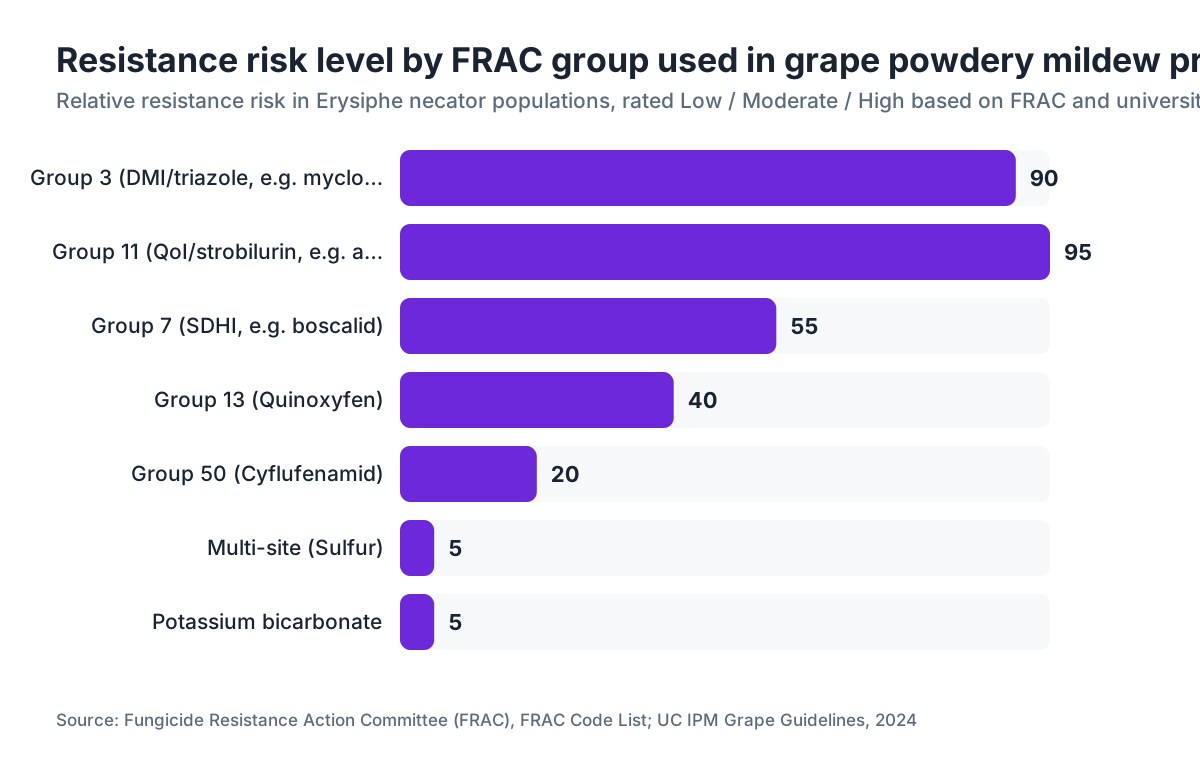
Here are the groups most common in grape powdery mildew programs and what you need to know about each:
| FRAC Group | Mode of Action | Example Active Ingredients | Resistance Risk |
|---|---|---|---|
| 3 (DMI/triazole) | Sterol biosynthesis inhibition | Myclobutanil, tebuconazole, difenoconazole | High, well-documented in E. necator |
| 7 (SDHI) | Succinate dehydrogenase inhibition | Fluxapyroxad, boscalid | Moderate, increasing concern |
| 11 (QoI/strobilurin) | Respiration (complex III) | Azoxystrobin, trifloxystrobin | Very high in many regions; use with caution |
| 13 (Quinoxyfen) | Sterol biosynthesis (different site) | Quintec | Moderate |
| 50 (Cyflufenamid) | Unknown exact target | Torino | Low so far |
| M (Multi-site/inorganic) | Multiple sites, no specific target | Sulfur, copper | Low, rarely develops resistance |
| U8 (Phosphonate) | Multiple mechanisms | Potassium phosphite | Low |
Sulfur is your backbone. It's cheap, multi-site, and there's no documented resistance in powdery mildew populations. [4] In a well-designed program, sulfur covers most of your applications, with single-site fungicides layered in at the highest-risk periods (pre-bloom through three to four weeks post-bloom for most regions).
A typical rotation for a moderate-to-high pressure season might run like this: sulfur at budbreak, sulfur again, myclobutanil (Group 3) at four-inch shoot, a Group 7 or Group 13 product at pre-bloom, sulfur again, then a Group 50 or Group 13 at early bunch closure if pressure holds. You get two to three myclobutanil applications at most, never back-to-back, with multi-site products between every single-site spray.
Premix products trip growers up. If your premix contains both a Group 3 and a Group 11 active ingredient, switching to a different brand hasn't rotated you away from Group 3 risk at all. Read the label.
The Fungicide Resistance Action Committee (FRAC) publishes annual guidance on group classifications. Cross-check your product labels against the current FRAC code list before you finalize your program each year, because reclassifications happen. [5]
How many myclobutanil applications per season is too many?
Two is the number to remember. Most label language and university extension guidance converges on no more than two to three applications of any single FRAC group per season, and for Group 3 specifically, two is the conservative and generally recommended ceiling given the documented history of resistance in E. necator.
UC IPM's grape disease management guidelines state this for DMI fungicides as a group: limit applications and always rotate with non-DMI products. [1] Cornell's integrated crop and pest management guidelines for grapes echo the same two-application-per-mode-of-action limit. [2]
Timing of those two applications matters as much as the count. Powdery mildew infections established before and just after bloom cause the most economic damage because they can directly infect the berry. Putting your myclobutanil applications at the highest-risk windows (late pre-bloom through two weeks post-bloom) extracts the most value from those two slots. Spraying myclobutanil in August, past bunch closure, is often a waste of your resistance-management budget.
Some growers ask whether a lower rate reduces selection pressure. The evidence is mixed, and the general recommendation from FRAC is to use full label rates, because sub-lethal doses may actually speed resistance up by letting more partially-resistant individuals survive and reproduce. Never go below label rate as a resistance-management strategy. [5]
Does myclobutanil still work at all if resistance is suspected?
Probably, to some degree, and that partial answer shapes how you design the rest of your program.
Resistance in E. necator populations is usually quantitative, not qualitative. Practically, the population becomes less sensitive over time rather than abruptly immune. You may still get some suppression from myclobutanil even in a population with documented sensitivity shifts. The catch is that "some suppression" may not protect a high-value winegrape crop in a high-pressure season. [9]
If you genuinely suspect your local population has shifted, deprioritize myclobutanil. Move it to lower-pressure windows if you use it at all, and make sure your primary sprays at the highest-risk windows use modes of action with proven local efficacy. Sulfur, Group 13 (quinoxyfen/Quintec), and Group 50 (cyflufenamid/Torino) are the candidates most extension pathologists lean toward when Group 3 efficacy is in doubt.
Some growers pull myclobutanil entirely for a few seasons to let population sensitivity recover. The theory: remove selection pressure and the more-sensitive (presumably more-fit) genotypes gradually outcompete the insensitive ones. There's some evidence this works over multiple seasons, but nobody has great vineyard-scale data on how fast sensitivity comes back. The WSU extension program on disease management has discussed the concept in its spray guides. [3]
The honest position: once you have a significantly shifted population, getting back to full efficacy is slow and uncertain. Prevention is dramatically easier than recovery.
What do the EPA and state regulations say about myclobutanil use in vineyards?
The label is federal law. Myclobutanil is a federally registered pesticide governed by EPA registration under FIFRA, and any use inconsistent with label directions, including exceeding maximum application rates or intervals, is a federal violation. [6]
For worker safety, myclobutanil applications in vineyards trigger the EPA Worker Protection Standard (WPS), codified at 40 CFR Part 170. The restricted-entry interval (REI) for most myclobutanil formulations is 24 hours. Workers can't enter the treated area during that period without personal protective equipment, and the employer must post field-reentry notices. [7]
California adds its own layer through the Department of Pesticide Regulation (CDPR) and county agricultural commissioner permit requirements. California requires spray records to be kept for at least two years after application, and each record must include the product name, EPA registration number, active ingredient, rate, location, application date, target pest, and applicator identity. [8] This is not optional paperwork.
In Oregon and Washington, state department of agriculture rules layer onto federal requirements with similar record-keeping mandates. If you operate in a groundwater protection area or a riparian buffer zone, extra restrictions on myclobutanil may apply. Check your state ag department guidance before you finalize application blocks near waterways.
Complete, accurate spray records are also your best defense if an efficacy question or a resistance claim ever comes up, with a crop insurance adjuster, a buyer, or a regulatory inspector.
How does your spray timing interact with resistance risk?
Good timing means fewer sprays, and fewer sprays means less selection pressure. That's the whole connection in one sentence. You get more disease control per application when you spray at the right time, so you need fewer applications, which directly lowers the odds of resistance building.
For grape powdery mildew, the infection risk model built by UC and refined over decades shows that E. necator needs specific temperature and wetness conditions to establish infection, and that the period from five-inch shoot to three to four weeks post-bloom is the critical window where infections most affect crop quality. [1] Nail coverage during that window and you may cut total fungicide applications by one or two per season compared to a calendar-based program.
Degree-day and infection risk models are available through UC IPM, the Washington State University Decision Aid System (WSU-DAS), and similar tools in other states. [3] These models don't tell you whether to spray myclobutanil or sulfur, but they tell you when timing is genuinely critical versus when you have flexibility. Putting your single-site fungicides (including myclobutanil) on the high-risk windows and letting sulfur carry the lower-risk applications is a concrete tactic, more than a philosophy.
Canopy management matters here in a way that's often underestimated. A dense, poorly-managed canopy creates the humid microclimate powdery mildew thrives in, and it blocks spray penetration so even a well-timed application misses large parts of the canopy. Hedging and fruit-zone leaf removal improve wine quality, sure. They also make your spray program more effective and cut the number of applications you need.
What are the best tank-mix and co-application strategies to protect myclobutanil efficacy?
Tank-mixing a single-site fungicide with a multi-site material is one of the most widely recommended resistance-management tactics, because the multi-site component (usually sulfur) controls any strains the single-site product misses.
For myclobutanil specifically, tank-mixing with wettable sulfur at full label rate for both products is common practice and lines up with guidance from UC, Cornell, and WSU. [1][2][3] The sulfur handles any myclobutanil-insensitive individuals in the population, keeping those strains from getting a free run during the application window.
A few practical notes on sulfur tank mixes. Check the label for temperature restrictions. Most sulfur labels warn against application when temperatures top 90 to 95 degrees Fahrenheit because phytotoxicity risk climbs sharply. Check the interval requirement between sulfur and any oil-based products. These are label-compliance issues, not optional cautions.
Some growers have shifted toward premix products that combine a Group 3 with a Group 7 (SDHI) or another mode of action. These can simplify a program, but they don't remove the need to rotate the entire premix away from those modes of action next time out. Use a 3+7 premix twice in a row and you've applied two consecutive doses of both modes of action and selected for resistance to both at once. You haven't gained protection. You've made your resistance problem more complex.
The principle worth internalizing: resistance management protects modes of action across the whole season, more than at any single spray event.
How should you document your resistance management program for compliance and recordkeeping?
"I rotate my FRAC groups" is not a record. A good resistance management program needs paper (or digital) proof that you actually followed it. A complete spray record for each application should capture, at minimum: date, block ID, product name, EPA registration number, FRAC group, active ingredient, application rate, water volume, equipment used, applicator name, target pest, weather conditions at spray time, and the REI expiration. [8]
For California growers, this is required by state regulation and must be kept for two years. For growers in other states, the specifics vary, but federal WPS requirements still mandate keeping certain records tied to pesticide applications. Check your state's rules.
Beyond compliance, good records let you do something useful: review last year's program before you write this year's. Look at a clear list of which FRAC groups hit which blocks and when, and you can spot immediately if one mode of action got over-used. That review is hard to do from memory and impossible to do accurately from incomplete records.
Managing multiple blocks or varietals with different programs, tracking FRAC group rotation by hand across a spreadsheet gets unwieldy fast. A field operations platform like VitiScribe ties spray records to blocks, pulls FRAC codes, and flags gaps in your rotation, which is the kind of specific function that saves time and catches mistakes paper logs miss.
Whatever tool you use, the record needs to exist before the inspector asks, before the crop insurance claim goes in, and before you can make an honest call on what last year's program actually was.
Are there biological or alternative chemistries worth including in a rotation?
Yes, and they're more reliable than they were ten years ago, though you still need realistic expectations.
Potassium bicarbonate (OMRI-listed, several registered products) disrupts the powdery mildew colony directly and carries no FRAC group designation because it doesn't work through a specific biochemical target. It fits into a conventional or organic rotation as a low-resistance-risk option. Efficacy runs lower than synthetic fungicides under high pressure, so it's better suited to lower-pressure windows. [10]
Potassium phosphite and similar phosphonate products have some direct fungicidal activity against powdery mildew and also appear to induce systemic resistance in the plant. They sit in FRAC Group P7. Efficacy data is somewhat inconsistent across trials and regions, but they earn a spot in low-to-moderate pressure windows and in an organic-compatible rotation.
Biofungicide products based on Bacillus subtilis (like Serenade Opti) or Bacillus amyloliquefaciens are registered for grape powdery mildew and rely on multi-site or induced-resistance mechanisms that carry low resistance risk. University trial data from Cornell and UC shows variable efficacy, generally 60 to 80 percent control under moderate pressure versus 85 to 95 percent for synthetic fungicides under the same conditions. [11] They're not a replacement for synthetics in a high-pressure season, but they're a legitimate rotation tool.
Organic growers in high-pressure regions often run sulfur as their primary fungicide all season, supplemented with potassium bicarbonate, copper, and biologicals. It works, but it demands tighter spray timing and more applications than a synthetic program. UC has published guidance on this. [10]
The broader point: your rotation doesn't have to be all synthetic fungicides. Adding low-resistance-risk materials, biological or inorganic, gives you more flexibility and cuts the total number of high-risk mode-of-action applications per season.
What do Cornell, UC Davis, and WSU actually recommend for a season-long mildew program?
All three major grape-growing extension programs publish annual spray guides, and while the specific recommendations differ by region and climate, the resistance management framework underneath them is consistent.
Cornell's Integrated Crop and Pest Management Guidelines for Commercial Grape Production (available through Cornell Cooperative Extension) recommend limiting applications of any single FRAC group to a maximum of two per season for high-resistance-risk groups including Group 3, and always alternating modes of action. Cornell also pushes growers to use the powdery mildew infection risk model to time applications and to cut unnecessary sprays when disease pressure is genuinely low. [2]
UC IPM's Pest Management Guidelines for Grape lay out a similar framework. Their guidance names myclobutanil and other DMI fungicides as requiring rotation with non-DMI materials, recommends sulfur as the backbone of any program, and flags the Group 11 strobilurins as having documented high resistance in California populations, making them a poor choice as rotation partners if the goal is meaningful protection. [1]
WSU Extension's grape disease management guidance for the Pacific Northwest gives similar rotation advice and points growers toward the WSU Decision Aid System for spray timing. WSU publications also discuss strobilurin resistance in regional populations and advise against relying on Group 11 products as primary protection. [3]
A synthesized program for a moderate-pressure season, built from these three sources, looks roughly like this: sulfur from budbreak, add a Group 13 (quinoxyfen) or Group 50 (cyflufenamid) product at pre-bloom, use myclobutanil at early post-bloom, return to sulfur or a Group 7 SDHI for the next application, then back to sulfur through bunch closure. Total single-site applications: two to three. Total Group 3 applications: one to two. Every single-site spray sits surrounded by multi-site coverage.
Frequently asked questions
Is myclobutanil still effective against grape powdery mildew?
It depends on your regional population's resistance history. In blocks with limited prior DMI use, myclobutanil still gives good control. In regions with heavy historical use, sensitivity shifts are documented and efficacy may be reduced. UC IPM and Cornell both recommend treating Group 3 as a limited resource: use it two times per season maximum, always surrounded by different FRAC groups, and scout for breakthrough infections.
What FRAC group is myclobutanil in and why does that matter?
Myclobutanil is in FRAC Group 3 (DMI/triazole fungicides). FRAC group designations indicate the mode of action, meaning all Group 3 fungicides kill fungi the same way. Using multiple Group 3 products in the same season, even under different trade names, counts as repeated selection pressure. Resistance that develops to myclobutanil typically extends to other Group 3 products like tebuconazole as well.
Can I use myclobutanil back to back with another triazole fungicide?
No. Two consecutive applications of any FRAC Group 3 product, regardless of trade name, is exactly the pattern that drives resistance. Tebuconazole, difenoconazole, and myclobutanil all exert the same selective pressure because they share the CYP51 target. FRAC guidance and university extension recommendations are consistent: always rotate to a different mode of action between Group 3 applications.
How many times can I apply myclobutanil in one growing season?
Most university extension programs recommend no more than two applications of any single FRAC group per season for powdery mildew. Some labels allow more, but resistance management guidance caps it at two to three for Group 3. Two applications, timed at the highest-risk windows (pre-bloom through three to four weeks post-bloom), is the most common recommendation from UC IPM, Cornell, and WSU.
Does tank-mixing myclobutanil with sulfur help prevent resistance?
Yes, and it's one of the most practical resistance management tactics available. Sulfur is a multi-site fungicide with no meaningful resistance risk in powdery mildew populations. Adding sulfur at full label rate to a myclobutanil application covers any myclobutanil-insensitive individuals, keeping them from reproducing freely. Check label temperature restrictions before applying sulfur, since most labels warn against application above 90 to 95 degrees Fahrenheit.
What fungicide should I switch to if myclobutanil is failing?
Move to a product from a completely unrelated FRAC group. The best candidates for high-pressure windows are Group 13 (quinoxyfen, sold as Quintec), Group 50 (cyflufenamid, sold as Torino), and Group 7 SDHIs (fluxapyroxad, boscalid). Avoid Group 11 strobilurins as a resistance escape, because they carry their own documented resistance in many E. necator populations. Sulfur stays the backbone for all windows where single-site protection isn't critical.
How do I know if powdery mildew in my vineyard has developed resistance to myclobutanil?
The clearest field sign is breakthrough infection in a block with good spray timing, full coverage, and correct rates. Compare it to blocks treated with a different FRAC group under similar conditions. Laboratory sensitivity assays are available through university plant disease labs. Consistent scouting records that show a rising infection trend over multiple seasons under the same program are your most accessible early indicator. No single spray failure proves resistance on its own.
Are there organic alternatives to myclobutanil for powdery mildew?
Sulfur is the primary organic tool and has no documented resistance risk in powdery mildew. Potassium bicarbonate, potassium phosphite, and Bacillus-based biofungicides (Serenade Opti) are registered and OMRI-listed options. Efficacy runs lower than synthetics under high pressure, typically 60 to 80 percent control versus 85 to 95 percent for synthetics in Cornell trial data. They're legitimate rotation components but not standalone replacements in severe disease years.
What are the worker protection standard requirements for myclobutanil applications?
Myclobutanil applications trigger EPA Worker Protection Standard requirements under 40 CFR Part 170. The restricted-entry interval for most myclobutanil formulations is 24 hours. No workers may enter the treated area during the REI without required personal protective equipment. Field reentry posting is required. Employers must also ensure workers have received WPS pesticide safety training before being assigned tasks in pesticide-treated areas.
What spray records do I need to keep for myclobutanil applications?
California requires spray records to be kept for at least two years, and each must include product name, EPA registration number, active ingredient, application rate, location (block), date, target pest, and applicator identity. Federal WPS requirements add worker safety documentation. Other states have similar or identical requirements. Records should also note weather conditions and equipment used, so poor efficacy can be evaluated against application quality rather than blamed on resistance by default.
Does resistance to myclobutanil mean resistance to all Group 3 fungicides?
Generally yes, and this is called cross-resistance. Because all Group 3 (DMI) fungicides inhibit the same CYP51 enzyme, mutations that reduce sensitivity to myclobutanil typically reduce sensitivity to other Group 3 products like tebuconazole and propiconazole too. If myclobutanil efficacy is failing, switching to another triazole from the same group is unlikely to solve the problem and may speed resistance up.
How does canopy management affect myclobutanil resistance risk?
Dense canopies create humid microclimates that favor powdery mildew and reduce spray penetration, so more of your applied fungicide misses the pathogen. The result is sub-lethal exposure across part of the population, which can accelerate resistance selection. Hedging and fruit-zone leaf removal improve spray coverage and cut the number of applications needed, directly lowering total selection pressure on the pathogen population.
Can I stop using myclobutanil for a few seasons to let resistance recover?
Theoretically yes. Removing selection pressure gives more-sensitive (presumably more competitive) genotypes a chance to increase back in the population. Some extension guidance mentions this concept, but there's limited vineyard-scale data on how fast recovery happens, and it could take multiple seasons. The practical challenge is holding adequate disease control during that period using only alternative FRAC groups and sulfur, which is doable but demands tighter timing.
What is the difference between a resistance management program and just following the label?
The label tells you the maximum you can do. Resistance management tells you the maximum you should do, which is usually less. A label may permit four or more myclobutanil applications per season, but extension guidance caps it at two to three, because the label doesn't account for cumulative regional selection pressure across multiple seasons and vineyards. Following the label for each product is required by federal law, but it isn't a resistance management plan on its own.
Sources
- UC IPM, University of California Statewide IPM Program, Pest Management Guidelines: Grape, Powdery Mildew: UC IPM guidelines on DMI fungicide rotation, sulfur as backbone, and population sensitivity shifts in E. necator
- Cornell Cooperative Extension, Integrated Crop and Pest Management Guidelines for Commercial Grape Production: Cornell recommendation to limit FRAC Group 3 applications to no more than two per season and always rotate with non-DMI materials
- Washington State University Extension, Grape Disease Management and WSU Decision Aid System: WSU guidance on infection risk modeling, sensitivity recovery concept, and strobilurin resistance in Pacific Northwest E. necator populations
- Fungicide Resistance Action Committee (FRAC), FRAC Code List: Fungicides Sorted by Mode of Action: Sulfur classified as multi-site contact fungicide with no documented resistance risk in powdery mildew; FRAC group classifications for all active ingredients cited
- Fungicide Resistance Action Committee (FRAC), Resistance Management Recommendations: FRAC recommendation to use full label rates (not sub-lethal doses) as resistance-management practice and to rotate modes of action
- U.S. Environmental Protection Agency, Federal Insecticide, Fungicide, and Rodenticide Act (FIFRA): Pesticide label is a federal legal document under FIFRA; any use inconsistent with label directions is a federal violation
- U.S. Environmental Protection Agency, Worker Protection Standard for Agricultural Pesticides, 40 CFR Part 170: EPA WPS requirements including 24-hour REI for myclobutanil, field reentry posting, and worker training requirements
- California Department of Pesticide Regulation, Pesticide Use Reporting Requirements: California requires spray records to be maintained for at least two years with specific data fields including product name, EPA registration number, rate, location, date, target pest, and applicator identity
- Fungicide Resistance Action Committee (FRAC), FRAC Monograph on Grape Powdery Mildew Resistance: Cross-resistance within FRAC Group 3 (triazole/DMI) fungicides due to shared CYP51 enzyme target; quantitative rather than qualitative resistance development in E. necator
- UC Cooperative Extension, Organic Grape Production Practices: UC guidance on organic vineyard fungicide programs including sulfur, potassium bicarbonate, copper, and biological options for powdery mildew
- Cornell Cooperative Extension, Biofungicide Efficacy Trials for Grape Powdery Mildew: Cornell trial data showing Bacillus-based biofungicides achieving 60 to 80 percent control of powdery mildew under moderate pressure versus 85 to 95 percent for synthetic fungicides
Last updated 2026-07-11