Early stage powdery mildew in grapes: how to catch and stop it
TL;DR
- Powdery mildew (Erysiphe necator) first shows as faint white colonies on young shoot tissue within 10-14 days of infection, usually before anything obvious.
- Catch it from woolly cap stage through bloom and sulfur or a DMI fungicide controls it.
- Miss it through fruit set and you're managing crop loss, not preventing it.
- Yield losses run 20% to 80% in bad years.
What does early stage powdery mildew look like on grapevines?
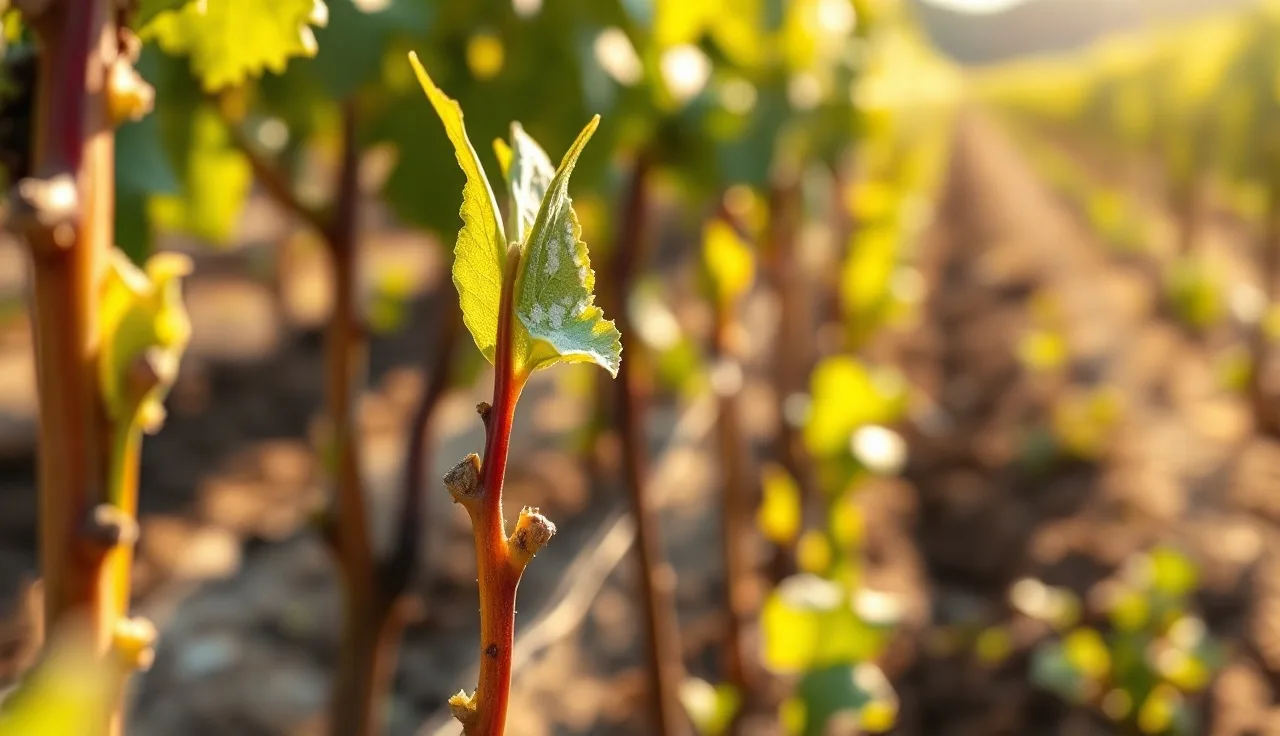
The first sign is subtle enough that experienced eyes still miss it. Young infected leaves develop a faint, dusty white or gray coating on either surface, most often the upper side of leaves that haven't fully expanded. The fungus, Erysiphe necator (called Uncinula necator in older literature), produces chains of barrel-shaped spores (conidia) in those white colonies, and that's the powder you're seeing.
On shoots, look for chlorotic (yellowed) patches that can look like a nutrient problem before the white sporulation shows. Infected berries in the earliest stages show faint bleaching or a net-like russeting on the skin. No white powder is visible on the berry itself until you look closely or the infection runs further. Flag tissue is the term for shoots emerging from overwintering flag shoots, which carry the primary inoculum from cleistothecia or internal mycelium. They can sporulate actively while the rest of the vineyard still looks clean [1].
Two things fool growers. First, grapevine powdery mildew doesn't produce the water-soaked lesions you see with downy mildew. It's a dry, obligate biotroph. Second, early berry infections can look almost like the natural bloom (waxy coating) the berry carries. Rub the tissue gently with your finger. If the white comes off and you see a discolored patch underneath, that's mildew.
When is the grapevine most susceptible to powdery mildew infection?
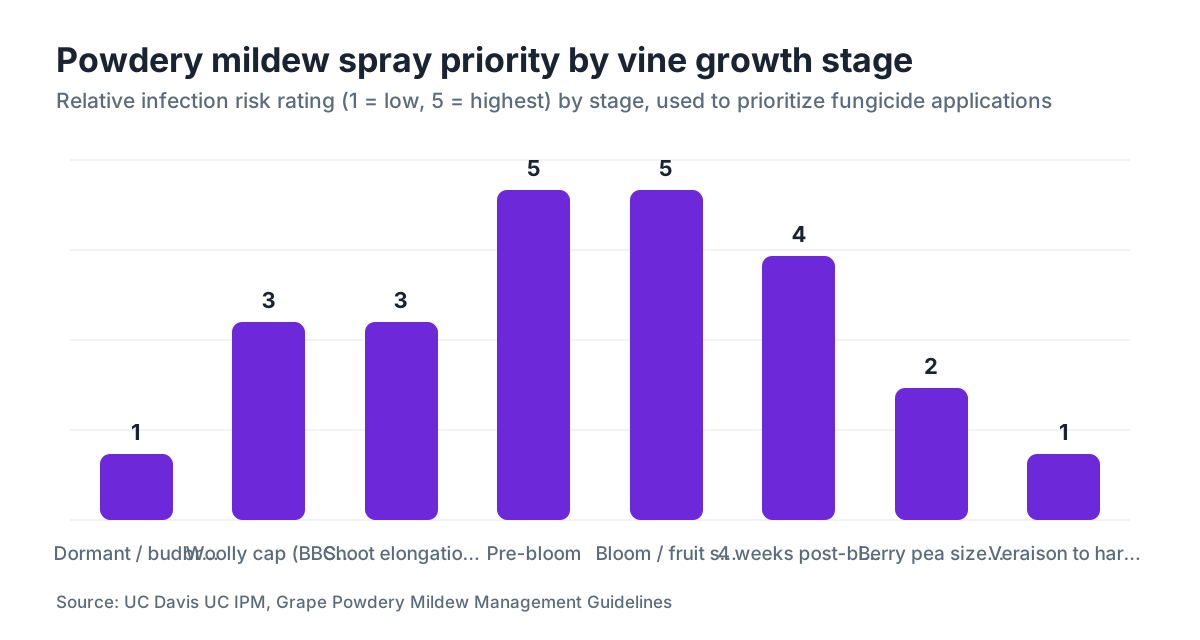
Susceptibility isn't uniform across the season. UC Davis research puts the highest-risk window from just before bloom through about three to four weeks after fruit set. Berries stay most susceptible from pre-bloom until roughly 4 weeks after bloom (about when berry diameter reaches 8-10 mm), after which the outer cell layers accumulate phenolics that slow fungal growth [1][9].
Shoot tissue is susceptible as long as it's actively growing, which in most California or Pacific Northwest vineyards means bud break through mid-summer. Once shoot growth slows and bark hardens, foliar infection risk drops sharply. Leaves are most susceptible when young, typically the first three weeks after they unfold.
Here's the timing takeaway. Your highest-value fungicide applications run from woolly cap stage (BBCH 05-07) through about 3-4 weeks post-bloom. That's non-negotiable. Everything applied before or after is risk management, not crop protection. Washington State University's spray guide puts the pre-bloom through 3-4 weeks post-bloom window in its highest-priority tier for every powdery mildew program [3].
What weather conditions trigger powdery mildew infections?
Powdery mildew is unusual among grape pathogens because it doesn't need free water to infect. It actually grows better in dry conditions with moderate humidity, one reason it thrives in inland California and much of the western wine country. The fungus infects across a broad temperature range, roughly 50°F to 95°F (10°C to 35°C), with an optimum of 68°F to 77°F (20°C to 25°C) [4].
The operational threshold comes from the UC Davis powdery mildew risk model: spore germination and infection can occur when temperatures stay above 50°F for 6 or more consecutive hours and daytime temperatures reach at least 70°F. Cool, wet stretches actually slow the fungus, since Erysiphe necator conidia are killed by direct rain and germination stops below about 50°F. Heavy dew and relative humidity above 40% help, but rain is not required.
Degree-day accumulation matters. UC Davis recommends starting fungicide applications when the vineyard accumulates 50 degree-days (base 50°F) after budbreak in a high-pressure region, or after first visible symptoms if pressure is low [1]. WSU uses a similar model tied to daily temperature and relative humidity [3]. Neither is perfect. They tell you when to scout harder, not when to skip scouting.
One field check: three or more consecutive days above 70°F without rain during bloom, and you almost certainly had an infection event. Pull leaves from the front of the canopy on the north or shaded side, which stays humid longer, and examine them closely.
How do you scout for powdery mildew before symptoms are obvious?
Good scouting starts before bud break. Check dormant canes and spurs for flag shoots in early spring, because those are the primary inoculum source. A flag shoot looks like a stunted, poorly developed shoot emerging 1-2 weeks ahead of normal shoots. It often lacks tendrils and has leaves that curl slightly inward [1].
Once the season is underway, a structured walk beats a casual look. Examine 10-15 shoots per block per sampling date, focusing on the third, fourth, and fifth leaves from the shoot tip, the youngest fully expanded leaves. Look at both leaf surfaces. Check cluster stems (rachis) from pre-bloom onward, because rachis infection is devastating and often overlooked. An infected rachis at bloom turns brown and brittle, and the whole cluster can shatter or fail to set properly.
Frequency beats method. Through the pre-bloom to post-fruit-set window, scout every 5-7 days. After canopy closure, every 7-10 days. Find even a single flag shoot or one sporulating colony, and you treat immediately, whatever your spray schedule says.
A quick number to act on: UC Davis extension recommends action if you find more than 1% of shoot terminals showing any powdery mildew symptoms before bloom, or more than 1% of clusters infected after bloom [9]. That threshold is very low, and deliberately so.
What fungicides work at the early stage and which ones fail?
The chemistry you reach for early matters a lot. Sulfur is cheap, effective, and has no resistance problems after decades of use. Elemental sulfur (dust and wettable formulations) kills conidia on contact and protects for about 7-10 days. The floor: do not apply sulfur above 90°F or you risk phytotoxicity, and do not apply within 14 days of an oil spray [2][3]. Sulfur works on the surface. It doesn't move systemically, so it can't clean up an established colony that has pushed hyphae into leaf tissue.
DMI fungicides (demethylation inhibitors, FRAC Group 3) are the workhorses for early-season systemic activity. Tebuconazole and myclobutanil move into plant tissue and can stop infections already started (a 72-96 hour kickback window). They're eradicant to a limited degree. The catch is resistance. DMI resistance in Erysiphe necator populations is documented in California, Oregon, and Washington, and Cornell's program has tracked shifts in the population since at least the early 2000s [5]. Rotating FRAC groups is not optional in high-pressure regions.
QoI fungicides (strobilurins, FRAC Group 11, such as azoxystrobin and trifloxystrobin) show strong activity against powdery mildew but face heavy resistance pressure. Use them no more than twice per season, always in a premix with a different FRAC group [3][5]. SDHI fungicides (FRAC Group 7) are a newer rotation option.
At the very early stage, a well-timed sulfur application on a 7-10 day schedule through bloom is often as good as expensive chemistry, provided you don't miss intervals. A missed application during bloom in a warm year costs you more than any product choice you'll make the rest of the season.
Kaolin clay products (Surround) work as a physical barrier in organic programs but give inconsistent results in high-pressure years. Potassium bicarbonate (Kaligreen, Armicarb) is another OMRI-listed option with moderate efficacy. Neither replaces sulfur in an organic program.
| Product class | FRAC group | Mode | Resistance risk | Temp limit |
|---|---|---|---|---|
| Elemental sulfur | M2 | Contact/protectant | Low | Do not use >90°F |
| Myclobutanil (Rally) | 3 (DMI) | Systemic, kickback | Moderate-high | None standard |
| Tebuconazole | 3 (DMI) | Systemic, kickback | Moderate-high | None standard |
| Azoxystrobin (Abound) | 11 (QoI) | Systemic | High (use in premix) | None standard |
| Trifloxystrobin + tebuconazole (Flint Extra) | 11+3 | Systemic | Moderate (premix) | None standard |
| Potassium bicarbonate | NC | Contact | Low | None standard |
| Kaolin clay | NC | Physical barrier | None | None standard |
How does powdery mildew spread from shoot to cluster in early season?
Understanding the disease cycle tells you exactly where your spray program can win. Erysiphe necator overwinters two ways: as chasmothecia (previously called cleistothecia) in bark crevices on the trunk and cordons, and as mycelium inside dormant primary buds [1][4]. The bud mycelium produces flag shoots, and those flag shoots sporulate heavily while most of the vine is still at 2-4 leaf stage.
Primary inoculum from flag shoots and chasmothecia releases conidia that wind carries to young expanding tissue. From there the fungus completes a full generation in as little as 5-7 days under optimal conditions. That means a single undetected colony at 5-leaf stage can throw off thousands of conidia that land on clusters right as they turn susceptible at pre-bloom.
The cluster stem (rachis) gets infected during bloom because it's young, succulent tissue. Once rachis infections take hold, fungal growth can move straight into developing berries from the point of attachment. That pathway is especially damaging because berries infected this way often don't show white sporulation on the outside until the internal damage is done.
This chain explains why every extension program (UC Davis, Cornell, WSU) tells you to treat the rachis as a target from pre-bloom onward, more than the leaf canopy.
What spray intervals and rates actually stop early infections?
The universal answer from extension programs is 7-10 days through the highest-risk window (pre-bloom through 4 weeks post-bloom), tightening to 7 days in warm, humid conditions or if you're behind. After that window, you can stretch to 10-14 days depending on local pressure and product choice.
Rates matter. Sulfur underdosing is the most common mistake. Wettable sulfur labels typically specify 3-10 lbs per acre depending on formulation. In high-pressure situations at bloom, use the high end of the label rate. Going low to save cost on a $15,000-per-acre crop is bad math.
Water volume and canopy penetration matter more than product choice on their own. UC Davis trial data consistently shows that thorough canopy penetration, getting spray to both sides of leaves and into the cluster zone, beats a premium product applied at too little volume [2]. Most California growers use 50-100 gallons per acre at full canopy. During pre-bloom, when the canopy is minimal, 25-40 gallons per acre can be enough.
Cornell's Integrated Pest Management program runs an online powdery mildew risk calculator that generates spray timing from daily temperature data. It's free and widely used in eastern grape regions [5]. UC Davis offers the UC IPM Grape Powdery Mildew Risk Index tool, also web-based [1].
If you keep spray records in a digital system, the links between application date, temperature accumulation, and scouting observations are exactly the data that makes your program defensible to a PCA or an auditor. VitiScribe captures that chain of scouting notes, spray applications, and REI/PHI compliance in one place, which helps when you're on a 7-day interval juggling multiple blocks.
How much yield loss can early powdery mildew cause if you miss it?
The range is wide and depends heavily on when infection hits and how long it runs unmanaged. UC Davis research and extension literature cite yield losses from 20% to as high as 80% in years with high disease pressure and poor spray coverage during bloom [1][2]. Losses at the severe end usually come when infection hits clusters between pre-bloom and two weeks post-bloom.
The indirect losses reach past the current season. Infected berries that don't shatter and stay on the vine cause juice quality problems (off-flavors, excess tannin from disrupted berry skin, reduced pH) that hurt wine quality regardless of yield. For premium wine grapes, a 20% yield loss in a high-value block can mean a six-figure hit per season.
Vine health takes a hit too. Heavy infection of shoot tissue and woody parts lets chasmothecia build up in bark over consecutive seasons, so a bad year without adequate management compounds into worse starting inoculum the following spring. Growers underweight that part when they decide to slack on late-season applications.
Nobody has clean published data on average economic loss per infected acre across the US wine grape industry, partly because losses swing so hard on variety, region, and management. The closest systematic look in the literature focuses on California coastal regions and puts the cost-benefit of a full sulfur program at roughly $200-400 per acre in product and application against potential losses of $1,000-10,000 per acre in premium wine grapes depending on price per ton [2].
Which grape varieties are most and least susceptible at early season?
Susceptibility is a spectrum, not a switch. Among widely grown wine varieties, the most susceptible include Chardonnay, Cabernet Franc, Merlot, and Zinfandel. Cabernet Sauvignon falls in the middle. Pinot Noir runs moderately to highly susceptible depending on clone and growing conditions [1][3].
Table grape varieties and some hybrid wine grapes show varying resistance. Varieties with Muscadinia rotundifolia genetics (muscadine grapes) carry natural resistance genes, and several university breeding programs have bred this into newer wine grape varieties. Cornell's breeding work, for example, produced Marquette, Frontenac, and Traminette with varying degrees of powdery mildew tolerance. These matter mainly in northeastern and midwestern US contexts where Vitis vinifera varieties face high disease pressure [5].
In practice, growing Chardonnay or Cab Franc in a warm, humid block means your spray program starts earlier and stays tighter than the block next door with a more tolerant variety. Variety susceptibility should drive block-by-block scheduling, not a single vineyard-wide calendar.
What are the worker protection and re-entry requirements for mildew sprays?
Every fungicide application in a commercial vineyard falls under EPA's Worker Protection Standard (WPS), 40 CFR Part 170, which covers agricultural workers and pesticide handlers [6]. The basics: post pesticide application information at a central location, train workers on WPS rights before they enter treated areas, and observe the REI (restricted-entry interval) for each product.
For common powdery mildew fungicides, REIs vary. Elemental sulfur carries a 24-hour REI under WPS. Myclobutanil (Rally) has a 24-hour REI. Azoxystrobin (Abound) is also 24 hours. Some products with more acute toxicity carry 48-72 hour REIs. Always check the label, which is the legal document.
PHI (pre-harvest interval) matters less for early-season sprays, but if you apply a DMI or QoI fungicide, know that most carry PHIs of 0-7 days for grapes. Sulfur is typically 0 days. The full label governs, and no product can be applied in a way inconsistent with its label under FIFRA.
California growers must report every commercial pesticide application to the county agricultural commissioner within the county's timeframe, generally within 30 days though some counties require 7 days [7]. That reporting applies to organic-approved materials including sulfur.
Track your applications: product name, EPA registration number, rate, water volume, block, date, applicator, REI, and PHI. That record is required. Paper spray logs work legally but create risk at audit time. A system that timestamps entries and links them to purchase records and scouting notes makes compliance reviewable at a glance. That's exactly what VitiScribe was built for.
How do you build a resistance management plan for powdery mildew?
Resistance in Erysiphe necator is real and documented. Cornell's research from 2011 and later years identified DMI-resistant populations across eastern and western US wine regions, with some isolates showing 10-fold reductions in sensitivity to myclobutanil [5]. The consequence is plain: a program built entirely on a single FRAC group will eventually fail, and in some California vineyards it already has.
A workable rotation moves through different FRAC groups across the season. Sulfur (FRAC M2) carries no resistance risk because it's a multi-site contact material. Use it as the backbone of your program, especially through early bloom, and rotate in one or two applications of a systemic FRAC 3, 7, or 11 product (always in a premix for Group 11) during the highest-risk period. WSU's spray guide gives a model FRAC rotation for Pacific Northwest growers [3].
Specific rules to follow:
- Apply no more than 2 applications of any FRAC Group 11 product per season.
- Alternate FRAC groups with each application when using systemics.
- Never use the same FRAC group for more than two consecutive applications.
- Do not apply a solo strobilurin (Group 11) if resistance is documented in your region.
Document which products you use in each block and the rotation sequence. If a certifier or a wholesale buyer requires integrated pest management records, you have to show you followed a FRAC rotation plan. That documentation starts in the spray record.
How is early powdery mildew managed differently in organic vs. conventional vineyards?
Organic programs have fewer tools but can hold adequate control with tight management. Sulfur is OMRI-listed and the primary organic workhorse. Potassium bicarbonate (Kaligreen, Armicarb) is OMRI-listed and gives some eradicant activity on colonies already established, though it's weaker against established infections than systemic conventionals. Copper fungicides (copper hydroxide, copper sulfate) have limited direct activity against powdery mildew but appear in some programs for other pathogens at the same time [2].
The practical difference: organic programs have no kickback option. Miss a spray interval during bloom and infection occurs, and no organic material with meaningful eradicant activity will clean it up. Spray interval discipline has to be tighter in organic programs, not looser.
Some organic growers in high-pressure regions run a 5-7 day sulfur interval through the most critical bloom window instead of the 10-day interval that might work conventionally. That raises per-acre sulfur costs and phytotoxicity risk on hot days, but it shrinks the exposure window for an uncovered infection event.
For farms transitioning to organic certification, the spray record from the conventional period is a required part of the certification application. USDA National Organic Program requirements apply [8].
Frequently asked questions
How early in the season does powdery mildew first appear on grapevines?
Flag shoots, the primary early-season source, can show active sporulation within the first 2-4 weeks after budbreak. That's often before most growers start any spray program. In warm regions like California's Central Valley, this can happen in late March or early April. The rule: start scouting at budbreak, not at bloom.
Can powdery mildew spread from infected grapes to neighboring vines quickly?
Yes. Conidia are wind-dispersed and light. Under optimal conditions, a single sporulating colony produces enough spores to infect susceptible tissue 20-30 feet away within hours. A flag shoot in one vine can seed an entire block during warm, breezy weather. Early removal of flag shoots is worth doing even if you can't spray right away.
What temperature kills powdery mildew spores on grapevines?
Temperatures above 95°F (35°C) inhibit spore germination, and sustained temperatures above 100°F can kill surface conidia. But the fungal mycelium inside plant tissue survives heat events that kill surface spores. Don't count on hot weather to solve an established infection. Rain is also lethal to conidia on contact.
Is it too late to spray if I already see white powder on leaves?
Not necessarily, but your goals change. Once visible sporulation is present, protectant-only products like sulfur slow further spread but won't clean up the existing colony. A systemic DMI fungicide (myclobutanil, tebuconazole) used within its eradicant window (72-96 hours after infection) can stop established but very new infections. Apply immediately and increase scouting frequency.
Does powdery mildew overwinter in the vineyard and come back every year?
Yes. Erysiphe necator overwinters as chasmothecia in bark on the trunk and cordons, and as internal mycelium in dormant primary buds. That internal bud mycelium produces flag shoots the following spring. Dormant-season trunk sanitation (removing loose bark, improving spray coverage on permanent wood with delayed-dormant copper or lime sulfur) reduces overwintering inoculum but doesn't eliminate it.
What is the difference between grape powdery mildew and downy mildew at early stage?
They look and behave differently. Powdery mildew produces a dry, white, superficial mycelium on the upper leaf surface and does not require free water to infect. Downy mildew (Plasmopara viticola) causes oily, angular, yellow lesions on the upper leaf and white downy sporulation on the underside, and it requires free water and temperatures between 50-85°F to infect. A quick check: flip the leaf. White fuzz underneath is downy mildew.
How do I know if my spray program is actually working during early season?
Keep a consistent scouting record with percent infected shoots and clusters per block per date. If the incidence rate is stable or declining after your first two applications, the program is working. If incidence climbs despite spray coverage, you have a timing or coverage problem, or resistance to your chemistry. Switching FRAC groups while improving coverage is the first step.
What spray coverage is needed to protect clusters from early powdery mildew?
You need fungicide to reach the cluster zone, more than the leaf canopy. At pre-bloom, when the canopy is minimal, 25-40 gallons per acre is often adequate. At bloom with a developing canopy, 50-75 gallons per acre is more realistic. UC Davis trial data shows coverage quality (reaching both leaf surfaces and rachis) matters more than product selection alone.
Can high humidity alone cause powdery mildew even without rain?
Somewhat. Powdery mildew is unusual because it doesn't need free water. Relative humidity above 40% supports spore germination, and humid nights extend the surface moisture window that helps conidia germinate. Prolonged fog or marine layer conditions without rain can favor disease. Rain is actually mildly suppressive, since it washes conidia off surfaces.
How do I record powdery mildew spray applications to stay compliant in California?
California requires all commercial pesticide applications to be reported to the county agricultural commissioner. Required fields include product name, EPA registration number, date, location (legal description or GPS block ID), acres treated, rate, total amount applied, and applicator license number. The California Department of Pesticide Regulation sets the reporting format. County-specific submission deadlines vary, so check with your local ag commissioner's office.
What is the economic cost of a powdery mildew spray program per acre?
A full-season sulfur-based conventional program runs roughly $200-400 per acre in materials and application labor, based on UC Davis extension estimates. An organic sulfur-only program at tighter intervals can hit $300-500 per acre. Against premium wine grape values of $2,000-10,000+ per ton, even a partial yield loss from uncontrolled early infection exceeds the cost of a full spray program many times over.
Should I use a degree-day model or calendar intervals for powdery mildew timing?
Degree-day models are more accurate because they account for the temperature-driven nature of fungal development. UC Davis recommends beginning the first fungicide application at 50 degree-days (base 50°F) after budbreak in high-pressure regions. Calendar intervals give you a rough schedule but can leave gaps during warm springs. Use a model to set your first application, then hold a 7-10 day calendar interval through bloom.
Can I use neem oil or bicarbonate sprays instead of sulfur for early stage powdery mildew?
Potassium bicarbonate and neem oil are OMRI-listed options with some efficacy. Potassium bicarbonate works best as an early eradicant on small colonies. Neem oil has limited published trial data specifically on Erysiphe necator on grapevines and should be used cautiously. Avoid application near bloom due to bee concerns and check the label for phytotoxicity risk. Neither replaces sulfur's track record or cost in an organic program.
Sources
- UC Davis UC IPM, Grape Powdery Mildew Management Guidelines: Flag shoots as primary inoculum source, berry susceptibility window, 50 degree-day threshold for spray initiation, and 20-80% yield loss range
- UC Davis Division of Agriculture and Natural Resources, Grape Pest Management Publication 3343: Sulfur as primary material, canopy penetration importance, cost-benefit of spray programs in premium wine grapes, organic management approaches
- Washington State University Extension, Pacific Northwest Pest Management Handbooks - Grape: Pre-bloom through 4 weeks post-bloom as highest-priority spray window, FRAC rotation guidelines, QoI resistance risk, sulfur temperature limits
- APS (American Phytopathological Society), Compendium of Grape Diseases, Disorders, and Pests: Erysiphe necator biology, temperature range for infection (50-95°F), optimal infection temperatures 68-77°F, overwintering mechanisms
- Cornell University Integrated Pest Management Program, New York and Pennsylvania Pest Management Guidelines for Grapes: DMI resistance in eastern and western US Erysiphe necator populations documented from early 2000s, FRAC rotation model, resistance management guidelines, powdery mildew risk calculator
- US EPA, Worker Protection Standard 40 CFR Part 170: WPS requirements for REI posting, worker training, and agricultural handler protections for all pesticide applications including fungicides
- California Department of Pesticide Regulation, Pesticide Use Reporting: California requirement to report all commercial pesticide applications to county agricultural commissioner, required data fields
- USDA National Organic Program, Organic Regulations 7 CFR Part 205: NOP requirements for spray records and prohibited materials during organic certification transition
- UC Davis Plant Pathology, Gubler et al., Powdery Mildew of Grape, Plant Disease 1999: Berry susceptibility ending at approximately 8-10mm diameter, 1% incidence action threshold, rachis as critical infection site during bloom
Last updated 2026-07-09