Potassium bicarbonate for powdery and downy mildew on grapes
TL;DR
- Potassium bicarbonate is an OMRI-listed contact fungicide that kills powdery mildew spores on contact by disrupting cell pH, giving 7 to 10 days of residual protection at 2 to 4 lb/acre.
- It has weak efficacy against downy mildew and works best when rotated with other modes of action.
- It's cheap, low-toxicity, and fits organic programs.
What does potassium bicarbonate actually do to mildew on grape vines?
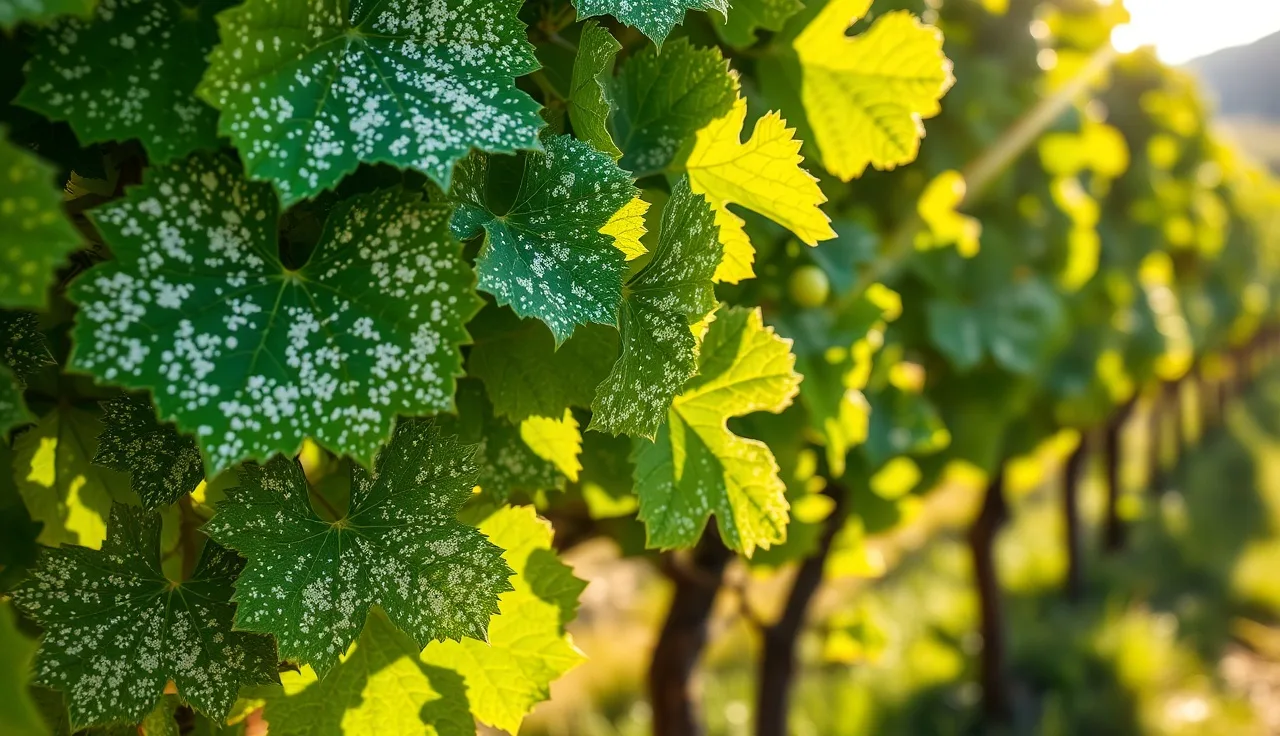
Potassium bicarbonate (KHCO3) kills powdery mildew fungi by doing two things at once. When the spray dries on the leaf surface, the salt absorbs moisture from fungal cells through osmosis, collapsing them. It also raises the pH on the leaf surface to around 8 to 9, which is lethal to the obligate biotroph Erysiphe necator (syn. Uncinula necator) that causes grape powdery mildew [1]. The result is a contact kill of existing colonies, not a protectant film waiting for new spores.
That contact mode matters a lot in practice. If you have open colonies, potassium bicarbonate is one of the few materials that will actually knock them back. Sulfur does the same thing but can volatilize above 90°F and cause phytotoxicity; potassium bicarbonate doesn't carry that heat threshold risk, which makes it useful during warm summer sprays [2].
The downy mildew story is different. Downy mildew on grapes is caused by Plasmopara viticola, an oomycete, not a true fungus. Oomycetes have a different cell-wall chemistry (cellulose rather than chitin), so potassium bicarbonate's osmotic mechanism is much weaker against them. You'll see a few studies and extension guides list it as having "some activity" against downy mildew, but nobody has good data showing it as a reliable standalone treatment. Use it for powdery mildew; reach for copper or phosphonate materials for downy [3].
Is potassium bicarbonate approved for organic grape growing?
Yes. Potassium bicarbonate is on the OMRI (Organic Materials Review Institute) Listed Products list and is allowed under the USDA National Organic Program (NOP) regulations at 7 CFR Part 205 [4]. Several commercial formulations, including Kaligreen, Milstop, and BiCarb (Omar brand), carry OMRI certification. If you're transitioning to organic or running a certified organic vineyard, this is one of the safer fungicide choices available because it leaves no synthetic residues and breaks down rapidly into water and CO2.
One administrative note: OMRI listing on the product label doesn't automatically mean your certifier will accept it without question. Some certifiers want documentation showing the specific lot formulation. Keep the product label and safety data sheet in your spray records. For California operations, the California Department of Food and Agriculture's organic program follows the same NOP standard [5].
For conventional growers, potassium bicarbonate is also a good rotational partner. It has a different mode of action from DMI fungicides (Group 3) and strobilurin fungicides (Group 11), which helps resistance management in programs where those chemistries are already heavy.
What are the correct application rates and timing for grapes?
Most university extension sources put the field rate at 2.0 to 4.0 lb active ingredient per acre per application, mixed in 50 to 150 gallons of water depending on canopy size [2]. Cornell's integrated pest management program recommends the higher end of that range, around 3 to 4 lb/acre, when disease pressure is moderate to high and colonies are already visible [6]. WSU's viticulture extension pegs effective rates similarly, noting that reducing below 2 lb/acre often drops efficacy below useful levels [7].
Timing is where most growers go wrong. Potassium bicarbonate is a contact material with roughly 7 to 10 days of residual activity under field conditions. That means spray intervals need to be tight during the high-risk window: shoot growth from 3 inches through veraison, roughly May through early August in most northern-hemisphere wine regions. During that window, a 10 to 14 day interval is the standard for any powdery mildew program; potassium bicarbonate fits that interval but doesn't stretch further [1].
The highest-value spray timing is pre-bloom through 3 to 4 weeks post-bloom. That's when young tissue is most susceptible and when berry infection sets up the cluster rot you'll deal with at harvest. If you're going to spend money on potassium bicarbonate, concentrate applications in that window. Late-season sprays on mature berries have lower payoff unless you're seeing active mildew pressure.
| Growth stage | Risk level | Recommended interval |
|---|---|---|
| Bud break to 3-in shoot | Low | Every 14 days if needed |
| 3-in shoot to pre-bloom | Moderate-High | Every 10 to 14 days |
| Pre-bloom to fruit set | High | Every 7 to 10 days |
| Fruit set to veraison | Moderate | Every 10 to 14 days |
| Post-veraison | Low-Moderate | Every 14 days or less |
Source: Cornell CALS Pest Management Guidelines, Grapes, 2023 [6]
How does potassium bicarbonate compare to sulfur and copper for mildew control?
Here's the comparison most growers actually need, laid out straight.
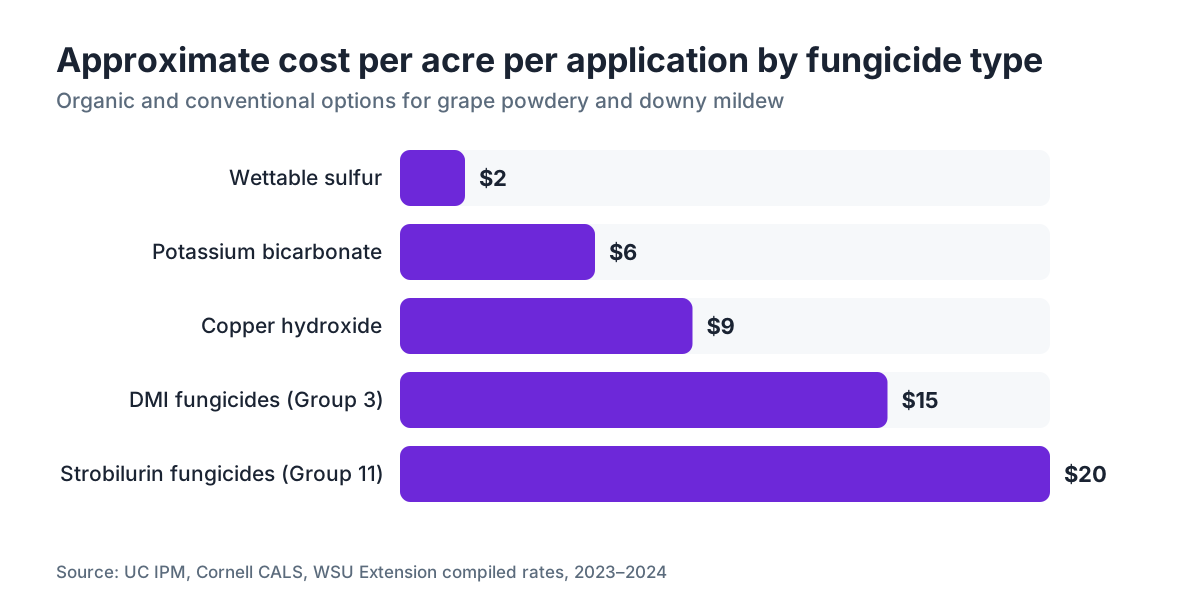
Against powdery mildew, potassium bicarbonate and sulfur are roughly comparable in efficacy when applied at correct rates and intervals. A trial published in Plant Disease comparing several low-toxicity fungicides found potassium bicarbonate formulations gave disease control statistically similar to wettable sulfur in multiple years [8]. Sulfur has the advantage of being very cheap, around $1 to 3 per acre per application at typical field rates, while potassium bicarbonate products run $4 to 8 per acre depending on formulation and source. Sulfur wins on cost. Potassium bicarbonate wins on heat safety and sulfur-sensitive variety suitability (some varieties like Concord and Riesling can show sulfur phytotoxicity at warm temperatures).
Copper is the primary tool for downy mildew in organic programs. Copper hydroxide and copper sulfate products are OMRI-listed and carry well-documented efficacy against Plasmopara viticola, with EPA registration and extensive university trial data behind them [3]. Potassium bicarbonate does not substitute for copper here.
For conventional growers, the DMI fungicides (tebuconazole, myclobutanil, trifloxystrobin in group 11) carry systemic, protectant, and kickback activity that potassium bicarbonate simply doesn't have. The practical role of potassium bicarbonate in conventional programs is as a rotation partner to manage resistance, not as the anchor product.
| Material | Powdery PM efficacy | Downy PM efficacy | Organic? | Heat risk | Approx cost/acre/app |
|---|---|---|---|---|---|
| Potassium bicarbonate | Good (contact) | Poor | Yes | Low | $4 to 8 |
| Wettable sulfur | Good (contact) | Poor | Yes | Above 90°F | $1 to 3 |
| Copper hydroxide | Poor | Good | Yes | Low | $6 to 12 |
| DMI fungicides | Excellent (systemic) | None | No | Low | $10 to 20 |
| Strobilurins (Qo) | Good (systemic) | Good (some) | No | Low | $15 to 25 |
Sources: UC IPM, Cornell CALS, WSU Extension [1][2][6][7]
Can you tank-mix potassium bicarbonate with other vineyard sprays?
This is where you have to be careful. Potassium bicarbonate is strongly alkaline in solution, typically pH 8.0 to 9.5 depending on concentration, and that pH will degrade acid-sensitive pesticides mixed in the same tank [2].
Do not mix potassium bicarbonate with organophosphate insecticides (alkaline hydrolysis degrades them quickly), most copper formulations (the alkalinity can cause salt formation and reduce copper efficacy), or captan (which hydrolyzes rapidly above pH 7). UC IPM explicitly warns against mixing potassium bicarbonate with copper-based materials in the same tank [1].
Compatible partners in most formulation guides include neem oil, kaolin clay, and most spray adjuvants. If you're using a sticker-spreader, pick a non-ionic surfactant and test the combination in a small jar before you fill the tank. Adding a spreader-sticker at 0.25 to 0.5% v/v is generally recommended because potassium bicarbonate on its own has low surface tension retention on waxy berry surfaces.
Always check the product label. That's not a throwaway disclaimer; the label is the legal document for that product's use, and tank-mix compatibility notes vary by formulation.
What worker safety rules apply when spraying potassium bicarbonate in vineyards?
Potassium bicarbonate has a low acute toxicity profile. The EPA classifies most registered formulations in Toxicity Category III or IV (the two least hazardous categories), meaning signal words are CAUTION or no signal word [9]. That's a meaningful difference from captan or myclobutanil from an exposure-risk standpoint.
That said, EPA's Worker Protection Standard (WPS) at 40 CFR Part 170 still applies to any pesticide applied on an agricultural establishment where workers are employed [9]. WPS requirements include: posting of treated areas, providing workers with pesticide safety information, and ensuring access to decontamination supplies. The restricted entry interval (REI) for potassium bicarbonate products is typically 4 hours, though you should verify on your specific product label because formulations vary.
For California growers, the California Department of Pesticide Regulation (CDPR) requires a pesticide use report (PUR) for any registered pesticide application, including OMRI-listed materials [5]. This is one area where thorough spray records matter practically, more than for certification audits. A vineyard compliance platform like VitiScribe can generate WPS posting records and PUR-ready spray logs automatically, which saves meaningful time at the end of the season when you're pulling together documentation.
Personal protective equipment for mixing and loading: eye protection and chemical-resistant gloves are standard for any dry or liquid pesticide concentrate, even low-toxicity ones. The alkalinity of the concentrated material can irritate eyes and skin.
How do you build a resistance management program with potassium bicarbonate?
Potassium bicarbonate doesn't carry a traditional FRAC (Fungicide Resistance Action Committee) group number the way synthetic fungicides do because its mode of action is physical/osmotic rather than biochemical [10]. That means E. necator populations are very unlikely to evolve meaningful resistance to it, which is exactly why it's a good rotation partner for chemistries that do carry resistance risk.
The resistance risk in grape powdery mildew programs is real and documented. Strobilurin (Group 11) resistance in E. necator has been confirmed in multiple California wine regions, and DMI fungicide (Group 3) resistance is a recurring problem in the Pacific Northwest [7]. FRAC guidelines recommend no more than 2 to 3 consecutive applications of any single mode-of-action group per season, then rotating to a different group [10].
A practical rotation in an organic program might look like this: potassium bicarbonate at 7 to 10 days, followed by sulfur at 7 to 10 days, back to potassium bicarbonate. In a conventional program you might anchor the pre-bloom window with a DMI fungicide, then rotate to potassium bicarbonate or sulfur for two applications in the summer heat window, then return to a strobilurin in the late-season wrap-up. The exact rotation depends on your resistance history, variety susceptibility, and regional pressure.
WSU Extension's wine grape production guide has specific rotation schemas for Pacific Northwest conditions that are worth downloading as a starting point [7]. Cornell CALS has comparable guidance for the East [6].
Does potassium bicarbonate have pre-harvest interval restrictions on wine grapes?
Most registered potassium bicarbonate products have a pre-harvest interval (PHI) of 0 days, meaning they can legally be applied up to harvest [2]. That's a practical advantage late in the season when you're trying to suppress a late powdery mildew push without adding residue concerns.
However, 0-day PHI doesn't mean zero consequence. Applying any salt-based material within 2 to 3 weeks of harvest on mature berries can affect must chemistry. Potassium bicarbonate raises must potassium content, which affects titratable acidity and potentially pH in the finished wine. A few studies have found measurable potassium elevation in grapes sprayed close to harvest, with one California trial showing must K increases of 100 to 200 mg/L in plots receiving late-season potassium bicarbonate applications compared to control plots [8]. That's not dramatic, but if your target is a high-acid white wine and you're already fighting potassium management, you'll want to think about timing.
For export markets, check the maximum residue limits (MRLs) in your target countries. The EU and Japanese MRL systems include potassium bicarbonate in their reviewed compounds, and levels are generally set generously given the material's low toxicity, but the specific numbers change and your importer should confirm current MRLs before you lock in a late-season spray program.
What do university trials actually show about potassium bicarbonate on wine grapes?
The honest summary: potassium bicarbonate works well for powdery mildew, performs consistently across multiple university trials, and doesn't work meaningfully for downy mildew.
UC Davis and UC Cooperative Extension have the most extensive California trial data. Their IPM program cites potassium bicarbonate as an effective powdery mildew material with a 3-year trial dataset showing 70 to 85% reduction in disease severity at labeled rates, comparable to sulfur when both were applied on 10-day intervals [1]. Cornell's data from New York wine regions is consistent with those numbers, though efficacy dropped in seasons with high humidity and frequent rain events, conditions that favor washing off the contact residue faster [6].
WSU Extension's work in Washington state found potassium bicarbonate most effective in hot, dry conditions where sulfur phytotoxicity risk is elevated, essentially filling the gap that sulfur leaves in July and August in Eastern Washington [7]. In cooler, wetter western Washington and Oregon coast conditions, the contact material gets washed off frequently enough that efficacy was less predictable.
The one consistent finding across all university programs: potassium bicarbonate works better when disease pressure is low to moderate. Once you have severe, established powdery mildew colonies, potassium bicarbonate alone won't pull you back. You need to be ahead of the pressure, not chasing it.
How do you record potassium bicarbonate applications to meet compliance requirements?
Every state that requires a pesticide use report (PUR) needs the same core data regardless of whether the material is OMRI-listed: product name, EPA registration number, application date and time, field location, acres treated, amount of product applied, applicator name and license number (if required in your state), and REI posting documentation [5][9].
For California growers, CDPR requires PURs to be filed monthly, with reports due within 30 days of the end of each month. Organic growers often assume they're exempt; they're not. OMRI-listed pesticides applied on commercial operations still trigger the reporting requirement.
For multi-block or multi-commodity operations, keeping a digital spray log with block-level records makes annual summary reports much faster to generate. This is exactly what VitiScribe is built to handle, connecting block maps to product records and producing PUR-ready outputs. If you're doing this in spreadsheets, at minimum set up a template with the required fields pre-labeled so nothing gets missed at record entry.
WPS documentation is separate from PUR reporting. You need records showing workers received pesticide safety training, that treated areas were posted, and that decontamination supplies were available during and after applications. Those records need to be kept on file for 2 years under federal WPS rules [9].
What are the most common application mistakes growers make with potassium bicarbonate?
The biggest mistake is under-coverage. Potassium bicarbonate is a contact material, which means it has to physically reach the powdery mildew colonies to work. Dense canopies in mid-summer, the exact time you most need coverage, are the worst enemy. Growers who dial back water volume to save time are leaving significant disease control on the table. Target 75 to 100 gallons per acre in a moderately open canopy and 100 to 150 gallons in a denser, bilateral cordon situation [2].
The second mistake is late starts. By the time you can see powdery mildew colonies with the naked eye, you're weeks behind where the spray program should have started. The pathogen's latent period is 7 to 10 days at typical summer temperatures, meaning what you see today was infected 1 to 2 spray intervals ago. Start spraying on a calendar schedule based on shoot development, not on visible symptoms.
Third is mixing errors. Growers mixing potassium bicarbonate with copper in the same tank either don't know about the incompatibility or are trying to cover both diseases in one pass. Understandable, but it's costing them efficacy on both materials. If you need copper and potassium bicarbonate applied on the same day, apply them in separate passes or in separate tank mixes.
Fourth is interval creep. When you're busy during harvest prep or cover crop seeding, spray intervals stretch from 10 days to 14 to 18. With a contact material on a fast-cycling pathogen, that gap often lets a fresh generation of spores establish before the next spray arrives.
Frequently asked questions
Is potassium bicarbonate effective against downy mildew on grapes?
No, not reliably. Potassium bicarbonate has limited activity against Plasmopara viticola, the oomycete that causes downy mildew, because its osmotic kill mechanism works poorly against oomycete cell walls. University extension programs at UC Davis and Cornell list copper-based fungicides as the primary organic tool for downy mildew control. Use potassium bicarbonate for powdery mildew and pair it with copper for downy mildew in the same program.
What is the best potassium bicarbonate product for vineyards?
Milstop and Kaligreen are the two most widely used OMRI-listed potassium bicarbonate formulations in commercial vineyards. Both are wettable powder formulations with EPA registration and strong university trial data behind them. The functional difference between brands is minor; price and availability from your local ag supplier usually drives the choice. Always verify the current OMRI listing status on the product label before applying on a certified organic operation.
How often should I spray potassium bicarbonate for grape powdery mildew?
Every 7 to 10 days during high-risk periods (pre-bloom through 4 weeks post-fruit set) and every 10 to 14 days during moderate-risk periods. Potassium bicarbonate has roughly 7 to 10 days of contact residual under field conditions, so intervals longer than that leave a gap in protection. Cornell and UC IPM both recommend tighter intervals in wet or high-humidity conditions that can wash the material off faster.
Can I use potassium bicarbonate on organic wine grapes?
Yes. Potassium bicarbonate is OMRI-listed and allowed under USDA NOP regulations at 7 CFR Part 205. Several commercial formulations carry OMRI certification. Keep the product label and lot documentation in your spray records, as certifiers may request it. California operations must still file pesticide use reports with CDPR even for OMRI-listed materials applied on commercial farms.
Does potassium bicarbonate leave residues on wine grapes that affect the wine?
Late-season applications can raise must potassium levels. One California trial found must potassium increases of roughly 100 to 200 mg/L in plots sprayed close to harvest versus unsprayed controls. Elevated potassium can lower titratable acidity and raise must pH, which matters most for high-acid white varieties. The formal pre-harvest interval on most registered products is 0 days, but late applications within 2 to 3 weeks of harvest are worth evaluating against your winemaking targets.
What is the EPA signal word for potassium bicarbonate fungicides?
Most registered potassium bicarbonate products carry the signal word CAUTION or no signal word, placing them in EPA Toxicity Category III or IV, the two least hazardous categories. This is meaningfully lower-risk than many conventional fungicides. Federal WPS rules under 40 CFR Part 170 still apply to any pesticide application on farms with agricultural workers, including REI posting and decontamination supply requirements.
What should I not mix with potassium bicarbonate in a spray tank?
Avoid mixing potassium bicarbonate with copper-based fungicides, organophosphate insecticides, or captan. The strongly alkaline pH of a potassium bicarbonate solution (typically 8 to 9.5) degrades organophosphates through hydrolysis and can reduce copper efficacy through salt formation. UC IPM specifically warns against copper-potassium bicarbonate tank mixes. Always do a jar test with any new combination before filling a full tank.
How does potassium bicarbonate work against powdery mildew at the cellular level?
Potassium bicarbonate kills Erysiphe necator through two mechanisms. The high salt concentration draws water out of fungal cells through osmosis, collapsing them. It also raises leaf surface pH to 8 to 9, which is outside the viable range for E. necator growth and reproduction. Both effects work on contact, meaning the spray must reach existing colonies to work. There is no systemic movement through plant tissue.
Does potassium bicarbonate have a FRAC resistance risk number?
No. FRAC does not assign a group number to potassium bicarbonate because its mode of action is physical and osmotic rather than a specific biochemical target site. This is a practical advantage: resistance evolution in E. necator to potassium bicarbonate is considered very unlikely, making it a safe rotation partner for Group 3 DMI and Group 11 strobilurin fungicides where resistance has been confirmed in California and Pacific Northwest vineyards.
What records do I need to keep after applying potassium bicarbonate in California?
California growers must file a Pesticide Use Report (PUR) with CDPR within 30 days of each month's end, covering the product name, EPA registration number, date, location, acres treated, and applicator information, even for OMRI-listed materials. Under federal WPS rules, you also need records showing REI posting, worker safety training, and decontamination supply availability, kept for 2 years minimum. Spray logs that capture all these fields at the point of application save significant time at reporting deadlines.
Is sulfur or potassium bicarbonate better for organic grape powdery mildew control?
Sulfur is cheaper, around $1 to 3 per acre per application versus $4 to 8 for potassium bicarbonate, and has equal or slightly better efficacy in most university trials. Potassium bicarbonate is better when temperatures exceed 90°F, which is when sulfur risks phytotoxicity, and on sulfur-sensitive varieties like Riesling or Concord. Most experienced organic growers use both: sulfur as the primary material, potassium bicarbonate for hot-weather windows and as a rotation partner.
At what growth stage should I start a potassium bicarbonate program on grapes?
Start no later than the 3-inch shoot growth stage, and earlier if you have a history of early-season powdery mildew. The pre-bloom through 4-weeks-post-fruit-set window carries the highest infection risk, and young tissue is most susceptible. Starting on a calendar-based schedule tied to shoot development is more reliable than waiting for visible symptoms, which appear only after the latent period of 7 to 10 days post-infection.
Does rain or irrigation wash potassium bicarbonate off grape leaves?
Yes. Potassium bicarbonate is water-soluble and washes off with rain or overhead irrigation. Its residual contact activity drops substantially after even moderate rainfall. Using a non-ionic sticker-spreader adjuvant at 0.25 to 0.5% v/v improves surface retention. In high-rainfall regions like eastern New York or the Oregon coast, the short residual life of contact materials makes them less predictable and tighter spray intervals or different product choices become more important.
Sources
- UC IPM, University of California, Grape Powdery Mildew Management Guidelines: Potassium bicarbonate efficacy against Erysiphe necator, incompatibility with copper tank mixes, and 70 to 85% disease severity reduction in California trials
- UC Cooperative Extension, Potassium Bicarbonate for Disease Management in Organic Vineyards: Application rates of 2 to 4 lb/acre, water volume 50 to 150 gal/acre, 0-day PHI, alkaline pH and tank-mix cautions
- UC IPM, University of California, Grape Downy Mildew Management Guidelines: Copper fungicides as primary organic tool for Plasmopara viticola; potassium bicarbonate not listed as effective against downy mildew
- USDA Agricultural Marketing Service, National Organic Program, 7 CFR Part 205: Potassium bicarbonate is allowed as a plant disease control material under the National Organic Program
- California Department of Pesticide Regulation (CDPR), Pesticide Use Reporting: All registered pesticides, including OMRI-listed materials, require monthly pesticide use reports filed within 30 days of month end
- Cornell CALS, Pest Management Guidelines for Grapes, 2023: Recommended rates of 3 to 4 lb/acre at moderate to high pressure, spray timing table by growth stage, 10-day intervals pre-bloom to fruit set
- Washington State University Extension, Wine Grape Production Guide for Eastern Washington: Potassium bicarbonate most effective in hot dry conditions where sulfur phytotoxicity risk is elevated; confirmed strobilurin resistance in Pacific Northwest E. necator populations
- Plant Disease, APS Journals, Comparative Efficacy of Low-Toxicity Fungicides for Grape Powdery Mildew: Potassium bicarbonate gave disease control statistically similar to wettable sulfur; must potassium increases of 100 to 200 mg/L in late-season application plots
- US EPA, Worker Protection Standard, 40 CFR Part 170: WPS requirements for REI posting, worker training, decontamination supplies, and 2-year record retention apply to all pesticide applications on agricultural establishments
- FRAC, Fungicide Resistance Action Committee, FRAC Code List 2024: Potassium bicarbonate does not carry a FRAC group number due to its physical/osmotic mode of action; Group 3 DMI and Group 11 strobilurin resistance confirmed in E. necator
Last updated 2026-07-10