How to prepare vineyard records for a third-party sustainability audit

TL;DR
- Most third-party vineyard sustainability audits, including SIP Certified, LODI RULES, and California Certified Sustainable, want two to three years of spray records, water use logs, soil health data, and worker safety documentation.
- Organizing these into a single folder structure before the auditor shows up saves the most time.
- This guide walks you through exactly what to pull and how to format it.
What does a third-party vineyard sustainability audit actually look at?
An auditor's job is to verify claims with paper, not conversation. They're checking whether what you say you do matches what your records show you did. Scope varies by program, but the core categories are nearly identical across SIP Certified, LODI RULES, and the California Sustainable Winegrowing Alliance (CSWA) framework: pesticide and spray records, water use and irrigation logs, soil health practices, energy and fuel use, worker health and safety compliance, and habitat or biodiversity documentation.
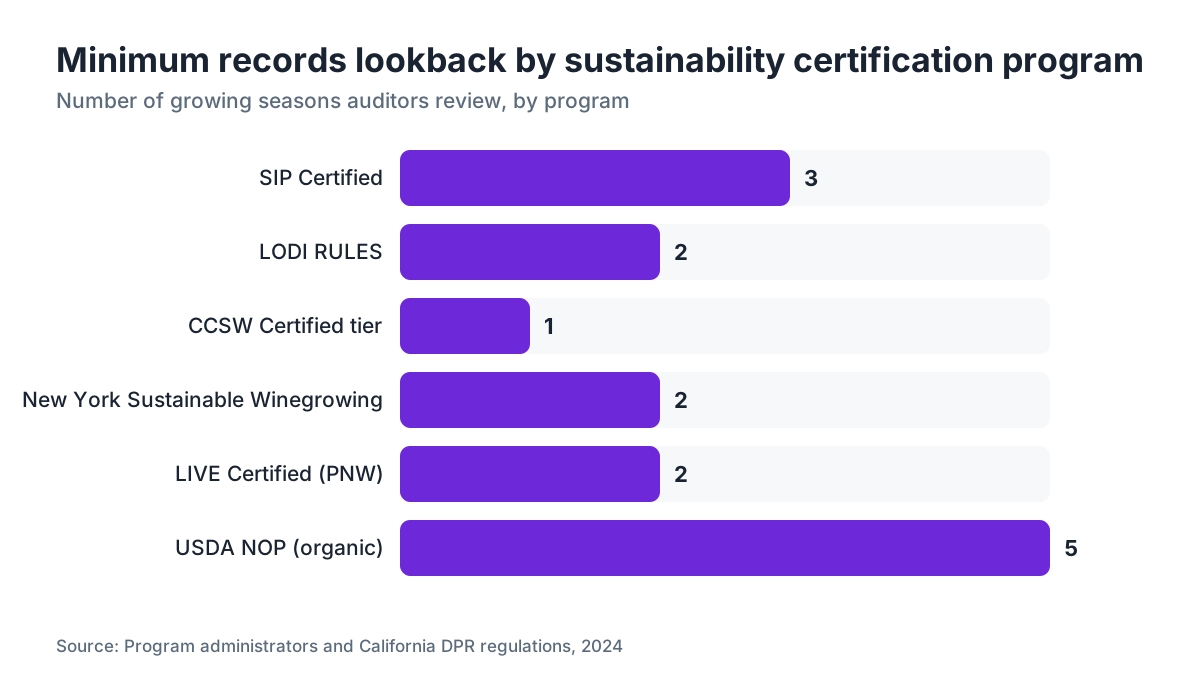
Most programs score you on a rubric, so missing records in one category won't automatically disqualify you. They lower your score and can flag you for a follow-up audit. Auditors usually look back two to three growing seasons. If your audit is scheduled for fall 2025, expect questions covering at minimum 2023 and 2024. Some programs want only the current season for specific categories like restricted material use reports.
Here's the thing growers underestimate. An auditor isn't just confirming that records exist. They're checking that records are complete and internally consistent. A spray log that names the pesticide but omits the application rate, weather conditions, or applicator name gets flagged. That's not a technicality. That's the whole point of the audit. [1]
Which sustainability certification programs are most common in U.S. vineyards?
The three programs you'll run into most often on the West Coast are SIP Certified (Sustainability in Practice), run out of Paso Robles [2]; LODI RULES, specific to the Lodi wine region and managed by the Lodi Winegrape Commission [3]; and the California Sustainable Winegrowing Alliance's Certified California Sustainable Winegrowing (CCSW) program. In Washington, the Washington State Wine Commission supports participation in the Low Input Viticulture and Enology (LIVE) program and SCS Global's certification. In New York, the New York Sustainable Winegrowing (NYSW) program, developed with Cornell Cooperative Extension, has grown steadily since its launch. [4]
These programs differ mainly in scoring weights, not in the fundamental categories of evidence they require. SIP Certified uses a third-party auditor from an accredited body and requires an on-site visit. LODI RULES uses certified third-party verifiers who review both documentation and field conditions. CCSW is a self-assessment program with a Certified tier that requires third-party verification.
If you export to Europe or sell to EU buyers, you may also run into GlobalG.A.P., which has a produce safety and sustainability standard for wine grapes. That one gets more granular on traceability and requires a documented Integrated Pest Management (IPM) plan as a precondition.
| Program | Geographic focus | Third-party required? | Records lookback |
|---|---|---|---|
| SIP Certified | California (primarily Central Coast) | Yes, accredited auditor | 2-3 seasons |
| LODI RULES | Lodi AVA, CA | Yes, certified verifier | Current + prior season |
| CCSW (Certified tier) | California statewide | Yes | Current season |
| New York Sustainable Winegrowing | New York | Yes | 2 seasons |
| LIVE Certified | Pacific Northwest | Yes, third-party | 2 seasons |
| GlobalG.A.P. | International | Yes | 1 year minimum |
Check with your program administrator every year. Audit criteria get updated, and what counted as adequate documentation in 2022 may not meet current standards. [5]
How far in advance should you start pulling records together?
Ninety days. That's the minimum buffer if your records are reasonably organized. If they're scattered across clipboards, spreadsheets, and email threads, make it six months.
The reason is simple. You will find gaps. A spray log from April two years ago is missing the adjuvant rate. Your water meter readings stopped being recorded consistently in August because your irrigation supervisor changed. Your pesticide purchase receipts for restricted materials sit in a filing cabinet, but your restricted material use reports (required under California Food and Agriculture Code Section 12973 for certain pesticides) live somewhere else and may not match. [6] Finding and reconciling those gaps takes time, and doing it while an auditor sits at your desk is a bad afternoon.
A realistic 90-day timeline looks like this. Spend the first month on a gap assessment, comparing what you have against the program's specific evidence checklist. The second month fills gaps: request copies from your PCA, reconcile water billing statements against irrigation logs, get worker training records signed and dated. The third month is for organizing, formatting, and running a dry run where someone who wasn't involved in the record-keeping tries to find a specific piece of information using only your filing system. If they can't find it in three minutes, your system needs work.
What spray records do auditors specifically require?
This is where most vineyards get tripped up. California requires pesticide application records to be completed within 24 hours of each application and retained for three years (California Code of Regulations, Title 3, Section 6624). [7] Auditors know this rule cold. They will look at dates, and if your records were clearly filled out in batches, they'll ask about it.
A complete spray record entry needs the date and time of application, the product name and EPA registration number, the application rate per acre and total amount applied, the specific block or field (by permanent block ID, more than "the Cab block"), wind speed and direction at time of application, temperature, the name and license number of the applicator, and the pest or disease target. Some programs also want the pre-harvest interval (PHI) noted, which helps them confirm your harvest dates don't violate label requirements.
For restricted-use pesticides, you also need documentation that the applicator held a valid California Pest Control Adviser (PCA) license and a valid Qualified Applicator License or Certificate. The PCA's written recommendation for each restricted-use product has to be in the file too. That's separate from your spray log. [6]
WSU Extension's viticulture team recommends indexing spray records by block ID, not by calendar date, because auditors often want the complete spray history for a single block rather than a chronological list. [8] That's good advice. Build your filing structure around the vineyard's geography, not the calendar.
How should you document water use and irrigation for an audit?
Water keeps climbing the priority list in sustainability audits, and programs are getting specific about what counts as adequate documentation. At minimum you need monthly or seasonal water volume applied per block (in acre-feet or gallons), source of water (well, surface water, recycled), any applicable water rights documentation or permit numbers, and the evapotranspiration (ET) data you used for irrigation scheduling.
Run a drip system with a flow meter? Keep the meter readings or totalizer logs. Rely on a district that bills you by volume? Keep those billing statements in the audit file, because they work as independent verification of your own logs. Some auditors cross-check your reported use against what the district shows you purchased.
ET-based scheduling, using resources like the California Department of Water Resources CIMIS network or WSU's AgWeatherNet, reads well with most programs because it shows a systematic approach rather than a gut feel. Print or export the ET reference data you actually used for the key decision windows during the season. It takes five minutes and strengthens your file a lot. [9]
UC Davis Cooperative Extension has published workbooks on vineyard water use benchmarking that give you a framework for comparing your use against regional averages. That comparison is useful context for an auditor reviewing your numbers. [10]
What worker safety records are required for a vineyard sustainability audit?
EPA's Worker Protection Standard (WPS), revised in 2015 and effective January 2017, governs agricultural worker and handler protections and has record-keeping requirements that overlap directly with sustainability audit checklists. [11] Auditors from SIP, LODI RULES, and similar programs treat WPS compliance as a baseline, not an optional category.
The WPS records you need current and accessible: safety training records for all agricultural workers and pesticide handlers (training has to happen before any exposure to pesticide-treated areas, and records must be kept for two years); central posting information at the main work area (emergency contact info, the nearest medical facility, and application-specific information); and application-specific records that workers can access.
Beyond WPS, most sustainability programs add worker welfare questions covering housing inspections if you provide on-site housing, access to sanitation facilities in the vineyard (California requires one toilet and handwashing facility per 20 workers within a quarter-mile of where workers are working, under Title 8 CCR Section 3457), and documentation of any worker injury incidents.
Cornell Cooperative Extension offers a plain worker safety record-keeping guide built for New York agricultural operations that's worth a look even in California, because the checklists translate well. [4] Training records are the single most common gap. If you run annual WPS training but don't collect and keep signed attendance sheets, you have no documentation. From an auditor's perspective, the training never happened.
How should you organize your files so the auditor can find things quickly?
File structure matters more than most growers think. An auditor who has to ask you where things are three times in a row starts to doubt that your operation runs as tight as your summary sheet claims.
The approach that works: mirror the audit's own category structure in your folders. Use the program's official scoring workbook or evidence checklist as your template. Make a top-level folder for each major category (Pest Management, Water, Soil, Energy, Worker Safety, Biodiversity). Inside each, create subfolders by year. Inside each year folder, name documents with the date first (YYYY-MM-DD format) so they sort chronologically without any manual effort.
Physical files follow the same logic. A three-ring binder with tabbed sections indexed to the audit categories works fine. Keep a table of contents on the inside cover. Some auditors move faster on paper than on a laptop, so even if your primary records are digital, a printed summary or index earns its keep.
Tools like VitiScribe are built around this exact problem: the system logs spray applications, water use, and worker training with the fields an auditor needs already in place, so at audit time you export a report instead of reconstructing a record. Purpose-built software, a spreadsheet, or physical logs, the discipline is the same. Records get completed at the time of activity, not rebuilt later.
Do a pre-audit walk-through with a colleague or advisor. Hand them the program's evidence checklist and ask them to request five specific pieces of documentation. Time how long each takes to find. If any takes more than four minutes, reorganize that section.
What soil health documentation do sustainability programs want to see?
Soil is one of the more variable categories across programs, but most want at minimum current soil test results (within three years, and ideally annually), documentation of any cover crop species and seeding rates, records of organic matter inputs like compost or mulch with quantity and source noted, and tillage records if you practice any form of tillage management.
Some programs ask you to show a trend over time, more than a snapshot. A single soil test from this year tells an auditor your current status. Three years of tests from the same blocks tell a story about direction. If your soil organic matter is climbing, that's a point in your favor. If you can't show the trend because you didn't test consistently, that's a missed opportunity.
For compost inputs, keep the delivery receipts and any analysis sheets the supplier provides. Using on-site compost? Document the feedstock sources and any pathogen reduction verification. LODI RULES evaluates composting practices in its soil management section and awards points for maintaining or building organic matter. [3]
Cover crop records can stay simple: a field log with the seeding date, species blend, seeding rate, and any termination method and date. If you take photos during cover crop establishment and termination, drop a few in the file with dates. Auditors don't need a photo essay, but timestamped images add credibility to written records.
What are the most common reasons vineyards fail or get a low score on their first audit?
The gap between practice and paperwork. That's the most common issue by a wide margin. A vineyard manager can genuinely follow good IPM practices all year and still score poorly because the spray logs never capture the scouting activity that drove the decisions. The practice is there. The evidence isn't.
Second most common: incomplete applicator records. Missing license numbers, missing PCA recommendation letters for restricted materials, spray entries filled in at week's end rather than within 24 hours. Auditors who see spray records dated on Fridays for a whole season are going to ask questions.
Third: worker safety training that was done but not documented. A verbal safety orientation doesn't count. A training session with no sign-in sheet might as well not have happened.
Fourth: water records that are estimated rather than metered. Programs keep moving toward requiring actual meter data, and "we ran the drip for about four hours three times a week" isn't the answer they want.
Fifth, and this one is fixable with almost no effort: missing pest monitoring logs. Auditors from most IPM-oriented programs want to see treatment decisions based on scouting, not a calendar spray schedule. A simple field scouting sheet with date, block, pest or disease observed, severity rating, and action taken is all you need. UC Davis Cooperative Extension offers scouting record templates through its viticulture program. [10]
Do you need a certified PCA involved in your audit preparation?
For California growers using restricted-use pesticides, yes. A licensed Pest Control Adviser's written recommendations are legally required under California Food and Agriculture Code Section 11993 before applying certain restricted materials, and those recommendations are an audit evidence requirement on top of the regulatory one. [6] Your PCA should already be generating these. The question is whether you're filing and keeping them systematically.
Beyond the legal requirement, having your PCA review your pest management records before an audit is genuinely useful. They can spot inconsistencies between the recommendations they issued and what your spray logs show was applied, and catching those gaps before the auditor does is worth the hour.
Growers outside California, check your state's pesticide regulatory requirements. Washington's WSDA and New York's DEC both have pesticide record-keeping rules that shape what auditors expect. [8]
If you're pursuing organic certification alongside a sustainability audit, note that the two record systems are partially compatible but not identical. USDA National Organic Program record-keeping requirements under 7 CFR Part 205 require an organic system plan and documentation of all substances applied, with records kept for five years. [12] Managing both? Design your record system to satisfy the five-year NOP requirement, and your sustainability audit records become a subset of that.
What should you do in the two weeks right before the auditor arrives?
Stop adding to your files and start reviewing them. The two weeks before an audit are not the time to reconstruct missing records from memory. If genuine gaps exist at that point, it's better to know where they are and explain them honestly than to hand over inconsistent or clearly rushed documentation.
Print your complete evidence package and review it against the program's scoring rubric, category by category. Mark anything missing or incomplete. For each gap, decide whether you have supporting evidence elsewhere (a billing statement that corroborates a missing water meter reading, say) or whether you simply have to own the gap.
Write a one-page summary of your operation that an auditor who has never seen your vineyard can read in five minutes: total acreage, number of blocks, varieties, major pest and disease pressures in your area, water source, and any significant practices or changes in the past two seasons. Most programs don't require it, but auditors appreciate the context, and it opens the visit on a collaborative note instead of an adversarial one.
Confirm logistics. Know which blocks the auditor will likely want to walk. Have irrigation infrastructure and monitoring equipment accessible. Make sure whoever accompanies the auditor in the field can answer basic questions about practices and won't contradict what the records say. A clean audit is internal consistency: what your records show, what your staff says, and what the auditor sees in the field all line up.
For operations spread across multiple vineyard sites, label each site's records clearly and make sure the auditor knows which documents belong to which property.
How do you keep records audit-ready year-round instead of scrambling before each audit?
The vineyards that sail through audits aren't running a 90-day sprint every cycle. They keep records as they go, which takes about the same total time but produces a dramatically better outcome.
The discipline is one line: a record gets completed the day the activity happens. Spray applied, spray log updated. Worker trained, signature collected. Irrigation run, meter recorded. It sounds obvious, but most record-keeping failures trace back to the habit of logging things "later," which in a busy season means never, or at least not accurately.
Designate a single person as records custodian for each category. In a small operation, that might be the same person for everything. In a larger vineyard, your spray technician owns spray logs, your irrigation manager owns water records, and your farm manager owns worker safety files. Responsibility spread across everyone usually means responsibility owned by no one.
Set a monthly records review, thirty minutes, to confirm every category is current. This is also when you catch things like a PCA recommendation that came in by email and never made it into the physical file. By the time your audit cycle rolls around, you're doing a verification review, not a reconstruction project.
If you're weighing software for this workflow, VitiScribe is built around exactly this kind of ongoing field-to-file logging, with audit-ready export formats that map to major program checklists. A structured system, software or a disciplined manual approach, is what separates the operations that treat audits as an annual crisis from the ones that treat them as a two-day formality.
Frequently asked questions
How many years of records do I need to keep for a vineyard sustainability audit?
Most programs require two to three prior growing seasons. California also has a separate legal requirement under Title 3 CCR Section 6624 to retain pesticide application records for three years. If you're pursuing USDA organic certification alongside sustainability certification, NOP rules require five years of records. Build your system around the longest requirement and everything else is covered.
Can I use spreadsheets instead of specialized software for my audit records?
Yes. Auditors care about completeness and consistency, not your software. A well-organized spreadsheet with all required fields, completed at time of activity, will pass. The practical problem with spreadsheets is version control and the temptation to edit historical entries. Use a format where entries are timestamped and additions are logged, or keep a printed copy of each month's records at month-end so you have an unedited reference.
What is the EPA Worker Protection Standard and why does it matter for sustainability audits?
EPA's Worker Protection Standard, revised in 2015 and effective January 2017, sets minimum protections for agricultural workers and pesticide handlers, including required safety training, posting of pesticide application information, and access to decontamination supplies. Most sustainability programs treat WPS compliance as a mandatory baseline category. Missing training records or unsigned attendance sheets are among the most common audit failures in the worker safety section.
Do I need to hire a consultant to prepare for a sustainability audit?
Not necessarily. All major programs publish their scoring workbooks and evidence checklists publicly, and your program administrator usually offers pre-audit guidance resources. A PCA is legally required for certain pesticide decisions in California regardless of audits. Some growers find a one-time review with a sustainability consultant useful for a first audit to identify gaps they'd miss themselves, but it's not a requirement.
What's the difference between a self-assessment and a third-party audit for vineyard sustainability?
A self-assessment is completed by the grower using the program's scoring tool, with no external verification. A third-party audit involves an independent, often accredited verifier reviewing your documentation and conducting a site visit. The certified tiers of programs like CCSW and SIP require third-party verification. Self-assessments help you identify gaps and benchmark practices, but they don't earn a certified status you can communicate to buyers.
How do auditors verify cover crop and soil health practices?
Auditors look for purchase receipts or seed tags showing the species blend and seeding rate, field logs with seeding and termination dates, and soil test results going back at least two to three seasons. Timestamped field photos support written records. Some programs, particularly LODI RULES, score the trend in soil organic matter over time, so a single current test is less valuable than three years of tests from the same blocks.
What water records do I specifically need for a SIP Certified audit?
SIP Certified evaluates water management including volume applied per block, irrigation scheduling method, and water source documentation. You need meter readings or flow totalizer logs, evapotranspiration data used for scheduling decisions, and any applicable water rights permits. Billing statements from your water district work as corroborating evidence. The program awards higher scores for ET-based scheduling over intuition-based approaches.
How does pest monitoring documentation affect my audit score?
Pest monitoring records are how you demonstrate that spray decisions were based on scouting results rather than a fixed calendar. Programs with IPM frameworks, including LODI RULES and SIP Certified, ask auditors to verify that treatment thresholds were used. A simple scouting log with date, block, pest observed, severity, and decision made is sufficient. Missing monitoring records effectively turns your IPM program into an unverifiable claim.
Are there sustainability audit requirements specific to organic-certified vineyards?
USDA NOP certification under 7 CFR Part 205 requires an organic system plan and records of all substances applied, kept for five years. These records overlap substantially with sustainability audit requirements but aren't identical. Organic certification doesn't automatically satisfy a sustainability audit, and a sustainability certification doesn't substitute for NOP compliance. Designed well, one record system can satisfy both, but they need to be cross-checked against each program's specific evidence list.
What happens if an auditor finds a discrepancy in my records?
The auditor will note it in their report. For minor discrepancies like a missing field in a few spray log entries, you'll typically get a corrective action request with a deadline. For serious issues like restricted-material applications without a PCA recommendation on file, the consequences can include a failed category score or, in California, a referral to the County Agricultural Commissioner. Being forthcoming about gaps is generally better received than presenting records that are internally inconsistent.
How long does a third-party vineyard sustainability audit typically take?
A typical on-site audit for a property under 100 acres runs one to two days. Larger or more complex operations can take three days. Document review often happens partially before the site visit if the auditor requests records in advance. The site visit itself usually includes a document review session, a vineyard walk to verify field conditions, and an interview with the farm manager. Having your records organized for quick retrieval shortens the document review significantly.
Can I get certified through multiple sustainability programs at the same time?
Yes, and many California growers do, particularly combining CCSW with SIP Certified or LODI RULES. The record-keeping burden is higher because you're satisfying multiple checklists, but the underlying records are largely the same. The main additional effort is mapping your file system to each program's evidence categories. Some programs have mutual recognition agreements that reduce duplicative documentation.
Does a vineyard sustainability certification expire and require re-auditing?
Yes. Most certifications run one to three years. SIP Certified runs on an annual verification cycle with a full audit on a defined schedule. LODI RULES requires annual third-party verification. CCSW Certified requires verification every three years with annual self-reporting in between. Build your records maintenance habits around the shortest cycle in your certification portfolio so you're always ready, not scrambling on a deadline.
Sources
- California Sustainable Winegrowing Alliance, Certified California Sustainable Winegrowing Program: CSWA sustainability audit categories include pest management, water, soil, energy, and worker health and safety
- SIP Certified, Sustainability in Practice program overview: SIP Certified requires an accredited third-party auditor and on-site verification for certification
- Lodi Winegrape Commission, LODI RULES Certification Program: LODI RULES requires annual third-party verification and evaluates soil organic matter trends in its soil management section
- Cornell Cooperative Extension, New York Sustainable Winegrowing Program: The New York Sustainable Winegrowing program was developed with Cornell Cooperative Extension and requires two seasons of records for third-party verification
- GlobalG.A.P., Integrated Farm Assurance Standard for wine grapes: GlobalG.A.P. requires a documented IPM plan as a precondition and a minimum one year records lookback for wine grape operations
- California Department of Pesticide Regulation, Pesticide Use Reporting and PCA Requirements: California Food and Agriculture Code Sections 11993 and 12973 require licensed PCA written recommendations before applying certain restricted-use pesticides and require reporting of restricted material use
- California Code of Regulations Title 3, Section 6624, Pesticide Application Records: California CCR Title 3 Section 6624 requires pesticide application records to be completed within 24 hours of application and retained for three years
- Washington State University Extension, Viticulture and Enology Program: WSU Extension recommends indexing spray records by block ID so auditors can review the full spray history of a single block
- California Department of Water Resources, CIMIS Evapotranspiration Network: CIMIS provides reference evapotranspiration data used by California growers for irrigation scheduling and auditable evidence of ET-based water management
- UC Davis Cooperative Extension, Viticulture Research and Extension: UC Davis Cooperative Extension provides vineyard water use benchmarking workbooks and pest scouting record templates for California growers
- U.S. Environmental Protection Agency, Worker Protection Standard for Agricultural Pesticides: EPA's revised Worker Protection Standard, effective January 2017, requires agricultural worker and handler safety training with records kept for two years
- USDA Agricultural Marketing Service, National Organic Program, 7 CFR Part 205: USDA NOP regulations under 7 CFR Part 205 require organic producers to maintain records for five years documenting all inputs and practices under their organic system plan
Last updated 2026-07-09