How to set up an IPM scouting program for vineyard pests

TL;DR
- A vineyard IPM scouting program has five parts: identify your target pests and their thresholds, set scouting routes and schedules, log every observation with date and location, decide treatments off threshold data instead of the calendar, and keep those records for pesticide-use and worker-protection rules.
- Most programs take one season to calibrate and pay back in cut spray costs inside two.
What is an IPM scouting program and why does your vineyard need one?
Integrated Pest Management is a decision framework, not a product you buy. The EPA calls it "an effective and environmentally sensitive approach to pest management that relies on a combination of common-sense practices," and it separates IPM from calendar spraying by tying every treatment to a documented pest pressure level [1]. For a vineyard, that difference is the whole game. You don't spray because it's the third week of June. You spray because you walked Block 7 on Tuesday, counted leafhoppers on 25 leaves per vine, and hit the action threshold.
The case is mostly economic. UC IPM trials in California wine grapes show that threshold-based spray programs use fewer applications than calendar programs, with no measurable yield loss on varieties that aren't already crippled by virus [2]. Fewer applications means lower material costs, less labor, fewer re-entry interruptions, and a shorter paper trail in your compliance files.
There's a compliance angle too. The EPA Worker Protection Standard requires that workers and handlers get specific application information, and many state agriculture departments want pesticide use reports that link each application to a pest condition. A scouting log is the fastest way to prove that condition existed [3].
One more thing. If you sell to a winery that holds a sustainability certification, the auditor asks for IPM records by default. A program that's already running hands you those records with no extra work.
Which vineyard pests should you be scouting for?
The target list depends on your region, but a handful show up everywhere. Start with pests that have published economic thresholds, because those are the ones you can manage with a defined program instead of gut feel.
| Pest | Regions of greatest concern | Scouting method | Published threshold (example) |
|---|---|---|---|
| Western grape leafhopper (Erythroneura elegantula) | CA, Pacific NW | Leaf count, sticky cards | 15-20 nymphs per leaf on 25 leaves [2] |
| Grape leafhopper (Erythroneura comes) | Eastern US | Leaf count | 10-20 nymphs per leaf [4] |
| Lecanium scale | National | Visual stem count | 1 live scale per 6 inches of cane [2] |
| Grape berry moth (Paralobesia viteana) | Eastern US | Pheromone traps | 5 moths per trap in 7-day window [4] |
| Mealybug (Planococcus ficus and others) | CA, Southeast | Vine count, ant activity | Treatment threshold varies by vine age [2] |
| Powdery mildew (Erysiphe necator) | National | Shoot and leaf inspection | First flag shoot triggers spray [4] |
| Botrytis cinerea | National | Bunch inspection | Dependent on variety and canopy density |
| Pacific spider mite | CA, WA, OR | Leaf brushing, mitoscope | 20-30% infested leaves, or 5+ mites per leaf [5] |
| Sharpshooters / glassy-winged sharpshooter | CA | Yellow sticky traps | Any detection triggers reporting in CA [2] |
Powdery mildew and botrytis are pathogens, not insects, but IPM programs fold them in because you manage them with the same threshold-and-record logic. Most extension programs treat them the same way.
In eastern vineyards, grape berry moth is probably your highest-dollar pest. Cornell's Integrated Crop and Pest Management program uses degree-day accumulation to time larval emergence and publishes real-time degree-day maps for New York and neighboring states [4]. That's free data. Pull it every week from shoot growth through veraison.
In California's Central Valley and coastal counties, glassy-winged sharpshooter gets special handling because it vectors Pierce's disease. Any trap catch triggers a report to the county agricultural commissioner. Build that into your scouting log on day one [2].
How do you design scouting routes and sampling plans?
The most common mistake is treating the whole vineyard as one block. Pests don't spread evenly. Leafhoppers gather near wind-protected borders. Mites flare first in the warmest, dustiest rows. Mealybug moves out from infected mother vines. Your routes have to match that biology.
Start by splitting the vineyard into scouting blocks. A block is any unit that shares a variety, rootstock, row orientation, irrigation system, and rough age. Blocks with those traits tend to show similar pest pressure, so one route covers them together.
Inside each block, walk a random or W-pattern to pick sample vines. WSU recommends at least 10 to 15 vines per 5-acre block for most insect pests, with leaf or shoot counts from several canopy positions (basal, mid, shoot tip) depending on the pest [5]. Scout fewer than that and you'll miss hotspots.
For sticky-card traps, hang them at vine height, 50 to 100 feet from the block edge and from each other, and check them weekly through the pest's flight window. Record each trap position precisely enough to find it again next year. GPS coordinates beat "near the pump house," and a spreadsheet or a tool like VitiScribe makes it easy to tie each trap record to a block and date.
Here's a scouting frequency table by season:
| Growth stage | Scouting frequency | Priority targets |
|---|---|---|
| Dormant (Dec-Feb) | Monthly | Scale, mealybug egg mass |
| Budbreak to bloom | Weekly | Leafhoppers, mites, powdery mildew flag shoots |
| Fruit set to veraison | Weekly | Berry moth, mealybug, botrytis flag bunches |
| Veraison to harvest | Twice weekly | Botrytis, bunch moths, sour rot |
| Post-harvest | Once or twice | Lecanium scale, mealybug |
That table pulls from UC IPM, Cornell, and WSU extension guidance combined, not a single document, so adjust timing to your own heat units.
What economic thresholds and action thresholds actually mean in practice
An economic threshold is the pest density where the cost of a control action equals the damage the pest would do if left alone. An action threshold sits a little below that, so you have time to act before damage crosses the line. For many vineyard pests, extension programs already did the math for you.
For grape leafhopper in California, UC IPM sets the action threshold near 15 to 20 third-instar nymphs per leaf, averaged across 25 randomly chosen leaves per block [2]. That's a real number with real economic backing. Western Oregon and Washington use similar but not identical figures, because yield value per ton and insecticide costs both differ.
Grape berry moth works differently. Cornell keys a biofix to pheromone trap catches, then tracks degree-day accumulation from that biofix to time larval emergence. The trap threshold of 5 moths in a 7-day period sets the biofix point [4]. Spray timing then comes from the degree-day model, not from watching trap counts climb. That distinction is worth knowing before you build your log.
Powdery mildew has no insect-style number. Extension programs use risk models (like the UC Davis powdery mildew risk model) that combine temperature, humidity, and leaf wetness hours into a risk index. A score above a set value triggers a fungicide. Still a threshold, it just runs on weather data instead of counts [2].
Where no published threshold exists for your region, you're making a judgment call. Write your internal threshold down and apply it the same way every time. "I spray when mealybug shows up on more than 20% of sampled vines in a block" is defensible. "I spray when it looks bad" is not, and it won't survive an audit.
How do you train scouts and set up a recording system?
Scouting is a skill. The gap between a good program and a useless one is usually the person doing the counting, not the threshold or the form. Spend two hours in the field with anyone who'll scout for you before they go out alone.
Key training points:
Show them the pest at every life stage they'll meet during the season. A second-instar leafhopper nymph looks nothing like an adult. Photos help. Holding an infested leaf helps more. UC IPM and Cornell both keep free online photo libraries for the major vineyard pests [2] [4].
Teach them to count the same way every time. If the threshold is 15 nymphs per leaf and your scout undercounts by 30 percent, you'll miss treatment windows. Calibration exercises, where you and the scout count the same vines separately and compare, are worth doing at least once a season.
For records, paper still works, but digital is better for rolling up data and running compliance reports. Each record needs at minimum: the date, the block or GPS location, the pest species, the count or incidence percentage, the growth stage, and the scout's name. That last one matters for accountability and for WPS training records.
Track spray records in the same system as your scouting records and you can see the whole decision chain: pest count, threshold comparison, application decision, product, rate, REI, and re-entry confirmation. That chain is what a PUR review or a sustainability audit checks. A field notebook for scouting and a separate spreadsheet for applications leaves gaps. One record is cleaner.
What are the record-keeping requirements for IPM and pesticide use?
Requirements vary by state, but three federal layers set the floor.
First, the Federal Insecticide, Fungicide, and Rodenticide Act (FIFRA) requires that applications follow label directions, which often name the conditions that justify use. Scouting records document those conditions [6].
Second, the EPA Worker Protection Standard (40 CFR Part 170) requires employers to keep pesticide application records for at least two years, and to give workers and handlers access to central posting information including product name, EPA registration number, active ingredient, application date, and location [3]. Your scouting log doesn't satisfy this on its own, but it supports the application decision record behind it.
Third, state pesticide use reporting programs (California's is the most detailed) require each application to be reported to the county agricultural commissioner within a set window, usually 7 to 30 days after application depending on the state and commodity [7]. California requires reporting within one month for most agricultural applications.
Beyond compliance, third-party certifications like Certified California Sustainable Winegrowing, LIVE in the Pacific Northwest, and Lodi Rules each require documented IPM practices: scouting records, threshold comparisons, and spray decisions tied to pest pressure [8]. Sell to a winery that holds or wants one of these and your records need to tell that story.
Keep records for at least three years even if your state asks for only two. Audit windows and legal look-back periods vary.
How do biological controls fit into a vineyard IPM program?
Biological control doesn't replace scouting. It works alongside it.
The cleanest vineyard example is leafhopper management through Anagrus wasps, tiny parasitoids that attack leafhopper eggs. UC Davis research has documented that riparian corridors next to vineyards, especially ones with wild blackberry (Rubus spp.) and prune trees, hold overwintering Anagrus populations that move into vineyards during the season and push leafhoppers below threshold [2]. You don't spray a pest that biocontrol is already handling. But you only know it's handled if you're scouting.
For mites, predatory mites in the genus Galendromus (formerly Metaseiulus) are the beneficials that matter. Broad-spectrum organophosphates and carbamates wipe out predatory mite populations and can set off mite outbreaks. That's textbook pest resurgence, driven by pesticides knocking out the natural enemies. Your scouting program should log predatory mite counts next to pest mite counts, so you can read the ratio and see risk coming [5].
For grape berry moth in the East, mating disruption pheromones break the pest's reproductive cycle. They don't kill moths, they confuse them. Cornell's IPM program has published solid data on mating disruption across infestation levels, and the takeaway is that it works best at low to moderate pressure, exactly the pressure you catch by scouting early [4].
Cover crops between rows feed beneficials with nectar and alternate hosts. That's a habitat decision, and it belongs in your IPM plan next to your scouting protocols.
How do degree-day models and weather data improve your scouting timing?
Pest biology runs on heat, not the calendar. Grape berry moth completes a larval instar in a predictable number of degree-days above a base of 50 degrees Fahrenheit. Western grape leafhopper generations track degree-day accumulation too. Scout on a fixed date every year instead of when the degree-days say the pest is in a vulnerable stage, and you'll miss windows and burn time.
Free tools make this practical. Cornell's Network for Environment and Weather Applications (NEWA) gives real-time degree-day accumulations, pest timing models, and disease risk models built for New York and cooperating states, with grape berry moth, leafhopper, and powdery mildew all covered [4]. UC IPM Online publishes degree-day models and a calculator you can run against your own weather station data [2]. WSU's Decision Aid System does the same for Pacific Northwest wine grapes [10].
To use these tools you need a weather station, or a deal with a neighbor who has one, or a regional network station within a few miles. Temperature can swing 5 to 10 degrees Fahrenheit across even a small valley, and that moves your accumulated degree-days enough to matter. A station on your own property gives you the most accurate biofix and emergence timing.
No station yet? Start with the nearest CIMIS station in California, NEWA station in the Northeast, or AgWeatherNet station in Washington and Oregon. They aren't perfect for your site. They beat a calendar.
How do you write an IPM plan document that satisfies an auditor?
An IPM plan is not a scouting log. It's the protocol that describes how you make decisions. Auditors want both: the plan that spells out your system, and the records that prove you ran it.
A minimal vineyard IPM plan includes:
- A list of target pests for your site and region.
- The scouting methods for each pest (sample size, canopy position, tool, frequency).
- The action thresholds you use and where they come from (cite the extension publication).
- A control hierarchy: biological or cultural first, then least-toxic chemical, then conventional.
- The names and training status of your scouts.
- How records are stored and who can see them.
It doesn't need to be long. Three to five pages covers most vineyards. Update it when you change thresholds or methods.
When an auditor shows up, they compare the plan to the records. If your plan says weekly leafhopper scouting from budbreak to harvest and your log has eight blank weeks in July, that's a finding. Consistency beats sophistication every time.
For farms under California's sustainable winegrowing frameworks, the California Sustainable Winegrowing Alliance publishes a Sustainable Winegrowing Workbook that maps straight to IPM documentation requirements [8]. Work through that workbook and it tells you exactly which records to build.
For eastern vineyards, Cornell's Vineyard IPM Guide covers documentation alongside pest management [4]. WSU's Pacific Northwest Pest Management Handbooks do the same for the Northwest [5].
Keeping all that in one place, instead of across a field notebook, a spreadsheet, and a stack of application receipts, is where a record tool earns its keep. VitiScribe links scouting observations, threshold comparisons, and application records in one file, so your auditor sees a complete chain instead of a pile of documents.
How much does it cost to run a vineyard IPM scouting program?
Honest answer: the range is wide, and it hinges almost entirely on whether you count labor at its real opportunity cost.
Direct costs are low. Pheromone lures and sticky-card traps for berry moth and sharpshooter monitoring run roughly $50 to $150 per season for a 10 to 20 acre block, depending on trap density [4]. A 10x hand lens is $10 to $30. A beatsheet for mite sampling is $20. A field thermometer is $15. Degree-day tools from NEWA, UC IPM, and WSU are free.
Labor is the real cost. A thorough scout of one 5-acre block, counting 15 vines per pest category plus trap checks, takes 45 to 90 minutes depending on pest pressure and canopy. Scout weekly from April through October and that's 28-plus sessions per block per season. At $20 to $25 an hour, a 10-acre vineyard with two blocks runs $1,500 to $3,500 a season in scouting labor.
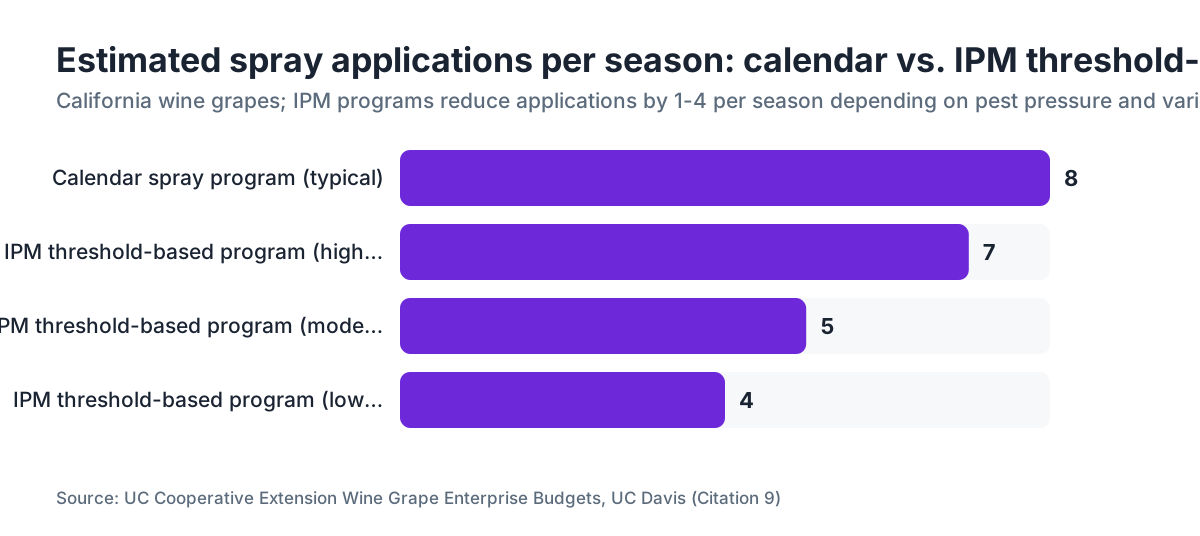
Here's the offset. UC Cooperative Extension enterprise budgets model threshold-based IPM programs cutting spray applications by one to four per season versus calendar programs in California wine grapes [9]. At $80 to $200 per spray in materials and application labor, dropping even two sprays pays for the scouting.
Nobody has clean controlled-trial data on the dollar-per-acre return of IPM scouting in small commercial vineyards specifically. The closest published analysis is those UC Cooperative Extension enterprise budgets, which model IPM labor as a line item against reduced input costs [9]. The return is positive in those models. They assume you actually use the threshold data to cut sprays, which takes discipline.
What are common mistakes that make vineyard IPM programs fail?
These are the real failure modes, not the theoretical ones.
Scouting without acting on the data. You count leafhoppers, hit threshold, then spray anyway because it was already on the schedule. That's a calendar program with extra steps. The whole point of scouting is that it changes the decision.
Inconsistent sampling spots. Scouting the same easy-to-reach vines near the headland every week gives you data on those five vines, not the block. Border rows almost always overstate block-wide pressure.
Missing the early window. Powdery mildew and first-generation leafhopper are both far easier to manage at low pressure than high. Programs that wait for visible symptoms are always behind.
No scout training. A trained eye spots third-instar leafhopper nymphs in 10 seconds. An untrained eye walks right past them. Two hours of training before the season fixes this.
Paper records that never get transferred. Field notebooks are fine. But if the data stays in the notebook and never touches a spray decision or a compliance record, the program produces nothing.
Thresholds from the wrong region. A leafhopper number calibrated for Napa Chardonnay may not fit a Finger Lakes Riesling block. Confirm your thresholds come from extension research in your region, or at least note in your IPM plan that you're adapting from the closest available data.
Frequently asked questions
How often should you scout a vineyard for pests?
From budbreak through harvest, weekly scouting is the standard minimum for most insect and disease pests. Around bloom and veraison, when pressure usually peaks, twice-weekly scouting catches problems before they cross thresholds. In dormancy, monthly checks for scale and mealybug egg masses are enough. Adjust for weather: cool wet springs demand more frequent powdery mildew checks.
What's the difference between an economic threshold and an action threshold in IPM?
An economic threshold is the pest density where damage costs equal control costs, the break-even point. An action threshold sits slightly below it, giving you time to buy and apply a treatment before damage crosses the economic line. Most extension publications list action thresholds, not economic ones, because they already build in the lead time. Use the number your extension program publishes and cite the source in your IPM plan.
Do I need an IPM plan to sell grapes or get a sustainability certification?
You don't need one to sell grapes under most contracts, but third-party certifications, including Certified California Sustainable Winegrowing, LIVE in the Pacific Northwest, and Lodi Rules, all require documented IPM practices. Some winery contracts in California and Oregon now ask for IPM records as a condition of purchase. Even without a formal requirement, documented records protect you in a pesticide use review.
What equipment do I actually need to start a vineyard IPM scouting program?
The basics: a 10x hand lens ($10-30), a beatsheet or white tray for mite and leafhopper counts, pheromone lures and sticky-card traps for moth species, a field notebook or mobile form, and access to a degree-day model like NEWA, UC IPM Online, or WSU DAS. A weather station helps but isn't required to start. Total equipment cost for a 10-20 acre vineyard is usually under $200.
How do I find economic thresholds for vineyard pests in my region?
Your first stop is your regional land-grant extension program: UC IPM Online for California, Cornell's Integrated Crop and Pest Management for the Northeast, and WSU's Pacific Northwest Pest Management Handbooks for the Northwest. Each publishes pest-specific thresholds calibrated to local conditions. If no threshold exists for your pest in your region, your county farm advisor or state agriculture department may have interim guidance.
Can I use degree-day models for vineyard pest timing without a weather station?
Yes, with caveats. Regional network stations on NEWA, CIMIS (California), and AgWeatherNet (Washington) provide free degree-day accumulation data. Accuracy depends on how close the station is and how different your local microclimate is. For calls like grape berry moth biofix in eastern vineyards, a station within one to two miles gives more reliable timing than one 10 miles away across a ridge.
What records does the EPA Worker Protection Standard require for pesticide applications?
Under 40 CFR Part 170, agricultural employers must keep pesticide application records for at least two years, and must post or provide to workers and handlers the product name, EPA registration number, active ingredient, application date, location, and the expiration of the restricted-entry interval. Scouting records aren't explicitly required by WPS, but they document the pest conditions that justified the application, which matters in any compliance review.
How do biological controls like Anagrus wasps work in a vineyard IPM program?
Anagrus wasps are tiny parasitoids that attack leafhopper eggs before they hatch, cutting leafhopper populations naturally. UC Davis research shows vineyards next to riparian corridors with wild blackberry or prune trees carry higher Anagrus populations and lower leafhopper pressure. Your scouting program tells you whether biocontrol is holding the pest below threshold, so you spray only when it isn't. Broad-spectrum insecticides can wipe out Anagrus and trigger leafhopper resurgence.
How many vines should I sample per block when scouting for leafhoppers?
UC IPM and WSU both recommend a minimum of 15 to 25 vines per block for leafhopper nymph counts, with leaves sampled from the basal and mid-canopy positions. Sample size matters: counting 10 vines in a 10-acre block is statistically weak and misses hotspots. For smaller blocks of 2-3 acres, 10 to 15 vines works. Use a random walk or W-pattern rather than grabbing vines near the row ends.
What pests should I prioritize if I'm setting up an IPM program for the first time?
Start with the one or two pests that caused you actual crop loss or high spray costs before. In California, that's usually leafhoppers and mealybug, plus powdery mildew if you grow susceptible varieties. In the Northeast, grape berry moth and powdery mildew are typically the highest-dollar pests. Adding more pests in year two, once your routes and records run smoothly, beats trying to cover everything on day one.
How do I document spray decisions based on scouting data for a compliance audit?
Each application record should link to the scouting observation that triggered it: the scout date, the pest counted, the count result, the threshold used and its source, and the decision. A note like 'Block 3, 6/14, leafhopper nymphs 22 per leaf on 20 leaves, exceeds UC IPM threshold of 15, applied [product] on 6/15' gives an auditor everything they need. The chain from observation to decision to application is what matters.
Does scouting for pests actually reduce spray costs in vineyards?
UC Cooperative Extension enterprise budgets model threshold-based spray programs cutting applications by one to four per season versus calendar programs in California wine grapes. At $80-200 per spray in materials and labor, dropping two sprays saves $160-400 per acre per season. Scouting labor typically costs $100-200 per acre per season in a well-run program, so the net is positive in most cases, though the exact return depends on your pest pressure and input costs.
Can a small vineyard with just a few acres run a real IPM scouting program?
Yes, and it's easier to start small. Two to five acres can be scouted thoroughly in under an hour a week. The threshold data and degree-day tools from extension programs work at any scale, and the record-keeping burden is lighter. Many small vineyard operators scout their own blocks, which builds the local knowledge about pest pressure patterns that makes the program sharper over time.
Sources
- EPA, Integrated Pest Management (IPM) Principles: EPA defines IPM as 'an effective and environmentally sensitive approach to pest management that relies on a combination of common-sense practices'
- UC IPM Online, UC Statewide IPM Program, University of California: UC IPM publishes economic and action thresholds for leafhoppers, mealybug, scale, and mites in California wine grapes, and hosts free degree-day calculation tools
- EPA, Worker Protection Standard (WPS), 40 CFR Part 170: WPS requires employers to maintain pesticide application records for at least two years and provide workers access to central posting information including product name, active ingredient, application date, and REI
- Cornell University, Network for Environment and Weather Applications (NEWA) and Cornell Integrated Crop and Pest Management Program: Cornell publishes degree-day models for grape berry moth with a biofix threshold of 5 moths per trap in a 7-day period, and maintains real-time pest timing tools via NEWA
- Washington State University Extension, Pacific Northwest Pest Management Handbooks: WSU recommends a minimum of 10-15 vines per 5-acre block for most insect pests and publishes predatory mite to pest mite ratio guidance for Pacific spider mite management
- EPA, Federal Insecticide, Fungicide, and Rodenticide Act (FIFRA): FIFRA requires pesticide applications to follow label directions, which may include conditions justifying use
- California Department of Pesticide Regulation, Pesticide Use Reporting (PUR): California requires agricultural pesticide application reporting to the county agricultural commissioner within one month of application
- California Sustainable Winegrowing Alliance (CSWA), Certified California Sustainable Winegrowing: CSWA's Sustainable Winegrowing Workbook maps to IPM documentation requirements including scouting records, threshold comparisons, and spray decisions tied to pest pressure
- UC Cooperative Extension, Wine Grape Enterprise Budgets, UC Davis: UC Cooperative Extension enterprise budgets model IPM scouting labor as a line item and show threshold-based programs reducing spray applications by one to four per season in California wine grapes
- WSU Decision Aid System (DAS) for Pacific Northwest Wine Grapes: WSU DAS provides real-time degree-day accumulations, pest timing models, and disease risk models for Pacific Northwest wine grapes
Last updated 2026-07-11