How to build a vineyard spray program calendar aligned with compliance deadlines

TL;DR
- A vineyard spray calendar combines phenological growth stages, pre-harvest intervals (PHIs), restricted-entry intervals (REIs), and state pesticide record-keeping deadlines into one master schedule.
- Build it before bud break, anchor every application window to a BBCH growth stage, and log each spray within the timeframe your state requires, which runs from 24 hours in California to a two-year retention rule federally.
Why do vineyards need a spray calendar that's tied to compliance deadlines?
A spray schedule and the compliance paperwork usually live in two different places. One sits in a spreadsheet or on the tractor dashboard. The other sits in a binder that gets filled out whenever someone remembers. That gap is where violations happen.
The EPA's Worker Protection Standard (WPS), 40 CFR Part 170, requires that workers and handlers get pesticide safety training, that application-specific information be posted at a central location, and that restricted-entry intervals be observed [1]. On top of that, every state with a pesticide use reporting requirement sets its own deadline for when an application must be logged, from 7 days after application in California to a straight two-year retention rule in most other states [2]. Miss a deadline and you're looking at fines, audit flags, or a license review.
A calendar that holds both the agronomic and the legal side of spraying means you never pick a product without knowing its PHI, and you never apply without knowing when the record is due. This is operational infrastructure, not a nice-to-have.
Small vineyards especially underestimate how fast the season moves. Once shoot growth starts in April or May, a warm year takes you from dormancy to flowering in about six weeks. Build the calendar before bud break and you're making decisions ahead of the pressure instead of during it.
What growth stages should anchor my spray calendar?
The BBCH scale for grapevines is the right framework to build on. It's the international standard used in extension publications from UC Davis, Cornell, and WSU, and it maps directly to fungicide and insecticide timing [3]. Vague descriptors like 'early season' or 'post-bloom' create ambiguity when you're audited or trying to reconstruct records months later.
Here are the stages that matter most for spray timing:
| BBCH Stage | Description | Common Spray Targets |
|---|---|---|
| 01-09 | Dormancy to bud swell | Dormant oils, lime sulfur for mites/scale |
| 07-09 | Bud burst (wool stage) | Powdery mildew first cover, black rot in humid climates |
| 12-16 | 2 to 6 leaves unfolded | Powdery mildew, downy mildew, leafhopper first generation |
| 55-60 | Inflorescence visible to just before bloom | Botrytis pre-bloom, grape berry moth timing |
| 65-69 | Full bloom to end of bloom | Botrytis, powdery mildew critical window |
| 71-75 | Fruit set, berry development | Powdery mildew, bunch rots |
| 77-81 | Berry touch to veraison | Late season mildew, bunch rots, PHI awareness starts here |
| 85-89 | Ripening to harvest | PHI compliance window, reduced or zero applications |
Each window has a rough calendar date range in your region, but temperature-driven degree-day models beat calendar dates every time. UC Davis publishes degree-day accumulation tools for California [3], and Cornell's Network for Environment and Weather Applications (NEWA) does the same for the Northeast [4]. WSU's Decision Aid System covers the Pacific Northwest [5]. Pick the one for your region and use it to set your BBCH-stage dates each spring instead of copying last year's calendar wholesale.
How do PHIs and REIs fit into the spray calendar?
Pre-harvest interval (PHI) is the number of days that must pass between the last application of a product and harvest. Restricted-entry interval (REI) is the number of hours or days workers must stay out of a treated area after application. Both appear on every registered pesticide label, and under FIFRA, the label is the law [6].
The trick is to work backward from your target harvest date. Say you're picking Chardonnay on September 15. A sulfur product with a 0-day PHI is fine. A fungicide with a 14-day PHI puts your last legal application date at September 1. Try to squeeze in a late-season mildew spray on September 5 and you're in violation.
For REIs, the concern is crew safety and scheduling. A product with a 24-hour REI applied Tuesday morning means nobody enters that block until Wednesday morning, minimum. Your harvest crew, your irrigation crew, your scouts, all of them need to know. WPS requires the REI and product information be posted at a central location accessible to workers before they enter a treated area [1].
Each application in your calendar should carry:
- Product name and EPA registration number
- Application date
- Block ID and acreage
- REI expiration date and time
- PHI in days, and the latest legal application date given your harvest target
- State record-filing deadline for this application
That last column is the one most managers forget to build.
What are the state pesticide record-keeping deadlines I need to know?
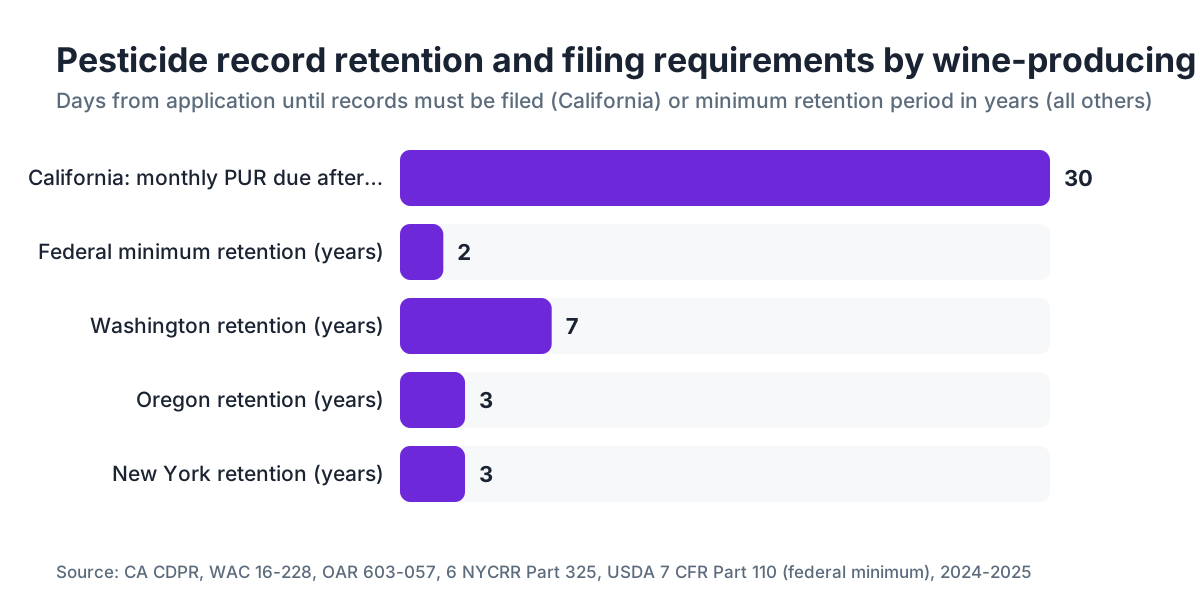
Every state is different here, and it's genuinely annoying. California is the strictest. Under the California Food and Agricultural Code Section 12981, growers submit pesticide use reports to their county agricultural commissioner within 30 days of application for most agricultural use, and monthly summary reporting is standard practice, though restricted-material permits carry tighter reporting terms set by the county [2]. Check your county's permit conditions, because they vary.
Most other western states with real viticulture, Oregon and Washington among them, follow the federal minimum: records kept for two years, no filing deadline as tight as California's [7]. New York requires pesticide applicator records to be kept for a minimum of three years and made available to inspectors on request, but doesn't require proactive reporting to the same degree [8].
The table below covers the major wine-producing states:
| State | Record Retention | Reporting Deadline | Authority |
|---|---|---|---|
| California | Reported to county/state archive | 30 days (monthly PUR); tighter per restricted-material permit | CA Food & Ag Code §12981 |
| Washington | 7 years | No proactive filing; on-demand | WAC 16-228 |
| Oregon | 3 years | No proactive filing; on-demand | OAR 603-057 |
| New York | 3 years | No proactive filing; on-demand | 6 NYCRR Part 325 |
| Texas | 2 years | No proactive filing; on-demand | 4 TAC §7.24 |
| Federal minimum | 2 years | No proactive filing; on-demand | 7 CFR Part 110 |
Note: these reflect requirements as of mid-2025. Regulations change. Verify with your state department of agriculture before the season starts.
California's monthly PUR clock is the one that catches people. Build a system where someone files a full-use report every month, right after month-end, rather than scrambling at year's end. That's the only reliable way to stay clean.
How do I actually build the calendar step by step?
Start in January or early February, before the season has any momentum.
Step 1: Pull your target harvest dates for each variety. Pinot Noir at one block might be September 10. Cabernet Sauvignon at another might be October 5. These dates drive all your backward-planning for PHIs.
Step 2: List every pesticide product you expect to use with its PHI and REI. Adding new products this year? Read the label before you commit them to the calendar.
Step 3: Mark the BBCH-stage windows that trigger applications in your region. Use your extension program's degree-day model to set approximate dates. Write them in pencil, because they shift a couple of weeks depending on the year.
Step 4: For each spray window, check whether any planned products carry a PHI that would make a late-season application impossible. If you're spraying close to harvest, swap in shorter-PHI products.
Step 5: Add the WPS compliance column. For every spray event, note the REI expiration and which blocks are off-limits to workers. Contractors entering the vineyard need this in writing before they enter [1].
Step 6: Add your state filing deadline column. In California that's the monthly PUR due after month-end. In other states it's a retention requirement, so set a reminder to file the record properly.
Step 7: Build a paper or digital template that captures every required field per application: applicator name, license number, product name and EPA reg number, target pest, rate, volume, equipment, and weather conditions including wind speed and direction. Most state regulations and the WPS require these fields [1][7].
Step 8: Assign one named person to file. Not 'the office.' Not 'whoever has time.' One person, with a calendar reminder for every deadline.
That's the whole structure. The discipline is repeating it every week during the season, not building it once.
How should I handle the WPS training and posting requirements in my calendar?
The EPA Worker Protection Standard applies to any agricultural employer or commercial pesticide handler using pesticides on farms, vineyards included. Since the revised rule took effect in January 2017, WPS requires that workers get pesticide safety training before they enter a treated area or work in one, delivered by a trained presenter or through EPA-approved materials, with no grace period for new hires [1].
For your spray calendar, WPS requires this information be posted at a central location (a bulletin board, office, or break area workers can reach freely) before any worker enters a treated area:
- The product name, EPA registration number, and active ingredient
- The location and description of the treated area
- The time the application ended
- The REI for the pesticide
- Instructions on any personal protective equipment needed for emergency entry during the REI
Add a 'posted' checkbox to each application in the calendar. Someone sprays, someone updates the central posting, the checkbox closes the loop.
The EPA's worker safety page has downloadable posters that meet the posting requirement [1]. Cornell's IPM program also maintains bilingual WPS training resources [4], which matters for most vineyard crews.
One more thing. WPS requires a pesticide safety information display at the central location throughout the season, including the EPA-approved safety poster and the contact for the nearest emergency medical facility. Put an annual check on your calendar: on or before the first spray of the season, confirm the bulletin board is current.
What records does my spray log actually need to include to pass an inspection?
The short answer is more fields than most paper logs capture.
Under the federal WPS and typical state regulations, a complete pesticide application record includes [1][7]:
- Date of application
- Applicator name and license number
- Product name and EPA registration number
- Active ingredient(s)
- Pest target (what you were treating for)
- Application site (block ID, field name, or legal description)
- Crop treated
- Total acres treated
- Application rate (per acre or per gallon mix)
- Total amount of product used
- Application method and equipment
- Weather conditions: temperature, wind speed, wind direction, humidity (required in many states, and essential for drift disputes)
- REI for the product applied
- PHI for the product applied
Some states add an applicator's signature. California requires the name and address of the person for whom the application was made, the permit number, and the county [2].
The weather field is the one inspectors flag most. 'Calm' is not an acceptable entry. You need real numbers: '72°F, wind SW at 4 mph, RH 65%.' A handheld weather meter costs under $50 and pays for itself the first time you have to defend an application against a drift complaint.
How do I integrate restricted-use pesticide permits into my spray schedule?
Restricted-use pesticides (RUPs) require a licensed private or commercial applicator to buy and apply them, and in California you also need a county-issued permit for each RUP [2]. Common RUPs in viticulture include certain fumigants used in new plantings and a handful of insecticides used for vine mealybug or leafhopper control.
The calendar implication is simple but easy to forget: you cannot apply an RUP until the permit is in hand. Permit applications in California go to the county agricultural commissioner, and processing time varies but often runs 1 to 3 weeks. Plan to use a restricted product in April? Submit the permit application in February.
In Washington, Oregon, and other states, the applicator license itself covers RUP purchase and use, so the calendar trigger is keeping that license current. Renewal cycles vary by state and endorsement category, so put the renewal deadline in the spray calendar as a January or February reminder, before the season starts.
Build the permit and license renewal dates into the same calendar that holds your spray schedule. Then one document answers the only question that matters at the tank: are we legally allowed to spray this today?
What's the best way to organize the calendar for multiple blocks and varieties?
The most functional format for a multi-block vineyard is a matrix. Rows are spray events by date and product, columns are blocks. Each cell shows whether a block got that application and the REI expiration. That gives you a visual audit trail and makes it easy to see which blocks are off-limits on any given day.
For vineyards with more than about 8 blocks, a spreadsheet stops working as a daily field tool. Paper pull-apart forms, one per application, filed chronologically by block, are actually more reliable in the field, as long as someone fills them out right after each application instead of reconstructing them Friday afternoon.
A tool like VitiScribe can handle block-by-block tracking and generate state-specific record formats automatically, which removes the reformatting step if you operate in California or another high-reporting state. The software isn't the point. The point is that whatever system you use has to be fast enough to use in the field, or it won't get used.
One structure that works for small operations (under 25 acres): a single Google Sheet with one tab per variety, rows organized by BBCH stage, and a shared calendar with REI and filing deadlines as events with automatic reminders. Not elegant. It's free, and it works if someone owns it.
How do organic certification requirements change the spray calendar?
Certified organic or transitioning? The spray calendar gets a third compliance layer on top of WPS and state reporting: the National Organic Program (NOP) under the USDA, 7 CFR Part 205 [9]. Every product you apply must be on the approved materials list, and you need records showing that only approved inputs went on throughout the transition and certification period.
The calendar implication: before you add any new product, check it against the Organic Materials Review Institute (OMRI) list or your state's organic approved materials database. Applying a non-listed product, even once, can cost you certification for the affected acreage for the rest of the growing season or longer, depending on your certifier.
Certified organic vineyards also document the source and lot number of every input, more than the product name. That's an extra field in your spray log.
Sulfur and copper are the workhorses of organic disease management. Copper carries use restrictions under the NOP: growers need to document that copper use is minimized and reduced over time [9]. If you're using copper regularly, log your per-acre annual totals so you can show a reduction trend when your certifier asks.
What does a full-season spray calendar actually look like in practice?
Here's a realistic example: a 20-acre Pinot Noir block in the Willamette Valley, target harvest around September 20.
| Date (approx) | BBCH Stage | Product (example type) | PHI (days) | REI (hrs) | Last Legal App Date | Filing Deadline |
|---|---|---|---|---|---|---|
| March 15 | 01-05 | Dormant oil (mite/scale) | 0 | 4 | n/a | Retain record |
| April 10 | 07-09 | Sulfur (PM) | 0 | 24 | n/a | Retain record |
| May 1 | 14-16 | Sulfur + copper (PM/DM) | 0 | 24 | n/a | Retain record |
| May 20 | 55-57 | Sulfur + botryticide | 7 | 12 | Sept 13 | Retain record |
| June 3 | 65-67 | Botryticide (critical bloom) | 14 | 12 | Sept 6 | Retain record |
| June 20 | 71-73 | Sulfur (PM) | 0 | 24 | n/a | Retain record |
| July 10 | 77-79 | Sulfur (PM) | 0 | 24 | n/a | Retain record |
| Aug 5 | 81-85 | Sulfur (PM, final cover) | 0 | 24 | n/a | Retain record |
| Aug 20 | 85-87 | Evaluate: PHI check required | n/a | n/a | Check all products | Retain record |
The 'last legal application date' column only matters for products with a non-zero PHI. For zero-PHI products like elemental sulfur, you could technically spray the morning of harvest, though agronomically you wouldn't. The column earns its keep when you're using fungicides with 7- to 21-day PHIs in the late-season window.
For California operations in Oregon and Washington, this retention-only model applies. California growers should replace 'Retain record' with the reporting month and track each application toward the monthly pesticide use report due after month-end.
What resources and extension programs can help me build this calendar?
Three university programs stand out for vineyard spray timing.
The UC Statewide Integrated Pest Management Program (ipm.ucanr.edu) maintains pest management guidelines for wine grapes with fungicide and insecticide timing tied to growth stages, PHI tables, and resistance management notes [3]. This is the primary resource for California growers.
Cornell's New York State IPM Program publishes the 'Pest Management Guidelines for Grapes,' updated annually. It includes fungicide efficacy ratings, PHIs for every registered product, and timing keyed to the BBCH scale [4]. The NEWA platform (newa.cornell.edu) also runs grape disease models for powdery mildew, downy mildew, and Botrytis that generate spray timing alerts from your local weather station data.
WSU's viticulture and enology program publishes spray timing guidance for the Pacific Northwest and runs the Decision Aid System (DAS) for disease forecasting [5]. In Washington or Oregon, set up the DAS before bud break.
For WPS compliance materials, the EPA's pesticide worker safety page has the full rule text, training materials, and the downloadable posting templates the regulation requires [1].
For organic certification, OMRI's database (omri.org) is searchable by product name and lets you verify allowed status before you buy.
None of these costs anything. Using them is a matter of building the habit of checking before the season, not during it. If you want one place to keep the records that tie back to these timing decisions, VitiScribe offers a free trial worth running through before your first spray date.
Frequently asked questions
How far in advance should I build my vineyard spray calendar?
Build the calendar in January or early February, before bud break. You need your harvest target dates first, then you work backward through PHIs to set the last legal application date for each product. Waiting until the season starts means you're making product-substitution decisions under pressure, which is exactly when PHI violations happen.
What happens if I miss a pesticide record-filing deadline in California?
In California, failing to submit your pesticide use report to the county agricultural commissioner can trigger civil penalties. Under the California Food and Agricultural Code, fines can reach several thousand dollars per violation, and repeated violations can trigger a permit or license review. The county ag commissioner's office handles enforcement, and penalty amounts turn on severity and history.
Do I need a separate spray calendar for each wine grape variety?
Not separate calendars, but separate harvest target dates and therefore separate PHI cutoff dates for each variety. A single calendar that lists blocks by variety, with each block's harvest date visible, works fine. The one thing that matters is that the 'last legal application date' column is calculated per block, not per vineyard.
Can I apply a pesticide with a 14-day PHI if I'm not sure exactly when I'll harvest?
Only if your earliest possible harvest date still clears the PHI. If harvest could be September 1 to September 10, use September 1 to calculate the cutoff. That puts the last legal application of a 14-day-PHI product at August 18. Guessing on the optimistic end is a violation waiting to happen.
What weather conditions do I need to record with each spray application?
Most state regulations require temperature, wind speed, and wind direction at minimum. Many also require relative humidity, especially for products with label limits on application temperature or humidity. Record actual numbers, not descriptions. 'Calm' or 'mild' are not acceptable entries if you're ever audited or need to defend against a drift complaint.
How do restricted-entry intervals affect my harvest crew?
Harvest workers are agricultural workers under the WPS and cannot enter a treated area during the REI without early-entry personal protective equipment. Spray a block Monday with a 24-hour REI and your harvest crew cannot legally pick it until Tuesday. Build this into harvest scheduling, especially during crunch weeks when you're trying to move through blocks fast.
What's the difference between a PHI and an REI, and which one controls harvest timing?
REI (restricted-entry interval) controls how long workers stay out of a treated area after application, measured in hours. PHI (pre-harvest interval) controls how many days must pass before the crop can be harvested. PHI controls harvest timing. REI controls crew access. Both appear on the product label and both are legally binding under FIFRA.
Do I need to track spray records for dormant applications before bud break?
Yes. Dormant oil, copper, lime sulfur, and other dormant-season applications are pesticide applications under state law and the WPS. They need the same records as in-season sprays. In California they feed the same monthly pesticide use report. In other states the records must be retained for the applicable period (usually 2 to 3 years) and produced on inspection.
How do I handle a situation where I need to make an unscheduled spray due to disease pressure?
Add the application to your calendar the same day you make it. Log every field, weather conditions included, before you move the sprayer to the next block. Check the PHI against your current harvest estimate right then. If your state has a reporting deadline, set a phone reminder immediately. Unscheduled applications are fine. Unrecorded ones are the problem.
What records do I need to keep for worker pesticide safety training under the WPS?
Under the revised WPS (40 CFR Part 170), you must keep worker safety training records for two years. Records must include the worker's name, the training date, the trainer's name, and the training materials used or the title of the EPA-approved training. These records must be made available to inspectors and to workers who request them.
Are there spray programs specifically designed for minimal-intervention or low-input viticulture?
Yes. UC IPM, Cornell, and WSU all publish reduced-spray or integrated pest management (IPM) programs for wine grapes that lean on disease-forecasting models to cut applications instead of running a fixed calendar schedule. Cornell's NEWA platform and WSU's Decision Aid System are both built around this approach. Fewer applications still require the same complete records as a conventional program.
How do I know if a product is restricted-use and requires a special permit?
The product label states 'Restricted Use Pesticide' in a box at the top, along with the reason for the restriction. The EPA maintains a searchable database of restricted-use products. In California, restricted-use status also means you need a county permit from your agricultural commissioner before purchase or use, regardless of whether you hold an applicator license.
What's the best way to share spray records with a winery buyer or auditor?
Export or copy your spray log for the relevant blocks and season, including product name, EPA registration number, application dates, rates, and confirmation that all applications met their pre-harvest intervals. Many wineries, especially those pursuing sustainability certifications, require this as part of their annual grower audit. A clean, date-ordered log by block is the most useful format.
Sources
- EPA, Agricultural Worker Protection Standard (40 CFR Part 170): WPS requires pesticide safety training for workers before entry into a treated area, posting of application-specific information at a central location, and observance of REIs; training records must be kept for two years.
- California Department of Pesticide Regulation, Pesticide Use Reporting: California Food and Agricultural Code Section 12981 requires pesticide use reports to the county agricultural commissioner, with monthly reporting standard and tighter terms set by restricted-material permits.
- UC Statewide Integrated Pest Management Program, Pest Management Guidelines: Grape: UC IPM publishes growth-stage-keyed fungicide and insecticide timing recommendations and PHI tables for California wine grape production, along with degree-day accumulation tools.
- Cornell New York State Integrated Pest Management Program: Cornell's NYS IPM program publishes annually updated fungicide efficacy ratings, PHI tables, and BBCH-keyed spray timing for wine grapes in the Northeast, plus bilingual WPS training resources.
- Washington State University, Viticulture and Enology Program: WSU publishes Pacific Northwest vineyard spray timing guidelines and operates the Decision Aid System (DAS) for grape disease forecasting.
- EPA, Summary of the Federal Insecticide, Fungicide, and Rodenticide Act (FIFRA): Under FIFRA, the pesticide label is a legally binding document; applying a product in a manner inconsistent with the label (including PHI and REI violations) is a federal violation.
- New York State Department of Environmental Conservation, Pesticides Program: New York requires pesticide applicator records to be kept for a minimum of three years and made available to inspectors on request under 6 NYCRR Part 325.
- USDA Agricultural Marketing Service, National Organic Program, 7 CFR Part 205: Under the NOP, organic growers must use only approved materials on the OMRI or state list; copper use must be minimized and growers must document reduction over time.
- Washington State Department of Agriculture, Pesticide Management: Washington state requires pesticide application records to be maintained for seven years and made available on demand; no proactive filing to the state is required for most agricultural uses.
- Oregon Department of Agriculture, Pesticides Program: Oregon requires pesticide application records to be retained for three years and available to inspectors on request; no proactive reporting requirement for most standard agricultural applications.
- Cornell NEWA, Network for Environment and Weather Applications: Cornell's NEWA platform runs real-time grape powdery mildew, downy mildew, and Botrytis disease models from local weather station data to generate spray timing recommendations.
Last updated 2026-07-09