How to set up record-keeping training for seasonal vineyard employees
TL;DR
- Seasonal vineyard employees need record-keeping training that covers pesticide application logs, re-entry intervals, and worker protection standards before they handle spray equipment or enter treated areas.
- A well-built program takes 2-4 hours of initial training, uses bilingual materials, and ties each paper form to a real field task.
- Most compliance failures trace back to no training at all, not bad record-keeping systems.
Why does record-keeping training matter for seasonal vineyard workers?
Seasonal vineyard crews turn over constantly. A worker who pruned for you in February may be on a different ranch by veraison, and the person walking rows during a spray window in June may have zero background in pesticide records. That gap is where compliance breaks down.
The EPA Worker Protection Standard (WPS), codified at 40 CFR Part 170, requires that agricultural workers and pesticide handlers receive specific safety information before they enter treated areas or handle pesticides [1]. That information includes how to read and understand pesticide application records, what restricted-entry intervals (REIs) mean, and where posted information is kept. Failing an EPA WPS inspection carries civil penalties up to $19,636 per violation as of 2024 inflation adjustments [2].
Beyond the federal floor, states pile on. California's Department of Pesticide Regulation (CDPR) requires that all pesticide application records be maintained for three years and be accessible to inspectors within 24 hours [3]. Washington State's WSDA has similar requirements. If a seasonal worker fills out a record wrong, or skips a column, or misreads an REI and your crew re-enters a block too early, the liability lands on the operator.
The practical argument is simpler: good records protect you. If a crop insurance claim, a food-safety audit, or a neighbor complaint ever surfaces, your spray logs are your defense. Seasonal employees who understand why records matter fill them out better than employees who think it's just paperwork.
What are the minimum training requirements under the EPA Worker Protection Standard?
The 2015 revised WPS (effective January 2, 2017) has specific training timelines. Agricultural workers must receive WPS safety training before they enter a treated area for the first time, or within the first 30 days of employment on the farm, whichever comes first [1]. Pesticide handlers, meaning anyone who mixes, loads, applies, or handles pesticides, must be trained before performing any handler task.
The WPS mandates that training cover at least these topics: how pesticides can harm you, routes of exposure, how to read pesticide labels, what personal protective equipment is required, how to handle decontamination, what emergency assistance looks like, and how to understand application and hazard information posted at the central location [1].
The regulation states: "handlers must be trained as an agricultural handler before performing any handler task." That language is unambiguous. There is no grace period for handlers.
Training must be done by a certified pesticide applicator, a WPS-trained trainer, or someone using an EPA-approved training program. The EPA's WPS Safety Training for Agricultural Workers curriculum is a free, approved resource available through the National Pesticide Safety Education Center [4]. It comes in English and Spanish and takes roughly 60-90 minutes to deliver.
Record-keeping for the training itself is also required. You must document who was trained, the date, and who conducted the training. That record must be kept for two years [1]. Yes, there's a record about your records training. That's vineyard compliance in a nutshell.
What records do seasonal workers actually need to know how to fill out?
Not every seasonal employee needs to complete every form. Match the training to the role.
| Worker Role | Records They Touch | Training Priority |
|---|---|---|
| General labor (pruning, shoot positioning) | Re-entry interval acknowledgment log | High: must know REIs before entering any treated block |
| Irrigation crew | Water use logs, chemical injection records if fertigation | Medium: fertigation logs may require pesticide handler training |
| Tractor operator, non-spray | Equipment maintenance log, field activity log | Low for pesticide records; medium for general field logs |
| Pesticide handler (spray crew) | Application record (full), PPE inspection log, equipment calibration log | High: all fields, every spray event |
| Harvest crew | Harvest log, pre-harvest interval (PHI) sign-off | High: PHI violations are the most common late-season failure |
The core pesticide application record, required in California under Food and Agricultural Code Section 12981 and by the EPA WPS, includes: date and time of application, location (block or APN), pest or disease target, product name and EPA registration number, amount applied per acre, water volume, equipment used, and the applicator's name and certification number [3].
Workers filling out any portion of that form need to understand what each field means. A handler who doesn't know the EPA registration number is a seven-digit-dash-five-digit code on the label will leave that field blank every time.
For non-spray crew, the most common training gap is the re-entry interval log. Many operations post REIs at the field entrance but never explain what the number means. An employee who sees "REI: 12 hours" and doesn't know when the application ended can't make a safe decision. Training needs to connect the posted record to the physical reality of what it means.
How do you design a training session that actually sticks?
Adult learning research is consistent on one point: people retain skills they practice, not skills they hear about. A 90-minute lecture followed by a stack of blank forms produces employees who nod and then guess.
The better structure is task-based. Show a completed application record. Walk through each field using a real product label from your operation. Have the trainee fill out a practice record using a fictional spray event you've prepared. Then review it together.
UC Cooperative Extension and UC Davis's Integrated Pest Management program publish the California Pesticide Safety Information Series, which includes bilingual fact sheets and sample record forms designed for field use [5]. These are free and built for exactly this population. WSU Extension has a comparable set of resources in its Pesticide Management Education Program [6].
Cornell's Agricultural Workforce Development program has published guidance on conducting worker training sessions, including how to structure hands-on practice and how to handle low-literacy learners [7]. Their core recommendation: limit each session to one or two tasks, not an entire compliance system.
A few things that consistently work in vineyard settings:
Train in the field, not a conference room. Walk a spray block, show the posting board, physically hand the worker the form they'll use at that location. Context matters more than any slideshow.
Use real records from your operation, with any identifying information removed if needed. Blank generic forms feel abstract. Your own spray records feel immediate.
Train in the worker's primary language. If your crew speaks primarily Spanish, the English-only version of a record form is not a training tool, it's a compliance gap waiting to happen. Both EPA WPS training materials and CDPR forms are available in Spanish [1][3].
Keep sessions under two hours. For initial WPS training, the EPA curriculum runs about 60-90 minutes. For record-keeping practice on top of that, add no more than 45-60 minutes. Schedule a refresher mid-season, more than at onboarding.
How long does it take to train a seasonal employee on vineyard record-keeping?
Honest answer: it depends on the role and the worker's prior experience, but here are real benchmarks.
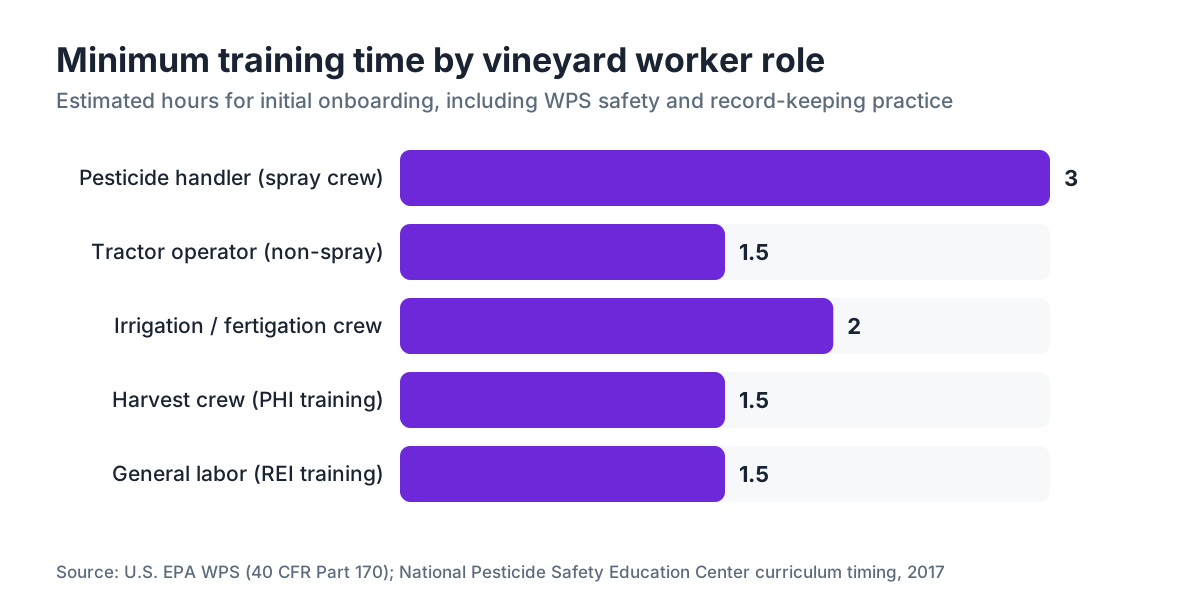
WPS safety training for a general agricultural worker: 60-90 minutes using an EPA-approved curriculum [4]. That covers the regulatory floor but does not cover how to fill out your specific records.
Record-keeping practice for a spray handler: add 45-60 minutes to walk through your application record, practice with a sample event, and go over your electronic or paper filing system.
Re-entry interval training for non-spray crew: 20-30 minutes if kept focused. Explain what REI means, show where it's posted, demonstrate how to calculate safe entry time, and have the worker practice one example.
Harvest crew PHI training: 20-30 minutes. Cover what a pre-harvest interval is, where to find it on the label, and how your operation tracks and signs off on PHI compliance before harvest begins.
Total onboarding time for a new seasonal handler, including WPS safety plus records training: roughly 2-3 hours. Plan for it. Build it into the first day, not the end of week two when they've already been in the vineyard.
For a returning seasonal worker who was trained last season: a 30-45 minute refresher is appropriate if your records system hasn't changed. The WPS requires annual retraining for workers and handlers [1].
What training materials should you prepare before the season starts?
The materials you prepare in January matter more than the training you scramble to do in April. Here's a practical build list.
First, pull your actual record forms, the ones your crew will use this season. If you're switching from paper to a digital system, get the digital interface ready before training, not after. Training someone on a form that changes in week three is a waste of everyone's time.
Second, prepare at least two sample spray events as training scenarios. Use real products you applied last season, real blocks, real rates. Blank out the applicator name and certification number so trainees practice filling those in.
Third, compile a bilingual glossary of the ten to fifteen terms that appear on every record form: REI, PHI, EPA Reg. No., PPB (parts per billion), signal word, adjuvant. A one-page laminated reference card is something a worker can keep in a back pocket and actually use.
Fourth, build your trainer documentation packet. You need a sign-in sheet with date, trainer name and credentials, and each trainee's name. Keep this for two years per WPS requirements [1]. If you're ever audited, this is the first document a CDPR or EPA inspector will ask for.
Fifth, review your posted information requirements. WPS requires a central location posting with specific information including the name and address of a treating physician and emergency contact numbers [1]. If your posting board is outdated or missing required elements, fix that before training, because you'll be pointing crews to that board during the session.
For operations managing records across multiple blocks and crews, a platform like VitiScribe can centralize your spray records and generate the documentation fields your seasonal staff needs to fill out, which reduces transcription errors and makes training more concrete because workers see the actual system they'll use.
How do you handle record-keeping training for workers with limited English or low literacy?
This is the question most vineyard managers don't ask out loud but deal with every season.
The WPS explicitly requires that training be provided in a manner that the workers and handlers can understand [1]. That is regulatory language, not a suggestion. If your crew is primarily Spanish-speaking, English-only training does not satisfy WPS. Full stop.
For low-literacy learners, pictogram-based materials work. The EPA's WPS training resources include visual aids. CDPR's pesticide safety materials include illustrated guides in Spanish [3]. UC Cooperative Extension's farm labor program has produced field-ready materials specifically designed for workers with low reading levels [5].
Practical approaches that work:
Pair new workers with experienced bilingual workers for the first week. Structured peer learning is not a shortcut, it's a legitimate training method. Document it as supervised on-the-job training and keep the supervisor's name in your training record.
Use photos of your actual forms, not generic images. Take a clear photo of a completed application record from last season, print it large, and use it as the teaching document. Workers can trace their hand over each field, matching it to the blank form.
For audio learners, California's ALRB and several farm bureaus have produced short Spanish-language audio recordings explaining pesticide records and WPS rights. Ask your county agricultural commissioner's office, most have resources they will give you for free.
Do not rely on a supervisor translating on the fly during a group session. The translation quality is inconsistent, critical details get dropped, and it's nearly impossible to document. Dedicated bilingual training, even if it means scheduling a separate session, is worth the time.
How do you document that training happened and stay audit-ready?
Documentation is the part most operations shortchange, and it's the part that determines your outcome when an inspector shows up.
The WPS requires that you keep records of worker and handler training for two years [1]. That record must include: the trained person's name, the date of training, and the name and credentials of the trainer. A sign-in sheet that covers all three is the minimum.
Beyond WPS, California's CDPR requires that pesticide application records be maintained for three years [3]. If a seasonal handler filled out part of your application record, their name appears on that record, and you want to be able to show their training predated the application.
Build a simple folder system. One folder per season. Inside: training sign-in sheets, copies of the curriculum or materials used, documentation of any refresher training, and a roster of certified applicators and their license numbers. When you onboard a new spray operator, verify their applicator certificate number and keep a copy. If their license expires mid-season, it's your operation's problem.
For paper-based operations, a three-ring binder kept in the farm office works fine. The CDPR inspector will ask to see it within 24 hours of a complaint or audit, so it needs to be accessible to you or your designee at all times [3].
For operations with multiple supervisors or multiple sites, consistency is the problem. If your head of operations trains crew at one location and a foreman trains at another, you need a standardized trainer checklist so both sessions cover the same required topics. Audit yourself once a season, walk through your own records as if you were an inspector, and you'll find the gaps before they do.
What do university extension programs recommend for seasonal worker training programs?
Three programs stand out for practical, field-tested guidance: UC Davis, Cornell, and Washington State University.
UC Davis's IPM program and UC Cooperative Extension have produced the deepest set of California-specific training materials for agricultural workers, covering pesticide safety, record-keeping, and WPS compliance [5]. Their Pesticide Safety Information Series is freely downloadable and comes in English and Spanish. The UC ANR website also hosts a searchable database of pest management guidelines that double as training reference material for handlers who need to understand why a particular pesticide is being used.
Cornell's Agricultural Workforce Development program focuses on supervisory training, specifically how farm managers and crew leaders can run effective safety and records training for workers with diverse backgrounds [7]. Cornell's materials are grounded in adult education research and include facilitation guides, which means you don't need to be a professional trainer to run a competent session.
WSU Extension's Pesticide Management Education Program covers WPS compliance in detail with Pacific Northwest-specific content [6]. Their materials are particularly strong on documenting restricted-entry intervals and handling record-keeping for operations that use organic-approved pesticides alongside conventional ones, a common situation in mixed-certification vineyards.
All three programs offer training-of-trainers resources. If you're a vineyard manager who trains five or six crew members each spring, spending two to three hours on a trainer certification course through one of these extension programs is a reasonable investment. It satisfies the WPS requirement that trainers be qualified, and it gives you defensible documentation that your training program was professionally grounded.
How do you handle mid-season changes to record-keeping procedures or forms?
Changes mid-season happen. A new product requires a different record format. Your county ag commissioner updates their required fields. You switch from paper to a digital system in July.
The rule of thumb: any time the form changes, training follows within one week. That's not a regulatory requirement in every state, but it's the standard that holds up in an audit. If an inspector asks why three records from August look different from those in June and you can show a brief training session on the new form from late July, you have a defensible record.
Keep a change log in your documentation folder. Date of change, nature of the change, and date of follow-up training. This is one page of notes, not a formal document, but it demonstrates that your operation tracks its own procedures.
For digital transitions mid-season, plan for a longer adjustment period. Workers who have been filling out paper forms for three months need hands-on time with the new interface, more than a five-minute walkthrough. Budget at least a 30-minute practice session per crew where they complete practice records in the new system before it goes live.
And be honest with yourself about your own systems. If you change procedures frequently, that's a training and management problem before it's a compliance problem. Seasonal workers can learn one good system. Retraining them every few weeks on a shifting process produces records that are inconsistent by design.
What are the most common record-keeping mistakes seasonal vineyard workers make?
Experience across multiple growing regions turns up the same errors repeatedly. None of them are hard to prevent with targeted training.
Leaving fields blank. The EPA registration number, the water volume, and the application end time are the three fields most often missing from spray records. Train specifically on these fields. Make sure workers know where to find the EPA Reg. No. on the product label (it's usually in the upper right of the label, formatted as EPA Reg. No. XXXXXXX-XXXXX).
Using incorrect product names. Workers sometimes write a brand nickname or abbreviation that doesn't match the label. Train on exact label name usage. Post a product list at the spray station with the correct label name for each material in your program.
Not recording the application end time. REIs run from the end of application, not the start. If the end time is missing, you cannot calculate a legally defensible REI. This one error is responsible for a large share of WPS re-entry violations.
Skipping the block-level location. Vineyard spray records that just say "the vineyard" instead of specifying block, row, or APN are a common deficiency. Train workers to use your block naming system consistently.
Not signing the record. Application records need the certified applicator's name and license number. A handler who isn't a licensed applicator should not be signing off as the applicator of record. Make sure your crew understands who signs what.
For operations looking at digital tools to reduce blank fields and enforce required data entry, VitiScribe is designed specifically for vineyard spray records and can flag missing fields before a record is submitted, which addresses several of these common errors at the system level rather than through retraining.
How does seasonal worker record-keeping training connect to food safety and audit readiness?
Grape buyers, particularly large retailers and distributors, increasingly require food-safety documentation as a condition of purchase. The USDA's Good Agricultural Practices (GAP) audit and GlobalG.A.P. certification both require documented worker training as a prerequisite [8].
GAP audits look at whether your records of worker training, pesticide applications, and PHI compliance are complete and accessible. A gap in seasonal worker training documentation can result in a failed audit, which can cost you a contract.
GlobalG.A.P.'s Integrated Farm Assurance standard requires documented evidence that workers who handle pesticides or work in areas with pesticide risks have received training appropriate to their tasks. The specific requirement is in the Crop Protection module of IFA version 5 [9]. The standard doesn't prescribe exactly how long training must be, but it does require written records.
The connection to record-keeping is direct: your spray application records must show that the pesticide was applied by a qualified, trained individual. If that record can't be connected back to documented training, it's a gap in your audit trail.
For wineries operating under FSMA (Food Safety Modernization Act) requirements, the Produce Safety Rule at 21 CFR Part 112 includes worker training requirements that overlap with WPS in some areas [10]. If you're growing under a FSMA-covered operation, check whether your record-keeping training program satisfies both sets of requirements, because the documentation standards differ slightly.
Frequently asked questions
How often do you have to retrain seasonal vineyard workers on record-keeping?
The EPA WPS requires annual retraining for all agricultural workers and pesticide handlers [1]. That means every worker who enters treated areas or handles pesticides needs to complete WPS training once per calendar year, even if they worked for you the prior season. Record-keeping procedure training should happen at onboarding and again any time your forms or systems change.
Does the EPA Worker Protection Standard require training before a seasonal worker's first day?
For pesticide handlers, yes. WPS requires that handlers are trained before performing any handler task [1]. For general agricultural workers, training must happen before they enter a treated area for the first time, or within 30 days of employment, whichever comes first. Practically, train everyone on day one and you'll never have a compliance gap.
Can a vineyard manager conduct WPS training themselves, or do they need to hire someone?
A vineyard manager can conduct WPS training if they are a certified pesticide applicator, a WPS-trained trainer, or if they use an EPA-approved training program such as the National Pesticide Safety Education Center's curriculum [4]. You don't need to hire an outside trainer. You do need to document your own qualifications as the trainer in your training records.
What language does WPS training have to be in for a Spanish-speaking crew?
The WPS requires that training be provided in a manner that workers and handlers can understand [1]. For a primarily Spanish-speaking crew, English-only training does not meet that standard. The EPA's WPS safety training curriculum and CDPR pesticide safety materials are both available in Spanish at no cost [3][4].
How long do you have to keep seasonal worker training records?
WPS requires that training records be kept for two years [1]. California's CDPR requires that pesticide application records themselves be kept for three years [3]. Keep both in the same documentation system so they're easy to produce together if an inspector asks.
What happens if a seasonal worker fills out a pesticide record incorrectly?
An incorrect record is not automatically a violation, but an incomplete or falsified record can be. CDPR requires that records be accessible and accurate within 24 hours of a request [3]. The practical fix is to catch errors at the end of each spray day, review records with the handler, and correct them before they're filed. Document any corrections with a note of when and why.
Do harvest crew members need record-keeping training even if they don't apply pesticides?
Yes. Harvest crew need to understand pre-harvest intervals (PHIs) before entering blocks. If your operation uses a PHI sign-off log, those workers need to know how to read and acknowledge that record. They're also covered by WPS requirements to understand re-entry intervals and posted information at the central location [1].
What free resources exist for vineyard record-keeping training materials?
Several strong free sources exist: the EPA's WPS safety training curriculum via the National Pesticide Safety Education Center [4], UC Cooperative Extension's Pesticide Safety Information Series in English and Spanish [5], WSU Extension's Pesticide Management Education Program [6], and Cornell's Agricultural Workforce Development facilitation guides [7]. Your county agricultural commissioner's office often has printed materials and can provide them at no charge.
How do you train seasonal workers on electronic or app-based record-keeping systems?
Treat digital training exactly like paper training: use real scenarios, have workers complete practice entries, and review the output together before going live. Build in extra time if workers aren't accustomed to smartphones or tablets. Train on the actual device they'll use in the field, not on a laptop in an office. A 30-minute hands-on practice session per crew is a reasonable minimum.
What specific fields must appear on a California pesticide application record?
California requires these fields under Food and Agricultural Code Section 12981: date and time of application, location (county, APN or block), operator name, pest or pest condition treated, product name and EPA registration number, amount applied per acre, total acres treated, equipment type, and the certified applicator's name and license number [3]. Application start and end times are also required because they determine when the REI clock starts.
How do you track whether a seasonal worker actually understood the training?
The WPS doesn't require a written test, but a short verbal check at the end of training is practical. Ask the worker to walk you through how they'd calculate a safe re-entry time, or point to where the EPA registration number appears on a label. Document that you conducted a comprehension check in your training notes. For handlers, having them complete a practice record form and reviewing it together is both a comprehension check and a training record.
Does GlobalG.A.P. or a GAP audit require different training documentation than WPS?
GlobalG.A.P.'s Integrated Farm Assurance standard requires written evidence of worker pesticide training with records showing the content covered and who attended [9]. USDA GAP audits look for similar documented training. WPS training records satisfy much of this requirement, but you may need to supplement them with records showing specific product handling competencies your certifying auditor requires.
What's the civil penalty for a WPS training violation?
EPA WPS civil penalties can reach $19,636 per violation as of 2024 inflation adjustments [2]. That per-violation structure means a single audit that finds multiple workers were not trained before entering treated areas can compound quickly. State-level penalties vary; California's CDPR can also assess separate fines under state law.
Can you use peer trainers or bilingual crew leaders to deliver WPS training?
A bilingual crew leader can assist with translation and hands-on demonstration, but the primary trainer must still meet WPS qualifications: certified applicator, WPS-trained trainer, or someone delivering an EPA-approved curriculum [1]. The crew leader's role as facilitator is valuable and should be documented, but they cannot substitute for a qualified trainer unless they themselves hold the required credentials.
Sources
- U.S. EPA, Worker Protection Standard (40 CFR Part 170): WPS training requirements, timelines, documentation obligations, and the requirement that training be provided in a manner workers can understand
- U.S. EPA, Civil Penalty Inflation Adjustments for Pesticide Violations: Maximum civil penalty of $19,636 per WPS violation as of 2024 inflation-adjusted figures
- California Department of Pesticide Regulation, Pesticide Application Record Requirements: California requires pesticide application records be kept for three years and be accessible within 24 hours; specific required fields under Food and Agricultural Code Section 12981
- National Pesticide Safety Education Center, EPA-Approved WPS Training Curriculum: Free EPA-approved WPS safety training curriculum available in English and Spanish, approximately 60-90 minutes to deliver
- UC Cooperative Extension / UC Davis IPM Program, Pesticide Safety Information Series: Free bilingual pesticide safety fact sheets and sample record forms designed for agricultural field use
- Washington State University Extension, Pesticide Management Education Program: WSU Extension WPS compliance and record-keeping training materials for Pacific Northwest agricultural operations
- Cornell University, Agricultural Workforce Development Program: Guidance on conducting worker training sessions for diverse agricultural crews, including adult education structure and low-literacy learner approaches
- USDA Agricultural Marketing Service, Good Agricultural Practices (GAP) Audit Program: USDA GAP audits require documented worker training and pesticide record completeness as audit criteria
- GlobalG.A.P., Integrated Farm Assurance Standard Version 5, Crop Protection Module: GlobalG.A.P. IFA requires written evidence of pesticide handler training with records showing content covered and attendees
- U.S. FDA, Food Safety Modernization Act Produce Safety Rule (21 CFR Part 112): FSMA Produce Safety Rule includes worker training requirements that overlap with WPS for covered agricultural operations
Last updated 2026-07-11